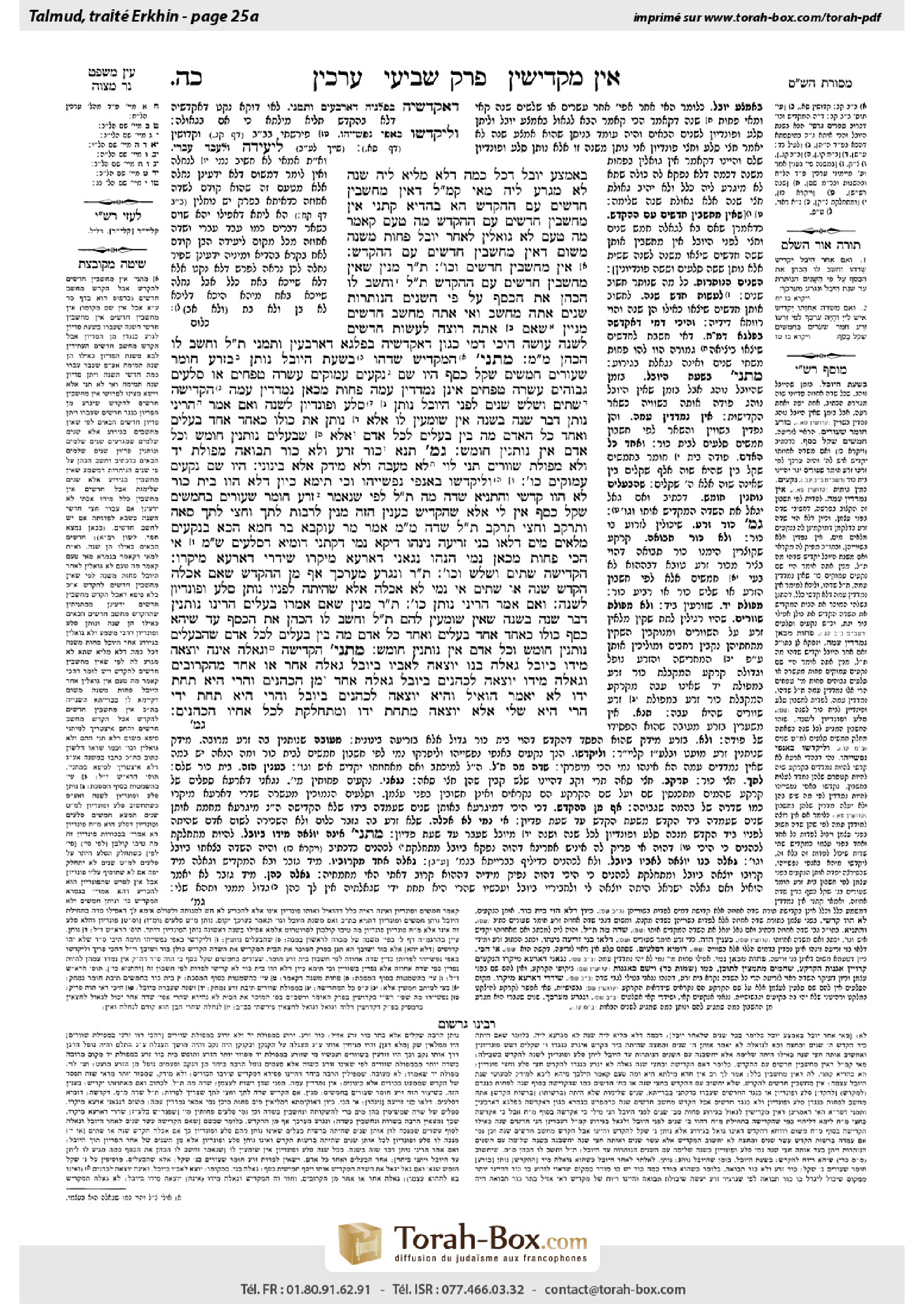
Arakhin 25a: Talmud study for Daf Yomi
Study the Talmud for Daf Yomi with scanned pages, Hebrew text, English translations from Sefaria and AI-generated French translations.
Passage selection and English or AI-generated French translation are available where the scan has annotations. Daf Study is independent of Torah-Box and Sefaria.
Browse Arakhin · ערכין · All tractatesArakhin 25a text and translations
This page of Arakhin includes the Aramaic text, an English translation and an AI-generated French translation, alongside the scan above.
ערכין כ״ה א · Aramaic and Hebrew text
בְּאֶמְצַע יוֹבֵל, דְּכֹל כַּמָּה דְּלָא מָלְיָא לֵיהּ שָׁנָה לָא מְגָרַע לֵיהּ.
מַאי קָא מַשְׁמַע לַן, דְּאֵין מְחַשְּׁבִין חֳדָשִׁים עִם הַהֶקְדֵּשׁ? הָא בְּהֶדְיָא קָתָנֵי: ״אֵין מְחַשְּׁבִין חֳדָשִׁים עִם הַהֶקְדֵּשׁ!״ מָה טַעַם קָאָמַר: מָה טַעַם לֹא גּוֹאֲלִין לְאַחַר יוֹבֵל פָּחוֹת מִשָּׁנָה — מִשּׁוּם דְּאֵין מְחַשְּׁבִין חֳדָשִׁים עִם הַהֶקְדֵּשׁ.
אֵין מְחַשְּׁבִין חֳדָשִׁים וְכוּ׳. תָּנוּ רַבָּנַן: מִנַּיִן שֶׁאֵין מְחַשְּׁבִין חֳדָשִׁים עִם הַהֶקְדֵּשׁ? תַּלְמוּד לוֹמַר: ״וְחִשַּׁב לוֹ הַכֹּהֵן אֶת הַכֶּסֶף עַל פִּי הַשָּׁנִים הַנּוֹתָרוֹת״ — שָׁנִים אַתָּה מְחַשֵּׁב, וְאִי אַתָּה מְחַשֵּׁב חֳדָשִׁים.
מִנַּיִין שֶׁאִם אַתָּה רוֹצֶה לַעֲשׂוֹת חֳדָשִׁים לַשָּׁנָה עוֹשֶׂה? הֵיכִי דָּמֵי — כְּגוֹן דְּאַקְדְּשֵׁיהּ בְּפַלְגָא דְּאַרְבְּעִין וְתַמְנֵי.
תַּלְמוּד לוֹמַר: ״וְחִשַּׁב לוֹ הַכֹּהֵן״, מִכׇּל מָקוֹם.
מַתְנִי׳ הַמַּקְדִּישׁ שָׂדֵהוּ בִּשְׁעַת הַיּוֹבֵל, נוֹתֵן בְּזֶרַע חוֹמֶר שְׂעוֹרִים ״חֲמִשִּׁים שֶׁקֶל כָּסֶף״. הָיוּ שָׁם נְקָעִים עֲמוּקִּים עֲשָׂרָה טְפָחִים, אוֹ סְלָעִים גְּבוֹהִים עֲשָׂרָה טְפָחִים — אֵינָן נִמְדָּדִין עִמָּהּ, פָּחוֹת מִכָּאן — נִמְדָּדִין עִמָּהּ.
הִקְדִּישָׁהּ שְׁתַּיִם וְשָׁלֹשׁ שָׁנִים לִפְנֵי הַיּוֹבֵל — נוֹתֵן סֶלַע וּפוּנְדְּיוֹן לְשָׁנָה, וְאִם אָמַר: ״הֲרֵינִי נוֹתֵן דְּבַר שָׁנָה בְּשָׁנָה״ — אֵין שׁוֹמְעִין לוֹ, אֶלָּא נוֹתֵן אֶת כּוּלּוֹ כְּאֶחָד. אֶחָד בְּעָלִים וְאֶחָד כׇּל הָאָדָם, מָה בֵּין בְּעָלִים לְכׇל אָדָם? אֶלָּא שֶׁבְּעָלִים נוֹתְנִין חוֹמֶשׁ, וְכׇל אָדָם אֵין נוֹתְנִין חוֹמֶשׁ.
גְּמָ׳ תָּנָא: כּוֹר זֶרַע, וְלֹא כּוֹר תְּבוּאָה, מַפּוֹלֶת יָד, וְלֹא מַפּוֹלֶת שְׁוָורִים. תָּנֵי לֵוִי: לֹא מְעֻבֶּה וְלָא מֵידֵק, אֶלָּא בֵּינוֹנִי.
הָיוּ שָׁם נְקָעִים עֲמוּקִּים כּוּ׳. וְלִיקְדְּשׁוּ בְּאַנְפֵּי נַפְשַׁיְיהוּ!
וְכִי תֵּימָא, כֵּיוָן דְּלָא הָווּ בֵּית כּוֹר, לָא (הֲווֹ) קָדְשִׁי, וְהָתַנְיָא: שְׂדֵה, מָה תַּלְמוּד לוֹמַר? לְפִי שֶׁנֶּאֱמַר ״זֶרַע חוֹמֶר שְׂעוֹרִים בַּחֲמִשִּׁים שֶׁקֶל כָּסֶף״, אֵין לִי אֶלָּא שֶׁהִקְדִּישׁ כָּעִנְיָן הַזֶּה, מִנַּיִן לְרַבּוֹת לֶתֶךְ וַחֲצִי לֶתֶךְ, סְאָה וְתַרְקַב וַחֲצִי תַרְקַב? תַּלְמוּד לוֹמַר ״שָׂדֶה״, מִכׇּל מָקוֹם!
אָמַר מָר עוּקְבָא בַּר חָמָא: הָכָא בִּנְקָעִים מְלֵאִים מַיִם, דְּלָאו בְּנֵי זְרִיעָה נִינְהוּ. דַּיְקָא נָמֵי, דְּקָתָנֵי דּוּמְיָא דִסְלָעִים, שְׁמַע מִינַּהּ.
אִי הָכִי, פָּחוֹת מִכָּאן נָמֵי! הָנְהוּ נְגָאנֵי דְאַרְעָא מִיקְּרוּ, שִׁידְרֵי דְּאַרְעָא מִיקְּרוּ.
הִקְדִּישָׁהּ שְׁתַּיִם וְשָׁלֹשׁ וְכוּ׳. תָּנוּ רַבָּנַן:
״וְנִגְרַע מֵעֶרְכֶּךָ״, אַף מִן הַהֶקְדֵּשׁ, שֶׁאִם אֲכָלָהּ הֶקְדֵּשׁ שָׁנָה אוֹ שְׁתַּיִם, אִי נָמֵי לֹא אֲכָלָהּ, אֶלָּא שֶׁהָיְתָה לְפָנָיו — נוֹתֵן סֶלַע וּפוּנְדְּיוֹן לְשָׁנָה.
וְאִם אָמַר ״הֲרֵינִי נוֹתֵן״ כּוּ׳. תָּנוּ רַבָּנַן: מִנַּיִן שֶׁאִם אָמְרוּ בְּעָלִים ״הֲרֵינוּ נוֹתְנִין דְּבַר שָׁנָה בְּשָׁנָה״, שֶׁאֵין שׁוֹמְעִין לָהֶם? תַּלְמוּד לוֹמַר: ״וְחִשַּׁב לוֹ הַכֹּהֵן אֶת הַכֶּסֶף״, עַד שֶׁיְּהֵא כֶּסֶף כּוּלּוֹ כְּאֶחָד. אֶחָד בְּעָלִים וְאֶחָד כׇּל אָדָם, מָה בֵּין בְּעָלִים לְכׇל אָדָם? שֶׁהַבְּעָלִים נוֹתְנִין חוֹמֶשׁ, וְכׇל אָדָם אֵין נוֹתְנִין חוֹמֶשׁ.
מַתְנִי׳ הִקְדִּישָׁהּ וּגְאָלָהּ — אֵינָהּ יוֹצְאָה מִיָּדוֹ בַּיּוֹבֵל, גְּאָלָהּ בְּנוֹ — יוֹצְאָה לְאָבִיו בְּיוֹבֵל, גְּאָלָהּ אַחֵר אוֹ אֶחָד מֵהַקְּרוֹבִים, וּגְאָלָהּ מִיָּדוֹ — יוֹצְאָה לַכֹּהֲנִים בַּיּוֹבֵל.
גְּאָלָהּ אֶחָד מִן הַכֹּהֲנִים, וַהֲרֵי הִיא תַּחַת יָדוֹ, לֹא יֹאמַר: הוֹאִיל וְהִיא יוֹצְאָה לַכֹּהֲנִים בַּיּוֹבֵל וַהֲרֵי הִיא תַּחַת יְדֵי — הֲרֵי הִיא שֶׁלִּי, אֶלָּא יוֹצְאָה מִתַּחַת יָדוֹ וּמִתְחַלֶּקֶת לְכׇל אֶחָיו הַכֹּהֲנִים.
Arakhin 25a · English translation
It is referring to any year in the middle of the Jubilee cycle. The mishna’s statement should be read as follows: After the Jubilee Year, one may not redeem a field for less than the price of a year, meaning that as long as a year has not been completed, he does not deduct it from the price of redemption. For example, if there are five and a half years remaining until the Jubilee Year, he must give six sela and six pundeyon for its redemption, not five and a half of each of a sela and a pundeyon.
The Gemara asks: What is the tanna teaching us? Is he saying that one does not count months in order to lower the price to be paid to the Temple treasury? Such an interpretation is untenable, as that halakha is taught explicitly in the following line of the mishna: One does not count months in order to lower the price to be paid to the Temple treasury. The Gemara answers: The tanna is not attempting to teach a separate halakha here. Rather, he employs the style known as: What is the reason, and the mishna is to be read as follows: What is the reason that one may not redeem a field after the Jubilee Year with less than the price of a complete year? It is because one does not count months in order to lower the price to be paid to the Temple treasury.
§ The mishna teaches: One does not count months in order to lower the price to be paid to the Temple treasury, but the Temple treasury may count months in order to raise the price of redemption. With regard to this statement, the Sages taught in a baraita: From where is it derived that one does not count months in order to lower the price to be paid to the Temple treasury? The verse states: “Then the priest shall reckon for him the money according to the years that remain until the Jubilee Year, and a deduction shall be made from your valuation” (Leviticus 27:18). This teaches that you are to calculate years, but you are not to count months.
Furthermore, from where is it derived that if you, i.e., the priest representing the Temple treasury, want to consider months as a year so that it will be considered as though a complete year has passed, you may do so? And what are the circumstances in which the priest would want to do this? For example, in a case where one consecrated the field in the middle of the forty-eighth year and wishes to redeem it. In such a case, if the months that have passed are calculated as a complete year, then the halakha with regard to the redemption of a field in the year preceding the Jubilee Year is in effect, and the field must be redeemed according to its full valuation of fifty sela per beit kor, rather than the redemption price of two sela and two pundeyon per beit kor that would apply if the calculation were based on two years remaining until the Jubilee.
From where is this halakha derived? The verse states: “Then the priest shall reckon for him,” which indicates that the priest reckons for him in any case, i.e., the calculation is to be performed according to his discretion.
MISHNA: In the case of one who consecrates his ancestral field during a period when the Jubilee Year is observed and wishes to redeem it, he gives the Temple treasury fifty sela, a talmudic measure referred to in the Bible as silver shekels, for an area required for sowing a ḥomer, a measure known in talmudic terminology as one kor, of barley seed (see Leviticus 27:16). If there were crevices [neka’im] ten handbreadths deep in the field, or if there were boulders ten handbreadths high, then when calculating the redemption price those areas are not measured with the rest of the field. But if the depth of the crevices, or the height of the boulders, was less than that amount, they are measured with the rest of the field.
If he consecrated the field two or three years before the Jubilee Year and wishes to redeem it, he gives the Temple treasury a sela and a pundeyon, a pundeyon being one forty-eighth of a sela, per year remaining until the Jubilee Year. And if he said: I will give the payment for each year during that year, one does not listen to him; rather, he must give the entire sum in one payment. This is the halakha both with regard to a case where the owner redeems the field and a case where any other person redeems the field. What then is the difference between redemption by the owner and redemption by any other person? It is only that the owner gives an extra one-fifth in addition to the payment, and any other person who redeems the field does not give the additional one-fifth.
GEMARA: The Sages taught in a baraita: The phrase: “The sowing of a ḥomer of barley shall be valued at fifty shekels of silver” (Leviticus 27:16), is referring to an area required for sowing one kor, thirty se’a, of barley seed, and not an area that yields one kor of barley crop, which is significantly smaller. This area is measured according to a field sowed by hand and not sowed by oxen. Since oxen sow the field by pulling a planter, which spreads the seeds at a higher density, the area containing one kor sown by oxen is smaller than the area of one kor sown by hand. Levi taught in a baraita: The area is not measured according to the sowing of a particularly dense layer of seeds, nor a sparse layer, but rather in accordance with an average amount of seeds.
§ The mishna teaches that if there were crevices ten handbreadths deep in the field, they are not measured with the rest of the field. The Gemara suggests: And let them be consecrated by themselves, as they are fit for sowing, and therefore they should require redemption at the same rate as the rest of the field. Accordingly, one could simply measure the field together with the crevices, and the measurement will be equal to the sum total of the sizes of the field and any crevices.
And if you would say that the mishna is referring to crevices that together take up only a small area, and since they do not measure a beit kor they are not consecrated, that cannot be correct: But isn’t it taught in a baraita: The verse states: “And if a man shall sanctify for the Lord part of his ancestral field” (Leviticus 27:16). Why must the verse state: “Field”? Since it is stated in the same verse: “Your valuation shall be according to its sowing; the sowing of a ḥomer of barley shall be valued at fifty shekels of silver,” one might say: I have derived only that this is the halakha when he consecrated a field like this, i.e., one measuring at least a beit kor. From where is it derived to include fields that are fit for sowing only a half-kor or half of a half-kor, a se’a or a half-se’a [vetarkav], or even half of a half-se’a? The verse states: “Field,” indicating that one may consecrate a field in any case, regardless of size.
Mar Ukva bar Ḥama said: Here, the mishna is referring to crevices that are full of water, which are not fit for sowing. Accordingly, they are not measured with the field, as the verse states that the valuation is in accordance with the areas fit for sowing barley seeds. The language is also precise, as the tanna teaches the halakha with regard to crevices similar to the way he teaches that of boulders, which are also not fit for sowing, as it states: If there were crevices ten handbreadths deep or boulders ten handbreadths high. Conclude from this that the mishna is referring to crevices unfit for sowing.
The Gemara asks: If so, then when the difference in height between the field and the crevices or boulders is less than ten handbreadths, they should also not be measured with the field. Why does the mishna indicate that they are measured with the field in this case? The Gemara responds: These crevices less than ten handbreadths deep are called cracks of the ground, and these boulders less than ten handbreadths tall are called spines of the ground. As there is no great disparity in surface level between them and the field itself, they are deemed part of the field and are therefore measured with it, despite the fact that they are unfit for sowing.
§ The mishna teaches that if he consecrated the field two or three years before the Jubilee Year and wishes to redeem it, he gives the Temple treasury a sela and a pundeyon per year. In this regard, the Sages taught a baraita that deals with the verse: “But if he sanctifies his field after the Jubilee, then the priest shall reckon for him the money according to the years that remain until the Jubilee Year, and a deduction shall be made from your valuation” (Leviticus 27:18).
The baraita states that the apparently superfluous phrase “And a deduction shall be made from your valuation” teaches that even the years that passed from the consecration of the field are deducted, and not only the years that passed before it was consecrated. That is, if the Temple treasury benefited from the field’s produce for a year or two, or if the Temple treasury did not benefit from it but the field nevertheless remained before it, i.e., in the possession of the Temple treasury, he gives a sela and a pundeyon for each remaining year until the Jubilee Year.
§ The mishna teaches: And if he said: I will give the payment for each year during that year, one does not listen to him; rather, he must give the entire sum in one payment. The Sages taught in a baraita: From where is it derived that if the owner said: I will give the payment for each year during that year, that one does not listen to him? The verse states: “Then the priest shall reckon for him the money” (Leviticus 27:18). The term “the money” indicates that the priest does not reckon the price for him unless all of the money will be paid together as one sum. This is the halakha with regard to both the owner and any other person. What then is the difference between redemption by the owner and redemption by any other person? It is that the owner gives an extra one-fifth in addition to the payment, and any other person does not give the additional one-fifth.
MISHNA: If one consecrated his ancestral field and then redeemed it himself, it is not removed from his possession to be divided among the priests during the Jubilee Year. If his son redeemed it, the field is removed from the son’s possession and returns to his father during the Jubilee Year. But if another person or one of his other relatives redeemed the field and the owner subsequently redeemed it from his possession, the field is removed from the owner’s possession and given to the priests during the Jubilee Year.
If one of the priests redeemed the field and when the Jubilee arrived it was in his possession, he may not say: Since it is removed from the possession of the one who redeemed it and given to the priests during the Jubilee Year, and since it is already in my possession, it is mine. Rather, the field is removed from his possession and is divided among all his brethren, the priests.
Arakhin 25a · Traduction française (IA)
Il s'agit de n'importe quelle année au milieu du cycle de l'année sainte. La déclaration de la mitsna doit être lue ainsi : Après l'année sainte, on ne peut pas racheter un champ à moins que le prix d'une année ne soit payé, ce qui signifie que tant qu'une année n'a pas été achevée, on ne déduit pas cela du prix du rachat. Par exemple, si cinq et demi ans restent jusqu'à l'année sainte, on doit payer six sela et six pundeyon pour son rachat, et non cinq et demi de chaque sela et pundeyon.
La Guemara pose la question : Quel tanna nous enseigne-t-il ? Est-ce qu'il dit que l'on ne compte pas les mois afin de réduire le prix à payer au trésor du Temple ? Une telle interprétation est inacceptable, car cette halakha est explicitement enseignée dans la ligne suivante de la mitsna : On ne compte pas les mois afin de réduire le prix à payer au trésor du Temple. La Guemara répond : Le tanna ne tente pas d'enseigner une halakha séparée ici. Il utilise plutôt le style connu comme : Quel est le motif, et la mitsna doit être lue ainsi : Quel est le motif qui empêche de racheter un champ après l'année sainte avec moins que le prix d'une année complète ? C'est parce qu'on ne compte pas les mois afin de réduire le prix à payer au trésor du Temple.
§ La mitsna enseigne : On ne compte pas les mois afin de réduire le prix à payer au trésor du Temple, mais le trésor du Temple peut compter les mois afin d'augmenter le prix du rachat. En ce qui concerne cette déclaration, les Sages ont enseigné dans une baraïta : D'où est-il déduit que l'on ne compte pas les mois afin de réduire le prix à payer au trésor du Temple ? La Sainte Écriture dit : « Puis le prêtre calculera pour lui l'argent selon les années restantes jusqu'à l'année sainte, et une déduction sera faite de votre estimation » (Lévitique 27:18). Cela enseigne que l'on doit calculer les années, mais qu'on ne doit pas compter les mois.
De plus, d'où est-il déduit que si vous, c'est-à-dire le prêtre représentant le trésor du Temple, souhaitez considérer les mois comme une année afin qu'il soit considéré comme si une année complète avait passé, vous pouvez le faire ? Et quels sont les cas où le prêtre voudrait le faire ? Par exemple, dans le cas où l'on a consacré le champ au milieu de l'année quarante-huitième et souhaite le racheter. Dans ce cas, si les mois passés sont calculés comme une année complète, alors la halakha concernant le rachat d'un champ dans l'année précédant l'année sainte s'applique, et le champ doit être racheté selon sa valeur totale de cinquante sela par beit kor, plutôt que le prix de rachat de deux sela et deux pundeyon par beit kor qui s'appliquerait si le calcul était basé sur deux ans restants jusqu'à l'année sainte.
D'où cette halakha est-elle déduite ? La Sainte Écriture dit : « Puis le prêtre calculera pour lui », ce qui indique que le prêtre calcule pour lui en tout cas, c'est-à-dire que le calcul est à effectuer selon son bon vouloir.
MICHNA : Dans le cas d'une personne qui consacre son champ ancestral pendant une période où l'année sainte est observée et souhaite le racheter, il paie au trésor du Temple cinquante sela, une mesure talmudique désignant des shekels d'argent, pour une surface nécessaire à la semence d'un ḥomer, une mesure connue dans le vocabulaire talmudique comme un kor de blé (cf. Lévitique 27:16). Si des fissures [neka’im] de dix palmes de profondeur étaient présentes dans le champ, ou si des rochers de dix palmes de hauteur étaient présents, alors lors du calcul du prix de rachat, ces zones ne sont pas mesurées avec le reste du champ. Mais si la profondeur des fissures, ou la hauteur des rochers, était inférieure à cette quantité, elles sont mesurées avec le reste du champ.
Si l'on a consacré le champ deux ou trois ans avant l'année sainte et souhaite le racheter, il paie au trésor du Temple un sela et un pundeyon, un pundeyon étant un quarantième-huitième d'un sela, par année restante jusqu'à l'année sainte. Et si l'on dit : Je paierai la somme pour chaque année durant cette année, on ne l'écoute pas ; plutôt, il doit payer la totalité en une seule fois. C'est la halakha à la fois concernant le cas où l'propriétaire rachète le champ et le cas où une autre personne rachète le champ. Quelle est alors la différence entre le rachat par l'propriétaire et le rachat par une autre personne ? C'est seulement que l'propriétaire paie un cinquième supplémentaire en plus du paiement, et toute autre personne qui rachète le champ ne paie pas ce cinquième supplémentaire.
GUEMARA : Les Sages ont enseigné dans une baraïta : La phrase : « La semence d'un ḥomer de céréales sera estimée à cinquante shekels d'argent » (Lévitique 27:16), fait référence à une surface nécessaire à la semence d'un kor, trente se’a, de céréales, et non à une surface qui produit un kor de céréales, qui est significativement plus petite. Cette surface est mesurée selon un champ semé à la main et non semé par des bœufs. Puisque les bœufs sèment le champ en tirant un semoir, ce qui répartit les graines à une densité plus élevée, la surface contenant un kor semé par des bœufs est plus petite que la surface d'un kor semé à la main. Lévi a enseigné dans une baraïta : La surface n'est pas mesurée selon la semence d'une couche de grain particulièrement dense, ni d'une couche éparse, mais plutôt selon une quantité moyenne de graines.
§ La mitsva enseigne que si des fissures de dix palmes de profondeur étaient présentes dans le champ, elles ne sont pas mesurées avec le reste du champ. La Guemara suggère : Et qu'on les consacre elles-mêmes, car elles sont propres à la semence, et donc elles devraient exiger un rachat au même taux que le reste du champ. Ainsi, on pourrait simplement mesurer le champ avec les fissures, et la mesure serait égale à la somme totale de la taille du champ et des fissures.
Et si l'on disait que la michna fait référence à des fissures qui occupent ensemble une petite surface, et qu'ayant une mesure inférieure à un beit kor, elles ne sont pas consacrées, cela ne peut pas être correct : Mais n'est-ce pas enseigné dans une baraïta : La parole dit : « Et si un homme sanctifie pour l'Éternel une partie de son champ ancestral » (Lévitique 27:16). Pourquoi la parole dit-elle : « Champ » ? Parce qu'elle dit dans la même parole : « La valeur sera selon son sowing ; le sowing d'un ḥomer de blé sera valué à cinquante sicles d'argent », on pourrait penser : J'ai déduit seulement que c'est la halakha lorsqu'on consacre un champ comme cela, c'est-à-dire un champ mesurant au moins un beit kor. D'où est-il déduit pour inclure les champs qui sont propres au sowing seulement un demi-kor, ou la moitié d'un demi-kor, un se'a ou la moitié d'un se'a [vetarkav], ou même la moitié d'un demi-se'a ? La parole dit : « Champ », indiquant qu'on peut consacrer un champ en tout cas, indépendamment de sa taille.
Mar Ukva bar Ḥama dit : Ici, la michna fait référence à des fissures remplies d'eau, qui ne sont pas propres au sowing. Ainsi, elles ne sont pas mesurées avec le champ, car la parole dit que la valeur est selon les zones propres au sowing des graines de blé. La formulation est aussi précise, car le tanna enseigne la halakha concernant les fissures de la même manière qu'il enseigne celle des rochers, qui sont également non propres au sowing, comme il dit : Si des fissures de dix tefachim de profondeur ou des rochers de dix tefachim de hauteur. Concluez-en que la michna fait référence à des fissures non propres au sowing.
Le Guemara demande : Si c'est ainsi, alors lorsque la différence de hauteur entre le champ et les fissures ou les rochers est inférieure à dix tefachim, ils ne devraient pas être mesurés avec le champ. Pourquoi la michna indique-t-elle qu'ils sont mesurés avec le champ dans ce cas ? Le Guemara répond : Ces fissures inférieures à dix tefachim de profondeur sont appelées des fissures du sol, et ces rochers inférieurs à dix tefachim de hauteur sont appelés des épines du sol. Comme il n'y a pas de grande différence de niveau de surface entre eux et le champ lui-même, ils sont considérés comme faisant partie du champ et sont donc mesurés avec lui, malgré le fait qu'ils ne soient pas propres au sowing.
§ La michna enseigne que si l'on a consacré le champ deux ou trois ans avant l'année du Jubilé et qu'on souhaite le racheter, on donne au trésor du Temple un sela et un pundeyon par année. À cet égard, les Sages ont enseigné une baraïta qui traite de la parole : « Mais si l'on sanctifie son champ après le Jubilé, alors le prêtre comptera pour lui l'argent selon les années restantes jusqu'au Jubilé, et une déduction sera faite de votre valuation » (Lévitique 27:18).
La baraïta dit que la phrase apparemment superflue « Et une déduction sera faite de votre valeur » enseigne que même les années passées depuis la consécration du champ sont déduites, et non seulement les années passées avant sa consécration. C'est-à-dire, si le trésor du Temple a bénéficié des récoltes du champ pendant une année ou deux, ou si le trésor du Temple n'a pas bénéficié de ce champ mais qu'il est resté en possession du trésor du Temple, il donne un sela et un pundeyon pour chaque année restante jusqu'au Jubilé.
§ La michna enseigne : Et si l'on dit : Je donnerai le paiement pour chaque année pendant cette année, on ne l'écoute pas ; plutôt, il faut donner l'ensemble de la somme en une seule fois. Les Sages ont enseigné dans une baraïta : D'où est-il déduit que si l'propriétaire dit : Je donnerai le paiement pour chaque année pendant cette année, on ne l'écoute pas ? La parole dit : « Alors le prêtre comptera pour lui l'argent » (Lévitique 27:18). Le terme « l'argent » indique que le prêtre ne compte pas le prix pour lui à moins que toute l'argent ne soit payée ensemble comme une seule somme. C'est la halakha concernant à la fois l'propriétaire et toute autre personne. Quelle est alors la différence entre le rachat par l'propriétaire et le rachat par toute autre personne ? C'est que l'propriétaire donne un supplément d'un cinquième en plus du paiement, et toute autre personne ne donne pas ce supplément supplémentaire.
MICHNA : Si l'on a consacré son champ ancestral et ensuite l'a racheté lui-même, il n'est pas retiré de sa possession pour être divisé parmi les prêtres pendant l'année du Jubilé. Si son fils l'a racheté, le champ est retiré de la possession du fils et retourne à son père pendant l'année du Jubilé. Mais si une autre personne ou l'un de ses autres parents a racheté le champ et que l'propriétaire l'a ensuite racheté de sa possession, le champ est retiré de la possession de l'propriétaire et donné aux prêtres pendant l'année du Jubilé.
Si l'un des prêtres a racheté le champ et que lors du Jubilé il était en sa possession, il ne peut pas dire : Puisque le champ est retiré de la possession de celui qui l'a racheté et donné aux prêtres pendant l'année du Jubilé, et puisque le champ est déjà en ma possession, c'est à moi. Plutôt, le champ est retiré de sa possession et est divisé parmi tous ses frères, les prêtres.
Traduction française générée par IA à partir de l’édition anglaise de Sefaria. Vérifie toujours un passage avec le texte source.
Text from Sefaria: William Davidson Edition - Vocalized Aramaic (CC BY NC); William Davidson Edition - English (CC BY NC).