Arakhin 25b: Talmud study for Daf Yomi
Study the Talmud for Daf Yomi with scanned pages, Hebrew text, English translations from Sefaria and AI-generated French translations.
Passage selection and English or AI-generated French translation are available where the scan has annotations. Daf Study is independent of Torah-Box and Sefaria.
Browse Arakhin · ערכין · All tractatesArakhin 25b text and translations
This page of Arakhin includes the Aramaic text, an English translation and an AI-generated French translation, alongside the scan above.
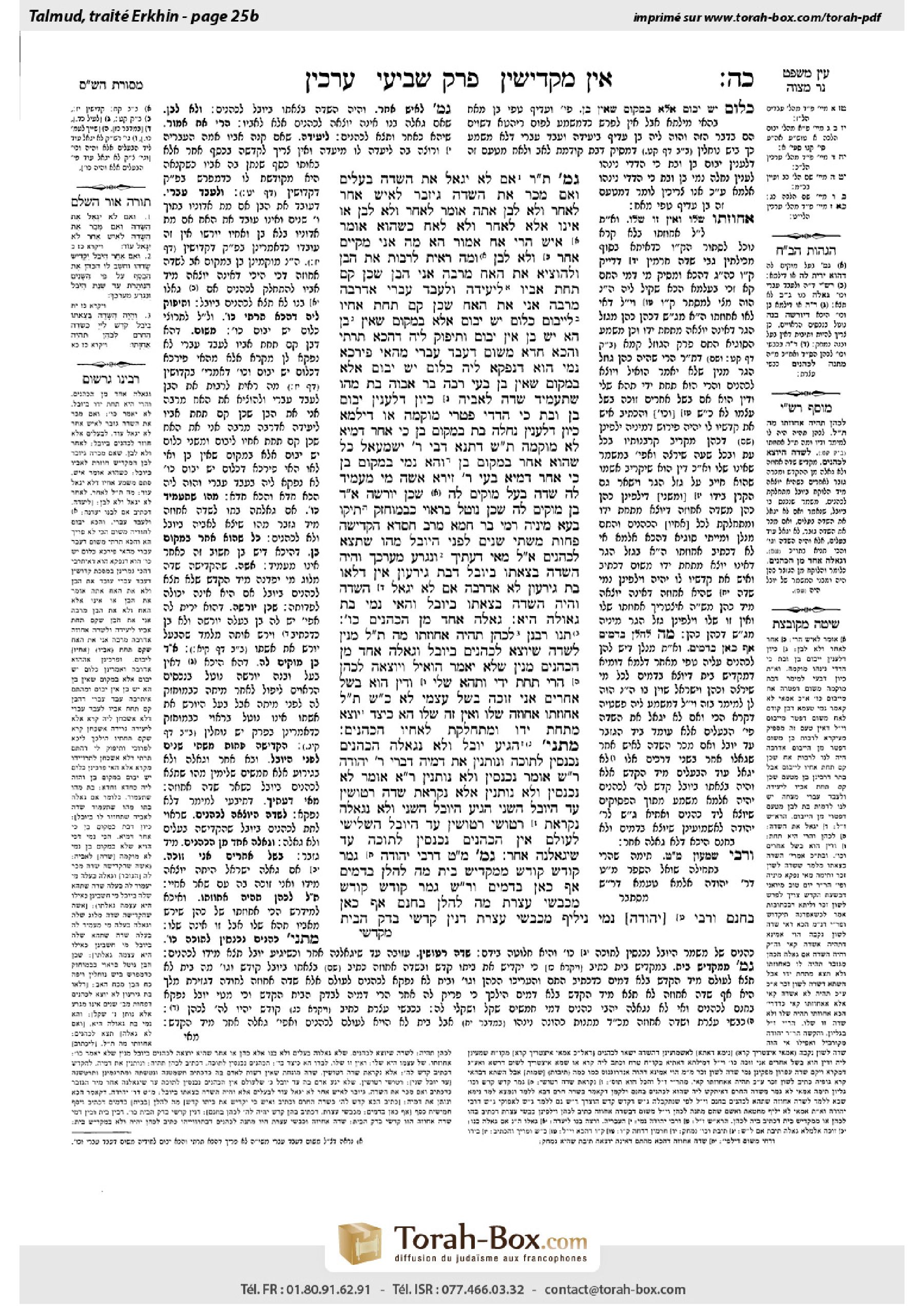
ערכין כ״ה ב · Aramaic and Hebrew text
גְּמָ׳ תָּנוּ רַבָּנַן:
״אִם לֹא יִגְאַל אֶת הַשָּׂדֶה״ — בְּעָלִים, ״וְאִם מָכַר אֶת הַשָּׂדֶה״ — גִּיזְבָּר.
״לְאִישׁ אַחֵר״ — לְאַחֵר, וְלֹא לַבֵּן. אַתָּה אוֹמֵר: לְאַחֵר וְלֹא לַבֵּן, אוֹ אֵינוֹ אֶלָּא לְאַחֵר וְלֹא לָאָח? כְּשֶׁהוּא אוֹמֵר ״אִישׁ״ — הֲרֵי אָח אָמוּר, הָא מָה אֲנִי מְקַיֵּים ״אַחֵר״ — וְלֹא לַבֵּן.
וּמָה רָאִיתָ לְרַבּוֹת אֶת הַבֵּן וּלְהוֹצִיא אֶת הָאָח? מְרַבֶּה אֲנִי הַבֵּן, שֶׁכֵּן קָם תַּחַת אָבִיו לִיעִידָה וּלְעֶבֶד עִבְרִי.
אַדְּרַבָּה, מְרַבֶּה אֲנִי אֶת הָאָח, שֶׁכֵּן קָם תַּחַת אָחִיו לְיִיבּוּם. כְּלוּם יֵשׁ יִבּוּם אֶלָּא בִּמְקוֹם שֶׁאֵין בֵּן? הָא יֵשׁ בֵּן — אֵין יִבּוּם.
וְתִיפּוֹק לֵיהּ, דְּהָכָא תַּרְתֵּי, וְהָכָא חֲדָא!
מִשּׁוּם דְּעֶבֶד עִבְרִי מֵהַאי פִּירְכָא נָמֵי הוּא דְּנָפְקָא לֵיהּ: כְּלוּם יֵשׁ יִבּוּם אֶלָּא בִּמְקוֹם שֶׁאֵין בֵּן?
בָּעֵי רַבָּה בַּר אֲבוּהּ: בַּת מַהוּ שֶׁתַּעֲמִיד שָׂדֶה לְאָבִיהָ? כֵּיוָן דִּלְעִנְיַן יִבּוּם, בֵּן וּבַת כִּי הֲדָדֵי פָּטְרִי — מוֹקְמָה, אוֹ דִילְמָא כֵּיוָן דִּלְעִנְיַן נַחֲלָה, בַּת בִּמְקוֹם בֵּן כִּי אַחֵר דָּמְיָא — לָא מוֹקְמָה.
תָּא שְׁמַע, דְּתָנָא דְּבֵי רַבִּי יִשְׁמָעֵאל: כֹּל שֶׁהוּא אַחֵר בִּמְקוֹם בֵּן, וְהָא נָמֵי בִּמְקוֹם בֵּן כִּי אַחֵר דָּמְיָא.
בָּעֵי רַבִּי זֵירָא: אִשָּׁה מִי מַעֲמִיד לָהּ שָׂדֶה? בַּעַל מוֹקֵים לַהּ, שֶׁכֵּן יוֹרְשָׁהּ, אוֹ דִילְמָא בֵּן מוֹקֵים לַהּ, שֶׁכֵּן נוֹטֵל בָּרָאוּי כְּבַמּוּחְזָק? תֵּיקוּ.
בְּעָא מִינֵּיהּ רָמֵי בַּר חָמָא מֵרַב חִסְדָּא: הִקְדִּישָׁהּ פָּחוֹת מִשְׁתֵּי שָׁנִים לִפְנֵי הַיּוֹבֵל, מַהוּ שֶׁתֵּצֵא לַכֹּהֲנִים?
אֲמַר לֵיהּ: מַאי דַּעְתָּיךְ? ״וְנִגְרַע מֵעֶרְכֶּךָ... וְהָיָה הַשָּׂדֶה בְּצֵאתוֹ בַיּוֹבֵל״ — דְּבַת גֵּירָעוֹן — אִין, דְּלָאו בַּת גֵּירָעוֹן — לָא.
אַדְּרַבָּה, ״אִם לֹא יִגְאַל הַשָּׂדֶה... וְהָיָה הַשָּׂדֶה בְּצֵאתוֹ בַיּוֹבֵל״, וְהַאי נָמֵי בַּת גְּאוּלָּה הִיא.
גְּאָלָהּ אֶחָד מִן הַכֹּהֲנִים כּוּ׳. תָּנוּ רַבָּנַן: ״לַכֹּהֵן תִּהְיֶה אֲחוּזָּתוֹ״, מָה תַּלְמוּד לוֹמַר?
מִנַּיִן לְשָׂדֶה שֶׁיּוֹצָא לַכֹּהֲנִים בַּיּוֹבֵל, וּגְאָלָהּ אֶחָד מִן הַכֹּהֲנִים, מִנַּיִן שֶׁלֹּא יֹאמַר: ״הוֹאִיל וְיוֹצְאָה לַכֹּהֵן, הֲרֵי תַּחַת יָדִי, וּתְהֵא שֶׁלִּי?״ וְדִין הוּא: בְּשֶׁל אֲחֵרִים אֲנִי זוֹכֶה, בְּשֶׁל עַצְמִי לֹא כׇּל שֶׁכֵּן?
תַּלְמוּד לוֹמַר: ״אֲחוּזָּתוֹ״, אֲחוּזָּה שֶׁלּוֹ, וְאֵין זֶה שֶׁלּוֹ. הָא כֵּיצַד? יוֹצָא מִתַּחַת יָדוֹ וּמִתְחַלֶּקֶת לְאֶחָיו הַכֹּהֲנִים.
מַתְנִי׳ הִגִּיעַ יוֹבֵל וְלֹא נִגְאֲלָה, הַכֹּהֲנִים נִכְנָסִין לְתוֹכָהּ וְנוֹתְנִין אֶת דָּמֶיהָ, דִּבְרֵי רַבִּי יְהוּדָה. רַבִּי שִׁמְעוֹן אוֹמֵר: נִכְנָסִין וְלֹא נוֹתְנִין.
רַבִּי אֱלִיעֶזֶר אוֹמֵר: לֹא נִכְנָסִין וְלֹא נוֹתְנִין, אֶלָּא נִקְרֵאת ״שְׂדֵה רְטוּשִׁין״ עַד הַיּוֹבֵל הַשֵּׁנִי. הִגִּיעַ הַיּוֹבֵל הַשֵּׁנִי וְלֹא נִגְאֲלָה, נִקְרֵאת ״רְטוּשֵׁי רְטוּשִׁין״ עַד הַיּוֹבֵל הַשְּׁלִישִׁי. לְעוֹלָם אֵין הַכֹּהֲנִים נִכְנָסִין לְתוֹכָהּ עַד שֶׁיִּגְאָלֶנָּה אַחֵר.
גְּמָ׳ מַאי טַעְמָא דְּרַבִּי יְהוּדָה? גָּמַר ״קֹדֶשׁ״ ״קֹדֶשׁ״ מִמַּקְדִּישׁ בַּיִת,
מָה לְהַלָּן בְּדָמִים — אַף כָּאן בְּדָמִים.
וְרַבִּי שִׁמְעוֹן, גָּמַר ״קֹדֶשׁ״ ״קֹדֶשׁ״ מִכִּבְשֵׂי עֲצֶרֶת, מָה לְהַלָּן בְּחִנָּם, אַף כָּאן בְּחִנָּם.
וְרַבִּי [יְהוּדָה] נָמֵי נֵילַיף מִכִּבְשֵׂי עֲצֶרֶת! דָּנִין קׇדְשֵׁי בֶּדֶק הַבַּיִת
Arakhin 25b · English translation
GEMARA: The mishna teaches that if one consecrated his ancestral field and his son redeemed it from the Temple treasury, the field returns to the original owner when the Jubilee arrives. By contrast, if another person redeemed it, the field is transferred to the priests during the Jubilee Year. With regard to this matter, the Sages taught a baraita analyzing the verse: “And if he will not redeem the field, or if he sold the field to another man, it shall not be redeemed anymore. But the field, when it goes out in the Jubilee, shall be holy for the Lord, as a dedicated field; his ancestral possession shall be for the priest” (Leviticus 27:20–21).
The phrase “and if he will not redeem the field” is referring to a case where the owner did not redeem it and it remained in the possession of the Temple treasury, and the phrase “or if he sold the field” is referring to a situation where the Temple treasurer sold it to another person. The verse indicates that in both of these instances, possession of the field goes to the priests.
The baraita continues: “To another man,” indicates that the field is transferred to the priests during the Jubilee Year only if it had been sold to another, and not to the son of the one who consecrated it. The baraita asks: Do you say that the verse is referring to another and not to his son? Or perhaps the verse means only that it was sold to another and not to his brother? The baraita rejects this suggestion: When it says: “Man,” the brother is stated, i.e., he is included in the category of a man. How do I realize the meaning of: “Another man”? It must mean: Another, but not his son.
The baraita asks: And what did you see to include the son in the same category as the father, and to exclude the brother? The baraita answers: I include the son, as he stands in place of his father with regard to designating a Hebrew maidservant as a wife for himself, in a case where the father purchased the Hebrew maidservant and designates her as a wife for his son, which he cannot do for his brother. And he also stands in place of his father with regard to a Hebrew slave, as when one inherits a Hebrew slave from his father, the slave is obligated to serve the son and does not go free, whereas if the deceased’s brother inherits the servant, he goes free.
The baraita objects: On the contrary, I should include the brother, as he stands in his brother’s place with regard to levirate marriage, which a son does not. The baraita rejects this suggestion: Is there ever a case of levirate marriage other than a case where there is no son? In a case where there is a son there is no levirate marriage. This indicates that with regard to levirate marriage as well, a son stands in place of the deceased more than a brother of the deceased.
The Gemara asks: Why is it necessary to answer the question in this way? Let one derive the halakha that the son stands in place of the father, and the brother does not, from the simple fact that here, in support of extending the father’s status to the son, there are two justifications, i.e., the halakha of designation of the Hebrew maidservant and the halakha of the Hebrew slave, and there, in support of extending it to the brother, there is only one justification, i.e., the halakha of levirate marriage?
The Gemara responds: That answer is invalid because the halakha that a son, but not a brother, stands in place of his father with regard to a Hebrew slave is not written explicitly in the Torah, but the tanna also derives it from this same refutation, namely: Is there ever a case of levirate marriage other than a case where there is no son. Without this refutation there would not be more justifications in support of extending the father’s status to the son rather than to the brother. Accordingly, this last refutation is the basis for the conclusion.
§ Rabba bar Avuh raises a dilemma: If a daughter redeemed the ancestral field that her father consecrated, what is the halakha? Does she thereby preserve possession of the field for her father at the Jubilee Year, like a son? Rabba bar Avuh explains the two sides of the dilemma: Perhaps the halakha is that since with regard to levirate marriage, a son and a daughter are like one another, as both exempt their father’s widow from the obligation of levirate marriage, the daughter preserves possession of the field for her father. Or perhaps the halakha is that since with regard to inheritance, when there is a son, a daughter is considered like another person, as she does not inherit a share of her father’s estate, she does not preserve possession of the field for her father.
The Gemara suggests: Come and hear a proof from a baraita that the school of Rabbi Yishmael taught: Anyone who is considered like another person when there is a son does not preserve possession of the field for the owner. And with regard to this, i.e., a daughter, as well, when there is a son, she is considered like another person.
Rabbi Zeira raises a dilemma: If a woman consecrated her ancestral field, which of her heirs can redeem the field and thereby preserve possession of the field for her during the Jubilee Year? Can her husband preserve it for her, as he inherits from her if she dies during his lifetime? Or perhaps her son can preserve if for her, as if the son inherits from his mother, when she was not married at the time of her death, he takes in inheritance the property due to her as he does the property she possessed? There is a halakha that if someone dies and his heir is a woman who is already deceased, her son inherits that property, not her late husband. No resolution is offered, and therefore the Gemara states that the dilemma shall stand unresolved.
§ Rami bar Ḥama raised a dilemma before Rav Ḥisda: If one consecrated his ancestral field less than two years before the Jubilee Year and did not redeem it, what is the halakha with regard to whether or not it is to be removed from his possession during the Jubilee and given to the priests?
Rav Ḥisda said to him: What is your reasoning? Is it that since the verse states: “And a deduction shall be made from your valuation” (Leviticus 27:18), which indicates that the field is redeemed with a deduction according to the years remaining until the Jubilee Year, and the verse also states: “But the field, when it goes out in the Jubilee, shall be holy for the Lord…his ancestral possession shall be for the priest” (Leviticus 27:21), this indicates that if the field is fit for deduction, then yes, when it is not redeemed by the owner it is given to the priests at the Jubilee Year, but with regard to a field that is not fit for deduction, i.e., one consecrated less than two years before the Jubilee Year, which must be redeemed according to its full valuation (24a), no, it is not given to the priests but rather is returned to the owner?
Rav Ḥisda responds: On the contrary, the verse states: “And if he will not redeem the field, or if he sold the field to another man, it shall not be redeemed anymore. But the field, when it goes out in the Jubilee, shall be holy for the Lord…his ancestral possession shall be for the priest” (Leviticus 27:20–21). This indicates that any field that could have been redeemed but was not redeemed becomes the possession of the priests. And this field, which was consecrated less than two years before the Jubilee Year, is also fit for redemption. Therefore, if it was not redeemed it is given to the priests.
§ The mishna teaches: If one of the priests redeemed the field and when the Jubilee Year arrived it was in his possession, he may not say: Since it is removed from the possession of the one who redeemed it and given to the priests during the Jubilee Year, and since it is already in my possession, it is mine. Rather, the field is removed from his possession and is divided among all of his brethren, the priests. With regard to this halakha, the Sages taught in a baraita: Why must the verse state: “But the field, when it goes out in the Jubilee, shall be holy for the Lord…his ancestral possession shall be for the priest” (Leviticus 27:21)?
The baraita explains: From where is it derived, with regard to a field that was consecrated and not redeemed by the owner, and therefore was to have been removed from the possession of the owner and given to the priests during the Jubilee Year, and one of the priests redeemed it before the Jubilee, from where is it derived that he may not say: Since it is removed from the possession of the owner and given to the priest at the Jubilee, and since it is already in my possession, it should therefore be mine? And this claim is supported by a logical inference: Since in the Jubilee Year I obtain fields of others that I did not previously redeem, is it not all the more so clear that I should retain my own field that I redeemed from the Temple treasury myself?
Therefore, the verse states: “His ancestral possession,” which can be interpreted to mean that only his ancestral field, i.e., one that the priest inherited from his own ancestors, is automatically his, but this field is not his. How so, i.e., how is this field treated? It is removed from his possession and is divided among all of his brethren, the priests.
MISHNA: If one consecrated his ancestral field and the Jubilee Year arrived and it was not redeemed by the owner or anyone else, the priests enter into the field and give its redemption payment to the Temple treasury; this is the statement of Rabbi Yehuda. Rabbi Shimon says: They enter into the field, but they do not give its redemption payment to the Temple treasury.
Rabbi Eliezer says: The priests do not enter into the field, and they also do not give its redemption payment to the Temple treasury. Rather, the field remains in the possession of the Temple treasury, and it is called: An abandoned field, until the second Jubilee Year. If the second Jubilee arrived and it was still not redeemed, it is called: An abandoned field from among the abandoned fields, meaning one that was abandoned twice, until the third Jubilee. In any case, the priests never enter into a consecrated field during the Jubilee Year until another person redeems it first.
GEMARA: The Gemara asks: What is the reason for Rabbi Yehuda’s opinion that the priests who enter into an unredeemed consecrated field during the Jubilee Year must give its redemption payment to the Temple treasury? The Gemara answers: He derives this halakha from a verbal analogy from the word “holy” stated in reference to an ancestral field, and the word “holy” that appears with regard to one who consecrates a house.
The Gemara explains: Just as there, with regard to one who consecrates a house, where the verse states: “And when a man shall consecrate his house to be holy for the Lord” (Leviticus 27:14), it can be redeemed from the Temple treasury only by payment of money, as the verse concludes: “As the priest shall value it, so shall it stand,” so too here, where the verse states with regard to the priests entering into an ancestral field: “But the field, when it goes out in the Jubilee, shall be holy for the Lord…his ancestral possession shall be for the priest” (Leviticus 27:21), the priests can enter the field only by payment of money.
The Gemara asks: And what is the source for the opinion of Rabbi Shimon, who maintains that the priests are not required to give the redemption payment to the Temple treasury? The Gemara answers: He derives the halakha from the word “holy” used with regard to an ancestral field, and the word “holy” used with regard to the communal peace offering of two lambs that accompanies the two loaves on Shavuot. Just as there, with regard to the offering of two lambs, where the verse states: “They shall be holy to the Lord for the priest” (Leviticus 23:20), the lambs are given to the priests for free, as is the halakha with regard to all offerings to which members of the priesthood are entitled, so too here, the consecrated and unredeemed ancestral field is given to the priests for free.
The Gemara asks: And as for Rabbi Yehuda, let him also derive the halakha by a verbal analogy from the two lambs brought on Shavuot. Why does he disagree with Rabbi Shimon? The Gemara answers: One derives the halakha with regard to items consecrated for Temple maintenance, such as an ancestral field,
Arakhin 25b · Traduction française (IA)
GUEMARA : La Michna enseigne que si l'on a consacré son champ ancestral et que son fils l'a racheté à partir du trésor du Temple, le champ retourne à l'original propriétaire lors de l'année sabbatique. En revanche, si un autre a racheté le champ, le champ est transféré aux prêtres lors de l'année sabbatique. À propos de cette question, les Sages ont enseigné une baraïta analysant la parole : « Et s'il ne rachète pas le champ, ou s'il vend le champ à un autre homme, il ne pourra plus le racheter. Mais le champ, lorsqu'il sortira en année sabbatique, sera saint pour l'Éternel, comme un champ consacré ; sa possession ancienne sera pour le prêtre » (Lévitique 27,20-21).
La phrase « et s'il ne rachète pas le champ » fait référence à un cas où le propriétaire n'a pas racheté le champ et où il reste en possession du trésor du Temple, et la phrase « ou s'il vend le champ » fait référence à un cas où le trésor du Temple l'a vendu à une autre personne. La parole indique que dans les deux cas, la possession du champ va aux prêtres.
La baraïta continue : « À un autre homme », indique que le champ est transféré aux prêtres lors de l'année sabbatique uniquement s'il a été vendu à un autre, et non au fils de celui qui l'avait consacré. La baraïta pose la question : Est-ce que vous dites que la parole fait référence à un autre et non à son fils ? Ou peut-être la parole signifie-t-elle seulement qu'il a été vendu à un autre et non à son frère ? La baraïta rejette cette suggestion : Lorsqu'elle dit : « homme », le frère est mentionné, c'est-à-dire qu'il est inclus dans la catégorie d'un homme. Comment puis-je comprendre : « un autre homme » ? Il doit signifier : un autre, mais pas son fils.
La baraïta pose la question : Et qu'avez-vous vu pour inclure le fils dans la même catégorie que le père, et exclure le frère ? La baraïta répond : J'inclus le fils, car il remplace son père concernant la désignation d'une servante hébreuse comme épouse pour lui-même, dans un cas où le père achète la servante hébreuse et la désigne comme épouse pour son fils, ce qu'il ne peut pas faire pour son frère. Il remplace également son père concernant un serviteur hébreu, car lorsqu'on hérite d'un serviteur hébreu de son père, le serviteur est tenu de servir le fils et ne devient pas libre, tandis que si le frère du défunt hérite du serviteur, il devient libre.
La baraïta s'oppose : Au contraire, je devrais inclure le frère, car il remplace son frère concernant le mariage levirat, ce que le fils ne peut pas faire. La baraïta rejette cette suggestion : Y a-t-il jamais un cas de mariage levirat autre qu'un cas où il n'y a pas de fils ? Lorsqu'il y a un fils, il n'y a pas de mariage levirat. Cela indique que concernant le mariage levirat également, le fils remplace le défunt plus que le frère du défunt.
La Guemara pose la question : Pourquoi est-il nécessaire de répondre ainsi ? Laissons un déduire la halakha que le fils remplace le père, et le frère ne le fait pas, à partir du fait simple que ici, en faveur d'étendre le statut du père au fils, il y a deux justifications, c'est-à-dire la halakha de la désignation de la servante hébreuse et la halakha du serviteur hébreu, et là, en faveur d'étendre cela au frère, il n'y a qu'une justification, c'est-à-dire la halakha du mariage levirat ?
La Guemara répond : Cette réponse est invalide, car la halakha que le fils, mais pas le frère, remplace son père concernant le serviteur hébreu n'est pas explicitement écrite dans la Torah, mais le tanna l'entend également de cette même réfutation, à savoir : Y a-t-il jamais un cas de mariage levirat autre qu'un cas où il n'y a pas de fils ? Sans cette réfutation, il n'y aurait pas plus de justifications en faveur d'étendre le statut du père au fils plutôt qu'au frère. Ainsi, cette dernière réfutation est la base de la conclusion.
§ Rabba bar Avuh soulève un dilemme : Si une fille rachète le champ ancestral que son père a consacré, quelle est la halakha ? Elle préserve-t-elle la possession du champ pour son père lors de l'année sabbatique, comme un fils ? Rabba bar Avuh explique les deux côtés du dilemme : Peut-être la halakha est-elle que puisque concernant le mariage levirat, un fils et une fille sont semblables, car les deux dispensent la veuve du père de l'obligation du mariage levirat, la fille préserve la possession du champ pour son père. Ou peut-être la halakha est-elle que puisque concernant l'héritage, lorsqu'il y a un fils, la fille est considérée comme une autre personne, car elle ne hérite pas une part de l'immobilier de son père, elle ne préserve pas la possession du champ pour son père.
La Guemara suggère : Venez entendre une preuve d'une baraïta que l'école de Rabbi Yishmael enseignait : Quiconque est considéré comme une autre personne lorsqu'il y a un fils ne préserve pas la possession du champ pour le propriétaire. Et concernant cela, c'est-à-dire la fille, ainsi que lorsqu'il y a un fils, elle est considérée comme une autre personne.
Rabbi Zeira soulève un dilemme : Si une femme a consacré son champ ancestral, quel est l'héritier qui peut racheter le champ et ainsi préserver la possession du champ pour elle lors de l'année sabbatique ? Son mari peut-il le préserver pour elle, car il hérite d'elle si elle meurt pendant sa vie ? Ou peut-être son fils peut-il le préserver pour elle, car si le fils hérite de sa mère, lorsqu'elle est décédée sans être mariée, il prend en héritage la propriété due à elle comme il le fait pour la propriété qu'elle possédait ? Il y a une halakha qui dit que si quelqu'un meurt et que son héritier est une femme déjà décédée, son fils hérite de cette propriété, pas son mari décédé. Aucune résolution n'est offerte, et donc la Guemara dit que le dilemme restera sans solution.
§ Rami bar Ḥama a soulevé un dilemme devant Rav Ḥisda : Si l'on a consacré son champ ancestral moins de deux ans avant l'année sabbatique et qu'on n'a pas racheté le champ, quelle est la halakha concernant le fait de le retirer de sa possession lors de l'année sabbatique et de le donner aux prêtres ?
Rav Ḥisda dit à lui : Quel est votre raisonnement ? Est-ce que c'est parce que la Parashah dit : « Et une déduction sera faite de votre estimation » (Lévitique 27:18), ce qui indique que le champ est racheté avec une déduction selon les années restantes jusqu'au Jubilé, et la Parashah dit aussi : « Mais le champ, lorsqu'il sortira au Jubilé, sera saint pour l'Éternel… sa possession paternelle sera pour le prêtre » (Lévitique 27:21), ce qui indique que si le champ est digne de déduction, alors oui, s'il n'est pas racheté par l'acheteur, il est donné aux prêtres au Jubilé, mais concernant un champ non digne de déduction, c'est-à-dire un champ consacré moins de deux ans avant le Jubilé, qui doit être racheté selon sa valeur totale (24a), non, il n'est pas donné aux prêtres mais plutôt rendu à l'acheteur ?
Rav Ḥisda répond : Au contraire, la Parashah dit : « Et s'il ne rachète pas le champ, ou s'il vend le champ à un autre homme, il ne sera plus racheté. Mais le champ, lorsqu'il sortira au Jubilé, sera saint pour l'Éternel… sa possession paternelle sera pour le prêtre » (Lévitique 27:20–21). Cela indique que tout champ qui aurait pu être racheté mais n'a pas été racheté devient la propriété des prêtres. Et ce champ, qui a été consacré moins de deux ans avant le Jubilé, est également digne de rachat. Ainsi, s'il n'a pas été racheté, il est donné aux prêtres.
§ La Michna enseigne : Si un prêtre rachète un champ et que lors du Jubilé il est en son possession, il ne peut pas dire : Puisque le champ est retiré de la possession de celui qui l'a racheté et donné aux prêtres lors du Jubilé, et puisque le champ est déjà en ma possession, il m'appartient. En revanche, le champ est retiré de sa possession et est partagé entre tous ses frères, les prêtres. Concernant cette halakha, les Sages ont enseigné dans une baraïta : Pourquoi la Parashah dit-elle : « Mais le champ, lorsqu'il sortira au Jubilé, sera saint pour l'Éternel… sa possession paternelle sera pour le prêtre » (Lévitique 27:21) ?
La baraïta explique : D'où est-il tiré, concernant un champ qui a été consacré et non racheté par l'acheteur, et donc devait être retiré de la possession de l'acheteur et donné aux prêtres lors du Jubilé, et que l'un des prêtres l'a racheté avant le Jubilé, d'où est-il tiré qu'il ne peut pas dire : Puisque le champ est retiré de la possession de l'acheteur et donné au prêtre lors du Jubilé, et puisque le champ est déjà en ma possession, il devrait donc m'appartenir ? Et cette affirmation est soutenue par une déduction logique : Puisque lors du Jubilé je obtiens des champs d'autres personnes que je n'ai pas rachetés auparavant, n'est-ce pas encore plus clair que je dois conserver mon propre champ que j'ai racheté moi-même du trésor du Temple ?
Ainsi, la Parashah dit : « Sa possession paternelle », ce qui peut être interprété pour signifier que seul son champ paternel, c'est-à-dire un champ hérité de ses ancêtres, est automatiquement sien, mais ce champ n'est pas sien. Comment cela est-il traité ? Il est retiré de sa possession et est partagé entre tous ses frères, les prêtres.
MICHNA : Si l'un a consacré son champ paternel et que le Jubilé est arrivé et qu'il n'a pas été racheté par l'owner ou par quiconque d'autre, les prêtres entrent dans le champ et donnent le paiement de rachat au trésor du Temple ; c'est l'opinion de Rabbi Yehuda. Rabbi Shimon dit : Ils entrent dans le champ, mais ils ne donnent pas le paiement de rachat au trésor du Temple.
Rabbi Eliezer dit : Les prêtres n'entrent pas dans le champ, et ils ne donnent pas le paiement de rachat au trésor du Temple. Plutôt, le champ reste en possession du trésor du Temple et est appelé : Un champ abandonné, jusqu'au deuxième Jubilé. Si le deuxième Jubilé est arrivé et qu'il n'a pas été racheté, il est appelé : Un champ abandonné parmi les champs abandonnés, c'est-à-dire un champ abandonné deux fois, jusqu'au troisième Jubilé. En tout cas, les prêtres n'entrent jamais dans un champ consacré durant le Jubilé jusqu'à ce qu'un autre personne le rachète d'abord.
GUEMARA : La Guemara pose la question : Quel est le motif de l'opinion de Rabbi Yehuda selon laquelle les prêtres qui entrent dans un champ consacré non racheté durant le Jubilé doivent donner le paiement de rachat au trésor du Temple ? La Guemara répond : Il dérive cette halakha d'une analogie verbale du mot « saint » mentionné concernant un champ paternel, et du mot « saint » qui apparaît concernant celui qui consacre une maison.
La Guemara explique : Tout comme là, concernant celui qui consacre une maison, où la Parashah dit : « Et lorsqu'un homme consacrera sa maison pour être saint à l'Éternel » (Lévitique 27:14), il peut être racheté du trésor du Temple uniquement par paiement d'argent, comme la Parashah conclut : « Comme le prêtre l'appréciera, ainsi sera-t-il », ainsi ici, concernant les prêtres qui entrent dans un champ paternel : « Mais le champ, lorsqu'il sortira au Jubilé, sera saint pour l'Éternel… sa possession paternelle sera pour le prêtre » (Lévitique 27:21), les prêtres peuvent entrer dans le champ uniquement par paiement d'argent.
La Guemara pose la question : Et quelle est la source de l'opinion de Rabbi Shimon, qui affirme que les prêtres ne sont pas tenus de verser le paiement de rachat au trésor du Temple ? La Guemara répond : Il dérive la halakha du mot « saint » utilisé en référence à un champ paternel, et du mot « saint » utilisé en référence à l'offrande communautaire de deux agnels qui accompagne les deux pains pendant la Pessa'h. Tout comme là, en référence à l'offrande de deux agnels, où la Parashah dit : « Ils seront saints à l'Éternel pour le prêtre » (Lévitique 23:20), les agnels sont donnés aux prêtres gratuitement, comme c'est la halakha concernant toutes les offrandes auxquelles les membres du clergé ont droit, ainsi ici, le champ consacré et non racheté paternel est donné aux prêtres gratuitement.
La Guemara pose la question : Et quant à Rabbi Yéhuda, qu’il dérive également la halakha par une analogie verbale à partir des deux agnels offerts pendant la fête des Pâques des Semaines. Pourquoi est-il en désaccord avec Rabbi Shimon ? La Guemara répond : On dérive la halakha concernant les objets consacrés à l’entretien du Temple, tels qu’un champ ancestral,
Traduction française générée par IA à partir de l’édition anglaise de Sefaria. Vérifie toujours un passage avec le texte source.
Text from Sefaria: William Davidson Edition - Vocalized Aramaic (CC BY NC); William Davidson Edition - English (CC BY NC).