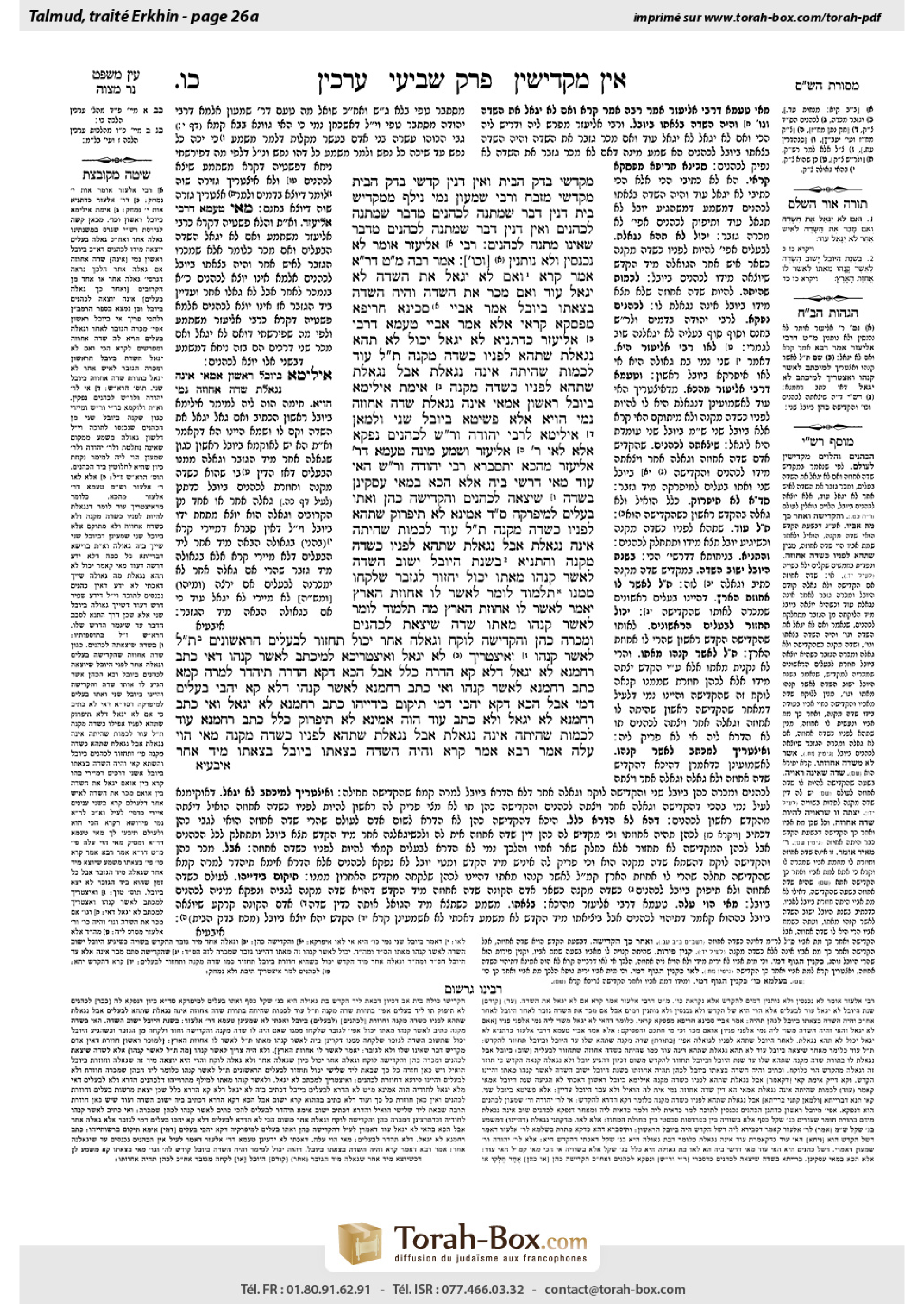
Arakhin 26a: Talmud study for Daf Yomi
Study the Talmud for Daf Yomi with scanned pages, Hebrew text, English translations from Sefaria and AI-generated French translations.
Passage selection and English or AI-generated French translation are available where the scan has annotations. Daf Study is independent of Torah-Box and Sefaria.
Browse Arakhin · ערכין · All tractatesArakhin 26a text and translations
This page of Arakhin includes the Aramaic text, an English translation and an AI-generated French translation, alongside the scan above.
ערכין כ״ו א · Aramaic and Hebrew text
מִקׇּדְשֵׁי בֶּדֶק הַבַּיִת, וְאֵין דָּנִין קׇדְשֵׁי בֶּדֶק הַבַּיִת מִקׇּדְשֵׁי מִזְבֵּחַ.
וְרַבִּי שִׁמְעוֹן נָמֵי, נֵילַף מִמַּקְדִּישׁ בַּיִת! דָּנִין דָּבָר שֶׁמַּתָּנָה לַכֹּהֲנִים, מִדָּבָר שֶׁמַּתָּנָה לַכֹּהֲנִים, וְאֵין דָּנִין דָּבָר שֶׁמַּתָּנָה לַכֹּהֲנִים, מִדָּבָר שֶׁאֵינוֹ מַתָּנָה לַכֹּהֲנִים.
רַבִּי אֱלִיעֶזֶר אוֹמֵר: לֹא נִכְנָסִין, וְלֹא נוֹתְנִין.
אָמַר רַבָּה: מַאי טַעְמָא דְּרַבִּי אֱלִיעֶזֶר? אָמַר קְרָא: ״וְאִם לֹא יִגְאַל אֶת הַשָּׂדֶה לֹא יִגָּאֵל עוֹד, וְאִם מָכַר אֶת הַשָּׂדֶה וְהָיָה הַשָּׂדֶה בְּצֵאתוֹ בַיּוֹבֵל״.
אָמַר אַבָּיֵי: סַכִּינָא חֲרִיפָא מַפְסְקָא קְרָאֵי? אֶלָּא אָמַר אַבָּיֵי: טַעְמָא דְּרַבִּי אֱלִיעֶזֶר כִּדְתַנְיָא: ״לֹא יִגָּאֵל״ — יָכוֹל לֹא תְּהֵא נִגְאֶלֶת שֶׁתְּהֵא לְפָנָיו כִּשְׂדֵה מִקְנָה? תַּלְמוּד לוֹמַר ״עוֹד״ — לִכְמוֹת שֶׁהָיְתָה אֵינָהּ נִגְאֶלֶת, אֲבָל נִגְאֶלֶת שֶׁתְּהֵא לְפָנָיו כִּשְׂדֵה מִקְנָה.
אֵימַת? אִילֵּימָא בְּיוֹבֵל רִאשׁוֹן — אַמַּאי אֵינָהּ נִגְאֶלֶת? שְׂדֵה אֲחוּזָּה נָמֵי הָוְיָא! אֶלָּא פְּשִׁיטָא בְּיוֹבֵל שֵׁנִי.
וּלְמַאן? אִילֵימָא לְרַבִּי יְהוּדָה וְרַבִּי שִׁמְעוֹן, לְכֹהֲנִים נָפְקָא! אֶלָּא לָאו רַבִּי אֱלִיעֶזֶר, וּשְׁמַע מִינַּהּ טַעְמָא דְּרַבִּי אֱלִיעֶזֶר מֵהָכָא.
וְתִסְבְּרָא, רַבִּי יְהוּדָה וְרַבִּי שִׁמְעוֹן הַאי ״עוֹד״ מַאי דָּרְשִׁי בֵּיהּ? אֶלָּא, הָכָא בְּמַאי עָסְקִינַן — בְּשָׂדֶה שֶׁיָּצְאָה לַכֹּהֲנִים, וְהִקְדִּישָׁהּ כֹּהֵן, וְאָתוּ בְּעָלִים לְמִיפְרְקַהּ.
סָלְקָא דַּעְתָּךְ אָמֵינָא: לָא תִּיפְרוֹק, שֶׁתְּהֵא לְפָנָיו כִּשְׂדֵה מִקְנָה — תַּלְמוּד לוֹמַר: ״עוֹד״, לִכְמוֹת שֶׁהָיְתָה אֵינָהּ נִגְאֶלֶת, אֲבָל נִגְאֶלֶת שֶׁתְּהֵא לְפָנָיו כִּשְׂדֵה מִקְנָה.
וְהָתַנְיָא: ״בִּשְׁנַת הַיּוֹבֵל יָשׁוּב הַשָּׂדֶה לַאֲשֶׁר קָנָהוּ מֵאִתּוֹ״, יָכוֹל יַחְזוֹר לַגִּזְבָּר שֶׁלְּקָחוֹ מִמֶּנּוּ? תַּלְמוּד לוֹמַר: ״לַאֲשֶׁר לוֹ אֲחֻזַּת הָאָרֶץ״.
יֵאָמֵר: ״לַאֲשֶׁר לוֹ אֲחֻזַּת הָאָרֶץ״, מָה תַּלְמוּד לוֹמַר ״לַאֲשֶׁר קָנָהוּ מֵאִתּוֹ״? שָׂדֶה שֶׁיָּצָאת לַכֹּהֲנִים, וּמְכָרָהּ כֹּהֵן, וְהִקְדִּישָׁהּ לוֹקֵחַ, וּגְאָלָהּ אַחֵר — יָכוֹל תַּחְזוֹר לַבְּעָלִים הָרִאשׁוֹנִים? תַּלְמוּד לוֹמַר: ״לַאֲשֶׁר קָנָהוּ״.
וְאִיצְטְרִיךְ ״לֹא יִגָּאֵל״, וְאִיצְטְרִיכָא לְמִיכְתַּב ״לַאֲשֶׁר קָנָהוּ״.
דְּאִי כְּתַב רַחֲמָנָא ״לֹא יִגָּאֵל״, דְּלָא קָא הָדְרָה כְּלָל, אֲבָל הָכָא דְּקָא הָדְרָה, תִּיהְדַּר לְמָרַהּ קַמָּא, כְּתַב רַחֲמָנָא ״לַאֲשֶׁר קָנָהוּ״.
וְאִי כְּתַב רַחֲמָנָא ״לַאֲשֶׁר קָנָהוּ״, דְּלָא קָא יָהֲבִי בְּעָלִים דָּמֵי, אֲבָל הָכָא, דְּקָא יָהֲבִי דְּמֵי, תֵּיקוּם בִּידַיְיהוּ, כְּתַב רַחֲמָנָא ״לֹא יִגָּאֵל״.
וְאִי כְּתַב רַחֲמָנָא ״לֹא יִגָּאֵל״, וְלָא כְּתַב ״עוֹד״, הֲוָה אָמֵינָא: לָא תִּיפְרוֹק כְּלָל, כְּתַב רַחֲמָנָא ״עוֹד״, לִכְמוֹת שֶׁהָיְתָה אֵינָהּ נִגְאֶלֶת, אֲבָל נִגְאֶלֶת שֶׁתְּהֵא לְפָנָיו כִּשְׂדֵה מִקְנָה.
מַאי הָוֵי עֲלַהּ? אָמַר רָבָא, אָמַר קְרָא: ״וְהָיָה הַשָּׂדֶה בְּצֵאתוֹ בַיּוֹבֵל״, בְּצֵאתוֹ מִיַּד אַחֵר.
Arakhin 26a · English translation
from that of other items consecrated for Temple maintenance, e.g., a consecrated house, but one does not derive the halakha with regard to items consecrated for Temple maintenance from items that are consecrated for the altar, such as the two lambs brought on Shavuot.
The Gemara objects: And let Rabbi Shimon also derive the halakha by means of a verbal analogy from one who consecrates a house. Why does he disagree with Rabbi Yehuda? The Gemara explains: One derives the halakha of an item that is a gift to the priests, such as an ancestral field that is given to the priests during the Jubilee Year, from that of another item that is a gift to the priests, i.e., the two lambs brought on Shavuot, but one does not derive the halakha of an item that is a gift to the priests from that of an item that is not a gift to the priests, i.e., a consecrated house.
§ The mishna teaches that if one consecrates his ancestral field and it is not redeemed before the Jubilee, Rabbi Eliezer says: The priests do not enter into the field, and they also do not give its redemption payment to the Temple treasury. According to Rabbi Eliezer, the priests do not obtain possession of a consecrated field during the Jubilee Year unless another person redeemed it first.
Rabba said: What is the reason for Rabbi Eliezer’s opinion? It is because the verse states: “And if he will not redeem the field, or if he sold the field to another man, it shall not be redeemed anymore. But the field, when it goes out in the Jubilee, shall be holy for the Lord, as a dedicated field; his ancestral possession shall be for the priest” (Leviticus 27:20–21). According to Rabba, Rabbi Eliezer maintains that these verses teach two separate halakhot, and should be read as follows: “And if he will not redeem the field…it shall not be redeemed anymore,” as an ancestral field, and: “Or if he sold the field…But the field, when it goes out in the Jubilee…his ancestral possession shall be for the priest.” Accordingly, if the field has not yet been sold to another man, it is not transferred to the priests during the Jubilee.
Abaye said: Does a sharp knife cut through the verses, that they may be interpreted by reading the words out of order? Rather, Abaye said: The reason for Rabbi Eliezer’s opinion is as it is taught in a baraita: Since the verse states: “And if he will not redeem the field, or if he sold the field to another man, it shall not be redeemed,” one might have thought that this means it shall not be redeemed at all by its owner, even for it to be treated for him like a purchased field, which remains in his possession until the Jubilee. Therefore, the verse states: “Anymore,” indicating that it shall not be redeemed in order for it to return to the way it was, i.e., to regain the status of an ancestral field, but it may be redeemed for it to be treated for him like a purchased field.
Abaye continues: According to this baraita, of when, i.e., about which time period, is the verse speaking? If we say that it is referring to a redemption occurring during the first Jubilee cycle in which the field was consecrated, then why may it not be redeemed in order for it to return to the way it was? At that point, it is even redeemable as an ancestral field, because if the owner redeems it then, it is not removed from his possession during the Jubilee Year. Rather, it is obvious that the baraita interprets the verse as referring to a redemption occurring during the second Jubilee cycle.
And according to whose opinion is this baraita? If we say that it is according to either Rabbi Yehuda or Rabbi Shimon, this cannot be correct, as according to them, the field leaves the possession of the Temple treasury and is given to the priests during the first Jubilee Year, after which it may no longer be redeemed. Rather, is it not in accordance with the opinion of Rabbi Eliezer, who maintains that the field remains in the possession of the Temple treasury until it is redeemed, even during a subsequent Jubilee cycle? And consequently, conclude from this baraita that the reason for Rabbi Eliezer’s opinion is from here, i.e., from the superfluous term “anymore.”
The Gemara asks: And can you understand the baraita this way? If so, then what do Rabbi Yehuda and Rabbi Shimon derive from this term: “Anymore”? Rather, the baraita can be understood in accordance with their opinions as well, and what are we dealing with here? We are dealing with an ancestral field whose owner consecrated it and did not redeem it, which left the possession of the Temple treasury and was given to the priests during the first Jubilee Year; and the priest who received the field then consecrated it, and then the original owner came to redeem it from the Temple treasury.
It might enter your mind to say: Since the owner failed to redeem this field during the first Jubilee cycle, it shall not be redeemed by him at all, even for it to be treated for him like a purchased field. Therefore, the verse states: “Anymore,” indicating that it shall not be redeemed in order for it to return to the way it was, i.e., an ancestral field, but it may be redeemed for it to be treated for him like a purchased field, which remains in his possession only until the Jubilee Year.
And similarly, it is taught in a baraita: With regard to one who consecrated a purchased field and redeemed it, since the verse states: “In the Jubilee Year the field shall return to the one from whom it was bought” (Leviticus 27:24), one might have thought that the field shall return to the Temple treasurer, from whom he bought it when he redeemed it. Therefore, the verse states immediately afterward: “To the one to whom the possession of the land belongs,” i.e., it goes to the ancestral owner who initially sold the field to the one who consecrated it.
The baraita continues: If so, let the verse simply state: “To the one to whom the possession of the land belongs.” Why must the verse state first: “To the one from whom it was bought”? The baraita answers: The verse is referring to an ancestral field whose owner consecrated it and did not redeem it, which left the possession of the Temple treasury and was given to the priests during the Jubilee Year, and the priest who received the field then sold it to another, and the buyer then consecrated it, and another person redeemed it from the Temple treasury. One might have thought that when the next Jubilee arrives, it shall return to the original owner. Therefore, the verse states: “In the Jubilee Year the field shall return to the one from whom it was bought,” indicating that the field is returned to the priest who sold the field.
The Gemara notes: And it was necessary for the Torah to write: “It shall not be redeemed,” and it was also necessary for it to write: “To the one from whom it was bought,” despite the fact both phrases apparently teach the same halakha, i.e., that after a consecrated ancestral field is left unredeemed and given to the priests during the Jubilee Year, it never returns to the original owner.
The Gemara explains: Because if the Merciful One had written only: “It shall not be redeemed,” one might have thought that the field does not return to the original owner only in a case where the priest consecrates the field and the original owner redeems it, as an ancestral field that is consecrated by its owner and redeemed by another does not return at all, but is divided among the priests. But here, where the priest sold the field that he received and the field was consecrated by the buyer as a purchased field and subsequently redeemed by another, as the field does return to its owner in the Jubilee Year, perhaps it should return to its original owner, and not the priest. Therefore, the Merciful One wrote: “To the one from whom it was bought,” indicating that it returns to the priest.
And if the Merciful One had written only: “To the one from whom it was bought,” one might have thought that the field does not return to its original owner during the Jubilee Year only in a case where the priest sold it and the buyer consecrated it, as the owner did not give any payment for the field to the Temple treasury. But here, where the priest consecrated the field and its original owner redeemed it, as he gives payment for the field to the Temple treasury, perhaps it should remain in his hands as his ancestral field. Therefore, the Merciful One wrote: “It shall not be redeemed.”
And if the Merciful One had written only: “It shall not be redeemed,” and did not write: “Anymore,” I would say that it shall not be redeemed at all, as its original owner failed to redeem it during the first Jubilee cycle. Therefore, the Merciful One writes: “Anymore,” to indicate that it shall not be redeemed in order for it to return to the way it was, i.e., an ancestral field, but it may be redeemed for it to be treated for him like a purchased field.
The Gemara asks: What conclusion was reached about it? In other words, now that both suggestions have been rejected, what is the reason for Rabbi Eliezer’s opinion that a consecrated ancestral field that has not been redeemed by the Jubilee Year is not given to the priests? Rava said that the verse states: “But the field, when it goes out in the Jubilee, shall be holy for the Lord, as a dedicated field; his ancestral possession shall be for the priest” (Leviticus 27:21). The term “when it goes out” indicates that it is given to the priests only when it goes out during the Jubilee Year from the possession of another person, who redeemed it from the Temple treasury.
Arakhin 26a · Traduction française (IA)
de celui des autres objets consacrés à l'entretien du Temple, par exemple, une maison consacrée, mais on ne dérive pas la halakha concernant les objets consacrés à l'entretien du Temple à partir des objets consacrés à l'autel, tels que les deux agnels offerts pendant la Fête des Pâques.
Le Guemara s'oppose à cela : Et pourquoi Rabbi Shimon ne dérive-t-il pas la halakha par analogie verbale à partir d'une personne qui consacre une maison ? Pourquoi est-il en désaccord avec Rabbi Yehuda ? Le Guemara explique : On dérive la halakha d'un objet qui est un don aux prêtres, comme un champ ancestral donné aux prêtres pendant l'année sabbatique, à partir d'un autre objet qui est un don aux prêtres, c'est-à-dire les deux agnels offerts pendant la Fête des Pâques, mais on ne dérive pas la halakha d'un objet qui est un don aux prêtres à partir d'un objet qui n'est pas un don aux prêtres, c'est-à-dire une maison consacrée.
§ La mitsva enseigne que si l'on consacre son champ ancestral et qu'il n'est pas racheté avant l'année sabbatique, Rabbi Eliezer dit : Les prêtres n'entrent pas dans le champ, et ils ne versent pas non plus le prix de rachat au trésor du Temple. Selon Rabbi Eliezer, les prêtres ne prennent possession d'un champ consacré pendant l'année sabbatique que si une autre personne l'a racheté d'abord.
Rabba dit : Quelle est la raison de l'opinion de Rabbi Eliezer ? C'est parce que la Parashah dit : « Et s'il ne rachète pas le champ, ou s'il vend le champ à un autre homme, il ne sera plus racheté. Mais le champ, lorsqu'il sortira en année sabbatique, sera saint pour l'Éternel, comme un champ consacré ; sa possession ancestrale sera pour le prêtre » (Lévitique 27 : 20–21). Selon Rabba, Rabbi Eliezer maintient que ces versets enseignent deux halakhot distinctes, et doivent être lus ainsi : « Et s'il ne rachète pas le champ… il ne sera plus racheté », comme un champ ancestral, et : « Ou s'il vend le champ… Mais le champ, lorsqu'il sortira en année sabbatique… sa possession ancestrale sera pour le prêtre. » Ainsi, si le champ n'a pas encore été vendu à un autre homme, il ne passe pas aux prêtres pendant l'année sabbatique.
Abaye dit : Est-ce que le couteau aigu tranche les versets, de sorte qu'ils puissent être interprétés en lisant les mots dans un ordre différent ? Plutôt, Abaye dit : La raison de l'opinion de Rabbi Eliezer est comme il est enseigné dans une baraïta : Puisque la Parashah dit : « Et s'il ne rachète pas le champ, ou s'il vend le champ à un autre homme, il ne sera plus racheté », on pourrait penser que cela signifie qu'il ne sera plus racheté du tout par son propriétaire, même pour qu'il soit traité comme un champ acheté, qui reste en son possession jusqu'à l'année sabbatique. Ainsi, la Parashah dit : « Plus », indiquant qu'il ne sera plus racheté afin qu'il retrouve l'état qu'il avait, c'est-à-dire pour reprendre le statut de champ ancestral, mais il peut être racheté afin qu'il soit traité comme un champ acheté.
Abaye continue : Selon cette baraïta, à quel moment, c'est-à-dire à quel période, la Parashah parle-t-elle ? Si nous disons qu'il s'agit d'un rachat ayant lieu pendant la première année sabbatique dans laquelle le champ a été consacré, pourquoi ne peut-il pas être racheté afin qu'il retrouve l'état qu'il avait ? À ce moment, il peut être racheté comme un champ ancestral, car si le propriétaire le rachète alors, il ne sort pas de sa possession pendant l'année sabbatique. Plutôt, il est évident que la baraïta interprète la Parashah comme faisant référence à un rachat ayant lieu pendant la deuxième année sabbatique.
Et selon l'opinion de qui est cette baraïta ? Si nous disons qu'elle est selon l'opinion de Rabbi Yehuda ou de Rabbi Shimon, cela ne peut pas être correct, car selon eux, le champ quitte le trésor du Temple et est donné aux prêtres pendant la première année sabbatique, après laquelle il ne peut plus être racheté. Plutôt, n'est-ce pas selon l'opinion de Rabbi Eliezer, qui maintient que le champ reste en possession du trésor du Temple jusqu'à ce qu'il soit racheté, même pendant une année sabbatique ultérieure ? Et par conséquent, concluez de cette baraïta que la raison de l'opinion de Rabbi Eliezer est ici, c'est-à-dire à partir du terme superflu « plus ».
Le Guemara demande : Et pouvez-vous comprendre la baraïta ainsi ? Si oui, alors qu'est-ce que Rabbi Yehuda et Rabbi Shimon dérivent de ce terme : « Plus » ? Plutôt, la baraïta peut être comprise selon leurs opinions également, et de quoi sommes-nous en train de parler ici ? Nous parlons d'un champ ancestral dont l'propriétaire l'a consacré et n'a pas racheté, qui a quitté la possession du trésor du Temple et a été donné aux prêtres pendant la première année sabbatique ; et le prêtre qui a reçu le champ l'a consacré, et ensuite l'propriétaire original est venu le racheter du trésor du Temple.
Il pourrait entrer en votre esprit de dire : Puisque l'owner n'a pas racheté ce champ pendant la première année sabbatique, il ne sera pas racheté du tout, même pour qu'il soit traité comme un champ acheté, qui reste en son possession jusqu'à l'année sabbatique. Ainsi, la Parashah dit : « Plus », indiquant qu'il ne sera pas racheté afin qu'il retrouve l'état qu'il avait, c'est-à-dire un champ ancestral, mais il peut être racheté afin qu'il soit traité comme un champ acheté, qui reste en son possession seulement jusqu'à l'année sabbatique.
Et de même, il est enseigné dans une baraïta : Concernant celui qui a consacré un champ acheté et l'a racheté, puisque la Parashah dit : « Dans l'année sabbatique, le champ retournera à celui d'qui il a été acheté » (Lévitique 27 : 24), on pourrait penser que le champ retournera au trésor du Temple, duquel il l'a acheté lorsqu'il l'a racheté. Ainsi, la Parashah dit immédiatement après : « À celui à qui appartient la possession de la terre », c'est-à-dire il va à l'propriétaire ancestral qui a initialement vendu le champ à celui qui l'a consacré.
La baraïta continue : Si c'est ainsi, la Torah pourrait simplement dire : « À celui à qui appartient la possession du pays. » Pourquoi la Torah doit-elle d'abord dire : « À celui d'qui elle a été achetée » ? La baraïta répond : La Torah fait référence à un champ ancestral dont l'propriétaire l'a consacré et n'a pas racheté, ce qui a laissé la possession du trésor du Temple et a été donné aux prêtres pendant l'année sabbatique, et le prêtre qui a reçu le champ l'a vendu à un autre, et l'acheteur l'a ensuite consacré, et une autre personne l'a racheté du trésor du Temple. On aurait pu penser que lors de la prochaine année sabbatique, il reviendrait à l'propriétaire originel. Par conséquent, la Torah dit : « Pendant l'année sabbatique, le champ reviendra à celui d'qui il a été acheté », indiquant que le champ revient au prêtre qui a vendu le champ.
Le Guemara note : Il était nécessaire que la Torah écrive : « Il ne sera pas racheté », et il était également nécessaire qu'elle écrive : « À celui d'qui il a été acheté », malgré le fait que ces deux phrases apparemment enseignent la même halakha, c'est-à-dire que, après un champ ancestral consacré qui n'a pas été racheté et donné aux prêtres pendant l'année sabbatique, il ne revient pas à l'propriétaire originel.
Le Guemara explique : Car si l'Éternel avait seulement écrit : « Il ne sera pas racheté », on aurait pu penser que le champ ne revient pas à l'original propriétaire qu'en cas où le prêtre consacre le champ et l'original propriétaire le rachète, car un champ ancestral consacré par son propriétaire et racheté par un autre ne revient pas du tout, mais est divisé parmi les prêtres. Mais ici, où le prêtre a vendu le champ qu'il avait reçu et le champ a été consacré par l'acheteur comme un champ acheté, et ensuite racheté par une autre personne, comme le champ revient à son propriétaire pendant l'année sabbatique, peut-être devrait-il revenir à son propriétaire originel et non au prêtre. Par conséquent, l'Éternel a écrit : « À celui d'qui il a été acheté », indiquant qu'il revient au prêtre.
Et si l'Éternel avait seulement écrit : « À celui d'qui il a été acheté », on aurait pu penser que le champ ne revient pas à son propriétaire originel pendant l'année sabbatique qu'en cas où le prêtre l'a vendu et l'acheteur l'a consacré, car l'original propriétaire n'a pas versé d'argent pour le champ au trésor du Temple. Mais ici, où le prêtre a consacré le champ et l'original propriétaire l'a racheté, comme il a versé de l'argent pour le champ au trésor du Temple, peut-être devrait-il rester en son possession comme un champ ancestral. Par conséquent, l'Éternel a écrit : « Il ne sera pas racheté. »
Et si l'Éternel avait seulement écrit : « Il ne sera pas racheté », et n'avait pas écrit : « Plus », je dirais qu'il ne sera pas racheté du tout, car l'original propriétaire n'a pas racheté pendant le premier cycle de l'année sabbatique. Par conséquent, l'Éternel a écrit : « Plus », pour indiquer qu'il ne sera pas racheté afin qu'il revienne à la manière d'avant, c'est-à-dire un champ ancestral, mais il peut être racheté afin qu'il soit traité comme un champ acheté.
Le Guemara pose la question : Quelle conclusion a-t-on tirée à ce sujet ? En d'autres termes, maintenant que les deux suggestions ont été rejetées, quelle est la raison de l'opinion de Rabbi Eliezer selon laquelle un champ ancestral consacré qui n'a pas été racheté par l'année sabbatique n'est pas donné aux prêtres ? Rava a dit que la Bible dit : « Mais le champ, lorsqu'il sort pendant l'année sabbatique, sera saint pour l'Éternel, comme un champ consacré ; sa possession ancienne sera pour le prêtre » (Lévitique 27:21). Le terme « lorsqu'il sort » indique qu'il est donné aux prêtres uniquement lorsqu'il sort pendant l'année sabbatique de la possession d'une autre personne, qui l'a racheté du trésor du Temple.
Traduction française générée par IA à partir de l’édition anglaise de Sefaria. Vérifie toujours un passage avec le texte source.
Text from Sefaria: William Davidson Edition - Vocalized Aramaic (CC BY NC); William Davidson Edition - English (CC BY NC).