Arakhin 27a: Talmud study for Daf Yomi
Study the Talmud for Daf Yomi with scanned pages, Hebrew text, English translations from Sefaria and AI-generated French translations.
Passage selection and English or AI-generated French translation are available where the scan has annotations. Daf Study is independent of Torah-Box and Sefaria.
Browse Arakhin · ערכין · All tractatesArakhin 27a text and translations
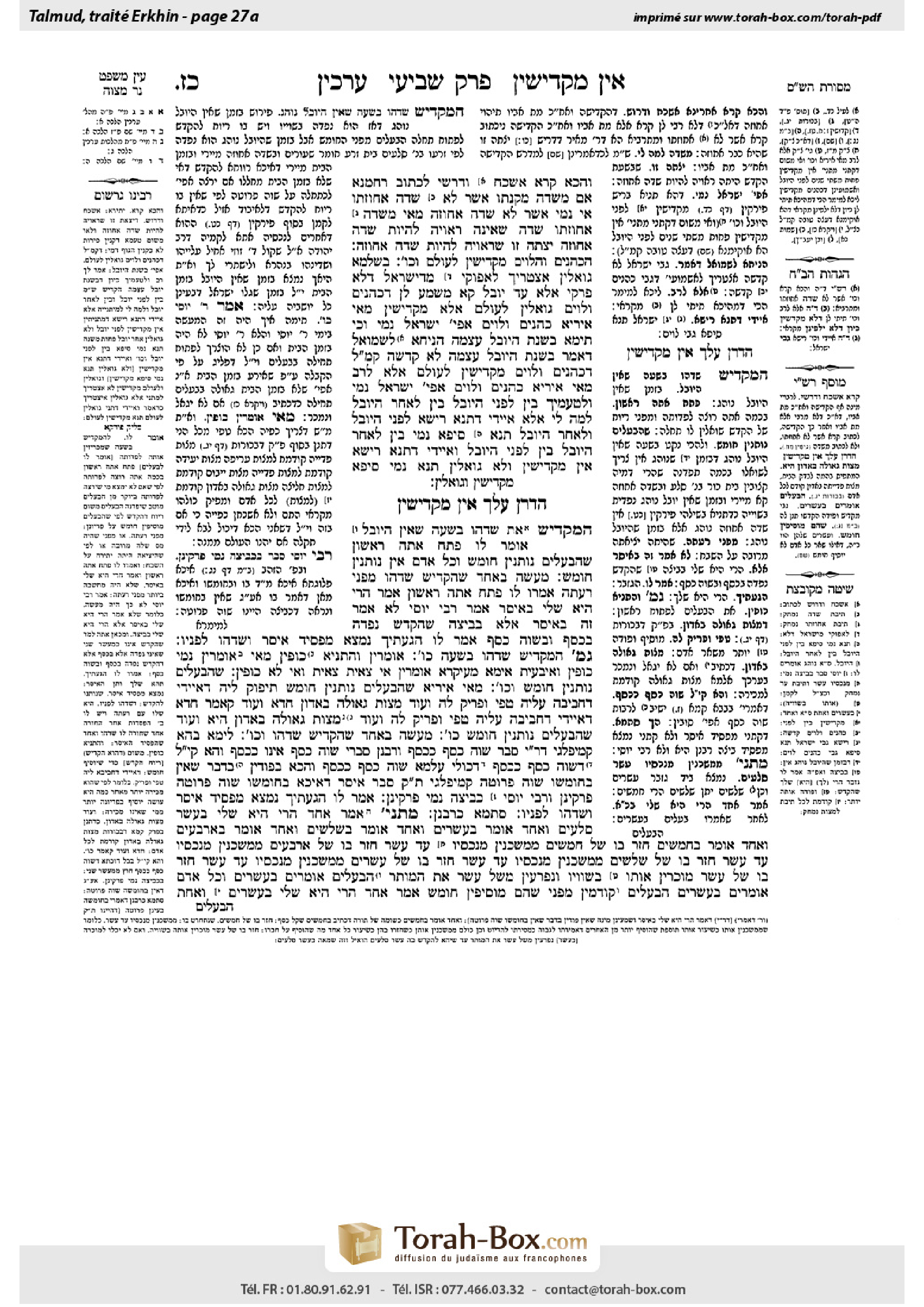
This page of Arakhin includes the Aramaic text, an English translation and an AI-generated French translation, alongside the scan above.
ערכין כ״ז א · Aramaic and Hebrew text
וְהָכָא קְרָא אַשְׁכֻּחַ וּדְרֻשׁי: לִכְתּוֹב רַחֲמָנָא ״אִם מִשְּׂדֵה מִקְנָתוֹ אֲשֶׁר לֹא שְׂדֵה אֲחוּזָּתוֹ״, אִי נָמֵי: ״אֲשֶׁר לֹא שְׂדֵה אֲחוּזָּה״, מַאי ״מִשְּׂדֵה אֲחֻזָּתוֹ״? שָׂדֶה שֶׁאֵינָהּ רְאוּיָה לִהְיוֹת שְׂדֵה אֲחוּזָּה, יָצְתָה זוֹ שֶׁרְאוּיָה לִהְיוֹת שְׂדֵה אֲחוּזָּה.
הַכֹּהֲנִים וְהַלְוִיִּם מַקְדִּישִׁין לְעוֹלָם וְכוּ׳. בִּשְׁלָמָא גּוֹאֲלִין אִצְטְרִיךְ, לְאַפּוֹקֵי מִדְּיִשְׂרָאֵל דְּלָא פָּרְקִי אֶלָּא עַד יוֹבֵל, קָא מַשְׁמַע לַן דְּכֹהֲנִים וּלְוִיִּם גּוֹאֲלִין לְעוֹלָם. אֶלָּא מַקְדִּישִׁין, מַאי אִירְיָא כֹּהֲנִים וּלְוִיִּם? אֲפִילּוּ יִשְׂרָאֵל נָמֵי!
וְכִי תֵּימָא בִּשְׁנַת הַיּוֹבֵל עַצְמָהּ, הָנִיחָא לִשְׁמוּאֵל דְּאָמַר: ״בִּשְׁנַת הַיּוֹבֵל עַצְמָהּ לָא קָדְשָׁה״, קָא מַשְׁמַע לַן דְּכֹהֲנִים וּלְוִיִּם מַקְדִּישִׁין לְעוֹלָם, אֶלָּא לְרַב, מַאי אִירְיָא כֹּהֲנִים וּלְוִיִּם? אֲפִילּוּ יִשְׂרָאֵל נָמֵי!
וּלְטַעְמָיךְ, בֵּין לִפְנֵי הַיּוֹבֵל בֵּין לְאַחַר הַיּוֹבֵל לְמָה לִי? אֶלָּא, אַיְּידֵי דִּתְנָא רֵישָׁא ״לִפְנֵי הַיּוֹבֵל וּלְאַחַר הַיּוֹבֵל״, תְּנָא סֵיפָא נָמֵי ״בֵּין לְאַחַר הַיּוֹבֵל בֵּין לִפְנֵי הַיּוֹבֵל״.
וְאַיְּידֵי דִּתְנָא רֵישָׁא ״אֵין מַקְדִּישִׁין וְלֹא גּוֹאֲלִין״, תְּנָא נָמֵי סֵיפָא ״מַקְדִּישִׁין וְגוֹאֲלִין״.
הֲדַרַן עֲלָךְ אֵין מַקְדִּישִׁין.
מַתְנִי׳ הַמַּקְדִּישׁ אֶת שָׂדֵהוּ בְּשָׁעָה שֶׁאֵין הַיּוֹבֵל, אוֹמֵר לוֹ: ״פְּתַח אַתָּה רִאשׁוֹן״, שֶׁהַבְּעָלִים נוֹתְנִין חוֹמֶשׁ, וְכׇל אָדָם אֵין נוֹתְנִין חוֹמֶשׁ.
מַעֲשֶׂה בְּאֶחָד שֶׁהִקְדִּישׁ שָׂדֵהוּ מִפְּנֵי רָעָתָהּ, אָמְרוּ לוֹ: פְּתַח אַתָּה רִאשׁוֹן. אָמַר: הֲרֵי הִיא שֶׁלִּי בְּאִיסָּר. אָמַר רַבִּי יוֹסֵי: לֹא אָמַר זֶה ״בְּאִיסָּר״, אֶלָּא ״בְּבֵיצָה״, שֶׁהֶקְדֵּשׁ נִפְדֶּה בְּכֶסֶף וּבְשָׁוֶה כֶּסֶף, אָמַר לוֹ: ״הִגַּעְתִּיךָ״, נִמְצָא מַפְסִיד אִיסָּר וְשָׂדֵהוּ לְפָנָיו.
גְּמָ׳ הַמַּקְדִּישׁ שָׂדֵהוּ בְּשָׁעָה כּוּ׳. אוֹמְרִין? וְהָתַנְיָא כּוֹפִין! מַאי ״אוֹמְרִין״ נָמֵי? כּוֹפִין. וְאִיבָּעֵית אֵימָא: מֵעִיקָּרָא אוֹמְרִין, אִי צָאֵית — צָאֵית, וְאִי לָא — כּוֹפִין.
שֶׁהַבְּעָלִים נוֹתְנִין חוֹמֶשׁ וְכוּ׳. מַאי אִירְיָא שֶׁהַבְּעָלִים נוֹתְנִין חוֹמֶשׁ? תִּיפּוֹק לֵיהּ דְּאַיְּידֵי דַּחֲבִיבָה עֲלֵיהּ טָפֵי וּפָרֵיק לַהּ! וְעוֹד, מִצְוַת גְּאוּלָּה בָּאָדוֹן!
חֲדָא וְעוֹד קָאָמַר, חֲדָא: דְּאַיְּידֵי דַּחֲבִיבָה עֲלֵיהּ טָפֵי וּפָרֵיק לַהּ, וְעוֹד: מִצְוַת גְּאוּלָּה בָּאָדוֹן הִיא, וְעוֹד: שֶׁהַבְּעָלִים נוֹתְנִין חוֹמֶשׁ כּוּ׳.
מַעֲשֶׂה בְּאֶחָד שֶׁהִקְדִּישׁ שָׂדֵהוּ וְכוּ׳. לֵימָא בְּהָא קָמִיפַּלְגִי, דְּרַבִּי יוֹסֵי סָבַר: שָׁוֶה כֶּסֶף כְּכֶסֶף, וְרַבָּנַן סָבְרִי: שָׁוֶה כֶּסֶף אֵינוֹ כְּכֶסֶף.
וְהָא קַיְימָא לַן, דְּשָׁוֶה כֶּסֶף כְּכֶסֶף! דְּכוּלֵּי עָלְמָא שָׁוֶה כֶּסֶף כְּכֶסֶף, וְהָכָא בְּפוֹדִין בְּדָבָר שֶׁאֵין בְּחוּמְשׁוֹ שָׁוֶה פְּרוּטָה קָמִיפַּלְגִי. תַּנָּא קַמָּא סָבַר: אִיסָּר, דְּאִיכָּא בְּחוּמְשׁוֹ שָׁוֶה פְּרוּטָה — פָּרְקִינַן, וְרַבִּי יוֹסֵי: כְּבֵיצָה נָמֵי פָּרְקִינַן.
אָמַר לוֹ: ״הִגַּעְתִּיךָ״, נִמְצָא מַפְסִיד אִיסָּר וְשָׂדֵהוּ לְפָנָיו. סְתָמָא כְּרַבָּנַן.
מַתְנִי׳ אָמַר אֶחָד: ״הֲרֵי הִיא שֶׁלִּי בְּעֶשֶׂר סְלָעִים״, וְאֶחָד אוֹמֵר: ״בְּעֶשְׂרִים״, וְאֶחָד אוֹמֵר: ״בִּשְׁלֹשִׁים״, וְאֶחָד אוֹמֵר: ״בְּאַרְבָּעִים״, וְאֶחָד אוֹמֵר: ״בַּחֲמִשִּׁים״. חָזַר בּוֹ שֶׁל חֲמִשִּׁים — מְמַשְׁכְּנִין מִנְּכָסָיו עַד עֶשֶׂר. חָזַר בּוֹ שֶׁל אַרְבָּעִים — מְמַשְׁכְּנִין מִנְּכָסָיו עַד עֶשֶׂר.
חָזַר בּוֹ שֶׁל שְׁלֹשִׁים — מְמַשְׁכְּנִין מִנְּכָסָיו עַד עֶשֶׂר, חָזַר בּוֹ שֶׁל עֶשְׂרִים — מְמַשְׁכְּנִין מִנְּכָסָיו עַד עֶשֶׂר, חָזַר בּוֹ שֶׁל עֶשֶׂר — מוֹכְרִין אוֹתוֹ בְּשׇׁוְויוֹ, וְנִפְרָעִין מִשֶּׁל עֶשֶׂר אֶת הַמּוֹתָר.
הַבְּעָלִים אוֹמְרִים בְּעֶשְׂרִים, וְכׇל אָדָם אוֹמְרִים בְּעֶשְׂרִים — הַבְּעָלִים קוֹדְמִין, מִפְּנֵי שֶׁהֵם מוֹסִיפִין חוֹמֶשׁ. אָמַר אֶחָד: ״הֲרֵי הִיא שֶׁלִּי בְּעֶשְׂרִים וְאַחַת״ —
Arakhin 27a · English translation
But here, with regard to their opinion that even if the son consecrated the field before his father’s death it is considered an ancestral field, this is because they found another allusion in the verse and interpreted it as follows: If the verse meant to indicate only the halakha that Rabbi Meir derives from it, let the Merciful One write: And if he will consecrate unto the Lord a field that he has bought, which is not his ancestral field, or: Which is not an ancestral field. What is the meaning of the extra word “of” in the phrase: “Which is not of his ancestral field” (Leviticus 27:22)? It teaches that only a field that is not due to become his ancestral field is treated like a purchased field, thereby excluding this field, which is due to become his ancestral field.
§ The mishna teaches: The priests and the Levites may always consecrate their ancestral fields and may always redeem their ancestral fields, both before the Jubilee Year and after the Jubilee Year. The Gemara asks: Granted, the mishna’s statement that they may always redeem their ancestral fields was necessary, in order to exclude them from the halakha that applies to the ancestral field of an Israelite, which may be redeemed only until the Jubilee Year, and if not redeemed by then, it is given to the priests. In contrast, the mishna teaches us that priests and Levites may always redeem their fields. But with regard to the statement that they may always consecrate their fields, why does the mishna specifically mention priests and Levites? Even an Israelite may always consecrate his field, both before and after the Jubilee Year.
The Gemara continues: And if you would say that the mishna means that priests and Levites may consecrate their fields during the Jubilee Year itself, whereas an Israelite may not, this works out well according to the opinion of Shmuel, who says (24a) that if an Israelite consecrated his field during the Jubilee Year itself it is not consecrated. Accordingly, the mishna teaches us that priests and Levites may always consecrate their fields, even in the Jubilee Year itself. But according to the opinion of Rav, why does the mishna specifically mention priests and Levites? Even an Israelite may consecrate his field during the Jubilee.
The Gemara responds: And according to your reasoning, one may similarly ask: Why do I need the statement that priests and Levites may consecrate their fields both before the Jubilee Year and after the Jubilee Year? Doesn’t the mishna already state that they may always consecrate their fields? Rather, since the tanna taught in the first mishna in this chapter (24a) that Israelites may not consecrate their fields less than two years before the Jubilee and they may not redeem them less than one year after the Jubilee, the tanna also taught in the latter mishna that priests and Levites may consecrate their fields both after the Jubilee and before the Jubilee, despite the fact that there is no novelty in this statement.
And similarly, since the tanna taught in the first mishna that Israelites may neither consecrate their fields less than two years before the Jubilee nor redeem them less than one year after the Jubilee, the tanna also taught in the latter mishna that priests and Levites may always consecrate and redeem their fields, despite the fact that there is no novelty with regard to consecrating in this statement either, as Israelites may also consecrate their fields both after the Jubilee and before the Jubilee.
MISHNA: In the case of one who consecrates his ancestral field during a period when the Jubilee Year is not observed, and therefore the field is not redeemed according to a fixed rate of fifty shekels per beit kor but according to its value, when the treasurer announces the sale of the field he says to the owner: You open the bidding first; how much do you offer for its redemption? This method is advantageous for the Temple treasury, as the owner gives an additional payment of one-fifth of the value of the field, and every other person does not give an additional one-fifth payment.
There was an incident involving one who consecrated his field due to its inferior quality. The treasurers said to him: You open the bidding first. He said: It is hereby mine for an issar, a small sum. Rabbi Yosei says: That person did not say he would purchase it for an issar; rather, he said he would purchase it for an egg, as consecrated items may be redeemed with money or with the equivalent value of money. The treasurer said to him: The field has come into your possession based on your bid. As a result, he loses an issar and his field remains before him in his possession.
GEMARA: The mishna teaches that with regard to one who consecrates his ancestral field during a period when the Jubilee Year is not observed, the treasurer says to him: You open the bidding first. The Gemara asks: Why does the treasurer merely say this to him? But isn’t it taught in a baraita that the treasurer forces him to open the bidding? The Gemara responds: What is the meaning of the phrase: The treasurer says to him? It means that the treasurer forces him to open the bidding. And if you wish, say instead that initially the treasurer says to him that he should open the bidding; if he complies, he complies; and if not, the treasurer forces him to comply.
The mishna teaches that the one who consecrated the field opens the bidding, as the owner gives an additional one-fifth payment whereas others do not give an additional one-fifth payment. The Gemara asks: Why does the mishna state that the reason he opens the bidding is specifically because the owner gives an additional one-fifth? Let the tanna derive it from the reason that since the field is dear to the owner he would increase his bid and redeem it for a higher price. And furthermore, doesn’t the mitzva of redemption begin with the owner of the field by Torah law?
The Gemara answers: The tanna states one reason and there are another two reasons: One reason is that since it is dear to him he would increase his bid and redeem it for a higher price; another reason is that the mitzva of redemption begins with the owner; and another reason is that the owner gives an additional one-fifth payment and every other person does not give an additional one-fifth payment.
§ The mishna teaches: There was an incident involving one who consecrated his field, which was causing him a loss due to its low quality. The treasurers said to him: You open the bidding first. He said: It is hereby mine for an issar. Rabbi Yosei says: That person did not say he would purchase it for an issar; rather, he said he would purchase it for an egg, as consecrated items may be redeemed with money or with the equivalent value of money. The Gemara suggests: Let us say they disagree about this, that Rabbi Yosei holds that the equivalent value of money is the same as money, and the Rabbis hold that the equivalent value of money is not the same as money.
The Gemara asks: But don’t we maintain as an accepted principle that the equivalent value of money is the same as money? The Gemara answers: Everyone agrees that the equivalent value of money is the same as money, and here they disagree with regard to whether one may redeem with an item one-fifth of whose value is not worth one peruta. The first tanna holds that one may redeem with an issar, which is worth eight perutot, as one-fifth of its value is greater than the value of one peruta, and Rabbi Yosei holds that one may even redeem with an item such as an egg, despite the fact that one-fifth of its value is not worth one peruta.
The mishna relates that after the owner made his bid the treasurer said to him: The field has come into your possession based on your bid. As a result, he loses an issar and his field remains before him in his possession. The Gemara notes: This statement, whose source is unspecified, is in accordance with the opinion of the Rabbis, who hold that in the incident in the mishna, the man redeemed the field with an issar.
MISHNA: If one said: The field is hereby mine for ten sela, and one other person said: It is mine for twenty, and one said for thirty, and one said for forty, and one said for fifty; and then the one who bid fifty reneged on his offer, the treasurer repossesses from his property up to ten sela and the field is redeemed by the one who bid forty. This ensures that the Temple treasury does not lose. If the one who bid forty sela subsequently reneged on his offer, the treasurer repossesses from his property up to ten sela and the field is redeemed by the one who bid thirty.
If the one who bid thirty subsequently reneged on his offer, the treasurer repossesses from his property up to ten sela and the field is redeemed by the one who bid twenty. If the one who bid twenty reneged on his offer, the treasurer repossesses from his property up to ten sela and it is redeemed by the one who bid ten. If the one who bid ten reneged on his offer, the treasurer sells the field at its value and collects the remainder from the property of the one who bid ten, to complete the sum of ten sela.
If the owner says he will pay twenty sela and any other person says he will pay twenty sela, the offer of the owner takes precedence, due to the fact that he adds one-fifth. If the owner says he will pay twenty sela and one other person said: The field is hereby mine for a payment of twenty-one sela,
Arakhin 27a · Traduction française (IA)
Mais ici, concernant leur opinion selon laquelle même si le fils a consacré le champ avant la mort de son père, il est considéré comme un champ ancestral, c'est parce qu'ils ont trouvé une autre allusion dans la parole et l'ont interprétée ainsi : Si la parole avait voulu indiquer seulement la halakha que Rabbi Meir en dérive, que le Miséricordieux écrive : Et s'il consacrera à l'Éternel un champ qu'il a acheté, qui n'est pas un champ ancestral, ou : Qui n'est pas un champ ancestral. Quel est le sens du mot supplémentaire « de » dans la phrase : « Qui n'est pas de son champ ancestral » (Lévitique 27:22) ? Elle enseigne que seul un champ qui n'est pas destiné à devenir un champ ancestral est traité comme un champ acheté, excluant ainsi ce champ, qui est destiné à devenir un champ ancestral.
§ La Michna enseigne : Les prêtres et les Lévites peuvent toujours consacrer leurs champs anciens et peuvent toujours racheter leurs champs anciens, tant avant que après l'année du Jubilé. La Guemara demande : C'est évident que l'assertion de la Michna selon laquelle ils peuvent toujours racheter leurs champs anciens était nécessaire, afin d'exclure les prêtres et les Lévites de la halakha qui s'applique au champ ancien d'un Israélite, qui peut être racheté uniquement jusqu'à l'année du Jubilé, et si non racheté à cette époque, il est donné aux prêtres. À l'inverse, la Michna nous apprend que les prêtres et les Lévites peuvent toujours racheter leurs champs. Mais concernant l'assertion selon laquelle ils peuvent toujours consacrer leurs champs, pourquoi la Michna mentionne-t-elle spécifiquement les prêtres et les Lévites ? Même un Israélite peut toujours consacrer son champ, tant avant que après l'année du Jubilé.
La Guemara continue : Et si vous dites que la Michna signifie que les prêtres et les Lévites peuvent consacrer leurs champs durant l'année du Jubilé elle-même, tandis qu'un Israélite ne peut pas le faire, cela s'accorde bien avec l'opinion de Shmuel, qui dit (24a) que si un Israélite a consacré son champ durant l'année du Jubilé elle-même, il n'est pas consacré. Ainsi, la Michna nous apprend que les prêtres et les Lévites peuvent toujours consacrer leurs champs, même durant l'année du Jubilé elle-même. Mais selon l'opinion de Rav, pourquoi la Michna mentionne-t-elle spécifiquement les prêtres et les Lévites ? Même un Israélite peut consacrer son champ durant l'année du Jubilé.
La Guemara répond : Et selon votre raisonnement, on pourrait aussi demander : Pourquoi avons-nous besoin de l'assertion selon laquelle les prêtres et les Lévites peuvent consacrer leurs champs tant avant que après l'année du Jubilé ? N'est-ce pas déjà dit qu'ils peuvent toujours consacrer leurs champs ? Plutôt, puisque le tanna a enseigné dans la première Michna de ce chapitre (24a) que les Israélites ne peuvent pas consacrer leurs champs moins de deux ans avant l'année du Jubilé et ne peuvent pas racheter leurs champs moins d'un an après l'année du Jubilé, le tanna a aussi enseigné dans la Michna suivante que les prêtres et les Lévites peuvent consacrer leurs champs tant après que avant l'année du Jubilé, malgré le fait qu'il n'y a pas de nouveauté dans cette affirmation.
Et de même, puisque le tanna a enseigné dans la première Michna que les Israélites ne peuvent ni consacrer leurs champs moins de deux ans avant l'année du Jubilé ni racheter leurs champs moins d'un an après l'année du Jubilé, le tanna a aussi enseigné dans la Michna suivante que les prêtres et les Lévites peuvent toujours consacrer et racheter leurs champs, malgré le fait qu'il n'y a pas de nouveauté concernant la consécration dans cette affirmation non plus, car les Israélites peuvent aussi consacrer leurs champs tant après que avant l'année du Jubilé.
MICHNA : Dans le cas d'une personne qui consacre son champ ancestral durant une période où l'année du Jubilé n'est pas observée, et donc le champ n'est pas racheté selon un taux fixe de cinquante sicles par beit kor mais selon sa valeur, lorsque le trésorier annonce la vente du champ, il dit à l'propriétaire : Vous ouvrez l'enchère d'abord ; combien proposez-vous pour son rachat ? Cette méthode est avantageuse pour le trésor du Temple, car l'propriétaire paie une somme supplémentaire d'un cinquième de la valeur du champ, et chaque autre personne ne paie pas une somme supplémentaire d'un cinquième de la valeur du champ.
Il y avait un cas concernant une personne qui avait consacré son champ en raison de sa qualité inférieure. Les trésoriers dirent à lui : Vous ouvrez l'enchère d'abord. Il dit : Il est désormais mien pour un issar, une somme petite. Rabbi Yosei dit : Cette personne n'a pas dit qu'il l'achèterait pour un issar ; plutôt, il a dit qu'il l'achèterait pour un œuf, car les objets consacrés peuvent être rachetés avec de l'argent ou avec la valeur équivalente de l'argent. Le trésorier dit à lui : Le champ est désormais à vous en raison de votre offre. En conséquence, il perd un issar et son champ reste à ses mains.
GUEMARA : La mitsva enseigne que concernant une personne qui consacre son champ ancestral durant une période où l'année du Jubilé n'est pas observée, le trésorier dit à lui : Vous ouvrez l'enchère d'abord. La Guemara demande : Pourquoi le trésorier dit-il simplement cela à lui ? Mais n'est-ce pas enseigné dans une baraïta que le trésorier force à ouvrir l'enchère ? La Guemara répond : Quel est le sens de la phrase : Le trésorier dit à lui ? Cela signifie que le trésorier force à ouvrir l'enchère. Et si vous le souhaitez, dites plutôt que d'abord le trésorier dit à lui qu'il devrait ouvrir l'enchère ; s'il s'y conforme, il s'y conforme ; et s'il ne s'y conforme pas, le trésorier le force à s'y conformer.
La mitsva enseigne que celui qui a consacré le champ ouvre l'enchère, car l'propriétaire paie une somme supplémentaire d'un cinquième, tandis que les autres ne paient pas une somme supplémentaire d'un cinquième. La Guemara demande : Pourquoi la mitsva indique-t-elle que la raison pour laquelle il ouvre l'enchère est spécifiquement parce que l'propriétaire paie une somme supplémentaire d'un cinquième ? Que le tanna en dérive de la raison selon laquelle puisque le champ est cher à l'propriétaire, il augmentera son offre et le rachètera à un prix plus élevé. Et de plus, n'est-ce pas la mitsva de rachat qui commence avec l'propriétaire du champ selon la Torah ?
La Guemara répond : Le tanna énonce une raison et il y a deux autres raisons : une raison est que puisque cela lui est cher, il augmenterait son offre et le rachèterait à un prix plus élevé ; une autre raison est que la Mitsva du rachat commence par l'propriétaire ; une autre raison est que l'propriétaire paie un supplément d'un cinquième et que tout autre personne ne paie pas un supplément d'un cinquième.
§ La mitsna enseigne : Il y avait un cas où une personne avait consacré son champ, ce qui lui causait une perte en raison de sa mauvaise qualité. Les trésoriers dirent à lui : Tu ouvres l'enchère en premier. Il dit : Il est à moi pour un issar. Rabbi Yosei dit : Cette personne n'a pas dit qu'il l'achèterait pour un issar ; plutôt, il a dit qu'il l'achèterait pour un œuf, car les objets consacrés peuvent être rachetés avec de l'argent ou avec la valeur équivalente de l'argent. La Guemara suggère : Disons qu'ils sont en désaccord sur cela, que Rabbi Yosei considère que la valeur équivalente de l'argent est la même que l'argent, et que les Rabbins considèrent que la valeur équivalente de l'argent n'est pas la même que l'argent.
La Guemara demande : Mais ne maintenons-nous pas comme un principe accepté que la valeur équivalente de l'argent est la même que l'argent ? La Guemara répond : Tout le monde convient que la valeur équivalente de l'argent est la même que l'argent, et ici ils s'opposent sur le fait de savoir si l'on peut racheter avec un objet dont un cinquième de sa valeur n'est pas équivalent à une peruta. Le premier tanna considère que l'on peut racheter avec un issar, qui vaut huit perutot, car un cinquième de sa valeur est supérieur à la valeur d'une peruta, et Rabbi Yosei considère que l'on peut même racheter avec un objet tel qu'un œuf, malgré le fait que un cinquième de sa valeur n'est pas équivalent à une peruta.
La mitsna rapporte que, après que l'propriétaire ait fait son offre, le trésorier lui dit : Le champ est désormais à toi selon ton offre. En conséquence, il perd un issar et son champ reste devant lui en son possession. La Guemara note : Cette déclaration, dont la source n'est pas spécifiée, correspond à l'opinion des Rabbins, qui considèrent que dans l'incident de la mitsna, la personne a racheté le champ avec un issar.
MITSNA : Si l'on dit : Le champ est à moi pour dix sela, et une autre personne dit : Il est à moi pour vingt, et une autre dit pour trente, et une autre dit pour quarante, et une autre dit pour cinquante ; et ensuite celui qui a offert cinquante renonce à son offre, le trésorier récupère jusqu'à dix sela de sa propriété et le champ est racheté par celui qui a offert quarante. Cela assure que le trésor du Temple ne perd pas. Si celui qui a offert quarante sela renonce ensuite à son offre, le trésorier récupère jusqu'à dix sela de sa propriété et le champ est racheté par celui qui a offert trente.
Si celui qui a offert trente renonce ensuite à son offre, le trésorier récupère jusqu'à dix sela de sa propriété et le champ est racheté par celui qui a offert vingt. Si celui qui a offert vingt renonce à son offre, le trésorier récupère jusqu'à dix sela de sa propriété et il est racheté par celui qui a offert dix. Si celui qui a offert dix renonce à son offre, le trésorier vend le champ à sa valeur et récupère le reste de la propriété de celui qui a offert dix, pour compléter la somme de dix sela.
Si l'propriétaire dit qu'il paiera vingt sela et une autre personne dit qu'elle paiera vingt sela, l'offre de l'propriétaire a la priorité, en raison du fait qu'il ajoute un cinquième. Si l'propriétaire dit qu'il paiera vingt sela et une autre personne dit : Le champ est à moi pour un paiement de vingt-et-un sela,
Traduction française générée par IA à partir de l’édition anglaise de Sefaria. Vérifie toujours un passage avec le texte source.
Text from Sefaria: William Davidson Edition - Vocalized Aramaic (CC BY NC); William Davidson Edition - English (CC BY NC).