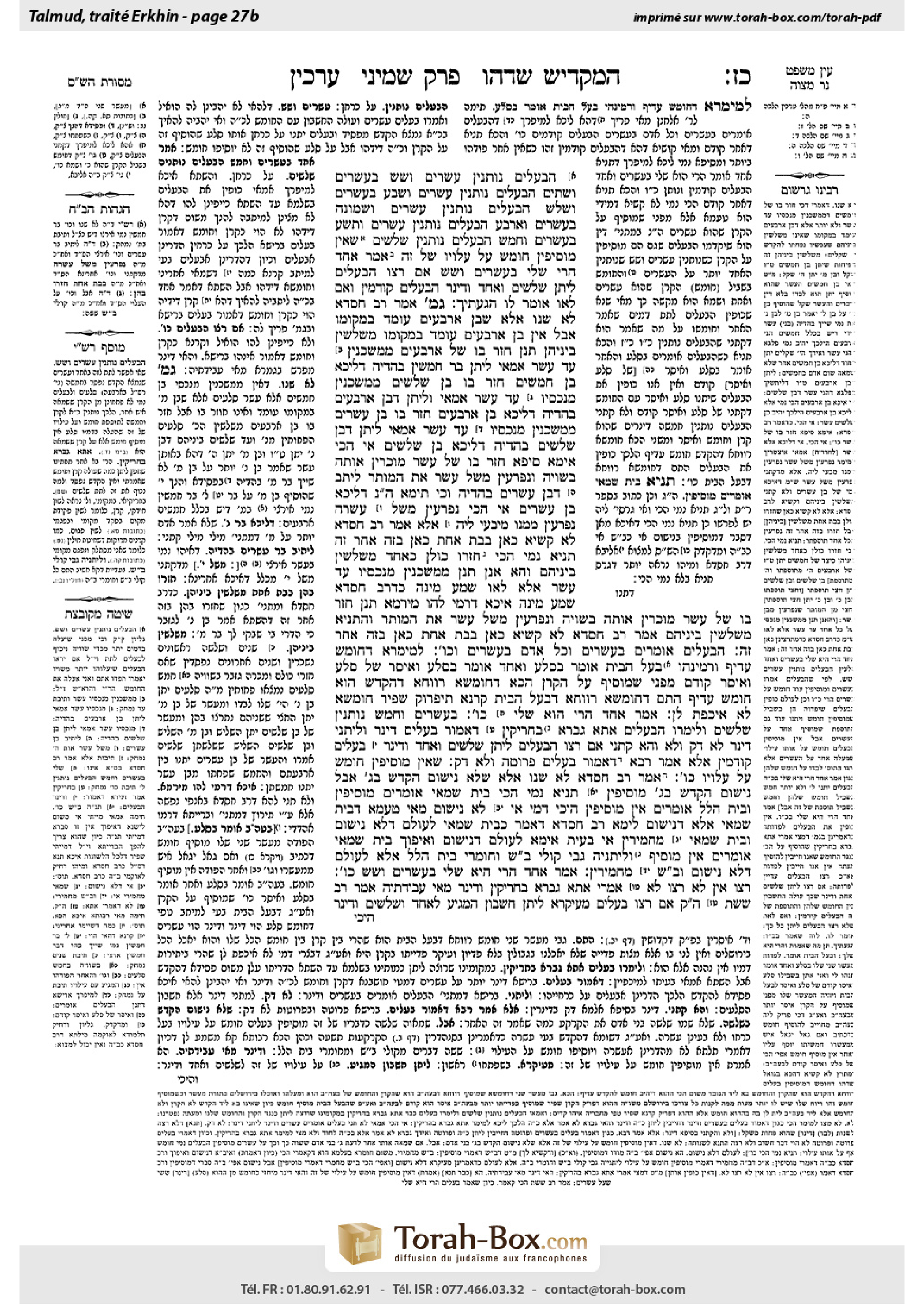
Arakhin 27b: Talmud study for Daf Yomi
Study the Talmud for Daf Yomi with scanned pages, Hebrew text, English translations from Sefaria and AI-generated French translations.
Passage selection and English or AI-generated French translation are available where the scan has annotations. Daf Study is independent of Torah-Box and Sefaria.
Browse Arakhin · ערכין · All tractatesArakhin 27b text and translations
This page of Arakhin includes the Aramaic text, an English translation and an AI-generated French translation, alongside the scan above.
ערכין כ״ז ב · Aramaic and Hebrew text
הַבְּעָלִים נוֹתְנִין עֶשְׂרִים וָשֵׁשׁ, ״בְּעֶשְׂרִים וּשְׁתַּיִם״ — הַבְּעָלִים נוֹתְנִין עֶשְׂרִים וָשֶׁבַע,
״בְּעֶשְׂרִים וְשָׁלֹשׁ״ — הַבְּעָלִים נוֹתְנִין עֶשְׂרִים וּשְׁמוֹנֶה, ״בְּעֶשְׂרִים וְאַרְבַּע״ — הַבְּעָלִים נוֹתְנִין עֶשְׂרִים וָתֵשַׁע, ״בְּעֶשְׂרִים וְחָמֵשׁ״ — הַבְּעָלִים נוֹתְנִין שְׁלֹשִׁים, שֶׁאֵין מוֹסִיפִין חוֹמֶשׁ עַל עִלּוּיוֹ שֶׁל זֶה.
אָמַר אֶחָד: ״הֲרֵי שֶׁלִּי בְּעֶשְׂרִים וָשֵׁשׁ״, אִם רָצוּ הַבְּעָלִים לִיתֵּן שְׁלֹשִׁים וְאֶחָד וְדִינָר — הַבְּעָלִים קוֹדְמִין, וְאִם לָאו — אוֹמֵר לוֹ: ״הִגַּעְתִּיךָ״.
גְּמָ׳ אָמַר רַב חִסְדָּא: לֹא שָׁנוּ אֶלָּא שֶׁבֶּן אַרְבָּעִים עוֹמֵד בִּמְקוֹמוֹ.
אֲבָל אֵין בֶּן אַרְבָּעִים עוֹמֵד בִּמְקוֹמוֹ, מְשַׁלְּשִׁין בֵּינֵיהֶן.
תְּנַן: חָזַר בּוֹ שֶׁל אַרְבָּעִים — מְמַשְׁכְּנִין עַד עֶשֶׂר. אַמַּאי? לִיתֵּן בַּר חַמְשִׁין בַּהֲדֵיהּ! דְּלֵיכָּא בֶּן חֲמִשִּׁים.
חָזַר בּוֹ בֶּן שְׁלֹשִׁים — מְמַשְׁכְּנִין מִנְּכָסָיו עַד עֶשֶׂר, אַמַּאי? וְלִיתֵּן דְּבֶן אַרְבָּעִים בַּהֲדֵיהּ! דְּלֵיכָּא בֶּן אַרְבָּעִים. חָזַר בּוֹ בֶּן עֶשְׂרִים — מְמַשְׁכְּנִין מִנְּכָסָיו עַד עֶשֶׂר, אַמַּאי? לִיתֵּן דְּבֶן שְׁלֹשִׁים בַּהֲדֵיהּ! דְּלֵיכָּא בֶּן שְׁלֹשִׁים.
אִי הָכִי, אֵימָא סֵיפָא: חָזַר בּוֹ שֶׁל עֶשֶׂר, מוֹכְרִין אוֹתָהּ בְּשׇׁוְיָהּ וְנִפְרָעִין מִשֶּׁל עֶשֶׂר אֶת הַמּוֹתָר, לִיתֵּב דְּבֶן עֶשְׂרִים בַּהֲדֵיהּ! וְכִי תֵּימָא הָכָא נָמֵי דְּלֵיכָּא בֶּן עֶשְׂרִים, אִי הָכִי, ״נִפְרָעִין מִשֶּׁל עֲשָׂרָה״ — ״נִפְרָעִין מִמֶּנּוּ״ מִיבְּעֵי לֵיהּ!
אֶלָּא אָמַר רַב חִסְדָּא: לָא קַשְׁיָא, כָּאן בְּבַת אַחַת, כָּאן בְּזֶה אַחַר זֶה. תַּנְיָא נָמֵי הָכִי: חָזְרוּ כּוּלָּן כְּאֶחָד — מְשַׁלְּשִׁין בֵּינֵיהֶם. וְהָא אֲנַן תְּנַן: מְמַשְׁכְּנִין מִנְּכָסָיו עַד עֶשֶׂר! אֶלָּא לָאו שְׁמַע מִינַּהּ כִּדְרַב חִסְדָּא, שְׁמַע מִינַּהּ.
אִיכָּא דְּרָמֵי לְהוּ מִירְמָא: תְּנַן: חָזַר בּוֹ שֶׁל עֶשֶׂר, מוֹכְרִין אוֹתָהּ בְּשׇׁוְיָהּ וְנִפְרָעִין מִשֶּׁל עֶשֶׂר אֶת הַמּוֹתָר, וְהָתַנְיָא: מְשַׁלְּשִׁין בֵּינֵיהֶם! אָמַר רַב חִסְדָּא: לָא קַשְׁיָא, כָּאן — בְּבַת אַחַת, כָּאן — בְּזֶה אַחַר זֶה.
הַבְּעָלִים אוֹמְרִים בְּעֶשְׂרִים וְכׇל אָדָם בְּעֶשְׂרִים וְכוּ׳. לְמֵימְרָא דְּחוֹמֶשׁ עֲדִיף? וּרְמִינְהוּ: בַּעַל הַבַּיִת אוֹמֵר בְּסֶלַע, וְאֶחָד אוֹמֵר בְּסֶלַע וְאִיסָּר — שֶׁל סֶלַע וְאִיסָּר קוֹדֵם, מִפְּנֵי שֶׁמּוֹסִיף עַל הַקֶּרֶן!
הָכָא דְּחוּמְשָׁא רַוְוחָא דְּהֶקְדֵּשׁ הוּא — חוֹמֶשׁ עֲדִיף, הָתָם דְּחוּמְשָׁא רַוְוחָא דְּבַעַל הַבַּיִת — קַרְנָא תִּיפְרוֹק שַׁפִּיר, חוּמְשָׁא לָא אִיכְפַּת לַן.
אָמַר אֶחָד: הֲרֵי הוּא שֶׁלִּי כּוּ׳. בְּעֶשְׂרִים וְחָמֵשׁ נוֹתְנִין שְׁלֹשִׁים. וְלֵימְרוּ הַבְּעָלִים: אֲתָא גַּבְרָא בַּחֲרִיקִין! דַּאֲמוּר בְּעָלִים דִּינָר.
וְלִיתְנֵי דִּינָר! לָא דָּק. וְלָא? וְהָא קָתָנֵי: אִם רָצוּ הַבְּעָלִים לִיתֵּן שְׁלֹשִׁים וְאֶחָד וְדִינָר — בְּעָלִים קוֹדְמִין! אֶלָּא אָמַר רָבָא: דַּאֲמוּר בְּעָלִים פְּרוּטָה, וְלָא דָּק.
שֶׁאֵין מוֹסִיפִין חוֹמֶשׁ עַל עִלּוּיוֹ כּוּ׳. אָמַר רַב חִסְדָּא: לֹא שָׁנוּ אֶלָּא שֶׁלֹּא נִישּׁוֹם הֶקְדֵּשׁ בִּשְׁלֹשָׁה, אֲבָל נִישּׁוֹם הֶקְדֵּשׁ בִּשְׁלֹשָׁה — מוֹסִיפִין.
תַּנְיָא נָמֵי הָכִי: בֵּית שַׁמַּאי אוֹמְרִים: מוֹסִיפִין, וּבֵית הִלֵּל אוֹמְרִים: אֵין מוֹסִיפִין. הֵיכִי דָּמֵי? אִי לָא נִישּׁוֹם, מַאי טַעְמָא דְּבֵית שַׁמַּאי? אֶלָּא דְּנִישּׁוֹם.
לֵימָא רַב חִסְדָּא דְּאָמַר כְּבֵית שַׁמַּאי? לְעוֹלָם דְּלָא נִישּׁוֹם, וּבֵית שַׁמַּאי מַחְמִירִין.
אִי בָּעֵית אֵימָא: לְעוֹלָם דְּנִישּׁוֹם, וְאֵיפוֹךְ — בֵּית שַׁמַּאי אוֹמְרִים: אֵין מוֹסִיף. וְלִיתְנְיַהּ גַּבֵּי קוּלֵּי בֵּית שַׁמַּאי וְחוּמְרֵי בֵּית הִלֵּל! אֶלָּא לְעוֹלָם דְּלֹא נִישּׁוֹם, וּבֵית שַׁמַּאי מַחְמִירִין.
אָמַר אֶחָד: הֲרֵי הִיא שֶׁלִּי בְּעֶשְׂרִים וָשֵׁשׁ כּוּ׳. רָצוּ — אִין, לֹא רָצוּ — לָא.
אָמְרִי: אֲתָא גַּבְרָא בַּחֲרִיקִין.
וְדִינָר מַאי עֲבִידְתֵּיהּ? אָמַר רַב שֵׁשֶׁת: הָכִי קָאָמַר, אִם רָצוּ בְּעָלִים מֵעִיקָּרָא לִיתֵּן חֶשְׁבּוֹן הַמַּגִּיעַ לְאֶחָד וּשְׁלֹשִׁים וְדִינָר;
Arakhin 27b · English translation
the owner gives twenty-six sela and takes the field. He pays the twenty that he initially offered; plus five sela, which is one-fifth of the total future sum, i.e., one-quarter of his initial offer. In addition, he adds one sela, the difference between his initial offer and that of the other person, so that the Temple treasury will not receive less than the twenty-one sela offer proposed by the other person. If the owner says he will pay twenty sela and another person said: The field is hereby mine for a payment of twenty-two sela, the owner gives twenty-seven sela and takes the field.
If the owner says he will pay twenty sela and another said: The field is hereby mine for a payment of twenty-three sela, the owner gives twenty-eight sela and takes the field. If the owner says he will pay twenty sela and another said: The field is hereby mine for a payment of twenty-four sela, the owner gives twenty-nine sela and takes the field. If the owner says he will pay twenty sela and another said: The field is hereby mine for a payment of twenty-five sela, the owner gives thirty sela, as the owner adds one-fifth only to the amount that he bid, and does not add one-fifth to the addition of that other person.
If the owner said he will pay twenty sela and one other person said: The field is hereby mine for a payment of twenty-six sela, if the owner wished to pay thirty-one sela and a dinar the owner takes precedence; and if not, the treasurer says to the other person: The field has come into your possession based on your bid, as it is more than the Temple treasury can compel the owner to pay.
GEMARA: The mishna teaches that if one said: The field is mine for ten sela, and another said for twenty, and another said thirty, and another said forty, and yet another said fifty; and then the one who bid fifty reneged on his offer, the treasurer repossesses from his property up to ten sela, and it is redeemed by the one who bid forty. In this manner, the Temple treasury does not lose. Rav Ḥisda says: The mishna taught that the treasurer repossesses ten sela from the one who initially offered fifty sela only when the one who offered forty stands in his place and intends to purchase the field, as the Temple treasury would have lost only ten sela.
But if the one who offered forty does not stand in his place, i.e., he too reneged on his offer, then the additional amount they had offered is divided between the one who initially offered fifty and the one who offered forty, as follows: The one who offered fifty pays all ten of the difference between fifty and forty, but he must also pay half of the extra ten that is the difference between the offer of forty and the previous offer of thirty. The reason is that the one who bid fifty agreed to that extra ten that raised the price from thirty to forty. In sum, the one who offered fifty pays fifteen, and the one who said forty pays five.
The Gemara raises an objection to the statement of Rav Ḥisda from that which we learned in the mishna: If the one who bid forty reneged on his offer, the treasurer repossesses from his property up to ten sela. The Gemara explains the objection: According to Rav Ḥisda, there is a difficulty: Why does the mishna rule that his property is repossessed by ten sela? Let the one who offered fifty give together with him, and therefore the one who offered forty should give only five. The Gemara responds: The mishna is referring to a case where there is no one who offered fifty sela.
The Gemara further objects: The mishna also teaches that if the one who bid thirty reneged on his offer, the treasurer repossesses from his property up to ten sela. But according to Rav Ḥisda, why is only his property repossessed? Let the one who offered forty give together with him. The Gemara again responds: The mishna is referring to a case where there is no one who offered forty sela. The Gemara persists: The mishna states that if the one who bid twenty reneged on his offer, the treasurer repossesses from his property up to ten sela. According to Rav Ḥisda, why is only his property repossessed? Let the one who offered thirty give together with him. Once again, the Gemara responds: The mishna is referring to a case where there is no one who offered thirty sela.
The Gemara asks: If so, then say the latter clause of the mishna: If the one who bid ten reneged on his offer, the treasurer sells the field at its value and collects the remainder from the property of the one who bid ten, to complete the sum of ten sela. Why is payment collected only from the one who offered ten? Let the one who offered twenty give together with him. And if you would say that here too, there is no one who offered twenty sela, then if so, why does the mishna state: And collects from the one who bid ten? The mishna should have stated simply: And collects from him, as there is no one else who submitted an offer.
Rather, Rav Ḥisda said: This is not difficult. Here, when the potential loss incurred by the Temple treasury is divided, they reneged on their offers simultaneously; whereas there, in the mishna, where only one individual must cover the loss, two individuals reneged one after the other. The Gemara notes that this is also taught in a baraita: If all of them reneged at once they divide the potential loss incurred by the Temple treasury between them. Now didn’t we learn in the mishna: The treasurer repossesses from his property up to ten sela, without any mention of a division? Rather, must one not conclude from the baraita that the halakha is in accordance with the statement of Rav Ḥisda, who holds that when two individuals renege on their offers simultaneously they divide the loss between them? The Gemara comments: Indeed, conclude from it that this is the case.
The Gemara notes that there are those who raise this baraita as a contradiction: We learned in the mishna that if the one who bid ten reneged on his offer, the treasurer sells the field at its value and collects the remainder from the property of the one who bid ten. But isn’t it taught in a baraita that they divide the potential loss to the Temple treasury between them? Rav Ḥisda said: This is not difficult. Here in the baraita they reneged on their offers simultaneously, whereas there, in the mishna, two individuals reneged one after the other.
§ The mishna teaches: If the owner says he will pay twenty sela and any other person says he will pay twenty sela, the owner’s offer takes precedence because he adds one-fifth. The Gemara asks: Is this to say that an offer of the owner, which perforce includes an additional one-fifth, is preferable to a higher offer for the principal submitted by another? And the Gemara raises a contradiction from a mishna (Ma’aser Sheni 4:3): If one is unable to transport his second-tithe produce to Jerusalem to consume it there, the produce is redeemed and the redemption money is spent on food in Jerusalem. If the owner of second tithe says he will redeem it for one sela and one other says he will redeem it for one sela and one issar, the offer of one sela and one issar takes precedence, because he adds to the principal.
The Gemara answers: Here, where the additional one-fifth is a gain of the Temple treasury, a calculation that includes the one-fifth is preferable. By contrast, there, where the additional one-fifth belongs to the owner, i.e., the Temple treasury gains nothing from it, as the redemption money for second-tithe produce belongs to the owner and must be taken to Jerusalem for him to spend it there, let the principal be redeemed for a proper sum, and we do not care about the additional one-fifth.
§ The mishna teaches that if the owner says he will pay twenty sela and one other person said: The field is hereby mine for a payment of twenty-five sela, the owner gives thirty sela. The Gemara suggests: And let the owner say: A man has come in my place [baḥarikin] to redeem the field, as even when accounting for the one-fifth that I must add, my offer stands at twenty-five sela, identical to this man’s offer. Why, then, am I forced to redeem the field for a greater sum? The Gemara responds: The mishna is referring to a case where the owner initially said he would pay twenty sela and an additional dinar, one-quarter of one sela. When the additional one-fifth is taken into account, the owner’s offer is greater than twenty-five sela.
The Gemara asks: But if so, let the mishna teach explicitly that he offered an additional dinar. The Gemara responds: The tanna was not meticulous with regard to the mention of small sums of money such as one dinar. The Gemara asks: And was the tanna not meticulous? But isn’t it taught in the mishna that in a case where one said: The field is hereby mine for a payment of twenty-six sela, if the owner wished to pay thirty-one sela and a dinar the owner takes precedence? Rather, Rava said: The mishna is referring to a case where the owner said he would redeem it for twenty sela and one peruta, and the tanna was not meticulous with regard to mentioning such a tiny sum.
§ The mishna teaches that even when the owner must give the amount offered by the second person for the field, he adds one-fifth only to the amount that he himself bid, as he does not add one-fifth to the addition of the other person. Rav Ḥisda says: The mishna taught that the owner does not add one-fifth to the addition of the other person only when the consecrated property was not appraised by three people. But if the consecrated property was appraised by three people, and the field was found to be worth the amount offered by the other person, the owner does add one-fifth to the addition of the other person.
The Gemara notes that this is also taught in a baraita: Beit Shammai say the owner adds one-fifth to the addition of the other person and Beit Hillel say the owner does not add that one-fifth. The Gemara explains: What are the circumstances of this baraita? If it is discussing a case where the field was not appraised by three people, then what is the reasoning of Beit Shammai for their ruling that the owner must add one-fifth to the addition of the other person? Rather, the baraita must be referring to a case where the field was appraised by three people and the appraisal matched the offer of the other person. The owner must therefore add one-fifth to the addition of that other person.
The Gemara asks: Shall we say that Rav Ḥisda says his statement in accordance with the opinion of Beit Shammai? This is difficult, as there is a principle that the halakha is ruled in accordance with the opinion of Beit Hillel. The Gemara responds: Actually, the baraita is referring to a case where the field was not appraised by three people, and Beit Shammai are stringent and rule that the owner must nevertheless add one-fifth to the addition of the other person. Rav Ḥisda rules in accordance with the opinion of Beit Hillel that the owner adds one-fifth to the addition of the other person only when the field was appraised by three people.
And if you wish, say instead: Actually, the baraita is referring to a case where the field was appraised by three people and the appraisal matched the offer of the other person; and one should reverse the opinions, i.e., Beit Shammai say that even in such a case the owner does not add one-fifth to the addition of the other person. The Gemara asks: But according to this interpretation, let the dispute be taught alongside the other rare instances of leniencies of Beit Shammai and stringencies of Beit Hillel (see tractate Eduyyot, chapters 4 and 5). Yet, this dispute does not appear there. Rather, one must accept the previous answer, that the baraita is actually discussing a case where the field was not appraised by three people, and Beit Shammai are stringent.
§ The mishna teaches that in a case where the owner offers to pay twenty sela and one other person said: The field is hereby mine for twenty-six sela, if the owner wished to pay thirty-one sela and a dinar, the owner takes precedence. The Gemara elaborates: If the owner wished to pay the additional sum, then yes, he redeems the field, but if the owner did not wish to do so, no, he is not forced to redeem it.
The Gemara explains that the reason is that the owner can say: A man has come in my place to redeem the field for a higher sum, since even when accounting for the additional one-fifth that I must give, my offer amounts to a total of only twenty-five sela, whereas this other person has offered to pay twenty-six. Nevertheless, if the owner chooses to redeem the field, he gives the other person’s offer, twenty-six sela, plus an additional one-fifth of his initial offer, for a total of thirty-one sela.
The Gemara asks: And the additional dinar that the owner gives, what is its purpose? Rav Sheshet said this is what the mishna is saying: If the owner wished from the outset to give based on a calculation that reaches thirty-one sela and one dinar, the owner takes precedence.
Arakhin 27b · Traduction française (IA)
L'acharné paie vingt-six sela et prend le champ. Il paie les vingt sela qu'il avait initialement offerts ; plus cinq sela, qui constituent un cinquième de la somme future totale, c'est-à-dire un quart de son offre initiale. En outre, il ajoute un sela, la différence entre son offre initiale et celle de l'autre personne, afin que le trésor du Temple ne reçoive pas moins de l'offre de vingt-et-un sela proposée par l'autre personne. Si l'acharné dit qu'il paiera vingt sela et qu'une autre personne dit : Le champ est désormais mien pour un paiement de vingt-deux sela, l'acharné paie vingt-sept sela et prend le champ.
Si l'acharné dit qu'il paiera vingt sela et qu'une autre personne dit : Le champ est désormais mien pour un paiement de vingt-trois sela, l'acharné paie vingt-huit sela et prend le champ. Si l'acharné dit qu'il paiera vingt sela et qu'une autre personne dit : Le champ est désormais mien pour un paiement de vingt-quatre sela, l'acharné paie vingt-neuf sela et prend le champ. Si l'acharné dit qu'il paiera vingt sela et qu'une autre personne dit : Le champ est désormais mien pour un paiement de vingt-cinq sela, l'acharné paie trente sela, car l'acharné ajoute un cinquième uniquement à l'offre qu'il a faite, et ne rajoute pas un cinquième à l'offre de l'autre personne.
Si l'acharné a dit qu'il paiera vingt sela et qu'une autre personne a dit : Le champ est désormais mien pour un paiement de vingt-six sela, si l'acharné souhaitait payer trente sela et un dinar, l'acharné a la priorité ; et si non, le trésorier dit à l'autre personne : Le champ est désormais à votre possession en vertu de votre offre, car c'est plus que le trésor du Temple ne peut faire payer à l'acharné.
GUEMARA : La mitsva enseigne que si l'un a dit : Le champ est mien pour dix sela, et un autre pour vingt, et un autre pour trente, et un autre pour quarante, et un autre pour cinquante ; et ensuite celui qui a offert cinquante a renoncé à son offre, le trésorier récupère jusqu'à dix sela de sa propriété, et il est racheté par celui qui a offert quarante. Ainsi, le trésor du Temple ne perd rien. Rav Ḥisda dit : La mitsva enseigne que le trésorier récupère dix sela de la propriété de celui qui a offert cinquante uniquement lorsque celui qui a offert quarante se tient à sa place et veut acheter le champ, car le trésor du Temple aurait perdu seulement dix sela.
Mais si celui qui a offert quarante ne se tient pas à sa place, c'est-à-dire qu'il a également renoncé à son offre, alors la somme supplémentaire qu'ils ont offerts est divisée entre celui qui a offert cinquante et celui qui a offert quarante, comme suit : Celui qui a offert cinquante paie les dix sela de la différence entre cinquante et quarante, mais il doit aussi payer la moitié des dix sela supplémentaires qui constituent la différence entre l'offre de quarante et l'offre précédente de trente. La raison est que celui qui a offert cinquante a accepté ces dix sela supplémentaires qui ont augmenté le prix de trente à quarante. En somme, celui qui a offert cinquante paie quinze sela, et celui qui a offert quarante paie cinq sela.
La Guemara soulève un objet contre l'affirmation de Rav Ḥisda à partir de ce que nous avons appris dans la mitsva : Si celui qui a offert quarante a renoncé à son offre, le trésorier récupère jusqu'à dix sela de sa propriété. La Guemara explique l'objet : Selon Rav Ḥisda, il y a un problème : Pourquoi la mitsva règle-t-elle que sa propriété est récupérée par dix sela ? Laissons celui qui a offert cinquante payer avec lui, et donc celui qui a offert quarante devrait payer seulement cinq. La Guemara répond : La mitsva se réfère à un cas où il n'y a personne qui a offert cinquante sela.
La Guemara soulève une objection supplémentaire : La mitsva enseigne également que si celui qui a offert trente a renoncé à son offre, le trésorier récupère jusqu'à dix sela de sa propriété. Mais selon Rav Ḥisda, pourquoi est-ce que seulement sa propriété est récupérée ? Laissez celui qui a offert quarante payer avec lui. La Guemara répond à nouveau : La mitsva se réfère à un cas où il n'y a personne qui a offert quarante sela. La Guemara persiste : La mitsva stipule que si celui qui a offert vingt a renoncé à son offre, le trésorier récupère jusqu'à dix sela de sa propriété. Selon Rav Ḥisda, pourquoi est-ce que seulement sa propriété est récupérée ? Laissez celui qui a offert trente payer avec lui. Une fois de plus, la Guemara répond : La mitsva se réfère à un cas où il n'y a personne qui a offert trente sela.
La Guemara pose la question : Si c'est ainsi, alors dites la dernière clause de la mitsva : Si celui qui a offert dix a renoncé à son offre, le trésorier vend le champ à sa valeur et récupère le reste de la propriété de celui qui a offert dix, pour compléter la somme de dix sela. Pourquoi la somme est-elle récupérée uniquement de celui qui a offert dix ? Laissez celui qui a offert vingt payer avec lui. Et si vous dites que là non plus, il n'y a personne qui a offert vingt sela, alors si c'est ainsi, pourquoi la mitsva stipule-t-elle : Et récupère de celui qui a offert dix ? La mitsva devrait simplement stipuler : Et récupère de lui, car il n'y a personne d'autre qui a soumis une offre.
Plutôt, Rav Ḥisda a dit : Ce n'est pas difficile. Ici, lorsque la perte potentielle subie par le trésor du Temple est divisée, ils ont renoncé simultanément à leurs offres ; tandis que là, dans la mitsna, où seul un individu doit couvrir la perte, deux individus ont renoncé l'un après l'autre. La Guemara note que cela est également enseigné dans une baraïta : Si tous d'entre eux ont renoncé en même temps, ils divisent la perte potentielle subie par le trésor du Temple entre eux. Maintenant, n'avons-nous pas appris dans la mitsna : Le trésorier récupère jusqu'à dix sela de sa propriété, sans aucune mention d'une division ? Plutôt, ne devons-nous pas conclure de la baraïta que la halakha est selon l'affirmation de Rav Ḥisda, qui maintient que lorsque deux individus renoncent simultanément à leurs offres, ils divisent la perte entre eux ? La Guemara commente : En effet, concluez-en à cela.
La Guemara note que certains soulèvent cette baraïta comme une contradiction : Nous avons appris dans la mitsna que si celui qui a offert dix renonce à son offre, le trésorier vend le champ à sa valeur et récupère le reste sur la propriété de celui qui a offert dix. Mais n’est-il pas enseigné dans une baraïta que l’on partage la perte potentielle du trésor sacré entre eux ? Rav Ḥisda dit : Ce n’est pas difficile. Ici, dans la baraïta, ils ont renoncé à leurs offres simultanément, tandis que là, dans la mitsna, deux individus ont renoncé l’un après l’autre.
§ La mitsna enseigne : Si l’propriétaire dit qu’il paiera vingt sela et qu’un autre dit qu’il paiera vingt sela, l’offre de l’propriétaire prévaut car il ajoute un cinquième. La Guemara demande : Est-ce que cela signifie que l’offre de l’propriétaire, qui inclut nécessairement un cinquième supplémentaire, est préférable à une offre plus élevée pour le principal soumise par un autre ? Et la Guemara soulève une contradiction à partir d’une mitsna (Ma’aser Sheni 4:3) : Si l’on ne peut transporter ses produits de dîme secondaire à Jérusalem pour les consommer là-bas, les produits sont rachetés et l’argent de rachat est dépensé en nourriture à Jérusalem. Si l’propriétaire de dîme secondaire dit qu’il rachètera pour un sela et qu’un autre dit qu’il rachètera pour un sela et un issar, l’offre d’un sela et un issar prévaut, car il ajoute au principal.
La Guemara répond : Ici, où le cinquième supplémentaire est un gain du trésor sacré, un calcul qui inclut ce cinquième est préférable. En revanche, là, où le cinquième supplémentaire appartient à l’propriétaire, c’est-à-dire que le trésor sacré ne gagne rien de cela, puisque l’argent de rachat des produits de dîme secondaire appartient à l’propriétaire et doit être emmené à Jérusalem pour qu’il le dépense là-bas, laissez racheter le principal pour une somme appropriée, et nous n’avons pas à nous soucier du cinquième supplémentaire.
§ La mitsva enseigne que si l’propriétaire dit qu’il paiera vingt sela et qu’un autre dit : Le champ est désormais mien pour un paiement de vingt-cinq sela, l’propriétaire paie trente sela. La Guemara suggère : Et laissez l’propriétaire dire : Un homme est venu à ma place [baḥarikin] pour racheter le champ, car même en tenant compte du cinquième que je dois ajouter, mon offre est de vingt-cinq sela, identique à celle de cet homme. Pourquoi, alors, suis-je contraint de racheter le champ pour une somme supérieure ? La Guemara répond : La mitsva fait référence à un cas où l’propriétaire a d’abord dit qu’il paierait vingt sela et un dinar, un quart d’un sela. Lorsque le cinquième supplémentaire est pris en compte, l’offre de l’propriétaire est supérieure à vingt-cinq sela.
La Guemara demande : Mais si c’est ainsi, laissez la mitsva enseigner explicitement qu’il a offert un dinar supplémentaire. La Guemara répond : Le tanna n’était pas précis concernant la mention de petites sommes d’argent telles qu’un dinar. La Guemara demande : Et le tanna n’était-il pas précis ? Mais n’est-il pas enseigné dans la mitsva que dans un cas où l’on dit : Le champ est désormais mien pour un paiement de vingt-six sela, si l’propriétaire souhaitait payer trente-et-un sela et un dinar, l’propriétaire a la priorité ? Plutôt, Rava dit : La mitsva fait référence à un cas où l’propriétaire a dit qu’il rachèterait pour vingt sela et une peruta, et le tanna n’était pas précis concernant la mention d’une telle somme minuscule.
§ La mitsva enseigne que même lorsque l'propriétaire doit donner la somme offerte par la deuxième personne pour le champ, il ajoute un cinquième seulement à la somme qu'il a lui-même offerte, car il ne l'ajoute pas au supplément de l'autre personne. Rav Ḥisda dit : La mitsva enseigne que l'propriétaire n'ajoute pas un cinquième au supplément de l'autre personne que lorsqu'il n'y a pas eu d'appréciation de la propriété consacrée par trois personnes. Mais si la propriété consacrée a été appréciée par trois personnes et que le champ a été trouvé valoir la somme offerte par l'autre personne, l'propriétaire doit donc ajouter un cinquième au supplément de cette autre personne.
La Guemara note que cela est également enseigné dans une baraïta : Beit Shammai disent que l'propriétaire ajoute un cinquième au supplément de l'autre personne et Beit Hillel disent que l'propriétaire n'ajoute pas ce cinquième. La Guemara explique : Quels sont les circonstances de cette baraïta ? Si elle parle d'un cas où la propriété n'a pas été appréciée par trois personnes, alors quelle est la raison de Beit Shammai pour leur décision que l'propriétaire doit ajouter un cinquième au supplément de l'autre personne ? Plutôt, la baraïta doit parler d'un cas où la propriété a été appréciée par trois personnes et que l'appréciation correspondait à l'offre de l'autre personne. L'propriétaire doit donc ajouter un cinquième au supplément de cette autre personne.
La Guemara demande : Devons-nous dire que Rav Ḥisda dit sa déclaration selon l'opinion de Beit Shammai ? Cela est difficile, car il y a un principe selon lequel la halakha est décidée selon l'opinion de Beit Hillel. La Guemara répond : En réalité, la baraïta parle d'un cas où la propriété n'a pas été appréciée par trois personnes, et Beit Shammai sont stricts et décident que l'propriétaire doit néanmoins ajouter un cinquième au supplément de l'autre personne. Rav Ḥisda décide selon l'opinion de Beit Hillel que l'propriétaire ajoute un cinquième au supplément de l'autre personne uniquement lorsque la propriété a été appréciée par trois personnes.
Et si vous le souhaitez, dites plutôt : En réalité, la baraïta parle d’un cas où la propriété a été appréciée par trois personnes et que l’appréciation correspondait à l’offre de l’autre personne ; et l’on devrait inverser les opinions, c’est-à-dire Beit Shammai disent que même dans un tel cas, l’propriétaire ne doit pas ajouter un cinquième au supplément de l’autre personne. La Guemara demande : Mais selon cette interprétation, laissez le débat être enseigné en même temps que les autres rares cas de leniencess de Beit Shammai et de stricteurs de Beit Hillel (voir le traité Eduyyot, chapitres 4 et 5). Cependant, ce débat n’apparaît pas là. Plutôt, l’on doit accepter la réponse précédente, que la baraïta parle en réalité d’un cas où la propriété n’a pas été appréciée par trois personnes, et Beit Shammai sont stricts.
§ La mitsna enseigne que dans un cas où l'acheteur propose de payer vingt sela et qu'un autre homme dit : Le champ est désormais mien pour vingt-six sela, si l'acheteur souhaitait payer trente sela et un dinar, l'acheteur a la priorité. La Guemara développe : Si l'acheteur souhaitait payer la somme supplémentaire, alors oui, il rachète le champ, mais si l'acheteur n'avait pas l'intention de le faire, non, il n'est pas contraint de racheter le champ.
La Guemara explique que la raison est que l'acheteur peut dire : Un homme est venu à ma place pour racheter le champ à un prix plus élevé, car même en tenant compte de la somme supplémentaire que je dois donner, mon offre ne représente qu'un total de vingt-cinq sela, alors que cet autre homme a proposé de payer vingt-six. Cependant, si l'acheteur choisit de racheter le champ, il donne à l'autre homme l'offre de vingt-six sela, plus un cinquième supplémentaire de son offre initiale, pour un total de trente sela et un dinar.
La Guemara pose la question : Et le dinar supplémentaire que l'acheteur donne, à quoi sert-il ? Rav Sheshet a dit que c'est ce que la mitsna signifie : Si l'acheteur souhaitait dès le début donner en fonction d'un calcul qui atteint trente sela et un dinar, l'acheteur a la priorité.
Traduction française générée par IA à partir de l’édition anglaise de Sefaria. Vérifie toujours un passage avec le texte source.
Text from Sefaria: William Davidson Edition - Vocalized Aramaic (CC BY NC); William Davidson Edition - English (CC BY NC).