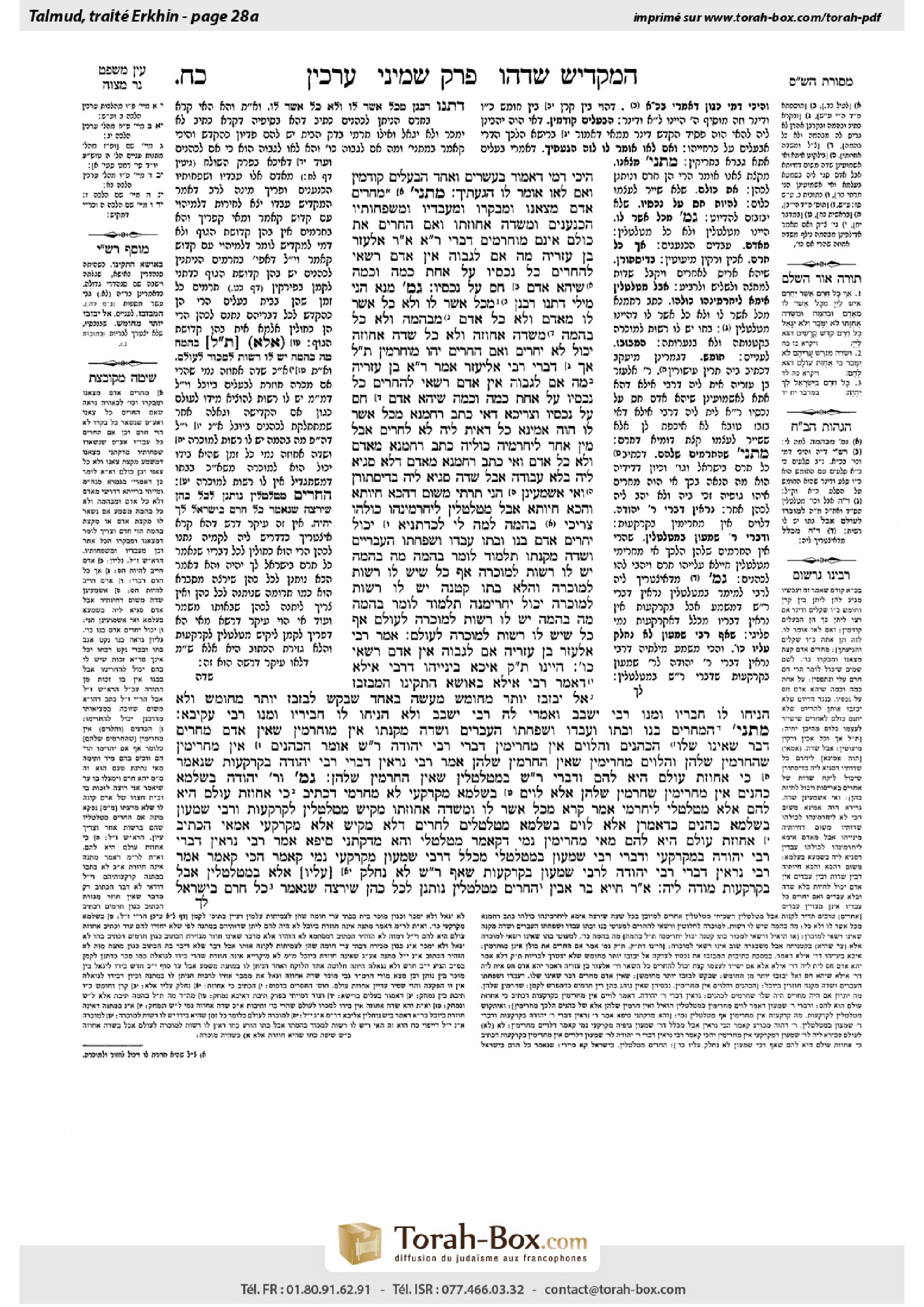
Arakhin 28a: Talmud study for Daf Yomi
Study the Talmud for Daf Yomi with scanned pages, Hebrew text, English translations from Sefaria and AI-generated French translations.
Passage selection and English or AI-generated French translation are available where the scan has annotations. Daf Study is independent of Torah-Box and Sefaria.
Browse Arakhin · ערכין · All tractatesArakhin 28a text and translations
This page of Arakhin includes the Aramaic text, an English translation and an AI-generated French translation, alongside the scan above.
ערכין כ״ח א · Aramaic and Hebrew text
הֵיכִי דָּמֵי? דַּאֲמוּר בְּעֶשְׂרִים וְאֶחָד — הַבְּעָלִים קוֹדְמִין, וְאִם לָאו — אוֹמֵר לוֹ: הִגַּעְתִּיךָ.
מַתְנִי׳ מַחֲרִים אָדָם מִצֹּאנוֹ וּמִבְּקָרוֹ, וּמֵעֲבָדָיו וּמִשִּׁפְחוֹתָיו הַכְּנַעֲנִים, וּמִשְּׂדֵה אֲחוּזָּתוֹ, וְאִם הֶחְרִים אֶת כּוּלָּם אֵינָם מוּחְרָמִים, דִּבְרֵי רַבִּי אֱלִיעֶזֶר. אָמַר רַבִּי אֶלְעָזָר בֶּן עֲזַרְיָה: מָה אִם לַגָּבוֹהַּ אֵין אָדָם רַשַּׁאי לְהַחְרִים כׇּל נְכָסָיו, עַל אַחַת כַּמָּה וְכַמָּה שֶׁיְּהֵא אָדָם חָס עַל נְכָסָיו!
גְּמָ׳ מְנָא הָנֵי מִילֵּי? דְּתָנוּ רַבָּנַן: ״מִכׇּל אֲשֶׁר לוֹ״ — וְלֹא כׇּל אֲשֶׁר לוֹ, ״מֵאָדָם״ — וְלֹא כׇּל אָדָם, ״מִבְּהֵמָה״ — וְלֹא כׇּל בְּהֵמָה, ״מִשְּׂדֵה אֲחוּזָּה״ — וְלֹא כׇּל שְׂדֵה אֲחוּזָּה.
יָכוֹל לֹא יַחְרִים, וְאִם הֶחְרִים יְהוּ מוּחְרָמִין? תַּלְמוּד לוֹמַר: ״אַךְ״, דִּבְרֵי רַבִּי אֱלִיעֶזֶר. אָמַר רַבִּי אֶלְעָזָר בֶּן עֲזַרְיָה: מָה אִם לַגָּבוֹהַּ אֵין אָדָם רַשַּׁאי לְהַחְרִים כׇּל נְכָסָיו, עַל אַחַת כַּמָּה וְכַמָּה שֶׁיְּהֵא אָדָם חָס עַל נְכָסָיו!
וּצְרִיכָא, דְּאִי כְּתַב רַחֲמָנָא ״מִכׇּל אֲשֶׁר לוֹ״, הֲוָה אָמֵינָא: כֹּל דְּאִית לֵיהּ לָא לַחְרֵים, אֲבָל מִין אֶחָד לַיחְרְמֵיהּ כּוּלֵּיהּ, כְּתַב רַחֲמָנָא ״מֵאָדָם״ — וְלֹא כׇּל אָדָם.
וְאִי כְּתַב רַחֲמָנָא ״מֵאָדָם״, דְּלָא סַגִּיא לֵיהּ בְּלָא עֲבוֹדָה, אֲבָל שָׂדֶה — סַגִּיא לֵיהּ בְּדִיסְתּוּרָן. וְאִי אַשְׁמְעִינַן הָנֵי תַּרְתֵּי, מִשּׁוּם דְּהָכָא חִיּוּתָא וְהָכָא חִיּוּתָא, אֲבָל מְטַלְטְלִין — לַיחְרְמִינְהוּ כּוּלְּהוּ, צְרִיכִי.
״בְּהֵמָה״ לְמָה לִי? לְכִדְתַנְיָא: יָכוֹל יַחְרִים אָדָם בְּנוֹ וּבִתּוֹ, עַבְדּוֹ וְשִׁפְחָתוֹ הָעִבְרִיִּים, וּשְׂדֵה מִקְנָתוֹ? תַּלְמוּד לוֹמַר: ״בְּהֵמָה״, מָה בְּהֵמָה יֵשׁ לוֹ רְשׁוּת לְמוֹכְרָהּ, אַף כֹּל שֶׁיֵּשׁ לוֹ רְשׁוּת לְמוֹכְרָהּ.
וַהֲלֹא בִּתּוֹ קְטַנָּה יֵשׁ לוֹ רְשׁוּת לְמוֹכְרָהּ, יָכוֹל יַחְרִימֶנָּה? תַּלְמוּד לוֹמַר: ״בְּהֵמָה״, מָה בְּהֵמָה יֵשׁ לוֹ רְשׁוּת לְמוֹכְרָהּ לְעוֹלָם, אַף כֹּל שֶׁיֵּשׁ לוֹ רְשׁוּת לְמוֹכְרָהּ לְעוֹלָם.
אָמַר רַבִּי אֶלְעָזָר בֶּן עֲזַרְיָה: אִם לַגָּבוֹהַּ אֵין אָדָם רַשַּׁאי כּוּ׳. הַיְינוּ תַּנָּא קַמָּא!
אִיכָּא בֵּינַיְיהוּ דְּרַבִּי אִילָא, דְּאָמַר רַבִּי אִילָא: בְּאוּשָׁא הִתְקִינוּ, הַמְבַזְבֵּז אַל יְבַזְבֵּז יוֹתֵר מֵחוֹמֶשׁ.
מַעֲשֶׂה בְּאֶחָד שֶׁבִּקֵּשׁ לְבַזְבֵּז יוֹתֵר מֵחוֹמֶשׁ, וְלֹא הִנִּיחוּ לוֹ חֲבֵרָיו. וּמַנּוּ? רַבִּי יְשֵׁבָב, וְאָמְרִי לַהּ: רַבִּי יְשֵׁבָב, וְלֹא הִנִּיחוּ לוֹ חֲבֵירָיו. וּמַנּוּ? רַבִּי עֲקִיבָא.
מַתְנִי׳ הַמַּחְרִים בְּנוֹ וּבִתּוֹ, וְעַבְדּוֹ וְשִׁפְחָתוֹ הָעִבְרִים, וּשְׂדֵה מִקְנָתוֹ — אֵין מוּחְרָמִין, שֶׁאֵין אָדָם מַחְרִים דָּבָר שֶׁאֵינוֹ שֶׁלּוֹ. הַכֹּהֲנִים וְהַלְוִיִּם אֵין מַחְרִימִין, דִּבְרֵי רַבִּי יְהוּדָה. רַבִּי שִׁמְעוֹן אוֹמֵר: הַכֹּהֲנִים אֵין מַחְרִימִין — שֶׁהַחֲרָמִין שֶׁלָּהֶן, וְהַלְוִיִּם מַחְרִימִין — שֶׁאֵין הַחֲרָמִין שֶׁלָּהֶן.
אָמַר רַבִּי: נִרְאִין דִּבְרֵי רַבִּי יְהוּדָה בְּקַרְקָעוֹת, שֶׁנֶּאֱמַר: ״כִּי אֲחֻזַּת עוֹלָם הִיא לָהֶם״, וְדִבְרֵי רַבִּי שִׁמְעוֹן בְּמִטַּלְטְלִין, שֶׁאֵין הַחֲרָמִין שֶׁלָּהֶן.
גְּמָ׳ וְרַבִּי יְהוּדָה, בִּשְׁלָמָא כֹּהֲנִים אֵין מַחְרִימִין — שֶׁחֲרָמִין שֶׁלָּהֶן, אֶלָּא לְוִיִּם, בִּשְׁלָמָא מְקַרְקְעֵי לָא מַחְרְמִי — דִּכְתִיב: ״כִּי אֲחוּזַּת עוֹלָם הִיא לָהֶם״, אֶלָּא מִטַּלְטְלֵי לַיחְרְמֻי! אָמַר קְרָא: ״מִכֹּל אֲשֶׁר לוֹ... וּמִשְּׂדֵה אֲחֻזָּתוֹ״ — מַקִּישׁ מִטַּלְטְלִין לְקַרְקָעוֹת.
וְרַבִּי שִׁמְעוֹן, בִּשְׁלָמָא כֹּהֲנִים — כְּדַאֲמַרַן, אֶלָּא לְוִיִּם, בִּשְׁלָמָא מְטַלְטְלִים לַחְרֵים — דְּלָא מַקֵּישׁ, אֶלָּא מְקַרְקְעֵי אַמַּאי? הָכְתִיב ״אֲחֻזַּת עוֹלָם הִיא לָהֶם״! מַאי ״מַחְרִימִין״ נָמֵי דְּקָאָמַר? מִטַּלְטְלֵי.
וְהָא מִדְּקָתָנֵי סֵיפָא: אָמַר רַבִּי: נִרְאִין דִּבְרֵי רַבִּי יְהוּדָה בִּמְקַרְקְעֵי וְדִבְרֵי רַבִּי שִׁמְעוֹן בְּמִטַּלְטְלֵי, מִכְּלָל דְּרַבִּי שִׁמְעוֹן מְקַרְקְעֵי נָמֵי קָאָמַר? הָכִי קָאָמַר: אָמַר רַבִּי: נִרְאִין דִּבְרֵי רַבִּי יְהוּדָה לְרַבִּי שִׁמְעוֹן בְּקַרְקָעוֹת, שֶׁאַף רַבִּי שִׁמְעוֹן לֹא נֶחְלַק אֶלָּא בְּמִטַּלְטְלִין, אֲבָל בְּקַרְקָעוֹת מוֹדֵה לֵיהּ.
אָמַר רַבִּי חִיָּיא בַּר אָבִין: הֶחְרִים מְטַלְטְלִין — נוֹתְנָן לְכׇל כֹּהֵן שֶׁיִּרְצֶה, שֶׁנֶּאֱמַר: ״כׇּל חֵרֶם בְּיִשְׂרָאֵל
Arakhin 28a · English translation
What are the circumstances of such an offer? It is in a case where the owner initially said he would purchase the field for twenty-one sela. In such an instance, the additional one-fifth amounts to five sela and one dinar, which means that the total payment of the owner is twenty-six sela and one dinar, greater than the offer of the other person. Accordingly, the owner takes precedence, and when the one-fifth is added to the twenty-six sela offer of the other person, the total price paid by the owner is equal to thirty-one sela and one dinar. And if the payment of the owner does not exceed the offer of the other person even when accounting for the additional one-fifth, then the treasurer says to the other person: The field has come into your possession.
MISHNA: A person may dedicate, for sacred or priestly use, some of his flock and some of his cattle, and some of his Canaanite slaves and maidservants, and some of his ancestral field. But if he dedicated all that he has of any type of property, they are not dedicated, i.e., the dedication does not take effect; this is the statement of Rabbi Eliezer. Rabbi Elazar ben Azarya said: If for the Most High a person may not dedicate all his property, it is all the more so the case that a person should spare his property and not give all of it to others.
GEMARA: The Gemara asks: From where are these matters, stated in the mishna, derived? The Gemara explains that this is as the Sages taught in a baraita, with regard to the verse: “Notwithstanding, no dedicated thing that a man may dedicate to the Lord of all that he has, whether of man or animal, or of his ancestral field” (Leviticus 27:28). The verse indicates that one may dedicate “of all that he has” but not all that he has; likewise “of man” but not every man, i.e., not every slave of his; “of man or animal” but not every animal of his; and finally one may dedicate “of his ancestral field” but not all of his ancestral field.
It might have been thought that one may not dedicate all his properties ab initio, but if he did dedicate all of them, they should be dedicated. Therefore the verse states: “Notwithstanding,” to teach that they are not dedicated. This is the statement of Rabbi Eliezer. Rabbi Elazar ben Azarya said: If for the Most High a person may not dedicate all his property, it is all the more so the case that a person should spare his property and not give it all to others.
The Gemara notes: And it is necessary to derive this halakha with regard to all the categories in the verse. As, if the Merciful One had written only: “Of all that he has,” I would say that one may not dedicate all that he has, but let him dedicate all of one type of property. Therefore, the Merciful One writes “of man,” to teach that he may not dedicate every man.
And if the Merciful One had written only: “of man,” one might say that he may not dedicate all of his slaves, as it is not possible for him to be without a slave to perform his work; but with regard to a field, it is possible for him to maintain a livelihood by sharecropping [distoran]. And if the Torah had taught this halakha with regard to only these two types, i.e., ancestral fields and slaves, one might say these may not be dedicated in their entirety because here there is livelihood and here there is also livelihood. But in the case of movable property, on which maintaining a livelihood does not depend, let him dedicate all of them. Therefore, all of these derivations are necessary.
The Gemara further asks: Why do I need for the verse to state “or animal”? The Gemara explains it is necessary for that which is taught in a baraita: One might have thought a person can dedicate his son or his daughter, his Hebrew slave or maidservant, or his purchased field. Therefore, the verse states “animal” to teach that just as an animal is an item that he has permission to sell, so too, one can dedicate any item that he has permission to sell. He cannot dedicate an item that he does not have the ability to sell.
The baraita continues: But in the case of his minor daughter, he has permission to sell her as a Hebrew maidservant. If so, one might have thought he may dedicate her. Therefore, the verse states “animal,” indicating that just as an animal is an item that he always has permission to sell, so too, one can dedicate any item that he always has permission to sell, whereas one may not sell his daughter once she reaches majority. A field as well can be sold only until the Jubilee Year.
§ The mishna teaches that Rabbi Elazar ben Azarya said: If for the Most High a person may not dedicate all his property, it is all the more so the case that one should spare his property and not give it all to others. The Gemara raises a difficulty: This is identical to the opinion of the first tanna, i.e., Rabbi Eliezer, who prohibits the dedication of all one’s property.
The Gemara responds: There is a practical difference between them with regard to the statement of Rabbi Ila, as Rabbi Ila said: In Usha the Sages instituted that one who dispenses his money to charity should not dispense more than a fifth. Rabbi Eliezer, who did not state that one should spare his property, rules that one may give all his money to charity, provided he keeps a small portion for himself, whereas Rabbi Elazar ben Azarya maintains that one should not give more than a fifth.
The Gemara relates that there was an incident involving a certain individual who sought to dispense more than a fifth of his property as charity, and his friend did not let him act upon his wishes. And who was this friend? It was Rabbi Yeshevav. And some say it was Rabbi Yeshevav who wanted to give too much charity, and his friend did not let him do so. And who was the friend? It was Rabbi Akiva.
MISHNA: In the case of one who dedicates his son or his daughter, or his Hebrew slave or maidservant, or his purchased field, those items are not considered dedicated, as a person may not dedicate an item that is not his. Priests and Levites may not dedicate their property; this is the statement of Rabbi Yehuda. Rabbi Shimon says: Priests may not dedicate their property, as all dedicated property is theirs; it is one of the priestly gifts, as the verse states: “Everything dedicated in Israel shall be yours” (Numbers 18:14). But Levites may dedicate their property, as dedicated property is not theirs.
Rabbi Yehuda HaNasi said: The statement of Rabbi Yehuda appears to be correct with regard to land, as it is stated about the land of the Levites: “But the fields of the open land surrounding their cities may not be sold, as that is their perpetual possession” (Leviticus 25:34), and they cannot renounce that land. And the statement of Rabbi Shimon appears to be correct with regard to movable property, which the Levites may dedicate, as dedicated property is not theirs. It is a gift for the priests, not the Levites.
GEMARA: The Gemara asks: And as for Rabbi Yehuda, what is his reasoning? Granted, priests may not dedicate property, as dedicated property is theirs; it is one of the gifts of the priesthood. But why are Levites unable to dedicate their property? Granted, they may not dedicate land, as it is written: “As that is their perpetual possession” (Leviticus 25:34). But let them dedicate movable property. The Gemara explains that the verse states: “Notwithstanding, no dedicated thing, that a man may dedicate to the Lord of all that he has, whether of man or animal, or of his ancestral field” (Leviticus 27:28). The verse juxtaposes the dedication of movable property to that of land. Accordingly, as Levites cannot dedicate land, they cannot dedicate movable property either.
The Gemara asks: And with regard to Rabbi Shimon, what is his reasoning? Granted, priests may not dedicate their property, as we stated above, because dedicated property is theirs. But why may Levites dedicate their property? Granted, let them dedicate movable property, as Rabbi Shimon does not juxtapose movable property to land. But why may Levites dedicate land? Isn’t it written: That is their perpetual possession? The Gemara answers: What does Rabbi Shimon mean when he says Levites may dedicate property? He means they may dedicate only movable property.
The Gemara objects: But from the fact that the latter clause of the mishna teaches: Rabbi Yehuda HaNasi said the statement of Rabbi Yehuda appears to be correct with regard to land, and the statement of Rabbi Shimon appears to be correct with regard to movable property; by inference one may conclude that Rabbi Shimon also says Levites can dedicate their land. The Gemara explains that this is what the mishna is saying: Rabbi Yehuda HaNasi said that the statement of Rabbi Yehuda appears to be correct even to Rabbi Shimon with regard to land belonging to Levites, as even Rabbi Shimon disagrees with Rabbi Yehuda about the ability of Levites to dedicate property only with regard to movable property. But with regard to land, Rabbi Shimon concedes to Rabbi Yehuda that the Levites cannot dedicate it.
§ Rabbi Ḥiyya bar Avin says: One who dedicated movable property may give it to any priest that he wishes, as it is stated: “Everything dedicated in Israel
Arakhin 28a · Traduction française (IA)
Quelles sont les circonstances de cette offre ? C'est dans le cas où l'acheteur initial a dit qu'il achèterait le champ à vingt-et-un sela. Dans ce cas, l'ajout d'un cinquième équivaut à cinq sela et un dinar, ce qui signifie que le paiement total de l'acheteur est de vingt-six sela et un dinar, supérieur à l'offre de l'autre personne. Ainsi, l'acheteur a la priorité, et lorsque ce cinquième est ajouté aux vingt-six sela de l'offre de l'autre personne, le prix total payé par l'acheteur est égal à trente-et-un sela et un dinar. Et si le paiement de l'acheteur ne dépasse pas l'offre de l'autre personne même en tenant compte du cinquième supplémentaire, le trésorier dit à l'autre personne : Le champ est désormais à votre possession.
MICHNA : Une personne peut dédier, à des fins sacrées ou pour le clergé, une partie de son troupeau et de son bétail, ainsi que certains de ses esclaves cananéens et servantes, et certains de ses champs familiaux. Mais si il a dédié tout ce qu'il possède d'un type de propriété, ils ne sont pas dédiés, c'est-à-dire la dédicace ne prend pas effet ; c'est l'opinion du Rabbi Eliezer. Le Rabbi Eléazar ben Azaria a dit : Si une personne ne peut pas dédier toute sa propriété à l'Éternel, encore moins devrait-elle sacrifier toute sa propriété et la donner à autrui.
GUEMARA : La Guemara pose la question : D'où ces matières, énoncées dans la mishna, sont-elles dérivées ? La Guemara explique que c'est comme les Sages ont enseigné dans une baraïta, en référence à la versette : « Néanmoins, aucun objet dédié que l'homme puisse dédier à l'Éternel de tout ce qu'il possède, qu'il s'agisse d'homme ou d'animal, ou de son champ familial » (Lévitique 27:28). La versette indique que l'on peut dédier « de tout ce qu'il possède » mais pas tout ce qu'il possède ; de même « d'homme » mais pas chaque homme, c'est-à-dire pas chaque esclave ; « d'homme ou d'animal » mais pas chaque animal ; et enfin l'on peut dédier « de son champ familial » mais pas tout son champ familial.
On aurait pu penser qu'on ne pouvait pas dédier toutes ses propriétés dès le début, mais si l'on a dédié toutes ses propriétés, elles devraient être dédiées. Ainsi, la versette dit : « Néanmoins », pour enseigner qu'elles ne sont pas dédiées. C'est l'opinion du Rabbi Eliezer. Le Rabbi Eléazar ben Azaria a dit : Si une personne ne peut pas dédier toute sa propriété à l'Éternel, encore moins devrait-elle sacrifier toute sa propriété et la donner à autrui.
La Guemara note : Il est nécessaire de dériver cette halakha concernant toutes les catégories de la versette. En effet, si l'Éternel avait seulement écrit : « De tout ce qu'il possède », je dirais qu'on ne peut pas dédier tout ce qu'il possède, mais qu'il doive dédier tout un type de propriété. Ainsi, l'Éternel écrit « d'homme », pour enseigner qu'il ne peut pas dédier chaque homme.
Et si l'Éternel avait seulement écrit : « d'homme », on pourrait dire qu'il ne peut pas dédier tous ses esclaves, car il est impossible de se passer d'un esclave pour accomplir ses tâches ; mais concernant un champ, il est possible de maintenir un revenu grâce à la culture partagée [distoran]. Et si la Torah avait enseigné cette halakha uniquement concernant ces deux types, c'est-à-dire les champs familiaux et les esclaves, on pourrait dire qu'ils ne peuvent pas être dédiés en entier car ici il y a un revenu et ici aussi un revenu. Mais concernant les biens mobiliers, sur lesquels le maintien d'un revenu ne dépend pas, il peut dédier tout ce qu'il possède. Ainsi, toutes ces dérivation sont nécessaires.
La Guemara pose ensuite la question : Pourquoi la versette doit-elle mentionner « ou d'animal » ? La Guemara explique que c'est nécessaire pour ce qui est enseigné dans une baraïta : On pourrait penser qu'une personne peut dédier son fils ou sa fille, son esclave hébreu ou sa servante, ou son champ acheté. Ainsi, la versette dit « animal », pour enseigner que tout comme un animal est un objet qu'il a le droit de vendre, ainsi l'on peut dédier tout objet qu'il a le droit de vendre. Il ne peut pas dédier un objet qu'il n'a pas le droit de vendre.
La baraïta continue : Mais concernant sa fille mineure, il a le droit de la vendre comme servante hébreuse. Si tel est le cas, on pourrait penser qu'il peut la dédier. Ainsi, la versette dit « animal », indiquant que tout comme un animal est un objet qu'il a toujours le droit de vendre, ainsi l'on peut dédier tout objet qu'il a toujours le droit de vendre, alors que l'on ne peut pas vendre sa fille une fois qu'elle atteint l'âge de majorité. Un champ peut être vendu uniquement jusqu'à l'année du Jubilé.
§ La mishna enseigne que le Rabbi Eléazar ben Azaria a dit : Si une personne ne peut pas dédier toute sa propriété à l'Éternel, encore moins devrait-elle sacrifier toute sa propriété et la donner à autrui. La Guemara soulève une difficulté : Cela est identique à l'opinion du premier tanna, c'est-à-dire du Rabbi Eliezer, qui interdit la dédicace de toute sa propriété.
La Guemara répond : Il y a une différence pratique entre eux concernant la déclaration du Rabbi Ila, car le Rabbi Ila a dit : À Usha, les Sages ont institué que celui qui distribue son argent à l'œuvre de charité ne doit pas distribuer plus d'un cinquième. Le Rabbi Eliezer, qui n'a pas dit qu'on doive préserver sa propriété, considère que l'on peut donner tout son argent à la charité, à condition de garder une petite part pour soi, tandis que le Rabbi Eléazar ben Azaria maintient qu'on ne doit pas donner plus d'un cinquième.
La Guemara rapporte qu'il y avait un incident concernant un certain individu qui voulait distribuer plus d'un cinquième de ses biens en charité, et son ami ne lui permettait pas d'agir ainsi. Et qui était ce ami ? C'était le Rabbi Yeshevav. Et certains disent que c'était le Rabbi Yeshevav qui voulait donner trop de charité, et son ami ne lui permettait pas de le faire. Et qui était cet ami ? C'était le Rabbi Akiva.
MISHNE : Dans le cas d'une personne qui consacre son fils ou sa fille, ou son serviteur hébreu ou sa servante, ou son champ acheté, ces biens ne sont pas considérés comme consacrés, car une personne ne peut pas consacrer un bien qui n'est pas le sien. Les prêtres et les Lévites ne peuvent pas consacrer leurs biens ; c'est la déclaration du Rabbi Yéhuda. Le Rabbi Shimon dit : les prêtres ne peuvent pas consacrer leurs biens, car tous les biens consacrés sont leurs biens ; c'est l'une des dons du sacerdoce, comme le texte dit : « Tout ce qui est consacré en Israël sera à toi » (Nombres 18 : 14). Mais les Lévites peuvent consacrer leurs biens, car les biens consacrés ne sont pas leurs biens.
Le Rabbi Yéhuda HaNasi dit : La déclaration du Rabbi Yéhuda semble être correcte concernant les terres, car il est dit à propos des terres des Lévites : « Mais les champs des terres ouvertes entourant leurs villes ne peuvent pas être vendus, car c'est leur possession perpétuelle » (Lévitique 25 : 34), et ils ne peuvent pas renoncer à cette terre. Et la déclaration du Rabbi Shimon semble être correcte concernant les biens mobiliers, que les Lévites peuvent consacrer, car les biens consacrés ne sont pas leurs biens. C'est un don pour les prêtres, pas pour les Lévites.
GUEMARA : La Guemara pose la question : Et concernant le Rabbi Yéhuda, quelle est sa raison ? C'est évident, les prêtres ne peuvent pas consacrer de biens, car les biens consacrés sont leurs biens ; c'est l'un des dons du sacerdoce. Mais pourquoi les Lévites ne peuvent-ils pas consacrer leurs biens ? C'est évident, ils ne peuvent pas consacrer la terre, car il est dit : « C'est leur possession perpétuelle » (Lévitique 25 : 34). Mais laissez-les consacrer les biens mobiliers. La Guemara explique que le texte dit : « Cependant, aucun bien consacré, que l'homme consacre au Seigneur de tout ce qu'il possède, qu'il s'agisse d'un homme ou d'un animal, ou de son champ ancestral » (Lévitique 27 : 28). Le texte juxtapose la consécration des biens mobiliers à celle de la terre. Ainsi, comme les Lévites ne peuvent pas consacrer la terre, ils ne peuvent pas non plus consacrer les biens mobiliers.
La Guemara pose la question : Et concernant le Rabbi Shimon, quelle est sa raison ? C'est évident, les prêtres ne peuvent pas consacrer leurs biens, comme nous l'avons dit ci-dessus, car les biens consacrés sont leurs biens. Mais pourquoi les Lévites peuvent-ils consacrer leurs biens ? C'est évident, laissez-les consacrer les biens mobiliers, comme le Rabbi Shimon ne juxtapose pas les biens mobiliers à la terre. Mais pourquoi les Lévites peuvent-ils consacrer la terre ? N'est-il pas dit : C'est leur possession perpétuelle ? La Guemara répond : Quel est le sens que le Rabbi Shimon donne quand il dit que les Lévites peuvent consacrer des biens ? Il veut dire qu'ils peuvent consacrer uniquement les biens mobiliers.
La Guemara s'oppose : Mais à partir du fait que la clause finale de la Michna enseigne : Le Rabbi Yéhuda HaNasi dit que la déclaration du Rabbi Yéhuda semble être correcte concernant la terre, et la déclaration du Rabbi Shimon semble être correcte concernant les biens mobiliers ; par conséquent, on peut conclure que le Rabbi Shimon dit aussi que les Lévites peuvent consacrer leurs terres. La Guemara explique que c'est ce que la Michna dit : Le Rabbi Yéhuda HaNasi dit que la déclaration du Rabbi Yéhuda semble être correcte même pour le Rabbi Shimon concernant les terres appartenant aux Lévites, car même le Rabbi Shimon désaccorde avec le Rabbi Yéhuda concernant la capacité des Lévites à consacrer des biens uniquement concernant les biens mobiliers. Mais concernant la terre, le Rabbi Shimon reconnaît au Rabbi Yéhuda que les Lévites ne peuvent pas la consacrer.
§ Le Rabbi Ḥiyya bar Avin dit : Celui qui a consacré un bien mobilier peut le donner à tout prêtre qu'il souhaite, car il est dit : « Tout ce qui est consacré en Israël »
Traduction française générée par IA à partir de l’édition anglaise de Sefaria. Vérifie toujours un passage avec le texte source.
Text from Sefaria: William Davidson Edition - Vocalized Aramaic (CC BY NC); William Davidson Edition - English (CC BY NC).