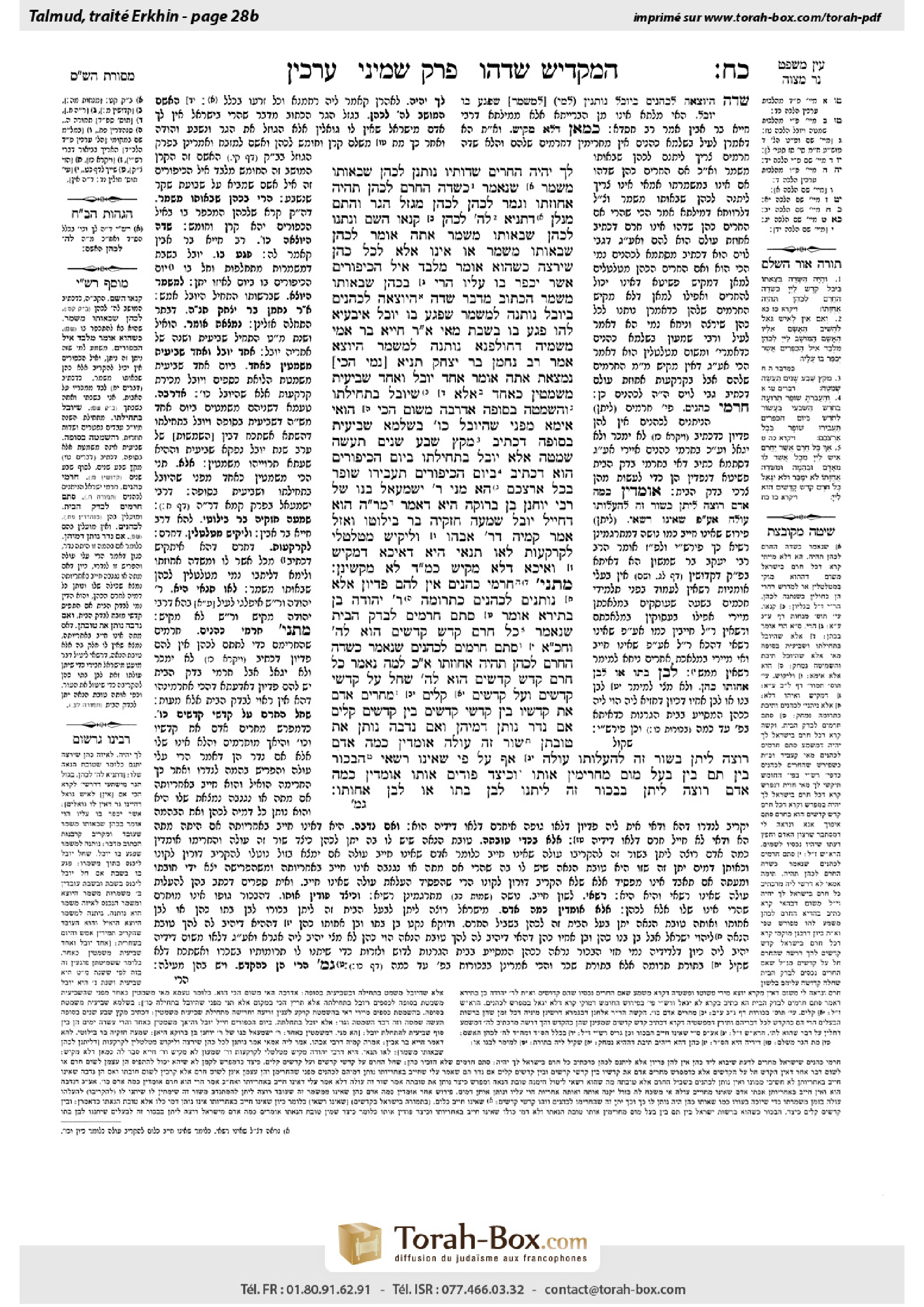
Arakhin 28b: Talmud study for Daf Yomi
Study the Talmud for Daf Yomi with scanned pages, Hebrew text, English translations from Sefaria and AI-generated French translations.
Passage selection and English or AI-generated French translation are available where the scan has annotations. Daf Study is independent of Torah-Box and Sefaria.
Browse Arakhin · ערכין · All tractatesArakhin 28b text and translations
This page of Arakhin includes the Aramaic text, an English translation and an AI-generated French translation, alongside the scan above.
ערכין כ״ח ב · Aramaic and Hebrew text
לְךָ יִהְיֶה״. הֶחְרִים שְׂדוֹתָיו — נוֹתְנָן לַכֹּהֵן שֶׁבְּאוֹתוֹ מִשְׁמָר, שֶׁנֶּאֱמַר: ״כִּשְׂדֵה הַחֵרֶם לַכֹּהֵן תִּהְיֶה אֲחֻזָּתוֹ״, וְגָמַר ״לַכֹּהֵן״ ״לַכֹּהֵן״ מִגֶּזֶל הַגֵּר.
וְהָתָם מְנָלַן? דְּתַנְיָא: ״לַה׳ לַכֹּהֵן״ — קְנָאוֹ הַשֵּׁם וּנְתָנוֹ לַכֹּהֵן שֶׁבְּאוֹתוֹ מִשְׁמָר.
אַתָּה אוֹמֵר לַכֹּהֵן שֶׁבְּאוֹתוֹ מִשְׁמָר, אוֹ אֵינוֹ אֶלָּא לְכׇל כֹּהֵן שֶׁיִּרְצֶה? כְּשֶׁהוּא אוֹמֵר: ״מִלְּבַד אֵיל הַכִּיפֻּרִים אֲשֶׁר יְכַפֶּר בּוֹ עָלָיו״, הֲרֵי בְּכֹהֵן שֶׁבְּאוֹתוֹ מִשְׁמָר הַכָּתוּב מְדַבֵּר.
שָׂדֶה הַיּוֹצְאָה לַכֹּהֲנִים בַּיּוֹבֵל, נוֹתְנָהּ לַמִּשְׁמָר שֶׁפָּגַע בּוֹ יוֹבֵל. אִיבַּעְיָא לְהוּ: פָּגַע בּוֹ בְּשַׁבָּת, מַאי? אָמַר רַב חִיָּיא בַּר אַמֵּי מִשְּׁמֵיהּ דְּחוּלְפָּנָא: נוֹתְנָהּ לַמִּשְׁמָר הַיּוֹצֵא.
אָמַר רַב נַחְמָן בַּר יִצְחָק: תַּנְיָא, נִמְצֵאתָ אַתָּה אוֹמֵר, אֶחָד יוֹבֵל וְאֶחָד שְׁבִיעִית מְשַׁמְּטִין כְּאֶחָד, אֶלָּא שֶׁיּוֹבֵל בִּתְחִילָּתוֹ וְהַשְּׁמִטָּה בְּסוֹפָהּ.
אַדְּרַבָּה, מִשּׁוּם הָכִי הֲוַאי! אֵימָא: מִפְּנֵי שֶׁהַיּוֹבֵל כּוּ׳.
בִּשְׁלָמָא שְׁבִיעִית בְּסוֹפָהּ, דִּכְתִיב: ״מִקֵּץ שֶׁבַע שָׁנִים תַּעֲשֶׂה שְׁמִטָּה״, אֶלָּא יוֹבֵל בִּתְחִילָּתוֹ? בְּיוֹם הַכִּיפּוּרִים הוּא, דִּכְתִיב: ״בַּיּוֹם הַכִּיפּוּרִים תַּעֲבִירוּ שׁוֹפָר בְּכׇל אַרְצְכֶם״! הָא מַנִּי? רַבִּי יִשְׁמָעֵאל בְּנוֹ שֶׁל רַבִּי יוֹחָנָן בֶּן בְּרוֹקָה הִיא, דְּאָמַר: מֵרֹאשׁ הַשָּׁנָה הוּא דְּחָיֵיל יוֹבֵל.
שַׁמְעַהּ חִזְקִיָּה בַּר בִּילְוָטִי, וַאֲזַל אֲמַר קַמֵּיהּ דְּרַבִּי אֲבָהוּ: וְלַיקֵּישׁ מִטַּלְטְלֵי לְקַרְקָעוֹת!
לָאו תַּנָּאֵי הִיא? דְּאִיכָּא דְּמַקֵּישׁ, וְאִיכָּא דְּלָא מַקֵּישׁ, כְּמַאן דְּאָמַר: ״לָא מַקְּשִׁינַן״.
מַתְנִי׳ חֶרְמֵי כֹּהֲנִים, אֵין לָהֶם פִּדְיוֹן, אֶלָּא נִותָּנִים לַכֹּהֲנִים כִּתְרוּמָה. רַבִּי יְהוּדָה בֶּן בְּתֵירָא אוֹמֵר: סְתַם חֲרָמִים לְבֶדֶק הַבַּיִת, שֶׁנֶּאֱמַר: ״כׇּל חֵרֶם קֹדֶשׁ קָדָשִׁים הוּא לַה׳״.
וַחֲכָמִים אוֹמְרִים: סְתַם חֲרָמִים לַכֹּהֲנִים, שֶׁנֶּאֱמַר: ״כִּשְׂדֵה הַחֵרֶם לַכֹּהֵן תִּהְיֶה אֲחֻזָּתוֹ״. אִם כֵּן, לָמָּה נֶאֱמַר ״כׇּל חֵרֶם קֹדֶשׁ קָדָשִׁים הוּא לַה׳״? שֶׁחָל עַל קׇדְשֵׁי קָדָשִׁים וְעַל קָדָשִׁים קַלִּים.
מַחְרִים אָדָם אֶת קֳדָשָׁיו, בֵּין קׇדְשֵׁי קָדָשִׁים בֵּין קָדָשִׁים קַלִּים, אִם נֶדֶר — נוֹתֵן דְּמֵיהֶן.
וְאִם נְדָבָה, נוֹתֵן אֶת טוֹבָתָן. ״שׁוֹר זֶה עוֹלָה״ — אוֹמְדִין כַּמָּה אָדָם רוֹצֶה לִיתֵּן בְּשׁוֹר זֶה לְהַעֲלוֹתוֹ עוֹלָה, אַף עַל פִּי שֶׁאֵינוֹ רַשַּׁאי.
הַבְּכוֹר, בֵּין תָּם בֵּין בַּעַל מוּם — מַחְרִימִין אוֹתוֹ, וְכֵיצַד פּוֹדִים אוֹתוֹ? אוֹמְדִין כַּמָּה אָדָם רוֹצֶה לִיתֵּן בִּבְכוֹר זֶה לִיתְּנוֹ לְבֶן בִּתּוֹ אוֹ לְבֶן אֲחוֹתוֹ.
Arakhin 28b · English translation
shall be yours” (Numbers 18:14), i.e., for Aaron and any of his descendants. But if one dedicated his fields, he gives them to a priest of that priestly watch which is currently serving in the Temple, as it is stated: “As a field dedicated; its possession shall be to the priest” (Leviticus 27:21). And one derives a verbal analogy between “to the priest” here and “to the priest” from a verse (Numbers 5:8) discussing property robbed from a convert. The halakha in that case is that if one took an oath that he did not rob a convert, and then after the convert died and left no descendants he admitted to taking a false oath, he must give the stolen property to the priests of the priestly watch currently serving in the Temple.
The Gemara asks: And there, in the case of property robbed from a convert, from where do we derive that it is given to the priests of the current priestly watch? As it is taught in a baraita: In the verse: “But if the man has no kinsman to whom restitution may be made for the guilt, the restitution for guilt that is made shall be the Lord’s, to the priest” (Numbers 5:8), the phrase: “Shall be the Lord’s, to the priest,” indicates that God has acquired the restitution for the guilt and has given it to the priest of that priestly watch.
The Gemara objects: Do you say the restitution is given to the priest of that priestly watch; or perhaps is it necessary only for it to be given to any priest to whom the robber wishes to give it. The Gemara explains that when the same verse says: “Besides the ram of the atonement, whereby atonement shall be made for him,” this indicates that the verse speaks of a priest of that priestly watch, i.e., the watch that is currently involved in sacrificing offerings.
§ Rabbi Ḥiyya bar Avin states another halakha involving property that is given to the priests. With regard to a field that was consecrated by its owner and was not redeemed by him, which goes out of his possession and passes to the possession of the priests at the Jubilee Year, one gives it to the members of the priestly watch serving when the Jubilee Year occurred, i.e., the watch serving at the beginning of the Jubilee Year. A dilemma was raised before the Sages: If the beginning of the Jubilee Year occurred on Shabbat, which is the day on which the priestly watches rotate, what is the halakha? Which priestly watch receives the property? Rav Ḥiyya bar Ami says in the name of Ḥulfana: One gives it to the watch that leaves the service of the Temple on that Shabbat.
Rav Naḥman bar Yitzḥak says: It is taught in a baraita in accordance with these statements: You are found to say that both the Jubilee Year, when fields that were sold are returned to their owners, and the Sabbatical Year, when debts are canceled, abrogate at once, i.e., at the same time, except that the Jubilee Year abrogates at its beginning and the Sabbatical Year abrogates at its end. In other words, the evening of Rosh HaShana at the conclusion of the Sabbatical Year, which is the forty-ninth year of the Jubilee cycle, is also the beginning of the Jubilee Year, which is the fiftieth year. At this time, all debts and land purchases are abrogated, and consecrated fields that were not redeemed become the property of the priests. Accordingly, if Rosh HaShana occurs on a Shabbat, the priestly watch that ends their service receives the fields, as the priestly watches rotate only in the morning.
The Gemara questions the terminology of the baraita: Why does the baraita state: Except that? This statement indicates that the Sabbatical Year and the Jubilee Year abrogate simultaneously despite the fact that the Jubilee Year abrogates at its beginning. On the contrary, this halakha is due to that very reason, i.e., they abrogate simultaneously because the Jubilee Year abrogates at its beginning and the Sabbatical Year at its end. The Gemara explains that in fact one should say the baraita as follows: They abrogate at the same time, due to the fact that the Jubilee Year abrogates at its beginning and the Sabbatical Year at its end.
The Gemara asks: Granted, it is clear that the Sabbatical Year abrogates at its end, as it is written: “At the end of every seven years you shall make a release” (Deuteronomy 15:1). But does the Jubilee Year abrogate at its very beginning? It abrogates only ten days later, on Yom Kippur, as it is written: “On Yom Kippur shall you make proclamation with the shofar throughout all your land…and you shall return every man to his possession” (Leviticus 25:9–10). The Gemara explains: In accordance with whose opinion is this baraita? It is in accordance with the opinion of Rabbi Yishmael, son of Rabbi Yoḥanan ben Beroka, who says: It is from Rosh HaShana that the Jubilee Year takes effect.
The Gemara returns to the statement of Rabbi Ḥiyya bar Avin that one who dedicates his movable property may give it to a priest of his choosing, whereas one who dedicates his land gives it to members of the current priestly watch. The Gemara relates that Ḥizkiyya bar Biluto heard this statement and went and said the following difficulty before Rabbi Abbahu: But let one juxtapose movable property to land, as the verse states: “That a man may dedicate to the Lord of all that he has, whether of man or animal, or of his ancestral field” (Leviticus 27:28). If so, movable property must also be given to members of the current priestly watch.
Rabbi Abbahu responded: Is it not a dispute between tanna’im? As there are those who juxtapose and there are those who do not juxtapose, in accordance with the earlier explanation of the Gemara that this is the basis for the dispute between Rabbi Yehuda and Rabbi Shimon with regard to whether or not Levites may dedicate movable property. Rabbi Ḥiyya bar Avin holds in accordance with the opinion of the one who says we do not juxtapose movable property and land.
MISHNA: Dedications of property for priests, unlike consecrations of property for Temple maintenance, have no redemption; rather, one gives it to the priests, and it is their property in every sense, like teruma. Rabbi Yehuda ben Beteira says: Dedications dedicated without specification of their purpose are designated for Temple maintenance, as it is stated: “Every dedicated item is most sacred to the Lord” (Leviticus 27:28).
And the Rabbis say: Dedications dedicated without specification of their purpose are designated for priests, as it is stated with regard to one who consecrated a field and did not redeem it: “As a field dedicated; its possession shall be to the priest” (Leviticus 27:21), indicating that a non-specific dedication belongs to the priest. If so, why is it stated: “Every dedicated item is most sacred to the Lord”? This comes to teach that dedication takes effect on offerings of the most sacred order and offerings of lesser sanctity. If one consecrated an animal for sacrifice and then dedicated it, the dedication takes effect. Nevertheless, it does not take effect on the body of the animal; rather, it applies to the owner’s financial stake in the offering.
As the Sages delineated: A person may dedicate his sacrificial animals, both offerings of the most sacred order and offerings of lesser sanctity. If the offering he dedicated was the object of a vow, e.g., if he said: It is incumbent upon me to sacrifice a burnt offering, since he is obligated to replace such offerings they are considered his property, and therefore he gives their value to the priests.
And if the offering he dedicated was a gift offering, e.g., if he said: This animal is a burnt offering, in which case he is not obligated to replace the animal, he gives the monetary benefit that he has in them. For example, if he said: This bull is a burnt offering, one estimates how much money a person would be willing to give in order to sacrifice the animal as a voluntary burnt offering, even though he is not permitted to do so.
With regard to a firstborn animal, whether it is unblemished or whether it is blemished, its owner may dedicate it. And how does one assess the payment required to redeem it? One estimates how much an Israelite person would be willing to give in exchange for that firstborn in order to give it to a priest who is his daughter’s son or to a priest who is his sister’s son.
Arakhin 28b · Traduction française (IA)
«sera à toi» (Nombres 18:14), c'est-à-dire pour Aaron et tout descendant d'Aaron. Mais si l'on consacre ses terres, il les donne à un prêtre de la faction de prêtres qui est actuellement en service dans le Temple, comme il est dit : « Une terre consacrée ; sa possession appartiendra au prêtre » (Lévitique 27:21). On tire une analogie verbale entre « au prêtre » ici et « au prêtre » dans un verset (Nombres 5:8) concernant une propriété volée à un converti. La halakha dans ce cas est que si l'on a pris un serment affirmant ne pas avoir volé un converti, et ensuite, après la mort du converti et l'absence de descendants, il avoue avoir pris un faux serment, il doit donner la propriété volée aux prêtres de la faction de prêtres actuellement en service dans le Temple.
Le Guemara pose la question : Et là, dans le cas d'une propriété volée à un converti, d'où tirons-nous que celle-ci est donnée aux prêtres de la faction actuelle ? Comme il est enseigné dans une baraïta : Dans le verset : « Mais si l'homme n'a pas de parent à qui il puisse faire restitution pour la faute, la restitution de la faute sera du Seigneur, au prêtre » (Nombres 5:8), la phrase : « Serait du Seigneur, au prêtre », indique que Dieu a acquis la restitution de la faute et l'a donnée au prêtre de la faction de prêtres en service.
Le Guemara s'oppose : Dis-tu que la restitution est donnée au prêtre de la faction de prêtres en service ; ou peut-être est-il nécessaire qu'elle soit donnée à tout prêtre auquel le voleur souhaite la donner. Le Guemara explique que lorsque le même verset dit : « En plus du bouc de l'atonement, par lequel on fera l'atonement pour lui », cela indique que le verset parle d'un prêtre de la faction de prêtres en service, c'est-à-dire de la faction qui est actuellement impliquée dans la sacrifice des offrandes.
§ Rabbi Ḥiyya bar Avin énonce une autre halakha concernant une propriété donnée aux prêtres. En ce qui concerne un champ qui a été consacré par son propriétaire et qui n'a pas été racheté par lui, qui sort de sa possession et passe à la possession des prêtres à la Journee de la Libération, on la donne aux membres de la faction de prêtres en service lors de la Journee de la Libération, c'est-à-dire la faction en service au début de la Journee de la Libération. Un dilemme a été soulevé devant les Sages : Si la Journee de la Libération a eu lieu un samedi, jour où les factions de prêtres changent, quelle est la halakha ? Quelle faction de prêtres reçoit la propriété ? Rav Ḥiyya bar Ami dit en nom de Ḥulfana : On la donne à la faction qui quitte le service du Temple ce samedi.
Rav Naḥman bar Yitzḥak dit : Il est enseigné dans une baraïta conformément à ces déclarations : Vous affirmez que tant la Journee de la Libération, lorsqu'un champ vendu est rendu à son propriétaire, que la Journee sabbatique, lorsqu'on annule les dettes, annulent simultanément, c'est-à-dire en même temps, sauf que la Journee de la Libération annule à son début et la Journee sabbatique annule à sa fin. En d'autres termes, la nuit de Rosh HaShana à la fin de la Journee sabbatique, qui est la quarante-neuvième année du cycle de la Journee de la Libération, est aussi le début de la Journee de la Libération, qui est la cinquantième année. À ce moment-là, toutes les dettes et les achats de terres sont annulés, et les champs consacrés qui n'ont pas été rachetés deviennent la propriété des prêtres. Ainsi, si Rosh HaShana a lieu un samedi, la faction de prêtres qui termine son service reçoit les champs, car les factions de prêtres ne changent que le matin.
Le Guemara questionne le vocabulaire de la baraïta : Pourquoi la baraïta dit-elle : Sauf que ? Cette déclaration indique que la année sabbatique et la année de la Libération annulent simultanément, malgré le fait que la année de la Libération annule à son début. Au contraire, cette halakha est due à cette raison même, c'est-à-dire qu'elles annulent simultanément parce que la année de la Libération annule à son début et la année sabbatique à sa fin. Le Guemara explique que, en réalité, on devrait dire que la baraïta est ainsi : Elles annulent à la même époque, en raison du fait que la année de la Libération annule à son début et la année sabbatique à sa fin.
Le Guemara pose la question : D'accord, il est clair que la année sabbatique annule à sa fin, comme il est écrit : « À la fin de chaque septième année, tu feras une remise » (Deutéronome 15:1). Mais la année de la Libération annule-t-elle à son début ? Elle annule seulement dix jours plus tard, le Yom Kippur, comme il est écrit : « Le Yom Kippur, tu feras l'annonce avec le cor à travers tout ton pays… et tu rendras à chacun son possession » (Lévitique 25:9–10). Le Guemara explique : Sur l'opinion de qui est cette baraïta ? C'est sur l'opinion de Rabbi Yishmael, fils de Rabbi Yoḥanan ben Beroka, qui dit : C'est à partir de Rosh HaShana que la année de la Libération prend effet.
Le Guemara revient à l'affirmation de Rabbi Ḥiyya bar Avin selon laquelle celui qui consacre ses biens mobiliers peut les donner à un prêtre de son choix, tandis que celui qui consacre ses terres les donne aux membres de la faction de prêtres actuelle. Le Guemara rapporte que Ḥizkiyya bar Biluto a entendu cette déclaration et est allé dire devant Rabbi Abbahu la difficulté suivante : Mais comparons les biens mobiliers aux terres, comme le verset dit : « Qu'un homme puisse consacrer à l'Éternel tout ce qu'il possède, qu'il s'agisse d'un homme ou d'un animal, ou de son champ ancestral » (Lévitique 27:28). Si c'est ainsi, les biens mobiliers doivent aussi être donnés aux membres de la faction de prêtres actuelle.
Rabbi Abbahu répondit : N'est-ce pas un débat entre des tannaïm ? Car il y a ceux qui comparent et ceux qui ne comparent pas, conformément à l'explication précédente du Guemara que c'est la base du débat entre Rabbi Yehuda et Rabbi Shimon concernant le fait que les Lévites puissent consacrer des biens mobiliers. Rabbi Ḥiyya bar Avin adopte l'opinion de celui qui dit que nous ne comparons pas les biens mobiliers et les terres.
MICHNA : Les dédicaces de biens pour les prêtres, contrairement aux consacrations de biens pour l'entretien du Temple, n'ont pas de rachat ; on donne directement ces biens aux prêtres, et ils en deviennent propriétaires en tout sens, comme la terouma. Rabbi Yehuda ben Beteira dit : Les dédicaces faites sans précision de leur usage sont destinées à l'entretien du Temple, car il est dit : « Tout objet dédié est très saint à l'Éternel » (Lévitique 27,28).
Et les Rabbins disent : Les dédicaces faites sans précision de leur usage sont destinées aux prêtres, car il est dit concernant celui qui a consacré un champ sans le racheter : « Comme un champ dédié ; sa possession appartiendra au prêtre » (Lévitique 27,21), ce qui indique que la dédicace non spécifiée appartient au prêtre. Si c'est ainsi, pourquoi dit-on : « Tout objet dédié est très saint à l'Éternel » ? Cela vient enseigner que la dédicace s'applique aux offrandes de l'ordre le plus saint et aux offrandes de sanctité moindre. Si l'on a consacré un animal pour un sacrifice et ensuite l'a dédié, la dédicace s'applique. Cependant, elle ne s'applique pas au corps de l'animal ; elle s'applique plutôt à la part financière du propriétaire dans l'offrande.
Comme les Sages l'ont délimité : une personne peut dédier ses animaux sacrés, que ce soit des offrandes de l'ordre le plus saint ou des offrandes de sanctité moindre. Si l'offrande qu'il a dédiée était l'objet d'un vœu, par exemple, s'il a dit : « Il m'est commandé de sacrifier un holocauste », puisqu'il est tenu de remplacer de telles offrandes, elles sont considérées comme sa propriété, et donc il donne leur valeur aux prêtres.
Et si l'offrande qu'il a dédiée était une offrande de bienfaisance, par exemple, s'il a dit : « Cet animal est un holocauste », dans ce cas, il n'est pas tenu de remplacer l'animal, il donne le bénéfice monétaire qu'il a dans ces offrandes. Par exemple, s'il a dit : « Ce taureau est un holocauste », on estime combien une personne serait prête à donner en échange de l'animal pour le sacrifier volontairement comme holocauste, même s'il n'est pas autorisé à le faire.
Concernant un animal premier-né, que ce soit un animal sans tache ou un animal taché, son propriétaire peut le dédier. Et comment évalue-t-on le prix requis pour le racheter ? On estime combien un Israélite serait prête à donner en échange de ce premier-né pour le donner à un prêtre qui est le fils de sa fille ou à un prêtre qui est le fils de sa sœur.
Traduction française générée par IA à partir de l’édition anglaise de Sefaria. Vérifie toujours un passage avec le texte source.
Text from Sefaria: William Davidson Edition - Vocalized Aramaic (CC BY NC); William Davidson Edition - English (CC BY NC).