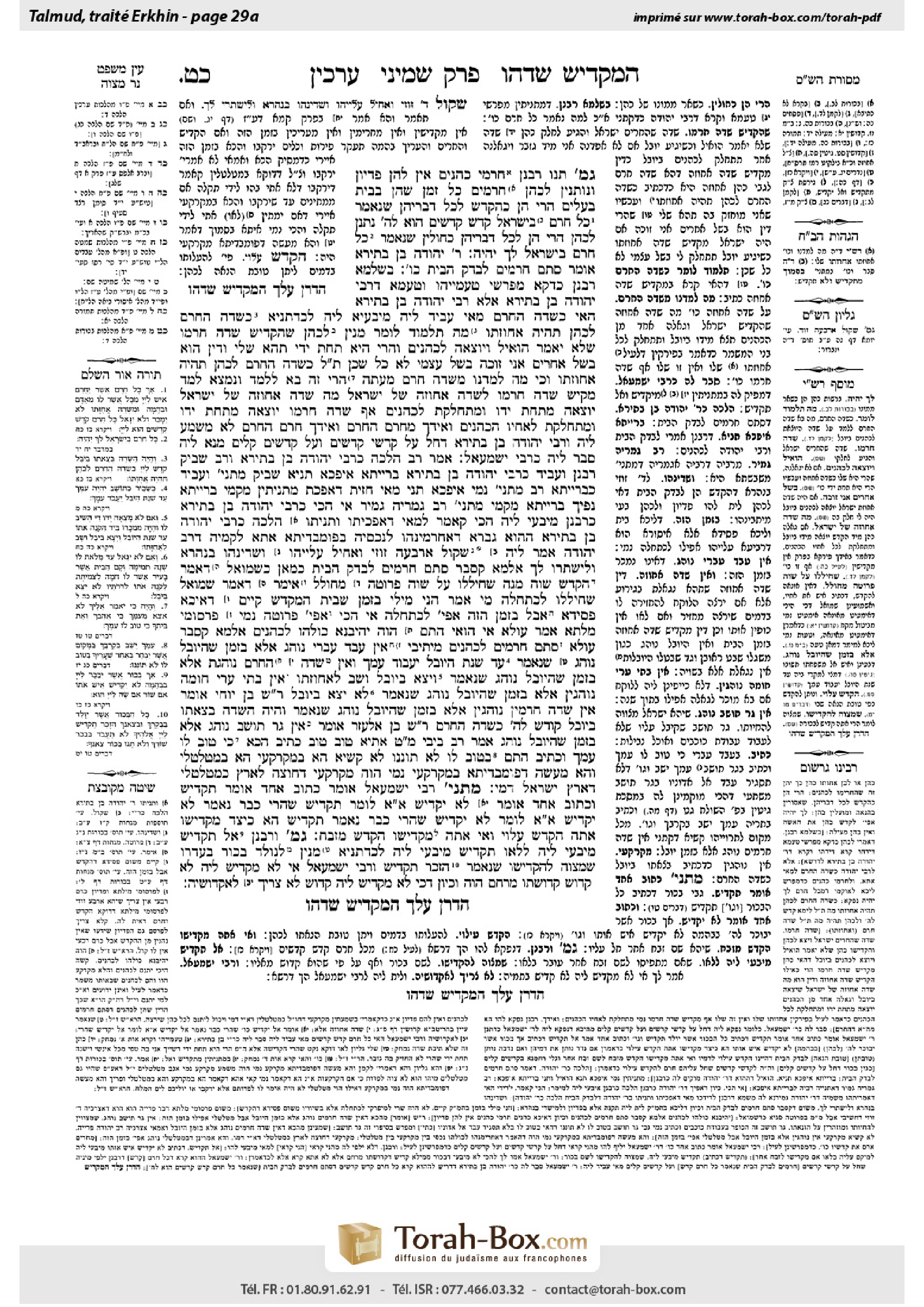
Arakhin 29a: Talmud study for Daf Yomi
Study the Talmud for Daf Yomi with scanned pages, Hebrew text, English translations from Sefaria and AI-generated French translations.
Passage selection and English or AI-generated French translation are available where the scan has annotations. Daf Study is independent of Torah-Box and Sefaria.
Browse Arakhin · ערכין · All tractatesArakhin 29a text and translations
This page of Arakhin includes the Aramaic text, an English translation and an AI-generated French translation, alongside the scan above.
ערכין כ״ט א · Aramaic and Hebrew text
גְּמָ׳ תָּנוּ רַבָּנַן: חֶרְמֵי כֹהֲנִים אֵין לָהֶן פִּדְיוֹן וְנִותָּנִין לַכֹּהֵן. חֲרָמִים כׇּל זְמַן שֶׁהֵן בְּבֵית בְּעָלִים הֲרֵי הֵן כְּהֶקְדֵּשׁ לְכׇל דִּבְרֵיהֶן, שֶׁנֶּאֱמַר: ״כׇּל חֵרֶם בְּיִשְׂרָאֵל קֹדֶשׁ קָדָשִׁים הוּא לַה׳״. נְתָנָן לְכֹהֵן — הֲרֵי הֵן לְכׇל דִּבְרֵיהֶן כְּחוּלִּין, שֶׁנֶּאֱמַר: ״כׇּל חֵרֶם בְּיִשְׂרָאֵל לְךָ יִהְיֶה״.
רַבִּי יְהוּדָה בֶּן בְּתִירָא אוֹמֵר: סְתַם חֲרָמִים לְבֶדֶק הַבַּיִת כּוּ׳. בִּשְׁלָמָא רַבָּנַן כִּדְקָא מְפָרְשִׁי טַעְמַיְיהוּ וְטַעְמָא דְּרַבִּי יְהוּדָה בֶּן בְּתִירָא, אֶלָּא רַבִּי יְהוּדָה בֶּן בְּתִירָא הַאי ״כִּשְׂדֵה הַחֵרֶם״ מַאי עָבֵיד לֵיהּ?
מִיבַּעְיָא לֵיהּ לְכִדְתַנְיָא: ״כִּשְׂדֵה הַחֵרֶם לַכֹּהֵן תִּהְיֶה אֲחֻזָּתוֹ״, מָה תַּלְמוּד לוֹמַר? מִנַּיִן לְכֹהֵן שֶׁהִקְדִּישׁ שְׂדֵה חֶרְמוֹ, שֶׁלֹּא יֹאמַר: הוֹאִיל וְיוֹצְאָה לַכֹּהֲנִים, וַהֲרֵי הִיא תַּחַת יָדִי — תְּהֵא שֶׁלִּי?
וְדִין הוּא: בְּשֶׁל אֲחֵרִים אֲנִי זוֹכֶה, בְּשֶׁל עַצְמִי לֹא כׇּל שֶׁכֵּן? תַּלְמוּד לוֹמַר: ״כִּשְׂדֵה הַחֵרֶם לַכֹּהֵן תִּהְיֶה אֲחֻזָּתוֹ״.
וְכִי מָה לָמַדְנוּ מִשְּׂדֵה חֵרֶם מֵעַתָּה? הֲרֵי זֶה בָּא לְלַמֵּד וְנִמְצָא לָמֵד: מַקִּישׁ שְׂדֵה חֶרְמוֹ לִשְׂדֵה אֲחוּזָּה שֶׁל יִשְׂרָאֵל.
מָה שְׂדֵה אֲחוּזָּה שֶׁל יִשְׂרָאֵל, יוֹצְאָה מִתַּחַת יָדוֹ, וּמִתְחַלֶּקֶת לַכֹּהֲנִים, אַף שָׂדֶה חֶרְמוֹ, יוֹצְאָה מִתַּחַת יָדוֹ, וּמִתְחַלֶּקֶת לְאֶחָיו הַכֹּהֲנִים.
וְאִידָּךְ? מֵ״חֵרֶם״ ״הַחֵרֶם״. וְאִידַּךְ, ״חֵרֶם״ ״הַחֵרֶם״ לָא מַשְׁמַע לֵיהּ.
וְרַבִּי יְהוּדָה בֶּן בְּתִירָא, דְּחָל עַל קׇדְשֵׁי קָדָשִׁים וְעַל קָדָשִׁים קַלִּים, מְנָא לֵיהּ? סָבַר לֵיהּ כְּרַבִּי יִשְׁמָעֵאל.
אָמַר רַב: הֲלָכָה כְּרַבִּי יְהוּדָה בֶּן בְּתִירָא, וְרַב שָׁבֵיק רַבָּנַן וְעָבֵיד כְּרַבִּי יְהוּדָה בֶּן בְּתִירָא? בָּרַיְיתָא אִיפְּכָא תַּנְיָא, שָׁבֵיק מַתְנִיתִין וְעָבֵיד כְּבָרַיְיתָא? רַב מַתְנִיתִין נָמֵי אִיפְּכָא תָּנֵי.
מַאי חֲזֵית דְּאָפְכַתְּ מַתְנִיתִין מִקַּמֵּי בָּרַיְיתָא? נֵפֵיךְ בָּרַיְיתָא מִקַּמֵּי מַתְנִיתִין! רַב גְּמָרֵיהּ גְּמִיר. אִי הָכִי, כְּרַבִּי יְהוּדָה בֶּן בְּתִירָא? כְּרַבָּנַן מִיבְּעֵי לֵיהּ! הָכִי קָאָמַר: לְמַאי דְּאָפְכִיתוּ וְתָנֵיתוּ, הֲלָכָה כְּרַבִּי יְהוּדָה בֶּן בְּתִירָא.
הָהוּא גַּבְרָא דְּאַחְרְמִינְהוּ לְנִכְסֵיהּ בְּפוּמְבְּדִיתָא, אֲתָא לְקַמֵּיהּ דְּרַב יְהוּדָה, אֲמַר לֵיהּ: שְׁקוֹל אַרְבְּעָה זוּזֵי וְאַחֵיל עֲלַיְיהוּ, וּשְׁדִינְהוּ בְּנַהֲרָא, וְלִישְׁתְּרוֹ לָךְ. אַלְמָא קָסָבַר: סְתַם חֲרָמִים לְבֶדֶק הַבַּיִת.
כְּמַאן? כִּשְׁמוּאֵל, דְּאָמַר: הֶקְדֵּשׁ שָׁוֶה מָנֶה שֶׁחִילְּלוֹ עַל שָׁוֶה פְּרוּטָה מְחוּלָּל. אֵימַר דְּאָמַר שְׁמוּאֵל שֶׁחִילְּלוֹ, לְכַתְּחִלָּה מִי אָמַר?
הָנֵי מִילֵּי בִּזְמַן שֶׁבֵּית הַמִּקְדָּשׁ קַיָּים, דְּאִיכָּא פְּסֵידָא, אֲבָל בִּזְמַן הַזֶּה אֲפִילּוּ לְכַתְּחִלָּה. אִי הָכִי, אֲפִילּוּ פְּרוּטָה נָמֵי? פַּרְסוֹמֵי מִלְּתָא.
אָמַר עוּלָּא: אִי הֲוַאי הָתָם, הֲוָה יָהֵיבְנָא כּוּלְּהוּ לְכֹהֲנִים. אַלְמָא קָסָבַר עוּלָּא: סְתַם חֲרָמִים לַכֹּהֲנִים.
מֵיתִיבִי: אֵין עֶבֶד עִבְרִי נוֹהֵג אֶלָּא בִּזְמַן שֶׁהַיּוֹבֵל נוֹהֵג, שֶׁנֶּאֱמַר: ״עַד שְׁנַת הַיּוֹבֵל יַעֲבֹד עִמָּךְ״.
וְאֵין שְׂדֵה הַחֵרֶם נוֹהֶגֶת אֶלָּא בִּזְמַן שֶׁהַיּוֹבֵל נוֹהֵג, שֶׁנֶּאֱמַר: ״וְיָצָא בַּיּוֹבֵל וְשָׁב לַאֲחֻזָּתוֹ״. אֵין בָּתֵּי עָרֵי חוֹמָה נוֹהֲגִין אֶלָּא בִּזְמַן שֶׁהַיּוֹבֵל נוֹהֵג, שֶׁנֶּאֱמַר: ״לֹא יֵצֵא בַּיּוֹבֵל״.
רַבִּי שִׁמְעוֹן בֶּן יוֹחַי אוֹמֵר: אֵין שְׂדֵה חֲרָמִין נוֹהֲגִין אֶלָּא בִּזְמַן שֶׁהַיּוֹבֵל נוֹהֵג, שֶׁנֶּאֱמַר: ״וְהָיָה הַשָּׂדֶה בְּצֵאתוֹ בַיּוֹבֵל קֹדֶשׁ לַה׳ כִּשְׂדֵה הַחֵרֶם״. רַבִּי שִׁמְעוֹן בֶּן אֶלְעָזָר אוֹמֵר: אֵין גֵּר תּוֹשָׁב נוֹהֵג אֶלָּא בִּזְמַן שֶׁהַיּוֹבֵל נוֹהֵג.
אָמַר רַב בִּיבִי: מַאי טַעְמָא? אַתְיָא ״טוֹב״ ״טוֹב״, כְּתִיב הָכָא: ״כִּי טוֹב לוֹ עִמָּךְ״, וּכְתִיב הָתָם: ״בַּטּוֹב לוֹ לֹא תּוֹנֶנּוּ״!
לָא קַשְׁיָא: הָא בִּמְקַרְקְעֵי, הָא בְּמִטַּלְטְלֵי. וְהָא מַעֲשֶׂה דְּפוּמְבְּדִיתָא בִּמְקַרְקְעֵי נָמֵי הֲוָה! מְקַרְקְעֵי דְּחוּצָה לָאָרֶץ כְּמִטַּלְטְלֵי דְּאֶרֶץ יִשְׂרָאֵל דָּמֵי.
מַתְנִי׳ רַבִּי יִשְׁמָעֵאל אוֹמֵר: כָּתוּב אֶחָד אוֹמֵר ״תַּקְדִּישׁ״, וְכָתוּב אֶחָד אוֹמֵר ״לֹא יַקְדִּישׁ״. אִי אֶפְשָׁר לוֹמַר ״תַּקְדִּישׁ״ — שֶׁהֲרֵי כְּבָר נֶאֱמַר ״לֹא יַקְדִּישׁ״, אִי אֶפְשָׁר לוֹמַר ״לֹא יַקְדִּישׁ״ — שֶׁהֲרֵי כְּבָר נֶאֱמַר ״תַּקְדִּישׁ״.
הָא כֵּיצַד? מַקְדִּישׁוֹ אַתָּה הֶקְדֵּשׁ עִלּוּי, וְאִי אַתָּה מַקְדִּישׁוֹ הֶקְדֵּשׁ מִזְבֵּחַ.
גּמ׳, וְרַבָּנַן: ״אַל תַּקְדִּישׁ״ מִיבְּעֵי לֵיהּ לְלָאו, ״תַּקְדִּישׁ״ מִיבְּעֵי לֵיהּ לְכִדְתַנְיָא: מִנַּיִן לְנוֹלַד בְּכוֹר בְּעֶדְרוֹ שֶׁמִּצְוָה לְהַקְדִּישׁוֹ? שֶׁנֶּאֱמַר: ״הַזָּכָר תַּקְדִּישׁ״.
וְרַבִּי יִשְׁמָעֵאל, אִי לָא מַקְדֵּישׁ לֵיהּ, לָא קָדֵישׁ? קְדוּשָּׁתוֹ מֵרֶחֶם הוּא, וְכֵיוָן דְּכִי לָא מַקְדֵּישׁ לֵיהּ קָדוֹשׁ, לָא צְרִיךְ לְאַקְדּוֹשֵׁיהּ.
הֲדַרַן עֲלָךְ הַמַּקְדִּישׁ שָׂדֵהוּ.
Arakhin 29a · English translation
GEMARA: The Sages taught: Dedications of property for priests have no redemption, and one gives the property to the priest. With regard to these dedications, as long as they remain in the house of the owner they are considered like consecrated property in every sense, as it is stated: “Every dedicated item is most sacred to the Lord” (Leviticus 27:28). Once the owner has given them to the priest they are in every sense like non-sacred property, as it is stated: “Everything dedicated in Israel shall be yours” (Numbers 18:14), i.e., it shall be like all other regular property belonging to a priest, which is non-sacred.
§ The mishna teaches: Rabbi Yehuda ben Beteira says dedications donated without specification are designated for Temple maintenance, as it is stated: “Every dedicated item is most sacred to the Lord” (Leviticus 27:28). And the Rabbis say they are designated for priests, as it is stated: “As a field dedicated; its possession shall be to the priest” (Leviticus 27:21), whereas the verse cited by Rabbi Yehuda ben Beteira teaches that dedication takes effect on offerings of the most sacred order and offerings of lesser sanctity. The Gemara asks: Granted, the opinion of the Rabbis is clear, as they explain their reason and the reason of Rabbi Yehuda ben Beteira, i.e., they interpret the verse he cited as his proof. But as for Rabbi Yehuda ben Beteira, this verse: “As a field dedicated; its possession shall be to the priest,” what does he do with it, i.e., what does he derive from it?
The Gemara responds: The verse is necessary for him for that which is taught in a baraita that discusses the case of one who consecrated his ancestral field and failed to redeem it. This field becomes the possession of the priests at the Jubilee Year. The baraita teaches: Why must the verse state at its end: “As a field dedicated; its possession shall be to the priest”? The baraita explains: From where is it derived with regard to a priest who consecrated his dedicated field, i.e., a field that was dedicated by an Israelite and was given to him and he then consecrated it, and then the Jubilee Year arrived, that he may not say: Since a field that was consecrated by its owners and was not redeemed goes out of the owner’s possession and passes to the possession of the priests at the Jubilee Year, and this field that I consecrated is already in my possession, it is therefore mine.
The baraita adds: And this claim of the priest is based on logical inference: If I acquire the fields of others that were consecrated and not redeemed at the Jubilee Year, then with regard to my own property, all the more so is it not clear that I should acquire it? Therefore, the verse states, with regard to an ancestral field that one consecrated: “As a field dedicated; its possession shall be to the priest,” which teaches that this priest does not acquire the field.
The baraita explains the derivation: But what have we now learned about a consecrated ancestral field from a dedicated field? In other words, the verse, which is dealing with an ancestral field, says an ancestral field is like a dedicated field, but it does not explicitly state the halakha of dedicated fields. Rather, this case of a dedicated field comes to teach a halakha about an ancestral field but is found to derive a halakha from that case, i.e., the verse juxtaposes a dedicated field of a priest to the ancestral field of an Israelite.
The baraita clarifies how the halakha is derived from the juxtaposition: Just as the ancestral field of an Israelite, which was redeemed by a priest from the Temple treasury, goes out of his possession at the arrival of the Jubilee Year and is divided among all the priests of the watch serving at the beginning of the Jubilee Year (see 25b), so too, the dedicated field of a priest that remained in his possession goes out of his possession and is divided among his brothers, the priests of the watch serving at the beginning of the Jubilee Year.
The Gemara asks: And the other, i.e., the Rabbis, from where do they derive this halakha? The Gemara responds: They derive it from a superfluous term in the verse, as it could have stated merely: Dedicated [ḥerem], from which one would have derived that unspecified dedications are designated for the priests. Yet the verse actually states: “Haḥerem,” with the definite article, and therefore both halakhot are derived from this verse. The Gemara notes: And as for the other, Rabbi Yehuda ben Beteira, he does not learn anything from the difference between ḥerem and haḥerem. Accordingly, he derives from here only that if a priest consecrated his dedicated field it is removed from his possession.
The Gemara asks: And as for Rabbi Yehuda ben Beteira, from where does he derive that a dedication takes effect on offerings of the most sacred order and offerings of lesser sanctity, which, according to the Rabbis, is learned from the verse: “Every dedicated item is most sacred to the Lord” (Leviticus 27:28)? The Gemara answers: He holds in accordance with the opinion of Rabbi Yishmael, who derives this halakha from another source, as explained in the mishna below.
§ Rav says: The halakha is in accordance with the opinion of Rabbi Yehuda ben Beteira that unspecified dedications of property are designated for Temple maintenance. The Gemara asks: And would Rav leave aside the majority opinion of the Rabbis and act in accordance with the individual opinion of Rabbi Yehuda ben Beteira? The Gemara answers: This dispute is taught in a baraita in the opposite manner, i.e., it is the Rabbis who hold that unspecified dedications are designated for Temple maintenance. The Gemara further asks: Would Rav leave aside a mishna and act in accordance with a baraita? The Gemara responds: Rav teaches the mishna as well in the opposite manner, in accordance with the baraita.
The Gemara asks: What did you see that you chose to reverse the opinions in the mishna due to the baraita? Let us reverse the opinions in the baraita due to the mishna. The Gemara answers: Rav learned by tradition from his teachers that the opinions cited in the mishna should be reversed. The Gemara asks: If so, why does Rav state that the halakha is in accordance with the opinion of Rabbi Yehuda ben Beteira? He should have said it is in accordance with the opinion of the Rabbis. The Gemara explains that this is what Rav is saying: In accordance with the manner in which you reversed the opinions and taught them in the mishna, the halakha is in accordance with the opinion of Rabbi Yehuda ben Beteira.
§ The Gemara relates that there was a certain man who dedicated his property in Pumbedita. He came before Rav Yehuda to ask him what to do. Rav Yehuda said to him: Take four dinars and desacralize the dedicated property by transferring its sanctity onto them. And then throw the dinars into the river, because one may not derive benefit from them. And then the property will be permitted to you, as it will have been redeemed. The Gemara notes: Evidently, Rav Yehuda holds that unspecified dedications of property are designated for Temple maintenance, which is why the man could redeem his property. Had the property been designated for the priests there could be no redemption, as taught in the mishna.
The Gemara asks: In accordance with whose opinion does Rav Yehuda hold, when he told the man to desacralize the dedicated property by transferring its sanctity onto money worth less than the dedicated property? The Gemara responds: He holds in accordance with the opinion of Shmuel, who said: Consecrated property worth one hundred dinars that one desacralized onto an item worth one peruta is desacralized. The Gemara asks: One can say that Shmuel said this is the halakha only in a case where one already desacralized the property, i.e., after the fact. Did he say one may do so ab initio?
The Gemara responds: This matter, that one must desacralize consecrated property onto an item worth the value of the property ab initio, applies only during a period when the Temple is standing, as there is a loss caused to the Temple treasury by desacralizing its property onto an item worth less than its value. But in the present time, when the Temple is not standing and there is no Temple treasury, one may desacralize with an item worth less than the consecrated property even ab initio. The Gemara asks: If so, then one may even desacralize with one peruta as well. Why, then, did Rav Yehuda require the man to use four dinars? The Gemara responds: He required four dinars in order to publicize the matter, so that the community will know the property is permitted for use only because it was redeemed.
Ulla says: If I had been there when this man asked what to do, I would have given all of the property to the priests. The Gemara notes: Evidently, Ulla holds that unspecified dedications of property are designated for the priests, and therefore they cannot be redeemed.
It can be inferred from the previous discussion that the halakhot of dedications are in effect even today. The Gemara raises an objection to this opinion from a baraita: The sale of a Hebrew slave is practiced only during a period when the Jubilee Year is observed, as it is stated: “And if your brother be waxen poor with you, and sell himself to you…he shall serve with you until the year of Jubilee” (Leviticus 25:39–40).
And likewise the halakhot pertaining to a dedicated, i.e., ancestral, field apply only during a period that the Jubilee Year is observed, as it is stated: “Then that which he has sold shall remain in the hand of him that has bought…and in the Jubilee it shall go out, and he shall return to his possession” (Leviticus 25:28). Finally, the halakhot pertaining to houses of walled cities apply only during a period when the Jubilee Year is observed, as it is stated: “Then the house that is in the walled city shall be made sure in perpetuity to him that bought it, throughout his generations; it shall not go out in the Jubilee” (Leviticus 25:30).
Rabbi Shimon ben Yoḥai says: The halakhot pertaining to a dedicated field apply only during a period when the Jubilee Year is observed, as it is stated: “But the field, when it goes out in the Jubilee, shall be sacred to the Lord, as a field dedicated; its possession shall be to the priest” (Leviticus 27:21). Rabbi Shimon ben Elazar says: The halakhot pertaining to a gentile who resides in Eretz Yisrael and observes the seven Noahide mitzvot [ger toshav] apply only during a period when the Jubilee Year is observed.
Rav Beivai said: What is the reason? It is derived from a verbal analogy between “well” and “well.” It is written here, with regard to a Hebrew slave, who can be sold only when the Jubilee Year is observed: “Because he fares well with you” (Deuteronomy 15:16). And it is written there, with regard to a ger toshav: “Where it is well for him; you shall not wrong him” (Deuteronomy 23:17). The Gemara’s objection is that it is evident from the baraita that the halakhot pertaining to dedicated fields apply only when the Jubilee Year is observed.
The Gemara explains that it is not difficult. This baraita is discussing the halakha with regard to land, whereas that incident, in Pumbedita, in which a dedication was effected, occurred with movable property. The Gemara raises a difficulty: But that incident that occurred in Pumbedita involved land as well, and Rav Yehuda nevertheless required the man to redeem them. The Gemara responds: Land outside of Eretz Yisrael is considered like movable property in Eretz Yisrael.
MISHNA: Rabbi Yishmael says: One verse states: “All the firstborn males that are born of your herd and of your flock you shall consecrate to the Lord your God” (Deuteronomy 15:19), and one verse states: “However, the firstborn among animals that is born first to the Lord, a man shall not consecrate it” (Leviticus 27:26). It is impossible to say: “You shall consecrate,” as it is already stated: “A man shall not consecrate.” It is likewise impossible to say: “A man shall not consecrate,” as it is already stated: “You shall consecrate.”
How, then, can these verses be reconciled? You can consecrate the firstborn animal by a consecration of value, i.e., an individual can donate to the Temple treasury the amount he would be willing to pay for the right to give the firstborn to a specific priest; and you cannot consecrate it by a consecration for the altar, as a firstborn may not be sacrificed for the sake of any other offering.
GEMARA: The Gemara comments: And the Rabbis, who derive the halakha that a dedication takes effect on all offerings of sanctity from the verse: “Every dedicated item is most sacred to the Lord” (Leviticus 27:28), would explain that the verse “A man shall not consecrate” is necessary to teach that there is a Torah prohibition against consecrating a firstborn animal for the sake of another offering. As for the other verse discussed in the mishna: “You shall consecrate,” it is necessary for that which is taught in a baraita: From where is it derived with regard to a firstborn animal that was born in one’s flock that it is a mitzva to consecrate it verbally as a firstborn? As it is stated: “The firstborn males that are born of your herd and of your flock you shall consecrate.”
And Rabbi Yishmael, who maintains there is no such mitzva, would argue: If one does not consecrate it verbally, is the animal not consecrated? It certainly is consecrated, as its sanctity is from the womb. And since when one does not consecrate it the animal is nevertheless sanctified automatically, he does not need to consecrate it verbally.
Arakhin 29a · Traduction française (IA)
GUEMARA : Les Sages enseignent : Les dédicaces de biens pour les prêtres n'ont pas de rédemption, et l'on donne le bien au prêtre. Concernant ces dédicaces, tant qu'elles restent dans la maison de l'propriétaire, elles sont considérées comme des biens sacrés dans tous les sens, comme il est dit : « Tout objet dédié est très saint à l'Éternel » (Lévitique 27:28). Une fois que l'propriétaire les a donnés au prêtre, elles sont dans tous les sens comme des biens non sacrés, comme il est dit : « Tout objet dédié en Israël sera à toi » (Nm 18:14), c'est-à-dire qu'il sera comme tout autre bien ordinaire appartenant au prêtre, qui n'est pas sacré.
§ La mésorah enseigne : Rabbi Yéhuda ben Bétaira dit que les dédicaces données sans spécification sont désignées pour l'entretien du Temple, comme il est dit : « Tout objet dédié est très saint à l'Éternel » (Lévitique 27:28). Et les Rabbins disent qu'elles sont désignées pour les prêtres, comme il est dit : « Comme un champ dédié ; sa possession appartiendra au prêtre » (Lévitique 27:21), tandis que la versette citée par Rabbi Yéhuda ben Bétaira enseigne que la dédicace s'applique aux offrandes de l'ordre le plus saint et aux offrandes de sanctité moindre. La Guemara demande : Cela est évident pour l'opinion des Rabbins, car ils expliquent leur raisonnement et celui de Rabbi Yéhuda ben Bétaira, c'est-à-dire qu'ils interprètent la versette qu'il cite comme preuve. Mais concernant Rabbi Yéhuda ben Bétaira, cette versette : « Comme un champ dédié ; sa possession appartiendra au prêtre », à quoi sert-elle, c'est-à-dire à quoi en dérive-t-elle ?
La Guemara répond : La versette est nécessaire pour lui dans le cas qui est enseigné dans une baraïta concernant celui qui a consacré son champ ancestral et n'a pas accompli sa rédemption. Ce champ devient la possession des prêtres à la Jubilé. La baraïta enseigne : Pourquoi la versette doit-elle préciser à la fin : « Comme un champ dédié ; sa possession appartiendra au prêtre » ? La baraïta explique : D'où est-elle dérivée concernant un prêtre qui a consacré son champ dédié, c'est-à-dire un champ qui a été dédié par un Israélite et qui lui a été donné, et il l'a ensuite consacré, et la Jubilé est arrivée, qu'il ne puisse pas dire : Puisque un champ qui a été consacré par ses propriétaires et qui n'a pas été racheté sort de la possession de l'propriétaire et passe à la possession des prêtres à la Jubilé, et ce champ que j'ai consacré est déjà en ma possession, il m'appartient donc.
La baraïta ajoute : Et cette revendication du prêtre est basée sur un raisonnement logique : Si je possède les champs d'autrui qui ont été consacrés et non rachetés à la Jubilé, alors concernant mes propres biens, n'est-ce pas encore plus clair que je les possède ? Par conséquent, la versette dit, concernant un champ ancestral que l'on a consacré : « Comme un champ dédié ; sa possession appartiendra au prêtre », ce qui enseigne que ce prêtre ne possède pas le champ.
La baraïta explique la dérivation : Mais qu'avons-nous appris à propos d'un champ ancestral consacré à partir d'un champ dédié ? En d'autres termes, la versette, qui traite d'un champ ancestral, dit qu'un champ ancestral est comme un champ dédié, mais elle ne précise pas explicitement la halakha concernant les champs dédiés. Au contraire, ce cas de champ dédié vient enseigner une halakha concernant un champ ancestral, mais on découvre qu'on dérive une halakha à partir de ce cas, c'est-à-dire que la versette juxtapose un champ dédié d'un prêtre au champ ancestral d'un Israélite.
La baraïta clarifie comment la halakha est dérivée de la juxtaposition : Tout comme un champ ancestral d'un Israélite, qui a été racheté par un prêtre à partir du trésor du Temple, sort de sa possession à l'arrivée de la année du Jubilé et est partagé entre tous les prêtres de la garde qui servent au début de la année du Jubilé (voir 25b), de même, un champ dédié d'un prêtre qui reste en sa possession sort de sa possession et est partagé entre ses frères, les prêtres de la garde qui servent au début de la année du Jubilé.
La Guemara demande : Et l'autre, c'est-à-dire les Rabbins, d'où dérivent-ils cette halakha ? La Guemara répond : Ils la dérivent d'un terme superflu dans la versette, car elle aurait pu simplement dire : Consacré [ḥerem], d'où on aurait déduit que les dédicaces non spécifiées sont désignées pour les prêtres. Cependant, la versette dit effectivement : « Haḥerem », avec l'article défini, et donc les deux halakhot sont dérivées de cette versette. La Guemara note : Et concernant l'autre, Rabbi Yéhuda ben Bétaira, il ne tire rien de la différence entre ḥerem et haḥerem. Ainsi, il dérive uniquement le fait que si un prêtre a consacré son champ dédié, il est retiré de sa possession.
La Guemara demande : Et concernant Rabbi Yéhuda ben Bétaira, d'où tire-t-il qu'une dédicace s'applique aux offrandes de l'ordre le plus saint et aux offrandes de sanctité moindre, ce qui, selon les Rabbins, est appris de la versette : « Tout objet dédié est très saint à l'Éternel » (Lévitique 27:28) ? La Guemara répond : Il suit l'opinion de Rabbi Yishmael, qui dérive cette halakha d'une autre source, comme expliqué dans la mitsva ci-dessous.
§ Rav dit : La halakha suit l'opinion de Rabbi Yéhuda ben Bétaira selon laquelle les dédicaces non spécifiées de biens sont désignées pour l'entretien du Temple. La Guemara demande : Et Rav néglige-t-il l'opinion majoritaire des Rabbins et agit-il selon l'opinion individuelle de Rabbi Yéhuda ben Bétaira ? La Guemara répond : Ce débat est enseigné dans une baraïta dans le sens opposé, c'est-à-dire que les Rabbins sont ceux qui pensent que les dédicaces non spécifiées sont désignées pour l'entretien du Temple. La Guemara demande encore : Est-ce que Rav néglige une mitsva et agit selon une baraïta ? La Guemara répond : Rav enseigne la mitsva dans le sens opposé, conformément à la baraïta.
La Guemara pose la question : Qu'as-tu vu qui te fait choisir d'inverser les opinions de la Michna en raison de la baraïta ? Faisons plutôt l'inverse en raison de la Michna. La Guemara répond : Rav a appris par tradition de ses maîtres que les opinions citées dans la Michna doivent être inversées. La Guemara pose alors la question : Si c'est ainsi, pourquoi Rav affirme-t-il que la halakha suit l'opinion de Rabbi Yehuda ben Bétaira ? Il aurait dû dire qu'elle suit l'opinion des Sages. La Guemara explique que c'est ce que Rav dit : En conformité avec la manière dont tu as inversé les opinions et les as enseignées dans la Michna, la halakha suit l'opinion de Rabbi Yehuda ben Bétaira.
§ La Guemara rapporte qu'il y avait un homme qui avait dédié sa propriété à Pumbedita. Il s'est présenté devant Rav Yéhuda pour lui demander ce qu'il devait faire. Rav Yéhuda lui a dit : Prends quatre dinars et désacrifie la propriété dédiée en transférant sa sanctité sur eux. Et ensuite jette les dinars dans le fleuve, car on ne peut pas en tirer un bénéfice. Et alors la propriété sera permise à toi, car elle aura été rachetée. La Guemara note : Évidemment, Rav Yéhuda considère que les dédications indéfinies de propriété sont destinées à la maintenance du Temple, ce qui explique pourquoi l'homme pouvait racheter sa propriété. Si la propriété avait été destinée aux prêtres, il n'y aurait pas eu de rachat, comme enseigné dans la Michna.
La Guemara pose la question : Sur l'opinion de qui Rav Yéhuda s'appuie lorsqu'il a dit à l'homme de désacraliser la propriété dédiée en transférant sa sanctité sur un objet de valeur inférieure à la propriété dédiée ? La Guemara répond : Il s'appuie sur l'opinion de Shmuel, qui a dit : Une propriété consacrée valant cent dinars que l'on a désacralisé sur un objet valant un perutâ est désacralisée. La Guemara pose alors la question : On peut dire que Shmuel a dit cela est la halakha uniquement dans un cas où l'on a déjà désacralisé la propriété, c'est-à-dire après l'acte. A-t-il dit qu'on peut le faire dès le début ?
La Guemara répond : Cette affaire, que l'on doit désacraliser une propriété consacrée sur un objet de valeur égale à la propriété dès le début, s'applique uniquement pendant une période où le Temple est debout, car cela cause une perte au trésor du Temple en désacralisant sa propriété sur un objet de valeur inférieure. Mais aujourd'hui, pendant que le Temple n'est pas debout et qu'il n'y a pas de trésor du Temple, on peut désacraliser avec un objet de valeur inférieure dès le début. La Guemara pose alors la question : Si c'est ainsi, alors on peut même désacraliser avec un perutâ. Pourquoi, alors, Rav Yéhuda a-t-il exigé que l'homme utilise quatre dinars ? La Guemara répond : Il a exigé quatre dinars afin de faire connaître l'affaire, afin que la communauté sache que la propriété est permise à l'usage uniquement parce qu'elle a été rachetée.
Ulla dit : Si j'avais été présent lorsqu'il demandait ce qu'il devait faire, j'aurais donné toute la propriété aux prêtres. La Guemara note : Évidemment, Ulla considère que les dédications indéfinies de propriété sont destinées aux prêtres, et par conséquent elles ne peuvent pas être rachetées.
On peut en déduire de la discussion précédente que les halakhot des dédications s'appliquent même aujourd'hui. La Guemara soulève une objection contre cette opinion à partir d'une baraïta : La vente d'un esclave juif est pratiquée uniquement pendant une période où l'année du Jubilé est observée, comme il est dit : « Et si ton frère s'abaisse avec toi, et s'engage à toi… il servira avec toi jusqu'à l'année du Jubilé » (Lévitique 25:39–40).
De même, les halakhot concernant un champ dédié, c'est-à-dire un champ ancestral, s'appliquent uniquement pendant une période où l'année du Jubilé est observée, comme il est dit : « Alors ce qu'il a vendu restera entre les mains de celui qui l'a acheté… et en Jubilé il sortira, et il reviendra à son possession » (Lévitique 25:28). Enfin, les halakhot concernant les maisons des villes murées s'appliquent uniquement pendant une période où l'année du Jubilé est observée, comme il est dit : « Alors la maison qui est dans la ville murée sera assurée en perpetuité à celui qui l'a achetée, durant ses générations ; elle ne sortira pas en Jubilé » (Lévitique 25:30).
Rabbi Shimon ben Yoḥai dit : Les halakhot concernant un champ dédié s'appliquent uniquement pendant une période où l'année du Jubilé est observée, comme il est dit : « Mais le champ, lorsqu'il sortira en Jubilé, sera sacré à l'Éternel, comme un champ dédié ; sa possession sera au prêtre » (Lévitique 27:21). Rabbi Shimon ben Elazar dit : Les halakhot concernant un non-Juif résidant en Terre d'Israël et observant les sept commandements de Noé [ger toshav] s'appliquent uniquement pendant une période où l'année du Jubilé est observée.
Rav Beivai dit : Quelle est la raison ? Elle est tirée d'une analogie verbale entre « bien » et « bien ». Il est écrit ici, concernant un esclave juif, qui peut être vendu uniquement lorsqu'on observe l'année du Jubilé : « Parce qu'il va bien avec toi » (Deutéronome 15:16). Et il est écrit là, concernant un ger toshav : « Là où il va bien ; tu ne le tromperas pas » (Deutéronome 23:17). La Guemara soulève une objection selon laquelle il est évident de la baraïta que les halakhot concernant les champs dédiés s'appliquent uniquement lorsqu'on observe l'année du Jubilé.
La Guemara explique que cela n'est pas difficile. Cette baraïta discute de la halakha concernant la terre, tandis que l'incident, à Pumbedita, où une dédication a eu lieu, concernait une propriété mobile. La Guemara soulève une difficulté : Mais cet incident à Pumbedita concernait aussi la terre, et Rav Yéhuda a tout de même exigé que l'homme rachète les terres. La Guemara répond : La terre en dehors de la Terre d'Israël est considérée comme une propriété mobile en Terre d'Israël.
MICHNA : Rabbi Yishmael dit : Une parole dit : « Tous les premiers-nés mâles qui naîtront de votre troupeau et de votre bétail, vous les consacrerez au Seigneur votre Dieu » (Deutéronome 15 : 19), et une autre parole dit : « Cependant, le premier-né d'animaux qui naît premier au Seigneur, un homme ne doit pas le consacrer » (Lévitique 27 : 26). Il est impossible de dire : « Vous consacrerez », car il est déjà dit : « Un homme ne doit pas le consacrer ». Il est également impossible de dire : « Un homme ne doit pas le consacrer », car il est déjà dit : « Vous consacrerez ».
Comment, alors, ces versets peuvent-ils être conciliés ? On peut consacrer l'animal premier-né par une consécration de valeur, c'est-à-dire qu'un individu peut donner au trésor du Temple la somme qu'il serait prêt à payer pour avoir le droit de donner l'animal premier-né à un prêtre spécifique ; et on ne peut pas le consacrer par une consécration pour l'autel, car un premier-né ne peut pas être sacrifié à l'intention d'une autre offrande.
GUEMARA : La Guemara commente : Et les Sages, qui dérivent la halakha selon laquelle une consécration est efficace pour toutes les offrandes de sanctité à partir du verset : « Tout objet consacré est très saint au Seigneur » (Lévitique 27 : 28), expliqueraient que le verset « Un homme ne doit pas le consacrer » est nécessaire pour enseigner qu'il existe une interdiction de la Torah contre la consécration d'un animal premier-né à l'intention d'une autre offrande. Quant à l'autre verset mentionné dans la mishna : « Vous consacrerez », il est nécessaire pour ce qui est enseigné dans une baraïta : D'où est tiré, concernant un animal premier-né né dans votre troupeau, que la consécration verbale est un mitsva ? Comme il est dit : « Les premiers-nés mâles qui naîtront de votre troupeau et de votre bétail, vous les consacrerez. »
Et Rabbi Yishmael, qui maintient qu'il n'y a pas telle mitsva, argumenterait ainsi : Si l'on ne consacre pas verbalement, l'animal n'est-il pas consacré ? Il est certainement consacré, car sa sainteté vient de l'utérus. Et puisque lorsqu'on ne consacre pas l'animal, il est tout de même sanctifié automatiquement, il n'a pas besoin de le consacrer verbalement.
Traduction française générée par IA à partir de l’édition anglaise de Sefaria. Vérifie toujours un passage avec le texte source.
Text from Sefaria: William Davidson Edition - Vocalized Aramaic (CC BY NC); William Davidson Edition - English (CC BY NC).