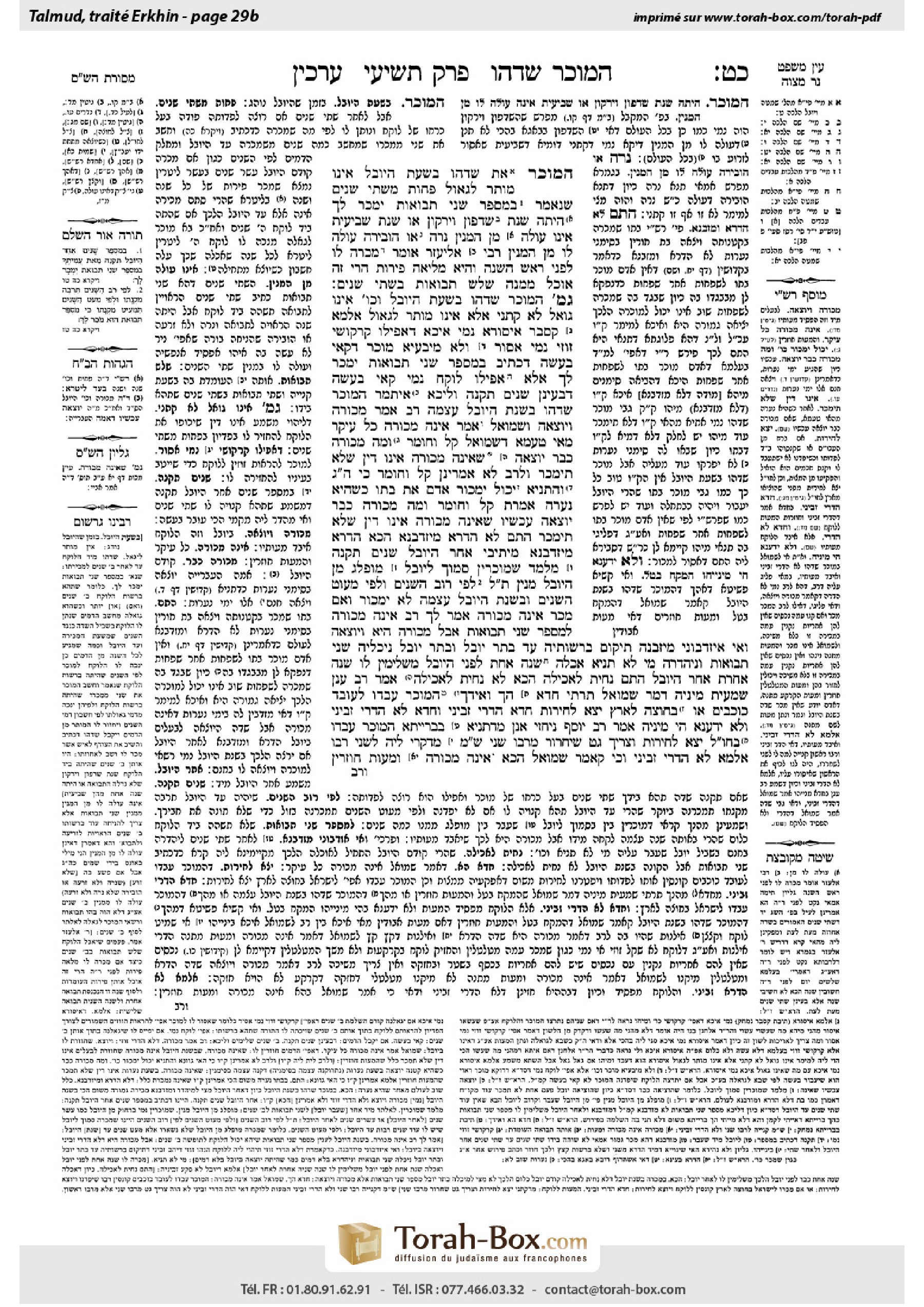
Arakhin 29b: Talmud study for Daf Yomi
Study the Talmud for Daf Yomi with scanned pages, Hebrew text, English translations from Sefaria and AI-generated French translations.
Passage selection and English or AI-generated French translation are available where the scan has annotations. Daf Study is independent of Torah-Box and Sefaria.
Browse Arakhin · ערכין · All tractatesArakhin 29b text and translations
This page of Arakhin includes the Aramaic text, an English translation and an AI-generated French translation, alongside the scan above.
ערכין כ״ט ב · Aramaic and Hebrew text
מַתְנִי׳ הַמּוֹכֵר אֶת שָׂדֵהוּ בִּשְׁעַת הַיּוֹבֵל — אֵינוֹ מוּתָּר לִגְאוֹל פָּחוֹת מִשְׁתֵּי שָׁנִים, שֶׁנֶּאֱמַר: ״בְּמִסְפַּר שְׁנֵי תְבוּאֹת יִמְכׇּר לָךְ״.
הָיְתָה שְׁנַת שִׁדָּפוֹן וְיֵרָקוֹן, אוֹ שְׁנַת שְׁבִיעִית — אֵינָו עוֹלָה מִן הַמִּנְיָן. נָרָהּ אוֹ הוֹבִירָהּ — עוֹלָה לוֹ מִן הַמִּנְיָן. רַבִּי אֱלִיעֶזֶר אוֹמֵר: מְכָרָהּ לוֹ לִפְנֵי רֹאשׁ הַשָּׁנָה וְהִיא מְלֵיאָה פֵּירוֹת — הֲרֵי זֶה אוֹכֵל מִמֶּנָּה שָׁלֹשׁ תְּבוּאוֹת בִּשְׁתֵּי שָׁנִים.
גְּמָ׳ הַמּוֹכֵר שָׂדֵהוּ בִּשְׁעַת הַיּוֹבֵל וְכוּ׳. ״אֵינוֹ גּוֹאֵל״ לָא קָתָנֵי, אֶלָּא ״אֵינוֹ מוּתָּר לִגְאוֹל״, אַלְמָא קָסָבַר: אִיסּוּרָא נָמֵי אִיכָּא, דַּאֲפִילּוּ קַרְקוֹשֵׁי זוּזֵי נָמֵי אָסוּר.
וְלָא מִיבַּעְיָא מוֹכֵר, דְּקָאֵי בַּעֲשֵׂה, דִּכְתִיב: ״בְּמִסְפַּר שְׁנֵי תְבוּאֹת יִמְכׇּר לָךְ״, אֶלָּא אֲפִילּוּ לוֹקֵחַ נָמֵי קָאֵי בַּעֲשֵׂה, דְּבָעֵינַן ״שָׁנִים תִּקְנֶה״, וְלֵיכָּא.
אִיתְּמַר: הַמּוֹכֵר שָׂדֵהוּ בִּשְׁנַת הַיּוֹבֵל עַצְמָהּ, רַב אָמַר: מְכוּרָה וְיוֹצְאָה, וּשְׁמוּאֵל אָמַר: אֵינָהּ מְכוּרָה כׇּל עִיקָּר. מַאי טַעְמָא דִּשְׁמוּאֵל? קַל וָחוֹמֶר, וּמָה מְכוּרָה כְּבָר יוֹצְאָה, שֶׁאֵינָהּ מְכוּרָה אֵינוֹ דִּין שֶׁלֹּא תִּימָּכֵר?
וּלְרַב, לָא אָמְרִינַן קַל וָחוֹמֶר כִּי הַאי גַוְונָא? וְהָתַנְיָא: יָכוֹל יִמְכּוֹר אָדָם אֶת בִּתּוֹ כְּשֶׁהִיא נַעֲרָה? אָמַרְתָּ קַל וָחוֹמֶר: וּמָה מְכוּרָה כְּבָר — יוֹצְאָה עַכְשָׁיו, שֶׁאֵינָהּ מְכוּרָה — אֵינוֹ דִּין שֶׁלֹּא תִּימָּכֵר?
הָתָם לָא הָדְרָא מִיזְדַּבְּנָא, הָכָא הָדְרָא מִיזְדַּבְּנָא.
מֵיתִיבִי: ״אַחַר הַיּוֹבֵל שָׁנִים תִּקְנֶה״ — מְלַמֵּד שֶׁמּוֹכְרִין סָמוּךְ לַיּוֹבֵל, מוּפְלָג מִן הַיּוֹבֵל מִנַּיִן? תַּלְמוּד לוֹמַר: ״לְפִי רֹב הַשָּׁנִים... וּלְפִי מְעוֹט הַשָּׁנִים״.
וּבִשְׁנַת הַיּוֹבֵל עַצְמָהּ לֹא יִמְכּוֹר, וְאִם מָכַר — אֵינָהּ מְכוּרָה! אָמַר לְךָ רַב: אֵינָהּ מְכוּרָה לְמִסְפַּר שְׁנֵי תְבוּאוֹת, אֲבָל מְכוּרָה הִיא וְיוֹצְאָה.
וְאִי אִיזְדַּבּוֹנֵי מִיזְדַּבְּנָה, תֵּיקוּם בִּרְשׁוּתֵיהּ עַד בָּתַר יוֹבֵל, וּבָתַר יוֹבֵל נֵיכְלַיהּ שְׁנֵי תְבוּאוֹת וְנַיהְדְּרַהּ! מִי לָא תַּנְיָא: אֲכָלָהּ שָׁנָה אַחַת לִפְנֵי הַיּוֹבֵל — מַשְׁלִימִין לוֹ שָׁנָה אַחֶרֶת אַחַר הַיּוֹבֵל? הָתָם נָחֵית לַאֲכִילָה, הָכָא לָא נָחֵית לַאֲכִילָה.
אָמַר רַב עָנָן: שְׁמַעִית מִינֵּיהּ דְּמָר שְׁמוּאֵל תַּרְתֵּי, חֲדָא הָךְ, וְאִידַּךְ הַמּוֹכֵר עַבְדּוֹ לְגוֹיִם אוֹ בְּחוּצָה לָאָרֶץ יָצָא לְחֵירוּת.
חֲדָא הָדְרִי זְבִינֵי, וַחֲדָא לָא הָדְרִי זְבִינֵי, וְלָא יָדַעְנָא הֵי (מיניה) [מִינַּיְהוּ].
אָמַר רַב יוֹסֵף: נִיחְזֵי אֲנַן, מִדְּתַנְיָא בְּבָרַיְיתָא: הַמּוֹכֵר עַבְדּוֹ בְּחוּצָה לָאָרֶץ יָצָא לְחֵירוּת, וְצָרִיךְ גֵּט שִׁיחְרוּר מֵרַבּוֹ שֵׁנִי. שְׁמַע מִינַּהּ, מִדְּקָרֵי לֵיהּ לְשֵׁנִי ״רַבּוֹ״, אַלְמָא לָא הָדְרִי זְבִינֵי, וְכִי קָאָמַר שְׁמוּאֵל הָכָא: אֵינָהּ מְכוּרָה וּמָעוֹת חוֹזְרִין.
Arakhin 29b · English translation
MISHNA: One who sells his field during a period when the Jubilee Year is in effect is not permitted to redeem it less than two years after the sale, as it is stated: “According to the number of years of the crops he shall sell to you” (Leviticus 25:15). The plural form “years” indicates a minimum of two years.
If one of those years was a year of blight or mildew, or if it was the Sabbatical Year, when the buyer is unable to derive benefit from the field, that year does not count as part of the tally, and the owner must wait an additional year before redeeming the field. If the buyer plowed the field but did not sow it, or if he left it fallow, that year counts as part of his tally, as it was fit to produce a crop. Rabbi Eliezer says: If the owner of the field sold it to the buyer before Rosh HaShana and the field was full of produce, and the owner redeems the field after two years, that buyer consumes from the field’s produce three crops in two years. Although he received the field with its crop, he is not required to return it in the same state.
GEMARA: The mishna states that one who sells his field during a period when the Jubilee Year is in effect is not permitted to redeem it less than two years after the sale. The Gemara notes: The mishna does not teach that one cannot redeem his field before two years have elapsed; rather, the mishna teaches that one is not permitted to redeem it. Evidently, the tanna of the mishna holds that there is also a prohibition involved in the matter, such that it is prohibited even to rattle dinars before the buyer in order to persuade him to sell back the field.
The Gemara continues: And it is not necessary to state this with regard to the seller, as he stands in violation of a positive mitzva, as it is written: “According to the number of years of the crops he shall sell to you” (Leviticus 25:15), and the plural form “years” indicates a minimum of two years. Rather, even the buyer stands in violation of a positive mitzva, as we require the fulfillment of another mitzva from the same verse: “According to the number of years after the Jubilee Year you shall buy from your neighbor,” and if the buyer returns the field before the two years elapse, the mitzva is not fulfilled.
§ It was stated: With regard to one who sells his field during the Jubilee Year itself, Rav says: The field is sold in principle, but it leaves the buyer’s possession immediately, and his money is not refunded. And Shmuel says: It is not sold at all. The Gemara elaborates: What is the reasoning of Shmuel? Shmuel derives his opinion via an a fortiori inference. And what, if a field that was already sold before the Jubilee Year leaves the possession of the buyer in the Jubilee Year, is it not logical that a field that was not yet sold is not sold at all during the Jubilee Year?
The Gemara asks: And according to Rav, do we not say that one may derive an a fortiori inference in this way? But isn’t it taught in a baraita: One might have thought that a person may sell his daughter as a maidservant when she is a young woman. You can say the following a fortiori inference to reject such a possibility: And what, if a daughter who was already sold, now leaves her master upon becoming a young woman, is it not logical that a daughter who was not sold is not capable of being sold once she becomes a young woman? Evidently, one may derive this type of an a fortiori inference. Why, then, does Rav disagree with Shmuel?
The Gemara answers that the cases are not comparable. There, with regard to a maidservant, once she becomes a young woman she is not ever sold again. Here, the field that is returned to the seller in the Jubilee Year may later be sold again. Rav therefore maintains that one may not derive the aforementioned a fortiori inference.
The Gemara raises an objection to Rav’s opinion from a baraita: The verse states: “According to the number of years after the Jubilee you shall buy from your neighbor” (Leviticus 25:15). The term: After the Jubilee, teaches that a field may be sold in the year adjacent to the Jubilee Year. From where is it derived that a field may be sold in a year that is separated from the Jubilee Year? The verse states: “According to the multitude of the years you shall increase the price thereof, and according to the fewness of the years you shall diminish the price of it” (Leviticus 25:16). The verse teaches that one may sell a field even after several years have elapsed since the last Jubilee Year.
The baraita continues: And in the Jubilee Year itself one may not sell his field, and if one sold it, it is not sold. This baraita clearly seems to contradict the opinion of Rav. The Gemara responds: Rav could say to you: The baraita means that the field is not sold for the number of years of the crops, i.e., it does not remain in the buyer’s possession for a minimum of two years, rather it is sold in principle, and then immediately leaves the buyer’s possession.
The Gemara objects: But if the field is indeed sold, let it stand in the buyer’s possession until after the Jubilee Year, and after the Jubilee Year let him consume the field’s produce for two years of crops, and only then return the field. Isn’t it taught in a baraita: If the buyer consumed the field’s produce for one year before the Jubilee Year, he completes another year after the Jubilee Year? The Gemara explains: The cases are not comparable. There, the buyer already entered the field in order to consume the produce, and therefore he completes the minimum of two years. Here, the buyer did not enter the field to consume the produce at all, as ownership of the field immediately reverts to the seller.
§ Rav Anan says: I learned two halakhot from Master Shmuel. One was this halakha, that if one sells his field during the Jubilee Year the sale is ineffective. And the other halakha concerned one who sells his Canaanite slave to gentiles, or to a Jew who resides outside of Eretz Yisrael, that the slave is emancipated. A Canaanite slave is partially obligated in the fulfillment of mitzvot. By selling him to a gentile, one prevents him from fulfilling the mitzvot, and by selling him to one who dwells outside of Eretz Yisrael, one prevents him from fulfilling the mitzva of dwelling in Eretz Yisrael. The Sages therefore decreed that the Jewish master must write the slave a bill of manumission after the sale, so that if he runs away from his gentile master, he would not reenter servitude under the Jewish master.
Rav Anan continues: With regard to one of these halakhot, Shmuel said that the sale is retracted and the money is refunded, and with regard to one of them, he said that the sale is not retracted and the buyer loses his money. But I do not know in which of the cases the sale is retracted and in which case it is not.
Rav Yosef said: Let us see if it is possible to resolve Rav Anan’s dilemma. It may be resolved from that which is taught in a baraita: In the case of one who sells his slave to a Jew outside of Eretz Yisrael, the slave is emancipated but nevertheless requires a bill of manumission from his second master. Conclude from the baraita as follows: Since the baraita calls the second owner the slave’s master, and requires him to emancipate the slave, evidently the sale is not retracted, and the buyer loses his money. And therefore, when Shmuel says here that the field is not sold during the Jubilee Year, he means that the sale does not take effect and the money is returned to the buyer.
Arakhin 29b · Traduction française (IA)
MICHNA: Celui qui vend son champ pendant une période où l'année sabbatique est en vigueur n'est pas autorisé à le racheter moins de deux ans après la vente, car il est dit : « Selon le nombre d'années des récoltes qu'il te vendra » (Lévitique 25:15). La forme plurielle « années » indique un minimum de deux ans.
Si l'une de ces années était une année de blé pourri ou de moisissure, ou si c'était l'année sabbatique, où l'acheteur ne peut pas tirer profit du champ, cette année ne compte pas dans le calcul, et le propriétaire doit attendre une année supplémentaire avant de racheter le champ. Si l'acheteur a labouré le champ mais n'a pas semé, ou s'il l'a laissé en friche, cette année compte dans le calcul, car le champ était apte à produire une récolte. Rabbi Eliezer dit : Si le propriétaire du champ a vendu le champ à l'acheteur avant Rosh HaShana et que le champ était plein de récoltes, et que le propriétaire rachète le champ après deux ans, l'acheteur peut consommer les récoltes du champ pendant trois récoltes en deux ans. Bien qu'il ait reçu le champ avec ses récoltes, il n'est pas tenu de le rendre dans le même état.
GUEMARA : La mishna indique que celui qui vend son champ pendant une période où l'année sabbatique est en vigueur n'est pas autorisé à le racheter moins de deux ans après la vente. La Guemara note : La mishna ne dit pas que l'on ne peut pas racheter son champ avant que deux ans aient écoulé ; plutôt, la mishna enseigne que l'on n'est pas autorisé à le racheter. Évidemment, le tanna de la mishna considère qu'il y a aussi une interdiction dans cette affaire, de sorte qu'il est interdit même de faire entendre des dinars avant l'acheteur pour le convaincre de lui rendre le champ.
La Guemara continue : Et il n'est pas nécessaire d'insister sur cela concernant le vendeur, car il viole une mitsva positive, car il est écrit : « Selon le nombre d'années des récoltes qu'il te vendra » (Lévitique 25:15), et la forme plurielle « années » indique un minimum de deux ans. Plutôt, même l'acheteur viole une mitsva positive, car nous exigeons la réalisation d'une autre mitsva à partir du même verset : « Selon le nombre d'années après l'année sabbatique tu achèteras de ton voisin », et si l'acheteur rend le champ avant que les deux ans ne soient écoulés, la mitsva n'est pas accomplie.
§ Il a été dit : Concernant celui qui vend son champ pendant l'année sabbatique elle-même, Rav dit : Le champ est vendu en principe, mais il quitte la possession de l'acheteur immédiatement, et son argent n'est pas remboursé. Et Shmuel dit : Il n'est pas vendu du tout. La Guemara développe : Quelle est la raison de Shmuel ? Shmuel dérive son opinion par une inférence a fortiori. Et que, si un champ qui avait déjà été vendu avant l'année sabbatique quitte la possession de l'acheteur pendant l'année sabbatique, n'est-il pas logique que un champ qui n'avait pas encore été vendu ne soit pas vendu du tout pendant l'année sabbatique ?
La Guemara pose une question : Et selon Rav, ne disons-nous pas que l'on peut déduire une inférence a fortiori ainsi ? Mais n'est-il pas enseigné dans une baraïta : On pourrait penser qu'une personne peut vendre sa fille comme servante quand elle est jeune. On peut dire l'inférence a fortiori suivante pour rejeter cette possibilité : Et que, si une fille qui avait déjà été vendue quitte son maître lorsqu'elle devient jeune, n'est-il pas logique que une fille qui n'avait pas été vendue ne soit pas capable d'être vendue une fois qu'elle devient jeune ? Évidemment, on peut déduire ce type d'inférence a fortiori. Pourquoi, alors, Rav diffère-t-il de Shmuel ?
La Guemara répond que les cas ne sont pas comparables. Là, concernant la servante, une fois qu'elle devient jeune femme, elle n'est plus jamais vendue. Ici, le champ qui est rendu au vendeur pendant l'année sabbatique peut être vendu à nouveau plus tard. Rav maintient donc que l'on ne peut pas déduire cette inférence a fortiori.
La Guemara soulève une objection contre l'opinion de Rav à partir d'une baraïta : Le verset dit : « Selon le nombre d'années après l'année sabbatique tu achèteras de ton voisin » (Lévitique 25:15). Le terme : après l'année sabbatique, enseigne qu'un champ peut être vendu dans l'année adjacente à l'année sabbatique. D'où est-il déduit que un champ peut être vendu dans une année séparée de l'année sabbatique ? Le verset dit : « Selon la multitude des années tu augmenteras le prix, et selon la rareté des années tu diminueras le prix » (Lévitique 25:16). Le verset enseigne qu'on peut vendre un champ même après plusieurs années ayant écoulé depuis la dernière année sabbatique.
La baraïta continue : Et pendant l'année sabbatique elle-même on ne peut pas vendre son champ, et si on le vend, il n'est pas vendu. Cette baraïta semble clairement contredire l'opinion de Rav. La Guemara répond : Rav pourrait dire à toi : La baraïta signifie que le champ n'est pas vendu selon le nombre d'années des récoltes, c'est-à-dire qu'il ne reste pas en possession de l'acheteur pendant un minimum de deux ans, mais il est vendu en principe, et quitte immédiatement la possession de l'acheteur.
La Guemara soulève une objection : Mais si le champ est effectivement vendu, qu'il reste en possession de l'acheteur jusqu'après l'année sabbatique, et après l'année sabbatique qu'il consomme les récoltes du champ pendant deux ans, et seulement alors le rendre. N'est-il pas enseigné dans une baraïta : Si l'acheteur a consommé les récoltes du champ pendant une année avant l'année sabbatique, il complète une autre année après l'année sabbatique ? La Guemara explique : Les cas ne sont pas comparables. Là, l'acheteur a déjà entré dans le champ pour consommer les récoltes, et donc il complète le minimum de deux ans. Ici, l'acheteur n'a pas du tout entré dans le champ pour consommer les récoltes, car la propriété du champ reprend immédiatement au vendeur.
§ Rav Anan dit : J'ai appris deux halakhot du maître Shmuel. L'une était celle-ci : si l'on vend son champ pendant l'année sainte, la vente est inefficace. L'autre halakha concernait celui qui vend son esclave cananéen à des non-juifs ou à un juif résidant en dehors de la Terre d'Israël, dans ce cas l'esclave est libéré. Un esclave cananéen est partiellement tenu de remplir les commandements. En le vendant à un non-juif, on empêche ainsi l'esclave de remplir les commandements, et en le vendant à celui qui demeure en dehors de la Terre d'Israël, on empêche l'esclave de remplir la mitsva de demeurer en Terre d'Israël. Les Sages ont donc décrété que le maître juif doit écrire à l'esclave un acte de manumission après la vente, afin que s'il s'échappe de son maître non-juif, il ne retombe pas en servitude sous le maître juif.
Rav Anan continue : En ce qui concerne l'une de ces halakhot, Shmuel a dit que la vente est rétractée et l'argent est remis, et en ce qui concerne l'autre, il a dit que la vente n'est pas rétractée et que l'acheteur perd son argent. Mais je ne sais pas dans quelle des deux situations la vente est rétractée et dans laquelle elle ne l'est pas.
Rav Yosef dit : Examinons si nous pouvons résoudre le dilemme de Rav Anan. Il peut être résolu à partir de ce qui est enseigné dans une baraïta : dans le cas où l'on vend son esclave à un juif en dehors de la Terre d'Israël, l'esclave est libéré, mais il nécessite tout de même un acte de manumission de son second maître. Concluez de la baraïta ainsi : puisque la baraïta appelle le second propriétaire le maître de l'esclave et exige qu'il le libère, il est évident que la vente n'est pas rétractée et que l'acheteur perd son argent. Et donc, lorsque Shmuel dit ici que le champ n'est pas vendu pendant l'année sainte, il veut dire que la vente n'entre pas en vigueur et que l'argent est remis à l'acheteur.
Traduction française générée par IA à partir de l’édition anglaise de Sefaria. Vérifie toujours un passage avec le texte source.
Text from Sefaria: William Davidson Edition - Vocalized Aramaic (CC BY NC); William Davidson Edition - English (CC BY NC).