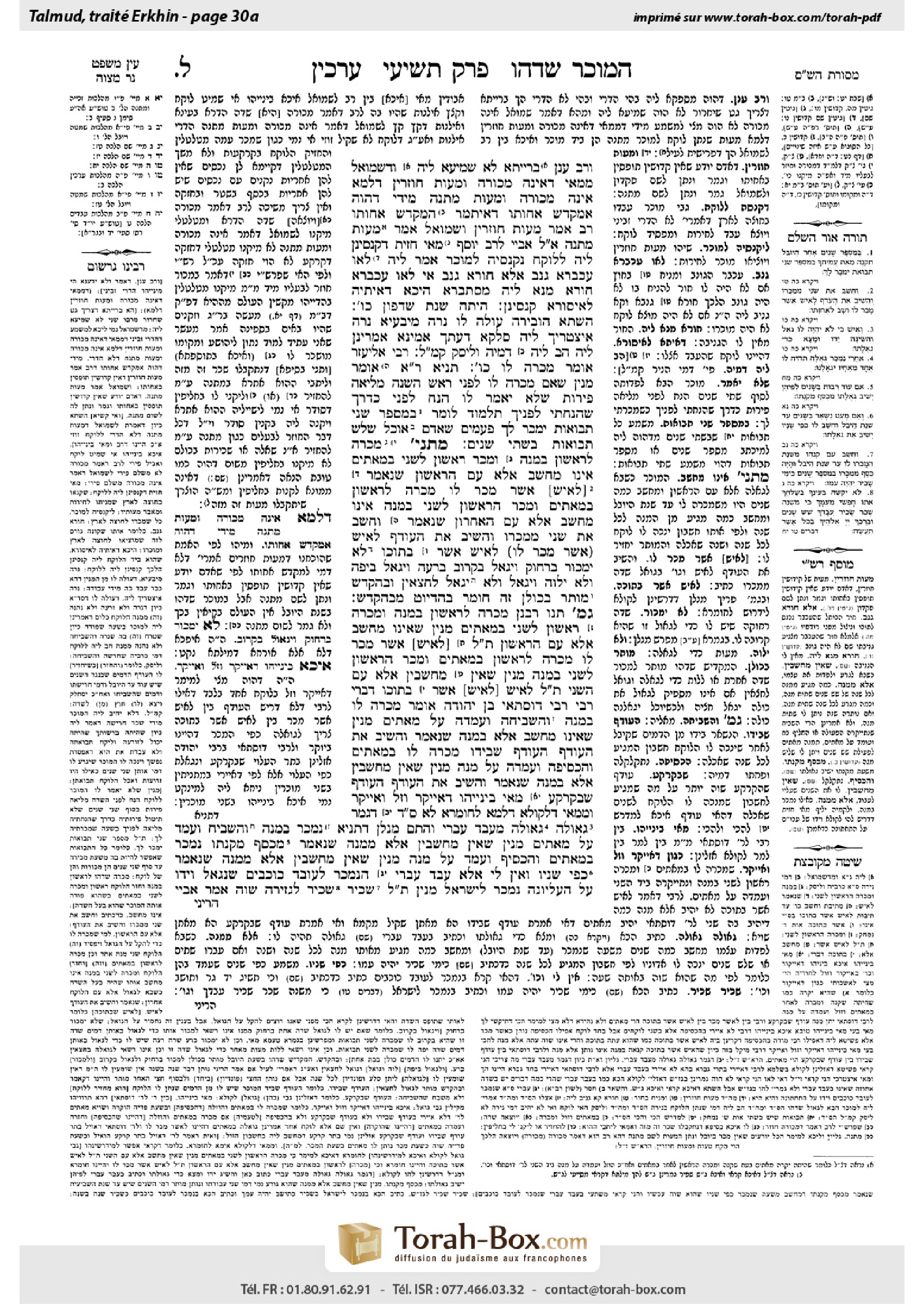
Arakhin 30a: Talmud study for Daf Yomi
Study the Talmud for Daf Yomi with scanned pages, Hebrew text, English translations from Sefaria and AI-generated French translations.
Passage selection and English or AI-generated French translation are available where the scan has annotations. Daf Study is independent of Torah-Box and Sefaria.
Browse Arakhin · ערכין · All tractatesArakhin 30a text and translations
This page of Arakhin includes the Aramaic text, an English translation and an AI-generated French translation, alongside the scan above.
ערכין ל׳ א · Aramaic and Hebrew text
וְרַב עָנָן בָּרָיְיתָא לָא שְׁמִיעָא לֵיהּ, וְדִשְׁמוּאֵל מִמַּאי דְּאֵינָהּ מְכוּרָה וּמָעוֹת חוֹזְרִין? דִּלְמָא אֵינָהּ מְכוּרָה וּמָעוֹת מַתָּנָה, מִידֵּי דְּהָוֵה אַמְּקַדֵּשׁ אֲחוֹתוֹ, דְּאִיתְּמַר: הַמְקַדֵּשׁ אֲחוֹתוֹ — רַב אָמַר: מָעוֹת חוֹזְרִין, וּשְׁמוּאֵל אָמַר: מָעוֹת מַתָּנָה.
אֲמַר לֵיהּ אַבָּיֵי לְרַב יוֹסֵף: מַאי חָזֵית דְּקָנְסִינַן לֵיהּ לְלוֹקֵחַ? נִקְנְסֵיהּ לְמוֹכֵר!
אֲמַר לֵיהּ: לָאו עַכְבְּרָא גַּנָּב, אֶלָּא חוֹרָא גַּנָּב. אִי לָאו עַכְבְּרָא, חוֹרָא מְנָא לֵיהּ? מִסְתַּבְּרָא, הֵיכָא דְּאִיתֵיהּ לְאִיסּוּרָא קָנְסִינַן.
הָיְתָה שְׁנַת שִׁדָּפוֹן כּוּ׳. הַשְׁתָּא הוֹבִירָהּ עוֹלָה לוֹ, נָרָהּ מִיבַּעְיָא?
נָרָהּ אִיצְטְרִיךְ לֵיהּ — סָלְקָא דַּעְתָּךְ אָמֵינָא, אָמְרִינַן לֵיהּ: הַב לֵיהּ דְּמֵיהּ וְלִיסַּק, קָא מַשְׁמַע לַן.
רַבִּי אֱלִיעֶזֶר אוֹמֵר: מְכָרָהּ לוֹ כּוּ׳. תַּנְיָא, רַבִּי אֱלִיעֶזֶר אוֹמֵר: מִנַּיִן שֶׁאִם מְכָרָהּ לוֹ לִפְנֵי רֹאשׁ הַשָּׁנָה מְלֵיאָה פֵּירוֹת, שֶׁלֹּא יֹאמַר לוֹ: ״הַנַּח לְפָנַי כְּדֶרֶךְ שֶׁהִנַּחְתִּי לְפָנֶיךָ״? תַּלְמוּד לוֹמַר: ״בְּמִסְפַּר שְׁנֵי תְּבוּאוֹת יִמְכׇּר לָךְ״, פְּעָמִים שֶׁאָדָם אוֹכֵל שָׁלֹשׁ תְּבוּאוֹת בִּשְׁתֵּי שָׁנִים.
מַתְנִי׳ מְכָרָהּ לָרִאשׁוֹן בְּמָנֶה, וּמָכַר רִאשׁוֹן לַשֵּׁנִי בְּמָאתַיִם, אֵינוֹ מְחַשֵּׁב אֶלָּא עִם הָרִאשׁוֹן, שֶׁנֶּאֱמַר: ״אֲשֶׁר מָכַר לוֹ״.
מְכָרָהּ לָרִאשׁוֹן בְּמָאתַיִם, וּמָכַר הָרִאשׁוֹן לַשֵּׁנִי בְּמָנֶה — אֵינוֹ מְחַשֵּׁב אֶלָּא עִם הָאַחֲרוֹן, שֶׁנֶּאֱמַר: ״וְחִשַּׁב אֶת שְׁנֵי מִמְכָּרוֹ וְהֵשִׁיב אֶת הָעוֹדֵף לָאִישׁ אֲשֶׁר מָכַר לוֹ״, לָאִישׁ אֲשֶׁר בְּתוֹכוֹ.
לֹא יִמְכּוֹר בְּרָחוֹק וְיִגְאַל בְּקָרוֹב, בְּרָעָה וְיִגְאַל בְּיָפָה, וְלֹא יִלְוֶה וְיִגְאַל, וְלֹא יִגְאַל לַחֲצָאִין, וּבַהֶקְדֵּשׁ מוּתָּר בְּכוּלָּן. זֶה חוֹמֶר בַּהֶדְיוֹט מִבַּהֶקְדֵּשׁ.
גְּמָ׳ תָּנוּ רַבָּנַן: מְכָרָהּ לָרִאשׁוֹן בְּמָנֶה, וּמְכָרָהּ רִאשׁוֹן לַשֵּׁנִי בְּמָאתַיִם, מִנַּיִן שֶׁאֵינוֹ מְחַשֵּׁב אֶלָּא עִם הָרִאשׁוֹן? תַּלְמוּד לוֹמַר: ״[לָאִישׁ] אֲשֶׁר מָכַר לוֹ״.
מְכָרָהּ לָרִאשׁוֹן בְּמָאתַיִם, וּמָכַר הָרִאשׁוֹן לַשֵּׁנִי בְּמָנֶה, מִנַּיִן שֶׁאֵין מְחַשְּׁבִין אֶלָּא עִם הַשֵּׁנִי? תַּלְמוּד לוֹמַר: ״לָאִישׁ [לָאִישׁ] אֲשֶׁר בְּתוֹכוֹ״, דִּבְרֵי רַבִּי.
רַבִּי דּוֹסְתַּאי בֶּן יְהוּדָה אוֹמֵר: מְכָרָהּ לוֹ בְּמָנֶה, וְהִשְׁבִּיחָהּ וְעָמְדָה עַל מָאתַיִם, מִנַּיִן שֶׁאֵינוֹ מְחַשֵּׁב אֶלָּא בְּמָנֶה? שֶׁנֶּאֱמַר: ״וְהֵשִׁיב אֶת הָעוֹדֵף״ — הָעוֹדֵף שֶׁבְּיָדוֹ.
מְכָרָהּ לוֹ בְּמָאתַיִם, וְהִכְסִיפָה וְעָמְדָה עַל מָנֶה, מִנַּיִן שֶׁאֵין מְחַשְּׁבִין אֶלָּא בְּמָנֶה? שֶׁנֶּאֱמַר: ״וְהֵשִׁיב אֶת הָעוֹדֵף״ — הָעוֹדֵף שֶׁבַּקַּרְקַע.
מַאי בֵּינַיְיהוּ? דְּאִיַּיקַּר, וְזָל, וְאִיַּיקַּר.
וּמִמַּאי דִּלְקוּלָּא? דִּלְמָא לְחוּמְרָא!
לָא סָלְקָא דַּעְתָּךְ, דְּגָמַר ״גְּאוּלָּה״ ״גְּאוּלָּה״ מֵעֶבֶד עִבְרִי.
וְהָתָם מְנָלַן? דְּתַנְיָא: נִמְכַּר בְּמָנֶה, וְהִשְׁבִּיחַ וְעָמַד עַל מָאתַיִם, מִנַּיִן שֶׁאֵין מְחַשְּׁבִין אֶלָּא מִמָּנֶה? שֶׁנֶּאֱמַר: ״מִכֶּסֶף מִקְנָתוֹ״.
נִמְכַּר בְּמָאתַיִם, וְהִכְסִיף וְעָמַד עַל מָנֶה, מִנַּיִן שֶׁאֵין מְחַשְּׁבִין אֶלָּא מִמָּנֶה? שֶׁנֶּאֱמַר: ״כְּפִי שָׁנָיו״.
וְאֵין לִי אֶלָּא עֶבֶד עִבְרִי הַנִּמְכָּר לְגוֹי, שֶׁנִּגְאָל וְיָדוֹ עַל הָעֶלְיוֹנָה, נִמְכָּר לְיִשְׂרָאֵל מִנַּיִן? תַּלְמוּד לוֹמַר: ״שָׂכִיר״ ״שָׂכִיר״ לִגְזֵירָה שָׁוָה.
אָמַר אַבָּיֵי:
Arakhin 30a · English translation
The Gemara explains: And Rav Anan did not resolve his dilemma from the baraita, as he did not learn this baraita. And he could not resolve it from the statement of Shmuel itself, that the sale of a field during the Jubilee Year is ineffective, as the meaning of Shmuel’s statement is unclear. From where can one infer that Shmuel means that the field is not sold and the money is returned? Perhaps he means that the field is not sold and the money is considered a gift, just as it is considered a gift in his opinion in the case of one who betroths his sister. As it was stated: With regard to one who betroths his sister, a betrothal that is invalid, Rav says that the money with which the brother betrothed his sister is returned, as he knew that the betrothal was invalid and merely intended to deposit the money with her for safekeeping. And Shmuel says that it is assumed that he wished to give her the money as a gift.
The Gemara earlier (29a) cited a baraita that teaches that if one sells his slave to a Jew outside of Eretz Yisrael, the buyer must free the slave. Nevertheless, his money is not refunded. With regard to this, Abaye said to Rav Yosef: What did you see to say, that we penalize the buyer and he loses his money? Let us penalize the seller and require him to refund the money he received, so that he loses both the money and the slave.
Rav Yosef said to Abaye: It is not the mouse that steals; rather, it is the hole that steals, as a mouse cannot steal any item unless he has a hole in which to hide it. In other words, the seller could not have sold his slave outside of Eretz Yisrael had the buyer been unwilling to purchase the slave. Abaye replied: The opposite is also true, namely that if not for the mouse, from where would the hole obtain the stolen item? Had the seller refused to sell his slave, the buyer could not have purchased him and taken him out of Eretz Yisrael. Rav Yosef replied to Abaye: Although both parties are at fault, it stands to reason that we apply the penalty wherever the subject of the prohibition is currently located. Since the buyer is now in possession of the slave, he is the one who is penalized.
§ The mishna teaches: If one of the two years after the sale was a year of blight, the buyer is entitled to an additional year’s crops. If the buyer plowed the field but did not sow it, or if he left it fallow, that year counts as part of his tally, as it was fit to produce a crop. The Gemara asks: Now that it was taught that if the buyer left his field fallow that year counts as part of his tally, even though he did not cultivate the field at all, is it necessary for the mishna to teach that the year counts as part of his tally if he plowed the field but did not sow it?
The Gemara answers: It was necessary to teach the case of a buyer who plowed the field but did not sow it, as it might enter your mind to say that we say to the seller: Give the monetary value of the enhancement of the field to the buyer, and then he will leave the field. The mishna therefore teaches us that the seller does not have to pay him that amount.
§ The mishna states that Rabbi Eliezer says: If the owner of the field sold it to the buyer before Rosh HaShana and the field was full of produce, and the owner redeems the field after two years, the buyer consumes three crops of the field’s produce in two years. With regard to this halakha it is taught in a baraita that Rabbi Eliezer says: From where is it derived that if the owner of the field sold it to the buyer before Rosh HaShana full of produce, that the seller should not say to the buyer when he redeems the field after two years: Leave the field for me full of produce in the manner that I left it for you? The verse states: “According to the number of years of the crops he shall sell to you” (Leviticus 25:15), indicating that the payment is calculated according to the number of years, not according to the number of crops. Consequently, sometimes a person consumes three crops in two years.
MISHNA: When the Jubilee Year is in effect, one may sell a field only until the Jubilee Year, at which point the field returns to its original owner. If the owner redeems the field before the Jubilee Year, the payment per annum is calculated by dividing the sale price by the number of years from the sale until the Jubilee Year. The owner returns the per annum payment multiplied by the number of years remaining until the Jubilee Year. If the owner of a field sold it to the first buyer for one hundred dinars and the first buyer then sold it to the second buyer for two hundred dinars, when the original owner redeems the field he calculates the payment only according to the price that he set with the first buyer, as it is stated: “And he calculates the years of its sale, and he returns the remainder to the man to whom he sold it” (Leviticus 25:27).
If the owner of a field sold it to the first buyer for two hundred dinars and the first buyer then sold it to the second buyer for one hundred dinars, when the original owner redeems the field, he calculates the payment only according to the price that was paid by the last buyer, as it is stated: “And he calculates the years of its sale, and he returns the remainder to the man to whom he sold it.” The superfluous term “to the man” indicates that the verse is referring to the man who is currently in possession of the field.
One may not sell his ancestral field that is located in a distant area and redeem with the proceeds a field that he sold in a nearby area. Likewise, he may not sell a low-quality field and redeem with the proceeds a high-quality field. And he may not borrow money and redeem the field, nor may he redeem the field incrementally, half now and half at a later date. But with regard to redeeming a field from the Temple treasury, it is permitted to redeem the field in any of these ways. This is a halakha where greater stringency applies with regard to redeeming a field from an ordinary individual than with regard to redeeming it from the Temple treasury.
GEMARA: The Sages taught: Consider the case where the owner of a field sold it to the first buyer for one hundred dinars and the first buyer then sold it to the second buyer for two hundred dinars. From where is it derived that when the original owner redeems the field, he calculates the payment only according to the price that he set with the first buyer? The verse states: “And he calculates the years of its sale, and he returns the remainder to the man to whom he sold it” (Leviticus 25:27).
Now consider the case where the owner of a field sold it to the first buyer for two hundred dinars and the first buyer then sold it to the second buyer for one hundred dinars. From where is it derived that when the original owner redeems the field, the payment is calculated only according to the price that was paid by the second buyer? The verse states: “And he returns the remainder to the man to whom he sold it.” The superfluous term “to the man” indicates that the verse is referring to the man who is currently in possession of the field. This is the statement of Rabbi Yehuda HaNasi.
Rabbi Dostai ben Yehuda says that the verse should be interpreted differently: Consider the case where the owner of a field sold it to the buyer for one hundred dinars, and the field appreciated in value while in the buyer’s possession and its value stood at two hundred dinars. From where is it derived that when the seller redeems the field he calculates the payment only according to the one hundred dinars he originally received for the field?As it is stated: “And he returns the remainder to the man to whom he sold it,” that is, the seller returns only the remainder of the original payment that is in his possession.
Rabbi Dostai ben Yehuda continues: Consider the case where the owner of a field sold it to the buyer for two hundred dinars, and the field depreciated in value while in the buyer’s possession and its value stood at one hundred dinars. From where is it derived that when the seller redeems the field, the payment is calculated only according to the one hundred dinars the field is currently worth? As it is stated: “And he returns the remainder to the man to whom he sold it,” i.e., he returns that which now remains of the value of the land.
The Gemara asks: What is the practical difference between the opinions of Rabbi Yehuda HaNasi and Rabbi Dostai ben Yehuda? The Gemara responds: The practical difference between them is in a case where the field’s value was high at the time of the first sale, e.g., it was worth two hundred dinars, and when the field was sold a second time it had depreciated in value and was worth only one hundred dinars. And when the original owner came to redeem it, it again appreciated in value until it was worth two hundred dinars. According to Rabbi Yehuda HaNasi, the redemption payment is calculated according to the one hundred dinars paid by the second buyer for the field. According to Rabbi Dostai ben Yehuda, it is calculated either according to the remainder of the original payment or according to that which now remains of the value of the land. Either way, it is calculated according to the remainder of two hundred dinars.
The aforementioned practical difference aside, Rabbi Yehuda HaNasi and Rabbi Dostai ben Yehuda agree that the verses are interpreted in a manner that benefits the original owner. The Gemara asks: And from where is it derived that the verses should be interpreted as a leniency for the seller? Perhaps they should be interpreted as a stringency for the seller.
The Gemara responds: Such a possibility should not enter your mind, as it is learned by means of a verbal analogy between the term “redemption” written in this context and “redemption” from the passage discussing a Hebrew slave that the Torah is lenient with regard to the redeemer. The verse states with regard to the redemption of a field: “And he prospers and finds sufficient means to redeem it” (Leviticus 25:26), and with regard to the redemption of a slave who was sold to a gentile, the verse states: “After he is sold he shall attain redemption” (Leviticus 25:48). Accordingly, just as the Torah is lenient with regard to the redemption of a Hebrew slave, so too the Torah is lenient with regard to redeeming a field.
The Gemara asks: And there, in the case of a Hebrew slave, from where do we derive that the Torah is lenient with regard to his redemption? The Gemara responds: As it is taught in a baraita: Consider the case of a Hebrew slave who was sold for one hundred dinars, and he appreciated in value during his term of servitude and his value stood at two hundred dinars. From where is it derived that if he redeems himself, the sum he pays for the remaining years of his service is calculated only according to the one hundred dinars for which he was originally sold? As it is stated: “If there are yet many years, according to them he shall return the price of his redemption from the money of his purchase” (Leviticus 25:51).
The baraita continues: Consider the case of a Hebrew slave who was sold for two hundred dinars, and he depreciated in value during his term and his value stood at one hundred dinars. From where is it derived that if he redeems himself, the sum he pays for the remaining years of his service is calculated only according to the one hundred dinars he is currently worth? As it is stated: “According to his years he shall return the price of his redemption” (Leviticus 25:52). The verse indicates that the sum is calculated according to the value of his remaining years of service.
The baraita continues: And I have derived only with regard to a Hebrew slave who was sold to a gentile, that he is redeemed and that he has the advantage, as the price of his redemption is always calculated according to the lesser value. From where is it derived that this halakha also applies in the case of a Hebrew slave who was sold to a Jew? The verse states: “Hired worker,” “hired worker,” in order to derive a verbal analogy, indicating that this halakha applies both to a slave sold to a gentile and to one sold to a Jew. The verse states with regard to a slave sold to a gentile: “According to the time of a hired worker shall he be with him” (Leviticus 25:50), and with regard to a slave sold to a Jew, the verse states: “For double the hire of a hired worker he served you six years” (Deuteronomy 15:18).
The Gemara relates that Abaye said:
Arakhin 30a · Traduction française (IA)
La Guemara explique que Rav Anan n’a pas résolu son dilemme à partir de la baraïta, car il n’avait pas appris cette baraïta. Il n’a pas pu non plus le résoudre à partir de la déclaration de Shmuel lui-même, que la vente d’un champ pendant l’année sainte est inefficace, car le sens de cette déclaration est ambigu. D’où peut-on déduire que Shmuel veut dire que le champ n’est pas vendu et que l’argent est rendu ? Peut-être veut-il dire que le champ n’est pas vendu et que l’argent est considéré comme un cadeau, tout comme il est considéré comme un cadeau selon son avis dans le cas d’un homme qui fiance sa sœur. Comme il a été dit : En ce qui concerne l’homme qui fiance sa sœur, un fiancement invalide, Rav dit que l’argent avec lequel le frère a fiancé sa sœur est rendu, car il savait que le fiancement était invalide et voulait simplement déposer l’argent chez elle pour la garder en sécurité. Et Shmuel dit qu’on suppose qu’il voulait lui donner l’argent en cadeau.
La Guemara avait cité plus tôt (29a) une baraïta qui enseigne que si l’on vend un esclave à un Juif en dehors de la Terre d’Israël, l’acheteur doit libérer l’esclave. Cependant, son argent n’est pas remboursé. À ce sujet, Abaye a dit à Rav Yosef : Qu’est-ce que tu as vu pour dire que nous pénalisons l’acheteur et qu’il perd son argent ? Laissons pénaliser le vendeur et exigeons qu’il rembourse l’argent qu’il a reçu, de sorte qu’il perde à la fois l’argent et l’esclave.
Rav Yosef a dit à Abaye : Ce n’est pas la souris qui vole ; c’est le trou qui vole, car une souris ne peut voler aucun objet sans avoir un trou où se cacher. En d’autres termes, le vendeur n’aurait pas pu vendre son esclave en dehors de la Terre d’Israël si l’acheteur n’avait pas été prêt à l’acheter. Abaye a répondu : L’inverse est également vrai, c’est-à-dire que si non pas la souris, d’où le trou obtiendrait l’objet volé ? Si le vendeur avait refusé de vendre son esclave, l’acheteur n’aurait pas pu l’acheter et le sortir de la Terre d’Israël. Rav Yosef a répondu à Abaye : Bien que les deux parties soient coupables, il est logique que nous appliquions la pénalité là où se trouve actuellement l’objet de la prohibition. Comme l’acheteur est désormais en possession de l’esclave, c’est lui qui est pénalisé.
§ La mitsna enseigne : Si l’un des deux ans après la vente a été une année de blé pourri, l’acheteur a droit à une année supplémentaire de récolte. Si l’acheteur a labouré le champ mais n’a pas semé, ou s’il l’a laissé en friche, cette année compte dans son calcul, car elle était propre à produire une récolte. La Guemara demande : Maintenant que cela a été enseigné que si l’acheteur a laissé son champ en friche, cette année compte dans son calcul, même s’il n’a pas cultivé le champ du tout, est-il nécessaire que la mitsna enseigne que cette année compte dans son calcul si l’acheteur a labouré le champ mais n’a pas semé ?
La Guemara répond : Il était nécessaire d’enseigner le cas d’un acheteur qui a labouré le champ mais n’a pas semé, car cela pourrait entrer dans votre esprit de dire que nous disons au vendeur : Donnez la valeur de l’amélioration du champ à l’acheteur, et alors il laissera le champ. La mitsna nous enseigne donc que le vendeur n’a pas à lui payer cette somme.
§ La mitsna stipule que Rabbi Eliezer dit : Si l’propriétaire du champ a vendu le champ à l’acheteur avant Rosh HaShana et que le champ était plein de récolte, et que l’propriétaire rachète le champ après deux ans, l’acheteur consomme trois récoltes du champ dans deux ans. En ce qui concerne cette halakha, il est enseigné dans une baraïta que Rabbi Eliezer dit : D’où est-il déduit que si l’propriétaire du champ a vendu le champ à l’acheteur avant Rosh HaShana plein de récolte, que le vendeur ne doive pas dire à l’acheteur lorsqu’il rachète le champ après deux ans : Laissez le champ pour moi plein de récolte dans la manière dont je l’ai laissé pour vous ? La Sainte Écriture dit : « Selon le nombre d’années des récoltes il le vendra à toi » (Lévitique 25:15), indiquant que le paiement est calculé selon le nombre d’années, pas selon le nombre de récoltes. Ainsi, parfois un homme consomme trois récoltes en deux ans.
MICHNA : Lorsque l’année sainte est en vigueur, on peut vendre un champ uniquement jusqu’à l’année sainte, à laquelle point le champ retourne à son propriétaire original. Si l’propriétaire rachète le champ avant l’année sainte, le paiement annuel est calculé en divisant le prix de vente par le nombre d’années entre la vente et l’année sainte. L’propriétaire rend le paiement annuel multiplié par le nombre d’années restants jusqu’à l’année sainte. Si l’propriétaire d’un champ a vendu le champ au premier acheteur pour cent dinars et que le premier acheteur a ensuite vendu le champ au deuxième acheteur pour deux cents dinars, lorsqu’il rachète le champ l’propriétaire calcule le paiement uniquement selon le prix qu’il a fixé avec le premier acheteur, car il est dit : « Et il calcule les années de sa vente, et il rend le reste à l’homme à qui il a vendu » (Lévitique 25:27).
Si l’propriétaire d’un champ a vendu le champ au premier acheteur pour deux cents dinars et que le premier acheteur a ensuite vendu le champ au deuxième acheteur pour cent dinars, lorsqu’il rachète le champ, l’propriétaire calcule le paiement uniquement selon le prix payé par l’acheteur dernier, car il est dit : « Et il calcule les années de sa vente, et il rend le reste à l’homme à qui il a vendu. » Le terme superflu « à l’homme » indique que la Sainte Écriture fait référence à l’homme qui est actuellement en possession du champ.
On ne peut pas vendre son champ ancestral situé dans une région éloignée et racheter avec les recettes un champ qu’il a vendu dans une région proche. De même, on ne peut pas vendre un champ de mauvaise qualité et racheter avec les recettes un champ de bonne qualité. Et on ne peut pas emprunter de l’argent pour racheter le champ, ni racheter le champ progressivement, la moitié maintenant et la moitié plus tard. Mais en ce qui concerne le rachat d’un champ auprès du trésor du Temple, il est permis de racheter le champ de toutes ces manières. C’est une halakha où une stricte application s’applique au rachat d’un champ auprès d’un individu ordinaire par rapport au rachat auprès du trésor du Temple.
GUEMARA : Les Sages enseignent : Imaginons le cas où un propriétaire d'un champ vend ce champ au premier acheteur pour cent drachmes, et que ce premier acheteur le vend ensuite au deuxième acheteur pour deux cents drachmes. D'où vient qu'il est déduit que lorsqu'il rédempte le champ, le propriétaire original calcule le paiement uniquement selon le prix qu'il a fixé avec le premier acheteur ? La Sainte Écriture dit : « Et il compte les années de sa vente, et il rend la différence à l'homme à qui il a vendu » (Lévitique 25:27).
Imaginons maintenant le cas où le propriétaire d'un champ vend ce champ au premier acheteur pour deux cents drachmes, et que ce premier acheteur le vend ensuite au deuxième acheteur pour cent drachmes. D'où vient qu'il est déduit que lorsqu'il rédempte le champ, le paiement est calculé uniquement selon le prix payé par le deuxième acheteur ? La Sainte Écriture dit : « Et il rend la différence à l'homme à qui il a vendu. » Le terme superflu « à l'homme » indique que la Sainte Écriture fait référence à l'homme qui possède actuellement le champ. C'est la déclaration de Rabbi Yéhouda Hanassi.
Rabbi Dostai ben Yéhouda dit que la Sainte Écriture doit être interprétée différemment : Imaginons le cas où le propriétaire d'un champ vend ce champ à l'acheteur pour cent drachmes, et que le champ augmente en valeur pendant la possession de l'acheteur, et que sa valeur est de deux cents drachmes. D'où vient qu'il est déduit que lorsqu'il rédempte le champ, le propriétaire calcule le paiement uniquement selon les cent drachmes qu'il a originellement reçus pour le champ ? Comme il est dit : « Et il rend la différence à l'homme à qui il a vendu », c'est-à-dire que le vendeur rend seulement la différence du paiement originel qui est en son possession.
Rabbi Dostai ben Yéhouda continue : Imaginons le cas où le propriétaire d'un champ vend ce champ à l'acheteur pour deux cents drachmes, et que le champ diminue en valeur pendant la possession de l'acheteur, et que sa valeur est de cent drachmes. D'où vient qu'il est déduit que lorsqu'il rédempte le champ, le paiement est calculé uniquement selon les cent drachmes que le champ vaut actuellement ? Comme il est dit : « Et il rend la différence à l'homme à qui il a vendu », c'est-à-dire qu'il rend ce qui reste maintenant de la valeur du champ.
La Guemara pose la question : Quelle est la différence pratique entre les opinions de Rabbi Yéhouda Hanassi et de Rabbi Dostai ben Yéhouda ? La Guemara répond : La différence pratique entre eux est dans le cas où la valeur du champ était élevée lors de la première vente, par exemple, elle valait deux cents drachmes, et lorsqu'elle a été vendue une deuxième fois, elle avait diminué en valeur et valait seulement cent drachmes. Et lorsqu'il a fallu rédempter le champ, il a à nouveau augmenté en valeur jusqu'à valoir deux cents drachmes. Selon Rabbi Yéhouda Hanassi, le paiement de rédemption est calculé selon les cent drachmes payés par le deuxième acheteur pour le champ. Selon Rabbi Dostai ben Yéhouda, il est calculé soit selon la différence du paiement originel, soit selon ce qui reste actuellement de la valeur du champ. Dans les deux cas, il est calculé selon la différence de deux cents drachmes.
À l'exception de cette différence pratique, Rabbi Yéhouda Hanassi et Rabbi Dostai ben Yéhouda s'accordent sur le fait que les versets sont interprétés de manière à bénéficier au propriétaire original. La Guemara pose la question : Et d'où vient qu'il est déduit que les versets doivent être interprétés comme une facilité pour le vendeur ? Peut-être qu'ils devraient être interprétés comme une restriction pour le vendeur.
La Guemara répond : Une telle possibilité ne devrait pas entrer en votre esprit, car elle est apprise par analogie verbale entre le terme « rédemption » utilisé dans ce contexte et « rédemption » dans le passage concernant l'esclave juif, la Torah étant favorable envers le rédempteur. La Sainte Écriture dit concernant la rédemption du champ : « Et il prospère et trouve suffisamment de moyens pour le rédempter » (Lévitique 25:26), et concernant la rédemption de l'esclave qui a été vendu à un non-Juif, la Sainté Écriture dit : « Après qu'il a été vendu, il atteindra la rédemption » (Lévitique 25:48). Ainsi, comme la Torah est favorable envers la rédemption de l'esclave juif, de même la Torah est favorable envers la rédemption du champ.
La Guemara pose la question : Et là, dans le cas de l'esclave juif, d'où déduit-on que la Torah est favorable envers sa rédemption ? La Guemara répond : Comme il est enseigné dans une baraïta : Imaginons le cas de l'esclave juif qui a été vendu pour cent drachmes, et qui a augmenté en valeur pendant sa période de servitude, et dont la valeur est de deux cents drachmes. D'où vient qu'il est déduit que si il se rédempte, la somme qu'il paie pour les années restantes de son service est calculée uniquement selon les cent drachmes pour lesquels il a été originellement vendu ? Comme il est dit : « Si il reste encore beaucoup d'années, selon elles il rendra le prix de sa rédemption à partir de l'argent de sa vente » (Lévitique 25:51).
La baraïta continue : Imaginons le cas d'un esclave juif qui a été vendu pour deux cents drachmes, et qui a diminué en valeur pendant sa période de servitude, et dont la valeur est de cent drachmes. D'où vient qu'il est déduit que si il se rédempte, la somme qu'il paie pour les années restantes de son service est calculée uniquement selon les cent drachmes qu'il vaut actuellement ? Comme il est dit : « Selon ses années il rendra le prix de sa rédemption » (Lévitique 25:52). Le verset indique que la somme est calculée selon la valeur de ses années restantes de service.
La baraïta continue : Et je dérive cela uniquement concernant un serviteur israélite vendu à un non-juif, qu'il soit racheté et qu'il ait l'avantage, car le prix de son rachat est toujours calculé selon la valeur moindre. D'où tire-t-on que cette halakha s'applique également dans le cas d'un serviteur israélite vendu à un juif ? La Parashah dit : « Ouvrier engagé », « ouvrier engagé », afin de déduire une analogie verbale, indiquant que cette halakha s'applique à la fois à un serviteur vendu à un non-juif et à un serviteur vendu à un juif. La Parashah dit concernant un serviteur vendu à un non-juif : « Selon le temps d'un ouvrier engagé, il restera avec lui » (Lévitique 25:50), et concernant un serviteur vendu à un juif, la Parashah dit : « Pour double le salaire d'un ouvrier engagé, il a travaillé pour toi six ans » (Dt 15:18).
Le Guemara rapporte que Abaye a dit :
Traduction française générée par IA à partir de l’édition anglaise de Sefaria. Vérifie toujours un passage avec le texte source.
Text from Sefaria: William Davidson Edition - Vocalized Aramaic (CC BY NC); William Davidson Edition - English (CC BY NC).