Arakhin 2a: Talmud study for Daf Yomi
Study the Talmud for Daf Yomi with scanned pages, Hebrew text, English translations from Sefaria and AI-generated French translations.
Passage selection and English or AI-generated French translation are available where the scan has annotations. Daf Study is independent of Torah-Box and Sefaria.
Browse Arakhin · ערכין · All tractatesArakhin 2a text and translations
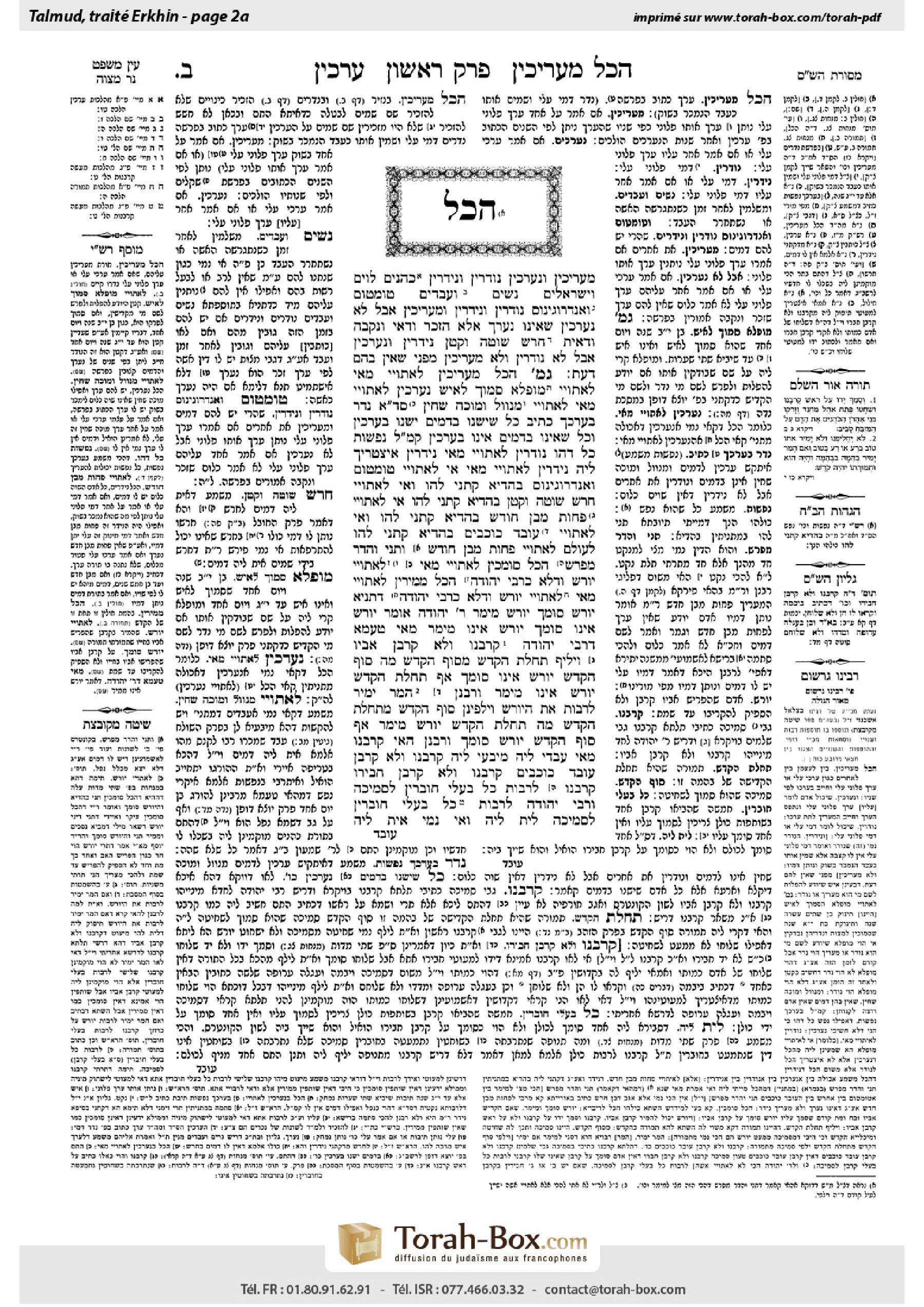
This page of Arakhin includes the Aramaic text, an English translation and an AI-generated French translation, alongside the scan above.
ערכין ב׳ א · Aramaic and Hebrew text
מַתְנִי׳ הַכֹּל מַעֲרִיכִין, וְנֶעֱרָכִין, נוֹדְרִין וְנִידָּרִין — כֹּהֲנִים, לֹוִים וְיִשְׂרְאֵלִים, נָשִׁים וַעֲבָדִים.
טוּמְטוּם וְאַנְדְּרוֹגִינוֹס, נוֹדְרִין וְנִידָּרִין וּמַעֲרִיכִין, אֲבָל לֹא נֶעֱרָכִין, שֶׁאֵינוֹ נֶעֱרָךְ אֶלָּא הַזָּכָר וַדַּאי וּנְקֵבָה וַדָּאִית.
חֵרֵשׁ שׁוֹטֶה וְקָטָן נִידָּרִין וְנֶעֱרָכִין, אֲבָל לֹא נוֹדְרִין וְלֹא מַעֲרִיכִין, מִפְּנֵי שֶׁאֵין בָּהֶם דַּעַת.
גְּמָ׳ ״הַכֹּל מַעֲרִיכִין״ — לְאֵתוֹיֵי מַאי? לְאֵתוֹיֵי מוּפְלָא סָמוּךְ לְאִישׁ.
״נֶעֱרָכִין״ — לְאֵתוֹיֵי מַאי? לְאֵתוֹיֵי מְנוָּּול וּמוּכֵּה שְׁחִין.
סָלְקָא דַּעְתָּךְ אָמֵינָא: ״נֶדֶר בְּעֶרְכְּךָ״ כְּתִיב, כֹּל שֶׁיֶּשְׁנוֹ בְּדָמִים — יֶשְׁנוֹ בַּעֲרָכִין, וְכֹל שֶׁאֵינוֹ בְּדָמִים — אֵינוֹ בַּעֲרָכִין.
קָא מַשְׁמַע לַן ״נְפָשֹׁת״, כָּל דְּהוּ.
״נוֹדְרִין״ — לְאֵתוֹיֵי מַאי? נִידָּרִין אִיצְטְרִיךְ לֵיהּ.
״נִידָּרִין״ — לְאֵתוֹיֵי מַאי? אִי לְאֵתוֹיֵי טוּמְטוּם וְאַנְדְּרוֹגִינוֹס — בְּהֶדְיָא קָתָנֵי לְהוּ! וְאִי לְאֵתוֹיֵי חֵרֵשׁ שׁוֹטֶה וְקָטָן — בְּהֶדְיָא קָתָנֵי לְהוּ!
אִי לְאֵתוֹיֵי פָּחוֹת מִבֶּן חוֹדֶשׁ, בְּהֶדְיָא קָתָנֵי לְהוּ! וְאִי לְאֵתוֹיֵי נָכְרִי, בְּהֶדְיָא קָתָנֵי לְהוּ! לְעוֹלָם לְאֵתוֹיֵי פָּחוֹת מִבֶּן חוֹדֶשׁ, וְתָנֵי וַהֲדַר מְפָרֵשׁ.
״הַכֹּל סוֹמְכִין״ — לְאֵתוֹיֵי מַאי? לְאֵתוֹיֵי יוֹרֵשׁ, וּדְלָא כְּרַבִּי יְהוּדָה.
״הַכֹּל מְמִירִין״ — לְאֵתוֹיֵי מַאי? לְאֵתוֹיֵי יוֹרֵשׁ, וּדְלָא כְּרַבִּי יְהוּדָה.
דְּתַנְיָא: יוֹרֵשׁ סוֹמֵךְ, יוֹרֵשׁ מֵימֵר. רַבִּי יְהוּדָה אוֹמֵר: יוֹרֵשׁ אֵינוֹ סוֹמֵךְ, יוֹרֵשׁ אֵינוֹ מֵימֵר.
מַאי טַעְמָא דְּרַבִּי יְהוּדָה? ״קׇרְבָּנוֹ״ וְלֹא קׇרְבַּן אָבִיו, וְיָלֵיף תְּחִלַּת הֶקְדֵּשׁ מִסּוֹף הֶקְדֵּשׁ — מָה סוֹף הֶקְדֵּשׁ יוֹרֵשׁ אֵינוֹ סוֹמֵךְ, אַף תְּחִלַּת הֶקְדֵּשׁ יוֹרֵשׁ אֵינוֹ מֵימֵר.
וְרַבָּנַן, הָמֵר יָמִיר — לְרַבּוֹת אֶת הַיּוֹרֵשׁ, וְיָלְפִינַן סוֹף הֶקְדֵּשׁ מִתְּחִלַּת הֶקְדֵּשׁ: מָה תְּחִלַּת הֶקְדֵּשׁ — יוֹרֵשׁ מֵימֵר, אַף סוֹף הֶקְדֵּשׁ — יוֹרֵשׁ סוֹמֵךְ.
וְרַבָּנַן, הַאי ״קׇרְבָּנוֹ״ מַאי עָבְדִי לֵיהּ? מִיבְּעֵי לֵיהּ: ״קׇרְבָּנוֹ״ — וְלֹא קׇרְבַּן גּוֹי, ״קׇרְבָּנוֹ״ — וְלֹא קׇרְבַּן חֲבֵירוֹ, ״קׇרְבָּנוֹ״ — לְרַבּוֹת כׇּל בַּעֲלֵי חוֹבְרִין לִסְמִיכָה.
וְרַבִּי יְהוּדָה, לְרַבּוֹת כׇּל בַּעֲלֵי חוֹבְרִין לִסְמִיכָה לֵית לֵיהּ, וְאִי נָמֵי אִית לֵיהּ,
Arakhin 2a · English translation
MISHNA: Everyone takes vows of valuation and is thereby obligated to donate to the Temple treasury the value fixed by the Torah (see Leviticus 27:3–7) for the age and sex of the person valuated. And similarly, everyone is valuated, and therefore one who vowed to donate his fixed value is obligated to pay. Likewise, everyone vows to donate to the Temple treasury the assessment of a person, based on his market value to be sold as a slave, and is thereby obligated to pay; and everyone is the object of a vow if others vowed to donate his assessment. This includes priests, Levites and Israelites, women, and Canaanite slaves.
A tumtum, whose sexual organs are concealed, and a hermaphrodite [androginos], vow, and are the object of a vow, and take vows of valuation, but they are not valuated. Consequently, if one says, with regard to a tumtum: The valuation of so-and-so is incumbent upon me to donate to the Temple treasury, he is not obligated to pay anything, as only a definite male or a definite female are valuated.
A deaf-mute, an imbecile, and a minor are the object of a vow and are valuated, but neither vow to donate the assessment of a person nor take a vow of valuation, because they lack the presumed mental competence to make a commitment.
GEMARA: The Gemara asks: What is added by the mishna’s statement: Everyone [hakol] takes vows of valuation? When a principle is stated in a mishna, it serves to include a particular case that it does not mention explicitly in its halakha. Which case is included by the broad statement here? The Gemara answers: The mishna teaches it to add a discriminating minor on the brink of adulthood [mufla samukh le’ish], i.e., during the year before a minor reaches majority.
The Gemara similarly asks: What is added by the statement: And everyone is valuated? The Gemara answers: The mishna serves to add a repulsive man and one afflicted with boils, who have no market value.
The Gemara explains why this addition is necessary: It might enter your mind to say that as it is written in the verse: “A vow of persons to the Lord, according to your valuation” (Leviticus 27:2), which juxtaposes one who is valuated to one who is the object of a vow, anyone who is included in the category of assessments, i.e., if he vows to pay his assessment he must pay it to the Temple, is also included in the category of valuations. But anyone who is not included in the category of assessments is not included in the category of valuations. Since these people, a repulsive man and one afflicted with boils, are not subject to assessment, as they have no market value, perhaps they are also not subject to valuation.
Therefore, the mishna teaches us that these too are subject to valuation, as the same verse also states: “Persons [nefashot],” indicating anyone who has any amount of life [nefesh] is subject to valuation.
The Gemara further asks: What is added by the mishna’s statement: Everyone vows to donate the assessment of a person? The Gemara answers: Actually, this statement is not necessary, but it is mentioned because the continuation: And everyone is the object of a vow, was necessary.
The Gemara inquires: What, then, is added by the clause: And everyone is the object of a vow? If one were to suggest that this serves to add a tumtum and a hermaphrodite, that cannot be correct, as they are explicitly taught in the mishna itself. And if one were to suggest that it serves to add a deaf-mute, an imbecile, and a minor, they too are explicitly taught in the mishna.
And if you say that this clause serves to add the halakha that a child who is less than a month old, who is not subject to valuation, is nevertheless subject to assessment, this too is explicitly taught in a mishna (5a). And if one were to say that it serves to add a gentile, that is also explicitly taught in a mishna (5b). The Gemara answers: Actually, the phrase: And everyone is the object of a vow, is mentioned in the mishna in order to add a child who is less than a month old, and the mishna teaches this halakha in general terms and then explains it in detail later.
§ The Gemara inquires about similar general expressions that appear in other mishnayot. What is added by the mishna (Menaḥot 93a): Everyone who brings an offering places hands on the head of the animal? The Gemara answers: This clause serves to add that an heir places hands on the offering of the deceased, and the mishna is not in accordance with the opinion of Rabbi Yehuda that an heir does not place his hands on an offering he inherited.
The Gemara asks: What is added by the ruling of the mishna (Temura 2a): Everyone substitutes a non-sacred animal for a consecrated animal? The Gemara answers: Here too, the mishna serves to add that an heir substitutes a non-sacred animal for his father’s consecrated animal, i.e., the non-sacred animal also becomes sanctified. And this mishna is also not in accordance with the opinion of Rabbi Yehuda, as he maintains that an heir cannot substitute a non-sacred animal for the consecrated animal he inherited.
The Gemara cites the source for these two opinions of Rabbi Yehuda. As it is taught in a baraita: An heir places hands on his father’s offering, and an heir can effect substitution for an offering inherited from his father. Rabbi Yehuda says: An heir does not place hands and an heir cannot effect substitution.
The Gemara asks: What is the reasoning of Rabbi Yehuda? With regard to placing of hands, he expounds the term: “His offering” (Leviticus 3:2), as teaching that one places his hands only on his own offering, but not on his father’s offering. And with regard to the ruling that an heir cannot effect substitution, Rabbi Yehuda derives the halakha of the initial stage of consecration, i.e., substitution, in which a previously non-sacred animal is consecrated, from the final stage of consecration, the act of placing hands, which is performed upon an already-consecrated animal immediately before it is slaughtered: Just as with regard to the final stage of consecration, an heir does not place hands, so too, with regard to the initial stage of consecration, an heir cannot effect substitution.
And from where do the Rabbis derive their opinion? The verse states: “If he shall substitute [hamer yamir] animal for animal” (Leviticus 27:10), with the doubled form of hamer yamir serving to include the heir as one capable of effecting substitution. And the Rabbis derive the final stage of consecration, i.e., the placing of hands, from the initial stage of consecration, i.e., substitution: Just as with regard to the initial stage of consecration an heir can effect substitution, so too, with regard to the final stage of consecration, an heir can place hands.
The Gemara asks: And as for the Rabbis, what do they do with this term: “His offering,” from which Rabbi Yehuda derives that an heir does not place his hands? The Gemara explains how the Rabbis expound each mention of the term, which appears three times (Leviticus 3:2, 7, 12). One instance of “his offering” teaches that one places hands only on one’s own offering, but not on the offering of a gentile. Another instance of “his offering” teaches that one places hands only on one’s own offering, but not on the offering of another person. The third instance of “his offering” serves to include all the owners of a jointly owned offering in the requirement of placing hands, i.e., they are all required to place their hands on the offering.
The Gemara clarifies: And how does Rabbi Yehuda respond to this claim? The Gemara explains that Rabbi Yehuda does not hold that one of the mentions serves to include all owners of a jointly owned offering in the requirement of placing hands. Rather, one of the owners places his hands on the offering on behalf of the entire group. Consequently, he is left with one spare mention of “his offering,” from which he derives that an heir does not place his hands. The Gemara adds: Alternatively, one can say that Rabbi Yehuda holds that one of the mentions serves to include owners of a jointly owned offering,
Arakhin 2a · Traduction française (IA)
MICHNA : Tout le monde prend des vœux de valeur et est ainsi tenu de donner au trésor du Temple la valeur fixée par la Torah (cf. Lévitique 27 : 3-7) pour l'âge et le sexe de la personne évaluée. De même, tout le monde est évalué, et donc celui qui a juré de donner sa valeur fixe est tenu de payer. De même, tout le monde jure de donner au trésor du Temple l'évaluation d'une personne, selon sa valeur marchande pour être vendu comme esclave, et est ainsi tenu de payer ; et tout le monde est l'objet d'un vœu si d'autres ont juré de donner son évaluation. Cela inclut les prêtres, les Lévites et les Israélites, les femmes et les esclaves cananéens.
Un tumtum, dont les organes sexuels sont cachés, et un hermaphrodite [androginos], jurent et sont l'objet d'un vœu et prennent des vœux de valeur, mais ils ne sont pas évalués. Ainsi, si l'on dit concernant un tumtum : La valeur de tel et tel est due à moi pour être donnée au trésor du Temple, il n'est pas tenu de payer quoi que ce soit, car seul un mâle déterminé ou une femelle déterminée est évalué.
Un sourd-muet, un imbécile et un mineur sont l'objet d'un vœu et sont évalués, mais ils ne jurent pas de donner l'évaluation d'une personne ni ne prennent un vœu de valeur, car ils manquent de la capacité mentale supposée pour faire un engagement.
GUEMARA : La Guemara pose la question : Quel est l'ajout de la déclaration de la Michna : Tout le monde [hakol] prend des vœux de valeur ? Lorsqu'un principe est énoncé dans une Michna, il sert à inclure un cas particulier qu'il ne mentionne pas explicitement dans sa halakha. Quel cas est inclus par cette déclaration large ici ? La Guemara répond : La Michna l'enseigne pour ajouter un mineur sur le point d'atteindre l'âge adulte [mufla samukh le'ish], c'est-à-dire durant l'année avant que le mineur ne devienne majeur.
La Guemara pose également la question : Quel est l'ajout de la déclaration : Et tout le monde est évalué ? La Guemara répond : La Michna l'enseigne pour ajouter un homme repoussant et un homme souffrant de cloques, qui n'ont pas de valeur marchande.
La Guemara explique pourquoi cet ajout est nécessaire : Il pourrait entrer en vous l'idée que, comme il est écrit dans la paracha : « Un vœu de personnes à l'Éternel, selon votre évaluation » (Lévitique 27 : 2), qui juxtapose celui qui est évalué à celui qui est l'objet d'un vœu, tout celui qui est inclus dans la catégorie des évaluations, c'est-à-dire si l'on jure de payer son évaluation, doit le payer au Temple, est également inclus dans la catégorie des évaluations. Toutefois, celui qui n'est pas inclus dans la catégorie des évaluations n'est pas inclus dans la catégorie des vœux. Comme ces personnes, un homme repoussant et un homme souffrant de cloques, ne sont pas soumises à une évaluation, car ils n'ont pas de valeur marchande, peut-être qu'ils ne sont pas non plus soumis à une évaluation.
Ainsi, la Michna nous enseigne que ces personnes sont également soumises à une évaluation, car la même parole dit aussi : « Personnes [nefashot] », indiquant que toute personne ayant une nefesh est soumise à une évaluation.
La Guemara pose ensuite la question : Quel est l'ajout de la déclaration de la Michna : Tout le monde jure de donner l'évaluation d'une personne ? La Guemara répond : En réalité, cette déclaration n'est pas nécessaire, mais elle est mentionnée car la continuation : Et tout le monde est l'objet d'un vœu était nécessaire.
La Guemara interroge : Quel est donc l'ajout de la clause : Et tout le monde est l'objet d'un vœu ? Si l'on suggère que cela sert à ajouter un tumtum et un hermaphrodite, cela ne peut pas être correct, car ils sont explicitement enseignés dans la Michna elle-même. Et si l'on suggère que cela sert à ajouter un sourd-muet, un imbécile et un mineur, ils sont également explicitement enseignés dans la Michna.
Et si l'on dit que cette clause sert à ajouter la halakha selon laquelle un enfant de moins d'un mois, qui n'est pas soumis à une évaluation, est tout de même soumis à une évaluation, cela est également explicitement enseigné dans une Michna (5a). Et si l'on dit que cela sert à ajouter un non-Juif, cela est également explicitement enseigné dans une Michna (5b). La Guemara répond : En réalité, la phrase : Et tout le monde est l'objet d'un vœu, est mentionnée dans la Michna afin d'ajouter un enfant de moins d'un mois, et la Michna enseigne cette halakha de manière générale, puis l'explique plus tard en détail.
§ La Guemara interroge sur d'autres expressions générales qui apparaissent dans d'autres Mishnayot. Quel est l'ajout de la Michna (Menaḥot 93a) : Tout celui qui apporte un sacrifice pose ses mains sur la tête de l'animal ? La Guemara répond : Cette clause sert à ajouter que l'héritier pose ses mains sur l'offrande du défunt, et la Michna n'est pas en accord avec l'opinion de Rabbi Yehuda, qui affirme que l'héritier ne pose pas ses mains sur une offrande qu'il a héritée.
La Guemara pose la question : Quel est l'ajout de la décision de la Michna (Temura 2a) : Tout le monde remplace un animal non sacré par un animal consacré ? La Guemara répond : Ici aussi, la Michna sert à ajouter que l'héritier remplace un animal non sacré par l'animal consacré de son père, c'est-à-dire que l'animal non sacré devient également consacré. Et cette Michna n'est pas en accord avec l'opinion de Rabbi Yehuda, car il maintient que l'héritier ne peut pas remplacer un animal consacré qu'il a hérité par un animal non sacré.
La Guemara cite la source de ces deux opinions de Rabbi Yehuda. Comme il est enseigné dans une baraïta : L'héritier pose ses mains sur l'offrande de son père, et l'héritier peut effectuer un remplacement pour une offrande héritée de son père. Rabbi Yehuda dit : L'héritier ne pose pas ses mains et l'héritier ne peut pas effectuer un remplacement.
La Guemara pose la question : Quel est le raisonnement du maître Yéhuda ? En ce qui concerne la pose des mains, il explique le terme : « Son holocauste » (Lévitique 3:2), comme enseignant que l'on pose ses mains uniquement sur son propre holocauste, mais pas sur celui de son père. Et en ce qui concerne la décision selon laquelle un héritier ne peut pas substituer, le maître Yéhuda dérive la halakha de la première phase de consécration, c'est-à-dire la substitution, dans laquelle un animal non sacré est consacré, à partir de la dernière phase de consécration, l'acte de pose des mains, qui est accompli sur un animal déjà consacré immédiatement avant son immolation : Tout comme, en ce qui concerne la dernière phase de consécration, l'héritier ne pose pas les mains, de même, en ce qui concerne la première phase de consécration, l'héritier ne peut pas effectuer la substitution.
Et d'où les Rabbins dérivent-ils leur opinion ? La Bible dit : « S'il substitue un animal à un autre » (Lévitique 27:10), avec la forme double de hamer yamir servant à inclure l'héritier comme celui capable d'effectuer la substitution. Et les Rabbins dérivent la dernière phase de consécration, c'est-à-dire la pose des mains, à partir de la première phase de consécration, c'est-à-dire la substitution : Tout comme, en ce qui concerne la première phase de consécration, l'héritier peut effectuer la substitution, de même, en ce qui concerne la dernière phase de consécration, l'héritier peut poser les mains.
La Guemara pose la question : Et en ce qui concerne les Rabbins, comment font-ils avec ce terme : « Son sacrifice expiatoire », à partir duquel le maître Yéhuda dérive que l'héritier ne pose pas ses mains ? La Guemara explique comment les Rabbins interprètent chaque mention de ce terme, qui apparaît trois fois (Lévitique 3:2, 7, 12). Une mention de « son sacrifice expiatoire » enseigne que l'on pose les mains uniquement sur son propre sacrifice expiatoire, mais pas sur celui d'un non-Juif. Une autre mention de « son sacrifice expiatoire » enseigne que l'on pose les mains uniquement sur son propre sacrifice expiatoire, mais pas sur celui d'une autre personne. La troisième mention de « son sacrifice expiatoire » sert à inclure tous les propriétaires d'un sacrifice expiatoire partagé dans l'obligation de poser les mains, c'est-à-dire qu'ils sont tous requis de poser leurs mains sur le sacrifice expiatoire.
La Guemara clarifie : Et comment le maître Yéhuda répond-il à cette allégation ? La Guemara explique que le maître Yéhuda ne considère pas que l'une des mentions sert à inclure tous les propriétaires d'un sacrifice expiatoire partagé dans l'obligation de poser les mains. Plutôt, l'un des propriétaires pose ses mains sur l'offrande au nom du groupe entier. Ainsi, il lui reste une mention supplémentaire de « son sacrifice expiatoire », à partir de laquelle il dérive que l'héritier ne pose pas ses mains. La Guemara ajoute : Alternativement, on peut dire que le maître Yéhuda considère que l'une des mentions sert à inclure les propriétaires d'un sacrifice expiatoire partagé,
Traduction française générée par IA à partir de l’édition anglaise de Sefaria. Vérifie toujours un passage avec le texte source.
Text from Sefaria: William Davidson Edition - Vocalized Aramaic (CC BY NC); William Davidson Edition - English (CC BY NC).