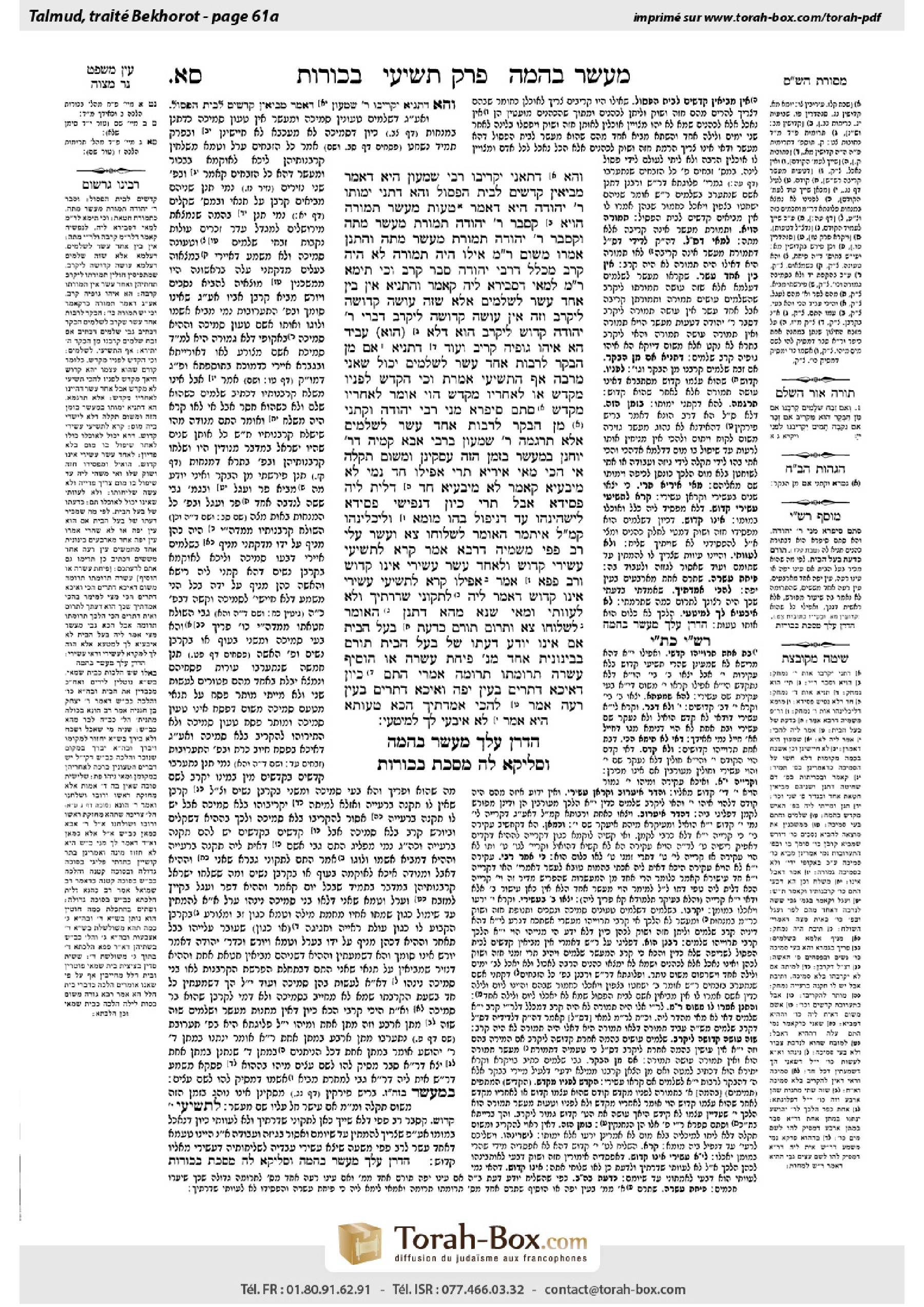
Bekhorot 61a: Talmud study for Daf Yomi
Study the Talmud for Daf Yomi with scanned pages, Hebrew text, English translations from Sefaria and AI-generated French translations.
Passage selection and English or AI-generated French translation are available where the scan has annotations. Daf Study is independent of Torah-Box and Sefaria.
Browse Bekhorot · בכורות · All tractatesBekhorot 61a text and translations
This page of Bekhorot includes the Aramaic text, an English translation and an AI-generated French translation, alongside the scan above.
בכורות ס״א א · Aramaic and Hebrew text
וְהָא דְּתָנֵי יִקְרְיבוּ — רַבִּי שִׁמְעוֹן הִיא, דְּאָמַר: מְבִיאִין קָדָשִׁים לְבֵית הַפְּסוּל.
וְהָא דְּתָנֵי יָמוּתוּ — רַבִּי יְהוּדָה הִיא, דְּאָמַר: טָעוּת מַעֲשֵׂר, תְּמוּרָה הָוְיָא, קָסָבַר רַבִּי יְהוּדָה: תְּמוּרַת מַעֲשֵׂר מֵתָה.
וְקָסָבַר רַבִּי יְהוּדָה תְּמוּרַת מַעֲשֵׂר מֵתָה? וְהָתְנַן, אָמְרוּ מִשּׁוּם רַבִּי מֵאִיר: אִילּוּ הָיָה תְּמוּרָה לֹא הָיָה קָרֵב, מִכְּלָל דְּרַבִּי יְהוּדָה סָבַר קָרֵב!
וְכִי תֵּימָא: רַבִּי מֵאִיר לְמַאי דִּסְבִירָא לֵיהּ קָאָמַר, וְהָתַנְיָא: אֵין בֵּין אַחַד עָשָׂר לִשְׁלָמִים, אֶלָּא שֶׁזֶּה עוֹשֶׂה קְדוּשָּׁה לִיקְרַב, וְזֶה אֵין עוֹשֶׂה קְדוּשָּׁה לִיקְרַב, דִּבְרֵי רַבִּי יְהוּדָה. קָדוֹשׁ לִיקְרַב הוּא דְּלָא הוּא עָבֵיד, הָא אִיהוּ גּוּפֵיהּ קָרֵיב!
וְעוֹד, דְּתַנְיָא: ״אִם מִן הַבָּקָר״ — לְרַבּוֹת אַחַד עָשָׂר לִשְׁלָמִים.
יָכוֹל שֶׁאֲנִי מְרַבֶּה אַף הַתְּשִׁיעִי? אָמַרְתָּ: וְכִי הֶקְדֵּשׁ לְפָנָיו מְקַדֵּשׁ אוֹ לְאַחֲרָיו מְקַדֵּשׁ? הֱוֵי אוֹמֵר — לְאַחֲרָיו מְקַדֵּשׁ.
סְתָם סִיפְרָא מַנִּי? רַבִּי יְהוּדָה, וְקָתָנֵי: ״מִן הַבָּקָר״ — לְרַבּוֹת אַחַד עָשָׂר לִשְׁלָמִים.
אֶלָּא תַּרְגְּמַהּ רַבִּי שִׁמְעוֹן בְּרַבִּי אַבָּא קַמֵּיהּ דְּרַבִּי יוֹחָנָן: בְּמַעֲשֵׂר בִּזְמַן הַזֶּה עָסְקִינַן, וּמִשּׁוּם תַּקָּלָה.
אִי הָכִי, מַאי אִירְיָא תְּרֵי? אֲפִילּוּ חַד נָמֵי! לָא מִיבַּעְיָא קָאָמַר: לָא מִיבַּעְיָא חַד דְּלֵית לֵיהּ פְּסֵידָא, אֲבָל תְּרֵי, כֵּיוָן דִּנְפִישִׁי פְּסֵידָא — לִישַׁהִינְהוּ עַד דְּנִיפּוֹל בְּהוּ מוּמָא וְלֵיכְלִינְהוּ, קָא מַשְׁמַע לַן.
אִיתְּמַר: הָאוֹמֵר לִשְׁלוּחוֹ ״צֵא וְעַשֵּׂר עָלַי״, רַב פַּפִּי מִשְּׁמֵיהּ דְּרָבָא אָמַר: קָרָא לַתְּשִׁיעִי ״עֲשִׂירִי״ — קָדוֹשׁ, וְלָאַחַד עָשָׂר ״עֲשִׂירִי״ — אֵינוֹ קָדוֹשׁ. וְרַב פָּפָּא אָמַר: אֲפִילּוּ קָרָא לַתְּשִׁיעִי ״עֲשִׂירִי״ — אֵינוֹ קָדוֹשׁ, דְּאָמַר לֵיהּ: לְתַקּוֹנֵי שַׁדַּרְתָּיךָ וְלָא לְעַוּוֹתֵי.
וּמַאי שְׁנָא מֵהָא דִּתְנַן: הָאוֹמֵר לִשְׁלוּחוֹ ״צֵא וּתְרוֹם״ — תּוֹרֵם כְּדַעַת בַּעַל הַבַּיִת.
אִם אֵינוֹ יוֹדֵעַ דַּעְתּוֹ שֶׁל בַּעַל הַבַּיִת — תּוֹרֵם בְּבֵינוֹנִית, אֶחָד מֵחֲמִשִּׁים. פִּיחֵת עֲשָׂרָה אוֹ הוֹסִיף עֲשָׂרָה — תְּרוּמָתוֹ תְּרוּמָה?
אָמְרִי: הָתָם, כֵּיוָן דְּאִיכָּא דְּתָרֵים בְּעַיִן יָפָה, וְאִיכָּא דְּתָרֵים בְּעַיִן רָעָה, אָמַר: לְהָכִי אֲמַדְתִּיךְ. הָכָא טָעוּתָא הִיא, אָמַר: לָא אִיבְּעִי לָךְ לְמִיטְעֵי.
הֲדַרַן עֲלָךְ מַעְשַׂר בְּהֵמָה, וּסְלִיקָא לַהּ מַסֶּכֶת בְּכוֹרוֹת.
Bekhorot 61a · English translation
And the ruling of this tanna, who teaches: Both animals must be sacrificed, is in accordance with the opinion of Rabbi Shimon, who says that one may bring sacrificial animals to a situation where the likelihood of disqualification is increased.
And the ruling of this tanna, who teaches: Both animals must die, is in accordance with the opinion of Rabbi Yehuda, who says: When the owner makes a mistake in designating animal tithe, e.g., if one designates the ninth animal as the tenth, the designated animal has the status of a substitute animal. And Rabbi Yehuda holds that a substitute for an animal tithe must be left to die. Since it is uncertain which animal is the eleventh, both are left to die.
The Gemara asks: And does Rabbi Yehuda hold that a substitute for an animal tithe must die? But didn’t we learn in the mishna: The Sages said in the name of Rabbi Meir, in response to the statement of Rabbi Yehuda: The eleventh animal is not considered a substitute for the animal tithe, since if it were a substitute it would not be sacrificed, as the substitute for an animal tithe is not sacrificed?By inference, Rabbi Yehuda holds that the eleventh animal is sacrificed, and not put to death, despite the fact that it has the status of a substitute animal.
The Gemara continues: And if you would say that Rabbi Meir is saying his statement according to what he himself holds, and therefore nothing can be inferred from his comment with regard to the opinion of Rabbi Yehuda, that cannot be so; but isn’t it taught in a baraita: The difference between the eleventh animal mistakenly designated as animal tithe and a peace offering is only that this, the peace offering, renders a substitute sanctified to the extent that it can be sacrificed, but that, the eleventh animal mistakenly designated as animal tithe, does not render its substitute sanctified to be sacrificed; this is the statement of Rabbi Yehuda? The Gemara infers: It is stated only that the eleventh animal mistakenly designated as tithe does not render its substitute sanctified with enough sanctity to be sacrificed, which indicates the eleventh animal itself is sacrificed and not put to death.
And furthermore, there is a source that indicates that Rabbi Yehuda holds that a mistakenly designated animal tithe is sacrificed, as it is taught in a baraita in the Sifra: “And if his offering be a sacrifice of peace offerings: If he sacrifice of the herd, whether male or female, he shall sacrifice it without blemish before the Lord” (Leviticus 3:1). This serves to include the eleventh animal mistakenly designated as tithe; it must be sacrificed as a peace offering.
One might have thought that I include even the ninth animal mistakenly designated as the tithe. You say in rejection of this suggestion: But does consecration sanctify a substitute before the original animal is sanctified, or does it sanctify only after the original animal is sanctified? You must say that it sanctifies only after the original animal is sanctified. If so, only the eleventh animal is sacrificed as a peace offering, but not the ninth.
And who is the author of the unattributed statement in the Sifra? It is Rabbi Yehuda. And the baraita is teaching that the verse: “If he sacrifice of the herd, whether male or female, he shall sacrifice it without blemish before the Lord,” serves to include the eleventh animal mistakenly designated as tithe, i.e., to teach that it must be sacrificed as a peace offering. Evidently, Rabbi Yehuda does not hold that the eleventh animal mistakenly designated as tithe must die.
If so, in accordance with whose opinion is the baraita that rules that in a case where two animals emerged together as the tenth, and the owner called them both the tenth, they must both die? It cannot be in accordance with the opinion of Rabbi Yehuda. Rather, Rabbi Shimon, son of Rabbi Abba, interpreted that baraita before Rabbi Yoḥanan: We are dealing with animal tithe in the present time, and the animals must die due to concern that a mishap might occur, as one might shear them or put them to work, or eat them before they develop a blemish.
The Gemara asks: If so, why is the baraita referring specifically to a case where two animals left the pen at the same time? The same would hold true even with regard to one animal designated as tithe, as it cannot be sacrificed nowadays. The Gemara answers: The tanna is speaking utilizing the style of: It is not necessary. It is not necessary to teach that in a case where one animal was designated as tithe it must die, as there is no major financial loss. But in a case where two animals were designated as tithe, since the loss is great one might think he should leave them until they develop a blemish, and then eat them. Therefore, the tanna teaches us that even in a case where two animals were designated as tithe, both must die.
It was stated: In the case of one who says to his agent: Go and separate animal tithe on my behalf, Rav Pappi says in the name of Rava: If he called the ninth animal the tenth, it is sanctified and may not be eaten until it has developed a blemish. The owner is not particular about this error, as the animal is not rendered entirely prohibited. But if he designated the eleventh animal as the tenth it is not sanctified as a peace offering, as the owner would not tolerate losing the animal entirely. And Rav Pappa disagrees and says: Even if the agent called the ninth animal the tenth it is not sanctified, as the owner who sent him can say to him: I sent you to act for my benefit and not to my detriment. The authority to serve as an agent does not extend to a case where he acts to the detriment of the one who designated him.
The Gemara asks: And in what manner is the case of animal tithe different from that which we learned in a mishna (Terumot 4:4): With regard to one who says to his agent: Go and separate teruma, the agent separates teruma in accordance with the intention of the homeowner. He must separate the amount that he assumes the owner would want to give, as there is no fixed measure that one must set aside as teruma. A generous person gives as much as one-fortieth of his produce as teruma, while a stingy person can give one-sixtieth.
The mishna continues: If he does not know the intention of the homeowner he separates an intermediate measure, i.e., one-fiftieth of the produce. If he subtracted ten from the denominator and separated one-fortieth of the produce, or added ten to the denominator and separated one-sixtieth, his teruma is considered teruma. In this case too, the owner should also be able to say he did not send the agent to act to his detriment, and therefore the act of separating teruma should not take effect.
The Sages say in answer: There, with regard to teruma, since there are those who separate teruma generously and there are those who separate teruma sparingly, the agent can say: I estimated that you were one such as this, i.e., either generous or stingy. But here, with regard to animal tithe, it is a mistake, and therefore the owner can say: I did not want you to make a mistake.
Bekhorot 61a · Traduction française (IA)
Et la décision de ce tanna, qui enseigne : les deux animaux doivent être sacrifiés, est conforme à l'opinion du Rabbi Simon, qui dit que l'on peut présenter des animaux sacrifiés dans une situation où la probabilité de disqualification est accrue.
Et la décision de ce tanna, qui enseigne : les deux animaux doivent mourir, est conforme à l'opinion du Rabbi Yéhuda, qui dit : Lorsque l'propriétaire fait une erreur dans la désignation de l'offrande d'animal, par exemple, si l'on désigne le neuvième animal comme le dixième, l'animal désigné a le statut d'un animal substitut. Et le Rabbi Yéhuda considère que le substitut d'une offrande d'animal doit être laissé mourir. Puisque l'on ne sait pas quel animal est le onzième, les deux sont laissés mourir.
La Guemara demande : Et le Rabbi Yéhuda considère-t-il que le substitut d'une offrande d'animal doit mourir ? Mais n'avons-nous pas appris dans la mishna : Les Sages, en nom du Rabbi Méir, répondent à la déclaration du Rabbi Yéhuda : L'onzième animal n'est pas considéré comme un substitut pour l'offrande d'animal, car s'il était un substitut, il ne serait pas sacrifié, car le substitut d'une offrande d'animal n'est pas sacrifié ? Par conséquent, le Rabbi Yéhuda considère que l'onzième animal est sacrifié, et non laissé mourir, malgré le fait qu'il ait le statut d'un animal substitut.
La Guemara continue : Et si vous dites que le Rabbi Méir dit cette déclaration selon ce qu'il considère lui-même, et donc rien ne peut être inféré de son commentaire concernant l'opinion du Rabbi Yéhuda, cela ne peut pas être vrai ; mais n'est-il pas enseigné dans une baraïta : La différence entre l'onzième animal désigné par erreur comme offrande d'animal et une offrande de paix est seulement que celui-ci, l'offrande de paix, rend le substitut sanctifié à un point tel qu'il peut être sacrifié, mais celui-là, l'onzième animal désigné par erreur comme offrande d'animal, ne rend son substitut sanctifié à un point tel qu'il puisse être sacrifié ; c'est l'opinion du Rabbi Yéhuda ? La Guemara infère : Il est dit seulement que l'onzième animal désigné par erreur comme offrande d'animal ne rend son substitut sanctifié avec assez de sanctification pour être sacrifié, ce qui indique que l'onzième animal lui-même est sacrifié et non laissé mourir.
Et de plus, il existe une source qui indique que le Rabbi Yéhuda considère que l'offrande d'animal désignée par erreur doit être sacrifiée, car il est enseigné dans une baraïta du Sifra : « Et s'il offre un sacrifice de paix : s'il sacrifie du troupeau, qu'il soit mâle ou femelle, il doit le sacrifier sans tache devant l'Éternel » (Lévitique 3:1). Cela sert à inclure l'onzième animal désigné par erreur comme offrande d'animal ; il doit être sacrifié comme offrande de paix.
On pourrait penser que je dois inclure même le neuvième animal désigné par erreur comme offrande d'animal. Vous répondez en rejetant cette suggestion : Mais la sanctification sanctifie-t-elle le substitut avant que l'animal original ne soit sanctifié, ou seulement après que l'animal original ait été sanctifié ? Vous devez dire qu'elle sanctifie seulement après que l'animal original ait été sanctifié. Si c'est ainsi, seul l'onzième animal est sacrifié comme offrande de paix, mais pas le neuvième.
Et qui est l'auteur de la déclaration non attribuée dans le Sifra ? C'est le Rabbi Yéhuda. Et la baraïta enseigne que la verset : « Si s'il offre du troupeau, qu'il soit mâle ou femelle, il doit le sacrifier sans tache devant l'Éternel », sert à inclure l'onzième animal désigné par erreur comme offrande d'animal, c'est-à-dire pour enseigner qu'il doit être sacrifié comme offrande de paix. Évidemment, le Rabbi Yéhuda ne considère pas que l'onzième animal désigné par erreur comme offrande d'animal doive mourir.
Si c'est ainsi, selon l'opinion de qui est la baraïta qui règle que dans un cas où deux animaux sont sortis ensemble comme le dixième, et que l'propriétaire les appelle tous les deux comme le dixième, ils doivent tous les deux mourir ? Cela ne peut pas être selon l'opinion du Rabbi Yéhuda. Plutôt, le Rabbi Simon, fils du Rabbi Abba, a interprété cette baraïta devant le Rabbi Yochanan : Nous sommes en présence d'offrandes d'animal à l'époque actuelle, et les animaux doivent mourir en raison de la crainte qu'un accident puisse survenir, car l'on pourrait les tondre ou les employer, ou les manger avant qu'ils ne développent une tache.
La Guemara demande : Si c'est ainsi, pourquoi la baraïta fait spécifiquement référence à un cas où deux animaux sont sortis ensemble du enclos ? La même chose serait vraie même dans le cas d'un seul animal désigné comme offrande d'animal, car il ne peut être sacrifié aujourd'hui. La Guemara répond : Le tanna parle en utilisant le style : Il n'est pas nécessaire. Il n'est pas nécessaire d'enseigner que dans le cas où un seul animal a été désigné comme offrande d'animal, il doit mourir, car il n'y a pas de perte financière majeure. Mais dans le cas où deux animaux ont été désignés comme offrande d'animal, puisque la perte est grande, on pourrait penser qu'il faut les laisser jusqu'à ce qu'ils développent une tache, puis les manger. Par conséquent, le tanna nous enseigne que même dans le cas où deux animaux ont été désignés comme offrande d'animal, les deux doivent mourir.
Il a été dit : Dans le cas d'une personne qui dit à son agent : Va et séparer l'offrande d'animal à ma place, Rav Pappi dit en nom de Rava : Si l'on a désigné le neuvième animal comme le dixième, il est sanctifié et ne peut pas être mangé avant qu'il ne développe une tache. L'propriétaire n'est pas exigeant à l'égard de cette erreur, car l'animal n'est pas rendu entièrement interdit. Mais si l'on a désigné l'onzième animal comme le dixième, il n'est pas sanctifié comme offrande de paix, car l'propriétaire ne tolérerait pas de perdre l'animal entièrement. Et Rav Pappa est d'avis contraire et dit : Même si l'agent a désigné le neuvième animal comme le dixième, il n'est pas sanctifié, car l'propriétaire qui l'a envoyé peut lui dire : J'ai envoyé toi pour agir en mon nom et non contre mon intérêt. L'autorité d'agir en tant qu'agent ne s'étend pas à un cas où il agit à son propre détriment.
La Guemara pose la question : Dans quel sens la situation de la dîme animale diffère-t-elle de celle que nous avons apprise dans une mitsva (Terouma 4:4) : Lorsqu'une personne dit à son agent : Va et sépare la terouma, l'agent sépare la terouma selon l'intention du propriétaire. Il doit séparer la quantité qu'il suppose que le propriétaire souhaite donner, car il n'y a pas de mesure fixe à mettre de côté comme terouma. Une personne généreuse donne un quarantième de sa récolte comme terouma, tandis qu'une personne avare peut donner un soixantième.
La mitsva continue : Si l'agent ne connaît pas l'intention du propriétaire, il sépare une mesure intermédiaire, c'est-à-dire un cinquantième de la récolte. Si l'agent a soustrait dix au dénominateur et a séparé un quarantième de la récolte, ou s'il a ajouté dix au dénominateur et a séparé un soixantième, sa terouma est considérée comme terouma. Dans ce cas également, le propriétaire devrait pouvoir dire qu'il n'a pas envoyé l'agent agir à son préjudice, et par conséquent l'acte de séparation de terouma ne devrait pas prendre effet.
Les Sages répondent : Là, concernant la terouma, puisque certains séparent la terouma de manière généreuse et d'autres de manière parcimonieuse, l'agent peut dire : J'ai estimé que vous étiez l'un ou l'autre, c'est-à-dire soit généreux soit parcimonieux. Mais ici, concernant la dîme animale, c'est une erreur, et par conséquent le propriétaire peut dire : Je n'ai pas voulu que tu fasses une erreur.
Traduction française générée par IA à partir de l’édition anglaise de Sefaria. Vérifie toujours un passage avec le texte source.
Text from Sefaria: William Davidson Edition - Vocalized Aramaic (CC BY NC); William Davidson Edition - English (CC BY NC).