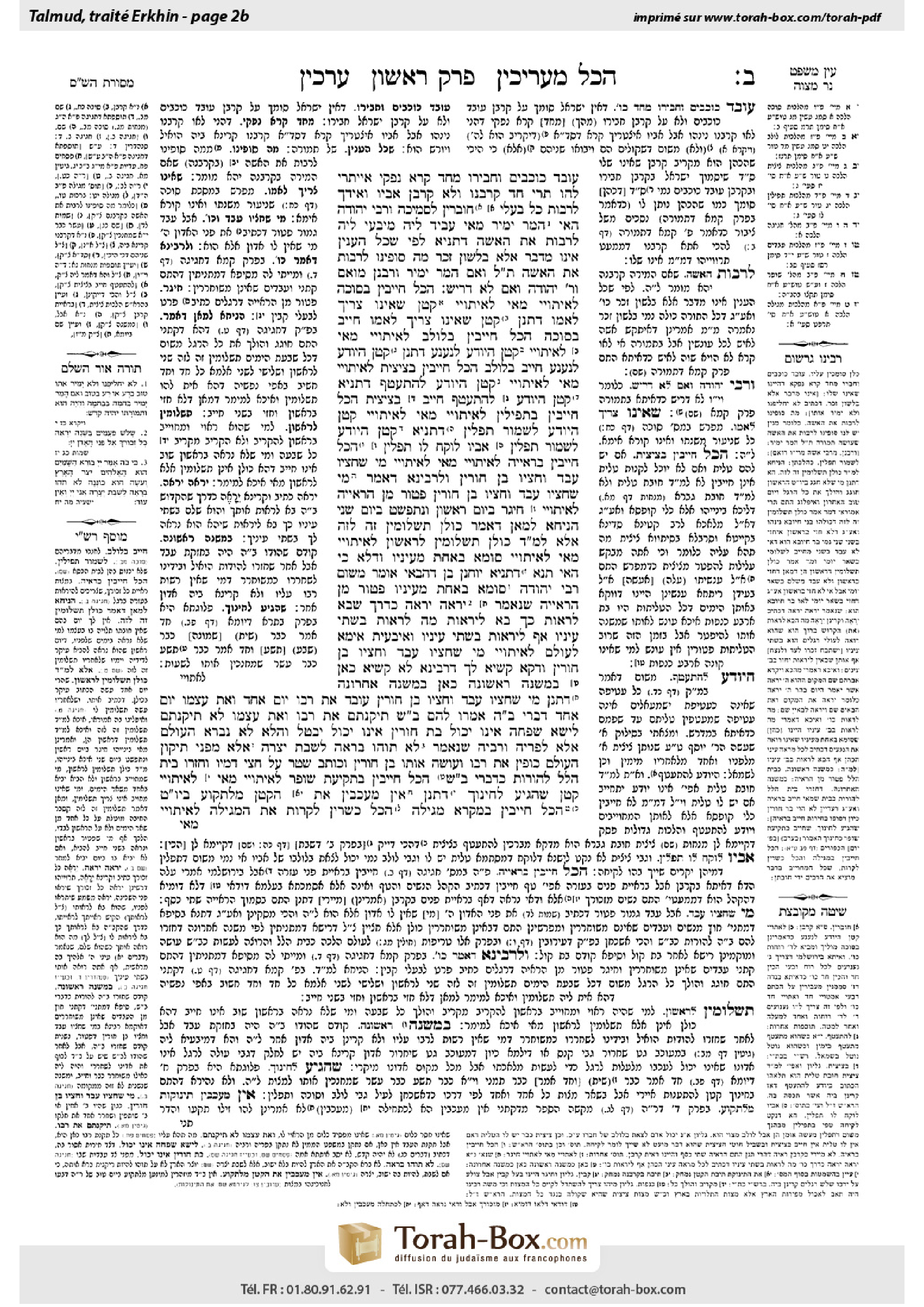
Arakhin 2b: Talmud study for Daf Yomi
Study the Talmud for Daf Yomi with scanned pages, Hebrew text, English translations from Sefaria and AI-generated French translations.
Passage selection and English or AI-generated French translation are available where the scan has annotations. Daf Study is independent of Torah-Box and Sefaria.
Browse Arakhin · ערכין · All tractatesArakhin 2b text and translations
This page of Arakhin includes the Aramaic text, an English translation and an AI-generated French translation, alongside the scan above.
ערכין ב׳ ב · Aramaic and Hebrew text
גּוֹי וַחֲבֵירוֹ מֵחַד קְרָא נָפְקִי, אִיַּיתַּרִי לְהוּ תְּרֵי: חַד ״קׇרְבָּנוֹ״ וְלֹא קׇרְבַּן אָבִיו, וְאִידָּךְ לְרַבּוֹת כׇּל בַּעֲלֵי חוֹבְרִין לִסְמִיכָה.
וְרַבִּי יְהוּדָה, הַאי ״הָמֵר יָמִיר״ מַאי עָבֵיד לֵיהּ? מִיבְּעֵי לֵיהּ לְרַבּוֹת אֶת הָאִשָּׁה, דְּתַנְיָא: לְפִי שֶׁכׇּל הָעִנְיָן אֵינוֹ מְדַבֵּר אֶלָּא בִּלְשׁוֹן זָכָר, מַה סּוֹפֵינוּ לְרַבּוֹת אֶת הָאִשָּׁה? תַּלְמוּד לוֹמַר ״וְאִם הָמֵר יָמִיר״.
וְרַבָּנַן? מִ״וְּאִם״, וְרַבִּי יְהוּדָה ״וְאִם״ לָא דָּרֵישׁ.
״הַכֹּל חַיָּיבִין בְּסוּכָּה״ — לְאֵיתוֹיֵי מַאי? לְאֵיתוֹיֵי קָטָן שֶׁאֵינוֹ צָרִיךְ לְאִמּוֹ, דִּתְנַן: קָטָן שֶׁאֵינוֹ צָרִיךְ לְאִמּוֹ חַיָּיב בְּסוּכָּה.
״הַכֹּל חַיָּיבִין בְּלוּלָב״ — לְאֵיתוֹיֵי מַאי? לְאֵיתוֹיֵי קָטָן הַיּוֹדֵעַ לְנַעְנֵעַ, דִּתְנַן: קָטָן הַיּוֹדֵעַ לְנַעְנֵעַ חַיָּיב בְּלוּלָב.
״הַכֹּל חַיָּיבִין בְּצִיצִית״ — לְאֵיתוֹיֵי מַאי? לְאֵיתוֹיֵי קָטָן הַיּוֹדֵעַ לְהִתְעַטֵּף, דְּתַנְיָא: קָטָן הַיּוֹדֵעַ לְהִתְעַטֵּף — חַיָּיב בְּצִיצִית.
״הַכֹּל חַיָּיבִין בִּתְפִילִּין״ — לְאֵיתוֹיֵי מַאי? לְאֵיתוֹיֵי קָטָן הַיּוֹדֵעַ לִשְׁמוֹר תְּפִלִּין, דְּתַנְיָא: קָטָן הַיּוֹדֵעַ לִשְׁמוֹר תְּפִלִּין — אָבִיו לוֹקֵחַ לוֹ תְּפִלִּין.
״הַכֹּל חַיָּיבִין בִּרְאִיָּיה״ — לְאֵיתוֹיֵי מַאי? לְאֵיתוֹיֵי מִי שֶׁחֶצְיוֹ עֶבֶד וְחֶצְיוֹ בֶּן חוֹרִין.
וּלְרָבִינָא דְּאָמַר: מִי שֶׁחֶצְיוֹ עֶבֶד וְחֶצְיוֹ בֶּן חוֹרִין פָּטוּר מִן הָרְאִיָּיה, לְאֵיתוֹיֵי חִיגֵּר בְּיוֹם רִאשׁוֹן וְנִתְפַּשֵּׁט בְּיוֹם שֵׁנִי.
הָנִיחָא לְמַאן דְּאָמַר: כּוּלָּן תַּשְׁלוּמִין זֶה לָזֶה, אֶלָּא לְמַאן דְּאָמַר: כּוּלָּן תַּשְׁלוּמִין לָרִאשׁוֹן — לְאֵיתוֹיֵי מַאי?
לְאֵיתוֹיֵי סוּמָא בְּאַחַת מֵעֵינָיו, וּדְלָא כִּי הַאי תַּנָּא.
דְּתַנְיָא, יוֹחָנָן בֶּן דַּהֲבַאי אוֹמֵר מִשּׁוּם רַבִּי יְהוּדָה: סוּמָא בְּאַחַת מֵעֵינָיו פָּטוּר מִן הָרְאִיָּיה, שֶׁנֶּאֱמַר: ״יִרְאֶה״ ״יֵרָאֶה״, כְּדֶרֶךְ שֶׁבָּא לִרְאוֹת כָּךְ בָּא לֵירָאוֹת, מַה לִּרְאוֹת בִּשְׁתֵּי עֵינָיו — אַף לֵירָאוֹת בִּשְׁתֵּי עֵינָיו.
וְאִיבָּעֵית אֵימָא: לְעוֹלָם לְאֵיתוֹיֵי מִי שֶׁחֶצְיוֹ עֶבֶד וְחֶצְיוֹ בֶּן חוֹרִין, וּדְקָא קַשְׁיָא לָךְ דְּרָבִינָא — לָא קַשְׁיָא: כָּאן בְּמִשְׁנָה רִאשׁוֹנָה, כָּאן בְּמִשְׁנָה אַחֲרוֹנָה.
דִּתְנַן: מִי שֶׁחֶצְיוֹ עֶבֶד וְחֶצְיוֹ בֶּן חוֹרִין, עוֹבֵד אֶת רַבּוֹ יוֹם אֶחָד, וְאֶת עַצְמוֹ יוֹם אֶחָד, דִּבְרֵי בֵּית הִלֵּל.
אָמְרוּ לָהֶם בֵּית שַׁמַּאי: תִּיקַּנְתֶּם אֶת רַבּוֹ, וְאֶת עַצְמוֹ לֹא תִּיקַּנְתֶּם? לִישָּׂא שִׁפְחָה אֵינוֹ יָכוֹל, בַּת חוֹרִין אֵינוֹ יָכוֹל, יִבָּטֵל? וַהֲלֹא לֹא נִבְרָא הָעוֹלָם אֶלָּא לִפְרִיָּה וּרְבִיָּה, שֶׁנֶּאֱמַר: ״לֹא תֹהוּ בְרָאָהּ לָשֶׁבֶת יְצָרָהּ״!
אֶלָּא, מִפְּנֵי תִּיקּוּן הָעוֹלָם, כּוֹפִין אֶת רַבּוֹ וְעוֹשֶׂה אוֹתוֹ בֶּן חוֹרִין, וְכוֹתֵב שְׁטָר עַל חֲצִי דָּמָיו, וְחָזְרוּ בֵּית הִלֵּל לְהוֹרוֹת כְּדִבְרֵי בֵּית שַׁמַּאי.
״הַכֹּל חַיָּיבִין בִּתְקִיעַת שׁוֹפָר״ — לְאֵיתוֹיֵי מַאי? לְאֵיתוֹיֵי קָטָן שֶׁהִגִּיעַ לְחִינּוּךְ, דִּתְנַן: אֵין מְעַכְּבִין אֶת הַקָּטָן מִלִּתְקוֹעַ בְּיוֹם טוֹב.
״הַכֹּל חַיָּיבִין בְּמִקְרָא מְגִילָּה״, ״הַכֹּל כְּשֵׁרִין לִקְרוֹת אֶת הַמְּגִילָּה״ — לְאֵיתוֹיֵי
Arakhin 2b · English translation
but he maintains that the exclusion of a gentile and the exclusion of the offering of another person from the requirement of placing hands are derived from the same one mention of “his offering” in the verse. This leaves two mentions of “his offering” for Rabbi Yehuda. One he expounds to teach that he places hands on “his offering,” but not on his father’s offering that he inherited, and the other mention remains to include all the owners of a jointly owned offering in the requirement of placing hands.
The Gemara asks: And as for Rabbi Yehuda, what does he do with the use of the doubled form in this verse: “If he shall substitute [hamer yamir]”? The Gemara answers: He requires it to include a woman among those who can effect substitution. As it is taught in a baraita: Since the entire matter of substitution is stated in the Torah only in the masculine form, what is the reason that we ultimately come to include a woman? The verse states: “And if he shall substitute [hamer yamir],” using a doubled form.
The Gemara asks: And as for the Rabbis, from where do they learn that a woman can perform substitution? The Gemara answers: They derive it from the extra “and” in the phrase: “And if he shall substitute” (Leviticus 27:10). But Rabbi Yehuda does not expound the extra “and” in the term “and if” at all.
§ The Gemara asks: What is added by the statement of the following baraita: Everyone is obligated in the mitzva of sukka? The Gemara answers: This serves to add a minor who does not need his mother when he awakes in the middle of the night. As we learned in a mishna (Sukka 28a): A minor who does not need his mother is obligated in the mitzva of sukka.
The Gemara further asks: What is added by the ruling of the following baraita: Everyone is obligated in the mitzva of lulav? The Gemara answers: This clause serves to add a minor who knows how to wave the lulav. As we learned in a mishna (Sukka 42a): A minor who knows how to wave the lulav is obligated in the mitzva of lulav.
The Gemara continues to ask similar questions: What is added by the statement of a baraita: Everyone is obligated in the mitzva of ritual fringes? The Gemara explains that this serves to add a minor who knows how to wrap himself in a garment. As it is taught in a baraita: A minor who knows how to wrap himself in a garment is obligated in the mitzva of ritual fringes.
The Gemara asks: What is added by the ruling of a baraita: Everyone is obligated in the mitzva of phylacteries? The Gemara answers that it serves to add a minor who knows how to preserve the sanctity of phylacteries by maintaining a state of bodily cleanliness. As it is taught in a baraita: With regard to a minor who knows how to preserve the sanctity of phylacteries in a state of cleanliness, his father purchases phylacteries for him.
§ The Gemara further inquires: What is added by the statement of the mishna (Ḥagiga 2a): Everyone is obligated in the mitzva of appearance, i.e., the obligation to appear in the Temple and to sacrifice an offering on the three pilgrimage Festivals. The Gemara answers: The mishna serves to add one who is a half-slave half-freeman, e.g., a Canaanite slave who was owned jointly, and only one of his owners freed him.
The Gemara explains: And according to the opinion of Ravina, who said: One who is half-slave half-freeman is exempt from the mitzva of appearance in the Temple, that clause serves to add one who was lame on the first day of the Festival and was unable to travel, and was therefore exempt at the time, but who was healed on the second day of the Festival. This man is obligated to appear in the Temple before the end of the Festival.
The Gemara asks: This works out well according to the one who says that all seven days of a Festival rectify one another, i.e., the obligation to appear applies equally to all days of the Festival, not just the first. Consequently, one who was exempt on the first day is nevertheless obligated on the second day. But according to the one who says that the main obligation is on the first day and that all the remaining days merely rectify the first day, a person who was lame on the first day of the Festival remains exempt throughout the rest of the Festival. If so, what does the statement of the mishna in Ḥagiga 2a serve to add?
The Gemara answers: It serves to add one who is blind in one of his eyes, and teaches that he is obligated to appear in the Temple, whereas one who is entirely blind is exempt. The Gemara notes: And this ruling is not in accordance with the opinion of this tanna, Rabbi Yehuda.
As it is taught in a baraita that Yoḥanan ben Dahavai says in the name of Rabbi Yehuda: One who is blind in one of his eyes is exempt from the mitzva of appearance, as it is stated: “Three times in the year all your males shall appear [yera’eh] before the Lord God” (Exodus 23:17). According to the way in which the verse is written, without vocalization, it can be read as yireh, meaning: Shall see, instead of yera’eh, meaning: Shall appear. This teaches that in the same manner that one comes to see, so he comes to appear, i.e., to be seen: Just as the usual way to see is with both of one’s eyes, so too, the obligation to appear applies only to one who comes with the sight of both his eyes. This is one possible explanation for what is added by the general statement of the mishna in Ḥagiga 2a, according to Ravina.
And if you wish, say instead: Actually, that statement serves to include one who is half-slave and half-freeman. And with regard to what was difficult for you according to the opinion of Ravina, that he exempts such a person from the obligation of appearance, it is not difficult: Here the ruling is in accordance with the initial version of the mishna, whereas there it is in accordance with the ultimate version of the mishna.
As we learned in a mishna (Pesaḥim 88a): One who is half-slave and half-freeman serves his master one day, as he is half a slave, and works for himself one day, since he is half free. This is the statement of Beit Hillel.
Beit Shammai said to them: You have thereby remedied the situation of his master, who fully derives benefit from all his rights to the slave, but you have not remedied his own situation. How so? He cannot marry a maidservant, as half of him is free, and a free Jew may not marry a Canaanite maidservant. He is also unable to marry a free woman, as half of him is still a slave, and a Jewish woman may not marry a Canaanite slave. And if you say he should be idle, i.e., refrain from marrying, but isn’t it true that the world was created only for procreation, as it is stated: “For so said the Lord that created the heavens…Who formed the earth and made it, He established it. He did not create it to be a waste; He formed it to be inhabited” (Isaiah 45:18)?
Rather, for the betterment of the world, i.e., so that the slave will be able to engage in procreation, the court forces his master to make him a freeman by emancipating the half that he owns. And the slave writes a bill to his master accepting responsibility to pay half his value to him over time, as currently he has no property with which to redeem himself. And Beit Hillel ultimately retracted their opinion, to rule in accordance with the statement of Beit Shammai that a half-slave must be emancipated. The ruling of the mishna that a half-slave must appear in the Temple is in accordance with this opinion, which holds that the master must free him. Ravina’s statement that he is not obligated to appear in the Temple is in accordance with the initial mishna, according to which Beit Hillel held that the master is not forced to free the half-slave.
§ The Gemara asks: What is added by the statement of the baraita: Everyone is obligated to sound the shofar? The Gemara answers: This serves to add a minor who reached the age of training in mitzvot. As we learned in a mishna (Rosh HaShana 32b): One need not prevent minors from sounding the shofar on the festival of Rosh HaShana, despite the fact that they are not obligated in mitzvot.
The Gemara asks: With regard to the ruling of the baraita: Everyone is obligated in the mitzva of reading the Megilla, the Scroll of Esther, and the statement of the mishna (Megilla 19b): Everyone is fit to read the Megilla, these serve to add
Arakhin 2b · Traduction française (IA)
mais il affirme que l'exclusion d'un non-Juif et l'exclusion de l'offrande d'une autre personne de la exigence de poser les mains sont dérivées de la même mention de « son offrande » dans la versette. Cela laisse deux mentions de « son offrande » pour Rabbi Yehuda. L'une il développe pour enseigner qu'il pose les mains sur « son offrande », mais pas sur l'offrande de son père qu'il a hérité, et l'autre mention reste pour inclure tous les propriétaires d'une offrande partagée dans l'exigence de poser les mains.
Le Guemara demande : Et quant à Rabbi Yehuda, que fait-il avec l'emploi de la forme double dans cette versette : « Si il substitue [hamer yamir] » ? Le Guemara répond : Il exige cela pour inclure une femme parmi ceux qui peuvent effectuer la substitution. Comme il est enseigné dans une baraïta : Puisque toute la matière de la substitution est mentionnée dans la Torah seulement sous la forme masculine, quelle est la raison qui nous conduit finalement à inclure la femme ? La versette dit : « Et si il substitue [hamer yamir] », en utilisant une forme double.
Le Guemara demande : Et quant aux Rabbins, d'où tirent-ils qu'une femme peut effectuer la substitution ? Le Guemara répond : Ils en dérivent de l'ajout de « et » dans la phrase : « Et si il substitue » (Lévitique 27:10). Mais Rabbi Yehuda ne développe pas l'ajout de « et » dans le terme « et si » du tout.
§ Le Guemara demande : Quel est l'ajout de l'affirmation de la baraïta suivante : Tout le monde est tenu de la mitsva de la sukkah ? Le Guemara répond : Cela sert à inclure un mineur qui n'a pas besoin de sa mère lorsqu'il se réveille au milieu de la nuit. Comme nous avons appris dans une mishna (Sukka 28a) : Un mineur qui n'a pas besoin de sa mère est tenu de la mitsva de la sukkah.
Le Guemara pose ensuite une question similaire : Quel est l'ajout de la décision de la baraïta suivante : Tout le monde est tenu de la mitsva de la lulav ? Le Guemara répond : Cette clause sert à inclure un mineur qui sait comment agiter la lulav. Comme nous avons appris dans une mishna (Sukka 42a) : Un mineur qui sait comment agiter la lulav est tenu de la mitsva de la lulav.
Le Guemara continue à poser des questions similaires : Quel est l'ajout de l'affirmation d'une baraïta : Tout le monde est tenu de la mitsva des franges rituelles ? Le Guemara explique que cela sert à inclure un mineur qui sait comment s'envelopper dans une robe. Comme il est enseigné dans une baraïta : Un mineur qui sait comment s'envelopper dans une robe est tenu de la mitsva des franges rituelles.
Le Guemara demande : Quel est l'ajout de la décision d'une baraïta : Tout le monde est tenu de la mitsva des phylactères ? Le Guemara répond que cela sert à ajouter un mineur qui sait conserver la sainteté des phylactères en maintenant un état de pureté corporelle. Comme il est enseigné dans une baraïta : En ce qui concerne un mineur qui sait conserver la sainteté des phylactères dans un état de pureté, son père achète des phylactères pour lui.
§ Le Guemara pose une question supplémentaire : Quel est l'ajout de l'affirmation de la mishna (Ḥagiga 2a) : Tout le monde est tenu de la mitsva de l'apparence, c'est-à-dire l'obligation de se présenter au Temple et de sacrifier une offrande aux trois fêtes de pèlerinage. Le Guemara répond : La mishna sert à ajouter celui qui est demi-esclave et demi-libre, c'est-à-dire un esclave cananéen possédé en commun, et dont seul l'un de ses propriétaires l'a libéré.
Le Guemara explique : Et selon l'opinion de Ravina, qui disait : Celui qui est demi-esclave et demi-libre est exempt de la mitsva de l'apparence au Temple, cette clause sert à ajouter celui qui était boiteux le premier jour de la fête et n'était pas capable de voyager, et était donc exempt à l'époque, mais qui s'est guéri le deuxième jour de la fête. Ce homme est tenu de se présenter au Temple avant la fin de la fête.
Le Guemara demande : Cela s'ajuste bien selon celui qui dit que les sept jours d'une fête rectifient mutuellement l'un l'autre, c'est-à-dire que l'obligation s'applique de manière égale à tous les jours de la fête, pas seulement le premier. Ainsi, celui qui était exempt le premier jour est néanmoins tenu le deuxième jour. Mais selon celui qui dit que l'obligation principale est le premier jour et que les autres jours ne rectifient que le premier, une personne boiteuse le premier jour de la fête reste exempt tout au long du reste de la fête. Si tel est le cas, que sert l'affirmation de la mishna dans Ḥagiga 2a ?
Le Guemara répond : Cela sert à ajouter celui qui est aveugle dans l'un de ses yeux, et enseigne qu'il est tenu de se présenter au Temple, alors que celui qui est totalement aveugle est exempt. Le Guemara note : Et cette décision ne correspond pas à l'opinion de ce tanna, Rabbi Yehuda.
Comme il est enseigné dans une baraïta que Yoḥanan ben Dahavai dit en nom de Rabbi Yehuda : Celui qui est aveugle dans l'un de ses yeux est exempt de la mitsva de l'apparence, car il est dit : « Trois fois par an, tous vos mâles doivent apparaître [yera’eh] devant l'Éternel » (Exode 23:17). Selon la manière dont la versette est écrite sans vocalisation, elle peut être lue comme yireh, signifiant : doit voir, au lieu de yera’eh, signifiant : doit apparaître. Cela enseigne que de la même manière qu'on vient voir, on vient apparaître, c'est-à-dire être vu : Comme la manière habituelle de voir est avec les deux yeux, de même l'obligation d'apparaître s'applique seulement à celui qui vient avec la vue des deux yeux. C'est une possible explication de ce qui est ajouté par l'affirmation générale de la mishna dans Ḥagiga 2a, selon Ravina.
Et si vous le souhaitez, dites plutôt : En réalité, cette affirmation sert à inclure celui qui est demi-esclave et demi-libre. Et concernant ce qui vous était difficile selon l'opinion de Ravina, qui exempt ce genre de personne de l'obligation d'apparaître, ce n'est pas difficile : ici la décision est selon la version initiale de la mishna, tandis que là elle est selon la version ultime de la mishna.
Comme nous avons appris dans une mitsva (Pessaïm 88a) : Celui qui est demi-esclave et demi-libre sert son maître un jour, car il est demi-esclave, et travaille pour lui-même un jour, car il est demi-libre. C'est la déclaration de Beit Hillel.
Beit Shammai a dit à ceux-ci : Vous avez ainsi réglé le cas de son maître, qui tire pleinement avantage de tous ses droits sur l'esclave, mais vous n'avez pas réglé son propre cas. Comment cela ? Il ne peut pas épouser une servante, car la moitié de lui est libre, et un Juif libre ne peut pas épouser une servante cananéenne. Il ne peut pas non plus épouser une femme libre, car la moitié de lui est encore un esclave, et une femme juive ne peut pas épouser un esclave cananéen. Et si vous dites qu'il doit être inactif, c'est-à-dire se passer d'épouser, n'est-ce pas vrai que le monde a été créé uniquement pour la procréation, comme il est dit : « Car ainsi a dit l'Éternel qui a créé les cieux… Qui a formé la terre et l'a faite, Il l'a établie. Il ne l'a pas créée pour être un désert ; Il l'a faite pour être habitée » (Yachout 45:18) ?
Au contraire, pour le bien du monde, c'est-à-dire afin que l'esclave puisse se procréer, la cour force son maître à le rendre libre en libérant la moitié qu'il possède. Et l'esclave écrit un contrat à son maître acceptant de lui payer la moitié de sa valeur en temps utile, car il n'a actuellement aucun bien avec lequel se racheter. Et Beit Hillel a finalement rétracté leur opinion pour décider selon la déclaration de Beit Shammai selon laquelle un esclave demi-libre doit être libéré. La décision de la mitsva selon laquelle un esclave demi-libre doit apparaître dans le Temple est en conformité avec cette opinion, qui considère que le maître doit le libérer. La déclaration de Ravina selon laquelle il n'est pas tenu de paraître dans le Temple est en conformité avec la mitsva initiale, selon laquelle Beit Hillel considérait que le maître n'était pas tenu de libérer l'esclave demi-libre.
§ La Guemara demande : Quel est l'ajout de la déclaration de la baraïta : Tout le monde est tenu de sonner le shofar ? La Guemara répond : Cela sert à ajouter un mineur qui a atteint l'âge de l'entraînement aux mitsvot. Comme nous avons appris dans une mitsna (Rosh HaShana 32b) : On ne doit pas empêcher les mineurs de sonner le shofar pendant la fête de Rosh HaShana, malgré le fait qu'ils ne sont pas tenus de mitsvot.
La Guemara demande : En ce qui concerne la décision de la baraïta : Tout le monde est tenu de la mitsva de lire la Megilla, le Livre d'Esther, et la déclaration de la mitsna (Megilla 19b) : Tout le monde est digne de lire la Megilla, ces déclarations servent à ajouter
Traduction française générée par IA à partir de l’édition anglaise de Sefaria. Vérifie toujours un passage avec le texte source.
Text from Sefaria: William Davidson Edition - Vocalized Aramaic (CC BY NC); William Davidson Edition - English (CC BY NC).