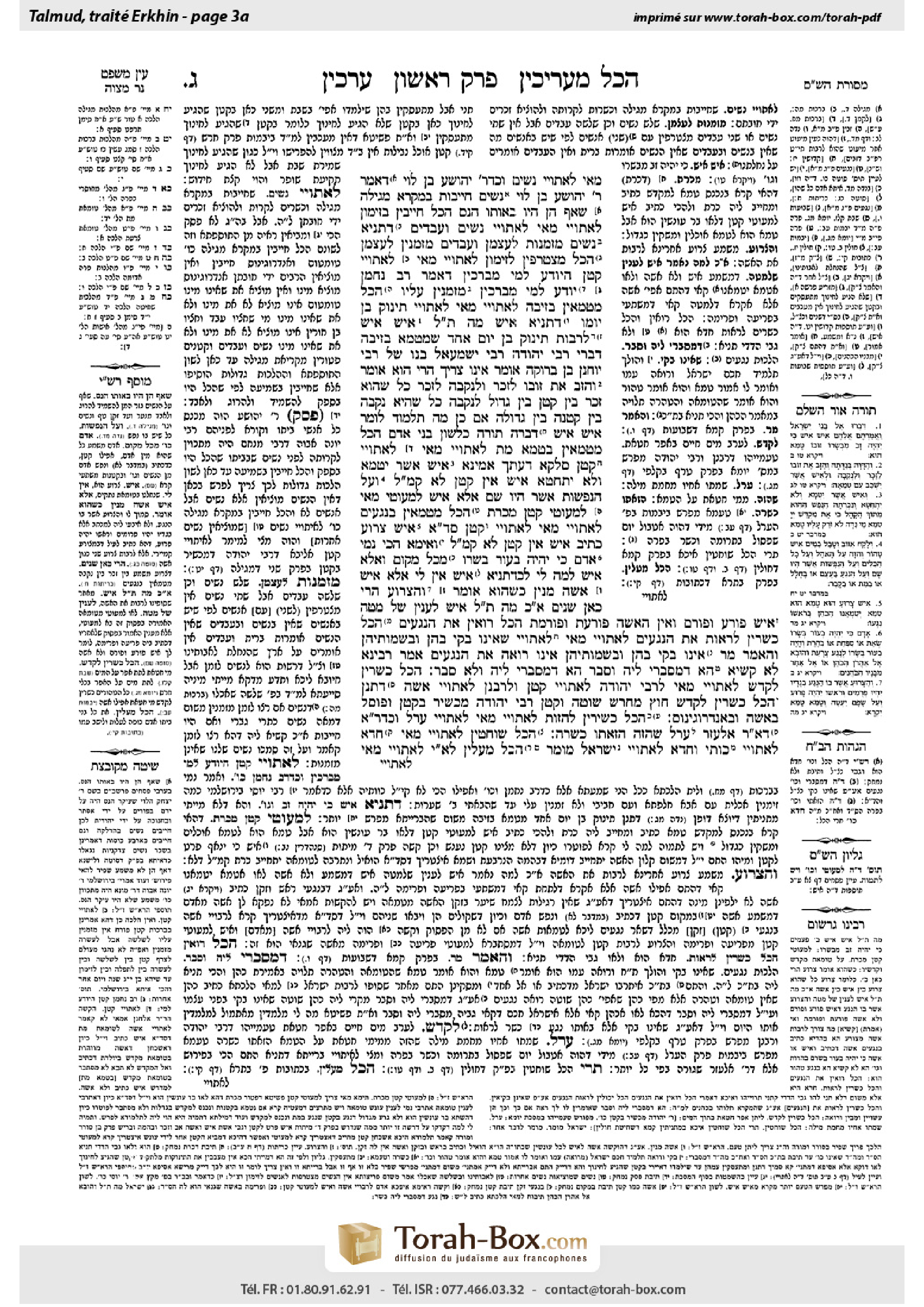
Arakhin 3a: Talmud study for Daf Yomi
Study the Talmud for Daf Yomi with scanned pages, Hebrew text, English translations from Sefaria and AI-generated French translations.
Passage selection and English or AI-generated French translation are available where the scan has annotations. Daf Study is independent of Torah-Box and Sefaria.
Browse Arakhin · ערכין · All tractatesArakhin 3a text and translations
This page of Arakhin includes the Aramaic text, an English translation and an AI-generated French translation, alongside the scan above.
ערכין ג׳ א · Aramaic and Hebrew text
מַאי? לְאֵתוֹיֵי נָשִׁים, וְכִדְרַבִּי יְהוֹשֻׁעַ בֶּן לֵוִי, דְּאָמַר רַבִּי יְהוֹשֻׁעַ בֶּן לֵוִי: נָשִׁים חַיָּיבוֹת בְּמִקְרָא מְגִילָּה, שֶׁאַף הֵן הָיוּ בְּאוֹתוֹ הַנֵּס.
״הַכֹּל חַיָּיבִין בְּזִימּוּן״ — לְאֵתוֹיֵי מַאי? לְאֵתוֹיֵי נָשִׁים וַעֲבָדִים, דְּתַנְיָא: נָשִׁים מְזַמְּנוֹת לְעַצְמָן, וַעֲבָדִים מְזַמְּנִין לְעַצְמָן.
״הַכֹּל מִצְטָרְפִין לְזִימּוּן״ — לְאֵתוֹיֵי מַאי? לְאֵתוֹיֵי קָטָן הַיּוֹדֵעַ לְמִי מְבָרְכִין, דְּאָמַר רַב נַחְמָן: יוֹדֵעַ לְמִי מְבָרְכִין — מְזַמְּנִין עָלָיו.
״הַכֹּל מִטַּמְּאִין בְּזִיבָה״ — לְאֵתוֹיֵי מַאי? לְאֵתוֹיֵי תִּינוֹק בֶּן יוֹמוֹ, דְּתַנְיָא: ״אִישׁ״ — מָה תַּלְמוּד לוֹמַר ״אִישׁ אִישׁ״? לְרַבּוֹת תִּינוֹק בֶּן יוֹם אֶחָד שֶׁמְטַמֵּא בְּזִיבָה, דִּבְרֵי רַבִּי יְהוּדָה.
רַבִּי יִשְׁמָעֵאל בְּנוֹ שֶׁל רַבִּי יוֹחָנָן בֶּן בְּרוֹקָה אוֹמֵר: אֵינוֹ צָרִיךְ, הֲרֵי הוּא אוֹמֵר: ״וְהַזָּב אֶת זוֹבוֹ לַזָּכָר וְלַנְּקֵבָה״, ״לַזָּכָר״ — כֹּל שֶׁהוּא זָכָר, בֵּין קָטָן בֵּין גָּדוֹל, ״לַנְּקֵבָה״ — כֹּל שֶׁהִיא נְקֵבָה, בֵּין קְטַנָּה בֵּין גְּדוֹלָה. אִם כֵּן, מָה תַּלְמוּד לוֹמַר ״אִישׁ אִישׁ״? דִּבְּרָה תוֹרָה כִלְשׁוֹן בְּנֵי אָדָם.
״הַכֹּל מִטַּמְּאִין בִּטְמֵא מֵת״ — לְאֵתוֹיֵי מַאי? לְאֵתוֹיֵי קָטָן; סָלְקָא דַּעְתָּךְ אָמֵינָא: ״אִישׁ אֲשֶׁר יִטְמָא וְלֹא יִתְחַטָּא״ — ״אִישׁ״ אִין, קָטָן לָא, קָא מַשְׁמַע לַן: ״וְעַל הַנְּפָשׁוֹת אֲשֶׁר הָיוּ שָׁם״.
אֶלָּא, ״אִישׁ״ לְמַעוֹטֵי מַאי? לְמַעוֹטֵי קָטָן מִכָּרֵת.
״הַכֹּל מִטַּמְּאִין בִּנְגָעִים״ — לְאֵתוֹיֵי מַאי? לְאֵתוֹיֵי קָטָן. סָלְקָא דַּעְתָּךְ אָמֵינָא: ״אִישׁ צָרוּעַ״ כְּתִיב — אִישׁ אִין, קָטָן לָא, קָא מַשְׁמַע לַן.
וְאֵימָא הָכִי נָמֵי! אָדָם ״כִּי יִהְיֶה בְעוֹר בְּשָׂרוֹ״, מִכׇּל מָקוֹם.
וְאֶלָּא ״אִישׁ״ לְמָה לִי? לְכִדְתַנְיָא: ״אִישׁ״ — אֵין לִי אֶלָּא אִישׁ, אִשָּׁה מִנַּיִן? כְּשֶׁהוּא אוֹמֵר ״וְהַצָּרוּעַ״ — הֲרֵי כָּאן שְׁנַיִם.
אִם כֵּן, מָה תַּלְמוּד לוֹמַר ״אִישׁ״? לָעִנְיָן שֶׁל מַטָּה — אִישׁ פּוֹרֵעַ וּפוֹרֵם, וְאֵין הָאִשָּׁה פּוֹרַעַת וּפוֹרֶמֶת.
״הַכֹּל רוֹאִין אֶת הַנְּגָעִים״, ״הַכֹּל כְּשֵׁרִין לִרְאוֹת אֶת הַנְּגָעִים״ — לְאֵתוֹיֵי מַאי? לְאֵתוֹיֵי שֶׁאֵינוֹ בָּקִי בָּהֶן וּבִשְׁמוֹתֵיהֶן.
וְהָאָמַר מַר: אֵינוֹ בָּקִי בָּהֶן וּבִשְׁמוֹתֵיהֶן — אֵינוֹ רוֹאֶה אֶת הַנְּגָעִים! אָמַר רָבִינָא: לָא קַשְׁיָא, הָא דְּמַסְבְּרִי לֵיהּ וְסָבַר, הָא דְּמַסְבְּרִי לֵיהּ וְלָא סָבַר.
״הַכֹּל כְּשֵׁרִין לְקַדֵּשׁ״ — לְאֵתוֹיֵי מַאי? לְרַבִּי יְהוּדָה לְאֵתוֹיֵי קָטָן, וּלְרַבָּנַן לְאֵתוֹיֵי אִשָּׁה. דִּתְנַן: הַכֹּל כְּשֵׁרִין לְקַדֵּשׁ, חוּץ מֵחֵרֵשׁ שׁוֹטֶה וְקָטָן; רַבִּי יְהוּדָה מַכְשִׁיר בְּקָטָן, וּפוֹסֵל בְּאִשָּׁה וּבְאַנְדְּרוֹגִינוֹס.
״הַכֹּל כְּשֵׁירִין לְהַזּוֹת״ — לְאֵתוֹיֵי מַאי? לְאֵתוֹיֵי עָרֵל, וְכִדְרַבִּי אֶלְעָזָר, דְּאָמַר רַבִּי אֶלְעָזָר: עָרֵל שֶׁהִזָּה — הַזָּאָתוֹ כְּשֵׁרָה.
״הַכֹּל שׁוֹחֲטִין״ — לְאֵתוֹיֵי מַאי? חֲדָא לְאֵתוֹיֵי כּוּתִי, וַחֲדָא לְאֵתוֹיֵי יִשְׂרָאֵל מְשׁוּמָּד.
״הַכֹּל מַעֲלִין לְאֶרֶץ יִשְׂרָאֵל״ — לְאֵתוֹיֵי מַאי?
Arakhin 3a · English translation
what? The Gemara answers: They serve to add women, and this is in accordance with the opinion of Rabbi Yehoshua ben Levi. As Rabbi Yehoshua ben Levi says: Women are obligated in the mitzva of reading the Megilla, as they too were participants in that miracle.
The Gemara asks: What is added by the ruling of the baraita: Everyone is obligated to form a zimmun and recite Grace after Meals as a group? The Gemara answers: The baraita serves to add women and slaves. As it is taught in a baraita: Women form a zimmun for themselves and slaves form a zimmun for themselves.
The Gemara further inquires: What is added by the baraita: Everyone is included in a zimmun? This serves to add a minor who knows to Whom one recites a blessing. As Rav Naḥman says: A minor who knows to Whom one recites a blessing is included in a zimmun.
§ The Gemara asks: What is added by the clause in the mishna (Zavim 2:1): Everyone becomes impure by means of a gonorrhea-like discharge [ziva]? This serves to add that even a day-old baby who has such a discharge becomes impure. As it is taught in a baraita: It would have been sufficient for the verse to state: A man. Why does the verse state: “When any man has an issue out of his flesh, his issue is impure” (Leviticus 15:2)? This serves to include a day-old baby who has such a discharge, to teach that even he becomes impure as one who experiences ziva. This is the statement of Rabbi Yehuda.
Rabbi Yishmael, son of Rabbi Yoḥanan ben Beroka, says that this amplification is not necessary, as the verse states: “And of them that have an issue, whether it be a male or a female” (Leviticus 15:33). “A male” includes anyone who is male, whether a small child or an adult; “a female” includes anyone who is female, whether a small child or an adult. If so, why does the verse state: “Any man”? The Torah spoke in the language of men, i.e., this is a normal way to phrase the sentence, and therefore one should not derive a halakha from the extra word.
The Gemara asks: What is added by the baraita: Everyone becomes impure with impurity imparted by a corpse? The baraita teaches it to add a minor. The Gemara elaborates: It might enter your mind to say that since the verse states: “But the man that shall be impure and shall not purify himself” (Numbers 19:20), one should derive from here that a man, i.e., an adult, yes, he becomes impure, but a minor does not. Therefore, the verse teaches us in the context of purification with purification water from impurity imparted by a corpse: “And sprinkle it upon the tent, and upon all the vessels, and upon the persons that were there” (Numbers 19:18). This indicates that all persons who were there became impure, regardless of age.
The Gemara asks: But if so, what does the term “the man” serve to exclude? The Gemara answers: It serves to exclude a minor from excision from the World-to-Come [karet], which is mentioned in that verse: “That soul shall be cut off from the midst of the assembly, because he has defiled the Sanctuary of the Lord” (Numbers 19:20). In other words, the term “the man” serves to teach that if a minor becomes impure and then enters the Temple, he is not liable to receive karet.
The Gemara further asks: What is added by the ruling of the mishna (Nega’im 3:1): Everyone becomes impure by means of leprous marks? The Gemara answers: This serves to add a minor. As it might enter your mind to say that since it is written in the verse: “He is a leprous man, he is impure” (Leviticus 13:44), this is teaching that a man, i.e., an adult, yes, he does become impure, but a minor does not. Therefore, the tanna teaches us that a minor becomes impure by means of leprous marks.
The Gemara asks: But why not say that the halakha is indeed so, that a minor does not become impure by means of leprous marks? The Gemara answers that the verse states: “When a person shall have in the skin of his flesh” (Leviticus 13:2), to include all people, in any case, irrespective of age.
The Gemara asks: But in that case, why do I need the term: “He is a leprous man” (Leviticus 13:44)? The Gemara answers: It comes for that which is taught in a baraita: From the phrase “he is a leprous man” I have derived only a leprous man. From where is it derived that leprous marks also render a woman impure? When the subsequent verse states: “And the leper in whom the affliction is” (Leviticus 13:45), there are two individuals indicated here, male and female, as this verse did not need to restate: “And the leper,” since the subject of this clause was clear from the previous verse.
If so, what is the meaning when the verse states: “A leprous man”? This is referring to the matter of the leper rending his clothes and letting his hair grow wild, which is stated in the verse below: “His clothes shall be rent, and the hair of his head shall go loose” (Leviticus 13:45). The verse therefore teaches that a man who is a leper lets his hair grow and rends his garments, but a woman who is a leper does not let her hair grow and does not rend her garments.
The Gemara asks: What is added by the ruling of the baraita: Everyone may inspect leprous marks in order to declare them pure or impure, and the clause of another baraita: Everyone is fit to inspect leprous marks in order to declare them pure or impure. The Gemara answers: These statements serve to add a priest who is not expert in distinguishing between them, the different types of leprous marks, and in identifying their names.
The Gemara asks: But didn’t the Master say that any priest who is not expert in distinguishing between them and in identifying their names is not authorized to inspect the leprous marks and make a decision with regard to them? Ravina said: This is not difficult. This statement, that the priest is fit, is referring to a situation where if they explain to him he understands; whereas that statement, that he is not fit, is referring to a case where even if they explain to him he still does not understand.
§ The Gemara asks: What is added by the statement of the mishna (Para 5:4): Everyone is fit to sanctify the ashes of the red heifer, i.e., to pour the water over them? The Gemara answers that according to Rabbi Yehuda the statement serves to add a minor, and according to the Rabbis, who disqualify a minor, it serves to add a woman. As we learned in a mishna (Para 5:4): Everyone is fit to sanctify the ashes of the red heifer except for a deaf-mute, an imbecile, and a minor. Rabbi Yehuda deems a minor fit, but deems a woman and a hermaphrodite, who has both male and female characteristics, unfit.
The Gemara asks: What is added by the statement of the mishna (Para 12:10): Everyone is qualified to sprinkle the purification waters on one who is ritually impure with impurity imparted by a corpse? The Gemara answers that this serves to add one who is uncircumcised. And this is in accordance with the opinion of Rabbi Elazar, as Rabbi Elazar says: If one who is uncircumcised sprinkled the purification water, his sprinkling is valid.
The Gemara asks: What is added by the ruling of the mishna (Ḥullin 2a, 15b): Everyone slaughters? The Gemara explains that the mishna teaches this once to add a Samaritan who slaughters, i.e., his slaughter is valid. And the one other mention of this serves to add a Jew who is an apostate [meshummad].
The Gemara further asks: What is added by the statement of the mishna (Ketubot 110b): Everyone can force others to ascend to Eretz Yisrael, i.e., one can compel his family and household to immigrate to Eretz Yisrael?
Arakhin 3a · Traduction française (IA)
Quel est le sens ? La Guemara répond : Ils servent à inclure les femmes, et cela correspond à l'opinion du Rabbi Yéhoshua ben Lévi. Comme le Rabbi Yéhoshua ben Lévi dit : Les femmes sont tenues de la Mitsva de lire la Megilla, car elles aussi ont participé à ce miracle.
La Guemara demande : Quel est l'ajout de la décision de la baraïta : Tout le monde est tenu de former un zimmun et de réciter la Bérit après le repas en groupe ? La Guemara répond : La baraïta sert à inclure les femmes et les esclaves. Comme il est enseigné dans une baraïta : Les femmes forment un zimmun pour elles-mêmes et les esclaves forment un zimmun pour elles-mêmes.
La Guemara interroge davantage : Quel est l'ajout de la baraïta : Tout le monde est inclus dans un zimmun ? Cela sert à inclure un mineur qui sait à qui on récite une bénédiction. Comme Rav Naḥman dit : Un mineur qui sait à qui on récite une bénédiction est inclus dans un zimmun.
§ La Guemara demande : Quel est l'ajout de la clause de la mitsna (Zavim 2:1) : Tout le monde devient impur par le moyen d'une émission similaire à la gonnorée [ziva] ? Cela sert à inclure même un bébé de un jour qui a une telle émission qui devient impur. Comme il est enseigné dans une baraïta : Il aurait suffi à la parole de dire : Un homme. Pourquoi la parole dit-elle : « Quand un homme a une émission de sa chair, son émission est impure » (Lévitique 15:2) ? Cela sert à inclure un bébé de un jour qui a une telle émission, pour enseigner qu'il devient impur comme celui qui a une ziva. C'est l'opinion du Rabbi Yéhuda.
Le Rabbi Yishmael, fils du Rabbi Yoḥanan ben Beroka, dit que cet ajout n'est pas nécessaire, car la parole dit : « Et de ceux qui ont une émission, qu'il soit un homme ou une femme » (Lévitique 15:33). « Un homme » inclut tout homme, qu'il soit un petit enfant ou un adulte ; « une femme » inclut toute femme, qu'elle soit un petit enfant ou un adulte. Si c'est ainsi, pourquoi la parole dit-elle : « Tout homme » ? La Torah parle en la langue des hommes, c'est-à-dire c'est une manière normale de formuler la phrase, et donc on ne doit pas déduire une halakha de ce mot supplémentaire.
La Guemara demande : Quel est l'ajout de la baraïta : Tout le monde devient impur par l'impureté transmise par un cadavre ? La baraïta enseigne cela pour inclure un mineur. La Guemara développe : Il pourrait entrer en votre esprit de dire que puisque la parole dit : « Mais l'homme qui est impur et qui ne se purifie pas » (Nb 19:20), on devrait déduire de là que l'homme, c'est-à-dire l'adulte, oui, il devient impur, mais le mineur non. Ainsi, la parole nous enseigne dans le contexte de la purification avec l'eau de purification de l'impureté transmise par un cadavre : « Et asperse-le sur la tente, et sur tous les ustensiles, et sur les personnes qui étaient là » (Nb 19:18). Cela indique que toutes les personnes qui étaient là deviennent impures, indépendamment de leur âge.
La Guemara demande : Mais si c'est ainsi, à quoi sert le terme « l'homme » ? La Guemara répond : Cela sert à exclure le mineur de la karet, qui est mentionné dans cette parole : « Ce âme sera coupée de milieu de l'assemblée, car il a souillé le Sanctuaire du Seigneur » (Nb 19:20). En d'autres termes, le terme « l'homme » sert à enseigner que si un mineur devient impur et entre ensuite dans le Temple, il n'est pas tenu de recevoir la karet.
La Guemara demande davantage : Quel est l'ajout de la décision de la mitsva (Nega’im 3:1) : Tout le monde devient impur par les marques de lèpre ? La Guemara répond : Cela sert à inclure un mineur. Comme il pourrait entrer en votre esprit de dire que puisque la parole dit : « Il est un homme lépreux, il est impur » (Lévitique 13:44), cela enseigne que l'homme, c'est-à-dire l'adulte, oui, il devient impur, mais le mineur non. Ainsi, le tanna nous enseigne que le mineur devient impur par les marques de lèpre.
La Guemara demande : Mais pourquoi ne pas dire que la halakha est effectivement ainsi, que le mineur ne devient pas impur par les marques de lèpre ? La Guemara répond que la parole dit : « Quand un homme aura dans la peau de sa chair » (Lévitique 13:2), pour inclure toutes les personnes, en tout cas, indépendamment de leur âge.
La Guemara demande : Mais pourquoi avoir besoin du terme : « Il est un homme lépreux » (Lévitique 13:44) ? La Guemara répond : Cela vient pour ce qui est enseigné dans une baraïta : De la phrase « il est un homme lépreux » j'ai déduit seulement un homme lépreux. D'où déduit-on que les marques de lèpre rendent aussi une femme impure ? Lorsque la parole suivante dit : « Et le lépreux dont l'affliction est » (Lévitique 13:45), il y a deux individus indiqués ici, homme et femme, car cette parole n'avait pas besoin de répéter : « Et le lépreux », puisque le sujet de cette clause était clair de la parole précédente.
Si c'est ainsi, à quoi sert la parole : « Un homme lépreux » ? Cela fait référence à la question du lépreux qui déchire ses vêtements et laisse ses cheveux pousser sauvagement, ce qui est dit dans la parole suivante : « Ses vêtements seront déchirés, et la chevelure de sa tête sera défaite » (Lévitique 13:45). La parole enseigne donc qu'un homme qui est un lépreux laisse ses cheveux pousser et déchire ses vêtements, mais une femme qui est un lépreux ne laisse pas pousser ses cheveux et ne déchire pas ses vêtements.
La Guemara demande : Quel est l'ajout de la décision de la baraïta : Tout le monde peut inspecter les marques de lèpre afin de déclarer leur pureté ou leur impureté, et de la clause d'une autre baraïta : Tout le monde est digne d'inspecter les marques de lèpre afin de déclarer leur pureté ou leur impureté. La Guemara répond : Ces déclarations sertent à inclure un prêtre qui n'est pas expert dans la distinction entre les différents types de marques de lèpre et dans l'identification de leurs noms.
La Guemara demande : Mais n’a-t-on pas dit que tout prêtre qui n’est pas expert dans la distinction entre eux et dans l’identification de leurs noms n’est pas autorisé à inspecter les marques de lèpre et à prendre une décision à leur sujet ? Ravina dit : Cela n’est pas difficile. Cette déclaration, que le prêtre est digne, fait référence à un cas où s’ils lui expliquent, il comprend ; tandis que cette déclaration, qu’il n’est pas digne, fait référence à un cas où même s’ils lui expliquent, il ne comprend pas.
§ La Guemara pose la question : Quel est l'ajout de la déclaration de la Michna (Para 5:4) : Tout le monde est digne de sanctifier les cendres de la vache rouge, c'est-à-dire de verser l'eau sur elles ? La Guemara répond que selon Rabbi Yehuda, cette déclaration sert à ajouter un mineur, et selon les Rabbins, qui déclarent un mineur inadmissible, elle sert à ajouter une femme. Comme nous avons appris dans une Michna (Para 5:4) : Tout le monde est digne de sanctifier les cendres de la vache rouge à l'exception du sourd-muet, de l'imbécile et du mineur. Rabbi Yehuda considère le mineur comme digne, mais considère la femme et l'hermaphrodite, qui possède à la fois des caractéristiques masculines et féminines, comme indigne.
La Guemara pose la question : Quel est l'ajout de la déclaration de la Michna (Para 12:10) : Tout le monde est digne de pulvériser les eaux de purification sur celui qui est impur par l'impureté transmise par un cadavre ? La Guemara répond que cela sert à ajouter celui qui est incirconcis. Et cela correspond à l'opinion de Rabbi Elazar, car Rabbi Elazar dit : Si un incirconcis pulvérisait les eaux de purification, son pulvérisation est valide.
La Guemara pose la question : Quel est l'ajout de la décision de la Michna (Ḥullin 2a, 15b) : Tout le monde sacrifie ? La Guemara explique que la Michna enseigne cela une fois pour ajouter un Samaritain qui sacrifie, c'est-à-dire que son sacrifice est valide. Et l'autre mention de cela sert à ajouter un Juif qui est un apostat [meshummad].
La Guemara pose en outre la question : Quel est l'ajout de la déclaration de la Michna (Ketubot 110b) : Tout le monde peut obliger les autres à monter en Terre d'Israël, c'est-à-dire qu'on peut forcer sa famille et sa maison à immigrer en Terre d'Israël ?
Traduction française générée par IA à partir de l’édition anglaise de Sefaria. Vérifie toujours un passage avec le texte source.
Text from Sefaria: William Davidson Edition - Vocalized Aramaic (CC BY NC); William Davidson Edition - English (CC BY NC).