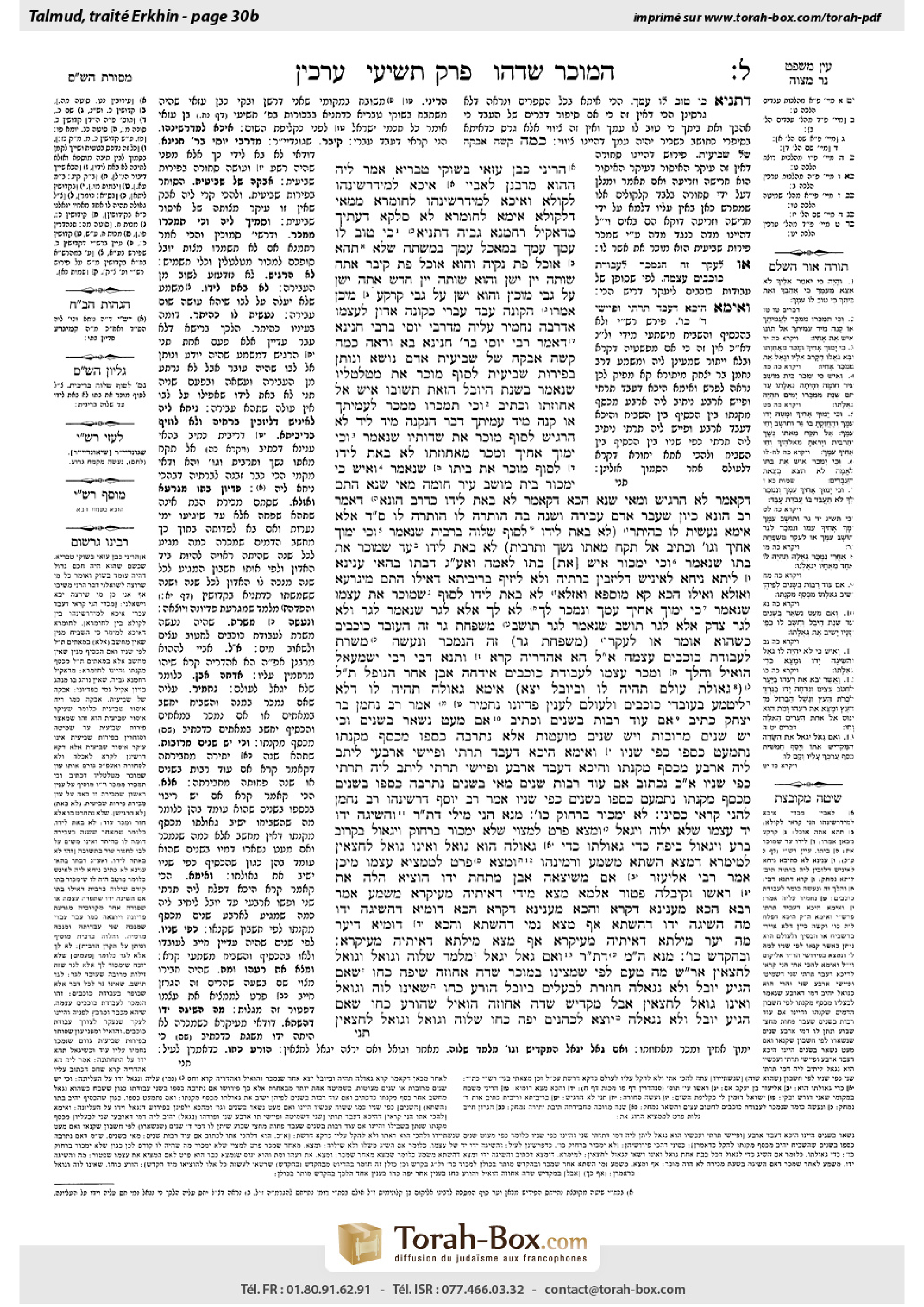
Arakhin 30b: Talmud study for Daf Yomi
Study the Talmud for Daf Yomi with scanned pages, Hebrew text, English translations from Sefaria and AI-generated French translations.
Passage selection and English or AI-generated French translation are available where the scan has annotations. Daf Study is independent of Torah-Box and Sefaria.
Browse Arakhin · ערכין · All tractatesArakhin 30b text and translations
This page of Arakhin includes the Aramaic text, an English translation and an AI-generated French translation, alongside the scan above.
ערכין ל׳ ב · Aramaic and Hebrew text
הֲרֵינִי כְּבֶן עַזַּאי בְּשׁוּקֵי טְבֶרְיָא. אֲמַר לֵיהּ הָהוּא מֵרַבָּנַן לְאַבָּיֵי: אִיכָּא לְמִידְרְשִׁינְהוּ לְקוּלָּא, וְאִיכָּא לְמִידְרְשִׁינְהוּ לְחוּמְרָא, מִמַּאי דִּלְקוּלָּא? אֵימָא לְחוּמְרָא!
לָא סָלְקָא דַּעְתָּיךְ, מִדְּאַקֵּיל רַחֲמָנָא גַּבֵּיהּ, דְּתַנְיָא: ״כִּי טוֹב לוֹ עִמָּךְ״ — עִמָּךְ בַּמַּאֲכָל, עִמְּךָ בַּמִּשְׁתֶּה, שֶׁלֹּא תְּהֵא אוֹכֵל פַּת נְקִיָּה וְהוּא אוֹכֵל פַּת קִיבָּר, אַתָּה שׁוֹתֶה יַיִן יָשָׁן וְהוּא שׁוֹתֶה יַיִן חָדָשׁ, אַתָּה יָשֵׁן עַל גַּבֵּי מוֹכִין וְהוּא יָשֵׁן עַל גַּבֵּי קַרְקַע; מִיכָּן אָמְרוּ: הַקּוֹנֶה עֶבֶד עִבְרִי כְּקוֹנֶה אָדוֹן לְעַצְמוֹ.
אַדְּרַבָּה, נַחְמִיר עֲלֵיהּ מִדְּרַבִּי יוֹסֵי בְּרַבִּי חֲנִינָא! דְּאָמַר רַבִּי יוֹסֵי בְּרַבִּי חֲנִינָא: ״בֹּא וּרְאֵה כַּמָּה קָשֶׁה אֲבָקָהּ שֶׁל שְׁבִיעִית״.
אָדָם נוֹשֵׂא וְנוֹתֵן בְּפֵירוֹת שְׁבִיעִית, לְסוֹף מוֹכֵר אֶת מִטַּלְטְלָיו, שֶׁנֶּאֱמַר: ״בִּשְׁנַת הַיּוֹבֵל הַזֹּאת תָּשׁוּבוּ אִישׁ אֶל אֲחוּזָּתוֹ״, וּכְתִיב: ״וְכִי תִמְכְּרוּ מִמְכָּר לַעֲמִיתֶךָ אוֹ קָנֹה מִיַּד עֲמִיתֶךָ״, דָּבָר הַנִּקְנֶה מִיָּד לְיָד.
לֹא הִרְגִּישׁ — לַסּוֹף מוֹכֵר אֶת שְׂדוֹתָיו, שֶׁנֶּאֱמַר: ״וְכִי יָמוּךְ אָחִיךָ וּמָכַר מֵאֲחֻזָּתוֹ״.
לֹא בָּאת לְיָדוֹ — לַסּוֹף מוֹכֵר אֶת בֵּיתוֹ, שֶׁנֶּאֱמַר: ״וְאִישׁ כִּי יִמְכּוֹר בֵּית מוֹשַׁב עִיר חוֹמָה״. מַאי שְׁנָא הָתָם דְּקָאָמַר ״לֹא הִרְגִּישׁ״, וּמַאי שְׁנָא הָכָא דְּקָאָמַר ״לֹא בָּאת לְיָדוֹ״? כִּדְרַב הוּנָא, דְּאָמַר רַב הוּנָא: כֵּיוָן שֶׁעָבַר אָדָם עֲבֵירָה וְשָׁנָה בָּהּ, הוּתְּרָה לוֹ.
הוּתְּרָה לוֹ סָלְקָא דַּעְתָּךְ?! אֶלָּא אֵימָא: נַעֲשֵׂית לוֹ כְּהֶיתֵּר.
לֹא בָּאת לְיָדוֹ — לַסּוֹף שֶׁלֹּוֶה בְּרִבִּית, שֶׁנֶּאֱמַר: ״וְכִי יָמוּךְ אָחִיךָ וְגוֹ׳״, וּכְתִיב: ״אַל תִּקַּח מֵאִתּוֹ נֶשֶׁךְ וְתַרְבִּית״.
לֹא בָּאת לְיָדוֹ — עַד שֶׁמּוֹכֵר אֶת בִּתּוֹ, שֶׁנֶּאֱמַר: ״וְכִי יִמְכּוֹר אִישׁ [אֶת] בִּתּוֹ לְאָמָה״, וְאַף עַל גַּב דְּבִתּוֹ בְּהַאי עִנְיָנָא לֵיתַהּ, נִיחָא לְאִינִישׁ דְּלִיזַבֵּין בְּרַתֵּיה וְלָא לֵיזִיף בְּרִיבִּיתָא, דְּאִילּוּ הָתָם מְיגָרְעָא וְאָזְלָא, וְאִילּוּ הָכָא קָא מוֹסְפָא וְאָזְלָא.
לֹא בָּאת לְיָדוֹ — לַסּוֹף שֶׁמּוֹכֵר אֶת עַצְמוֹ, שֶׁנֶּאֱמַר: ״כִּי יָמוּךְ אָחִיךָ עִמָּךְ וְנִמְכַּר לָךְ״; לֹא לָךְ אֶלָּא לְגֵר, שֶׁנֶּאֱמַר: ״לְגֵר״, וְלֹא לְגֵר צֶדֶק אֶלָּא לְגֵר תּוֹשָׁב, שֶׁנֶּאֱמַר: ״לְגֵר תּוֹשָׁב״.
״מִשְׁפַּחַת גֵּר״ — זֶה הַגּוֹי. כְּשֶׁהוּא אוֹמֵר ״אוֹ לְעֵקֶר מִשְׁפַּחַת גֵּר״ — זֶה הַנִּמְכָּר וְנַעֲשֶׂה מְשָׁרֵת לַעֲבוֹדָה זָרָה עַצְמָהּ.
אֲמַר לֵיהּ: הָא אַהְדְּרֵיהּ קְרָא, וְתָנָא דְּבֵי רַבִּי יִשְׁמָעֵאל: הוֹאִיל וְהָלַךְ וּמָכַר עַצְמוֹ לַעֲבוֹדָה זָרָה, אֶידְחֶה אֶבֶן אַחֵר הַנּוֹפֵל? תַּלְמוּד לוֹמַר: ״גְּאוּלַּת עוֹלָם תִּהְיֶה לּוֹ וּבַיּוֹבֵל יֵצֵא״. אֵימָא: גְּאוּלָּה תִּהְיֶה לוֹ — דְּלָא לִיטַּמַּע בַּגּוֹיִם, וּלְעוֹלָם לְעִנְיַן פִּדְיוֹנוֹ נַחְמִיר!
אָמַר רַב נַחְמָן בַּר יִצְחָק: כְּתִיב ״אִם עוֹד רַבּוֹת בַּשָּׁנִים״, וּכְתִיב ״אִם מְעַט נִשְׁאַר בַּשָּׁנִים״.
וְכִי יֵשׁ שָׁנִים מְרוּבּוֹת וְיֵשׁ שָׁנִים מוּעָטוֹת? אֶלָּא: נִתְרַבָּה כַּסְפּוֹ — ״מִכֶּסֶף מִקְנָתוֹ״, נִתְמַעֵט כַּסְפּוֹ — ״כְּפִי שָׁנָיו״.
וְאֵימָא: הֵיכָא דַּעֲבַד תַּרְתֵּי וּפָיְישִׁי אַרְבְּעֵי — לִיתֵּב לֵיהּ אַרְבַּע ״מִכֶּסֶף מִקְנָתוֹ״, וְהֵיכָא דַּעֲבַד אַרְבַּע וּפָיְישִׁי תַּרְתֵּי — לִיתֵּב לֵיהּ תַּרְתֵּי ״כְּפִי שָׁנָיו״!
אִם כֵּן, נִכְתּוֹב ״אִם עוֹד רַבּוֹת שָׁנִים״, מַאי ״בַּשָּׁנִים״? נִתְרַבָּה כַּסְפּוֹ בַּשָּׁנִים — מִ״כֶּסֶף מִקְנָתוֹ״, נִתְמַעֵט כַּסְפּוֹ בַּשָּׁנִים — ״כְּפִי שָׁנָיו״. אָמַר רַב יוֹסֵף: דַּרְשִׁינְהוּ רַב נַחְמָן לְהָנֵי קְרָאֵי כְּסִינַי.
לֹא יִמְכּוֹר בְּרָחוֹק כּוּ׳. מְנָא הָנֵי מִילֵּי? דְּתָנוּ רַבָּנַן: ״וְהִשִּׂיגָה יָדוֹ״ — יַד עַצְמוֹ, שֶׁלֹּא יִלְוֶה וְיִגְאַל.
״וּמָצָא״ — פְּרָט לְמָצוּי, שֶׁלֹּא יִמְכּוֹר בְּרָחוֹק וְיִגְאוֹל בְּקָרוֹב, בְּרַע וְיִגְאוֹל בְּיָפֶה; ״כְּדֵי גְאוּלָּתוֹ״ — כְּדֵי גְאוּלָּה הוּא גּוֹאֵל, וְאֵינוֹ גּוֹאֵל לַחֲצָאִין.
לְמֵימְרָא דְּ״מָצָא״ הַשְׁתָּא מַשְׁמַע? וּרְמִינְהוּ: ״וּמָצָא״ — פְּרָט לְמַמְצִיא עַצְמוֹ, מִיכָּן אָמַר רַבִּי אֱלִיעֶזֶר: אִם מִשֶּׁיָּצְאָה אֶבֶן מִתַּחַת יָדוֹ, הוֹצִיא הַלָּה אֶת רֹאשׁוֹ וְקִיבְּלָהּ — פָּטוּר; אַלְמָא ״מָצָא״ מִידֵי דְּאִיתֵיהּ מֵעִיקָּרָא מַשְׁמַע!
אָמַר רָבָא: הָכָא מֵעִנְיָנָא דִקְרָא, וְהָכָא מֵעִנְיָנָא דִקְרָא. הָכָא דּוּמְיָא דְּ״הִשִּׂיגָה יָדוֹ״, מָה ״הִשִּׂיגָה יָדוֹ״ דְּהַשְׁתָּא, אַף ״מָצָא״ נָמֵי דְּהַשְׁתָּא. וְהָכָא דּוּמְיָא דְּ״יַעַר״, מָה יַעַר מִילְּתָא דְּאִיתֵיהּ מֵעִיקָּרָא, אַף ״מָצָא״ מִילְּתָא דְּאִיתֵיהּ מֵעִיקָּרָא.
וּבְהֶקְדֵּשׁ כּוּ׳. מְנָא הָנֵי מִילֵּי? דְּתָנוּ רַבָּנַן: ״וְאִם גָּאֹל יִגְאַל״ — מְלַמֵּד שֶׁלֹּוֶה וְגוֹאֵל, וְגוֹאֵל לַחֲצָאִין.
אָמַר רַבִּי שִׁמְעוֹן: מָה טַעַם? לְפִי שֶׁמָּצִינוּ בְּמוֹכֵר שְׂדֵה אֲחוּזָּה שֶׁיִּפָּה כֹּחוֹ, שֶׁאִם הִגִּיעַ יוֹבֵל וְלֹא נִגְאֲלָה חוֹזֶרֶת לַבְּעָלִים בַּיּוֹבֵל — הוֹרַע כֹּחוֹ, שֶׁאֵינוֹ לֹוֶה וְגוֹאֵל, וְאֵינוֹ גּוֹאֵל לַחֲצָאִין.
אֲבָל מַקְדִּישׁ שְׂדֵה אֲחוּזָּה, הוֹאִיל שֶׁהוֹרַע כֹּחוֹ, שֶׁאִם הִגִּיעַ יוֹבֵל וְלֹא נִגְאֲלָה יוֹצָא לַכֹּהֲנִים, יִפָּה כֹּחוֹ שֶׁלֹּוֶה וְגוֹאֵל וְגוֹאֵל לַחֲצָאִין.
Arakhin 30b · English translation
I am ready to answer any questions put to me like those of the intellectually sharp ben Azzai, who would regularly expound in the markets of Tiberias. One of the Sages said to Abaye: The verses discussing the redemption of a Hebrew slave can be interpreted as a leniency for the slave, and they can also be interpreted as a stringency for him. From where is it derived that the verses should be interpreted as a leniency for the slave? Say that they should be interpreted as a stringency for him.
Abaye explained: Such a possibility should not enter your mind, due to the fact that the Merciful One was explicitly lenient with regard to a slave. As it is taught in a baraita: The verse states with regard to a Hebrew slave: “And it shall be, if he says to you I will not leave you…because he fares well with you” (Deuteronomy 15:16). The term “with you” indicates that the slave must be with you, i.e., treated as your equal, with regard to food, and with you with regard to drink. This means that you should not be eating fine bread while he eats inferior bread [kibbar], bread from coarse flour mixed with bran. Likewise, you should not drink old wine while he drinks inferior new wine. You should not sleep on bedding made from soft sheets while he sleeps on the ground. From here the Sages stated: One who acquires a Hebrew slave is considered like one who acquires a master for himself, as he must ensure that the slave’s living conditions are equal to his own.
That Sage raised an objection to Abaye: On the contrary, let us impose a stringency upon the slave, due to the statement of Rabbi Yosei, son of Rabbi Ḥanina. As Rabbi Yosei, son of Rabbi Ḥanina, says in explanation of the juxtaposition of several passages in the Torah (Leviticus, chapter 25): Come and see how severe is even the hint of violation of the prohibition of the Sabbatical Year, as the prohibition against engaging in commerce with produce of the Sabbatical Year is not one of the primary prohibitions of the Sabbatical Year, and yet its punishment is harsh.
Rabbi Yosei, son of Rabbi Ḥanina, continues: If a person has commercial dealings with produce of the Sabbatical Year or of the Jubilee Year, ultimately he will become so poor that he will be compelled to sell his movable property, as it is stated: “In this Jubilee Year you shall return every man to his possession” (Leviticus 25:13), and it is written in the subsequent verse: “And if you sell something to your neighbor or buy from your neighbor’s hand,” which is referring to an item acquired by passing it from hand to hand. The juxtaposition of the two verses indicates that if one violates the halakhot of the Jubilee Year or the Sabbatical Year, he will eventually have to sell his movable property.
If he does not feel remorse and he does not repent, ultimately he will be compelled to sell his fields, as it is stated in an adjacent verse: “If your brother becomes poor and sells part of his ancestral land” (Leviticus 25:25).
If consciousness of his sins does not come to him, ultimately he will be compelled to sell his house, as it is stated: “And if a man sells a dwelling house in a walled city” (Leviticus 25:29). The Gemara asks: What is different there, in the previous clause, where the tanna says that the sinner does not sense remorse, and what is different here, where he says that consciousness of his sins does not come to him? The Gemara responds: This is in accordance with the statement of Rav Huna, as Rav Huna says: Once a person commits a transgression and repeats it, it is permitted to him.
The Gemara asks: Can it enter your mind to say that it is actually permitted to him because he has transgressed twice? Rather, say that it becomes as though it were permitted to him, that is, after transgressing the prohibition twice he becomes accustomed to this behavior and no longer feels that it is a sin. If one transgresses the prohibition only once, he is apt to feel remorse. Once he repeats his transgression, he loses this sensibility concerning his sins and will no longer feel any remorse.
Rabbi Yosei, son of Rabbi Ḥanina, continues: If consciousness of his sins does not come to him, ultimately he will be compelled to borrow with interest, as it is stated: “And if your brother becomes poor and his means fail with you, then you shall uphold him” (Leviticus 25:35), and it is written in the subsequent verse: “You shall take no interest or increase from him.”
One does not come to borrow with interest until he has already been compelled to sell his daughter, as it is stated: “And when a man sells his daughter as a maidservant” (Exodus 21:7). The Gemara explains: And even though his daughter is not mentioned in that context in Leviticus, nevertheless, a person prefers to sell his daughter and not to borrow money with interest. This is because there, when one sells his daughter, the sum required in order to redeem her continuously decreases, while here, where one borrows with interest, his debt continuously increases. One may therefore assume that if one borrows with interest, he has already sold his daughter.
If consciousness of his sins does not come to him, ultimately he will be compelled to sell himself, as it is stated: “And when your brother becomes poor with you and sells himself to you” (Leviticus 25:39). Not only will he be sold to you, a born Jew; rather, he will even be sold to a stranger, as it is stated: “And sells himself to the stranger” (Leviticus 25:47). And not only to a stranger who is a convert, but even to a gentile who resides in Eretz Yisrael and observes the seven Noahide mitzvot [ger toshav], as it is stated: “And sells himself to a ger toshav with you” (Leviticus 25:47).
When the verse further states: “Or to the offshoot of a stranger’s family,” this is referring to the gentile relatives of a ger toshav, who are idolaters. When it says: “Or to the offshoot [le’eker] of a stranger’s family,” this is referring to one who is sold and becomes a servant to idol worship itself, i.e., he is put to work in a temple dedicated to idolatry. In any event, the baraita teaches that it is only due to an individual’s sins that he reaches such a low point that he must sell himself as a slave. If so, the verses dealing with a Hebrew slave should be interpreted in a stringent manner, so that the slave cannot easily be redeemed.
Abaye said to that Sage: But the verse subsequently restores him, i.e., it requires that one strive to redeem him from slavery. As the tanna of the school of Rabbi Yishmael taught: Since he went and sold himself to a temple dedicated to idol worship, should I throw a stone after the fallen? In other words, perhaps he should be left to his own devices? The verse states: He shall have a perpetual right of redemption, and he shall leave in the Jubilee (see Leviticus 25:31, 48). The Gemara objects: Even so, you can say that he shall have a redemption so that he will not be assimilated among the gentiles, but actually, with regard to his redemption we will be stringent, as it is due only to his sins that he is enslaved.
Rav Naḥman bar Yitzḥak said: Two verses are written with regard to redeeming someone who was sold to a gentile. It is written: “If there are yet many in the years, according to them he shall return the price of his redemption from the money that he was bought for” (Leviticus 25:51). And it is written in the next verse: “And if there remain but few in the years until the Jubilee Year, then he shall reckon with him; according to his years he shall return the price of his redemption.”
Now, are there years with much time and years with little time? Every year is the same length. Rather, this means that if his monetary value appreciated during the years of his service, he is redeemed according to “the money that he was bought for,” which is the lower sum. And if his monetary value depreciated over time, one determines his value “according to his years,” i.e., according to his current value rather than according to his previous worth. The verse indicates that one acts leniently when calculating the redemption payment of a Hebrew slave.
The Gemara asks: But say that the verses should be interpreted as follows: “If there are yet many in the years,” is referring to a case where he served for two years, and four years of servitude remain. In this situation let him return to his master the value of four years of his servitude according to “the money that he was bought for.” And the phrase “if there remain but few in the years” is referring to a case where he served for four years and two years of servitude remain. In this situation let him return to his master the value of two years of his servitude “according to his years.”
The Gemara rejects this suggestion: If so, let the verse write: If there are yet many years. What is the meaning of the phrase “in the years”? Rather, this indicates that if his monetary value appreciated in the years of his service, he is redeemed according to “the money that he was bought for,” which is the lower sum. If his monetary value depreciated in the years, one determines his value “according to his years,” i.e., according to his current value. Upon hearing this explanation, Rav Yosef said: Rav Naḥman bar Yitzḥak interpreted these verses as truly as if the interpretation had been transmitted to Moses from Sinai.
§ The mishna teaches: One may not sell his ancestral field that is located in a distant area and redeem with that money a field that he sold in a nearby area. Likewise, he may not sell a low-quality field and redeem with that money a high-quality field. And he may not borrow money and redeem the field, nor may he redeem the field incrementally, half now and half at a later date. The Gemara asks: From where are these matters derived? As the Sages taught with regard to the verse: “And he prospers and finds sufficient means to redeem it” (Leviticus 25:26), the phrase “and he prospers” teaches that the money he uses to redeem the field must be his own possession, meaning that he may not borrow money and redeem the field.
The baraita continues: “And finds sufficient means”; this excludes the usage of means that were previously available, meaning that one may not sell property that he owned at the time of the sale in order to redeem his field, e.g., he may not sell a field that is located in a distant area and redeem a field that is located in a nearby area, nor may he sell a low-quality field and redeem a high-quality field. “Sufficient means to redeem it”; this indicates that one may redeem his field if he possesses sufficient means to redeem the entire field, but he may not partially redeem his field.
The Gemara asks: Is this to say that the term “finds” indicates that the means were found now and were not previously available? But you can raise a contradiction to this premise from a baraita: The verse states with regard to an unintentional killer: “And one who goes into the forest with another to hew wood, and his hand fetches a stroke with the ax to cut down the tree, and the blade slips off the wood, and finds another person, and he dies, he shall flee to one of these cities and live” (Deuteronomy 19:5). The term “and finds” excludes one who introduces himself into the area of danger. From here Rabbi Eliezer said: If, after the stone departed from one’s hand, the other person stuck his head out and received a blow from it and died, the killer is exempt from exile. Evidently, the term “finds” indicates an item that is there from the outset.
Rava said: Here, “finds” is interpreted according to the context of the verse, and here it is likewise interpreted according to the context of the verse. Here, with regard to redeeming a field, one interprets “finds” in a manner similar to the phrase “he prospers.” Just as “he prospers” is referring to funds that he acquires only now, so too “finds” indicates property that he finds only now, and not property that he owned from the outset. And here, with regard to an unintentional killer, one interprets “finds” in a manner similar to the term “forest.” Just as a forest is something that is there from the outset, so too, “finds” indicates something, i.e., an individual, that is there from the outset. This excludes an individual who was not in the vicinity when the ax slipped.
§ The mishna teaches: But with regard to redeeming a field from the Temple treasury, it is permitted to redeem the field in any of these ways. This is a halakha where greater stringency applies with regard to redeeming a field from an ordinary individual than with regard to redeeming it from the Temple treasury. The Gemara asks: From where are these matters derived? As the Sages taught with regard to a verse dealing with one who consecrates his field: “And if the one who consecrates the field will indeed redeem it” (Leviticus 27:19). The phrase “will indeed redeem” teaches that one may borrow money and redeem his field, and one may partially redeem his field, despite the fact that one may not do so when redeeming a field from an ordinary individual.
Rabbi Shimon said: What is the reason for this leniency in the case of consecrated fields? It is because we find with regard to one who sells his ancestral field, that the Torah enhanced his power, in that if the Jubilee Year arrived and the field was not redeemed, it returns to its original owners in the Jubilee Year. Therefore, his power was diminished with regard to the manner of redemption, in that he cannot borrow money and redeem the field, and he cannot partially redeem it.
But with regard to one who consecrates his ancestral field, since his power was diminished, in that if the Jubilee Year arrived and the field was not redeemed, the field leaves the possession of the Temple treasury and passes to the possession of the priests and does not return to the original owner, the Torah therefore enhanced his power, in that he may borrow money and redeem his field, and he may partially redeem it.
Arakhin 30b · Traduction française (IA)
Je suis prêt à répondre à toute question posée, comme celles du ben Azzai, homme intelligent, qui exposait régulièrement dans les marchés de Tébérija. L'un des Sages dit à Abaye : Les versets relatifs à la libération d'un serviteur juif peuvent être interprétés comme une facilité pour le serviteur, et peuvent aussi être interprétés comme une restriction pour lui. D'où vient qu'ils doivent être interprétés comme une facilité pour le serviteur ? Dis qu'ils doivent être interprétés comme une restriction pour lui.
Abaye explique : Une telle possibilité ne doit pas entrer dans votre esprit, en raison du fait que le Très Miséricordieux a été clairement clément envers le serviteur. Comme il est enseigné dans une baraïta : Le verset dit concernant un serviteur juif : « Et il arrivera, s'il dit à toi : Je ne veux pas te quitter... parce qu'il va bien avec toi » (Deutéronome 15:16). Le terme « avec toi » indique que le serviteur doit être avec toi, c'est-à-dire traité comme ton égal, en ce qui concerne la nourriture, et avec toi en ce qui concerne la boisson. Cela signifie que vous ne devriez pas manger du pain fin tandis qu'il mange du pain inférieur [kibbar], du pain fait de farine grossière mélangée à des céréales. De même, vous ne devriez pas boire du vin vieux tandis qu'il boit du vin nouveau inférieur. Vous ne devriez pas dormir sur des draps doux tandis qu'il dort sur le sol. D'où les Sages ont dit : Celui qui acquiert un serviteur juif est considéré comme celui qui acquiert un maître pour lui-même, car il doit veiller à ce que les conditions de vie du serviteur soient égales aux siennes.
Ce Sage a soulevé une objection contre Abaye : Au contraire, imposons une stricte rigueur concernant le serviteur, en raison de la déclaration de Rabbi Yosei, fils de Rabbi Ḥanina. Comme Rabbi Yosei, fils de Rabbi Ḥanina, explique en commentant la juxtaposition de plusieurs passages dans la Torah (Lévitique, chapitre 25) : Venez voir à quel point est grave même l'indice de violation de la prohibition de l'année sainte, car la prohibition de commerce avec les produits de l'année sainte n'est pas l'une des principales prohibitions de l'année sainte, et pourtant sa sanction est sévère.
Rabbi Yosei, fils de Rabbi Ḥanina, continue : Si une personne a des affaires commerciales avec les produits de l'année sainte ou de l'année sabbatique, finalement il deviendra si pauvre qu'il sera contraint de vendre ses biens mobiliers, comme il est dit : « Dans cette année sabbatique, vous rendrez à chacun son possession » (Lévitique 25:13), et il est écrit dans le verset suivant : « Et si tu vends quelque chose à ton voisin ou achètes de la main de ton voisin », ce qui fait référence à un objet acquis en passant de main en main. La juxtaposition des deux versets indique que si l'on viole les halakhot de l'année sabbatique ou de l'année sainte, on finira par devoir vendre ses biens mobiliers.
Si il ne ressent pas de remords et ne se repente pas, finalement il sera contraint de vendre ses champs, comme il est dit dans un verset adjacent : « Si ton frère devient pauvre et vend une partie de sa terre paternelle » (Lévitique 25:25).
Si la conscience de ses péchés ne vient pas à lui, finalement il sera contraint de vendre sa maison, comme il est dit : « Et si un homme vend une maison dans une ville fortifiée » (Lévitique 25:29). La Guemara demande : Qu'est-ce qui diffère là, dans la clause précédente, où le tanna dit que le pécheur ne ressent pas de remords, et qu'est-ce qui diffère ici, où il dit que la conscience de ses péchés ne vient pas à lui ? La Guemara répond : Cela est selon la déclaration de Rav Huna, comme Rav Huna dit : Une fois qu'une personne commet un péché et le répète, il lui est permis.
La Guemara demande : Peut-il entrer dans votre esprit de dire qu'il est vraiment permis à lui, car il a péché deux fois ? Plutôt, disons qu'il devient comme s'il était permis à lui, c'est-à-dire, après avoir péché contre la prohibition deux fois, il devient habitué à ce comportement et ne ressent plus que ce n'est pas un péché. Si une personne péche contre la prohibition une seule fois, il est enclin à ressentir du remords. Une fois qu'il répète son péché, il perd cette sensibilité concernant ses péchés et ne ressentira plus aucun remords.
Rabbi Yosei, fils de Rabbi Ḥanina, continue : Si la conscience de ses péchés ne vient pas à lui, finalement il sera contraint de prêter à intérêt, comme il est dit : « Et si ton frère devient pauvre et ses moyens manquent à toi, alors tu le soutiendras » (Lévitique 25:35), et il est écrit dans le verset suivant : « Tu ne prendras pas d'intérêt ou d'augmentation de lui. »
On ne vient pas à emprunter à intérêt jusqu'à ce qu'il ait déjà été contraint de vendre sa fille, comme il est dit : « Et quand un homme vend sa fille comme une servante » (Exode 21:7). La Guemara explique : Et même si sa fille n'est pas mentionnée dans ce contexte dans Lévitique, néanmoins, une personne préfère vendre sa fille plutôt que de prêter de l'argent à intérêt. Cela est dû au fait que, là, quand on vend sa fille, la somme nécessaire pour la racheter diminue continuellement, tandis que là, où l'on prête à intérêt, sa dette augmente continuellement. On peut donc supposer que si l'on prête à intérêt, on a déjà vendu sa fille.
Si la conscience de ses péchés ne vient pas à lui, finalement il sera contraint de se vendre, comme il est dit : « Et quand ton frère devient pauvre avec toi et se vend à toi » (Lévitique 25:39). Non seulement sera-t-il vendu à toi, un Juif né, mais il sera même vendu à un étranger, comme il est dit : « Et se vend à l'étranger » (Lévitique 25:47). Et non seulement à un étranger qui est un converti, mais même à un gentil qui habite en Eretz Yisrael et observe les sept commandements de Noé [ger toshav], comme il est dit : « Et se vend à un ger toshav avec toi » (Lévitique 25:47).
Lorsque la parole suivante dit : « Ou à l'offspring d'une famille étrangère », cela fait référence aux parents païens d'un ger toshav. Lorsqu'elle dit : « Ou à l'offspring [le'eker] d'une famille étrangère », cela fait référence à celui qui est vendu et devient un serviteur de l'idolâtrie, c'est-à-dire qu'il est employé dans un temple dédié à l'idolâtrie. En tout cas, la baraïta enseigne que c'est uniquement en raison des péchés d'un individu qu'il atteint un tel point bas qu'il doit se vendre comme esclave. Si tel est le cas, les versets relatifs à l'esclave hébreu doivent être interprétés de manière stricte, de sorte que l'esclave ne puisse pas facilement être racheté.
Abaye dit à ce Sage : Mais le verset suivant le rétablit, c'est-à-dire qu'il exige que l'on cherche à le racheter de l'esclavage. Comme le tanna de la maison de Rabbi Yishmael a enseigné : Puisqu'il est allé se vendre à un temple dédié à l'idolâtrie, dois-je jeter une pierre après celui qui est tombé ? Autrement dit, peut-être devrait-il être laissé à son propre sort ? Le verset dit : « Il aura un droit perpétuel de rachat, et il sortira à la Jubilé (voir Lévitique 25:31, 48). » La Guemara s'oppose à cela : Même ainsi, vous pouvez dire qu'il aura un rachat afin qu'il ne s'assimile pas parmi les païens, mais en réalité, concernant son rachat, nous serons stricts, car c'est uniquement en raison de ses péchés qu'il est en esclavage.
Rav Naḥman bar Yitzḥak dit : Deux versets sont écrits concernant le rachat d'une personne vendue à un païen. Il est écrit : « Si il reste encore beaucoup d'années, selon elles il reviendra au prix de son rachat à partir de l'argent par lequel il a été acheté » (Lévitique 25:51). Et il est écrit dans le verset suivant : « Et si il reste peu d'années jusqu'à l'année de Jubilé, alors il comptera avec lui ; selon ses années il reviendra au prix de son rachat. »
Maintenant, y a-t-il des années avec beaucoup de temps et des années avec peu de temps ? Chaque année a la même durée. Plutôt, cela signifie que si sa valeur monétaire a augmenté pendant les années de son service, il est racheté selon « l'argent par lequel il a été acheté », qui est la somme inférieure. Et si sa valeur monétaire a diminué au fil du temps, on détermine sa valeur « selon ses années », c'est-à-dire selon sa valeur actuelle plutôt que selon sa valeur précédente. Le verset indique que l'on agit avec bienveillance lors du calcul du paiement de rachat d'un esclave hébreu.
La Guemara demande : Mais disons que les versets doivent être interprétés ainsi : « Si il reste encore beaucoup d'années », fait référence à un cas où il a servi pendant deux ans et quatre ans de servitude restent. Dans ce cas-là, il doit rendre à son maître la valeur de quatre ans de son service selon « l'argent par lequel il a été acheté ». Et la phrase « si il reste peu d'années » fait référence à un cas où il a servi pendant quatre ans et deux ans de servitude restent. Dans ce cas-là, il doit rendre à son maître la valeur de deux ans de son service « selon ses années ».
La Guemara rejette cette suggestion : Si tel est le cas, laissez le verset écrire : « Si il reste encore beaucoup d'années ». Quelle est la signification de la phrase « dans les années » ? Plutôt, cela indique que si sa valeur monétaire a augmenté pendant les années de son service, il est racheté selon « l'argent par lequel il a été acheté », qui est la somme inférieure. Si sa valeur monétaire a diminué pendant les années, on détermine sa valeur « selon ses années », c'est-à-dire selon sa valeur actuelle. En entendant cette explication, Rav Yosef dit : Rav Naḥman bar Yitzḥak a interprété ces versets véritablement comme si l'interprétation avait été transmise à Moïse depuis le Sinaï.
§ La mitsva enseigne : On ne peut pas vendre son champ ancestral situé dans une région éloignée et racheter avec cet argent un champ qu'il a vendu dans une région proche. De même, on ne peut pas vendre un champ de mauvaise qualité et racheter avec cet argent un champ de bonne qualité. Et on ne peut pas emprunter de l'argent pour racheter le champ, ni racheter le champ progressivement, la moitié maintenant et la moitié plus tard. La Guemara demande : D'où sont dérivés ces enseignements ? Comme les Sages ont enseigné concernant le verset : « Et il s'élève et trouve des moyens suffisants pour racheter cela » (Lévitique 25:26), la phrase « et il s'élève » enseigne que l'argent qu'on utilise pour racheter le champ doit être la propriété de l'individu, c'est-à-dire qu'il ne peut pas emprunter de l'argent pour racheter le champ.
La baraïta continue : « Et trouve des moyens suffisants » ; cela exclut l'utilisation de moyens préalablement disponibles, c'est-à-dire qu'on ne peut pas vendre une propriété qu'on possédait au moment de la vente pour racheter son champ, par exemple, on ne peut pas vendre un champ situé dans une région éloignée pour racheter un champ situé dans une région proche, ni vendre un champ de mauvaise qualité pour racheter un champ de bonne qualité. « Des moyens suffisants pour racheter cela » ; cela indique qu'on peut racheter son champ s'il possède des moyens suffisants pour racheter l'ensemble du champ, mais on ne peut pas racheter partiellement son champ.
La Guemara demande : Est-ce que cela signifie que le terme « trouve » indique que les moyens ont été trouvés maintenant et n'étaient pas disponibles auparavant ? Mais vous pouvez élever une contradiction à cette hypothèse à partir d'une baraïta : Le verset parle d'un meurtrier involontaire : « Et celui qui entre dans la forêt avec un autre pour tailler du bois, et sa main saisit un coup avec la hache pour couper l'arbre, et la lame glisse du bois, et trouve un autre personne, et il meurt, il fuira vers l'une de ces villes et vivra » (Deutéronome 19:5). Le terme « et trouve » exclut celui qui s'introduit dans la zone de danger. À partir de là, Rabbi Eliezer a dit : Si, après que la pierre ait quitté la main de l'individu, la personne a mis sa tête en avant et a reçu un coup de celle-ci et est morte, le meurtrier est exempt de l'exil. Évidemment, le terme « trouve » indique un objet qui est là dès le départ.
Rava a dit : Ici, « trouve » est interprété selon le contexte du verset, et ici aussi il est interprété selon le contexte du verset. Ici, concernant le rachat d'un champ, on interprète « trouve » de manière similaire à la phrase « il prospère ». Tout comme « il prospère » fait référence à des fonds qu'il acquiert seulement maintenant, de même « trouve » indique une propriété qu'il découvre seulement maintenant, et non une propriété qu'il possédait dès le départ. Et ici, concernant un meurtrier involontaire, on interprète « trouve » de manière similaire au terme « forêt ». Tout comme une forêt est quelque chose qui existe depuis le début, de même « trouve » indique quelque chose, c'est-à-dire une personne, qui existe depuis le début. Cela exclut une personne qui n'était pas présente lorsqu'un marteau a glissé.
§ La mitsva enseigne : Mais concernant le rachat d'un champ à partir du trésor du Temple, il est permis de racheter le champ de différentes manières. C'est une halakha où une stricte application s'applique concernant le rachat d'un champ d'une personne ordinaire par rapport au rachat d'un champ à partir du trésor du Temple. Le Guemara demande : D'où ces choses sont-elles dérivées ? Comme les Sages ont enseigné concernant un verset relatif à celui qui consacre son champ : « Et si celui qui consacre le champ le rachète effectivement » (Lévitique 27:19). La phrase « rachète effectivement » enseigne que l'on peut emprunter de l'argent et racheter son champ, et l'on peut racheter partiellement son champ, malgré le fait que l'on ne peut pas le faire lors du rachat d'un champ d'une personne ordinaire.
Rabbi Shimon a dit : Quelle est la raison de cette leniavance dans le cas des champs consacrés ? C'est parce que nous trouvons concernant celui qui vend son champ ancestral, que la Torah a renforcé son pouvoir, en ce sens que si l'année sabbatique est arrivée et que le champ n'a pas été racheté, il revient aux propriétaires originels en année sabbatique. Par conséquent, son pouvoir a été diminué concernant la manière de racheter, en ce sens qu'il ne peut pas emprunter de l'argent et racheter le champ, et il ne peut pas racheter partiellement le champ.
Mais concernant celui qui consacre son champ ancestral, puisque son pouvoir a été diminué, en ce sens que si l'année sabbatique est arrivée et que le champ n'a pas été racheté, le champ quitte la possession du trésor du Temple et passe à la possession des prêtres et ne revient pas au propriétaire originel, la Torah a donc renforcé son pouvoir, en ce sens qu'il peut emprunter de l'argent et racheter son champ, et il peut racheter partiellement le champ.
Traduction française générée par IA à partir de l’édition anglaise de Sefaria. Vérifie toujours un passage avec le texte source.
Text from Sefaria: William Davidson Edition - Vocalized Aramaic (CC BY NC); William Davidson Edition - English (CC BY NC).