Arakhin 31a: Talmud study for Daf Yomi
Study the Talmud for Daf Yomi with scanned pages, Hebrew text, English translations from Sefaria and AI-generated French translations.
Passage selection and English or AI-generated French translation are available where the scan has annotations. Daf Study is independent of Torah-Box and Sefaria.
Browse Arakhin · ערכין · All tractatesArakhin 31a text and translations
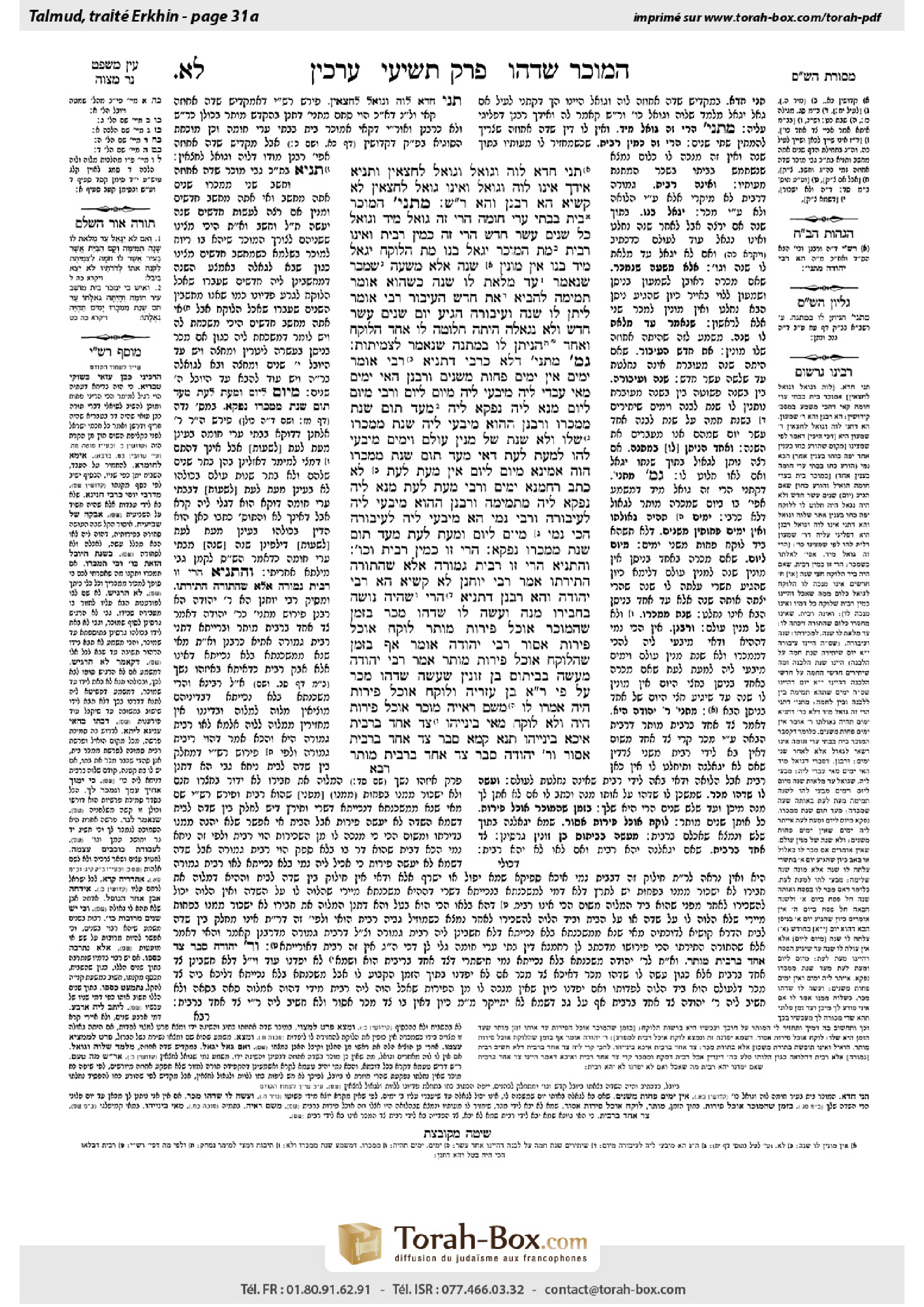
This page of Arakhin includes the Aramaic text, an English translation and an AI-generated French translation, alongside the scan above.
ערכין ל״א א · Aramaic and Hebrew text
תָּנֵי חֲדָא: לֹוֶה וְגוֹאֵל וְגוֹאֵל לַחֲצָאִין, וְתַנְיָא אִידַּךְ: אֵינוֹ לֹוֶה וְגוֹאֵל וְאֵינוֹ גּוֹאֵל לַחֲצָאִין. לָא קַשְׁיָא, הָא רַבָּנַן וְהָא רַבִּי שִׁמְעוֹן.
מַתְנִי׳ הַמּוֹכֵר בֵּית בְּבָתֵּי עָרֵי חוֹמָה — הֲרֵי זֶה גּוֹאֵל מִיָּד, וְגוֹאֵל כׇּל שְׁנֵים עָשָׂר חֹדֶשׁ, הֲרֵי זֶה כְּמִין רִבִּית, וְאֵינוֹ רִבִּית.
מֵת הַמּוֹכֵר — יִגְאַל בְּנוֹ, מֵת הַלּוֹקֵחַ — יִגְאַל מִיַּד בְּנוֹ. אֵין מוֹנִין שָׁנָה אֶלָּא מִשָּׁעָה שֶׁמָּכַר, שֶׁנֶּאֱמַר: ״עַד מְלֹאת לוֹ שָׁנָה״.
כְּשֶׁהוּא אוֹמֵר ״תְּמִימָה״, לְהָבִיא אֶת חֹדֶשׁ הָעִיבּוּר. רַבִּי אוֹמֵר: לִיתֵּן לוֹ שָׁנָה וְעִיבּוּרָהּ. הִגִּיעַ יוֹם שְׁנֵים עָשָׂר חֹדֶשׁ וְלֹא נִגְאֲלָה — הָיְתָה חֲלוּטָה לוֹ. אֶחָד הַלּוֹקֵחַ וְאֶחָד הַנִּיתָּן לוֹ בְּמַתָּנָה, שֶׁנֶּאֱמַר: ״לַצְּמִיתוּת״.
גְּמָ׳ מַתְנִיתִין דְּלָא כְּרַבִּי, דְּתַנְיָא: רַבִּי אוֹמֵר: ״יָמִים״ — אֵין יָמִים פָּחוֹת מִשְּׁנַיִם.
וְרַבָּנַן, הַאי ״יָמִים״ מַאי עָבְדִי לֵיהּ? מִיבְּעֵי לֵיהּ מִיּוֹם לְיוֹם. וְרַבִּי, מִיּוֹם לְיוֹם מְנָא לֵיהּ? נָפְקָא לֵיהּ מֵ״עַד תּוֹם שְׁנַת מִמְכָּרוֹ״.
וְרַבָּנַן? הַהוּא מִיבְּעֵי לֵיהּ שְׁנַת מִמְכָּרוֹ שֶׁלּוֹ, וְלֹא (שְׁנַת) [שָׁנָה] שֶׁל מִנְיַן עוֹלָם. וְיָמִים מִיבְּעֵי לְהוּ לְמֵעֵת לְעֵת, דְּאִי מֵ״עַד תּוֹם שְׁנַת מִמְכָּרוֹ״ הֲוָה אָמֵינָא: מִיּוֹם לְיוֹם — אִין, מֵעֵת לְעֵת — לָא, כְּתַב רַחֲמָנָא ״יָמִים״.
וְרַבִּי, מֵעֵת לְעֵת מְנָא לֵיהּ? נָפְקָא לֵיהּ מִ״תְּמִימָה״. וְרַבָּנַן? הַהוּא מִיבְּעֵי לֵיהּ לְעִיבּוּרַהּ.
וְרַבִּי נָמֵי, הָא מִיבְּעֵי לֵיהּ לְעִיבּוּרַהּ! הָכִי נָמֵי, מִיּוֹם לְיוֹם וּמֵעֵת לְעֵת מֵ״עַד תּוֹם שְׁנַת מִמְכָּרוֹ״ נָפְקָא.
הֲרֵי זוֹ כְּמִין רִבִּית וְכוּ׳. וְהָתַנְיָא: הֲרֵי זוֹ רִבִּית גְּמוּרָה, אֶלָּא שֶׁהַתּוֹרָה הִתִּירַתּוּ!
אָמַר רַבִּי יוֹחָנָן: לָא קַשְׁיָא, הָא רַבִּי יְהוּדָה וְהָא רַבָּנַן. דְּתַנְיָא: הֲרֵי שֶׁהָיָה נוֹשֶׁה בַּחֲבֵירוֹ מָנֶה, וְעָשָׂה לוֹ שָׂדֵהוּ מֶכֶר, בִּזְמַן שֶׁהַמּוֹכֵר אוֹכֵל פֵּירוֹת — מוּתָּר, לוֹקֵחַ אוֹכֵל פֵּירוֹת — אָסוּר.
רַבִּי יְהוּדָה אוֹמֵר: אַף בִּזְמַן שֶׁהַלּוֹקֵחַ אוֹכֵל פֵּירוֹת — מוּתָּר. אָמַר רַבִּי יְהוּדָה: מַעֲשֶׂה בְּבַיְתוֹס בֶּן זוֹנִין שֶׁעָשָׂה שָׂדֵהוּ מֶכֶר עַל פִּי רַבִּי אֶלְעָזָר בֶּן עֲזַרְיָה, וְלוֹקֵחַ אוֹכֵל פֵּירוֹת הָיָה. אָמְרוּ לוֹ: מִשָּׁם רְאָיָיה? מוֹכֵר אוֹכֵל פֵּירוֹת הָיָה, וְלֹא לוֹקֵחַ.
מַאי בֵּינַיְיהוּ? צַד אֶחָד בְּרִבִּית אִיכָּא בֵּינַיְיהוּ, תַּנָּא קַמָּא סָבַר: צַד אֶחָד בְּרִבִּית אָסוּר, וְרַבִּי יְהוּדָה סָבַר: צַד אֶחָד בְּרִבִּית מוּתָּר.
Arakhin 31a · English translation
The Gemara raises a contradiction between two baraitot with regard to redeeming a field from the Temple treasury: It is taught in one baraita: One may borrow money and redeem a field, and one may partially redeem it. And it is taught in another baraita: One may not borrow money and redeem a field, nor may one partially redeem it. The Gemara explains: It is not difficult. This baraita, which teaches that one may not borrow money and redeem his field, is in accordance with the opinion of the Rabbis; and that baraita, which states that one may borrow money and redeem his field, is in accordance with the opinion of Rabbi Shimon, who is lenient with regard to redeeming a field from the Temple treasury.
MISHNA: One who sells a house from among the houses of walled cities may redeem the house immediately, even without the consent of the buyer, and he may redeem the house during the entire twelve months following the sale, but not after that. When he redeems the house within the twelve-month period, he returns the sale price to the buyer, and this is ostensibly like a form of interest, as the buyer has effectively resided in the house for free in exchange for the fact that the buyer’s money was in the possession of the seller. It is not considered interest, because the buyer owned the house during the period in which he resided in it.
If the seller died, his son may redeem the house from the buyer. If the buyer died, the seller may redeem it from the possession of the buyer’s son. If the buyer sold the house to another, one calculates the year only from the time that the owner sold the house to the first buyer, as it is stated: “And if it is not redeemed until the passage of a full year for him, then the house that is in the walled city shall stand in possession of the one who bought it in perpetuity” (Leviticus 25:30). The term “for him” indicates that the year is calculated from when the initial owner sold the house.
When it says: “A full year,” this serves to include the intercalated month in the year calculated from the sale, if it was a leap year. Rabbi Yehuda HaNasi says: The word “full” serves to give the seller a year and its addition, i.e., the year during which the house may be redeemed is not the 354-day lunar year, but the 365-day solar year. If the final day of the twelve-month period arrived and the house was not redeemed, the house has become the property of the buyer in perpetuity. This is the halakha with regard to both one who buys a house in a walled city and one to whom it is given as a gift, as it is stated: “Then the house that is in the walled city shall stand in possession of the one who bought it in perpetuity” (Leviticus 25:30).
GEMARA: The mishna teaches that one who sells a house in a walled city may redeem it immediately. The Gemara comments: The mishna is not in accordance with the opinion of Rabbi Yehuda HaNasi, as it is taught in a baraita that Rabbi Yehuda HaNasi says: The Torah states: “And if a man sells a dwelling house in a walled city, then he may redeem it until the completion of the year after it is sold; for days he shall have the right of redemption” (Leviticus 25:29). The word “days” means no fewer than two days, i.e., the house cannot be redeemed during the first two days after the sale.
The Gemara asks: And the Rabbis, what do they do with this word “days”? The Gemara answers: The Rabbis require it to teach the halakha that the year does not conclude with the arrival of Rosh HaShana, at the end of the calendar year; rather, it is calculated from day to day, that is, until the arrival of the date of the sale in the subsequent year. The Gemara asks: And Rabbi Yehuda HaNasi, from where does he derive that the year is calculated from day to day? The Gemara responds: He derives it from the phrase: “Until the completion of the year after it is sold” (Leviticus 25:29).
The Gemara asks: And the Rabbis, what do they do with this phrase? The Gemara responds: Actually, they require that phrase to teach that the calculated year is a year from his sale and not the year of the counting of the world, i.e., not the calendar year. And the Rabbis require the word “days” to teach that the year is calculated not only from day to day, but also from hour to hour, i.e., the year is completed only when the hour of the sale arrives in the subsequent year. As if one sought to derive this from the phrase “until the completion of the year after it is sold,” I would say that with regard to calculating the year from day to day, yes, it is calculated in this manner, but with regard to calculating the year from hour to hour, no, it is not calculated in this manner. Rather, once the beginning of the day arrives the seller can no longer redeem the house. The Merciful One therefore wrote the word “days” to teach that the year is calculated from hour to hour.
The Gemara asks: And Rabbi Yehuda HaNasi, from where does he derive that the year is calculated from hour to hour? The Gemara answers that he derives it from the term “a full year” (Leviticus 25:30). The Gemara asks: And the Rabbis, what do they derive from the term “a full year”? The Gemara responds: The Rabbis require that term to teach that the intercalated month of a leap year is included in the year of sale.
The Gemara objects: But Rabbi Yehuda HaNasi also requires that term to teach that the intercalated month of a leap year is included in the year of sale. The Gemara explains: Indeed, i.e., Rabbi Yehuda HaNasi derives the inclusion of the intercalated month from the term “a full year.” Rather, according to Rabbi Yehuda HaNasi, the fact that the year is calculated from day to day and from hour to hour constitutes one halakha, which is derived from the phrase “until the completion of the year after it is sold.”
§ The mishna teaches: When one redeems a house among those of a walled city, this is ostensibly like a form of interest, as the seller returns the original sale price to the buyer and he does not subtract from it in exchange for the period during which the buyer resided in the house. This is not considered interest because the buyer owned the house during that period. The Gemara asks: But isn’t it taught in a baraita: This is fully considered interest, but in this case the Torah permitted it?
Rabbi Yoḥanan said: It is not difficult. This mishna is in accordance with the opinion of Rabbi Yehuda, and that baraita is in accordance with the opinion of the Rabbis. As it is taught in a baraita: Consider the case of one who had a debt of one hundred dinars against another, and the borrower made a conditional sale of his field to the lender, stipulating that if he does not repay the loan on time then the sale shall take effect retroactively from the present moment. As long as the seller, i.e., the borrower, consumes the produce of that field until the time the loan comes due, this arrangement is permitted. But if the buyer, i.e., the lender, consumes the produce during this time, the arrangement is prohibited, as it constitutes interest. The reason is that if the loan is repaid on time, the sale is nullified, which means that the produce consumed by the lender will have been consumed as payment for allowing the loan to remain in the borrower’s possession.
Rabbi Yehuda says: Even when the buyer consumes the produce, such an arrangement is permitted. Rabbi Yehuda said in support of his opinion: There was an incident involving Baitos ben Zunin, who made a conditional sale of his field by a similar arrangement under the direction of Rabbi Elazar ben Azarya, and in this case the buyer was consuming the produce. The Rabbis said to him: Do you seek to bring proof from there? Actually, it was the seller who was consuming the produce, and not the buyer.
The Gemara asks: What is the basis for the dispute between Rabbi Yehuda and the Rabbis? The Gemara responds: The dispute between them concerns the permissibility of an agreement involving an uncertain interest, i.e., an agreement that will involve interest only under certain circumstances. This is the case here, since if the loan is repaid the produce consumed by the lender constitutes interest, but if the loan is not repaid then the field is acquired retroactively by the lender and no interest is involved. The Gemara elaborates: The first tanna, i.e., the Rabbis, holds that uncertain interest is prohibited, and Rabbi Yehuda holds that uncertain interest is permitted.
Arakhin 31a · Traduction française (IA)
La Guemara soulève une contradiction entre deux baraïtôt concernant la rédemption d'un champ à partir du trésor du Temple : Il est enseigné dans une baraïta : On peut emprunter de l'argent et rédimer un champ, et on peut rédimer partiellement ce champ. Et il est enseigné dans une autre baraïta : On ne peut pas emprunter de l'argent et rédimer un champ, ni rédimer partiellement ce champ. La Guemara explique : Ce n'est pas difficile. Cette baraïta, qui enseigne qu'on ne peut pas emprunter de l'argent et rédimer son champ, correspond à l'opinion des Rabbins ; et cette autre baraïta, qui affirme qu'on peut emprunter de l'argent et rédimer son champ, correspond à l'opinion de Rabbi Shimon, qui est plus accommodant concernant la rédemption d'un champ à partir du trésor du Temple.
MICHNA : Celui qui vend une maison parmi les maisons des villes murées peut rédimer la maison immédiatement, même sans le consentement de l'acheteur, et il peut rédimer la maison durant les douze mois suivant la vente, mais pas après cela. Lorsqu'il rédige la maison pendant la période des douze mois, il restitue le prix de la vente à l'acheteur, et cela semble être comme un intérêt, car l'acheteur a effectivement résidé dans la maison gratuitement en échange du fait que l'argent de l'acheteur était en possession du vendeur. Cela n'est pas considéré comme un intérêt, car l'acheteur possédait la maison pendant la période où il y résidait.
Si le vendeur est décédé, son fils peut rédimer la maison auprès de l'acheteur. Si l'acheteur est décédé, le vendeur peut rédimer la maison à partir de la possession du fils de l'acheteur. Si l'acheteur a vendu la maison à un autre, on calcule la période uniquement à partir du moment où l'propriétaire a vendu la maison à l'acheteur initial, car il est dit : « Et si cela n'est pas réduit jusqu'à la fin d'un an pour lui, alors la maison qui est dans la ville murée restera en possession de celui qui l'a achetée de manière permanente » (Lévitique 25:30). Le terme « pour lui » indique que l'année est calculée à partir du moment où l'propriétaire initial a vendu la maison.
Lorsqu'il est dit : « Un an complet », cela sert à inclure le mois intercalaire dans l'année calculée à partir de la vente, si c'était une année bissextile. Rabbi Yehuda HaNasi dit : Le mot « complet » sert à donner à l'acheteur un an et son addition, c'est-à-dire que l'année durant laquelle la maison peut être rédémie n'est pas l'année lunaire de 354 jours, mais l'année solaire de 365 jours. Si la fin de la période des douze mois est arrivée et que la maison n'a pas été rédémie, la maison devient la propriété de l'acheteur de manière permanente. C'est la halakha concernant à la fois celui qui achète une maison dans une ville murée et celui à qui elle est donnée en cadeau, car il est dit : « Alors la maison qui est dans la ville murée restera en possession de celui qui l'a achetée de manière permanente » (Lévitique 25:30).
GUEMARA : La mishna enseigne que celui qui vend une maison dans une ville murée peut la rédémier immédiatement. La Guemara commente : La mishna ne correspond pas à l'opinion de Rabbi Yehuda HaNasi, car il est enseigné dans une baraïta que Rabbi Yehuda HaNasi dit : La Torah dit : « Et si un homme vend une maison dans une ville murée, alors il peut la rédémier jusqu'à la fin de l'année après sa vente ; pour les jours, il aura le droit de rédémier » (Lévitique 25:29). Le mot « jours » signifie au moins deux jours, c'est-à-dire que la maison ne peut être rédémie pendant les deux premiers jours après la vente.
La Guemara demande : Et les Rabbins, qu'en font-ils de ce mot « jours » ? La Guemara répond : Les Rabbins exigent cela pour enseigner la halakha que l'année ne se termine pas avec l'arrivée de Rosh HaShana, à la fin de l'année calendrier ; plutôt, elle est calculée jour après jour, c'est-à-dire jusqu'à l'arrivée de la date de la vente dans l'année suivante. La Guemara demande : Et Rabbi Yehuda HaNasi, d'où tire-t-il qu'il est calculé jour après jour ? La Guemara répond : Il le tire de la phrase : « Jusqu'à la fin de l'année après sa vente » (Lévitique 25:29).
La Guemara demande : Et les Rabbins, qu'en font-ils de cette phrase ? La Guemara répond : En réalité, ils exigent cette phrase pour enseigner que l'année calculée est l'année de la vente et non l'année du comptage du monde, c'est-à-dire pas l'année civile. Et les Rabbins exigent le mot « jours » pour enseigner que l'année est calculée non seulement jour après jour, mais aussi heure après heure, c'est-à-dire que l'année est achevée uniquement lorsque l'heure de la vente arrive dans l'année suivante. Comme si l'on voulait en déduire cela de la phrase « jusqu'à la fin de l'année après sa vente », je dirais que concernant le calcul de l'année jour après jour, oui, il est calculé ainsi, mais concernant le calcul de l'année heure après heure, non, il n'est pas calculé ainsi. Plutôt, une fois que le début du jour arrive, le vendeur ne peut plus rédémier la maison. L'Éternel a donc écrit le mot « jours » pour enseigner que l'année est calculée heure après heure.
La Guemara demande : Et Rabbi Yehuda HaNasi, d'où tire-t-il qu'il est calculé heure après heure ? La Guemara répond qu'il le tire du terme « un an complet » (Lévitique 25:30). La Guemara demande : Et les Rabbins, d'où tirent-ils le terme « un an complet » ? La Guemara répond : Les Rabbins exigent ce terme pour enseigner que le mois intercalaire d'une année bissextile est inclus dans l'année de la vente.
La Guemara s'oppose : Mais Rabbi Yehuda HaNasi exige aussi ce terme pour enseigner que le mois intercalaire d'une année bissextile est inclus dans l'année de la vente. La Guemara explique : En effet, c'est-à-dire Rabbi Yehuda HaNasi tire l'inclusion du mois intercalaire du terme « un an complet ». Plutôt, selon Rabbi Yehuda HaNasi, le fait que l'année soit calculée jour après jour et heure après heure constitue une halakha, qui est tirée de la phrase « jusqu'à la fin de l'année après sa vente ».
§ La Michna enseigne : Lorsqu'on rachète une maison parmi les habitants d'une ville entourée de murs, cela semble être une forme d'intérêt, car le vendeur restitue le prix initial de la vente à l'acheteur et celui-ci ne déduit pas ce prix en échange de la période durant laquelle l'acheteur a habité dans la maison. Cela n'est pas considéré comme de l'intérêt, car l'acheteur possédait la maison durant cette période. La Guemara pose la question : Mais n'est-ce pas enseigné dans une baraïta : cela est pleinement considéré comme de l'intérêt, mais dans ce cas la Torah l'a permis ?
Rabbi Yoḥanan a dit : Ce n'est pas difficile. Cette Michna est selon l'opinion de Rabbi Yehuda, et cette baraïta selon l'opinion des Rabbins. Comme il est enseigné dans une baraïta : Considérons le cas d'une dette de cent drachmes contre un autre, et le prêteur a fait une vente conditionnelle de son champ au créancier, stipulant que si celui-ci ne rembourse pas le prêt à temps, la vente prendra effet rétroactivement à partir du moment présent. Tant que le vendeur, c'est-à-dire le prêteur, consomme les produits de ce champ jusqu'au moment où le prêt est dû, cette disposition est permise. Mais si l'acheteur, c'est-à-dire le créancier, consomme les produits durant cette période, cette disposition est interdite, car cela constitue de l'intérêt. La raison est que si le prêt est remboursé à temps, la vente est annulée, ce qui signifie que les produits consommés par le créancier ont été consommés comme paiement pour permettre au prêt de rester en possession du prêteur.
Rabbi Yehuda dit : Même lorsque l'acheteur consomme les produits, cette disposition est permise. Rabbi Yehuda a soutenu son opinion en disant : Il y avait un cas impliquant Baitos ben Zunin, qui a fait une vente conditionnelle de son champ par une disposition similaire sous la direction de Rabbi Elazar ben Azarya, et dans ce cas l'acheteur consommait les produits. Les Rabbins lui dirent : Voulez-vous tirer une preuve de là ? En réalité, c'était le vendeur qui consommait les produits, et non l'acheteur.
La Guemara pose la question : Quelle est la base du désaccord entre Rabbi Yehuda et les Rabbins ? La Guemara répond : Le désaccord entre eux concerne la permissibilité d'un accord impliquant un intérêt incertain, c'est-à-dire un accord qui impliquera de l'intérêt uniquement sous certaines conditions. C'est le cas ici, car si le prêt est remboursé, les produits consommés par le créancier constituent de l'intérêt, mais si le prêt n'est pas remboursé, le champ est acquis rétroactivement par le créancier et aucun intérêt n'est impliqué. La Guemara développe : Le premier tanna, c'est-à-dire les Rabbins, considère que l'intérêt incertain est interdit, et Rabbi Yehuda considère que l'intérêt incertain est permis.
Traduction française générée par IA à partir de l’édition anglaise de Sefaria. Vérifie toujours un passage avec le texte source.
Text from Sefaria: William Davidson Edition - Vocalized Aramaic (CC BY NC); William Davidson Edition - English (CC BY NC).