Arakhin 6b: Talmud study for Daf Yomi
Study the Talmud for Daf Yomi with scanned pages, Hebrew text, English translations from Sefaria and AI-generated French translations.
Passage selection and English or AI-generated French translation are available where the scan has annotations. Daf Study is independent of Torah-Box and Sefaria.
Browse Arakhin · ערכין · All tractatesArakhin 6b text and translations
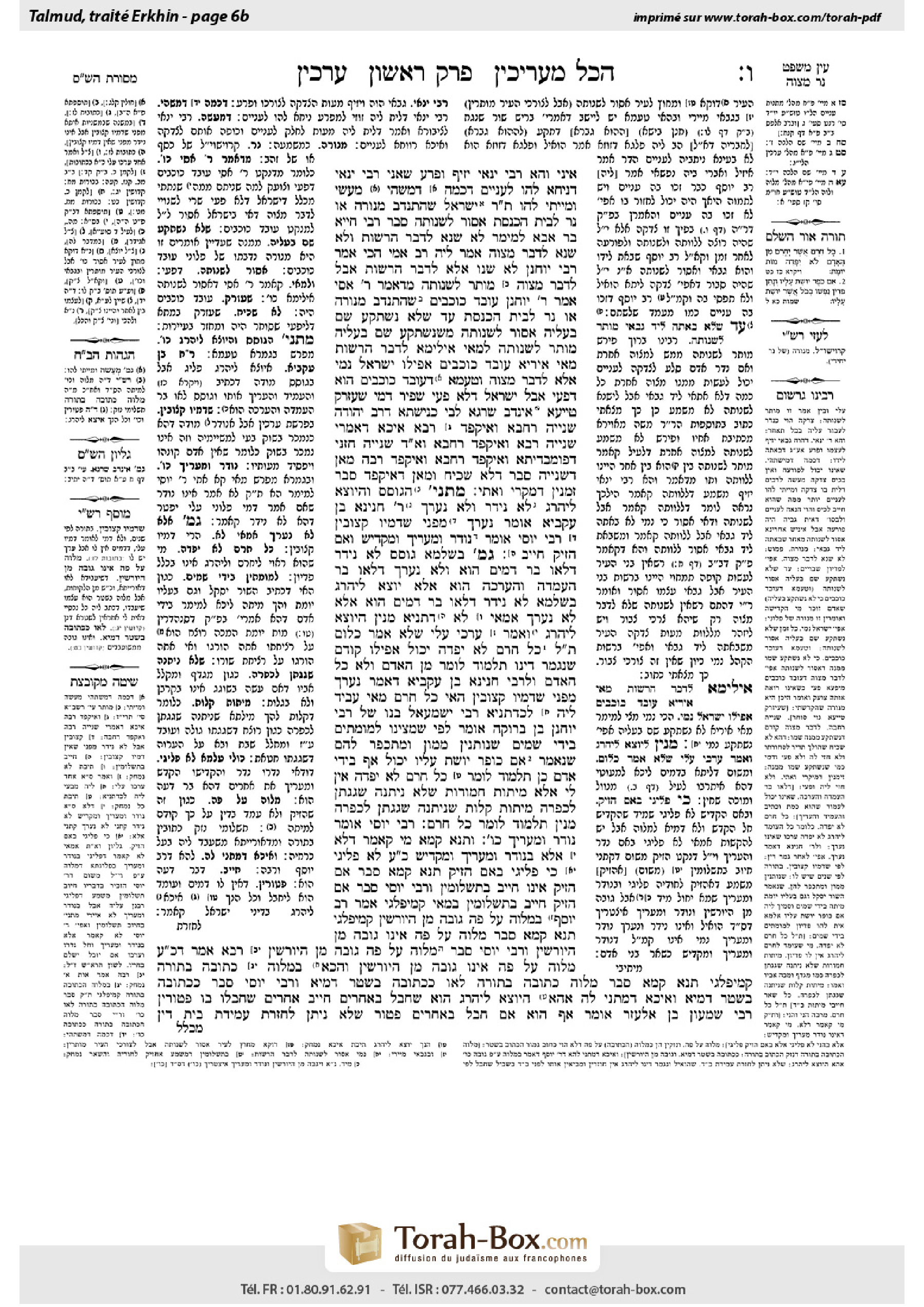
This page of Arakhin includes the Aramaic text, an English translation and an AI-generated French translation, alongside the scan above.
ערכין ו׳ ב · Aramaic and Hebrew text
אִינִי? וְהָא רַבִּי יַנַּאי יָזֵיף וּפָרַע! שָׁאנֵי רַבִּי יַנַּאי, דְּנִיחָא לְהוּ לַעֲנִיִּים דְּכַמָּה דִּמְשַׁהֵי מְעַשֵּׂה וּמַיְיתֵי לְהוּ.
תָּנוּ רַבָּנַן: יִשְׂרָאֵל שֶׁהִתְנַדֵּב מְנוֹרָה אוֹ נֵר לְבֵית הַכְּנֶסֶת — אָסוּר לְשַׁנּוֹתָהּ. סָבַר רַבִּי חִיָּיא בַּר אַבָּא לְמֵימָר: לָא שְׁנָא לִדְבַר הָרְשׁוּת וְלָא שְׁנָא לִדְבַר מִצְוָה. אֲמַר לֵיהּ רַב אַמֵּי: הָכִי אָמַר רַבִּי יוֹחָנָן — לֹא שָׁנוּ אֶלָּא לִדְבַר הָרְשׁוּת, אֲבָל לִדְבַר מִצְוָה מוּתָּר לְשַׁנּוֹתָהּ.
מִדְּאָמַר רַבִּי אַסִּי אָמַר רַבִּי יוֹחָנָן: גּוֹי שֶׁהִתְנַדֵּב מְנוֹרָה אוֹ נֵר לְבֵית הַכְּנֶסֶת, עַד שֶׁלֹּא נִשְׁתַּקַּע שֵׁם בְּעָלֶיהָ — אָסוּר לְשַׁנּוֹתָהּ, מִשֶּׁנִּשְׁתַּקַּע שֵׁם בְּעָלֶיהָ — מוּתָּר לְשַׁנּוֹתָהּ.
לְמַאי? אִילֵימָא לִדְבַר הָרְשׁוּת, מַאי אִירְיָא גּוֹי? אֲפִילּוּ יִשְׂרָאֵל נָמֵי!
אֶלָּא לִדְבַר מִצְוָה, וְטַעְמָא דְּגוֹי הוּא דְּפָעֵי, אֲבָל יִשְׂרָאֵל דְּלָא פָּעֵי — שַׁפִּיר דָּמֵי.
שַׁעַזְרַק טַיָּיעָא אִינַּדַּב שְׁרָגָא לְבֵי כְנִישְׁתָּא דְּרַב יְהוּדָה, שַׁנְּיֵיהּ רַחֲבָא וְאִיקְּפֵד רָבָא. אִיכָּא דְּאָמְרִי: שַׁנְּיֵיהּ רָבָא וְאִיקְּפֵד רַחֲבָא, וְאִיכָּא דְּאָמְרִי: שַׁנְּיֻיהּ חַזָּנֵי דְּפוּמְבְּדִיתָא, וְאִיקְּפֵד רַחֲבָא וְאִיקְּפֵד רַבָּה.
מַאן דְּשַׁנְּיֵיהּ סָבַר דְּלָא שְׁכִיחַ, וּמַאן דְּאִיקְּפֵד סָבַר זִמְנִין דְּמִקְּרֵי וְאָתֵי.
מַתְנִי׳ הַגּוֹסֵס וְהַיּוֹצֵא לֵיהָרֵג — לֹא נִידָּר וְלֹא נֶעֱרָךְ. רַבִּי חֲנִינָא בֶּן עֲקַבְיָא אוֹמֵר: נֶעֱרָךְ, מִפְּנֵי שֶׁדָּמָיו קְצוּבִין. רַבִּי יוֹסֵי אוֹמֵר: נוֹדֵר וּמַעֲרִיךְ וּמַקְדִּישׁ, וְאִם הִזִּיק — חַיָּיב.
גְּמָ׳ בִּשְׁלָמָא גּוֹסֵס לֹא נִידָּר — דְּלָאו בַּר דָּמִים הוּא, וְלֹא נֶעֱרָךְ — דְּלָאו בַּר הַעֲמָדָה וְהַעֲרָכָה הוּא, אֶלָּא יוֹצֵא לֵיהָרֵג, בִּשְׁלָמָא לֹא נִידָּר — דְּלָאו בַּר דָּמִים הוּא, אֶלָּא לֹא נֶעֱרָךְ אַמַּאי לָא?
דְּתַנְיָא: מִנַּיִן הַיּוֹצֵא לֵיהָרֵג וְאָמַר ״עֶרְכִּי עָלַי״, שֶׁלֹּא אָמַר כְּלוּם? תַּלְמוּד לוֹמַר: ״כׇּל חֵרֶם לֹא יִפָּדֶה״. יָכוֹל אֲפִילּוּ קוֹדֶם שֶׁנִּגְמַר דִּינוֹ? תַּלְמוּד לוֹמַר: ״מִן הָאָדָם״, וְלֹא כׇּל הָאָדָם.
וּלְרַבִּי חֲנִינָא בֶּן עֲקַבְיָא, דְּאָמַר נֶעֱרָךְ מִפְּנֵי שֶׁדָּמָיו קְצוּבִין, הַאי ״כׇּל חֵרֶם״ מַאי עָבֵיד לֵיהּ?
לְכִדְתַנְיָא, רַבִּי יִשְׁמָעֵאל בְּנוֹ שֶׁל רַבִּי יוֹחָנָן בֶּן בְּרוֹקָה אוֹמֵר: לְפִי שֶׁמָּצִינוּ לַמּוּמָתִים בִּידֵי שָׁמַיִם שֶׁנּוֹתְנִין מָמוֹן וּמִתְכַּפֵּר לָהֶם, שֶׁנֶּאֱמַר ״אִם כֹּפֶר יוּשַׁת עָלָיו״, יָכוֹל אַף בִּידֵי אָדָם כֵּן? תַּלְמוּד לוֹמַר ״כׇּל חֵרֶם לֹא יִפָּדֶה״.
אֵין לִי אֶלָּא מִיתוֹת חֲמוּרוֹת, שֶׁלֹּא נִיתְּנָה שִׁגְגָתָן לְכַפָּרָה, מִיתוֹת קַלּוֹת, שֶׁנִּיתְּנָה שִׁגְגָתָן לְכַפָּרָה, מִנַּיִן? תַּלְמוּד לוֹמַר: ״כׇּל חֵרֶם״.
רַבִּי יוֹסֵי אוֹמֵר: נוֹדֵר וּמַעֲרִיךְ כּוּ׳. וְתַנָּא קַמָּא מִי קָאָמַר דְּלָא?
אֶלָּא, בְּנוֹדֵר וּמַעֲרִיךְ וּמִקַּדִּישׁ — כּוּלֵּי עָלְמָא לָא פְּלִיגִי, כִּי פְלִיגִי — בְּאִם הִזִּיק. תַּנָּא קַמָּא סָבַר: אִם הִזִּיק — אֵינוֹ חַיָּיב בְּתַשְׁלוּמִין, וְרַבִּי יוֹסֵי סָבַר: אִם הִזִּיק — חַיָּיב בְּתַשְׁלוּמִין.
בְּמַאי קָמִיפַּלְגִי? אָמַר רַב יוֹסֵף: בְּמִלְוָה עַל פֶּה גּוֹבֶה מִן הַיּוֹרְשִׁין קָמִיפַּלְגִי, תַּנָּא קַמָּא סָבַר: מִלְוָה עַל פֶּה אֵינוֹ גּוֹבֶה מִן הַיּוֹרְשִׁין, וְרַבִּי יוֹסֵי סָבַר: מִלְוָה עַל פֶּה גּוֹבֶה מִן הַיּוֹרְשִׁין.
רָבָא אָמַר: דְּכוּלֵּי עָלְמָא מִלְוָה עַל פֶּה אֵינוֹ גּוֹבֶה מִן הַיּוֹרְשִׁין, וְהָכָא בְּמִלְוָה כְּתוּבָה בַּתּוֹרָה קָמִיפַּלְגִי, תַּנָּא קַמָּא סָבַר: מִלְוָה כְּתוּבָה בַּתּוֹרָה לָאו כִּכְתוּבָה בִּשְׁטָר דָּמְיָא, וְרַבִּי יוֹסֵי סָבַר: כִּכְתוּבָה בִּשְׁטָר דָּמְיָא.
וְאִיכָּא דְּמַתְנֵי לַהּ אַהָא: הַיּוֹצֵא לֵיהָרֵג, הוּא שֶׁחָבַל בַּאֲחֵרִים — חַיָּיב, אֲחֵרִים שֶׁחָבְלוּ בּוֹ — פְּטוּרִין. רַבִּי שִׁמְעוֹן בֶּן אֶלְעָזָר אוֹמֵר: אַף הוּא אִם חָבַל בַּאֲחֵרִים — פָּטוּר, שֶׁלֹּא נִיתַּן לַחֲזָרַת עֲמִידַת בֵּית דִּין.
Arakhin 6b · English translation
The Gemara asks: Is that so? But Rabbi Yannai, who was a charity collector, borrowed money belonging to charity and repaid. The Gemara answers: The case of Rabbi Yannai is different; it is beneficial to the poor that he be allowed to borrow and repay, as the longer he leaves the charity fund empty, the more he impels people to give charity, and he thereby brings more money to the poor.
The Sages taught a baraita that deals with a similar matter: In the case of a Jew who donated a candelabrum or a lamp to the synagogue, it is prohibited to change it and use it for another purpose. Rabbi Ḥiyya bar Abba thought to say that there is no difference whether he wishes to change for a voluntary matter or for a matter involving a mitzva, as in both cases it is prohibited. Rav Ami said to Rabbi Ḥiyya bar Abba: This is what Rabbi Yoḥanan says: When the Sages taught the baraita, they taught only that it is prohibited when he changes it for a voluntary matter, but it is permitted to change it for a matter involving a mitzva.
This halakha is derived from the fact that Rabbi Asi says that Rabbi Yoḥanan says: With regard to a gentile who donated a candelabrum or a lamp to the synagogue, if it is before its owner’s name has been forgotten, i.e., people still remember that he donated the item, it is prohibited to change it and use it for another purpose. Once its owner’s name has been forgotten, it is permitted to change it.
The Gemara clarifies: With regard to what purpose is it stated that one may not change it before the owner’s name was forgotten? If we say that it is prohibited to change it for a voluntary matter, why does the baraita specifically mention a gentile? It is prohibited to change it in this manner even if it was donated by a Jew.
Rather, the baraita must be dealing with a change for a matter involving a mitzva, and therefore it is prohibited only if the donor is a gentile and his name has not yet been forgotten. And the reason for this halakha is that it is specifically a gentile who would protest and scream: Where is the candelabrum that I donated? But in the case of a Jew, who would not protest and scream if they used his donation for a different mitzva, one may well change it.
The Gemara relates that Sha’azrak, an Arab [tayya’a] merchant, donated a candelabrum to Rav Yehuda’s synagogue. Raḥava changed its purpose before Sha’azrak’s name was forgotten as the donor, and Rava became angry at Raḥava for not waiting. Some say the opposite: Rava changed its purpose, and Raḥava became angry at Rava. And some say that the attendants of Pumbedita, the charity collectors, changed its purpose, and Raḥava became angry at them, and Rabba became angry at them as well.
The Gemara explains: The one who changed its purpose holds that it was permitted to change it, as it was not common for Sha’azrak to be in the city and it was unlikely that he would protest the change. And the one who became angry holds that even so, they should not have changed it, as sometimes he happens to come there.
MISHNA: One who is moribund and one who is taken to be executed after being sentenced by the court is neither the object of a vow nor valuated. Rabbi Ḥanina ben Akavya says: He is not the object of a vow, because he has no market value; but he is valuated, due to the fact that one’s value is fixed by the Torah based on age and sex. Rabbi Yosei says: One with that status vows to donate the assessment of another person to the Temple treasury, and takes vows of valuation, and consecrates his property; and if he damages the property of others, he is liable to pay compensation.
GEMARA: The Gemara asks: Granted, it makes sense that one who is moribund is not the object of a vow, as he has no monetary value. And it also stands to reason that he is not valuated, as he is not subject to setting, i.e., standing, and therefore is not subject to valuation. The verse states: “Then he shall be set before the priest, and the priest shall value him” (Leviticus 27:8). This teaches that anyone who cannot stand, such as one who is dying, is not included in the halakha of valuation. But with regard to one who is taken to be executed, granted, he is not the object of a vow, as he has no monetary value, since no one would purchase him. But with regard to the mishna’s statement that he is not valuated, why not?
The Gemara answers that the reason is as it is taught in a baraita: From where is it derived that in the case of one who is being taken to be executed and who said: My valuation is upon me to donate to the Temple, that he did not say anything, and the valuation is not collected from his estate? The verse states: “Anything dedicated [ḥerem], that may be dedicated of men, shall not be redeemed” (Leviticus 27:29). This teaches that with regard to one who is worthy of excommunication [ḥerem], i.e., condemned to death, one cannot redeem him, i.e., pay his valuation. One might have thought that this applies even before his verdict is issued, i.e., that this halakha applies even if one issued this statement before being sentenced to death. Therefore, the verse states: “Of men,” and not all men, i.e., only some men destined to be executed have no valuation, and not all of them.
The Gemara asks: And with regard to Rabbi Ḥanina ben Akavya, who says in the mishna that even a person taken to be executed is valuated, due to the fact that one’s value is fixed, what does he do with the phrase “anything dedicated”?
The Gemara answers that he requires it for that which is taught in a baraita: Rabbi Yishmael, son of Rabbi Yoḥanan ben Beroka, says: Since we found with regard to those executed at the hand of Heaven that they give money and their sins are atoned, as it is stated in the case of the owner of a forewarned ox that killed a person: “The ox shall be stoned, and its owner shall also be put to death. If there be laid upon him a ransom, then he shall give for the redemption of his life whatsoever is laid upon him” (Exodus 21:29–30), one might have thought that even with regard to those liable to receive the death penalty at the hands of man it is so, that one can pay in lieu of execution. Therefore, the verse states: “Anything dedicated that may be dedicated of men, shall not be redeemed” (Leviticus 27:29).
I have derived only that one cannot give payment in lieu of execution with regard to severe prohibitions punishable by the death penalty, e.g., blasphemy or cursing one’s father, for which no atonement is designated in the Torah for their unwitting violation. From where is it derived that the same applies to less severe prohibitions punishable by the death penalty, e.g., violating Shabbat or killing, for which atonement of an offering or exile is designated in the Torah for their unwitting violation? The verse states: “Anything dedicated,” to include all prohibitions punishable by court-administered execution.
§ The mishna teaches, with regard to one who is taken to be executed, that Rabbi Yosei says: Such a person vows to donate the assessment of another person to the Temple treasury, and takes vows of valuation, and consecrates his property; and if he damages the property of others, he is liable to pay compensation. The Gemara asks: And does the first tanna say that such a person does not vow to donate the assessment of another person to the Temple treasury and take vows of valuation, such that Rabbi Yosei could be understood as disputing his opinion? The first tanna merely said that such an individual is not subject to vows and valuations. What is the difference between their opinions?
Rather, with regard to whether or not one who is taken to be executed can vow to donate the assessment of another person to the Temple treasury, and take vows of valuation, and consecrate his property, everyone, including the first tanna, agrees that he can. When they disagree, it is in a case where he causes damage. The first tanna holds that if he causes damage he is not liable for payment, and Rabbi Yosei holds that if he causes damage he is liable to pay compensation.
The Gemara asks: With regard to what principle do these tanna’im disagree, as it is an accepted principle that one who causes damage must pay? Rav Yosef said: They disagree as to whether the payment can be collected from his estate. This depends on the question of whether or not one who is owed money from a loan by oral agreement, i.e., a loan given without a document that places a lien on the land, can collect from the heirs. The first tanna holds that one who is owed money from a loan by oral agreement cannot collect from the heirs, and Rabbi Yosei holds that one who is owed money from a loan by oral agreement can collect from the heirs.
Rava says: In fact, everyone agrees that one who is owed money from a loan by oral agreement cannot collect from the heirs; and here the tanna’im disagree with regard to the status of a loan that is written in the Torah, i.e., a financial obligation decreed by Torah law, such as paying damages. The first tanna holds that a loan that is written in the Torah is not considered as though it is written in a document, and may not be collected from the heirs. Rabbi Yosei holds that such a loan is considered as though it is written in a document, and therefore it may be collected from the heirs.
And there are those who teach the dispute between Rava and Rav Yosef with regard to this baraita: In the case of one who is taken to be executed after being sentenced by the court, if he injured another he is liable for payment. But if others injured him they are exempt, as they would be if they injured a dead person. Rabbi Shimon ben Elazar says: Even if it was he who injured others, he is exempt, as he cannot be brought back to stand before the court for judgment, since he must be executed without delay.
Arakhin 6b · Traduction française (IA)
La Guemara pose la question : C’est ainsi ? Mais Rabbi Yannai, qui était un collecteur de charité, avait emprunté de l’argent appartenant à la charité et l’avait remboursé. La Guemara répond : Le cas de Rabbi Yannai est différent ; il est bénéfique pour les pauvres qu’il soit autorisé à emprunter et à rembourser, car plus il laisse le fonds de charité vide, plus il encourage les gens à donner de la charité, et ainsi il apporte davantage d’argent aux pauvres.
Les Sages enseignèrent une baraïta qui traite d’une affaire similaire : Dans le cas d’un Juif qui a donné un chandelier ou une lampe à la synagogue, il est interdit de le changer et de l’utiliser à un autre usage. Rabbi Ḥiyya bar Abba avait l’intention de dire que cela ne fait pas de différence si l’on souhaite le changer pour une affaire volontaire ou pour une affaire impliquant une mitsva, car dans les deux cas, cela est interdit. Rav Ami dit à Rabbi Ḥiyya bar Abba : C’est ce que Rabbi Yoḥanan dit : Lorsque les Sages enseignèrent la baraïta, ils enseignèrent seulement que cela est interdit lorsqu’on le change pour une affaire volontaire, mais il est permis de le changer pour une affaire impliquant une mitsva.
Cette halakha est tirée du fait que Rabbi Asi dit que Rabbi Yoḥanan dit : En ce qui concerne un non-Juif qui a donné un chandelier ou une lampe à la synagogue, si c’est avant que le nom de l’auteur ne soit oublié, c’est-à-dire que les gens se souviennent qu’il a donné l’objet, il est interdit de le changer et de l’utiliser à un autre usage. Une fois que le nom de l’auteur est oublié, il est permis de le changer.
La Guemara clarifie : À quel usage est-il dit qu’on ne doit pas le changer avant que le nom de l’auteur ne soit oublié ? Si nous disons qu’il est interdit de le changer pour une affaire volontaire, pourquoi la baraïta mentionne-t-elle spécifiquement un non-Juif ? Il est interdit de le changer ainsi même si l’objet a été donné par un Juif.
Plutôt, la baraïta doit traiter d’un changement pour une affaire impliquant une mitsva, et c’est pourquoi il est interdit seulement si l’auteur est un non-Juif et que son nom n’a pas encore été oublié. Et la raison de cette halakha est que c’est spécifiquement un non-Juif qui protesterait et hurlerait : Où est le chandelier que j’ai donné ? Mais dans le cas d’un Juif, qui ne protesterait pas et ne hurlerait pas s’il utilisait sa donation pour une autre mitsva, on peut bien le changer.
La Guemara rapporte que Sha’azrak, un marchand arabe [tayya’a], avait donné un chandelier à la synagogue de Rav Yehuda. Raḥava avait changé son usage avant que le nom de Sha’azrak ne soit oublié comme donateur, et Rava s’était fâché contre Raḥava pour ne pas attendre. Certains disent le contraire : Rava avait changé son usage, et Raḥava s’était fâché contre Rava. Et certains disent que les assistants de Pumbedita, les collecteurs de charité, avaient changé son usage, et Raḥava s’était fâché contre eux, ainsi que Rabba.
La Guemara explique : Celui qui a changé son usage considère qu’il était permis de le changer, car il n’était pas courant que Sha’azrak soit dans la ville et il était peu probable qu’il proteste contre le changement. Et celui qui s’est fâché considère que même ainsi, ils ne devraient pas avoir changé, car parfois il arrive là.
MICHNA : Celui qui est mourant et celui qui est emmené pour être exécuté après avoir été condamné par le tribunal n’est ni l’objet d’un vœu ni évalué. Rabbi Ḥanina ben Akavya dit : Il n’est pas l’objet d’un vœu, car il n’a pas de valeur marchande ; mais il est évalué, en raison du fait que la valeur d’une personne est fixée par la Torah en fonction de l’âge et du sexe. Rabbi Yosei dit : Celui qui est dans ce statut jure de donner l’évaluation d’une autre personne au trésor du Temple, et prend des vœux d’évaluation, et consacre ses biens ; et s’il endommege les biens d’autrui, il est tenu responsable de réparer le préjudice.
GUEMARA : La Guemara pose la question : C’est évident que celui qui est mourant n’est pas l’objet d’un vœu, car il n’a pas de valeur monétaire. Et cela est également logique qu’il ne soit pas évalué, car il n’est pas sujet à être mis debout, donc il n’est pas sujet à l’évaluation. La Sainte Écriture dit : « Alors il sera mis devant le prêtre, et le prêtre évaluera son prix » (Lévitique 27:8). Cela enseigne que toute personne qui ne peut pas se tenir debout, comme celui qui meurt, n’est pas incluse dans la halakha de l’évaluation. Mais concernant celui qui est emmené pour être exécuté, c’est évident qu’il n’est pas l’objet d’un vœu, car il n’a pas de valeur monétaire, car personne ne l’achèterait. Mais concernant l’affirmation de la mishna qu’il n’est pas évalué, pourquoi pas ?
La Guemara répond que la raison est comme il est enseigné dans une baraïta : D’où est tiré le fait que dans le cas d’un homme condamné à la mort et qui dit : Mon évaluation est sur moi pour donner au Temple, qu’il n’a pas dit quelque chose, et l’évaluation n’est pas recueillie de son patrimoine ? La Sainte Écriture dit : « Tout ce qui est consacré [ḥerem], qui peut être consacré d’hommes, ne peut pas être racheté » (Lévitique 27:29). Cela enseigne que concernant celui qui est digne d’exil [ḥerem], c’est-à-dire condamné à la mort, on ne peut pas le racheter, c’est-à-dire payer son évaluation. On aurait pu penser que cela s’applique même avant que son verdict ne soit rendu, c’est-à-dire que cette halakha s’applique même si l’on a émis cette déclaration avant d’être condamné à mort. Par conséquent, la Sainte Écriture dit : « D’hommes », et non tous les hommes, c’est-à-dire seulement certains hommes destinés à être exécutés n’ont pas d’évaluation, et non tous d’entre eux.
La Guemara pose la question : Et concernant Rabbi Ḥanina ben Akavya, qui dit dans la mishna que même un homme condamné à l’exécution est évalué, en raison du fait que la valeur d’une personne est fixée, que fait-il avec la phrase « tout ce qui est consacré » ?
La Guemara répond que cela est nécessaire pour ce qui est enseigné dans une baraïta : Rabbi Yishmael, fils de Rabbi Yoḥanan ben Beroka, dit : Puisque nous avons trouvé concernant ceux qui ont été exécutés par la main du Ciel qu'ils donnent de l'argent et que leurs péchés sont expiés, comme il est dit dans le cas de l'propriétaire d'un bœuf averti qui a tué une personne : « L'animal sera lapidé, et son propriétaire sera également mis à mort. Si un rachat est imposé, il donnera pour la rançon de sa vie ce qui est imposé » (Exode 21:29–30), on aurait pu penser que même concernant ceux qui sont condamnés à la peine de mort par la main des hommes, cela est ainsi, c'est-à-dire qu'on peut payer en lieu et place de l'exécution. Par conséquent, la Parashah dit : « Tout ce qui est consacré, ce qui peut être consacré parmi les hommes, ne peut pas être racheté » (Lévitique 27:29).
J'ai tiré seulement que l'on ne peut pas payer en lieu et place de l'exécution concernant les prohibitions graves punissables par la peine de mort, par exemple, l'apostasie ou la malédiction de son père, pour lesquelles il n'est pas désigné dans la Torah une expiation pour leur violation involontaire. D'où tire-t-on que cela s'applique également aux prohibitions moins graves punissables par la peine de mort, par exemple, la violation du Sabbat ou le meurtre, pour lesquelles il est désigné dans la Torah une expiation par un sacrifice ou l'exil pour leur violation involontaire ? La Parashah dit : « Tout ce qui est consacré », pour inclure toutes les prohibitions punissables par l'exécution par le tribunal.
§ La Michna enseigne, concernant celui qui est conduit à l'exécution, que Rabbi Yosei dit : Ce dernier jure de donner la valeur d'une autre personne au trésor du Temple, et prend des vœux de valorisation, et consacre ses biens ; et s'il endommage les biens d'autrui, il est tenu responsable de réparer le préjudice. La Guemara demande : Et le premier tanna dit-il que ce dernier ne jure pas de donner la valeur d'une autre personne au trésor du Temple et ne prend pas de vœux de valorisation, de sorte que Rabbi Yosei puisse être compris comme contredisant son opinion ? Le premier tanna a simplement dit que cette personne n'est pas soumise aux vœux et aux valorisations. Quelle est la différence entre leurs opinions ?
Plutôt, concernant la question de savoir si celui qui est conduit à l'exécution peut jurer de donner la valeur d'une autre personne au trésor du Temple, et prendre des vœux de valorisation, et consacrer ses biens, tout le monde, y compris le premier tanna, est d'accord sur le fait qu'il peut le faire. Lorsqu'ils divergent, c'est dans le cas où il cause un préjudice. Le premier tanna maintient que s'il cause un préjudice, il n'est pas tenu de payer, et Rabbi Yosei maintient que s'il cause un préjudice, il est tenu de réparer le préjudice.
La Guemara demande : Sur quel principe ces tanna’im divergent, car il est un principe accepté que celui qui cause un préjudice doit payer ? Rav Yosef dit : Ils divergent sur la question de savoir si le paiement peut être récupéré à partir de son patrimoine. Cela dépend de la question de savoir si celui qui est dû de l'argent d'un prêt oral, c'est-à-dire un prêt donné sans document qui impose un droit sur la terre, peut récupérer auprès des héritiers. Le premier tanna maintient que celui qui est dû de l'argent d'un prêt oral ne peut pas récupérer auprès des héritiers, et Rabbi Yosei maintient que celui qui est dû de l'argent d'un prêt oral peut récupérer auprès des héritiers.
Rava dit : En réalité, tout le monde est d'accord sur le fait que celui qui est dû de l'argent d'un prêt oral ne peut pas récupérer auprès des héritiers ; et ici les tanna’im divergent concernant le statut d'un prêt écrit dans la Torah, c'est-à-dire une obligation financière décrétée par la loi divine, comme le paiement des dommages. Le premier tanna affirme qu'un prêt écrit dans la Torah n'est pas considéré comme s'il était écrit dans un document, et ne peut donc pas être récupéré auprès des héritiers. Rabbi Yosei affirme que ce prêt est considéré comme s'il était écrit dans un document, et par conséquent il peut être récupéré auprès des héritiers.
Et il y a ceux qui enseignent la dispute entre Rava et Rav Yosef concernant cette baraïta : Dans le cas d'une personne conduite à l'exécution après avoir été condamnée par le tribunal, s'il a blessé un autre, il est tenu responsable de réparer le préjudice. Mais si d'autres l'ont blessé, ils sont exempt, comme s'ils avaient blessé un mort. Rabbi Shimon ben Elazar dit : Même s'il a blessé d'autres, il est exempt, car il ne peut pas être ramené devant le tribunal pour être jugé, car il doit être exécuté sans délai.
Traduction française générée par IA à partir de l’édition anglaise de Sefaria. Vérifie toujours un passage avec le texte source.
Text from Sefaria: William Davidson Edition - Vocalized Aramaic (CC BY NC); William Davidson Edition - English (CC BY NC).