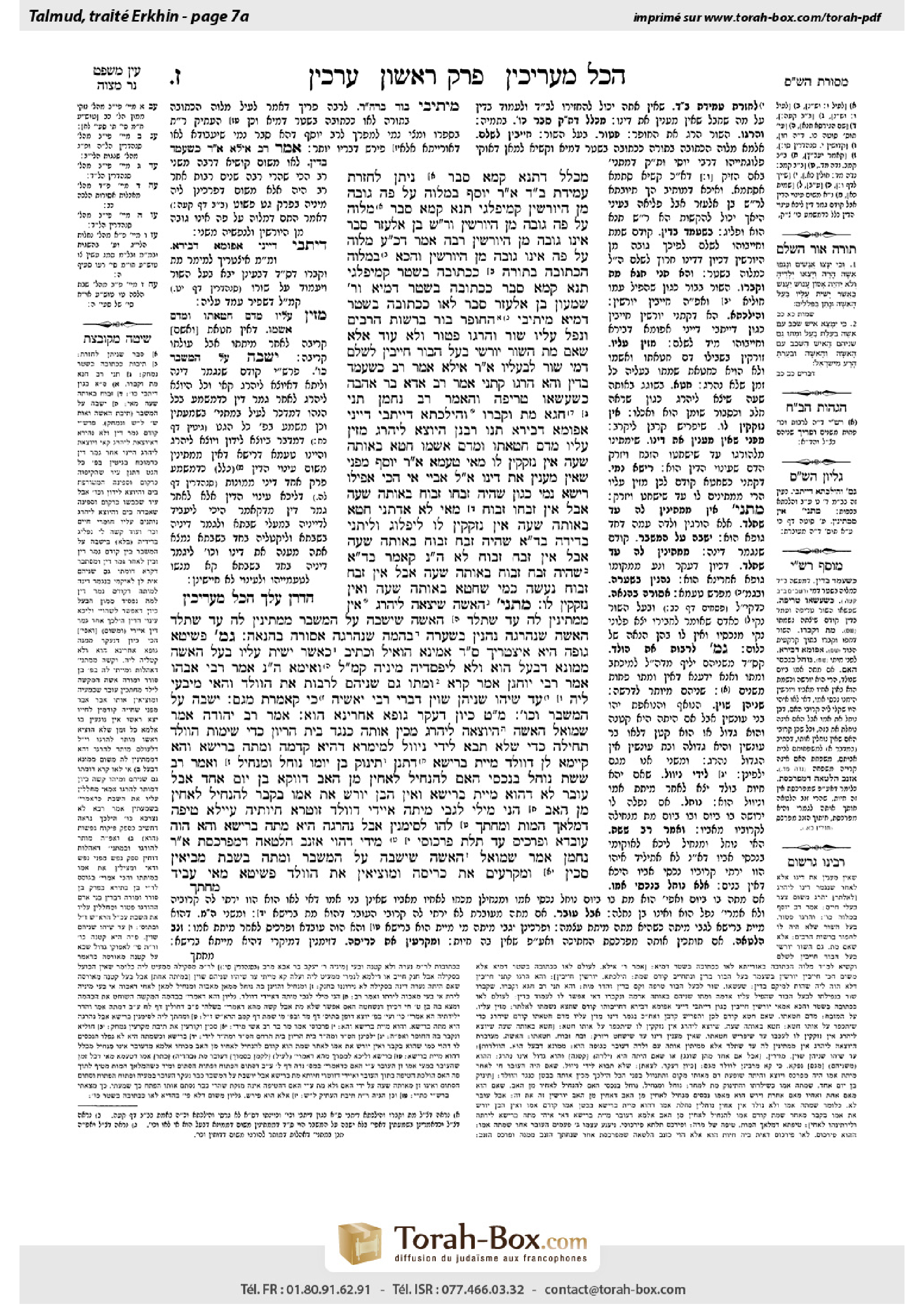
Arakhin 7a: Talmud study for Daf Yomi
Study the Talmud for Daf Yomi with scanned pages, Hebrew text, English translations from Sefaria and AI-generated French translations.
Passage selection and English or AI-generated French translation are available where the scan has annotations. Daf Study is independent of Torah-Box and Sefaria.
Browse Arakhin · ערכין · All tractatesArakhin 7a text and translations
This page of Arakhin includes the Aramaic text, an English translation and an AI-generated French translation, alongside the scan above.
ערכין ז׳ א · Aramaic and Hebrew text
מִכְּלָל דְּתַנָּא קַמָּא סָבַר: נִיתַּן לַחֲזָרַת עֲמִידַת בֵּית דִּין?!
אָמַר רַב יוֹסֵף: בְּמִלְוָה עַל פֶּה גּוֹבֶה מִן הַיּוֹרְשִׁין קָמִיפַּלְגִי, תַּנָּא קַמָּא סָבַר: מִלְוָה עַל פֶּה גּוֹבֶה מִן הַיּוֹרְשִׁין, וְרַבִּי שִׁמְעוֹן בֶּן אֶלְעָזָר סָבַר: אֵינוֹ גּוֹבֶה מִן הַיּוֹרְשִׁין.
רַבָּה אָמַר: דְּכוּלֵּי עָלְמָא מִלְוָה עַל פֶּה אֵינוֹ גּוֹבֶה מִן הַיּוֹרְשִׁין, וְהָכָא בְּמִלְוָה הַכְּתוּבָה בַּתּוֹרָה כִּכְתוּבָה בִּשְׁטָר קָמִיפַּלְגִי, תַּנָּא קַמָּא סָבַר: כִּכְתוּבָה בִּשְׁטָר דָּמְיָא, וְרַבִּי שִׁמְעוֹן בֶּן אֶלְעָזָר סָבַר: לָאו כִּכְתוּבָה בִּשְׁטָר דָּמְיָא.
מֵיתִיבִי: הַחוֹפֵר בּוֹר בִּרְשׁוּת הָרַבִּים, וְנָפַל עָלָיו שׁוֹר וַהֲרָגוֹ — פָּטוּר, וְלֹא עוֹד, אֶלָּא שֶׁאִם מֵת הַשּׁוֹר — יוֹרְשֵׁי בַּעַל הַבּוֹר חַיָּיבִין לְשַׁלֵּם דְּמֵי שׁוֹר לִבְעָלָיו!
אָמַר רַבִּי אִילָא אָמַר רַב: כְּשֶׁעָמַד בַּדִּין, וְהָא ״הֲרָגוֹ״ קָתָנֵי! אָמַר רַב אַדָּא בַּר אַהֲבָה: כְּשֶׁעֲשָׂאוֹ טְרֵיפָה.
וְהָאָמַר רַב נַחְמָן, תָּנֵי חַגָּא: מֵת וּקְבָרוֹ! וְהִילְכְתָא דְּיָיתְבִי דַּיָּינֵי אַפּוּמָּא דְבֵירָא.
תָּנוּ רַבָּנַן: הַיּוֹצֵא לֵיהָרֵג — מַזִּין עָלָיו מִדַּם חַטָּאתוֹ וּמִדַּם אֲשָׁמוֹ, חָטָא בְּאוֹתָהּ שָׁעָה — אֵין נִזְקָקִין לוֹ. מַאי טַעְמָא? אָמַר רַב יוֹסֵף: מִפְּנֵי שֶׁאֵין מְעַנִּין אֶת דִּינוֹ.
אֲמַר לֵיהּ אַבָּיֵי: אִי הָכִי, אֲפִילּוּ רֵישָׁא נָמֵי! כְּגוֹן שֶׁהָיָה זִבְחוֹ זָבוּחַ בְּאוֹתָהּ שָׁעָה.
אֲבָל אֵין זִבְחוֹ זָבוּחַ, מַאי? לָא? אַדְּתָנֵי ״חָטָא בְּאוֹתָהּ שָׁעָה אֵין נִזְקָקִין לוֹ״, לִיפְלוֹג וְלִיתְנֵי בְּדִידַהּ: בַּמֶּה דְּבָרִים אֲמוּרִים — שֶׁהָיָה זֶבַח זָבוּחַ בְּאוֹתָהּ שָׁעָה, אֲבָל אֵין זֶבַח זָבוּחַ — לֹא!
הָכִי נָמֵי קָאָמַר: בַּמֶּה דְּבָרִים אֲמוּרִים — שֶׁהָיָה זֶבַח זָבוּחַ בְּאוֹתָהּ שָׁעָה, אֲבָל אֵין זֶבַח זָבוּחַ — נַעֲשָׂה כְּמִי שֶׁחָטָא בְּאוֹתָהּ שָׁעָה, וְאֵין נִזְקָקִין לוֹ.
מַתְנִי׳ הָאִשָּׁה שֶׁיָּצְאָה לֵיהָרֵג, אֵין מַמְתִּינִין לָהּ עַד שֶׁתֵּלֵד. הָאִשָּׁה שֶׁיָּשְׁבָה עַל הַמַּשְׁבֵּר, מַמְתִּינִין לָהּ עַד שֶׁתֵּלֵד. הָאִשָּׁה שֶׁנֶּהֶרְגָה, נֶהֱנִין בִּשְׂעָרָהּ. בְּהֵמָה שֶׁנֶּהֶרְגָה, אֲסוּרָה בַּהֲנָאָה.
גְּמָ׳ פְּשִׁיטָא, גּוּפַהּ הִיא! אִיצְטְרִיךְ, סָלְקָא דַּעְתָּךְ אָמֵינָא: הוֹאִיל וּכְתִיב ״כַּאֲשֶׁר יָשִׁית עָלָיו בַּעַל הָאִשָּׁה״, מָמוֹנָא דְבַעַל הוּא, וְלָא לַיפְסְדֵיהּ מִינֵּיהּ, קָא מַשְׁמַע לַן.
וְאֵימָא הָכִי נָמֵי! אָמַר רַבִּי אֲבָהוּ אָמַר רַבִּי יוֹחָנָן: אָמַר קְרָא ״וּמֵתוּ גַּם שְׁנֵיהֶם״ — לְרַבּוֹת אֶת הַוָּולָד.
וְהַאי מִיבְּעֵי לֵיהּ, עַד שֶׁיְּהוּ שְׁנֵיהֶן שָׁוִין, דִּבְרֵי רַבִּי יֹאשִׁיָּה! כִּי קָאָמְרִינַן מִ״גַּם״.
יָשְׁבָה עַל הַמַּשְׁבֵּר וְכוּ׳. מַאי טַעְמָא? כֵּיוָן דְּעָקַר, גּוּפָא אַחֲרִינָא הוּא.
אָמַר רַב יְהוּדָה אָמַר שְׁמוּאֵל: הָאִשָּׁה הַיּוֹצְאָה לֵיהָרֵג, מַכִּין אוֹתָהּ כְּנֶגֶד בֵּית הֵרָיוֹן, כְּדֵי שֶׁיָּמוּת הַוָּולָד תְּחִילָּה, כְּדֵי שֶׁלֹּא תָּבֹא לִידֵי נִיוּוּל. לְמֵימְרָא דְּהִיא קָדְמָה וּמֵתָה בְּרֵישָׁא? וְהָא קַיְימָא לַן דְּוָולָד מָיֵית בְּרֵישָׁא!
דִּתְנַן: תִּינוֹק בֶּן יוֹמוֹ נוֹחֵל וּמַנְחִיל, וְאָמַר רַב שֵׁשֶׁת: נוֹחֵל בְּנִכְסֵי הָאֵם לְהַנְחִיל לָאַחִין מִן הָאָב.
דַּוְוקָא בֶּן יוֹם אֶחָד, אֲבָל עוּבָּר — לָא, דְּהוּא מָיֵית בְּרֵישָׁא, וְאֵין הַבֵּן יוֹרֵשׁ אֶת אִמּוֹ בְּקֶבֶר לְהַנְחִיל לָאַחִין מִן הָאָב!
הָנֵי מִילֵּי לְגַבֵּי מִיתָה, אַיְּידֵי דְּוָולָד זוּטְרָא חַיּוּתֵיהּ, עָיְילָא טִיפָּה דְּמַלְאַךְ הַמָּוֶת וּמְחַתֵּךְ לְהוּ לְסִימָנִין, אֲבָל נֶהֶרְגָה — הִיא מֵתָה בְּרֵישָׁא.
וְהָא הֲוָה עוֹבָדָא, וּפַרְכֵּיס עַד תְּלָת פִּרְכּוּסֵי! מִידֵּי דְּהָוֵי אַזְּנַב הַלְּטָאָה דִּמְפַרְכֶּסֶת.
אָמַר רַב נַחְמָן אָמַר שְׁמוּאֵל: הָאִשָּׁה שֶׁיָּשְׁבָה עַל הַמַּשְׁבֵּר וּמֵתָה בְּשַׁבָּת, מְבִיאִין סַכִּין וּמְקָרְעִים אֶת כְּרֵיסָהּ, וּמוֹצִיאִין אֶת הַוָּולָד. פְּשִׁיטָא, מַאי עָבֵיד?
Arakhin 7a · English translation
The Gemara asks: If so, can one conclude by inference that the first tanna holds that one who is being taken to be executed can be brought back to stand before the court for judgment? This is clearly erroneous, as the court is not permitted to delay his execution.
Rav Yosef says: Everyone agrees that his execution may not be delayed. Rather, they disagree as to whether or not one who is owed money from a loan by oral agreement can collect from the heirs. The first tanna holds that one who is owed money from a loan by oral agreement can collect from the heirs, and therefore the injured party can collect from the heirs after the execution. But Rabbi Shimon ben Elazar holds that one who is owed money from a loan by oral agreement cannot collect from the heirs, and therefore the heirs are exempt from payment for the injury.
Rabba said: Actually, everyone agrees that one who is owed money from a loan by oral agreement cannot collect from the heirs; and here the tanna’im disagree with regard to whether a loan that is written in the Torah, e.g., one’s obligation to pay if he causes damage, is considered as though it is written in a document. The first tanna holds that a loan that is written in the Torah is considered as though it is written in a document, and may be collected from the heirs. And Rabbi Shimon ben Elazar holds that it is not considered as though it is written in a document, and therefore it may not be collected.
The Gemara raises an objection against the opinion that one cannot collect a loan that is written in the Torah from the heirs, from a baraita (Tosefta, Bava Kamma 6:2): If one was digging a pit in the public thoroughfare, and an ox fell on the digger of the pit and killed him, the owner of the ox is exempt from paying damages, as the digger of the pit should not have dug the pit. Moreover, if the ox died as a result of the fall, the heirs of the owner of the pit are liable to pay the value of the ox to its owner. This shows that an obligation that is written in the Torah, such as compensation for damage, is collected from heirs.
Rabbi Ila said that Rav said: The baraita is dealing with a case where the digger of the pit stood trial for the damage before he died, and once judgment is rendered by a court the resulting financial obligation is comparable to a written loan, not one that is written in the Torah. The Gemara raises an objection: But it is taught in the baraita that the ox killed him. Rav Adda bar Ahava said: The baraita does not mean that the ox literally killed him, rather, that it rendered him as one who has a wound that will cause him to die within twelve months [tereifa], and there was enough time before his death to sentence him to pay damages.
The Gemara raises an objection: But doesn’t Rav Naḥman say that Ḥagga teaches a slightly different version of the baraita, that if the digger of the pit died from the impact of the ox, and the ox effectively buried him in the ground at the bottom of the pit, his heirs have to pay damages to the owner of the ox? In this scenario, how could it be possible for the digger to stand trial? The Gemara answers: The halakha in the baraita, that the owner of the ox collects from the heirs of the digger, is dealing with a case where judges sat at the opening of the pit and rendered the digger liable to pay damages before he died.
§ The Sages taught another baraita on the same topic: With regard to one taken to be executed, they sprinkle for his sake on the altar from the blood of his sin offering and from the blood of his guilt offering, which he brought earlier. But if he sinned at that time, obligating him to bring a sin offering or a guilt offering, the court does not attend to his obligation, and his execution is not delayed so that he can sacrifice the offering. The Gemara asks: What is the reason for this? Rav Yosef said: It is because the court may not afflict him by forcing him to wait for his judgment, his execution, until the offering is sacrificed.
Abaye said to Rav Yosef: If so, if the offering is not sacrificed in order to avoid afflicting the sentenced by delaying his execution, then this should apply even in the first clause as well, where he had already brought the offering. Why does the court delay his execution until the blood is sprinkled? Rav Yosef answered: The first clause is referring to a case where his offering was already slaughtered at that time, and all that remained to be done was the sprinkling of the blood. Delaying the execution for such a short time is not a problem.
The Gemara asks: But then in a case where he set aside his offering but it was not yet slaughtered, what is the halakha? Is it true that they do not delay his execution in order to sacrifice the offering? If so, instead of teaching a new case and stating: But if he sinned at that time and thereby became obligated to sacrifice a sin offering or a guilt offering, the court does not attend to his obligation, let the baraita distinguish and teach a distinction within the case of where he already brought the offering itself: In what case is this statement, that the blood is sprinkled, said? When his offering was already slaughtered at that time. But if his offering was not yet slaughtered, his execution is not delayed.
The Gemara answers: That is indeed what he is saying: In what case is this statement said? When his offering was already slaughtered at that time. But if his offering was not yet slaughtered, it is considered as though he sinned at that time, and therefore the court does not attend to his obligation.
MISHNA: In the case of a pregnant woman who is taken by the court to be executed, the court does not wait to execute her until she gives birth. Rather, she is killed immediately. But with regard to a woman taken to be executed who sat on the travailing chair [hamashber] in the throes of labor, the court waits to execute her until she gives birth. In the case of a woman who was killed through court-imposed capital punishment, one may derive benefit from her hair. But in the case of an animal that was killed through court-imposed execution, e.g., for goring a person, deriving benefit from the animal is prohibited.
GEMARA: Isn’t it obvious that the court executes the pregnant woman rather than waiting? After all, it is part of her body. The Gemara answers: It was necessary for the mishna to teach this, as it might enter your mind to say that since it is written: “And if men strive together, and hurt a woman with child, so that her offspring depart…he shall be fined, as the woman’s husband shall place upon him” (Exodus 21:22), the fetus is considered to be the property of the husband. If so, the court should wait until she gives birth before executing her, and not cause him to lose the fetus. Consequently, the mishna teaches us that the court does not take this factor into account.
The Gemara asks: But why not say that indeed the court should delay her execution until she gives birth? Rabbi Abbahu says that Rabbi Yoḥanan says: The verse states: “If a man be found lying with a woman married to a husband, then they shall also both of them die, the man that lay with the woman, and the woman” (Deuteronomy 22:22). The amplifying term “both of them” serves to add her fetus, teaching that it dies together with her.
The Gemara asks: But this phrase is required for the following halakha: Neither of the two adulterers mentioned in the verse is punished until both of them are equal, i.e., they have both reached majority. This is the statement of Rabbi Yoshiya. The Gemara answers: When you say that the child also dies, it is derived from the word “also,” whereas the halakha that they must be equal is learned from the term “both of them.”
§ The mishna teaches: With regard to a woman taken to be executed who sat on the travailing chair in the throes of labor, the court waits to execute her until she gives birth. The Gemara asks: What is the reason for delaying the execution in this case? The Gemara answers: Once the fetus uproots from its place and begins to leave the woman’s body, it is considered an independent body and may not be killed together with the mother.
Rav Yehuda says that Shmuel says: In the case of a pregnant woman who is taken by the court to be executed, one strikes her opposite the womb, i.e., on the abdomen, so that the fetus dies first and so that she not suffer disgrace as a result of publicly bleeding from labor. The Gemara asks: Is this to say that according to Shmuel if a pregnant woman dies, she dies first, before the fetus? It is clear that this is Shmuel’s assumption, as he mandates killing the fetus before the mother, lest the live fetus bring about the onset of labor as a reaction to the woman’s death. Were the fetus to perish first, before the woman, there would be no need for this. But this is difficult, as we maintain that the fetus dies first.
As we learned in a mishna (Nidda 43b–44a): A baby boy, one day old, inherits the estate of his relatives who died on the day of his birth, and if he dies, he bequeaths that inheritance to his relatives. And Rav Sheshet says: This mishna is teaching that a day-old child inherits his mother’s property when she died after he was born, to bequeath it to his heirs who are not the mother’s heirs, e.g., to his paternal brothers.
The Gemara explains the difficulty: It is specifically in a case where the boy is one day old that he inherits and bequeaths, but a fetus who died while still in the womb does not inherit and bequeath. The reason is that we presume that the fetus died first, before its mother, and a son does not inherit through his mother while in the grave, in order to bequeath her property to his paternal brothers.
The Gemara answers: This matter, i.e., the presumption that the fetus dies first, applies only in a case of natural death. In such a situation, since the fetus’s vitality is minimal, the Angel of Death’s drop of poison enters his body and cuts the two organs that must be severed in ritual slaughter, i.e., the windpipe and the gullet [simanim], thereby killing him before his mother. But in a case where the mother was killed, e.g., if she was executed, she dies first.
The Gemara asks: Is it true that the fetus always dies first when the mother dies naturally? But there was an incident where the mother died naturally and the fetus made three spasmodic motions afterward. The Gemara answers: That is just as it is with the tail of the lizard, which jerks after being severed from the lizard; it is just a spasmodic motion, which does not indicate that it is still alive.
§ Rav Naḥman says that Shmuel says: In the case of a woman who sat on the travailing chair in the throes of labor, and died on Shabbat, one brings a knife, and tears open her abdomen, and removes the fetus, as it might still be alive, and it could be possible to save its life. The Gemara asks: But isn’t it obvious that this is permitted? After all, what is the person who cuts her abdomen doing?
Arakhin 7a · Traduction française (IA)
La Guemara pose la question : Si c’est ainsi, peut-on conclure par déduction que le premier tanna considère qu’une personne qui est conduite à l’exécution peut être ramenée devant la cour pour être jugée ? Cela est clairement erroné, car la cour n’est pas autorisée à retarder son exécution.
Rav Yosef dit : Tout le monde convient que son exécution ne peut pas être retardée. Cependant, ils divergent sur le fait de savoir si une personne qui doit de l’argent en vertu d’un prêt oral peut récupérer auprès des héritiers. Le premier tanna considère que l’on peut récupérer auprès des héritiers, et donc la personne blessée peut récupérer auprès des héritiers après l’exécution. Rabbi Shimon ben Elazar, en revanche, considère que l’on ne peut pas récupérer auprès des héritiers, et donc les héritiers sont exemptés de payer la compensation.
Rabba dit : En réalité, tout le monde convient que l’on ne peut pas récupérer auprès des héritiers une dette en vertu d’un prêt oral. Ici, les tanna’im divergent sur le fait de savoir si un prêt écrit dans la Torah, par exemple, l’obligation de payer en cas de dommage, est considéré comme s’il était écrit dans un document. Le premier tanna considère que ce prêt est considéré comme s’il était écrit dans un document et peut être récupéré auprès des héritiers. Rabbi Shimon ben Elazar, en revanche, considère qu’il n’est pas considéré comme s’il était écrit dans un document, et donc il ne peut pas être récupéré.
La Guemara soulève une objection contre l’opinion selon laquelle l’on ne peut pas récupérer un prêt écrit dans la Torah auprès des héritiers, à partir d’une baraïta (Tosefta, Bava Kamma 6:2) : Si l’on creusait un puits dans une rue publique, et un bœuf tomba sur le creuseur du puits et le tua, l’propriétaire du bœuf est exempt de payer des dommages, car le creuseur du puits ne devrait pas avoir creusé le puits. De plus, si le bœuf mourut en raison de la chute, les héritiers de l’propriétaire du puits sont tenus de payer la valeur du bœuf à son propriétaire. Cela montre qu’une obligation écrite dans la Torah, telle que la compensation pour un dommage, est récupérée auprès des héritiers.
Rabbi Ila dit que Rav dit : La baraïta traite d’un cas où le creuseur du puits a été jugé pour le dommage avant de mourir, et une fois que la décision de la cour a été rendue, l’obligation financière est comparée à un prêt écrit, pas à un prêt écrit dans la Torah. La Guemara soulève une objection : Mais il est enseigné dans la baraïta que le bœuf l’a tué. Rav Adda bar Ahava dit : La baraïta ne signifie pas que le bœuf l’a littéralement tué, mais plutôt qu’il l’a rendu gravement blessé, ce qui entraînerait sa mort dans les douze mois [tereifa], et il y avait suffisamment de temps avant sa mort pour le juger et lui faire payer des dommages.
La Guemara soulève une objection : Mais n’est-ce pas ce que Rav Naḥman dit que Ḥagga enseigne une version légèrement différente de la baraïta, à savoir que si le creuseur du puits mourut de la chute du bœuf, et que le bœuf l’a enterré au fond du puits, ses héritiers doivent payer des dommages à l’propriétaire du bœuf ? Dans ce scénario, comment pouvait-il être jugé ? La Guemara répond : La halakha dans la baraïta, selon laquelle l’propriétaire du bœuf récupère auprès des héritiers du creuseur, traite d’un cas où des juges siégeaient à l’ouverture du puits et jugeaient le creuseur coupable de dommages avant sa mort.
§ Les Sages enseignèrent une autre baraïta sur le même sujet : En ce qui concerne une personne conduite à l’exécution, on verse pour son compte sur l’autel le sang de son sacrifice expiatoire et le sang de son sacrifice de culpabilité, qu’il avait déjà apportés précédemment. Mais si il a péché à ce moment-là, ce qui l’obligeait à apporter un sacrifice expiatoire ou un sacrifice de culpabilité, la cour ne s’occupe pas de son obligation, et son exécution n’est pas retardée afin qu’il puisse sacrifier l’offrande. La Guemara pose la question : Quel est le motif de cela ? Rav Yosef dit : C’est parce que la cour ne doit pas affliger la personne en la forçant à attendre son jugement, son exécution, jusqu’à ce que l’offrande soit sacrifiée.
Abaye dit à Rav Yosef : Si c’est ainsi, alors cela devrait s’appliquer également dans la première clause, où l’offrande avait déjà été apportée. Pourquoi la cour retarde-t-elle son exécution jusqu’à ce que le sang soit versé ? Rav Yosef répondit : La première clause traite d’un cas où l’offrande avait déjà été sacrifiée à ce moment-là, et il ne restait plus qu’à verser le sang. Retarder l’exécution pendant une si courte durée n’est pas un problème.
La Guemara pose la question : Mais alors, dans un cas où il avait réservé son offrande mais qu’elle n’avait pas encore été sacrifiée, quelle est la halakha ? Est-ce vrai que l’on ne retarde pas son exécution afin de sacrifier l’offrande ? Si c’est le cas, au lieu de présenter un nouveau cas et d’affirmer : Mais s’il a péché à ce moment-là et s’est ainsi rendu obligatoire de sacrifier un sacrifice expiatoire ou un sacrifice de culpabilité, la cour ne s’occupe pas de son obligation, laisse la baraïta distinguer et enseigner une distinction dans le cas où il avait déjà apporté l’offrande elle-même : Dans quel cas cette déclaration, que le sang est versé, est-elle dite ? Lorsque son offrande avait déjà été sacrifiée à ce moment-là. Mais si son offrande n’avait pas encore été sacrifiée, son exécution n’est pas retardée.
La Guemara répond : C’est exactement ce qu’il dit : Dans quel cas cette déclaration est-elle faite ? Lorsque son offrande avait déjà été sacrifiée à ce moment-là. Mais si son offrande n’avait pas encore été sacrifiée, elle est considérée comme s’il avait péché à ce moment-là, et donc la cour ne s’occupe pas de son obligation.
MICHNA : Dans le cas d'une femme enceinte qui est conduite devant la cour pour être exécutée, la cour ne tarde pas à l'exécuter jusqu'à ce qu'elle accouche. Elle est tuée immédiatement. Mais dans le cas d'une femme conduite devant la cour pour être exécutée qui s'est assise sur la chaise de travail [hamashber] en pleine délivrance, la cour attend qu'elle accouche avant de l'exécuter. Dans le cas d'une femme tuée par une exécution capital imposée par la cour, on peut tirer profit de ses cheveux. Mais dans le cas d'un animal tué par une exécution capital imposée par la cour, par exemple pour avoir écrasé une personne, il est interdit de tirer profit de l'animal.
GUEMARA : N'est-ce pas évident que la cour exécute la femme enceinte plutôt que d'attendre ? Après tout, c'est partie de son corps. La Guemara répond : Il était nécessaire que la Michna enseigne cela, car il pourrait entrer en vous l'idée que puisque cela est écrit : « Et si des hommes s'entre-tuent et blessent une femme enceinte, de sorte que son enfant meure... il sera puni, comme le mari de la femme le placera sur lui » (Exode 21:22), l'enfant est considéré comme la propriété du mari. Si c'est ainsi, la cour devrait attendre qu'elle accouche avant de l'exécuter, afin de ne pas faire perdre au mari l'enfant. Ainsi, la Michna nous enseigne que la cour ne tient pas compte de ce facteur.
La Guemara demande : Mais pourquoi ne pas dire que la cour devrait retarder son exécution jusqu'à ce qu'elle accouche ? Rabbi Abbahu dit que Rabbi Yoḥanan dit : Le verset dit : « Si un homme est trouvé avec une femme mariée à un mari, alors les deux d'entre eux mourront, l'homme qui a couché avec la femme, et la femme » (Deutéronome 22:22). L'expression amplificative « les deux d'entre eux » sert à ajouter l'enfant, enseignant que celui-ci meurt avec elle.
La Guemara demande : Mais cette expression est nécessaire pour la halakha suivante : ni l'un ni l'autre des adultères mentionnés dans le verset ne sont punis avant que les deux ne soient égaux, c'est-à-dire qu'ils aient tous deux atteint la majorité. C'est la déclaration de Rabbi Yoshiya. La Guemara répond : Lorsque vous dites que l'enfant meurt également, cela est tiré du mot « aussi », tandis que la halakha selon laquelle ils doivent être égaux est tirée du terme « les deux d'entre eux ».
§ La Michna enseigne : Dans le cas d'une femme conduite devant la cour pour être exécutée qui s'est assise sur la chaise de travail en pleine délivrance, la cour attend qu'elle accouche avant de l'exécuter. La Guemara demande : Quel est le motif de ce retard dans ce cas ? La Guemara répond : Une fois que le fœtus se détache de son lieu et commence à quitter le corps de la femme, il est considéré comme un corps indépendant et ne peut pas être tué avec la mère.
Rav Yehuda dit que Shmuel dit : Dans le cas d'une femme enceinte conduite devant la cour pour être exécutée, on frappe le ventre, c'est-à-dire sur l'abdomen, afin que le fœtus meure d'abord et afin qu'elle ne souffre pas de la honte d'une saignée publique. La Guemara demande : Est-ce que cela signifie que selon Shmuel, si une femme enceinte meurt, c'est elle qui meurt d'abord, avant le fœtus ? Il est clair que c'est l'hypothèse de Shmuel, car il ordonne de tuer le fœtus avant la mère, afin que le fœtus vivant ne provoque pas l'accouchement en réaction à la mort de la femme. Si le fœtus meurt d'abord, avant la femme, il n'y aurait pas besoin de cela. Mais cela est difficile, car nous maintenons que le fœtus meurt d'abord.
Comme nous l'avons appris dans une Michna (Nidda 43b–44a) : Un bébé garçon, âgé d'un jour, hérite de l'immobilier de ses parents décédés le jour de sa naissance, et si il meurt, il transmet cette héritage à ses parents. Et Rav Sheshet dit : Cette Michna enseigne que le bébé d'un jour hérite de la propriété de sa mère lorsqu'elle meurt après qu'il est né, afin de transmettre cette propriété à ses héritiers qui ne sont pas les héritiers de sa mère, par exemple à ses frères paternels.
La Guemara explique la difficulté : C'est spécifiquement dans le cas où le garçon a un jour qu'il hérite et transmet, mais un fœtus qui meurt encore dans le ventre ne hérite ni ne transmet. La raison est que nous supposons que le fœtus meurt d'abord, avant sa mère, et un fils ne hérite à travers sa mère alors qu'elle est en terre, afin de transmettre sa propriété à ses frères paternels.
La Guemara répond : Cette question, c'est-à-dire la supposition que le fœtus meurt d'abord, s'applique uniquement dans le cas d'une mort naturelle. Dans ce cas, puisque la vitalité du fœtus est minime, la goutte de poison de l'Ange de la Mort entre dans son corps et coupe les deux organes qui doivent être séparés lors de la bête de sacrifice, c'est-à-dire la trachée et l'œsophage [simanim], ce qui le tue avant sa mère. Mais dans le cas où la mère est tuée, par exemple si elle est exécutée, c'est elle qui meurt d'abord.
La Guemara demande : Est-ce vrai que le fœtus meurt toujours d'abord lorsque la mère meurt naturellement ? Mais il y a eu un cas où la mère est morte naturellement et le fœtus a fait trois mouvements convulsifs après. La Guemara répond : C'est tout à fait comme la queue du lézard, qui se contracte après avoir été séparée du lézard ; c'est juste un mouvement convulsif, qui ne montre pas qu'il est encore vivant.
§ Rav Naḥman dit que Shmuel dit : Dans le cas d'une femme qui s'est assise sur la chaise de travail en pleine délivrance et est morte le sabbat, on apporte un couteau, on ouvre son ventre et on retire le fœtus, car il pourrait encore être vivant et il pourrait être possible de sauver sa vie. La Guemara demande : Mais n'est-ce pas évident que cela est permis ? Après tout, que fait la personne qui ouvre son ventre ?
Traduction française générée par IA à partir de l’édition anglaise de Sefaria. Vérifie toujours un passage avec le texte source.
Text from Sefaria: William Davidson Edition - Vocalized Aramaic (CC BY NC); William Davidson Edition - English (CC BY NC).