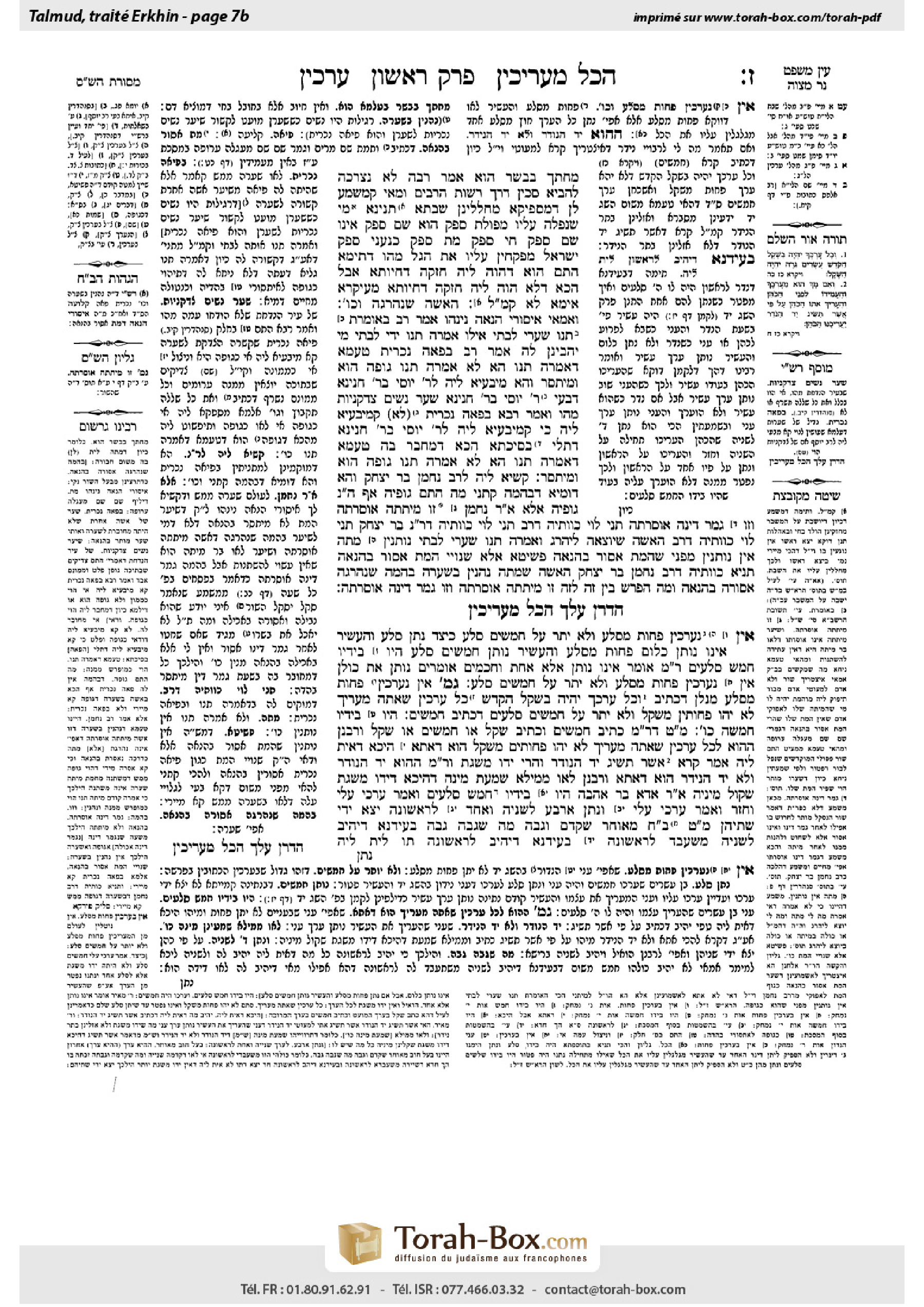
Arakhin 7b: Talmud study for Daf Yomi
Study the Talmud for Daf Yomi with scanned pages, Hebrew text, English translations from Sefaria and AI-generated French translations.
Passage selection and English or AI-generated French translation are available where the scan has annotations. Daf Study is independent of Torah-Box and Sefaria.
Browse Arakhin · ערכין · All tractatesArakhin 7b text and translations
This page of Arakhin includes the Aramaic text, an English translation and an AI-generated French translation, alongside the scan above.
ערכין ז׳ ב · Aramaic and Hebrew text
מְחַתֵּךְ בְּבָשָׂר הוּא! אָמַר רַבָּה: לֹא נִצְרְכָה לְהָבִיא סַכִּין דֶּרֶךְ רְשׁוּת הָרַבִּים.
וּמַאי קָמַשְׁמַע לַן, דְּמִסְּפֵיקָא מְחַלְּלִינַן שַׁבְּתָא? תְּנֵינָא: מִי שֶׁנָּפְלָה עָלָיו מַפּוֹלֶת, סָפֵק הוּא שָׁם, סָפֵק אֵינוֹ שָׁם, סָפֵק חַי, סָפֵק מֵת, סָפֵק נׇכְרִי, סָפֵק יִשְׂרָאֵל — מְפַקְּחִין עָלָיו אֶת הַגַּל!
מַהוּ דְּתֵימָא: הָתָם הוּא דַּהֲוָה לֵיהּ חֲזָקָה דְּחַיּוּתָא, אֲבָל הָכָא דְּלָא הֲוָה לֵיהּ חֲזָקָה דְּחַיּוּתָא מֵעִיקָּרָא — אֵימָא לָא, קָא מַשְׁמַע לַן.
הָאִשָּׁה שֶׁנֶּהֶרְגָה וְכוּ׳. וְאַמַּאי? אִיסּוּרֵי הֲנָאָה נִינְהוּ! אָמַר רַב: בְּאוֹמֶרֶת ״תְּנוּ שְׂעָרִי לְבִתִּי״. אִילּוּ אָמְרָה ״תְּנוּ יָדִי לְבִתִּי״, מִי יָהֲבִינַן לַהּ?!
אָמַר רַב: בְּפֵאָה נׇכְרִית, טַעְמָא דְּאָמְרָה ״תְּנוּ״, הָא לֹא אָמְרָה ״תְּנוּ״ — גּוּפַהּ הוּא וּמִיתְּסַר.
וְהָא מִיבַּעְיָא לֵיהּ לְרַבִּי יוֹסֵי בְּרַבִּי חֲנִינָא, דְּבָעֵי רַבִּי יוֹסֵי בְּרַבִּי חֲנִינָא: שְׂעַר נָשִׁים צִדְקָנִיּוֹת מַהוּ?
וְאָמַר רָבָא: בְּפֵאָה נׇכְרִית לָא קָמִיבַּעְיָא לֵיהּ, כִּי קָמִיבַּעְיָא לֵיהּ לְרַבִּי יוֹסֵי בְּרַבִּי חֲנִינָא דִּתְלֵי בְּסִיכְּתָא.
הָכָא דִּמְחַבַּר בַּהּ, טַעְמָא דְּאָמְרָה ״תְּנוּ״, הָא לֹא אָמְרָה ״תְּנוּ״ — גּוּפַהּ הוּא וּמִיתְּסַר.
קַשְׁיָא לֵיהּ לְרַב נַחְמָן בַּר יִצְחָק, וְהָא דּוּמְיָא דִּבְהֵמָה קָתָנֵי, מָה הָתָם גּוּפַיהּ — אַף הָכָא נָמֵי גּוּפַיהּ!
אֶלָּא אָמַר רַב נַחְמָן: זוֹ מִיתָתָהּ אוֹסַרְתָּהּ, וְזוֹ גְּמַר דִּינָה אוֹסַרְתָּהּ.
תָּנֵי לֵוִי כְּוָותֵיהּ דְּרַב, תָּנֵי לֵוִי כְּוָותֵיהּ דְּרַב נַחְמָן בַּר יִצְחָק. תָּנֵי לֵוִי כְּוָותֵיהּ דְּרַב: הָאִשָּׁה שֶׁיּוֹצְאָה לֵיהָרֵג וְאָמְרָה: ״תְּנוּ שְׂעָרִי לְבִתִּי״ — נוֹתְנִין, מֵתָה — אֵין נוֹתְנִין, מִפְּנֵי שֶׁהַמֵּת אָסוּר בַּהֲנָאָה.
פְּשִׁיטָא! אֶלָּא שֶׁנּוֹיֵי הַמֵּת אָסוּר בַּהֲנָאָה.
תַּנְיָא כְּוָותֵיהּ דְּרַב נַחְמָן בַּר יִצְחָק: הָאִשָּׁה שֶׁמֵּתָה — נֶהֱנִין בִּשְׂעָרָהּ, בְּהֵמָה שֶׁנֶּהֶרְגָה — אֲסוּרָה בַּהֲנָאָה; וּמָה הֶפְרֵשׁ בֵּין זֶה לָזֶה? זוֹ — מִיתָתָהּ אוֹסַרְתָּהּ, וְזוֹ — גָּמַר דִּינָה אוֹסַרְתָּהּ.
הֲדַרַן עֲלָךְ הַכֹּל מַעֲרִיכִין.
מַתְנִי׳ אֵין נֶעֱרָכִין פָּחוֹת מִסֶּלַע, וְלֹא יָתֵר עַל חֲמִשִּׁים סֶלַע. כֵּיצַד? נָתַן סֶלַע וְהֶעֱשִׁיר — אֵינוֹ נוֹתֵן כְּלוּם, פָּחוֹת מִסֶּלַע וְהֶעֱשִׁיר — נוֹתֵן חֲמִשִּׁים סֶלַע.
הָיוּ בְּיָדָיו חָמֵשׁ סְלָעִים, רַבִּי מֵאִיר אוֹמֵר: אֵינוֹ נוֹתֵן אֶלָּא אַחַת, וַחֲכָמִים אוֹמְרִים: נוֹתֵן אֶת כּוּלָּן. אֵין נֶעֱרָכִין פָּחוֹת מִסֶּלַע, וְלֹא יָתֵר עַל חֲמִשִּׁים סֶלַע.
גּמ׳ אֵין נֶעֱרָכִין פָּחוֹת מִסֶּלַע. מְנָלַן? דִּכְתִיב: ״וְכׇל עֶרְכְּךָ יִהְיֶה בְּשֶׁקֶל הַקֹּדֶשׁ״, כׇּל עֲרָכִין שֶׁאַתָּה מַעֲרִיךְ לֹא יְהוּ פְּחוּתִין מִשְׁקָל.
וְלֹא יָתֵר עַל חֲמִשִּׁים סְלָעִים. דִּכְתִיב: ״חֲמִשִּׁים״.
הָיוּ בְּיָדָיו חֲמִשָּׁה כּוּ׳. מַאי טַעְמָא דְּרַבִּי מֵאִיר? כְּתִיב ״חֲמִשִּׁים״ וּכְתִיב ״שֶׁקֶל״, אוֹ חֲמִשִּׁים אוֹ שֶׁקֶל.
וְרַבָּנַן? הַהוּא, לְכׇל עֲרָכִין שֶׁאַתָּה מַעֲרִיךְ לֹא יְהוּ פְּחוּתִים מִשְׁקָל הוּא דַּאֲתָא, הֵיכָא דְּאִית לֵיהּ — אָמַר קְרָא: ״אֲשֶׁר תַּשִּׂיג יַד הַנּוֹדֵר״, וַהֲרֵי יָדוֹ מַשֶּׂגֶת.
וְרַבִּי מֵאִיר? הָהוּא ״יַד הַנּוֹדֵר וְלֹא יַד הַנִּידָּר״ הוּא דַּאֲתָא, וְרַבָּנַן, לָאו מִמֵּילָא שָׁמְעַתְּ מִינַּהּ דְּהֵיכָא דְּיָדוֹ מַשֶּׂגֶת שְׁקוֹל מִינֵּיהּ?
אָמַר רַב אַדָּא בַּר אַהֲבָה: הָיוּ בְּיָדָיו חָמֵשׁ סְלָעִים, וְאָמַר ״עֶרְכִּי עָלַי״, וְחָזַר וְאָמַר ״עֶרְכִּי עָלַי״, וְנָתַן אַרְבַּע לַשְּׁנִיָּה וְאֶחָד לָרִאשׁוֹנָה — יָצָא יְדֵי שְׁתֵּיהֶן.
מַאי טַעְמָא? בַּעַל חוֹב מְאוּחָר שֶׁקָּדַם וְגָבָה — מַה שֶּׁגָּבָה גָּבָה.
בְּעִידָּנָא דְּיָהֵיב לַשְּׁנִיָּה, מְשַׁעְבַּד לְרִאשׁוֹנָה. בְּעִידָּנָא דְּיָהֵיב לָרִאשׁוֹנָה, תּוּ לֵית לֵיהּ.
Arakhin 7b · English translation
It is merely cutting flesh, and there is no reason why it should be prohibited. Rabba said: No, the halakha concerning cutting open her abdomen is necessary only to teach that it is permitted to bring a knife by way of the public thoroughfare for that purpose, despite the fact that this constitutes a prohibited labor by Torah law.
The Gemara asks: And what does this teach us? Does it teach that even in a case of uncertainty we desecrate Shabbat for the chance of saving a life? But we already learned this in a mishna (Yoma 83a): With regard to one upon whom a rockslide fell, and there is uncertainty as to whether he is there under the debris or whether he is not there, and there is also uncertainty as to whether he is still alive or whether he is dead, and finally there is uncertainty as to whether the person under the debris is a gentile or a Jew, one clears the pile from atop him on Shabbat.
The Gemara answers: It is necessary to teach that one may bring a knife in the case of a woman, lest you say that it is specifically there that one may desecrate Shabbat, as the person who was buried under the rockslide had a presumptive status of being alive and therefore he is assumed to still be alive. But here, where the child had no prior presumptive status of being alive, as he was not yet born, you might say that one may not desecrate Shabbat in order to save his life. Therefore, it is necessary for Shmuel to teach us that even here one may desecrate Shabbat for the possibility of saving the fetus’s life.
§ The mishna taught: In the case of a woman who was killed through court-imposed capital punishment, one may derive benefit from her hair. The Gemara asks: But why is it permitted? After all, a corpse and its hair are items from which deriving benefit is prohibited. Rav said that this is referring to a case where she says before she dies: Give my hair to my daughter. The Gemara asks: Is the prohibition contingent on the deceased’s wishes? Were she to say: Give my hand to my daughter, would we give the hand to her?
Rather, Rav said: This is not referring to the actual hair of the deceased, but to a wig [pe’a nokhrit], which is not part of the deceased’s body. The Gemara infers from Rav’s statement that the reason it is permitted is that she said to give her wig to her daughter, thereby indicating that she did not consider it part of her body. But if she did not say to give her wig to her daughter, it is considered part of her body, and it is forbidden to derive benefit from it.
The Gemara explains why this implication is problematic: But didn’t Rabbi Yosei, son of Rabbi Ḥanina, raise this as a dilemma? As Rabbi Yosei, son of Rabbi Ḥanina raised a dilemma: With regard to the hair of righteous women in a city whose residents were incited to idolatry and, therefore, all of their property must be burned, what is the halakha? Is it considered their property and burned, or part of their body and not burned?
And Rava said: Rabbi Yosei, son of Rabbi Ḥanina, was not referring to actual hair, but rather he raised his dilemma with regard to a wig. This is difficult according to the opinion of Rav, as his ruling indicates that a wig should be considered part of a woman’s body unless she stipulated otherwise. The Gemara answers: When Rabbi Yosei, son of Rabbi Ḥanina, raised his dilemma as to whether a wig is considered part of the body, he was referring specifically to a case where the wig was hanging on a peg. The dilemma is whether it is considered part of her clothing, which, like her body, is not burned, or whether it is considered like any other property of hers, since she was not wearing it at the time.
On the other hand, here Rav is referring to a wig that is actually attached to her. In such a case, one may correctly infer that the reason that it is permitted is that the deceased said to give her wig to her daughter, thereby indicating that she did not consider it part of her body. But if she did not say to give her wig to her daughter, it is considered to be part of her body and is prohibited.
This claim, that the mishna is dealing with a wig rather than natural hair, is difficult for Rav Naḥman bar Yitzḥak. He explains the difficulty: The mishna teaches the issue of the prohibition of the woman’s hair as being similar to the other prohibition it mentions, that of the animal. Just as there, in the case of the animal, it is referring to deriving benefit from its body, so too here, it must be referring to benefit from her body itself, not from a wig.
Rather, Rav Naḥman bar Yitzḥak says: The mishna is referring to natural hair, and there is a distinction between the hair of an animal and that of a woman. In the case of this woman, it is her death that causes her to be forbidden. Therefore, the hair, which does not undergo any change when she dies, remains permitted. But in the case of that animal, the verdict causes it to be forbidden, even before it is killed. It is prohibited to derive benefit from the animal as soon as the verdict is issued. Therefore, the hair that is attached to the animal is forbidden as well.
Levi teaches a baraita in accordance with the opinion of Rav, and Levi also teaches a baraita in accordance with the opinion of Rav Naḥman bar Yitzḥak. The Gemara elaborates: Levi teaches a baraita in accordance with the opinion of Rav: In the case of a woman who was being taken to be killed and who said: Give my hair to my daughter, one gives it to the daughter. If she died without instructing that it be given to her daughter, one does not give it to the daughter, because it is forbidden to derive benefit from a corpse.
The Gemara asks: Isn’t it obvious that this is the reason her hair is prohibited? The Gemara explains that this is referring not to the hair itself, but rather to a wig, and the baraita is teaching that it is forbidden to derive benefit even from the adornments of the deceased, such as a wig.
The Gemara further explains: It is taught in a baraita in accordance with the opinion of Rav Naḥman bar Yitzḥak, as follows: Whereas in the case of a woman who died, one may derive benefit from her hair, with regard to an animal that was put to death, it is forbidden to derive benefit from it. And what is the difference between this case and that one? In this case it is her death that causes her to be forbidden, but in that case the verdict causes the animal to be forbidden.
MISHNA: One cannot be charged for a valuation less than a sela, nor can one be charged more than fifty sela. How so? If one gave one sela and became wealthy, he is not required to give anything more, as he has fulfilled his obligation. If he gave less than a sela and became wealthy, he is required to give fifty sela, as he has not fulfilled his obligation.
If there were five sela in the possession of the destitute person, and the valuation he undertook is more than five sela, how much should he pay? Rabbi Meir says: He gives only one sela and thereby fulfills his obligation. And the Rabbis say: He gives all five. One cannot be charged for a valuation less than a sela; nor can one be charged more than fifty sela.
GEMARA: The mishna teaches: One cannot be charged for a valuation less than a sela. The Gemara asks: From where do we derive this principle? The Gemara answers: As it is written: “And all your valuations shall be according to the shekel of the Sanctuary” (Leviticus 27:25). This verse indicates that all valuations that you valuate shall not be less than a shekel, which is the equivalent of a sela. One does not fulfill his obligation by giving less than this amount.
The mishna further teaches: Nor can one be charged more than fifty sela. This is the highest valuation specified in the Torah, as it is written: “Then your valuation shall be for the male from twenty years old unto sixty years old, your valuation shall be fifty shekels of silver” (Leviticus 27:3).
§ The mishna teaches that if there were five sela in the possession of the destitute person, Rabbi Meir says: He gives only one sela and thereby fulfills his obligation, and the Rabbis say: He gives all five. The Gemara asks: What is the reason for the opinion of Rabbi Meir? The Gemara answers: It is written with regard to a male between the ages of twenty and sixty: “Your valuation shall be fifty shekels of silver” (Leviticus 27:3), and the verses likewise specify the valuations for other individuals. And it is also written: “Your valuations shall be according to the shekel of the Sanctuary” (Leviticus 27:25). This teaches that the valuation is either fifty shekels for one who vows to donate the valuation of a man between twenty and sixty, or one shekel, if he cannot afford to pay fifty.
And how do the Rabbis respond to this reasoning? According to the Rabbis, that second verse comes to teach that all valuations that you valuate shall not be less than a shekel, but in a case where the individual has more than a shekel, the verse states: “According to the means of him that vowed shall the priest value him” (Leviticus 27:8), and as he has the means to pay more than a shekel, he is required to pay the maximum that he can afford.
And how does Rabbi Meir respond to this reasoning? According to Rabbi Meir, that verse comes to teach that the charge is calculated according to the means of one who took the vow and not according to the means of the one about whom the vow was made. Consequently, if a poor man vowed to donate the valuation of a rich man, the amount to be paid is calculated according to what the poor man, not the rich man, can afford. And how do the Rabbis respond to this reasoning? They would say: Doesn’t it emerge by itself that you also learn from this verse that in a case where he has the means to pay more than a shekel, you should take from him the maximum that he can afford?
§ The Gemara cites a ruling based upon the opinion of the Rabbis. Rav Adda bar Ahava says: If one had five sela in his possession and said: It is incumbent upon me to donate my valuation, and he then said again: It is incumbent upon me to donate my valuation, and he gave four sela for the second vow and one sela for the first vow, he has fulfilled his obligation to pay for both of the vows. Consequently, even if he becomes wealthy, he is not required to make any further payments.
What is the reason for this? There is a principle that with regard to a creditor holding a promissory note dated later than the notes of other creditors, who collected his debt before the other creditors collected theirs, whatever he has collected he has collected, and it is not expropriated from him even if the debtor does not have the means to pay back all his creditors.
In this case, since at the time that he gave the four sela for the second vow, his possessions were liened for the payment of his first vow, it is as though he had no possessions at all with which to pay the second vow, and he therefore fulfilled the second vow even though he paid less than the full amount of money in his possession. Then, at the time he gave one sela for payment of the first vow, he in fact had no more than one sela, as he had given the other four sela in payment of the second vow, and therefore he fulfills his obligation by paying one sela.
Arakhin 7b · Traduction française (IA)
C'est simplement une découpe de viande, et il n'y a pas de raison pour la prohiber. Rabba a dit : Non, la halakha concernant l'ouverture de l'abdomen est nécessaire uniquement pour enseigner que l'on peut apporter un couteau par le chemin public à cet effet, malgré le fait que cela constitue un travail interdit selon la Torah.
La Guemara demande : Et qu'enseigne-t-elle ? Est-ce qu'elle enseigne que même en cas d'incertitude, on sacrifie le Shabbat pour l'occasion de sauver une vie ? Mais nous avons déjà appris cela dans une mitsva (Yoma 83a) : En ce qui concerne une personne sur laquelle un glissement de rochers s'est produit, et dont on est incertain s'il est sous les débris ou s'il n'y est pas, et dont on est également incertain s'il est encore vivant ou s'il est mort, et enfin on est incertain si la personne sous les débris est un non-Juif ou un Juif, on dégage les débris du dessus de lui le Shabbat.
La Guemara répond : Il est nécessaire d'enseigner que l'on peut apporter un couteau dans le cas d'une femme, afin que l'on ne dise pas que c'est spécifiquement là qu'on sacrifie le Shabbat, car la personne qui était sous le glissement de rochers avait un statut présomptif de vivant et donc on l'assumait vivant. Mais ici, où l'enfant n'avait pas de statut présomptif de vivant, car il n'était pas encore né, on pourrait dire qu'on ne sacrifie pas le Shabbat pour sauver sa vie. Par conséquent, il est nécessaire que Shmuel nous enseigne que même ici, on peut sacrifier le Shabbat pour l'occasion de sauver la vie du fœtus.
§ La Michna a enseigné : Dans le cas d'une femme qui est morte par une peine de mort imposée par la cour, on peut tirer un bénéfice de ses cheveux. La Guemara demande : Mais pourquoi est-ce permis ? Après tout, un cadavre et ses cheveux sont des objets dont tirer un bénéfice est interdit. Rav a dit que cela fait référence à un cas où elle dit avant de mourir : Donne mes cheveux à ma fille. La Guemara demande : La prohibition dépend-elle des désirs de la défunte ? Si elle disait : Donne ma main à ma fille, donnerait-on la main à sa fille ?
Plutôt, Rav a dit : Ce n'est pas en référence aux cheveux réels de la défunte, mais à un chignon [pe’a nokhrit], qui n'est pas partie du corps de la défunte. La Guemara déduit de la déclaration de Rav que la raison pour laquelle cela est permis est que elle a dit de donner son chignon à sa fille, ce qui indique qu'elle ne le considérait pas comme faisant partie de son corps. Mais si elle n'avait pas dit de donner son chignon à sa fille, il est considéré comme faisant partie de son corps et il est interdit de tirer un bénéfice de lui.
La Guemara explique pourquoi cette implication est problématique : Mais n'a-t-il pas été soulevé par Rabbi Yosei, fils de Rabbi Ḥanina, comme un dilemme ? Comme Rabbi Yosei, fils de Rabbi Ḥanina a soulevé un dilemme : En ce qui concerne les cheveux des femmes justes dans une ville dont les habitants ont été incités à l'idolâtrie et, par conséquent, tous leurs biens doivent être brûlés, quelle est la halakha ? Est-ce considéré comme leur propriété et brûlé, ou comme partie de leur corps et non brûlé ?
Et Rava a dit : Rabbi Yosei, fils de Rabbi Ḥanina, ne faisait pas référence aux cheveux réels, mais plutôt il a soulevé son dilemme concernant un couvre-chef. Cela est difficile selon l'opinion de Rav, car son jugement indique que le couvre-chef devrait être considéré comme faisant partie du corps d'une femme à moins qu'elle ne stipule autrement. La Guemara répond : Lorsque Rabbi Yosei, fils de Rabbi Ḥanina, a soulevé son dilemme concernant si le couvre-chef est considéré comme faisant partie du corps, il faisait référence spécifiquement à un cas où le couvre-chef était accroché à un clou. Le dilemme est de savoir s'il est considéré comme faisant partie de ses vêtements, qui, comme son corps, ne sont pas brûlés, ou s'il est considéré comme toute autre propriété à son sujet, puisqu'elle ne le portait pas à ce moment-là.
Du côté opposé, ici Rav fait référence à un couvre-chef qui est effectivement attaché à elle. Dans ce cas, on peut correctement déduire que la raison pour laquelle il est permis est que la défunte a dit de donner son couvre-chef à sa fille, ce qui indique qu'elle ne le considérait pas comme faisant partie de son corps. Mais si elle n'avait pas dit de donner son couvre-chef à sa fille, il est considéré comme faisant partie de son corps et est interdit de tirer un bénéfice de lui.
Cette affirmation, que la mitsna fait référence à un couvre-chef plutôt qu'aux cheveux naturels, est difficile pour Rav Naḥman bar Yitzḥak. Il explique la difficulté : La mitsna enseigne la question de la prohibition des cheveux de la femme comme étant similaire à l'autre prohibition qu'elle mentionne, celle de l'animal. Tout comme là, dans le cas de l'animal, il s'agit de tirer un bénéfice de son corps, de même ici, il doit s'agir de tirer un bénéfice de son corps lui-même, pas d'un couvre-chef.
Plutôt, Rav Naḥman bar Yitzḥak dit : La mitsva fait référence aux cheveux naturels, et il y a une distinction entre les cheveux d'un animal et ceux d'une femme. Dans le cas de cette femme, c'est sa mort qui la rend interdite. Par conséquent, les cheveux, qui ne subissent aucun changement lorsqu'elle meurt, restent permis. Mais dans le cas de cet animal, le verdict le rend interdit, même avant qu'il ne soit tué. Il est interdit de tirer un bénéfice de l'animal dès que le verdict est rendu. Par conséquent, les cheveux attachés à l'animal sont également interdits.
Lévi enseigne une baraïta selon l'opinion de Rav, et Lévi enseigne également une baraïta selon l'opinion de Rav Naḥman bar Yitzḥak. La Guemara développe : Lévi enseigne une baraïta selon l'opinion de Rav : Dans le cas d'une femme qui était conduite à être tuée et qui disait : Donne mes cheveux à ma fille, on donne les cheveux à la fille. Si elle est morte sans avoir indiqué qu'ils doivent être donnés à sa fille, on ne donne pas les cheveux à la fille, car il est interdit de tirer un bénéfice d'un cadavre.
La Guemara demande : N'est-ce pas évident que c'est la raison pour laquelle ses cheveux sont interdits ? La Guemara explique que cela fait référence non aux cheveux eux-mêmes, mais plutôt à un chignon, et la baraïta enseigne qu'il est interdit de tirer un bénéfice même des ornements de la défunte, tels qu'un chignon.
La Guemara explique davantage : Il est enseigné dans une baraïta selon l'opinion de Rav Naḥman bar Yitzḥak, comme suit : Tandis qu'en cas d'une femme décédée, on peut tirer un bénéfice de ses cheveux, concernant un animal qui a été tué, il est interdit de tirer un bénéfice de lui. Et quelle est la différence entre ce cas et celui-là ? Dans ce cas, c'est sa mort qui rend elle-même interdite, mais dans celui-là, le verdict rend l'animal interdit.
MICHNA : On ne peut pas être chargé d'une estimation inférieure à un sela, ni d'une estimation supérieure à cinquante sela. Comment cela se comprend-il ? Si l'on donna un sela et devint riche, il n'est pas tenu de donner davantage, car il a accompli son obligation. Si l'on donna moins qu'un sela et devint riche, il est tenu de donner cinquante sela, car il n'a pas accompli son obligation.
Si cinq sela étaient en possession de la personne pauvre, et l'estimation qu'il a effectuée est supérieure à cinq sela, combien doit-il payer ? Rabbi Meïr dit : Il donne seulement un sela et ainsi accompli son obligation. Et les Sages disent : Il donne les cinq. On ne peut pas être chargé d'une estimation inférieure à un sela ; ni d'une estimation supérieure à cinquante sela.
GUEMARA : La Michna enseigne : On ne peut pas être tenu responsable d'une estimation inférieure à un sela. La Guemara pose la question : D'où dérive ce principe ? La Guemara répond : Comme il est écrit : « Et toutes vos estimations seront selon le sela du Sanctuaire » (Lévitique 27:25). Cette versette indique que toutes les estimations que vous évaluez ne doivent pas être inférieures à un sela, qui est équivalent à un sela. On ne rempli pas son obligation en donnant moins de cette somme.
La mishna enseigne davantage : On ne peut pas être chargé d'une estimation supérieure à cinquante sela. C'est la plus haute estimation spécifiée dans la Torah, comme il est écrit : « Puis votre estimation sera pour le mâle de vingt ans à soixante ans, votre estimation sera cinquante sela d'argent » (Lévitique 27:3).
§ La mishna enseigne que si cinq sela étaient en possession de la personne pauvre, Rabbi Meïr dit : Il donne seulement un sela et ainsi accompli son obligation, et les Sages disent : Il donne les cinq. La Guemara pose la question : Quel est le raisonnement de l'opinion de Rabbi Meïr ? La Guemara répond : Il est écrit concernant un homme entre vingt et soixante ans : « Votre estimation sera cinquante sela d'argent » (Lévitique 27:3), et les versets spécifient également les estimations pour d'autres personnes. Et il est également écrit : « Votre estimation sera selon le sela du Sanctuaire » (Lévitique 27:25). Cela enseigne que l'estimation est soit cinquante sela pour celui qui a prêté l'estimation d'un homme entre vingt et soixante, soit un sela, s'il ne peut pas payer cinquante.
Et comment les Sages répondent-ils à ce raisonnement ? Selon les Sages, ce second verset vient enseigner que toutes les estimations que vous évaluez ne doivent pas être inférieures à un sela, mais dans le cas où l'individu possède plus qu'un sela, le verset dit : « Selon les moyens de celui qui a pris le vœu, le prêtre évaluera » (Lévitique 27:8), et comme il a les moyens de payer plus qu'un sela, il est tenu de payer la somme maximale qu'il peut se permettre.
Et comment Rabbi Meïr répond-il à ce raisonnement ? Selon Rabbi Meïr, ce verset vient enseigner que l'estimation est calculée selon les moyens de celui qui a pris le vœu et non selon les moyens de celui à qui le vœu a été fait. Ainsi, si un homme pauvre a pris le vœu de donner l'estimation d'un homme riche, la somme à payer est calculée selon ce que l'homme pauvre, et non l'homme riche, peut se permettre. Et comment les Sages répondent-ils à ce raisonnement ? Ils diraient : N'émerge-t-il pas par lui-même que vous apprenez de ce verset que dans le cas où il a les moyens de payer plus qu'un sela, vous devez prendre de lui la somme maximale qu'il peut se permettre ?
§ La Guemara cite un jugement fondé sur l'opinion des Sages. Rav Adda bar Ahava dit : Si l'on avait cinq sela en possession et dit : Il est incumbent sur moi de donner mon estimation, et ensuite dit à nouveau : Il est incumbent sur moi de donner mon estimation, et il donna quatre sela pour le second vœu et un sela pour le premier vœu, il a accompli son obligation de payer pour les deux vœux. Ainsi, même s'il devient riche, il n'est pas tenu de faire d'autres paiements.
Quel est le raisonnement de cela ? Il y a un principe selon lequel, concernant un créancier qui détient un titre de créance daté plus tard que les titres d'autres créanciers, et qui a recouvré sa créance avant que les autres créanciers ne recouvrassent la leur, tout ce qu'il a recouvré est considéré comme recouvré, et il n'est pas exproprié même si le débiteur n'a pas les moyens de rembourser tous ses créanciers.
Dans ce cas, puisque lorsqu'il a donné les quatre sela pour le second vœu, ses biens étaient liés au paiement du premier vœu, c'est comme s'il n'avait aucun bien avec lequel payer le second vœu, et il a ainsi accompli le second vœu même s'il a payé moins que la somme totale de ses biens. Ensuite, lorsqu'il a donné un sela pour le premier vœu, il n'avait en réalité que un sela, car il avait donné les autres quatre sela pour le second vœu, et il a ainsi accompli son obligation en payant un sela.
Traduction française générée par IA à partir de l’édition anglaise de Sefaria. Vérifie toujours un passage avec le texte source.
Text from Sefaria: William Davidson Edition - Vocalized Aramaic (CC BY NC); William Davidson Edition - English (CC BY NC).