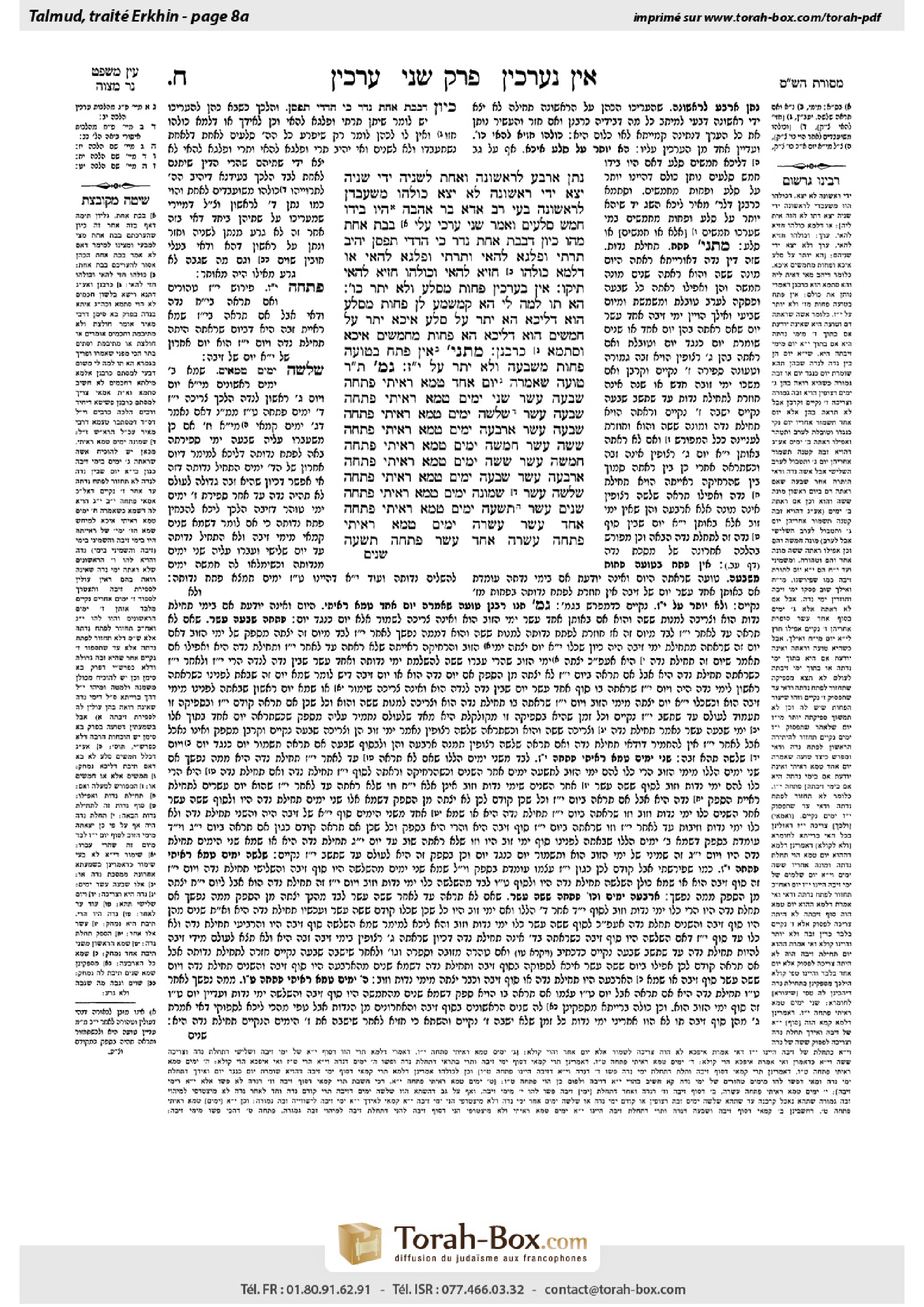
Arakhin 8a: Talmud study for Daf Yomi
Study the Talmud for Daf Yomi with scanned pages, Hebrew text, English translations from Sefaria and AI-generated French translations.
Passage selection and English or AI-generated French translation are available where the scan has annotations. Daf Study is independent of Torah-Box and Sefaria.
Browse Arakhin · ערכין · All tractatesArakhin 8a text and translations
This page of Arakhin includes the Aramaic text, an English translation and an AI-generated French translation, alongside the scan above.
ערכין ח׳ א · Aramaic and Hebrew text
נָתַן אַרְבַּע לָרִאשׁוֹנָה וְאַחַת לַשְּׁנִיָּה — יְדֵי שְׁנִיָּה יָצָא, יְדֵי רִאשׁוֹנָה לֹא יָצָא, כּוּלְּהוּ מְשַׁעְבְּדָן לְרִאשׁוֹנָה.
בָּעֵי רַב אַדָּא בַּר אַהֲבָה: הָיוּ בְּיָדוֹ חָמֵשׁ סְלָעִים וְאָמַר ״שֵׁנִי עֶרְכִּי עָלַי״ בְּבַת אַחַת, מַהוּ? כֵּיוָן דִּבְבַת אַחַת נָדַר — כִּי הֲדָדֵי תָּפְסָן, יָהֵיב תַּרְתֵּי וּפַלְגָא לְהַאי וְתַרְתֵּי וּפַלְגָא לְהַאי, אוֹ דִלְמָא כּוּלְּהוּ חַזְיָא לְהַאי וְכוּלְּהוּ חַזְיָא לְהַאי? תֵּיקוּ.
אֵין בַּעֲרָכִין פָּחוֹת מִסֶּלַע וְלֹא יָתֵר כּוּ׳. הָא תּוּ לְמָה לִי?
הָא קָמַשְׁמַע לַן: פָּחוֹת מִסֶּלַע הוּא דְּלֵיכָּא, הָא יָתֵר עַל סֶלַע אִיכָּא; יָתֵר עַל חֲמִשִּׁים הוּא דְּלֵיכָּא, הָא פָּחוֹת מֵחֲמִשִּׁים אִיכָּא, וּסְתָמָא כְּרַבָּנַן.
מַתְנִי׳ אֵין ״פֶּתַח בְּטוֹעָה״ פָּחוֹת מִשִּׁבְעָה, וְלֹא יָתֵר עַל שִׁבְעָה עָשָׂר.
גְּמָ׳ תָּנוּ רַבָּנַן: טוֹעָה שֶׁאָמְרָה ״יוֹם אֶחָד טָמֵא רָאִיתִי״, פִּתְחָהּ שִׁבְעָה עָשָׂר.
״שְׁנֵי יָמִים טָמֵא רָאִיתִי״ — פִּתְחָהּ שִׁבְעָה עָשָׂר.
״שְׁלֹשָׁה יָמִים טָמֵא רָאִיתִי״ — פִּתְחָהּ שִׁבְעָה עָשָׂר.
״אַרְבָּעָה יָמִים טָמֵא רָאִיתִי״ — פִּתְחָהּ שִׁשָּׁה עָשָׂר.
״חֲמִשָּׁה יָמִים טָמֵא רָאִיתִי״ — פִּתְחָהּ חֲמִשָּׁה עָשָׂר. ״שִׁשָּׁה יָמִים טָמֵא רָאִיתִי״ — פִּתְחָהּ אַרְבָּעָה עָשָׂר.
״שִׁבְעָה יָמִים טָמֵא רָאִיתִי״ — פִּתְחָהּ שְׁלֹשָׁה עָשָׂר.
״שְׁמוֹנָה יָמִים טָמֵא רָאִיתִי״ — פִּתְחָהּ שְׁנֵים עָשָׂר.
״תִּשְׁעָה יָמִים טָמֵא רָאִיתִי״ — פִּתְחָהּ אַחַד עָשָׂר.
״עֲשָׂרָה יָמִים טָמֵא רָאִיתִי״ — פִּתְחָהּ עֲשָׂרָה. ״אַחַד עָשָׂר״ — פִּתְחָהּ תִּשְׁעָה.
Arakhin 8a · English translation
By contrast, if he first gave four sela for payment of the first vow and then one sela for payment of the second vow, he has fulfilled his obligation with regard to the second vow, because all he had at that stage was one sela. But he has not fulfilled his obligation with regard to the first vow, because all five sela in his possession were liened for payment of the first vow, and therefore he did not fulfill his obligation by paying only four.
Rav Adda bar Ahava raises a dilemma: If one had in his possession five sela and he said: It is hereby incumbent upon me to donate my valuation twice, and consequently both obligations take effect simultaneously, what is the halakha? One can claim that since he vowed both vows simultaneously, they take effect together, and therefore he gives two and a half sela for this vow and two and a half sela for that vow; or perhaps all of the five sela are fit for this vow and all of them are also fit for that vow, and therefore he must pay five sela for each vow? The Gemara concludes: The dilemma shall stand unresolved.
§ The mishna teaches at its conclusion that there is no payment of valuations less than a sela; nor is there a payment greater than fifty sela. The Gemara asks: Why do I also need this statement, as this halakha was already stated at the beginning of the mishna?
The Gemara answers: This additional statement teaches us that there is no payment of valuations less than a sela, but, by inference, there is a payment of valuations more than a sela. Similarly, there is no payment of valuations for a sum greater than fifty sela, but there is a payment that is less than fifty sela. And this unattributed statement of the mishna is in accordance with the opinion of the Rabbis, who maintain that if one cannot pay the full amount of the valuation, he pays however much he can afford, even if it is more than a sela, rather than paying only one sela, as stated by Rabbi Meir.
MISHNA: If a woman experienced a discharge of blood and is unsure whether it was during her days of menstruation or during the eleven days that would render her a zava, the alleviation of her state of uncertainty does not occur in fewer than seven clean days, nor in more than seventeen clean days, depending on the number of days that she experiences the discharge.
GEMARA: The Sages elaborated on the principle of the mishna, as taught in a baraita: With regard to a woman who had a discharge of blood and is unsure whether it was during her days of menstruation or during the eleven days that would render her a zava, who said: I saw one impure day, i.e., I had a discharge of blood for one day, the alleviation of her state of uncertainty occurs after seventeen clean days, i.e., seventeen days without any discharge. If her discharge occurred on the first of her days of menstruation, she has another six days of menstruation followed by eleven days of ziva; if she experiences a discharge after these seventeen clean days, she has certainly returned to her days of menstruation. If the initial discharge had been on any of the other days of the seven-day followed by eleven-day cycle, she would return to her days of menstruation after fewer days, but the definitive alleviation of her uncertainty does not occur until seventeen days.
If she said: I saw two impure days, i.e., I had a discharge of blood for two days, the alleviation of her state of uncertainty occurs after she experiences seventeen clean days. If the two days had been at the beginning of the days of her menstrual cycle, she would begin another menstrual cycle if she experienced her next discharge after sixteen clean days. Yet, there is a possibility that the first day of her discharge was on the last of the eleven days of ziva, and the second day was on the first of the days of her menstrual cycle. In that case, she would return to the beginning of her menstrual cycle only after the six remaining days of menstruation followed by eleven additional days, for a total of seventeen.
If she said: I saw three impure days, i.e., I had a discharge of blood for three days, the alleviation of her state of uncertainty occurs after she experiences seventeen clean days, as it is possible that the first two days of discharge were on the last two of the eleven days of ziva, and the third day of discharge was on the first of the days of her menstrual cycle.
If she said: I saw four impure days, i.e., I had a discharge of blood for four days, the alleviation of her state of uncertainty occurs after she experiences sixteen clean days. This is because the longest possible interval between these days of discharge and the beginning of her next menstrual cycle would occur if the first two days of discharge were at the end of her days of ziva and the other two were at the beginning of the days of her menstrual cycle. She would then require another five days of menstruation and the eleven days of ziva, for a total of sixteen.
If she said: I saw five impure days, i.e., I had a discharge of blood for five days, the alleviation of her state of uncertainty occurs after she experiences fifteen clean days, to account for the possibility that the first two days of discharge occurred on the last two of the eleven days of ziva and the other three were on her days of her menstrual cycle. If she said: I saw six impure days, i.e., I had a discharge of blood for six days, the alleviation of her state of uncertainty occurs after she experiences fourteen clean days, to account for the possibility that the first two days of discharge occurred at the end of her days of ziva and the other four occurred at the beginning of her days of menstruation.
If she said: I saw seven impure days, i.e., I had a discharge of blood for seven days, the alleviation of her state of uncertainty occurs after she experiences thirteen clean days, to account for the possibility that the first two days of discharge occurred on the last two of the eleven days of ziva and the other five occurred at the beginning of her menstrual cycle. In that case, she would have another two days to conclude her days of menstruation, followed by the eleven days of ziva, before she would start a new menstrual cycle.
If she said: I saw eight impure days, i.e., I had a discharge of blood for eight days, the alleviation of her state of uncertainty occurs after she experiences twelve clean days, to account for the possibility that the first two days of discharge occurred on the last two of the eleven days of ziva and the other six occurred at the beginning of her menstrual cycle.
If she said: I saw nine impure days, i.e., I had a discharge of blood for nine days, the alleviation of her state of uncertainty occurs after she experiences eleven clean days, to account for the possibility that the first two days of discharge occurred at the end of her days of ziva and the other seven occurred on the days of her menstrual cycle. In that case, she would have only the eleven days of ziva before beginning a new menstrual cycle.
If she said: I saw ten impure days, i.e., I had a discharge of blood for ten days, the alleviation of her state of uncertainty occurs after she experiences ten clean days, to account for the possibility that the first two days of discharge occurred on the last two of the eleven days of ziva and the other eight occurred on the seven days of her menstrual cycle and one additional day. If she said: I saw eleven impure days, i.e., I had a discharge of blood for eleven days, the alleviation of her state of uncertainty occurs after she experiences nine clean days, to account for the worst-case scenario that the first two days of discharge occurred on the last two of the eleven days of ziva and the other nine occurred on the seven days of her menstrual cycle, followed by two additional days.
Arakhin 8a · Traduction française (IA)
Par contre, si d'abord il a donné quatre sela pour le premier serment, puis un sela pour le second, il a accompli son obligation concernant le second serment, car à ce stade il ne possédait qu'un sela. Mais il n'a pas accompli son obligation concernant le premier serment, car les cinq sela qu'il possédait étaient liés à la rémunération du premier serment, et donc il n'a pas accompli son obligation en payant seulement quatre.
Rav Adda bar Ahava pose un dilemme : Si l'on possédait cinq sela et qu'on disait : Il est désormais tenu de m'offrir une estimation double, et donc les deux obligations prennent effet simultanément, quelle est la halakha ? On peut affirmer que puisqu'il a fait les deux serments simultanément, ils prennent effet ensemble, et donc il donne deux et demi sela pour ce serment et deux et demi sela pour celui-ci ; ou peut-être que tous les cinq sela sont appropriés à ce serment et à celui-ci, et donc il doit payer cinq sela pour chaque serment ? La Guemara conclut : Ce dilemme restera sans solution.
§ La mitsna enseigne en conclusion qu'il n'y a pas de paiement d'estimations inférieures à un sela ; ni non plus de paiement supérieur à cinquante sela. La Guemara demande : Pourquoi ai-je besoin de cette déclaration, puisque cette halakha a déjà été évoquée au début de la mitsna ?
La Guemara répond : Cette déclaration supplémentaire nous apprend qu'il n'y a pas de paiement d'estimations inférieures à un sela, mais par déduction, il y a un paiement d'estimations supérieures à un sela. De même, il n'y a pas de paiement d'estimations pour une somme supérieure à cinquante sela, mais il y a un paiement inférieur à cinquante sela. Et cette déclaration non attribuée de la mitsna est conforme à l'opinion des Rabbins, qui maintiennent que si l'on ne peut pas payer le montant total de l'estimation, on paie ce que l'on peut, même s'il est supérieur à un sela, plutôt que de payer seulement un sela, comme l'a dit Rabbi Meir.
MITSNA : Si une femme a eu un dégagement de sang et est incertaine quant à ce que cela était, soit durant ses jours de menstruation, soit durant les onze jours qui la rendraient zava, la résolution de son doute ne se produit pas en moins de sept jours purs, ni en plus de dix-sept jours purs, selon le nombre de jours qu'elle a eu le dégagement.
GUEMARA : Les Sages ont développé le principe de la mitsna, comme enseigné dans une baraïta : Concernant une femme qui a eu un dégagement de sang et est incertaine quant à ce que cela était, soit durant ses jours de menstruation, soit durant les onze jours qui la rendraient zava, qui dit : J'ai vu un jour impur, c'est-à-dire j'ai eu un dégagement de sang un jour, la résolution de son doute se produit après dix-sept jours purs, c'est-à-dire dix-sept jours sans dégagement. Si son dégagement s'était produit le premier jour de ses jours de menstruation, elle aurait eu six jours supplémentaires de menstruation suivis de onze jours de ziva ; si elle a un dégagement après ces dix-sept jours purs, elle a certainement retrouvé ses jours de menstruation. Si le dégagement initial s'était produit à l'une des autres jours des sept jours suivis des onze jours du cycle, elle aurait retrouvé ses jours de menstruation après moins de jours, mais la résolution définitive de son doute ne se produit que après dix-sept jours.
Si elle dit : J'ai vu deux jours impurs, c'est-à-dire j'ai eu un dégagement de sang pendant deux jours, la résolution de son doute a lieu après qu'elle ait vécu dix-sept jours purs. Si les deux jours s'étaient produits au début de ses jours de menstruation, elle aurait commencé un nouveau cycle menstruel si elle avait eu un dégagement après seize jours purs. Cependant, il y a une possibilité que le premier jour de son dégagement ait été le dernier des onze jours de ziva, et le deuxième jour ait été le premier de ses jours de menstruation. Dans ce cas, elle aurait retrouvé le début de son cycle menstruel seulement après les six jours restants de menstruation suivis de onze jours supplémentaires, pour un total de dix-sept.
Si elle dit : J'ai vu trois jours impurs, c'est-à-dire j'ai eu un dégagement de sang pendant trois jours, la résolution de son doute a lieu après qu'elle ait vécu dix-sept jours purs, car il est possible que les deux premiers jours de dégagement aient été les deux derniers des onze jours de ziva, et le troisième jour de dégagement ait été le premier des jours de son cycle menstruel.
Si elle dit : J'ai vu quatre jours impurs, c'est-à-dire j'ai eu un dégagement de sang pendant quatre jours, la résolution de son doute a lieu après qu'elle ait vécu seize jours purs. Cela est dû au fait que l'intervalle le plus long entre ces jours de dégagement et le début de son prochain cycle menstruel se produirait si les deux premiers jours de dégagement étaient à la fin de ses jours de ziva et les deux autres au début de ses jours de menstruation. Elle aurait alors besoin de cinq jours supplémentaires de menstruation et des onze jours de ziva, pour un total de seize.
Si elle dit : J'ai vu cinq jours impurs, c'est-à-dire j'ai eu un dégagement de sang pendant cinq jours, la résolution de son doute a lieu après qu'elle ait vécu quinze jours purs, pour tenir compte de la possibilité que les deux premiers jours de dégagement aient eu lieu aux deux derniers des onze jours de ziva et les trois autres sur ses jours de menstruation. Si elle dit : J'ai vu six jours impurs, c'est-à-dire j'ai eu un dégagement de sang pendant six jours, la résolution de son doute a lieu après qu'elle ait vécu quatorze jours purs, pour tenir compte de la possibilité que les deux premiers jours de dégagement aient eu lieu à la fin de ses jours de ziva et les quatre autres au début de ses jours de menstruation.
Si elle dit : J'ai vu sept jours impurs, c'est-à-dire que j'ai eu un dégagement de sang pendant sept jours, la levée de son état d'incertitude a lieu après qu'elle ait vécu treize jours purs, pour tenir compte de la possibilité que les deux premiers jours de dégagement aient eu lieu sur les deux derniers jours de ziva et que les cinq autres aient eu lieu au début de son cycle menstruel. Dans ce cas, elle aurait encore deux jours pour terminer ses jours de menstruation, suivis des onze jours de ziva, avant de commencer un nouveau cycle menstruel.
Si elle dit : J'ai vu huit jours impurs, c'est-à-dire que j'ai eu un dégagement de sang pendant huit jours, la levée de son état d'incertitude a lieu après qu'elle ait vécu douze jours purs, pour tenir compte de la possibilité que les deux premiers jours de dégagement aient eu lieu sur les deux derniers jours de ziva et que les six autres aient eu lieu au début de son cycle menstruel.
Si elle dit : J'ai vu neuf jours impurs, c'est-à-dire que j'ai eu un dégagement de sang pendant neuf jours, la levée de son état d'incertitude a lieu après qu'elle ait vécu onze jours purs, pour tenir compte de la possibilité que les deux premiers jours de dégagement aient eu lieu à la fin de ses jours de ziva et que les sept autres aient eu lieu pendant ses jours de menstruation. Dans ce cas, elle aurait seulement les onze jours de ziva avant de commencer un nouveau cycle menstruel.
Si elle dit : J'ai vu dix jours impurs, c'est-à-dire que j'ai eu un dégagement de sang pendant dix jours, la levée de son état d'incertitude a lieu après qu'elle ait vécu dix jours purs, pour tenir compte de la possibilité que les deux premiers jours de dégagement aient eu lieu sur les deux derniers jours de ziva et que les huit autres aient eu place sur les sept jours de son cycle menstruel et un jour supplémentaire. Si elle dit : J'ai vu onze jours impurs, c'est-à-dire que j'ai eu un dégagement de sang pendant onze jours, la levée de son état d'incertitude a lieu après qu'elle ait vécu neuf jours purs, pour tenir compte du scénario le plus défavorable, celui où les deux premiers jours de dégagement auraient eu lieu sur les deux derniers jours de ziva et que les neuf autres aient eu lieu sur les sept jours de son cycle menstruel, suivis de deux jours supplémentaires.
Traduction française générée par IA à partir de l’édition anglaise de Sefaria. Vérifie toujours un passage avec le texte source.
Text from Sefaria: William Davidson Edition - Vocalized Aramaic (CC BY NC); William Davidson Edition - English (CC BY NC).