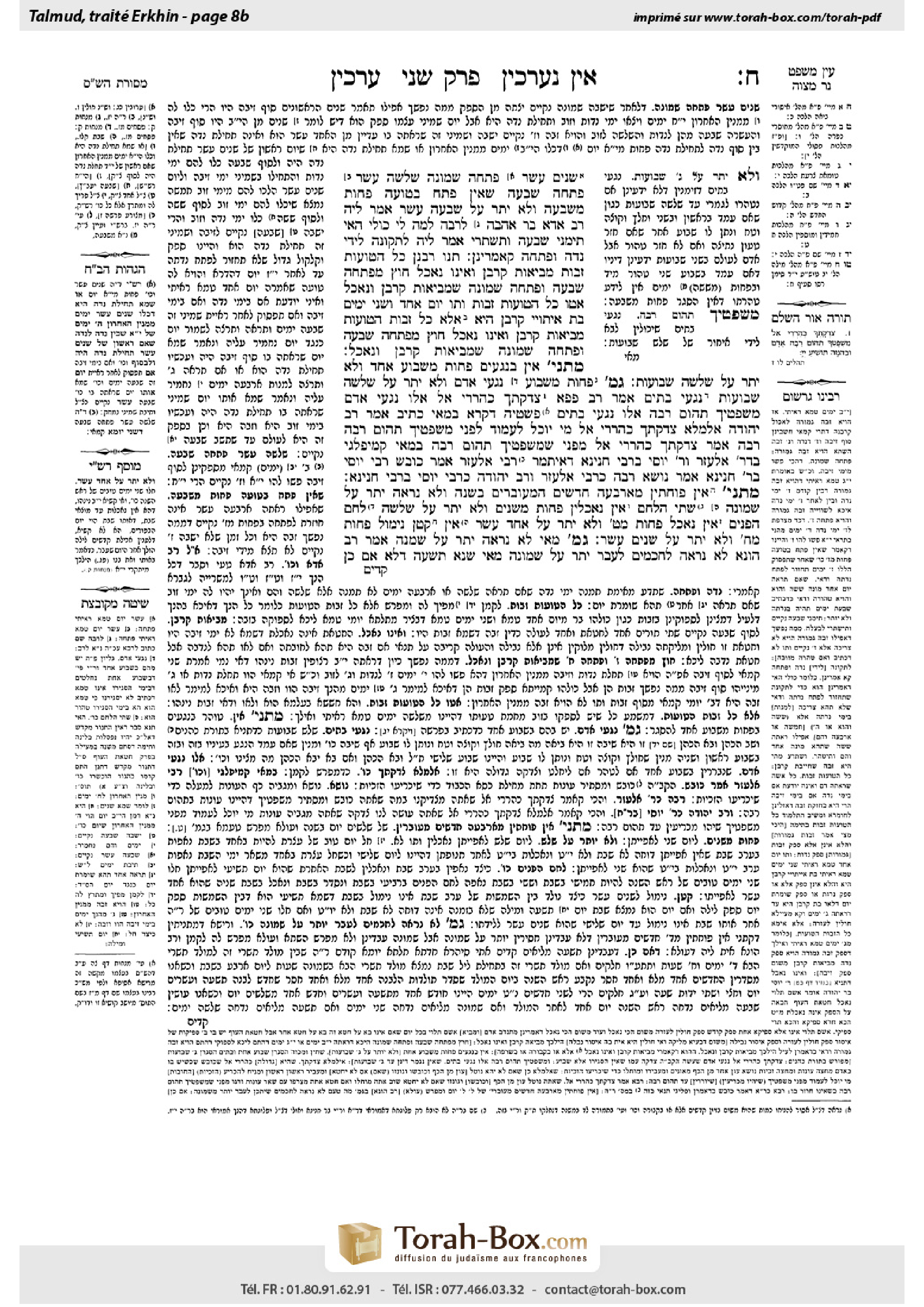
Arakhin 8b: Talmud study for Daf Yomi
Study the Talmud for Daf Yomi with scanned pages, Hebrew text, English translations from Sefaria and AI-generated French translations.
Passage selection and English or AI-generated French translation are available where the scan has annotations. Daf Study is independent of Torah-Box and Sefaria.
Browse Arakhin · ערכין · All tractatesArakhin 8b text and translations
This page of Arakhin includes the Aramaic text, an English translation and an AI-generated French translation, alongside the scan above.
ערכין ח׳ ב · Aramaic and Hebrew text
״שְׁנֵים עָשָׂר״ — פִּתְחָהּ שְׁמוֹנָה.
״שְׁלֹשָׁה עָשָׂר״ — פִּתְחָהּ שִׁבְעָה.
שֶׁאֵין פֶּתַח בְּטוֹעָה פָּחוֹת מִשִּׁבְעָה, וְלֹא יָתֵר עַל שִׁבְעָה עָשָׂר.
אֲמַר לֵיהּ רַב אַדָּא בַּר אַהֲבָה לְרַבָּה: לְמָה לִי כּוּלֵּי הַאי? תִּימְנֵי שִׁבְעָה וְתִשְׁתְּרֵי!
אֲמַר לֵיהּ: לְתַקּוֹנַהּ לִידֵי נִדָּה וּפִתְחָהּ קָאָמְרִינַן.
תָּנוּ רַבָּנַן: כׇּל הַטּוֹעוֹת זָבוֹת, מְבִיאוֹת קׇרְבָּן וְאֵינוֹ נֶאֱכָל, חוּץ מִפִּתְחָהּ שִׁבְעָה וּפִתְחָהּ שְׁמוֹנָה, שֶׁמְּבִיאוֹת קׇרְבָּן וְנֶאֱכָל.
אַטּוּ כׇּל הַטּוֹעוֹת זָבוֹת? וְתוּ, יוֹם אֶחָד וּשְׁנֵי יָמִים בַּת אֵיתוֹיֵי קׇרְבָּן הִיא?
אֶלָּא, כׇּל זָבוֹת הַטּוֹעוֹת מְבִיאוֹת קׇרְבָּן וְאֵינוֹ נֶאֱכָל, חוּץ מִפִּתְחָהּ שִׁבְעָה, וּפִתְחָהּ שְׁמוֹנָה, שֶׁמְּבִיאוֹת קׇרְבָּן וְנֶאֱכָל.
מַתְנִי׳ אֵין בִּנְגָעִים פָּחוֹת מִשָּׁבוּעַ אֶחָד, וְלֹא יָתֵר עַל שְׁלֹשָׁה שְׁבוּעוֹת.
גְּמָ׳ פָּחוֹת מִשָּׁבוּעַ — נִגְעֵי אָדָם, וְלֹא יָתֵר עַל שְׁלֹשָׁה שְׁבוּעוֹת — נִגְעֵי בָתִּים.
אָמַר רַב פָּפָּא: ״צִדְקָתְךָ כְּהַרְרֵי אֵל״ — אֵלּוּ נִגְעֵי אָדָם, ״מִשְׁפָּטֶיךָ תְּהוֹם רַבָּה״ — אֵלּוּ נִגְעֵי בָתִּים.
פְּשָׁטֵיהּ דִּקְרָא בְּמַאי כְּתִיב? אָמַר רַב יְהוּדָה: אִלְמָלֵא ״צִדְקָתְךָ כְּהַרְרֵי אֵל״ — מִי יוּכַל לַעֲמוֹד לִפְנֵי ״מִשְׁפָּטֶיךָ תְּהוֹם רַבָּה״. רַבָּה אָמַר: ״צִדְקָתְךָ כְּהַרְרֵי אֵל״ — מִפְּנֵי שֶׁ״מִּשְׁפָּטֶיךָ תְּהוֹם רַבָּה״.
בְּמַאי קָמִיפַּלְגִי? בִּדְרַבִּי אֶלְעָזָר וְרַבִּי יוֹסֵי בְּרַבִּי חֲנִינָא, דְּאִיתְּמַר: רַבִּי אֶלְעָזָר אָמַר: כּוֹבֵשׁ, רַבִּי יוֹסֵי בְּרַבִּי חֲנִינָא אָמַר: נוֹשֵׂא.
רַבָּה כְּרַבִּי אֶלְעָזָר, וְרַב יְהוּדָה כְּרַבִּי יוֹסֵי בְּרַבִּי חֲנִינָא.
מַתְנִי׳ אֵין פּוֹחֲתִין מֵאַרְבָּעָה חֳדָשִׁים הַמְעוּבָּרִים בְּשָׁנָה, וְלֹא נִרְאָה יָתֵר עַל שְׁמוֹנָה. שְׁתֵּי הַלֶּחֶם אֵין נֶאֱכָלִין פָּחוֹת מִשְּׁנַיִם, וְלֹא יָתֵר עַל שְׁלֹשָׁה. לֶחֶם הַפָּנִים אֵין נֶאֱכָל פָּחוֹת מִתִּשְׁעָה, וְלֹא יָתֵר עַל אַחַד עָשָׂר.
אִין קָטָן נִימּוֹל פָּחוֹת מִשְּׁמוֹנָה, וְלֹא יָתֵר עַל שְׁנֵים עָשָׂר.
גְּמָ׳ מַאי ״לֹא נִרְאָה יָתֵר עַל שְׁמֹנָה״? אָמַר רַב הוּנָא: לֹא נִרְאָה לַחֲכָמִים לְעַבֵּר יָתֵר עַל שְׁמוֹנָה. מַאי שְׁנָא תִּשְׁעָה דְּלָא? אִם כֵּן
Arakhin 8b · English translation
If she said: I saw twelve impure days, i.e., I had a discharge of blood for twelve days, the alleviation of her state of uncertainty occurs after she experiences eight clean days, to account for the worst-case scenario that the first two days of discharge occurred on the last two of the eleven days of ziva and the other ten occurred on the seven days of her menstrual cycle and the three subsequent days. If so, she would have another eight days until the end of the full eighteen-day cycle, and when she next experiences a discharge it is the beginning of her new menstrual cycle.
If she said: I saw thirteen impure days, i.e., I had a discharge of blood for thirteen days, the alleviation of her state of uncertainty occurs after she experiences seven clean days, to account for the possibility that the first two days of discharge occurred on the last two of the eleven days of ziva and the others occurred on the seven days of her menstrual cycle and the four subsequent days. If so, she would be left with only seven more days until the end of the full eighteen-day cycle, and when she next experiences a discharge it is the beginning of her new menstrual cycle.
All this shows that there is no alleviation of a woman’s state of uncertainty if she had a discharge of blood and is unsure whether it was during her days of menstruation or during her days of ziva in fewer than seven clean days and in no more than seventeen clean days.
Rav Adda bar Ahava said to Rabba: Why do I need all of these clean days? Let her count a mere seven clean days and be permitted to her husband. Regardless of whether the bleeding occurred during her days of menstruation or during her days of ziva, a woman can immerse in a ritual bath and become ritually pure and permitted to her husband after a maximum of seven clean days.
Rabba said to him: We say that she must experience seventeen clean days only with regard to setting her right concerning her status as a menstruating woman and the alleviation of her state of uncertainty. It is true that a woman can always become permitted to her husband after seven clean days. The discussion in the mishna and baraita concerns the resolution of uncertainty about whether her next discharge of blood will render her a menstruating woman or a zava. This is significant because if she is menstruating she can become ritually pure and permitted to her husband after seven days even if none of them are clean days, whereas if the discharge occurred over one or two days during the eleven days of ziva, she becomes pure after one clean day; and if the bleeding lasts three days or more during that time, she must wait for seven clean days.
§ The Sages taught in a baraita: All women who experience a discharge of blood and are unsure whether it is during the days of menstruation or the days of ziva are considered zavot. Therefore, they must bring the offering of a zava, in case they have this status; but it is not eaten by the priests, due to the possibility they were not actually zavot. This is the case for all women, except for a woman who experiences a discharge for thirteen consecutive days, whose alleviation of her state of uncertainty occurs after seven clean days, and for a woman who experiences a discharge for twelve consecutive days, whose alleviation of her state of uncertainty occurs after eight clean days. In those two instances, the women bring the offering of a zava and it is eaten by the priests.
The Gemara asks: Is that to say that all women who experience a discharge of blood and are unsure whether it is during the days of menstruation or the days of ziva are considered zavot? It is in fact unknown whether they are menstruating or are zavot. And furthermore, is a woman who experienced a discharge for one day or for two days fit to bring an offering? Only a zava who experienced a discharge for three consecutive days is required to bring an offering.
The Gemara answers: Rather, the baraita means that all zavot, i.e., women who experienced a discharge for three consecutive days, who are unsure whether their discharge took place during the seven days of menstruation or the eleven days of ziva, can become ritually pure after seven clean days, at which point they bring an offering, but it is not eaten by the priests. This, the baraita continues, is the case for all women except for a woman who experiences a discharge for thirteen consecutive days, whose alleviation of her state of uncertainty occurs after seven clean days, and for a woman who experiences a discharge for twelve consecutive days, whose alleviation of her state of uncertainty occurs after eight clean days. These women bring the offering of a zava and it is eaten by the priests.
MISHNA: There are symptoms of leprosy that a priest will immediately confirm to be ritually pure or ritually impure, and there are others for which the priest quarantines the leper in order to determine his status. With regard to leprous marks, there is no quarantine that is less than one week and none greater than three weeks.
GEMARA: When the mishna states that there is no period of quarantine less than one week, it is referring to leprous marks that affect a person, as the priest issues a definitive decision about leprous symptoms on an inflammation or a burn after one week (see Leviticus 13:18–28). When the mishna states: And none greater than three weeks, it is referring to leprous marks that affect houses, as there are instances when a definitive decision is rendered only after the house has been quarantined for three weeks.
§ Rav Pappa says: In the phrase: “Your benevolence is like the mighty mountains” (Psalms 36:7), these acts of benevolence are referring to leprous marks that affect a person. When God punishes someone with benevolence, He afflicts the individual with leprous symptoms on his body that can be resolved in just one week. When the verse continues with the phrase, “Your judgments are like the great deep,” these judgments are referring to leprous marks that appear on houses, the status of which can take up to three weeks to be determined.
The Gemara asks: To what does the plain meaning of the aforementioned verse refer? Rav Yehuda said that the plain meaning of the verse is as follows: If not for the fact that Your benevolence is like the mighty mountains, who could withstand Your judgments, which are like the great deep? Rabba says the verse should be understood differently: Your benevolence is like the mighty mountains, because Your judgments are like the great deep.
The Gemara asks: With regard to what principle do Rav Yehuda and Rabba disagree? The Gemara answers that they disagree with regard to the dispute between Rabbi Elazar and Rabbi Yosei, son of Rabbi Ḥanina, about how God applies His attribute of “abundant in kindness” (Exodus 34:6) when He judges a person whose merits and sins are equal. As it was stated that Rabbi Elazar says: He hides away some sins and does not put them on the scale, thereby allowing the merits to outweigh the sins. Rabbi Yosei, son of Rabbi Ḥanina, says: He lifts the side of the scale that holds the sins so that the merits outweigh the sins.
The Gemara explains the connection between the two disputes: Rabba holds in accordance with the opinion of Rabbi Elazar, and therefore he interprets the verse as saying that God is benevolent because He discards one’s judgments, i.e., sins, by throwing them to the great deep, thereby allowing his merits to outweigh his sins. And Rav Yehuda holds in accordance with the opinion of Rabbi Yosei, son of Rabbi Ḥanina, and therefore he interprets the verse to mean that God lifts the side of merits as high as the mighty mountains, and were it not for this act of benevolence no one could stand before God’s judgments, which are like the great deep.
MISHNA: No fewer than four full thirty-day months may be established during the course of a year, and it did not seem appropriate to establish more than eight. The two loaves that are brought to the Temple on Shavuot are eaten by the priests not before the second and not after the third day from when they were baked. The shewbread is eaten not before the ninth day from when it was baked, which is the situation in a regular week when the bread is baked on Friday and eaten on the following Shabbat; and not after the eleventh day, when the two Festival days of Rosh HaShana occur on Thursday and Friday, as the shewbread is baked on Wednesday and not eaten until the following Shabbat.
A minor boy is not circumcised before the eighth day after his birth and not after the twelfth day. Normally a newborn is circumcised on his eighth day. If he was born during twilight, which an uncertain period of day or night, he is circumcised on what would be the eighth day of his birth if he is was born at night, which is the ninth day if he was born during the day. If he was born during twilight on Shabbat eve, the circumcision cannot be performed on Friday, as he might have been born on Shabbat and therefore Friday is only the seventh day. And the circumcision cannot be on Shabbat, as perhaps he was born on Friday and only circumcision performed on the eighth day overrides Shabbat. Therefore, it is postponed until after Shabbat. If two days of Rosh HaShana occur on Sunday and Monday, the circumcision is postponed until Tuesday, the twelfth day after birth.
GEMARA: The Gemara asks: What is the meaning of the statement of the mishna that it did not seem appropriate to establish more than eight? Rav Huna says: It did not seem appropriate to the Sages to extend more than eight months in a year and establish them as full, thirty-day months. The Gemara asks: What is different about nine months, in that the Sages did not deem it appropriate to establish that many full months in one year? Apparently, the Sages were concerned that if so, i.e., if there were that many full months,
Arakhin 8b · Traduction française (IA)
Si elle dit : J'ai vu douze jours impurs, c'est-à-dire que j'ai eu un dégagement de sang pendant douze jours, l'apaisement de son état d'incertitude a lieu après qu'elle ait vécu huit jours purs, pour tenir compte du scénario le plus défavorable où les deux premiers jours de dégagement ont eu lieu sur les deux derniers jours de ziva et les dix autres sur les sept jours de son cycle menstruel et les trois jours suivants. Ainsi, elle aurait encore huit jours jusqu'à la fin du cycle complet de dix-huit jours, et lorsqu'elle ressent à nouveau un dégagement, c'est le début de son nouveau cycle menstruel.
Si elle dit : J'ai vu treize jours impurs, c'est-à-dire que j'ai eu un dégagement de sang pendant treize jours, l'apaisement de son état d'incertitude a lieu après qu'elle ait vécu sept jours purs, pour tenir compte de la possibilité que les deux premiers jours de dégagement aient eu lieu sur les deux derniers jours de ziva et les autres sur les sept jours de son cycle menstruel et les quatre jours suivants. Ainsi, elle aurait encore sept jours jusqu'à la fin du cycle complet de dix-huit jours, et lorsqu'elle ressent à nouveau un dégagement, c'est le début de son nouveau cycle menstruel.
Tout cela montre qu'il n'y a pas d'apaisement de l'état d'incertitude d'une femme si elle a eu un dégagement de sang et est incertaine quant à ce qu'il s'agissait de ses jours menstruels ou de ses jours de ziva, à moins de sept jours purs et dans un délai ne dépassant pas dix-sept jours purs.
Rav Adda bar Ahava a dit à Rabba : Pourquoi ai-je besoin de tous ces jours purs ? Que la femme compte simplement sept jours purs et soit autorisée à son mari. Quel que soit le moment où le saignement a eu lieu, soit pendant ses jours menstruels soit pendant ses jours de ziva, elle peut se purifier dans un bain rituel et être autorisée à son mari après maximum sept jours purs.
Rabba a répondu à lui : Nous disons qu'elle doit vivre dix-sept jours purs uniquement concernant la détermination de son statut de femme menstruelle et l'apaisement de son état d'incertitude. Il est vrai qu'une femme peut toujours être autorisée à son mari après sept jours purs. La discussion dans la mishna et la baraïta concerne la résolution de l'incertitude quant à ce que son prochain dégagement de sang la rendra une femme menstruelle ou une zava. Cela est important car si elle est menstruelle, elle peut se purifier dans un bain rituel et être autorisée à son mari après sept jours même si aucun d'entre eux n'est un jour pur, tandis que si le dégagement s'est produit sur un ou deux jours parmi les onze jours de ziva, elle devient pure après un seul jour pur ; et si le saignement dure trois jours ou plus durant cette période, elle doit attendre sept jours purs.
§ Les Sages ont enseigné dans une baraïta : Toutes les femmes qui éprouvent un dégagement de sang et sont incertaines de savoir si cela a lieu pendant les jours de menstruation ou les jours de ziva sont considérées comme des zavot. Ainsi, elles doivent apporter l'offrande de la zava, en cas qu'elles aient ce statut ; mais ce sacrifice n'est pas mangé par les prêtres, en raison de la possibilité qu'elles ne fussent pas effectivement des zavot. C'est le cas pour toutes les femmes, sauf pour une femme qui éprouve un dégagement pendant treize jours consecutifs, dont la résolution de son doute s'effectue après sept jours purs, et pour une femme qui éprouve un dégagement pendant douze jours consecutifs, dont la résolution de son doute s'effectue après huit jours purs. Dans ces deux cas, les femmes apportent l'offrande de la zava et ce sacrifice est mangé par les prêtres.
La Guemara pose la question : Est-ce que cela signifie que toutes les femmes qui éprouvent un dégagement de sang et sont incertaines de savoir si cela a lieu pendant les jours de menstruation ou les jours de ziva sont considérées comme des zavot ? En réalité, on ignore si elles sont en période de menstruation ou des zavot. Et de plus, une femme qui a eu un dégagement pendant un jour ou deux est-elle digne d'apporter un sacrifice ? Seule une zava qui a eu un dégagement pendant trois jours consecutifs est tenue de présenter un sacrifice.
La Guemara répond : Plutôt, la baraïta signifie que toutes les zavot, c'est-à-dire les femmes qui ont eu un dégagement pendant trois jours consecutifs, qui sont incertaines de savoir si leur dégagement s'est produit pendant les sept jours de menstruation ou les onze jours de ziva, peuvent devenir rituellement pures après sept jours purs, à ce moment-là elles apportent un sacrifice, mais ce sacrifice n'est pas mangé par les prêtres. Cela, la baraïta continue, est le cas pour toutes les femmes, sauf pour une femme qui a eu un dégagement pendant treize jours consecutifs, dont la résolution de son doute s'effectue après sept jours purs, et pour une femme qui a eu un dégagement pendant douze jours consecutifs, dont la résolution de son doute s'effectue après huit jours purs. Ces femmes apportent l'offrande de la zava et ce sacrifice est mangé par les prêtres.
MICHNA : Il existe des symptômes de lèpre que le prêtre confirme immédiatement comme rituellement purs ou impurs, et d'autres pour lesquels le prêtre met le lèpreux en quarantaine afin de déterminer son statut. En ce qui concerne les marques de lèpre, il n'y a pas de période de quarantaine inférieure à sept jours et aucune supérieure à trois semaines.
GUEMARA : Lorsque la mishna dit qu'il n'y a pas de période de quarantaine inférieure à sept jours, elle fait référence aux marques de lèpre qui affectent une personne, car le prêtre rend un jugement définitif sur les symptômes de lèpre sur une inflammation ou une brûlure après sept jours (cf. Lévitique 13 : 18-28). Lorsque la mishna dit : Et aucune supérieure à trois semaines, elle fait référence aux marques de lèpre qui affectent les maisons, car il y a des cas où un jugement définitif est rendu seulement après que la maison ait été en quarantaine pendant trois semaines.
§ Rav Pappa dit : Dans la phrase : « Votre bonté est comme les montagnes puissantes » (Psaumes 36 : 7), ces actes de bonté font référence aux marques de lèpre qui affectent une personne. Lorsque Dieu puni quelqu'un avec de la bonté, Il afflige l'individu de symptômes de lèpre sur son corps qui peuvent être résolus en une semaine seulement. Lorsque la parabole continue avec la phrase : « Vos jugements sont comme la grande mer », ces jugements font référence aux marques de lèpre qui apparaissent sur les maisons, dont le statut peut prendre jusqu'à trois semaines pour être déterminé.
La Guemara pose la question : À quoi fait référence le sens littéral du verset mentionné précédemment ? Rav Yéhuda dit que le sens littéral du verset est le suivant : Si ce n'était pas pour le fait que Ta bonté est comme les montagnes puissantes, qui pourrait résister à Tes jugements, qui sont comme la grande mer ? Rabba dit que le verset doit être compris différemment : Ta bonté est comme les montagnes puissantes, car Tes jugements sont comme la grande mer.
La Guemara pose la question : À quel principe Rav Yéhuda et Rabba sont-ils en désaccord ? La Guemara répond que leur désaccord porte sur le débat entre Rabbi Eléazar et Rabbi Yosei, fils de Rabbi Chanina, concernant la manière dont Dieu applique Son attribut de « généreux en bonté » (Exode 34:6) lorsqu'Il juge une personne dont les mérites et les péchés sont égaux. Comme il a été dit que Rabbi Eléazar dit : Il cache certains péchés et ne les place pas sur la balance, permettant ainsi aux mérites de surpasser les péchés. Rabbi Yosei, fils de Rabbi Chanina, dit : Il soulève le côté de la balance qui contient les péchés afin que les mérites surpassent les péchés.
La Guemara explique la connexion entre les deux débats : Rabba suit l'opinion de Rabbi Eléazar, et donc il interprète le verset en disant que Dieu est généreux car Il jette les jugements, c'est-à-dire les péchés, dans la grande mer, permettant ainsi aux mérites de surpasser les péchés. Et Rav Yéhuda suit l'opinion de Rabbi Yosei, fils de Rabbi Chanina, et donc il interprète le verset pour signifier que Dieu soulève le côté des mérites aussi haut que les montagnes puissantes, et sans cet acte de bonté, personne ne pourrait résister aux jugements de Dieu, qui sont comme la grande mer.
MICHNA : Il ne peut être établi moins de quatre mois complets de trente jours durant l'année, et il ne semblait pas approprié d'établir plus de huit. Les deux pains apportés au Temple pendant la fête de Shavuot sont mangés par les prêtres ni avant le deuxième jour ni après le troisième jour à partir de leur cuisson. Le pain de table est mangé ni avant le neuvième jour à partir de sa cuisson, ce qui correspond à la situation d'une semaine normale où le pain est cuit le vendredi et mangé le samedi suivant ; ni après le onzième jour, lorsque les deux jours festifs de Rosh HaShana tombent le jeudi et le vendredi, car le pain de table est cuit le mercredi et n'est mangé que le samedi suivant.
Un petit garçon n'est pas circoncis avant le huitième jour après sa naissance et pas après le douzième jour. Normalement, un nouveau-né est circoncis le huitième jour. Si il est né pendant le crépuscule, période incertaine entre la journée et la nuit, il est circoncis le huitième jour de sa naissance si on suppose qu'il est né la nuit, ce qui correspond au neuvième jour s'il est né pendant la journée. Si il est né pendant le crépuscule le soir du sabbat, la circoncision ne peut pas avoir lieu le vendredi, car il pourrait avoir été né le sabbat et donc le vendredi est seulement le septième jour. Et la circoncision ne peut pas avoir lieu le sabbat, car on pourrait penser qu'il est né le vendredi et que la circoncision effectuée le huitième jour l'emporte sur le sabbat. Par conséquent, elle est reportée après le sabbat. Si deux jours de Rosh HaShana tombent le dimanche et le lundi, la circoncision est reportée jusqu'au mardi, le douzième jour après la naissance.
GUEMARA : La Guemara pose la question : Quelle est la signification de l'affirmation de la Michna selon laquelle il ne semblait pas approprié d'établir plus de huit ? Rav Huna dit : Il ne semblait pas approprié aux Sages d'étendre plus de huit mois dans une année et d'en établir comme des mois complets de trente jours. La Guemara pose la question : Quelle est la différence concernant neuf mois, dans le sens où les Sages n'ont pas jugé approprié d'établir autant de mois complets en une année ? Apparemment, les Sages étaient préoccupés par le fait que si cela était fait, c'est-à-dire s'il y avait autant de mois complets,
Traduction française générée par IA à partir de l’édition anglaise de Sefaria. Vérifie toujours un passage avec le texte source.
Text from Sefaria: William Davidson Edition - Vocalized Aramaic (CC BY NC); William Davidson Edition - English (CC BY NC).