Arakhin 9a: Talmud study for Daf Yomi
Study the Talmud for Daf Yomi with scanned pages, Hebrew text, English translations from Sefaria and AI-generated French translations.
Passage selection and English or AI-generated French translation are available where the scan has annotations. Daf Study is independent of Torah-Box and Sefaria.
Browse Arakhin · ערכין · All tractatesArakhin 9a text and translations
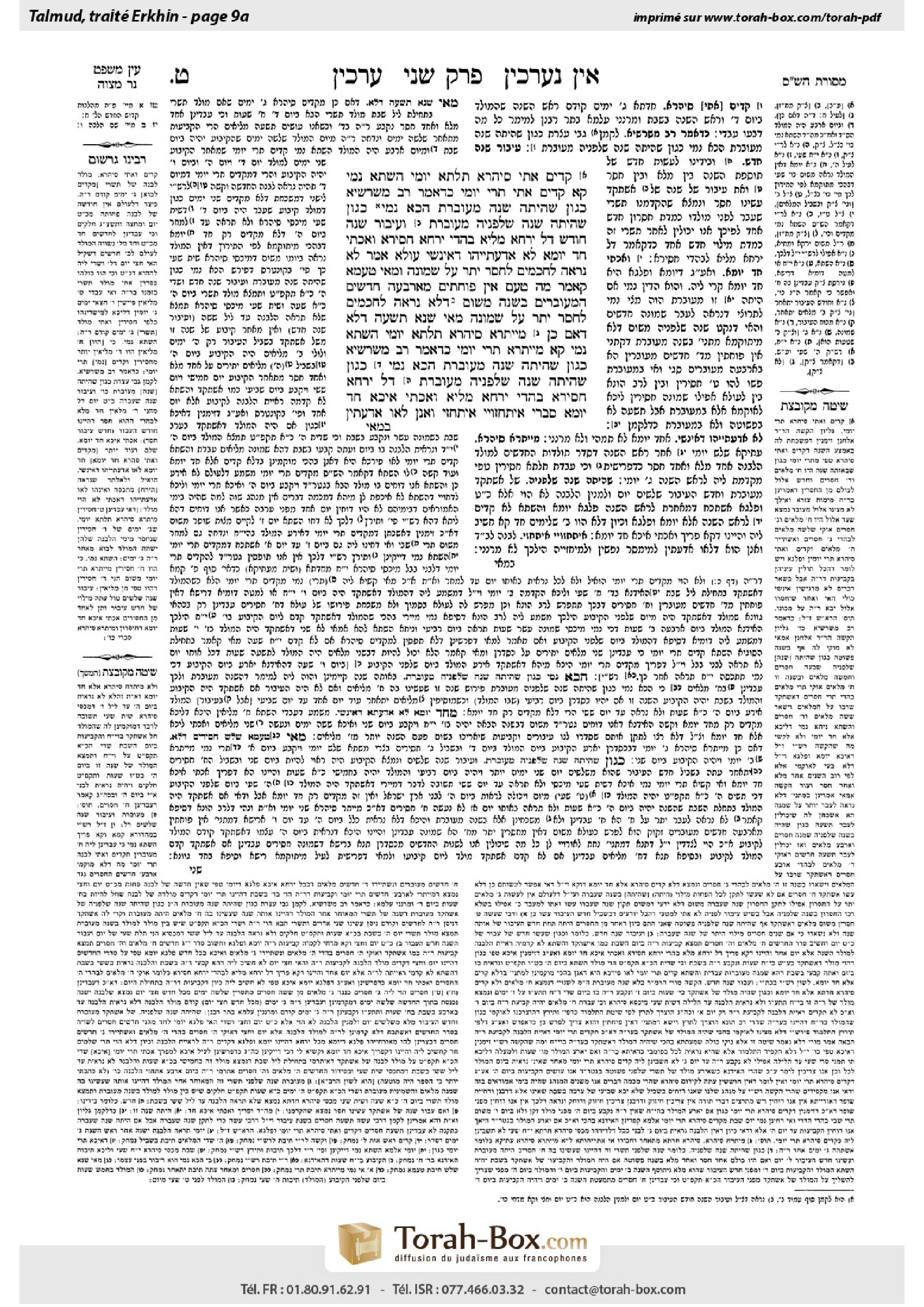
This page of Arakhin includes the Aramaic text, an English translation and an AI-generated French translation, alongside the scan above.
ערכין ט׳ א · Aramaic and Hebrew text
קָדֵים אָתֵי סֵיהֲרָא תְּלָתָא יוֹמֵי! הַשְׁתָּא נָמֵי קָא קָדֵים אָתֵי תְּרֵי יוֹמֵי.
כִּדְאָמַר רַב מְשַׁרְשְׁיָא, כְּגוֹן שֶׁהָיְתָה שָׁנָה מְעוּבֶּרֶת, הָכָא נָמֵי כְּגוֹן שֶׁהָיְתָה שָׁנָה שֶׁלְּפָנֶיהָ מְעוּבֶּרֶת, וְעִיבּוּר שָׁנָה חוֹדֶשׁ. דַּל יַרְחָא מַלְיָא בַּהֲדֵי יַרְחָא חַסִּירָא, וְאַכַּתִּי חַד יוֹמָא! לָא אַדַּעְתַּיְיהוּ דְּאִינָשֵׁי.
עוּלָּא אָמַר: לֹא נִרְאָה לַחֲכָמִים לְחַסֵּר יָתֵר עַל שְׁמוֹנָה, וּמַאי טַעְמָא קָאָמַר — מָה טַעַם אֵין פּוֹחֲתִים מֵאַרְבָּעָה חֳדָשִׁים הַמְעוּבָּרִים בְּשָׁנָה — מִשּׁוּם דְּלֹא נִרְאָה לַחֲכָמִים לְחַסֵּר יָתֵר עַל שְׁמוֹנֶה.
מַאי שְׁנָא תִּשְׁעָה דְּלָא, דְּאִם כֵּן מְיַיתְּרָא סֵיהֲרָא תְּלָתָא יוֹמֵי, הַשְׁתָּא נָמֵי קָא מְיַיתְּרָא תְּרֵי יוֹמֵי!
כִּדְאָמַר רַב מְשַׁרְשְׁיָא, כְּגוֹן שֶׁהָיְתָה שָׁנָה מְעוּבֶּרֶת, הָכָא נָמֵי כְּגוֹן שֶׁהָיְתָה שָׁנָה שֶׁלְּפָנֶיהָ מְעוּבֶּרֶת, דַּל יַרְחָא חַסִּירָא בַּהֲדֵי יַרְחָא מַלְיָא.
וְאַכַּתִּי אִיכָּא חַד יוֹמָא, סָבְרִי: אִיתְחֲזוֹיֵי אִיתְחֲזִי וַאֲנַן לָאו אַדַּעְתִּין.
Arakhin 9a · English translation
then the new moon of Tishrei would arrive three days before Rosh HaShana. A lunar month is twenty-nine and a half days, and therefore a twelve-month period should have six full months of thirty days and six deficient months of twenty-nine days. If there were nine full months, this would cause subsequent months to start three days after the new moon. This in turn would lead people to deride the rabbinical court and accuse it of declaring the new month whenever it wanted, without regard for the astronomical facts. The Gemara explains its question: Now, too, when there are eight full months in one year, the new moon of Tishrei will arrive two days before Rosh HaShana, which will also cause people to disparage the court.
The Gemara answers: It is as Rav Mesharshiyya says, with regard to a different question: This is referring to a case where the year before was a leap year. Here, too, one can answer that it is a case where the year before it was a leap year, and the extension of the year was accomplished with an added month of twenty-nine days. Accordingly, remove a full, thirty-day month from the calculation of the current year corresponding to the extra deficient, twenty-nine-day month of the previous year, and the result is that only seven thirty-day months have an impact on the appearance of the new moon relative to the following Rosh HaShana. The Gemara asks: But even in a year with only seven thirty-day months the new moon would still precede Rosh HaShana by one day. The Gemara answers: People do not pay attention to a difference of one day, and therefore they will not deride the court.
Until this point the Gemara has discussed Rav Huna’s interpretation of the mishna, that the statement: It did not seem appropriate to establish more than eight, means that the Sages did not wish to establish more than eight full months in one year. The Gemara presents an alternative opinion. Ulla says: The mishna means that it did not seem appropriate to the Sages to establish more than eight deficient, twenty-nine-day months. And the mishna is saying what the reason is for the previous statement in the mishna, as follows: What is the reason that no fewer than four full, thirty-day months may be established during a year? It is because it did not seem appropriate to the Sages to establish more than eight deficient, twenty-nine-day months, so that the shortest possible year would comprise four full months and eight deficient months.
The Gemara asks: What is different about nine deficient months, in that the Sages did not deem it appropriate to have so many deficient months in one year? Apparently, the Sages were concerned that if so, i.e., if there were nine deficient months, the new moon of Tishrei would appear three days after Rosh HaShana. But now, too, if there are eight deficient months in one year, the new moon will appear two days after Rosh HaShana.
The Gemara answers: It is as Rav Mesharshiyya says with regard to a different question: This is referring to a case where the year before was a leap year. Here, too, one can answer that it is a case where the year before it was a leap year, and the added month was a thirty-day month. Accordingly, remove a deficient, twenty-nine-day month from the calculation of the current year corresponding to the extra full, thirty-day month of the previous year, and the result is that only seven deficient months have an impact on the appearance of the new moon relative to the following Rosh HaShana.
The Gemara asks: But even in a year with seven deficient months there is still one day between Rosh HaShana and the appearance of the new moon, and therefore people will deride the court. The Gemara answers: People will assume that the new moon was sighted by witnesses and reported to the court, and they will say: The new moon was visible yesterday but we did not pay attention and did not notice it.
Arakhin 9a · Traduction française (IA)
alors la nouvelle lune de Tishrei arriverait trois jours avant Rosh HaShana. Un mois lunaire est de vingt-neuf et demi jours, et donc une période d'un an devrait comporter six mois complets de trente jours et six mois déficients de vingt-neuf jours. Si on avait neuf mois complets, cela provoquerait que les mois suivants commencent trois jours après la nouvelle lune. Cela entraînerait à son tour que les gens dénigrent la cour rabbinique et l'accusent de déclarer la nouvelle lune à sa guise, sans tenir compte des faits astronomiques. La Guemara explique sa question : Maintenant aussi, lorsque l'on a huit mois complets dans une année, la nouvelle lune de Tishrei arrivera deux jours avant Rosh HaShana, ce qui provoquerait également que les gens dénigrent la cour.
La Guemara répond : C'est comme Rav Mesharshiyya l'a dit, concernant une autre question : cela fait référence à un cas où l'année précédente était une année bissextive. Ici aussi, on peut répondre qu'il s'agit d'un cas où l'année précédente était bissextive, et l'extension de l'année a été accomplie avec un mois supplémentaire de vingt-neuf jours. Ainsi, on retire un mois complet de trente jours de l'année actuelle correspondant au mois déficient de vingt-neuf jours de l'année précédente, et le résultat est que seulement sept mois de trente jours ont un impact sur l'apparition de la nouvelle lune par rapport au prochain Rosh HaShana. La Guemara demande : Mais même dans une année avec seulement sept mois de trente jours, la nouvelle lune serait encore précédée d'un jour par Rosh HaShana. La Guemara répond : Les gens ne prêtent pas attention à une différence d'un jour, et donc ils ne dénigrent pas la cour.
Jusqu'à présent, la Guemara a discuté de l'interprétation de Rav Huna de la michna, selon laquelle l'affirmation : Il ne semblait pas approprié d'établir plus de huit, signifie que les Sages ne souhaitaient pas établir plus de huit mois complets dans une année. La Guemara présente un avis alternatif. Ulla dit : La michna signifie que les Sages ne souhaitaient pas établir plus de huit mois déficients de vingt-neuf jours. Et la michna explique la raison de l'affirmation précédente, comme suit : Pourquoi est-il dit que moins de quatre mois complets de trente jours ne peuvent être établis dans une année ? C'est parce que les Sages ne souhaitaient pas établir plus de huit mois déficients de vingt-neuf jours, afin que l'année la plus courte comprenne quatre mois complets et huit mois déficients.
La Guemara demande : Qu'est-ce qui diffère les neuf mois déficients, de sorte que les Sages ne considéraient pas approprié d'avoir autant de mois déficients dans une année ? Apparemment, les Sages étaient préoccupés par le fait que si cela était le cas, c'est-à-dire s'il y avait neuf mois déficients, la nouvelle lune de Tishrei apparaîtrait trois jours après Rosh HaShana. Mais maintenant aussi, si l'on a huit mois déficients dans une année, la nouvelle lune apparaîtra deux jours après Rosh HaShana.
La Guemara répond : C'est comme Rav Mesharshiyya l'a dit concernant une autre question : cela fait référence à un cas où l'année précédente était bissextive. Ici aussi, on peut répondre qu'il s'agit d'un cas où l'année précédente était bissextive, et le mois ajouté était un mois de trente jours. Ainsi, on retire un mois déficient de vingt-neuf jours de l'année actuelle correspondant au mois supplémentaire de trente jours de l'année précédente, et le résultat est que seulement sept mois déficients ont un impact sur l'apparition de la nouvelle lune par rapport au prochain Rosh HaShana.
La Guemara demande : Mais même dans une année comportant sept mois déficients, il reste un jour entre Rosh HaShana et l'apparition de la nouvelle lune, et donc les gens dénigrent la cour. La Guemara répond : Les gens supposeront que la nouvelle lune a été vue par des témoins et rapportée à la cour, et ils diront : La nouvelle lune était visible hier, mais nous n'avons pas prêté attention et n'avons pas remarqué cela.
Traduction française générée par IA à partir de l’édition anglaise de Sefaria. Vérifie toujours un passage avec le texte source.
Text from Sefaria: William Davidson Edition - Vocalized Aramaic (CC BY NC); William Davidson Edition - English (CC BY NC).