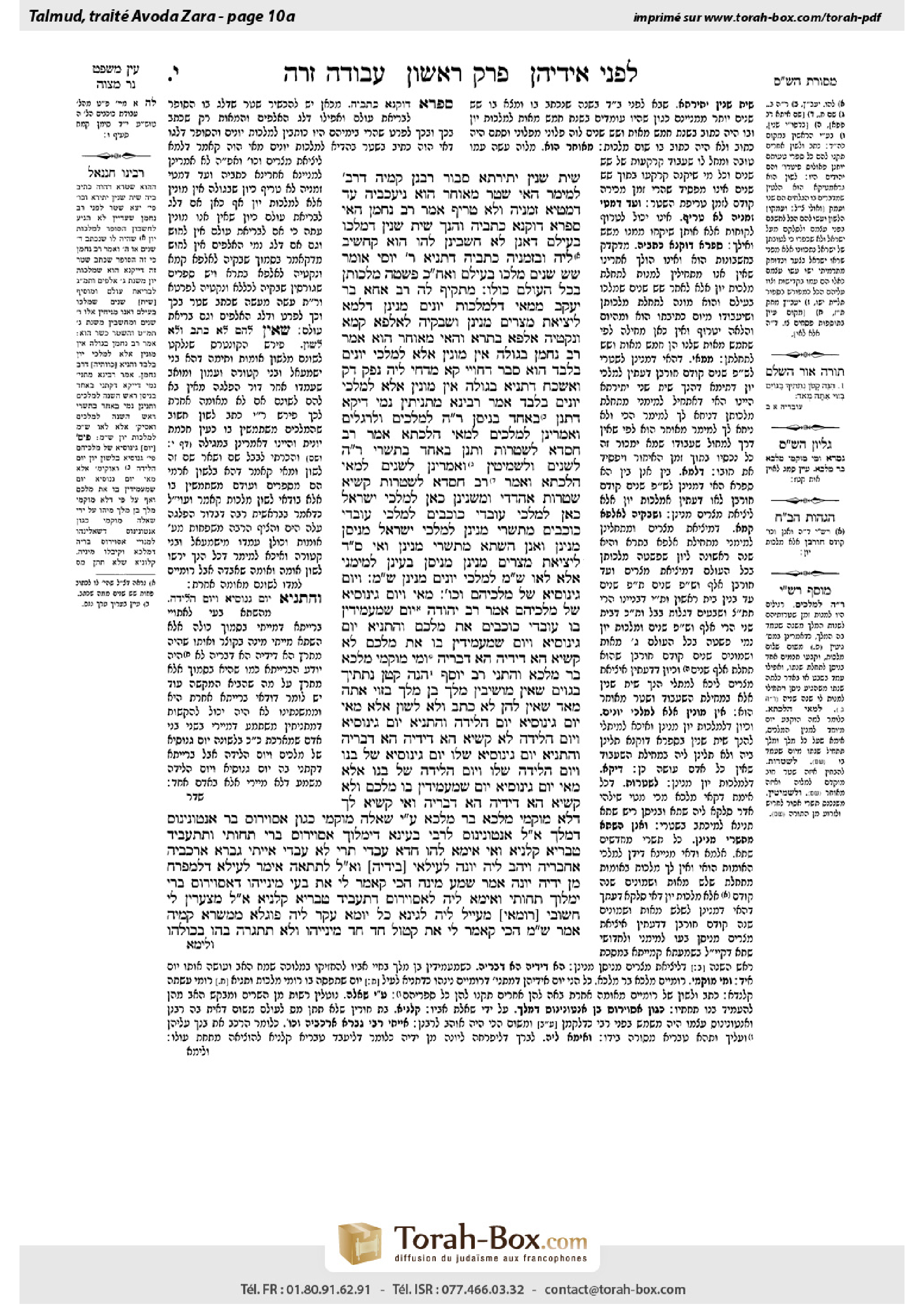
Avodah Zarah 10a: Talmud study for Daf Yomi
Study the Talmud for Daf Yomi with scanned pages, Hebrew text, English translations from Sefaria and AI-generated French translations.
Passage selection and English or AI-generated French translation are available where the scan has annotations. Daf Study is independent of Torah-Box and Sefaria.
Browse Avodah Zarah · עבודה זרה · All tractatesAvodah Zarah 10a text and translations
This page of Avodah Zarah includes the Aramaic text, an English translation and an AI-generated French translation, alongside the scan above.
עבודה זרה י׳ א · Aramaic and Hebrew text
״שֵׁית שְׁנִין יַתִּירָתָא״, סְבוּר רַבָּנַן קַמֵּיהּ דְּרַבָּה לְמֵימַר: הַאי שְׁטָר מְאוּחָר הוּא, נִיעַכְּבֵיהּ עַד דְּמָטֵיא זִמְנֵיהּ וְלָא טָרֵיף. אָמַר רַב נַחְמָן: הַאי סָפְרָא דַּוְקָנָא כַּתְבֵיהּ, וְהָנָךְ שֵׁית שְׁנִין דִּמְלַכוּ בְּעֵילָם, דַּאֲנַן לָא חָשְׁבִינַן לְהוּ, הוּא קָחָשֵׁיב (לֵיהּ) [לְהוּ], וּבְזִמְנֵיהּ כַּתְבֵיהּ.
דְּתַנְיָא, רַבִּי יוֹסֵי אוֹמֵר: שֵׁשׁ שָׁנִים מָלְכוּ בְּעֵילָם, וְאַחַר כָּךְ פָּשְׁטָה מַלְכוּתָן בְּכׇל הָעוֹלָם כּוּלּוֹ.
מַתְקֵיף לַהּ רַב אַחָא בַּר יַעֲקֹב: מִמַּאי דִּלְמַלְכוּת יְוָנִים מָנֵינַן? דִּלְמָא לִיצִיאַת מִצְרַיִם מָנֵינַן, וְשַׁבְקֵיהּ לְאַלְפָּא קַמָּא וְנַקְטֵיהּ אַלְפָּא בָּתְרָא, וְהַאי מְאוּחָר הוּא! אָמַר רַב נַחְמָן: בַּגּוֹלָה אֵין מוֹנִין אֶלָּא לְמַלְכֵי יְוָנִים בִּלְבַד.
הוּא סָבַר דַּחוֹיֵי קָא מְדַחֵי לֵיהּ, נְפַק דָּק וְאַשְׁכַּח, דְּתַנְיָא: בַּגּוֹלָה אֵין מוֹנִין אֶלָּא לְמַלְכֵי יְוָנִים בִּלְבָד.
אָמַר רָבִינָא: מַתְנִיתִין נָמֵי דַּיְקָא, דִּתְנַן: ״בְּאֶחָד בְּנִיסָן רֹאשׁ הַשָּׁנָה לַמְּלָכִים וְלָרְגָלִים״, וְאָמְרִינַן: לַמְּלָכִים — לְמַאי הִלְכְתָא? אָמַר רַב חִסְדָּא: לִשְׁטָרוֹת.
וּתְנַן: בְּאֶחָד בְּתִשְׁרִי רֹאשׁ הַשָּׁנָה לַשָּׁנִים וְלַשְּׁמִיטִּין, וְאָמְרִינַן: לַשָּׁנִים — לְמַאי הִלְכְתָא? וְאָמַר רַב חִסְדָּא: לִשְׁטָרוֹת. קַשְׁיָא שְׁטָרוֹת אַהֲדָדֵי!
וּמְשַׁנֵּינַן: כָּאן לְמַלְכֵי יִשְׂרָאֵל, כָּאן לְמַלְכֵי אוּמּוֹת הָעוֹלָם. לְמַלְכֵי אוּמּוֹת הָעוֹלָם מִתִּשְׁרִי מָנֵינַן, לְמַלְכֵי יִשְׂרָאֵל מִנִּיסָן מָנֵינַן.
וַאֲנַן הַשְׁתָּא מִתִּשְׁרִי מָנֵינַן, וְאִי סָלְקָא דַעְתָּךְ לִיצִיאַת מִצְרַיִם מָנֵינַן — מִנִּיסָן בָּעֵינַן לְמִימְנֵי! אֶלָּא לָאו שְׁמַע מִינַּהּ לְמַלְכֵי יְוָנִים מָנֵינַן? שְׁמַע מִינַּהּ.
וְיוֹם גִּינּוּסְיָא שֶׁל מַלְכֵיהֶם וְכוּ׳. מַאי ״וְיוֹם גִּינּוּסְיָא שֶׁל מַלְכֵיהֶם״? אָמַר רַב יְהוּדָה: יוֹם שֶׁמַּעֲמִידִין בּוֹ גּוֹיִם אֶת מַלְכָּם. וְהָתַנְיָא: יוֹם גִּינּוּסְיָא וְיוֹם שֶׁמַּעֲמִידִין בּוֹ אֶת מַלְכָּם! לָא קַשְׁיָא, הָא דִידֵיהּ, הָא דִּבְרֵיהּ.
וּמִי מוֹקְמִי מַלְכָּא בַּר מַלְכָּא? וְהָתָנֵי רַב יוֹסֵף: ״הִנֵּה קָטֹן נְתַתִּיךָ בַּגּוֹיִם״ — שֶׁאֵין מוֹשִׁיבִין מֶלֶךְ בֶּן מֶלֶךְ, ״בָּזוּי אַתָּה מְאֹד״ — שֶׁאֵין לָהֶן לֹא כְּתָב וְלֹא לָשׁוֹן. אֶלָּא מַאי יוֹם גִּינּוּסְיָא? יוֹם הַלֵּידָה.
וְהָתַנְיָא: יוֹם גִּינּוּסְיָא וְיוֹם הַלֵּידָה! לָא קַשְׁיָא: הָא דִידֵיהּ, הָא דִּבְרֵיהּ.
וְהָתַנְיָא: יוֹם גִּינּוּסְיָא שֶׁלּוֹ, יוֹם גִּינּוּסְיָא שֶׁל בְּנוֹ, וְיוֹם הַלֵּידָה שֶׁלּוֹ, וְיוֹם הַלֵּידָה שֶׁל בְּנוֹ! אֶלָּא מַאי ״יוֹם גִּינּוּסְיָא״? יוֹם שֶׁמַּעֲמִידִין בּוֹ מַלְכָּם, וְלָא קַשְׁיָא — הָא דִידֵיהּ, הָא דִּבְרֵיהּ.
וְאִי קַשְׁיָא לָךְ דְּלָא מוֹקְמִי מַלְכָּא בַּר מַלְכָּא, עַל יְדֵי שְׁאֵלָה מוֹקְמִי, כְּגוֹן אַסְוִירוּס בַּר אַנְטוֹנִינוּס דִּמְלַךְ.
אֲמַר לֵיהּ אַנְטוֹנִינוּס לְרַבִּי: בָּעֵינָא דְּיִמְלוֹךְ אַסְוִירוּס בְּרִי תְּחוֹתַי, וְתִתְעֲבֵיד טְבֶרְיָא קָלָנְיָא, וְאִי אֵימָא לְהוּ חֲדָא — עָבְדִי, תְּרֵי — לָא עָבְדִי. אַיְיתִי גַּבְרָא, אַרְכְּבֵיהּ אַחַבְרֵיהּ, וִיהַב לֵיהּ יוֹנָה לְעִילַּאי (בִּידֵיהּ), וַאֲמַר לֵיהּ לְתַתַּאי: אֵימַר (לעילא דלמפרח) [לְעִילַּאי דְּנַפְרַח] יוֹנָה מִן יְדֵיהּ. אֲמַר: שְׁמַע מִינַּהּ הָכִי קָאָמַר לִי: אַתְּ בְּעִי מִינַּיְיהוּ דְּ״אַסְוִירוּס בְּרִי יִמְלוֹךְ תְּחוֹתַי״, וְאֵימָא לֵיהּ לְאַסְוִירוּס דְּתִעֲבֵיד טְבֶרְיָא קָלָנְיָא.
אֲמַר לֵיהּ: מְצַעֲרִין לִי חֲשִׁיבִי רוֹמָאֵי. [הֲוָה] מְעַיֵּיל לֵיהּ (לגינא) [לְגִינְּתָא], כֹּל יוֹמָא עֲקַר לֵיהּ פּוּגְלָא מִמֵּשָׁרָא קַמֵּיהּ. אֲמַר: שְׁמַע מִינַּהּ הָכִי קָאָמַר לִי — אַתְּ קְטוֹל חַד חַד מִינַּיְיהוּ, וְלָא תִּתְגָּרֵה בְּהוּ בְּכוּלְּהוּ.
Avodah Zarah 10a · English translation
a date that had six additional years relative to the correct scribal date, which takes for its starting point the beginning of Greek rule. The Sages who studied before Rabba thought to say: This is a postdated promissory note, which can be used only from the date it specifies. Therefore, let us hold it until its time arrives so that the creditor will not repossess property that the debtor sold prior to the date that appears in the note. Rav Naḥman disagreed and said: This promissory note was written by an exacting scribe, and those six years are referring to the years when the Greeks ruled only in Elam. We do not count them, as Greek rule had not yet spread throughout the world, but he does count them. And therefore he wrote in the promissory note the correct time, as the date does in fact match the year in which the promissory note was written.
Rav Naḥman cites a proof for his resolution: As it is taught in a baraita that Rabbi Yosei says: The Greeks ruled for six years in Elam alone, and afterward their dominion spread throughout the entire world. It is the later event that serves as the basis for the dating system used by most scribes.
Rav Aḥa bar Ya’akov objects to Rav Naḥman’s answer: From where is it known that we count years according to the Greek rule, and that this promissory note was dated according to a system that uses the Greek rule as a starting point and was written by an exacting scribe? Perhaps we count the years using the exodus from Egypt as the starting point, which occurred one thousand years before the start of the Greek rule, and in this case the scribe left out the first thousand years from the time of the exodus and held on only to the last thousand years, omitting the thousands digit and writing merely the hundreds, tens, and single digits. And if so, this promissory note is postdated. Rav Naḥman said in response: The practice is that in the exile we count years only according to the Greek kings.
Upon hearing this reply, Rav Aḥa bar Ya’akov thought: Rav Naḥman is merely deflecting my legitimate questions with this answer. Afterward, he went out, examined the matter, and discovered that it was as Rav Naḥman said. As it is taught in a baraita: In the exile we count years only according to the Greek kings.
Ravina said: The mishna is also precisely formulated, as it teaches that we calculate years according to the Greek kings. As we learned in a mishna (Rosh HaShana 2a): On the first of Nisan is the New Year for kings and for the Festivals. And we say about this: With regard to what halakha is it stated that the first of Nisan is the New Year for kings? Rav Ḥisda said: It is said with regard to dating documents and determining their validity.
And we learned in the same mishna: On the first of Tishrei is the New Year for counting years and for calculating Sabbatical cycles. And we say: With regard to what halakha is it stated that the first of Tishrei is the New Year for counting years? And Rav Ḥisda said: It is said with regard to dating documents. These two statements with regard to the dating of documents are difficult in light of each other, as according to one statement the dating system is based on Nisan as the first month, whereas according to the other the year begins in Tishrei.
And we resolved the contradiction by explaining that here the dating is according to kings of Israel, and there the dating is according to the kings of the gentile nations of the world. That is, when we date years according to the kings of the nations of the world, we count from the month of Tishrei, whereas when we date years according to the kings of Israel, we count from the month of Nisan.
Ravina explains his proof: And now that we count from the month of Tishrei when dating documents, one can claim as follows: If it enters your mind that we count and date years using the exodus from Egypt as the starting point, while leaving off the first thousand years, then we should count from the month of Nisan, when the exodus occurred. Rather, isn’t it correct to conclude from the mishna that we count years according to the Greek kings? The Gemara affirms: Conclude from it that the scribal years are in fact calculated according to the Greek kings. Therefore, one should explain as did Rav Naḥman: A promissory note that appears to be postdated by six years may not actually be a postdated promissory note; rather, it is assumed to have been written by an exacting scribe.
§ One of the gentile festivals listed in the mishna is the day of the festival [geinuseya] of their kings. The Gemara asks: What is meant by: The day of geinuseya of their kings? Rav Yehuda says: This is referring to the day on which the gentiles appoint and crown their king. The Gemara asks: But isn’t it taught in a baraita: Two gentile festivals are the day of geinuseya and the day on which the gentiles appoint their king? This indicates that these are two separate occasions. The Gemara answers that it is not difficult: This, the day of geinuseya, is referring to the coronation of the king himself, whereas that, the day on which the gentiles appoint and crown their king, is referring to the coronation of his son, when a son is crowned during his father’s lifetime.
The Gemara asks: And do the Romans actually appoint as king the son of the king? But didn’t Rav Yosef teach: The verse relating a prophesy about Edom, associated with the Roman Empire: “Behold, I made you small among the nations” (Obadiah 1:2), is a reference to the fact that the Romans do not place on the throne as king the son of the king. The continuation of the verse: “You are greatly despised,” is a reference to the fact that the Romans have neither their own script nor their own language, but use those of other nations. The Gemara therefore rejects the explanation of the baraita that distinguishes between coronation of a king and coronation of the king’s son: Rather, what is the day of geinuseya? It is the king’s birthday.
The Gemara asks: But isn’t it taught in a baraita: Two gentile festivals are the day of geinuseya and the birthday. Once again, these two events cannot be the same. The Gemara answers: It is not difficult: This, the day of geinuseya, is referring to the birthday of the king himself, whereas that, the birthday mentioned in the baraita, is referring to the birthday of his son.
The Gemara further asks: But isn’t it taught in a baraita: The day of geinuseya of the king, the day of geinuseya of his son, and the king’s birthday and the birthday of his son? If so, the geinuseya cannot be either his or his son’s birthday. Rather, what is meant by the day of geinuseya? In fact it is referring to the day on which the gentiles appoint and crown their king. And the fact that a baraita mentions both the day of geinuseya and the day on which the gentiles appoint and crown their king is not difficult, as this, the day of geinuseya, is referring to his own coronation, whereas that, the day on which the gentiles appoint and crown their king, is referring to the coronation of his son.
And if it is difficult for you that which was stated earlier, that the Romans do not appoint as king the son of the king, in fact they do appoint a son of the king as king through the request of the king. For example, there was Asveirus, son of Antoninus, who ruled at the request of Antoninus.
The Gemara provides the background for this assertion. It is related that Antoninus said to Rabbi Yehuda HaNasi: I wish for Asveirus my son to rule instead of me, and that the city Tiberias be released [kelaneya] from paying taxes. And if I tell the Roman senate one of my wishes, they will do as I wish, but if I ask for two of them they will not do as I wish. Rabbi Yehuda HaNasi conveyed his answer in the following manner: He brought a man, placed him on the shoulders of another man, and put a dove in the hands of the one on top. And he said to the one on the bottom: Tell the one on top that he should cause the dove to fly from his hands. Antoninus said to himself: Learn from it that this is what Rabbi Yehuda HaNasi is saying to me: You should ask the Senate: Let Asveirus my son rule instead of me, and say to Asveirus that he should release Tiberias from paying taxes.
Antoninus also said to Rabbi Yehuda HaNasi: Important Romans are upsetting me; what can I do about them? Rabbi Yehuda HaNasi brought him to his garden, and every day he uprooted a radish from the garden bed before him. Antoninus said to himself: Learn from it that this is what Rabbi Yehuda HaNasi is saying to me: You should kill them one by one, and do not incite all of them at once.
Avodah Zarah 10a · Traduction française (IA)
une date qui comportait six années supplémentaires par rapport à la date correcte selon le scribe, qui prend comme point de départ le début de la domination grecque. Les Sages qui étudièrent avant Rabba pensaient dire : C'est une note de promesse postérieure, qui ne peut être utilisée qu'à la date indiquée. Ainsi, nous devons la conserver jusqu'à ce que cette date arrive, afin que le créancier ne puisse pas récupérer une propriété vendue par le débiteur avant la date inscrite sur la note. Rav Naḥman s'est opposé et a dit : Cette note de promesse a été écrite par un scribe précis, et ces six années font référence aux années où les Grecs régnaient uniquement en Elam. Nous ne les comptons pas, car la domination grecque n'avait pas encore pris tout le monde, mais il les compte. Et donc, il a inscrit dans la note de promesse la bonne date, car la date correspond effectivement à l'année où la note a été écrite.
Rav Naḥman cite une preuve pour sa résolution : Comme il est enseigné dans une baraïta que Rabbi Yosei dit : Les Grecs régnaient pendant six ans uniquement en Elam, et ensuite leur domination s'étendait à tout le monde. C'est cet événement ultérieur qui sert de base au système de datation utilisé par la plupart des scribes.
Rav Aḥa bar Ya’akov s'oppose à la réponse de Rav Naḥman : D'où sait-on que nous comptons les années selon la domination grecque, et que cette note de promesse a été datée selon un système qui utilise la domination grecque comme point de départ et a été écrite par un scribe précis ? Peut-être comptons-nous les années à partir de l'exode d'Égypte, qui s'est produit mille ans avant le début de la domination grecque, et dans ce cas, le scribe a omis les mille premières années de l'exode et ne retenu que les dernières mille années, en omettant le chiffre des milliers et en écrivant seulement les centaines, les dizaines et les unités. Et si c'est ainsi, cette note de promesse est postérieure. Rav Naḥman a répondu : La pratique est que pendant l'exil, nous comptons les années uniquement selon les rois grecs.
En entendant cette réponse, Rav Aḥa bar Ya’akov pensa : Rav Naḥman déflecte simplement mes questions légitimes avec cette réponse. Par la suite, il sortit, examina la question et découvrit que c'était comme Rav Naḥman l'avait dit. Comme il est enseigné dans une baraïta : Pendant l'exil, nous comptons les années uniquement selon les rois grecs.
Ravina dit : La mitsna est également parfaitement formulée, car elle enseigne que nous calculons les années selon les rois grecs. Comme nous avons appris dans une mitsna (Rosh HaShana 2a) : Le premier de Nisan est le Nouvel An pour les rois et pour les fêtes. Et nous disons à ce sujet : À propos de quelle halakha est-il dit que le premier de Nisan est le Nouvel An pour les rois ? Rav Ḥisda dit : C'est dit à propos de la datation des documents et de leur validité.
Et nous avons appris dans la même mitsna : Le premier de Tishrei est le Nouvel An pour le compte des années et pour le calcul des cycles sabbatiques. Et nous disons : À propos de quelle halakha est-il dit que le premier de Tishrei est le Nouvel An pour le compte des années ? Et Rav Ḥisda dit : C'est dit à propos de la datation des documents. Ces deux déclarations à propos de la datation des documents sont difficiles à concilier, car selon l'une, le système de datation est basé sur Nisan comme premier mois, tandis que selon l'autre, l'année commence en Tishrei.
Et nous avons résolu la contradiction en expliquant que ici la datation est selon les rois des nations païennes du monde, et là la datation est selon les rois d'Israël. C'est-à-dire, lorsque nous datons les années selon les rois des nations du monde, nous comptons à partir du mois de Tishrei, tandis que lorsque nous datons les années selon les rois d'Israël, nous comptons à partir du mois de Nisan.
Ravina explique sa preuve : Et maintenant que nous comptons à partir du mois de Tishrei pour la datation des documents, on peut affirmer comme suit : Si l'on pense que nous comptons et datons les années à partir de l'exode d'Égypte comme point de départ, tout en omettant les mille premières années, alors nous devrions compter à partir du mois de Nisan, lorsque l'exode s'est produit. Cependant, n'est-ce pas correct de conclure à partir de la mitsna que nous comptons les années selon les rois grecs ? La Guemara confirme : Concluez à partir de cela que les années des scribes sont effectivement calculées selon les rois grecs. Ainsi, on devrait expliquer comme l'a fait Rav Naḥman : Une note de promesse qui semble postérieure de six ans ne peut pas être réellement une note de promesse postérieure ; plutôt, elle est supposée avoir été écrite par un scribe précis.
§ L'une des fêtes païennes mentionnée dans la mitsna est le jour de la fête [geinuseya] de leurs rois. La Guemara pose la question : De quoi s'agit-il par : le jour de geinuseya de leurs rois ? Rav Yehuda dit : Cela fait référence au jour où les païens désignent et couronnent leur roi. La Guemara pose la question : Mais n'est-ce pas enseigné dans une baraïta : Deux fêtes païennes sont le jour de geinuseya et le jour où les païens désignent et couronnent leur roi ? Cela indique que ces sont deux occasions distinctes. La Guemara répond que ce n'est pas difficile : Cela, le jour de geinuseya, fait référence à la couronne du roi lui-même, tandis que cela, le jour où les païens désignent et couronnent leur roi, fait référence à la couronne de son fils, lorsque un fils est couronné pendant la vie de son père.
La Guemara pose la question : Et les Romains désignent-ils vraiment leur fils comme roi ? Mais n’a-t-il pas enseigné Rav Yosef : La prophétie concernant Edom, associée à l’Empire romain : « Regarde, je t’ai rendu petit parmi les nations » (Obadiah 1:2), fait référence au fait que les Romains ne mettent pas sur le trône comme roi le fils du roi. La continuation de la prophétie : « Tu es grandement méprisé », fait référence au fait que les Romains n’ont ni leur propre script ni leur propre langue, mais utilisent ceux des autres nations. La Guemara rejette donc l’explication de la baraïta qui distingue entre la couronne du roi et la couronne du fils du roi : Plutôt, que signifie le jour de geinuseya ? C’est l’anniversaire du roi.
La Guemara pose la question : Mais n’est-il pas enseigné dans une baraïta : Deux fêtes païennes sont le jour de geinuseya et le jour d’anniversaire. Une fois de plus, ces deux événements ne peuvent pas être les mêmes. La Guemara répond : Ce n’est pas difficile : ce jour de geinuseya, c’est le jour d’anniversaire du roi lui-même, tandis que celui mentionné dans la baraïta, c’est le jour d’anniversaire de son fils.
La Guemara pose encore la question : Mais n’est-il pas enseigné dans une baraïta : Le jour de geinuseya du roi, le jour de geinuseya de son fils, et le jour d’anniversaire du roi et le jour d’anniversaire de son fils ? Si c’est ainsi, le jour de geinuseya ne peut pas être celui du roi ou de son fils. Plutôt, ce que signifie le jour de geinuseya, c’est le jour où les païens désignent et couronnent leur roi. Et le fait que la baraïta mentionne à la fois le jour de geinuseya et le jour où les païens désignent et couronnent leur roi n’est pas difficile, car ce jour de geinuseya désigne sa propre couronnement, tandis que celui où les païens désignent et couronnent leur roi désigne la couronnement de son fils.
Et si cela vous semble difficile, ce qui a été dit plus tôt, que les Romains ne désignent pas comme roi le fils du roi, en réalité, ils désignent un fils du roi comme roi par la demande du roi. Par exemple, il y avait Asveirus, fils d’Antoninus, qui régnait sur demande d’Antoninus.
La Guemara fournit le contexte de cette affirmation. On raconte que Antoninus dit à Rabbi Yéhuda HaNasi : J’aimerais que mon fils Asveirus règne à ma place, et que la ville de Tibériade soit libérée [kelaneya] de payer des impôts. Et si je demande au sénat l’un de mes désirs, ils feront ce que je désire, mais si je demande deux de ces désirs, ils ne feront pas ce que je désire. Rabbi Yéhuda HaNasi a transmis sa réponse de la manière suivante : Il a amené un homme, l’a placé sur les épaules d’un autre homme, et a mis un pigeon entre les mains de celui qui était sur le haut. Et il a dit à celui qui était en bas : Dis à celui qui est en haut qu’il doit faire voler le pigeon de ses mains. Antoninus se disait : Apprends-en que c’est ce que Rabbi Yéhuda HaNasi me dit : Tu dois demander au Sénat : Que mon fils Asveirus règne à ma place, et dis à Asveirus qu’il doit libérer Tibériade de payer des impôts.
Antoninus a aussi dit à Rabbi Yéhuda HaNasi : Les Romains importants me dérangent ; que puis-je faire à leur sujet ? Rabbi Yéhuda HaNasi l’a conduit dans son jardin, et chaque jour il arrachait un radis du lit de jardin devant lui. Antoninus se disait : Apprends-en que c’est ce que Rabbi Yéhuda HaNasi me dit : Tu dois les tuer un par un, et ne pas exaspérer tous ensemble.
Traduction française générée par IA à partir de l’édition anglaise de Sefaria. Vérifie toujours un passage avec le texte source.
Text from Sefaria: William Davidson Edition - Vocalized Aramaic (CC BY NC); William Davidson Edition - English (CC BY NC).