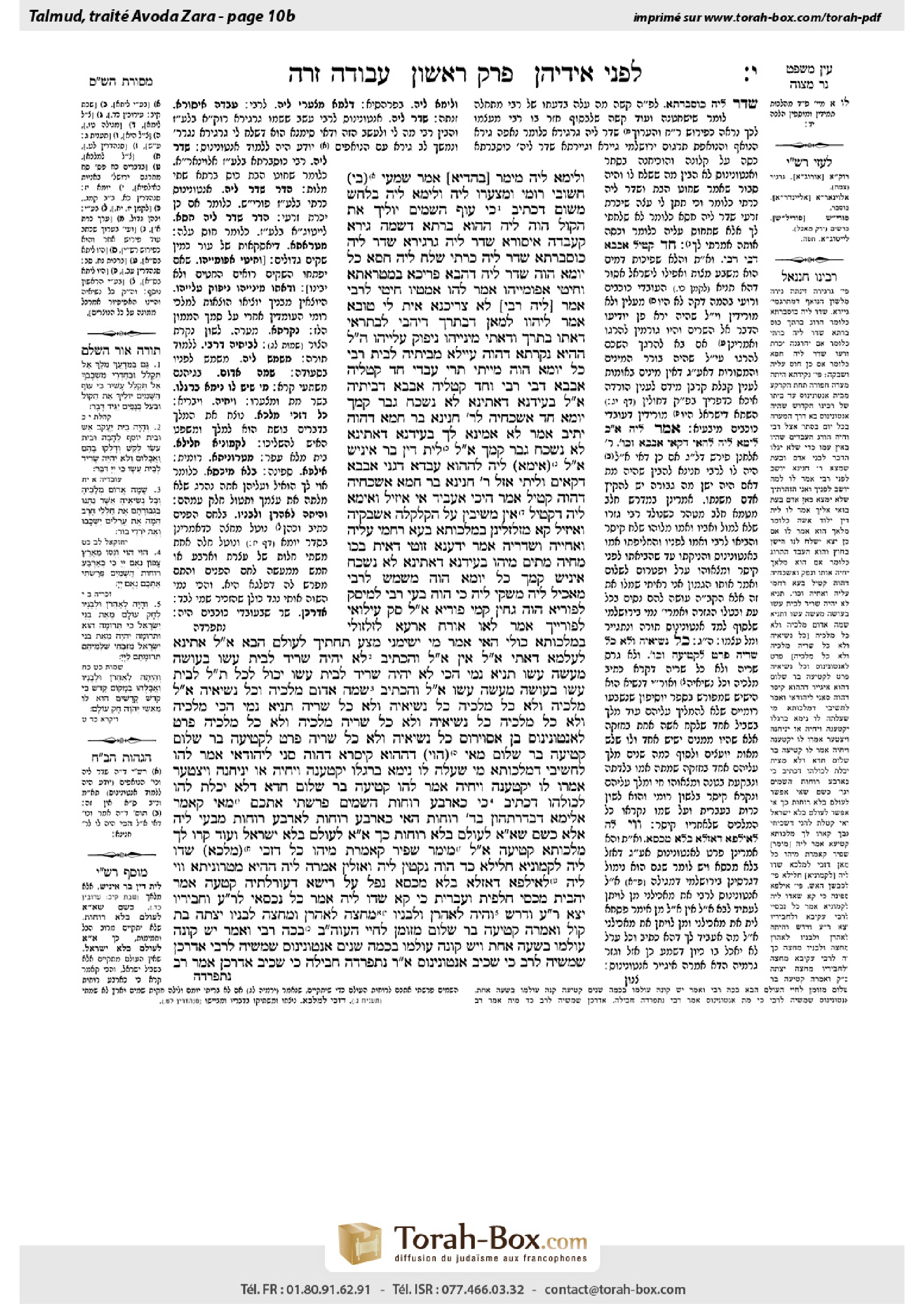
Avodah Zarah 10b: Talmud study for Daf Yomi
Study the Talmud for Daf Yomi with scanned pages, Hebrew text, English translations from Sefaria and AI-generated French translations.
Passage selection and English or AI-generated French translation are available where the scan has annotations. Daf Study is independent of Torah-Box and Sefaria.
Browse Avodah Zarah · עבודה זרה · All tractatesAvodah Zarah 10b text and translations
This page of Avodah Zarah includes the Aramaic text, an English translation and an AI-generated French translation, alongside the scan above.
עבודה זרה י׳ ב · Aramaic and Hebrew text
וְלֵימָא לֵיהּ מֵימָר [בְּהֶדְיָא]! אָמַר: שָׁמְעִי בִּי חֲשִׁיבִי דְּרוֹמָאֵי וּמְצַעֲרוּ לִי. וְלֵימָא לֵיהּ בְּלַחַשׁ! מִשּׁוּם דִּכְתִיב: ״כִּי עוֹף הַשָּׁמַיִם יוֹלִיךְ אֶת הַקּוֹל״.
הֲוָה לֵיהּ הָהוּא בְּרַתָּא דִּשְׁמַהּ ״גִּירָא״, קָעָבְדָה אִיסּוּרָא. שַׁדַּר לֵיהּ ״גַּרְגִּירָא״, שַׁדַּר לֵיהּ ״כּוּסְבַּרְתָּא״, שַׁדַּר לֵיהּ ״כַּרָּתֵי״, שְׁלַח לֵיהּ ״חַסָּא״.
כֹּל יוֹמָא הֲוָה (שדר) [מְשַׁדַּר] לֵיהּ דַּהֲבָא פְּרִיכָא בְּמַטְרָאתָא, וְחִיטֵּי אַפּוּמַּיְיהוּ. אֲמַר לְהוּ: אַמְטִיוּ חִיטֵּי לְרַבִּי. אֲמַר [לֵיהּ רַבִּי]: לָא צְרִיכְנָא, אִית לִי טוּבָא. אֲמַר: לִיהְווֹ לְמַאן דְּבָתְרָךְ, דְּיָהֲבִי לְבָתְרַאי דְּאָתוּ בָּתְרָךְ, וּדְאָתֵי מִינַּיְיהוּ נִיפּוֹק עֲלַיְיהוּ.
הֲוָה לֵיהּ הָהִיא נְקִרְתָּא דַּהֲוָה עָיְילָא מִבֵּיתֵיהּ לְבֵית רַבִּי, כֹּל יוֹמָא הֲוָה מַיְיתֵי תְּרֵי עַבְדֵי, חַד קַטְלֵיהּ אַבָּבָא דְּבֵי רַבִּי, וְחַד קַטְלֵיהּ אַבָּבָא דְּבֵיתֵיהּ. אֲמַר לֵיהּ: בְּעִידָּנָא דְּאָתֵינָא לָא נַשְׁכַּח גְּבַר קַמָּךְ.
יוֹמָא חַד אַשְׁכְּחֵיהּ לְרַבִּי חֲנִינָא בַּר חָמָא דַּהֲוָה יָתֵיב. אָמַר: לָא אָמֵינָא לָךְ בְּעִידָּנָא דְּאָתֵינָא לָא נַשְׁכַּח גְּבַר קַמָּךְ? אֲמַר לֵיהּ: לֵית דֵּין בַּר אִינִישׁ. אֲמַר לֵיהּ: אֵימָא לֵיהּ לְהָהוּא עַבְדָּא דְּגָנֵי אַבָּבָא דְּקָאֵים וְלֵיתֵי.
אֲזַל רַבִּי חֲנִינָא בַּר חָמָא, אַשְׁכְּחֵיהּ דַּהֲוָה קְטִיל, אֲמַר: הֵיכִי אַעֲבֵיד? אִי אֵיזִיל וְאֵימָא לֵיהּ דִּקְטִיל — אֵין מְשִׁיבִין עַל הַקַּלְקָלָה, אֶשְׁבְּקֵיהּ וְאֵיזִיל — קָא מְזַלְזֵילְנָא בְּמַלְכוּתָא. בְּעָא רַחֲמֵי עֲלֵיהּ וְאַחְיֵיהּ וְשַׁדְּרֵיהּ. אָמַר: יָדַעְנָא זוּטֵי דְּאִית בְּכוּ (מחייה) [מְחַיֵּי] מֵתִים, מִיהוּ בְּעִידָּנָא דְּאָתֵינָא לָא נַשְׁכַּח אִינִישׁ קַמָּךְ.
כֹּל יוֹמָא הֲוָה מְשַׁמֵּשׁ לְרַבִּי, מַאֲכֵיל לֵיהּ, מַשְׁקֵי לֵיהּ. כִּי הֲוָה בָּעֵי רַבִּי לְמִיסַּק לְפוּרְיָא, הֲוָה גָּחֵין קַמֵּי פּוּרְיָא, אֲמַר לֵיהּ: סַק עִילָּוַאי לְפוּרְיָיךְ. אֲמַר לֵיהּ: לָאו אוֹרַח אַרְעָא לְזַלְזוֹלֵי בְּמַלְכוּתָא כּוּלֵּי הַאי. אֲמַר לֵיהּ: מִי יְשִׂמֵנִי מַצָּע תַּחְתֶּיךָ לָעוֹלָם הַבָּא.
אֲמַר לֵיהּ: אָתֵינָא לְעָלְמָא דְּאָתֵי? אֲמַר לֵיהּ: אִין. אֲמַר לֵיהּ: וְהָכְתִיב ״לֹא יִהְיֶה שָׂרִיד לְבֵית עֵשָׂו״! בְּעוֹשֶׂה מַעֲשֵׂה עֵשָׂו.
תַּנְיָא נָמֵי הָכִי: ״לֹא יִהְיֶה שָׂרִיד לְבֵית עֵשָׂו״ — יָכוֹל לַכֹּל? תַּלְמוּד לוֹמַר: ״לְבֵית עֵשָׂו״, בְּעוֹשֶׂה מַעֲשֵׂה עֵשָׂו.
אֲמַר לֵיהּ: וְהָכְתִיב ״שָׁמָּה אֱדוֹם מְלָכֶיהָ וְכׇל נְשִׂיאֶיהָ״! אֲמַר לֵיהּ: ״מְלָכֶיהָ״ — וְלֹא כׇּל מְלָכֶיהָ, ״כָּל נְשִׂיאֶיהָ״ — וְלֹא כׇּל שָׂרֶיהָ.
תַּנְיָא נָמֵי הָכִי: ״מְלָכֶיהָ״ וְלֹא כׇּל מְלָכֶיהָ, ״כָּל נְשִׂיאֶיהָ״ וְלֹא כׇּל שָׂרֶיהָ. ״מְלָכֶיהָ״ וְלֹא כׇּל מְלָכֶיהָ — פְּרָט לְאַנְטוֹנִינוּס בֶּן אַסְוִירוּס, ״כָּל נְשִׂיאֶיהָ״ וְלֹא כׇּל שָׂרֶיהָ — פְּרָט לִקְטִיעָה בַּר שָׁלוֹם.
קְטִיעָה בַּר שָׁלוֹם מַאי הָוֵי? דְּהָהוּא קֵיסָרָא דַּהֲוָה סָנֵי לִיהוּדָאֵי, אֲמַר לְהוּ לַחֲשִׁיבֵי דְּמַלְכוּתָא: מִי שֶׁעָלָה לוֹ נִימָא בְּרַגְלוֹ, יִקְטָעֶנָּה וְיִחְיֶה אוֹ יַנִּיחֶנָּה וְיִצְטַעֵר? אָמְרוּ לוֹ: יִקְטָעֶנָּה וְיִחְיֶה.
אֲמַר לְהוּ קְטִיעָה בַּר שָׁלוֹם: חֲדָא, דְּלָא יָכְלַתְּ לְהוּ לְכוּלְּהוּ, דִּכְתִיב: ״כִּי כְּאַרְבַּע רוּחוֹת הַשָּׁמַיִם פֵּרַשְׂתִּי אֶתְכֶם״. מַאי קָאָמַר? אִלֵּימָא (דְּבַדַּרְתְּהוֹן) [דְּבַדַּרִית יָתְכוֹן] בְּאַרְבַּע רוּחוֹת, הַאי ״כְּאַרְבַּע רוּחוֹת״ — ״לְאַרְבַּע רוּחוֹת״ מִבְּעֵי לֵיהּ! אֶלָּא, כְּשֵׁם שֶׁאִי אֶפְשָׁר לָעוֹלָם בְּלֹא רוּחוֹת, כָּךְ אִי אֶפְשָׁר לָעוֹלָם בְּלֹא יִשְׂרָאֵל. וְעוֹד, קָרוּ לָךְ מַלְכוּתָא קְטִיעָה.
אֲמַר לֵיהּ: מֵימָר שַׁפִּיר קָאָמְרַתְּ, מִיהוּ כֹּל דְּזָכֵי מַלְכָּא שָׁדוּ לֵיהּ לְקָמוֹנְיָא חֲלִילָא. כַּד הֲוָה נָקְטִין לֵיהּ וְאָזְלִין, אֲמַרָה לֵיהּ הָהִיא מַטְרוֹנִיתָא: וַוי לֵיהּ לְאִילְפָא דְּאָזְלָא בְּלָא מִכְסָא. נְפַל עַל רֵישָׁא דְּעוּרְלְתֵיהּ קַטְּעַהּ, אֲמַר: יְהַבִית מִכְסַי חֲלֵפִית וַעֲבַרִית. כִּי קָא שָׁדוּ לֵיהּ, אֲמַר: כֹּל נִכְסַאי לְרַבִּי עֲקִיבָא וַחֲבֵירָיו. יָצָא רַבִּי עֲקִיבָא וְדָרַשׁ: ״וְהָיָה לְאַהֲרֹן וּלְבָנָיו״ — מֶחֱצָה לְאַהֲרֹן וּמֶחֱצָה לְבָנָיו.
יָצְתָה בַּת קוֹל וְאָמְרָה: קְטִיעָה בַּר שָׁלוֹם מְזֻומָּן לְחַיֵּי הָעוֹלָם הַבָּא. בָּכָה רַבִּי וְאָמַר: יֵשׁ קוֹנֶה עוֹלָמוֹ בְּשָׁעָה אַחַת, וְיֵשׁ קוֹנֶה עוֹלָמוֹ בְּכַמָּה שָׁנִים.
אַנְטוֹנִינוּס שַׁמְּשֵׁיהּ לְרַבִּי, אַדַּרְכָּן שַׁמְּשֵׁיהּ לְרַב. כִּי שְׁכֵיב אַנְטוֹנִינוּס, אָמַר רַבִּי: נִתְפָּרְדָה חֲבִילָה. כִּי שָׁכֵיב אַדַּרְכָּן, אָמַר רַב:
Avodah Zarah 10b · English translation
The Gemara asks: But why not let him say his advice explicitly? Why did Rabbi Yehuda HaNasi answer in such a circumspect way, which could have been interpreted incorrectly? The Gemara answers: Rabbi Yehuda HaNasi said to himself: If I answer openly, the important Romans might hear me and will cause me anguish. The Gemara asks: But why not let him say his advice quietly? The Gemara explains: Rabbi Yehuda HaNasi was still worried that they might hear what he had said, because it is written: “Curse not the king, no, not in your thought, and curse not the rich in your bedchamber, for a bird of the air shall carry the voice” (Ecclesiastes 10:20).
The Gemara relates: Antoninus had a certain daughter whose name was Gira, who performed a prohibited action, i.e., she engaged in promiscuous intercourse. Antoninus sent a rocket plant [gargira] to Rabbi Yehuda HaNasi, to allude to the fact that Gira had acted promiscuously [gar]. Rabbi Yehuda HaNasi sent him coriander [kusbarta], which Antoninus understood as a message to kill [kos] his daughter [barta], as she was liable to receive the death penalty for her actions. Antoninus sent him leeks [karti] to say: I will be cut off [karet] if I do so. Rabbi Yehuda HaNasi then sent him lettuce [ḥasa], i.e., Antoninus should have mercy [ḥas] on her.
The Gemara relates: Every day Antoninus would send to Rabbi Yehuda HaNasi crushed gold in large sacks, with wheat in the opening of the sacks. He would say to his servants: Bring this wheat to Rabbi Yehuda HaNasi, and they did not realize that the bags actually contained gold. Rabbi Yehuda HaNasi said to Antoninus: I do not need gold, as I have plenty. Antoninus said: The gold should be for those who will come after you, who will give it to the last ones who come after you. And those who descend from them will bring forth the gold that I now give you, and will be able to pay taxes to the Romans from this money.
The Gemara relates anther anecdote involving Antoninus. Antoninus had a certain underground cave from which there was a tunnel that went from his house to the house of Rabbi Yehuda HaNasi. Every day he would bring two servants to serve him. He would kill one at the entrance of the house of Rabbi Yehuda HaNasi, and would kill the other one at the entrance of his house, so that no living person would know that he had visited Rabbi Yehuda HaNasi. He said to Rabbi Yehuda HaNasi: When I come to visit, let no man be found before you.
One day, Antoninus found that Rabbi Ḥanina bar Ḥama was sitting there. He said: Did I not tell you that when I come to visit, let no man be found before you? Rabbi Yehuda HaNasi said to him: This is not a human being; he is like an angel, and you have nothing to fear from him. Antoninus said to Rabbi Ḥanina bar Ḥama: Tell that servant who is sleeping at the entrance that he should rise and come.
Rabbi Ḥanina bar Ḥama went and found that the servant Antoninus referred to had been killed. He said to himself: How shall I act? If I go and tell Antoninus that he was killed, this is problematic, as one should not report distressing news. If I leave him and go, then I would be treating the king with disrespect. He prayed for God to have mercy and revived the servant, and he sent him to Antoninus. Antoninus said: I know that even the least among you can revive the dead; but when I come to visit let no man be found before you, even one as great as Rabbi Ḥanina bar Ḥama.
The Gemara relates: Every day Antoninus would minister to Rabbi Yehuda HaNasi; he would feed him and give him to drink. When Rabbi Yehuda HaNasi wanted to ascend to his bed, Antoninus would bend down in front of the bed and say to him: Ascend upon me to your bed. Rabbi Yehuda HaNasi said in response: It is not proper conduct to treat the king with this much disrespect. Antoninus said: Oh, that I were set as a mattress under you in the World-to-Come!
On another occasion, Antoninus said to Rabbi Yehuda HaNasi: Will I enter the World-to-Come? Rabbi Yehuda HaNasi said to him: Yes. Antoninus said to him: But isn’t it written: “And there shall not be any remaining of the house of Esau” (Obadiah 1:18)? Rabbi Yehuda HaNasi answered: The verse is stated with regard to those who perform actions similar to those of the wicked Esau, not to people like you.
This is also taught in a baraita: From the verse: “And there shall not be any remaining of the house of Esau,” one might have thought that this applies to everyone descended from Esau, irrespective of an individual’s actions. Therefore, the verse states: “Of the house of Esau,” to indicate that the verse is stated only with regard to those who continue in the way of Esau, and perform actions similar to those of Esau.
Antoninus said to Rabbi Yehuda HaNasi: But isn’t it written in the description of the netherworld: “There is Edom, her kings and all her leaders” (Ezekiel 32:29)? Rabbi Yehuda HaNasi said to him: The verse states: “Her kings,” but not: All of her kings, and likewise it states: “All her leaders,” but not: All of her officers. Some of them will merit the World-to-Come.
This is also taught in a baraita: The verse states: “Her kings,” but not: All of her kings, and: “All her leaders,” but not: All of her officers. The inference learned from the wording of the verse: “Her kings,” but not: All of her kings, serves to exclude Antoninus the son of Asveirus; and the inference from the wording: “All her leaders,” but not: All of her officers, serves to exclude the Roman officer Ketia, son of Shalom.
The Gemara asks: What is it that occurred involving Ketia, son of Shalom? As there was a certain Roman emperor who hated the Jews. He said to the important members of the kingdom: If one had an ulcerous sore [nima] rise on his foot, should he cut it off and live, or leave it and suffer? They said to him: He should cut it off and live. The ulcerous sore was a metaphor for the Jewish people, whom the emperor sought to eliminate as the cause of harm for the Roman Empire.
Ketia, son of Shalom, said to them: It is unwise to do so, for two reasons. One is that you cannot destroy all of them, as it is written: “For I have spread you abroad as the four winds of the heaven, says the Lord” (Zechariah 2:10). He clarified: What is it saying? Shall we say that the verse means that God has scattered them to the four winds of the world? If so, this phrase: “As the four winds,” is inaccurate, since it should have said: To the four winds. Rather, this is what the verse is saying: Just as the world cannot exist without winds, so too, the world cannot exist without the Jewish people, and they will never be destroyed. And furthermore, if you attempt to carry out the destruction of the Jews, they will call you the severed kingdom, as the Roman Empire would be devoid of Jews, but Jews would exist in other locations.
The emperor said to Ketia: You have spoken well and your statement is correct; but they throw anyone who defeats the king in argument into a house full of ashes [lekamonya ḥalila], where he would die. When they were seizing Ketia and going to take him to his death, a certain matron [matronita] said to him: Woe to the ship that goes without paying the tax. Ketia bent down over his foreskin, severed it, and said: I gave my tax; I will pass and enter. When they threw him into the house of ashes, he said: All of my property is given to Rabbi Akiva and his colleagues. How was this inheritance to be divided? The Gemara relates: Rabbi Akiva went out and taught that the verse: “And it shall be for Aaron and his sons” (Exodus 29:28), means half to Aaron and half to his sons. Here too, as Rabbi Akiva is mentioned separately, he should receive half, while his colleagues receive the other half.
The Gemara returns to the story of Ketia. A Divine Voice emerged and said: Ketia, son of Shalom, is destined for life in the World-to-Come. When Rabbi Yehuda HaNasi heard this, he wept, saying: There is one who acquires his share in the World-to-Come in one moment, and there is one who acquires his share in the World-to-Come only after many years of toil.
The Gemara relates: Antoninus would attend to Rabbi Yehuda HaNasi, and similarly the Persian king Adrakan would attend to Rav. When Antoninus died, Rabbi Yehuda HaNasi said: The bundle is separated. When Adrakan died, Rav likewise said:
Avodah Zarah 10b · Traduction française (IA)
La Guemara pose la question : Mais pourquoi ne pas laisser qu'il exprime clairement son avis ? Pourquoi Rabbi Yehuda HaNasi a-t-il répondu de manière si circonspecte, ce qui pouvait être mal interprété ? La Guemara répond : Rabbi Yehuda HaNasi se disait à lui-même : Si je réponds ouvertement, les Romains importants pourraient m'entendre et m'occasionner de la souffrance. La Guemara pose la question : Mais pourquoi ne pas laisser qu'il dise son avis à voix basse ? La Guemara explique : Rabbi Yehuda HaNasi redoutait encore qu'ils puissent entendre ce qu'il avait dit, car il est écrit : « Ne maudis pas le roi, non, pas même en pensée, et ne maudis pas le riche dans ta chambre, car un oiseau du ciel portera la voix » (Ecclésiaste 10:20).
La Guemara rapporte : Antoninus avait une fille dont le nom était Gira, qui avait commis une action interdite, c'est-à-dire qu'elle avait eu des relations sexuelles promiscues. Antoninus envoya à Rabbi Yehuda HaNasi un plant de rocket [gargira], pour suggérer que Gira avait agi de manière promiscue [gar]. Rabbi Yehuda HaNasi envoya à Antoninus de la coriandre [kusbarta], que Antoninus comprit comme un message pour tuer [kos] sa fille [barta], car elle était punissable de la mort pour ses actions. Antoninus envoya à Rabbi Yehuda HaNasi des oignons [karti] pour dire : Je serai coupé [karet] si je le fais. Rabbi Yehuda HaNasi envoya alors à Antoninus de la laitue [ḥasa], c'est-à-dire qu'Antoninus devait avoir pitié [ḥas] d'elle.
La Guemara rapporte : Chaque jour, Antoninus envoyait à Rabbi Yehuda HaNasi de l'or en poudre dans de grands sacs, avec du blé dans l'ouverture des sacs. Il disait à ses serviteurs : Apportez ce blé à Rabbi Yehuda HaNasi, et ils ne savaient pas que les sacs contenaient en réalité de l'or. Rabbi Yehuda HaNasi dit à Antoninus : Je n'ai pas besoin d'or, car j'en ai beaucoup. Antoninus dit : L'or doit être pour ceux qui viendront après vous, qui le donneront aux derniers qui viendront après vous. Et ceux qui descendront d'eux apporteront l'or que je vous donne maintenant, et pourront payer des impôts aux Romains avec cet argent.
La Guemara rapporte un autre récit concernant Antoninus. Antoninus avait une grotte souterraine d'où partait un tunnel qui allait de sa maison à celle de Rabbi Yehuda HaNasi. Chaque jour, il amenait deux serviteurs pour le servir. Il tuait l'un à l'entrée de la maison de Rabbi Yehuda HaNasi, et tuait l'autre à l'entrée de sa propre maison, afin que personne ne sache qu'il avait visité Rabbi Yehuda HaNasi. Il dit à Rabbi Yehuda HaNasi : Quand je viens te voir, ne laissez personne être trouvé avant vous.
Un jour, Antoninus trouva que Rabbi Ḥanina bar Ḥama était assis là. Il dit : N'ai-je pas dit que quand je viens te voir, ne laissez personne être trouvé avant vous ? Rabbi Yehuda HaNasi dit à lui : Ce n'est pas un être humain ; il est comme un ange, et vous n'avez rien à craindre de lui. Antoninus dit à Rabbi Ḥanina bar Ḥama : Dis à ce serviteur qui dort à l'entrée qu'il doive se lever et venir.
Rabbi Ḥanina bar Ḥama alla trouver que le serviteur auquel Antoninus faisait référence avait été tué. Il se dit : Comment dois-je agir ? Si je vais et dis à Antoninus qu'il a été tué, c'est problématique, car on ne doit pas rapporter de nouvelles déplorables. Si je le laisse et vais, je traiterais le roi avec mépris. Il pria Dieu pour avoir pitié et ressuscita le serviteur, et il l'envoya à Antoninus. Antoninus dit : Je sais que même le moins important parmi vous peut ressusciter les morts ; mais quand je viens te voir, ne laissez personne être trouvé avant vous, même un homme aussi grand que Rabbi Ḥanina bar Ḥama.
La Guemara rapporte : Chaque jour, Antoninus prenait soin de Rabbi Yehuda HaNasi ; il le nourrissait et lui donnait à boire. Quand Rabbi Yehuda HaNasi voulait monter sur son lit, Antoninus se prosternait devant le lit et disait à lui : Monte sur moi vers ton lit. Rabbi Yehuda HaNasi répondit : Il n'est pas convenable de traiter le roi avec un tel mépris. Antoninus dit : Oh, que je fusse mis comme un matelas sous toi dans le Monde à Venir !
Un autre jour, Antoninus dit à Rabbi Yehuda HaNasi : Entrerai-je dans le Monde à Venir ? Rabbi Yehuda HaNasi dit à lui : Oui. Antoninus dit à lui : Mais n'est-il pas écrit : « Et il ne restera aucun membre de la maison d'Ésaü » (Obadie 1:18) ? Rabbi Yehuda HaNasi répondit : La verset est dit en référence à ceux qui font des actions semblables à celles du méchant Ésaü, pas aux gens comme vous.
Cela est également enseigné dans une baraïta : À partir du verset : « Et il ne restera aucun membre de la maison d'Ésaü », on pourrait penser que cela s'applique à tous les descendants d'Ésaü, indépendamment des actions de l'individu. Par conséquent, le verset dit : « De la maison d'Ésaü », pour indiquer que le verset est dit uniquement en référence à ceux qui continuent dans la voie d'Ésaü et font des actions semblables à celles d'Ésaü.
Antoninus dit à Rabbi Yehuda HaNasi : Mais n'est-il pas écrit dans la description de l'au-delà : « Il y a Edom, ses rois et tous ses chefs » (Ézéchiel 32:29) ? Rabbi Yehuda HaNasi dit à lui : Le verset dit : « Ses rois », mais pas : Tous ses rois, et de même il dit : « Tous ses chefs », mais pas : Tous ses officiers. Certains d'entre eux mériteront le Monde à Venir.
Cela est également enseigné dans une baraïta : Le verset dit : « Ses rois », mais pas : Tous ses rois, et : « Tous ses chefs », mais pas : Tous ses officiers. L'inférence tirée du texte du verset : « Ses rois », mais pas : Tous ses rois, sert à exclure Antoninus fils d'Asveirus ; et l'inférence tirée du texte : « Tous ses chefs », mais pas : Tous ses officiers, sert à exclure l'officier romain Ketia fils de Shalom.
La Guemara pose la question : Qu'est-ce qui s'est produit concernant Ketia, fils de Shalom ? Comme il y avait un certain empereur romain qui haïssait les Juifs. Il dit aux membres importants du royaume : Si l'on avait une plaie ulcérée [nima] sur le pied, devrait-on la couper et vivre, ou la laisser et souffrir ? Ils dirent à lui : Il devrait la couper et vivre. La plaie ulcérée était une métaphore pour le peuple juif, que l'empereur voulait éliminer comme cause de préjudice pour l'Empire romain.
Ketia, fils de Shalom, leur dit : C'est inutile de le faire, pour deux raisons. La première est que vous ne pouvez pas détruire tous les Juifs, car il est écrit : « Car je vous ai dispersés comme les quatre vents du ciel, dit l'Éternel » (Zacharie 2:10). Il explique : De quoi parle-t-on ? Devons-nous dire que la Sainte Écriture signifie que Dieu a dispersé les Juifs dans les quatre vents du monde ? Si c'est ainsi, cette expression : « comme les quatre vents », est inexacte, car elle aurait dû dire : « vers les quatre vents ». En réalité, ce que la Sainte Écriture dit est : Tout comme le monde ne peut pas exister sans vents, de même le monde ne peut pas exister sans le peuple juif, et ils ne seront jamais détruits. Et de plus, si vous tentez de mettre en œuvre la destruction des Juifs, ils vous appelleront le royaume coupé, car l'Empire romain serait privé de Juifs, mais les Juifs existeraient ailleurs.
L'empereur dit à Ketia : Tu as parlé avec raison, et ton discours est juste ; mais ceux qui défient le roi dans un débat sont jetés dans une maison pleine de cendres [lekamonya ḥalila], où ils meurent. Lorsqu'ils arrêtaient Ketia et le conduisaient à sa mort, une certaine matrone [matronita] lui dit : Malheur à la nef qui ne paie pas l'impôt. Ketia se pencha sur son prépuce, le coupa et dit : J'ai payé mon impôt ; je vais passer et entrer. Lorsqu'ils le jetèrent dans la maison des cendres, il dit : Tout mon bien est donné à Rabbi Akiva et à ses collègues. Comment cette héritage devait-il être divisé ? La Guemara rapporte : Rabbi Akiva sortit et enseigna que la Sainte Écriture : « Et cela sera pour Aaron et ses fils » (Exode 29:28), signifie la moitié pour Aaron et la moitié pour ses fils. Ici aussi, comme Rabbi Akiva est mentionné séparément, il devrait recevoir la moitié, tandis que ses collègues recevront l'autre moitié.
La Guemara reprend l'histoire de Ketia. Une Voix Divine s'éleva et dit : Ketia, fils de Shalom, est destiné à la vie dans le Monde à Venir. Lorsque Rabbi Yehuda HaNasi entendit cela, il pleura, disant : Il y a celui qui acquiert sa part dans le Monde à Venir en un seul moment, et celui qui acquiert sa part dans le Monde à Venir seulement après de nombreuses années de travail.
La Guemara rapporte : Antoninus assistait Rabbi Yehuda HaNasi, et de même le roi perse Adrakan assistait Rav. Lorsque Antoninus mourut, Rabbi Yehuda HaNasi dit : Le faisceau est séparé. Lorsque Adrakan mourut, Rav dit également :
Traduction française générée par IA à partir de l’édition anglaise de Sefaria. Vérifie toujours un passage avec le texte source.
Text from Sefaria: William Davidson Edition - Vocalized Aramaic (CC BY NC); William Davidson Edition - English (CC BY NC).