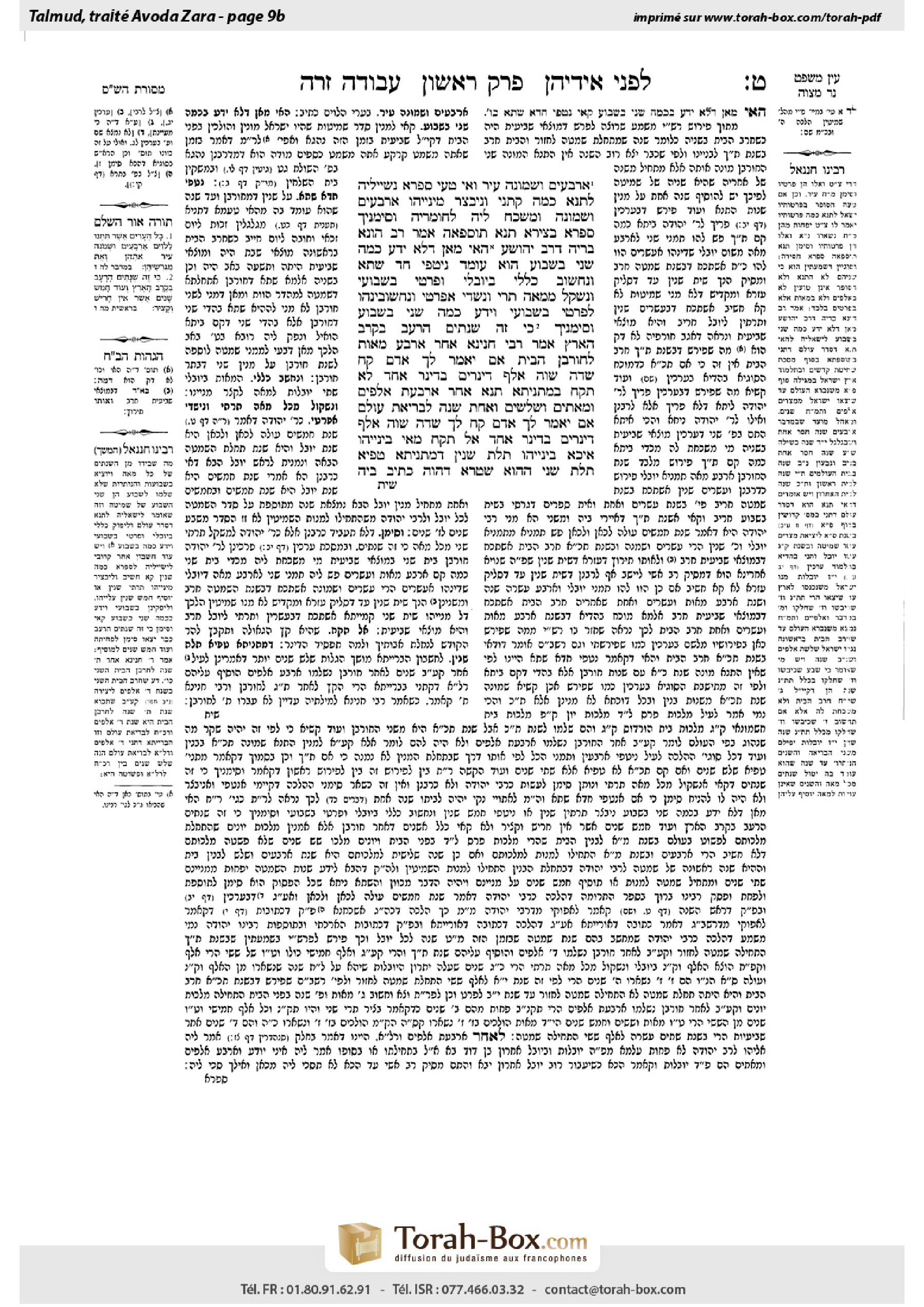
Avodah Zarah 9b: Talmud study for Daf Yomi
Study the Talmud for Daf Yomi with scanned pages, Hebrew text, English translations from Sefaria and AI-generated French translations.
Passage selection and English or AI-generated French translation are available where the scan has annotations. Daf Study is independent of Torah-Box and Sefaria.
Browse Avodah Zarah · עבודה זרה · All tractatesAvodah Zarah 9b text and translations
This page of Avodah Zarah includes the Aramaic text, an English translation and an AI-generated French translation, alongside the scan above.
עבודה זרה ט׳ ב · Aramaic and Hebrew text
״אַרְבָּעִים וּשְׁמֹנֶה עִיר״. וְאִי טָעֵי סָפְרָא — נְשַׁיְּילֵיהּ לְתַנָּא כַּמָּה קָתָנֵי, וְנִיבַצַּר מִינַּיְיהוּ אַרְבָּעִים וּשְׁמוֹנֶה, וּמַשְׁכַּח לֵיהּ לְחוּמְרֵיהּ, וְסִימָנָיךְ: סָפְרָא בְּצִירָא, תַּנָּא תּוֹסְפָאָה.
אָמַר רַב הוּנָא בְּרֵיהּ דְּרַב יְהוֹשֻׁעַ: הַאי מַאן דְּלָא יָדַע כַּמָּה שְׁנֵי בְּשָׁבוּעַ הוּא עוֹמֵד — נִיטַּפֵּי חַד שַׁתָּא, וְנִחְשׁוֹב כְּלָלֵי בְּיוֹבְלֵי, וּפְרָטֵי בְּשָׁבוּעֵי.
וְנִשְׁקֹל מִמֵּאָה תְּרֵי, וְנִשְׁדֵּי אַפְּרָטֵי, וְנַחְשׁוֹבִינְהוּ לִפְרָטֵי בְּשָׁבוּעֵי, וְיִדַּע כַּמָּה שְׁנֵי בְּשָׁבוּעַ, וְסִימָנָיךְ: ״כִּי זֶה שְׁנָתַיִם הָרָעָב בְּקֶרֶב הָאָרֶץ״.
אָמַר רַבִּי חֲנִינָא: אַחַר אַרְבַּע מֵאוֹת לְחוּרְבַּן הַבַּיִת, אִם יֹאמַר לְךָ אָדָם: קַח שָׂדֶה שָׁוֶה אֶלֶף דִּינָרִים בְּדִינָר אֶחָד — לֹא תִּקַּח. בְּמַתְנִיתָא תָּנָא: אַחַר אַרְבַּעַת אֲלָפִים וּמָאתַיִם וּשְׁלֹשִׁים וְאַחַת שָׁנָה לִבְרִיאַת עוֹלָם, אִם יֹאמַר לְךָ אָדָם: קַח לָךְ שָׂדֶה שָׁוֶה אֶלֶף דִּינָרִים בְּדִינָר אֶחָד — אַל תִּקַּח. מַאי בֵּינַיְיהוּ? אִיכָּא בֵּינַיְיהוּ תְּלָת שְׁנִין, דְּמַתְנִיתָא טָפְיָא תְּלָת שְׁנֵי.
הָהוּא שְׁטָרָא דַּהֲוָה כְּתִיב בֵּיהּ
Avodah Zarah 9b · English translation
“Forty-eight cities” (Numbers 35:7). Similarly, if a scribe forgot the exact year, let him ask the tanna how many years does he teach have already been lost from the two thousand years that are designated for the days of the Messiah. And he should deduct forty-eight years from the number, correcting for the century, and in this manner he will find his number. And your mnemonic to remember that the tanna must add to the date of the scribe, while the scribe must deduct from the number of the tanna, is again: A scribe deducts, while a tanna adds on [tosfa’a].
§ Rav Huna, son of Rav Yehoshua, says: In the case of one who does not know which year of the seven-year Sabbatical cycle he stands in, he should add one year to the years that have passed since the destruction of the Temple in order to begin at the start of a Sabbatical cycle. And he should calculate the general years, i.e., the centuries, as Jubilee cycles, as every Jubilee concludes seven completed Sabbatical cycles of forty-nine years, and the details as Sabbatical cycles, i.e., he should divide the remaining years into seven-year Sabbatical cycles.
But as the Jubilee Year itself is counted as one year of a Sabbatical cycle, he should take, from every hundred years that passed, two years, and add it to the details, i.e., the remaining decades and single years. And then he should calculate with the details by dividing them into Sabbatical cycles. And from the remainder he will know how many years in the current Sabbatical cycle have passed. And your mnemonic that two years must be deducted from every century is the following verse: “For these two years the famine has been in the land” (Genesis 45:6).
Rabbi Ḥanina says: After the year 400 from the destruction of the Temple, if a person says to you: Purchase a field that is worth one thousand dinars for one dinar, do not purchase it. It is not a worthwhile investment, as the redemption will soon come and all fields will revert to their original owners. It was taught in a baraita: After the year 4,231 from the creation of the world, if a person says to you: Purchase a field that is worth one thousand dinars for one dinar, do not purchase it. The Gemara asks: What is the difference between these two dates? The Gemara answers: There is a difference between them of three years, as the baraita adds three years. The year 400 from the destruction of the Temple corresponds to the year 4,228 from the creation of the world.
§ The Gemara relates: There was a certain promissory note in which was written
Avodah Zarah 9b · Traduction française (IA)
« Quarante-huit villes » (Nombres 35,7). De même, si un scribe a oublié l'année exacte, qu'il demande au tanna combien d'années ont déjà été perdues depuis les deux mille ans désignés pour les jours du Messie. Et qu'il retranche quarante-huit ans du nombre, en tenant compte du siècle, et ainsi il trouvera son nombre. Et votre mnémonique pour se souvenir que le tanna doit ajouter à la date du scribe, tandis que le scribe doit retrancher du nombre du tanna, est à nouveau : le scribe retranche, tandis que le tanna ajoute [tosfa’a].
§ Rav Huna, fils de Rav Yéhoshua, dit : Dans le cas d'une personne qui ne sait pas en quel année du cycle des sept ans de sabbat il se trouve, il doit ajouter une année aux années écoulées depuis la destruction du Temple afin de commencer au début d'un cycle de sabbat. Et il doit calculer les années générales, c'est-à-dire les siècles, comme des cycles de jubilé, car chaque jubilé marque sept cycles de sabbat complets de quarante-neuf ans, et les détails comme des cycles de sabbat, c'est-à-dire qu'il doit diviser les années restantes en cycles de sabbat de sept ans.
Mais comme l'année de jubilé elle-même est comptée comme une année d'un cycle de sabbat, il doit prendre, de chaque siècle passé, deux ans, et les ajouter aux détails, c'est-à-dire aux décennies et années restantes. Et ensuite il doit calculer avec les détails en les divisant en cycles de sabbat. Et à partir du reste, il saura combien d'années dans le cycle de sabbat actuel ont déjà passé. Et votre mnémonique que deux ans doivent être retranchés de chaque siècle est le suivant : « Pour ces deux ans la famine a été dans la terre » (Genèse 45,6).
Rabbi Ḥanina dit : Après l'année 400 depuis la destruction du Temple, si une personne te dit : Achète un champ valant mille dinars pour un dinar, ne l'achète pas. C'est une mauvaise investissement, car la rédemption viendra bientôt et tous les champs reverront leurs propriétaires originels. Il a été enseigné dans une baraïta : Après l'année 4 231 depuis la création du monde, si une personne te dit : Achète un champ valant mille dinars pour un dinar, ne l'achète pas. La Guemara demande : Quelle est la différence entre ces deux dates ? La Guemara répond : Il y a une différence de trois ans entre eux, car la baraïta ajoute trois ans. L'année 400 depuis la destruction du Temple correspond à l'année 4 228 depuis la création du monde.
§ La Guemara rapporte : Il y avait un certain titre de créance dans lequel était écrit
Traduction française générée par IA à partir de l’édition anglaise de Sefaria. Vérifie toujours un passage avec le texte source.
Text from Sefaria: William Davidson Edition - Vocalized Aramaic (CC BY NC); William Davidson Edition - English (CC BY NC).