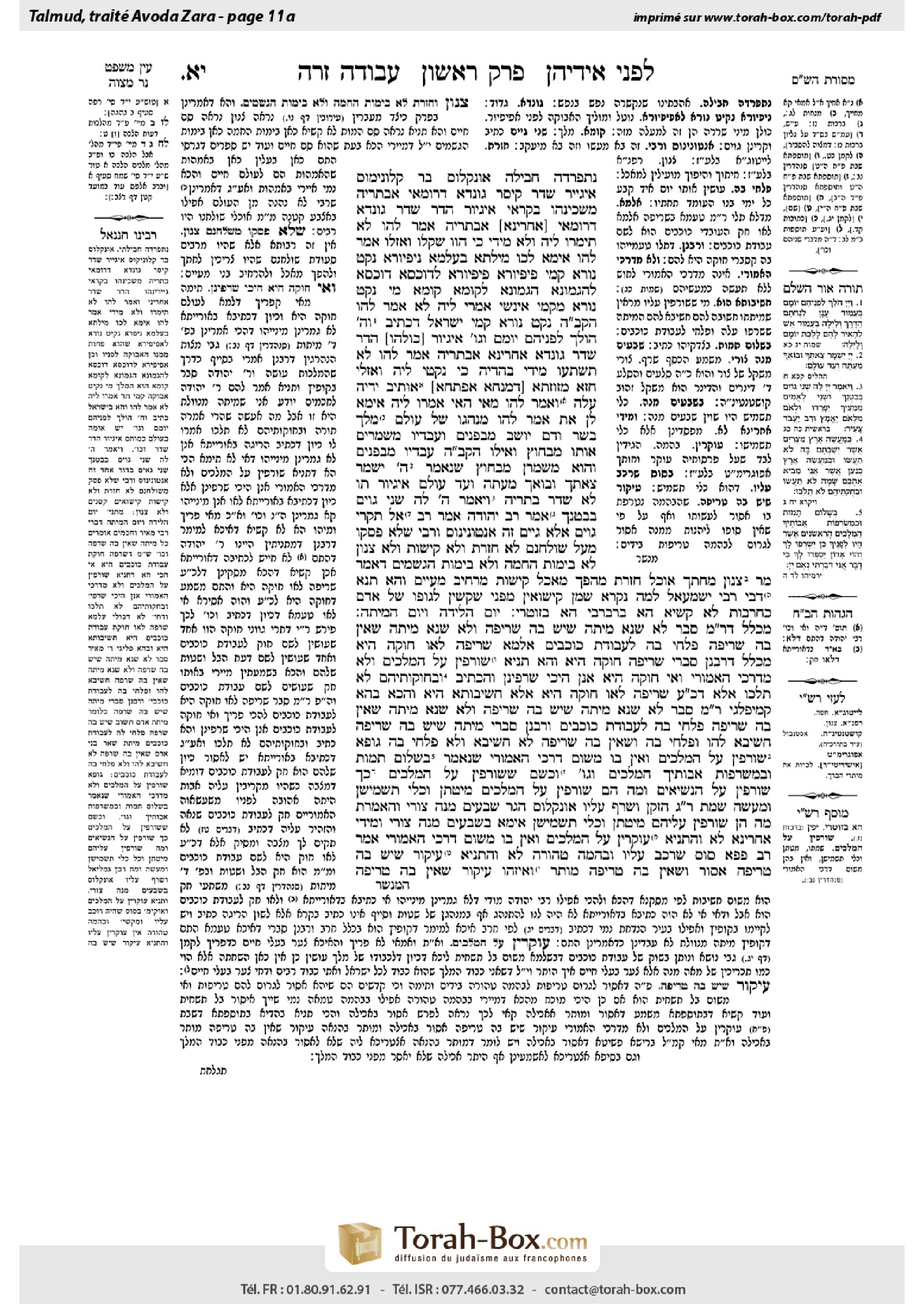
Avodah Zarah 11a: Talmud study for Daf Yomi
Study the Talmud for Daf Yomi with scanned pages, Hebrew text, English translations from Sefaria and AI-generated French translations.
Passage selection and English or AI-generated French translation are available where the scan has annotations. Daf Study is independent of Torah-Box and Sefaria.
Browse Avodah Zarah · עבודה זרה · All tractatesAvodah Zarah 11a text and translations
This page of Avodah Zarah includes the Aramaic text, an English translation and an AI-generated French translation, alongside the scan above.
עבודה זרה י״א א · Aramaic and Hebrew text
נִתְפָּרְדָה חֲבִילָה.
אוּנְקְלוֹס בַּר קְלוֹנִימוּס אִיגַּיַּיר, שַׁדַּר קֵיסָר גּוּנְדָּא דְּרוֹמָאֵי אַבָּתְרֵיהּ, מַשְׁכִינְהוּ בִּקְרָאֵי, אִיגַּיּוּר. הֲדַר שַׁדַּר גּוּנְדָּא דְּרוֹמָאֵי [אַחֲרִינָא] אַבָּתְרֵיהּ, אֲמַר לְהוּ: לָא תֵּימְרוּ לֵיהּ וְלָא מִידֵּי.
כִּי הֲווֹ שָׁקְלִי וְאָזְלִי, אֲמַר לְהוּ אֵימָא לְכוּ מִילְּתָא בְּעָלְמָא: נִיפְיוֹרָא נָקֵט נוּרָא קַמֵּי אַפִּיפְיוֹרָא, אַפִּיפְיוֹרָא לְדוּכָּסָא, דּוּכָּסָא לְהֶגְמוֹנָא, הַגְמוֹנָא לְקוֹמָא, קוֹמָא מִי נָקֵט נוּרָא מִקַּמֵּי אִינָשֵׁי? אָמְרִי לֵיהּ: לָא. אֲמַר לְהוּ: הַקָּדוֹשׁ בָּרוּךְ הוּא נְקַט נוּרָא קַמֵּי יִשְׂרָאֵל, דִּכְתִיב: ״וַה׳ הֹלֵךְ לִפְנֵיהֶם יוֹמָם וְגוֹ׳״. אִיגַּיּוּר כּוּלְּהוּ.
הֲדַר שַׁדַּר גּוּנְדָּא אַחֲרִינָא אַבָּתְרֵיהּ, אֲמַר לְהוּ: לָא תִּשְׁתַּעוּ מִידֵּי בַּהֲדֵיהּ. כִּי נָקְטִי לֵיהּ וְאָזְלִי, חֲזָא מְזוּזְתָּא דְּמַנְּחָא אַפִּתְחָא, אוֹתֵיב יְדֵיהּ עֲלַהּ, וַאֲמַר לְהוּ: מַאי הַאי? אֲמַרוּ לֵיהּ: אֵימָא לַן אַתְּ.
אֲמַר לְהוּ: מִנְהָגוֹ שֶׁל עוֹלָם, מֶלֶךְ בָּשָׂר וָדָם יוֹשֵׁב מִבִּפְנִים, וַעֲבָדָיו מְשַׁמְּרִים אוֹתוֹ מִבַּחוּץ, וְאִילּוּ הַקָּדוֹשׁ בָּרוּךְ הוּא, עֲבָדָיו מִבִּפְנִים וְהוּא מְשַׁמְּרָן מִבַּחוּץ, שֶׁנֶּאֱמַר: ״ה׳ יִשְׁמׇר צֵאתְךָ וּבוֹאֶךָ מֵעַתָּה וְעַד עוֹלָם״. אִיגַּיּוּר תּוּ לָא שַׁדַּר בָּתְרֵיהּ.
״וַיֹּאמֶר ה׳ לָהּ, שְׁנֵי גוֹיִם בְּבִטְנֵךְ״. אָמַר רַב יְהוּדָה אָמַר רַב: אַל תִּקְרֵי ״גּוֹיִם״ אֶלָּא ״גֵּיִים״, זֶה אַנְטוֹנִינוּס וְרַבִּי, שֶׁלֹּא פָּסְקוּ מֵעַל שׁוּלְחָנָם לֹא חֲזֶרֶת וְלֹא קִישּׁוּת וְלֹא צְנוֹן, לֹא בִּימוֹת הַחַמָּה וְלֹא בִּימוֹת הַגְּשָׁמִים, דְּאָמַר מָר: צְנוֹן מְחַתֵּךְ אוֹכֶל, חֲזֶרֶת מְהַפֵּךְ מַאֲכָל, קִישּׁוּת מַרְחִיב מֵעַיִים.
וְהָא תָּנָא דְּבֵי רַבִּי יִשְׁמָעֵאל: לָמָּה נִקְרָא שְׁמָן קִישּׁוּאִין? מִפְּנֵי שֶׁקָּשִׁין לְגוּפוֹ שֶׁל אָדָם כַּחֲרָבוֹת! לָא קַשְׁיָא: הָא בְּרַבְרְבֵי, הָא בְּזוּטְרֵי.
יוֹם הַלֵּידָה וְיוֹם הַמִּיתָה. מִכְּלָל דְּרַבִּי מֵאִיר סָבַר: לָא שְׁנָא מִיתָה שֶׁיֵּשׁ בָּהּ שְׂרֵיפָה, וְלָא שְׁנָא מִיתָה שֶׁאֵין בָּהּ שְׂרֵיפָה — פָּלְחִי בַּהּ לַעֲבוֹדָה זָרָה, אַלְמָא שְׂרֵיפָה לָאו חוּקָּה הִיא. מִכְּלָל דְּרַבָּנַן סָבְרִי: שְׂרֵיפָה חוּקָּה הִיא.
וְהָא תַּנְיָא: שׂוֹרְפִין עַל הַמְּלָכִים, וְלֹא מִדַּרְכֵי הָאֱמוֹרִי, וְאִי חוּקָּה הִיא, אֲנַן הֵיכִי שָׂרְפִינַן? וְהָכְתִיב: ״וּבְחֻקֹּתֵיהֶם לֹא תֵּלֵכוּ״!
אֶלָּא, דְּכוּלֵּי עָלְמָא שְׂרֵיפָה לָאו חוּקָּה הִיא, אֶלָּא חֲשִׁיבוּתָא הִיא, וְהָכָא בְּהָא קָמִיפַּלְגִי: רַבִּי מֵאִיר סָבַר — לָא שְׁנָא מִיתָה שֶׁיֵּשׁ בָּהּ שְׂרֵיפָה, וְלָא שְׁנָא מִיתָה שֶׁאֵין בָּהּ שְׂרֵיפָה — פָּלְחִי בַּהּ לַעֲבוֹדָה זָרָה, וְרַבָּנַן סָבְרִי — מִיתָה שֶׁיֵּשׁ בָּהּ שְׂרֵיפָה חֲשִׁיבָא לְהוּ וּפָלְחִי בַּהּ, וְשֶׁאֵין בָּהּ שְׂרֵיפָה לָא חֲשִׁיבָא וְלָא פָּלְחִי בַּהּ.
גּוּפָא: שׂוֹרְפִין עַל הַמְּלָכִים, וְאֵין בּוֹ מִשּׁוּם דַּרְכֵי הָאֱמוֹרִי, שֶׁנֶּאֱמַר: ״בְּשָׁלוֹם תָּמוּת וּבְמִשְׂרְפוֹת אֲבוֹתֶיךָ הַמְּלָכִים וְגוֹ׳״, וּכְשֵׁם שֶׁשּׂוֹרְפִין עַל הַמְּלָכִים, כָּךְ שׂוֹרְפִין עַל הַנְּשִׂיאִים.
וּמָה הֵם שׂוֹרְפִין עַל הַמְּלָכִים? מִיטָּתָן וּכְלֵי תַּשְׁמִישָׁן, וּמַעֲשֶׂה שֶׁמֵּת רַבָּן גַּמְלִיאֵל הַזָּקֵן, וְשָׂרַף עָלָיו אוּנְקְלוֹס הַגֵּר שִׁבְעִים מָנֶה צוֹרִי. וְהָאָמְרַתְּ: מָה הֵן שׂוֹרְפִין עֲלֵיהֶם — מִיטָּתָן וּכְלֵי תַּשְׁמִישָׁן! אֵימָא: בְּשִׁבְעִים מָנֶה צוֹרִי.
וּמִידֵּי אַחֲרִינָא לָא? וְהָתַנְיָא: עוֹקְרִין עַל הַמְּלָכִים, וְאֵין בּוֹ מִשּׁוּם דַּרְכֵי הָאֱמוֹרִי! אָמַר רַב פָּפָּא: סוּס שֶׁרָכַב עָלָיו.
וּבְהֵמָה טְהוֹרָה לָא? וְהָתַנְיָא: עִיקּוּר שֶׁיֵּשׁ בָּהּ טְרֵיפָה — אָסוּר, וְשֶׁאֵין בָּהּ טְרֵיפָה — מוּתָּר, וְאֵיזֶהוּ עִיקּוּר שֶׁאֵין בָּהּ טְרֵיפָה?
Avodah Zarah 11a · English translation
The bundle is separated.
§ The Gemara mentions other Romans who converted to Judaism. It relates: Onkelos bar Kelonimos converted to Judaism. The Roman emperor sent a troop [gunda] of Roman soldiers after him to seize Onkelos and bring him to the emperor. Onkelos drew them toward him with verses that he cited and learned with them, and they converted. The emperor then sent another troop of Roman soldiers after him, and said to them: Do not say anything to him, so that he cannot convince you with his arguments. The troops followed this instruction, and took Onkelos with them.
When they were walking, Onkelos said to the troop of soldiers: I will say a mere statement to you: A minor official [nifyora] holds a torch before a high official [apifyora], the high official holds a torch for a duke [dukasa], a duke for the governor, and the governor for the ruler [koma]. Does the ruler hold a torch before the common people? The soldiers said to Onkelos: No. Onkelos said to them: Yet the Holy One, Blessed be He, holds a torch before the Jewish people, as it is written: “And the Lord went before them by day in a pillar of cloud, to lead them the way, and by night in a pillar of fire, to give them light” (Exodus 13:21). They all converted.
The emperor then sent another troop of soldiers after him, to bring Onkelos, and said to them: Do not converse with him at all. The troops followed this instruction, and took Onkelos with them. While they grabbed him and were walking, Onkelos saw a mezuza that was placed on the doorway. He placed his hand upon it and said to the soldiers: What is this? They said to him: You tell us.
Onkelos said to them: The standard practice throughout the world is that a king of flesh and blood sits inside his palace, and his servants stand guard, protecting him outside; but with regard to the Holy One, Blessed be He, His servants, the Jewish people, sit inside their homes and He guards over them outside. As it is stated: “The Lord shall guard your going out and your coming in, from now and forever” (Psalms 121:8). Upon hearing this, those soldiers also converted to Judaism. After that, the emperor sent no more soldiers after him.
§ The Gemara returns to its discussion of Antoninus: When the matriarch Rebecca was pregnant with Jacob and Esau, “the Lord said to her: Two nations [goyim] are in your womb” (Genesis 25:23). Rav Yehuda says that Rav says: Do not read it as goyim, meaning nations; rather read it as geyim, meaning proud ones. This verse was fulfilled in two prominent individuals who descended from Rebecca, Antoninus and Rabbi Yehuda HaNasi, whose tables, due to their wealth, never lacked for lettuce, nor cucumbers, nor radish, neither in the summer nor in the rainy season, despite the fact that these foods do not grow year round. The reason they ensured that these items were always present at their tables is that the Master said: A radish breaks up food, lettuce stirs up food, and cucumbers expand the intestines.
The Gemara asks: But isn’t it taught in the school of Rabbi Yishmael: Why are they called cucumbers [kishuin]? It is because they are as harmful [kashim] to a person’s body as swords. The Gemara answers: This is not difficult. This statement, that they are harmful to the body, is referring to large cucumbers, whereas that statement, explaining why they were always present on the tables of Rabbi Yehuda HaNasi and Antoninus, is referring to small ones.
§ The mishna teaches that according to Rabbi Meir the birthday of the king and the day of the death of the king are considered gentile festivals, whereas the Rabbis hold that only a death that includes public burning is considered a festival that includes idol worship. The Gemara comments: By inference, this means that Rabbi Meir holds that there is no difference whether it is a death that includes public burning, and there is no difference whether it is a death that does not include public burning; in either case, they engage in idol worship on that occasion. Evidently, Rabbi Meir holds that the burning performed at the death of the king is not an idolatrous custom, as it is not the cause of the prohibition. The Gemara continues: From here, one can conclude by inference that the Rabbis hold that the burning upon the death of the king is an idolatrous custom.
The Gemara raises a difficulty: But isn’t it taught in a baraita: We burn items upon the death of kings as an expression of grief, and this is not of the ways of the Amorites, but rather a Jewish custom? And if this is an idolatrous custom, how could we perform this public burning? But isn’t it written: “And you shall not walk in their statutes” (Leviticus 18:3)?
Rather, everyone agrees that the public burning itself is not an idolatrous custom. Rather, it is performed due to the great importance of the king who passed away. And here, in the mishna, they disagree about this: Rabbi Meir holds that there is no difference whether it is a death that includes public burning and there is no difference whether it is a death that does not include public burning; in either case, in practice they engage in idol worship on that occasion. And the Rabbis hold that a death that includes public burning is important to the gentiles, and therefore they engage in idol worship on that occasion, but a death that does not include public burning is not important to them, and they do not engage in idol worship on that occasion.
Having mentioned this baraita, the Gemara returns to discuss the matter itself. The baraita teaches: One burns items due to the death of kings as an expression of grief, and this is not subject to the prohibition of imitating the ways of the Amorites, since it is a Jewish custom. As it is stated that Jeremiah prophesied to Zedekiah king of Judah: “You shall die in peace; and with the burnings of your fathers, the former kings that were before you, so shall they make a burning for you” (Jeremiah 34:5). And just as one burns items upon the death of the kings, so too one burns items upon the death of the heads of the Sanhedrin.
And what items do they burn upon the death of kings? They burn the kings’ beds and their utensils, so that no one else can make use of them. And there was an incident in which Rabban Gamliel the Elder died, and upon his death Onkelos the convert burned seven thousand dinars in valuable Tyrian coinage. The Gemara asks: But didn’t you state in response to the question: What do they burn upon the death of kings, that they burn their beds and their utensils? Why, then, did Onkelos burn money? The Gemara answers: Say that Onkelos burned items that were valued at seven thousand dinars in Tyrian coinage.
The Gemara asks: And are other items not destroyed in order to accord honor to the deceased king, apart from his utensils? But isn’t it taught in a baraita that we detach the hooves of livestock upon the death of kings, and this is not subject to the prohibition of the ways of the Amorites? Rav Pappa says: That baraita is referring to the horse upon which the king rode. Since that animal was designated as the king’s personal item, it is therefore rendered unusable for anyone else, like his personal utensils.
The Gemara asks: And did they not detach the hooves of the king’s kosher animals, which are not used by the king for riding? But isn’t it taught in a baraita: If removing the hooves of an animal would entail that it becomes an animal with a wound that will cause it to die within twelve months [tereifa], it is prohibited to do so. And when doing so would not entail rendering it a tereifa, it is permitted. And what is a way of removing hooves that does not entail rendering the animal a tereifa?
Avodah Zarah 11a · Traduction française (IA)
Le faisceau est séparé.
§ La Guemara mentionne d'autres Romains qui se sont convertis à la Torah d'Israël. Elle rapporte : Onkélès fils de Kélonimos s'est converti à la Torah d'Israël. L'empereur romain envoya une troupe [gunda] de soldats romains à sa poursuite afin de le capturer et de le ramener à l'empereur. Onkélès les attira vers lui en citant des versets qu'il avait appris, et ils se convertirent. L'empereur envoya alors une autre troupe de soldats romains à sa poursuite, et leur dit : Ne leur dites rien, afin qu'ils ne puissent pas être convaincus par ses arguments. Les troupes suivirent cet ordre, et emmenèrent Onkélès avec eux.
En marchant, Onkélès dit aux soldats : Je vais vous dire une simple affirmation : un fonctionnaire mineur [nifyora] tient une torche devant un fonctionnaire important [apifyora], le fonctionnaire important tient une torche pour un duc [dukasa], le duc tient une torche pour le gouverneur, et le gouverneur tient une torche pour le roi [koma]. Le roi tient-il une torche devant le peuple ordinaire ? Les soldats dirent à Onkélès : Non. Onkélès dit à eux : Cependant, le Saint, le Très Haut, tient une torche devant le peuple juif, comme il est écrit : « Et l'Éternel marcha devant eux de jour dans un pilier de nuage, pour les guider, et de nuit dans un pilier de feu, pour leur donner la lumière » (Exode 13:21). Ils tous se convertirent.
L'empereur envoya alors une autre troupe de soldats à sa poursuite, afin de ramener Onkélès, et leur dit : Ne lui parlez pas du tout. Les troupes suivirent cet ordre, et emmenèrent Onkélès avec eux. En les emmenant, Onkélès vit une mezuza placée sur la porte. Il posa sa main sur elle et dit aux soldats : Qu'est-ce que c'est ? Ils dirent à lui : Vous nous le dites.
Onkélès dit à eux : La pratique courante dans le monde entier est que le roi de chair et de sang est assis dans son palais, et ses serviteurs sont postés à l'extérieur pour le protéger ; mais concernant le Saint, le Très Haut, Ses serviteurs, le peuple juif, sont assis dans leurs maisons, et Il les protège à l'extérieur. Comme il est dit : « L'Éternel gardera ton départ et ton arrivée, de maintenant et pour toujours » (Psaumes 121:8). En entendant cela, ces soldats se convertirent également à la Torah d'Israël. Après cela, l'empereur ne envoya plus de soldats à sa poursuite.
§ La Guemara reprend sa discussion sur Antoninus : Lorsque la mère de Jacob et d'Ésaü, Rebecca, était enceinte, « l'Éternel dit à elle : Deux nations [goyim] sont dans ton ventre » (Genèse 25:23). Rav Yéhuda dit que Rav dit : Ne lisez pas goyim, signifiant nations ; plutôt lisez geyim, signifiant orgueilleux. Cette versette fut accomplie dans deux individus promis qui descendaient de Rebecca, Antoninus et Rabbi Yéhuda HaNasi, dont les tables, en raison de leur richesse, ne manquaient jamais de la laitue, ni des concombres, ni des radis, ni en été ni en saison des pluies, malgré le fait que ces aliments ne poussent pas toute l'année. La raison pour laquelle ils s'assuraient que ces aliments étaient toujours présents sur leurs tables est que le Maître dit : Le radis décompose la nourriture, la laitue agite la nourriture, et les concombres étendent les intestins.
La Guemara pose une question : Mais n'est-il pas enseigné dans la maison de Rabbi Yishmael : Pourquoi sont-ils appelés concombres [kishuin] ? C'est parce qu'ils sont aussi nuisibles [kashim] pour le corps d'une personne que des épées. La Guemara répond : Ce n'est pas difficile. Cette déclaration, selon laquelle ils sont nuisibles pour le corps, fait référence aux grands concombres, tandis que cette déclaration, expliquant pourquoi ils étaient toujours présents sur les tables de Rabbi Yéhuda HaNasi et d'Antoninus, fait référence aux petits concombres.
§ La michna enseigne que selon Rabbi Meir, la fête du roi et la journée de la mort du roi sont considérées comme des fêtes païennes, tandis que les Rabbins considèrent que seule la mort qui inclut une combustion publique est considérée comme une fête qui inclut l'idolâtrie. La Guemara commente : Par déduction, cela signifie que Rabbi Meir considère qu'il n'y a pas de différence entre une mort qui inclut une combustion publique et une mort qui ne l'inclut pas ; dans les deux cas, ils célèbrent l'idolâtrie à cette occasion. Évidemment, Rabbi Meir considère que la combustion effectuée à la mort du roi n'est pas une coutume idolâtre, car elle n'est pas la cause de l'interdiction. La Guemara continue : D'après cela, on peut conclure par déduction que les Rabbins considèrent que la combustion à la mort du roi est une coutume idolâtre.
La Guemara soulève une difficulté : Mais n'est-il pas enseigné dans une baraïta : On brûle des objets à la mort des rois comme expression de deuil, et cela n'est pas de la manière des Amorites, mais bien une coutume juive ? Et si c'est une coutume idolâtre, comment pouvons-nous effectuer cette combustion publique ? Mais n'est-il pas écrit : « Et vous ne marcherez pas selon leurs statuts » (Lévitique 18:3) ?
Plutôt, tout le monde convient que la combustion publique elle-même n'est pas une coutume idolâtre. Elle est effectuée en raison de l'importance du roi décédé. Et ici, dans la michna, ils divergent sur cela : Rabbi Meir considère qu'il n'y a pas de différence entre une mort qui inclut une combustion publique et une mort qui ne l'inclut pas ; dans les deux cas, en pratique, ils célèbrent l'idolâtrie à cette occasion. Et les Rabbins considèrent que la mort qui inclut une combustion publique est importante pour les païens, et donc ils célèbrent l'idolâtrie à cette occasion, mais une mort qui ne l'inclut pas n'est pas importante pour eux, et ils ne célèbrent pas l'idolâtrie à cette occasion.
Ayant mentionné cette baraïta, la Guemara retourne à la discussion du sujet. La baraïta enseigne : On brûle des objets en raison de la mort des rois comme expression de deuil, et cela n'est pas soumis à l'interdiction de copier les manières des Amorites, car c'est une coutume juive. Comme il est dit que Jérémie prophétisa à Zéchariah roi de Juda : « Tu mourras en paix ; et avec les brûlures de tes pères, les rois précédents qui étaient avant toi, ainsi seront-ils faits pour toi » (Jérémie 34:5). Et comme on brûle des objets à la mort des rois, ainsi on brûle des objets à la mort des chefs du Sanhédrin.
Et quels objets brûle-t-on lors de la mort des rois ? On brûle les lits et les ustensiles des rois, afin que personne d'autre ne puisse en faire usage. Il y avait un cas où Rabban Gamliel le Vieil est décédé, et lors de sa mort, Onkelos le converti a brûlé sept mille dinars de monnaie précieuse tyrienne. La Guemara demande : Mais n'avez-vous pas dit en réponse à la question : Quels objets brûle-t-on lors de la mort des rois, que l'on brûle leurs lits et leurs ustensiles ? Pourquoi, alors, Onkelos a-t-il brûlé de l'argent ? La Guemara répond : Dites qu'Onkelos a brûlé des objets dont la valeur était de sept mille dinars en monnaie tyrienne.
La Guemara demande : Et d'autres objets ne sont-ils pas détruits afin d'accorder une honnêteté au défunt roi, en dehors de ses ustensiles ? Mais n'est-il pas enseigné dans une baraïta que l'on détache les sabres des bêtes de trait lors de la mort des rois, et cela n'est pas soumis à l'interdiction des manières des Amoréens ? Rav Pappa dit : Cette baraïta fait référence au cheval sur lequel le roi montait. Puisque cet animal était désigné comme l'objet personnel du roi, il est donc rendu inutilisable pour tout autre, comme ses ustensiles personnels.
La Guemara demande : Et n'ont-ils pas détaché les sabres des bêtes kasher du roi, qui ne sont pas utilisées par le roi pour monter ? Mais n'est-il pas enseigné dans une baraïta : Si l'élimination des sabres d'un animal entraîne qu'il devienne un animal blessé qui mourra dans les douze mois [tereifa], il est interdit de le faire. Et lorsqu'il ne provoque pas qu'il devienne tereifa, il est permis. Et qu'est-ce qu'une manière d'éliminer les sabres qui n'entraîne pas que l'animal devienne tereifa ?
Traduction française générée par IA à partir de l’édition anglaise de Sefaria. Vérifie toujours un passage avec le texte source.
Text from Sefaria: William Davidson Edition - Vocalized Aramaic (CC BY NC); William Davidson Edition - English (CC BY NC).