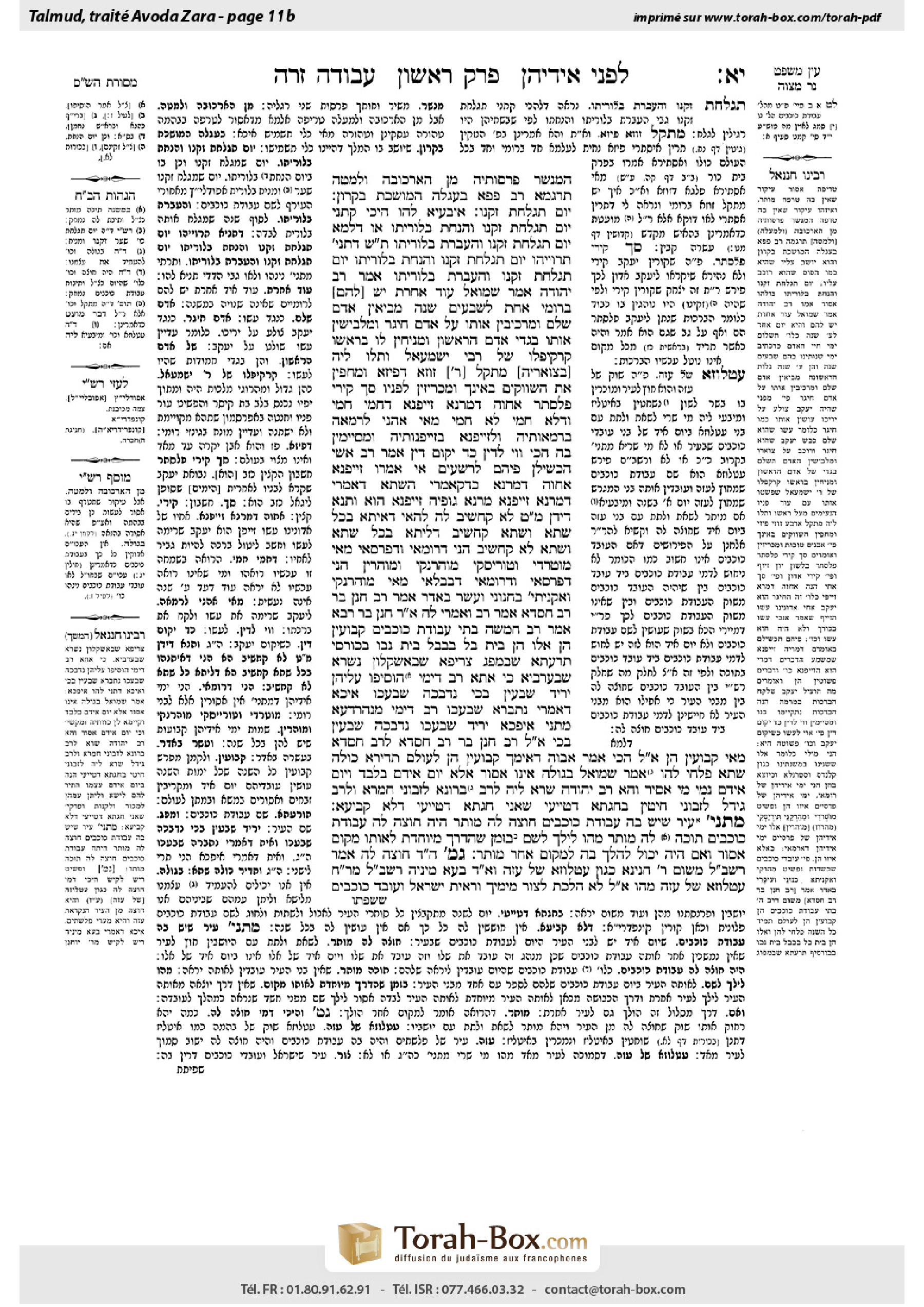
Avodah Zarah 11b: Talmud study for Daf Yomi
Study the Talmud for Daf Yomi with scanned pages, Hebrew text, English translations from Sefaria and AI-generated French translations.
Passage selection and English or AI-generated French translation are available where the scan has annotations. Daf Study is independent of Torah-Box and Sefaria.
Browse Avodah Zarah · עבודה זרה · All tractatesAvodah Zarah 11b text and translations
This page of Avodah Zarah includes the Aramaic text, an English translation and an AI-generated French translation, alongside the scan above.
עבודה זרה י״א ב · Aramaic and Hebrew text
הַמְנַשֵּׁר פַּרְסוֹתֶיהָ מִן הָאַרְכּוּבָּה וּלְמַטָּה. תַּרְגְּמַהּ רַב פָּפָּא: בְּעֶגְלָה הַמּוֹשֶׁכֶת בְּקָרוֹן.
יוֹם תִּגְלַחַת זְקָנוֹ. אִיבַּעְיָא לְהוּ, הֵיכִי קָתָנֵי? יוֹם תִּגְלַחַת זְקָנוֹ וְהַנָּחַת בְּלוֹרִיתוֹ, אוֹ דִלְמָא יוֹם תִּגְלַחַת זְקָנוֹ וְהַעֲבָרַת בְּלוֹרִיתוֹ? תָּא שְׁמַע, דְּתַנְיָא תַּרְוַיְיהוּ: יוֹם תִּגְלַחַת זְקָנוֹ וְהַנָּחַת בְּלוֹרִיתוֹ, יוֹם תִּגְלַחַת זְקָנוֹ וְהַעֲבָרַת בְּלוֹרִיתוֹ.
אָמַר רַב יְהוּדָה אָמַר שְׁמוּאֵל: עוֹד אַחֶרֶת יֵשׁ [לָהֶם] בְּרוֹמִי, אַחַת לְשִׁבְעִים שָׁנָה מְבִיאִין אָדָם שָׁלֵם, וּמַרְכִּיבִין אוֹתוֹ עַל אָדָם חִיגֵּר, וּמַלְבִּישִׁין אוֹתוֹ בִּגְדֵי אָדָם הָרִאשׁוֹן, וּמַנִּיחִין לוֹ בְּרֹאשׁוֹ קַרְקִיפְלוֹ שֶׁל רַבִּי יִשְׁמָעֵאל,
וְתָלוּ לֵיהּ [בְּצַוְּארֵיהּ] מַתְקַל [מָאתַן] זוּזָא דְּפִיזָּא, וּמְחַפִּין אֶת הַשְּׁוָוקִים בְּאִינָךְ, וּמַכְרִיזִין לְפָנָיו: סַךְ קִירִי פְּלַסְתֵּר, אֲחוּהּ דְּמָרַנָא זַיְיפָנָא. דְּחָמֵי חָמֵי, וּדְלָא חָמֵי לָא חָמֵי, מַאי אַהֲנִי לְרַמָּאָה בְּרַמָּאוּתֵיהּ וּלְזַיְיפָנָא בְּזַיְיפָנוּתֵיהּ? וּמְסַיְּימִין בַּהּ הָכִי: וַוי לְדֵין כַּד יְקוּם דֵּין.
אָמַר רַב אָשֵׁי: הִכְשִׁילָן פִּיהֶם לָרְשָׁעִים, אִי אָמְרוּ ״זַיְיפָנָא אֲחוּהּ דְּמָרַנָא״ — כִּדְקָאָמְרִי, הַשְׁתָּא דְּאָמְרִי ״דְּמָרַנָא זַיְיפָנָא״ — מָרַנָא גּוּפֵיהּ זַיְיפָנָא הוּא.
וְתַנָּא דִּידַן מַאי טַעְמָא לָא קָחָשֵׁיב לַהּ לְהַאי? דְּאִיתַהּ בְּכֹל שַׁתָּא וְשַׁתָּא קָחָשֵׁיב, דְּלֵיתַהּ בְּכֹל שַׁתָּא וְשַׁתָּא לָא קָחָשֵׁיב.
הָנֵי דְּרוֹמָאֵי, וּדְפָרְסָאֵי מַאי? מוּטְרְדֵי וְטוּרְיַסְקִי, מוּהַרְנְקֵי וּמוּהְרִין. הָנֵי דְּפָרְסָאֵי וּדְרוֹמָאֵי דְּבַבְלָאֵי מַאי? מוּהַרְנְקֵי וְאַקְנִיתָא, בַּחְנוּנֵי וַעֲשַׂר בַּאֲדָר.
אָמַר רַב חָנָן בַּר רַב חִסְדָּא אָמַר רַב, וְאָמְרִי לַהּ אָמַר רַב חָנָן בַּר רָבָא אָמַר רַב: חֲמִשָּׁה בָּתֵּי עֲבוֹדָה זָרָה קְבוּעִין הֵן, אֵלּוּ הֵן: בֵּית בֵּל בְּבָבֶל, בֵּית נְבוֹ (בְּכוּרְסֵי) [בְּבוּרְסִיף], תְּרַעְתָּא שֶׁבְּמַפַּג, צְרִיפָא שֶׁבְּאַשְׁקְלוֹן, נִשְׁרָא שֶׁבְּעַרְבִיָּא. כִּי אֲתָא רַב דִּימִי הוֹסִיפוּ עֲלֵיהֶן יָרִיד שֶׁבְּעֵין בֶּכִי, נִדְבָּכָה שֶׁבְּעַכּוֹ. אִיכָּא דְּאָמְרִי נִתְבָּרָא שֶׁבְּעַכּוֹ. רַב דִּימִי מִנְּהַרְדְּעָא מַתְנִי אִיפְּכָא: יָרִיד שֶׁבְּעַכּוֹ, נִדְבָּכָה שֶׁבְּעֵין בֶּכִי.
אֲמַר לֵיהּ רַב חָנָן בַּר רַב חִסְדָּא לְרַב חִסְדָּא: מַאי ״קְבוּעִין הֵן״? אֲמַר לֵיהּ, הָכִי אָמַר אֲבוּהּ דְּאִימָּךְ: קְבוּעִין הֵן לְעוֹלָם. תְּדִירָא, כּוּלַּהּ שַׁתָּא פָּלְחִי לְהוּ.
אָמַר שְׁמוּאֵל: בַּגּוֹלָה אֵינוֹ אָסוּר אֶלָּא יוֹם אֵידָם בִּלְבַד, וְיוֹם אֵידָם נָמֵי מִי אֲסִיר? וְהָא רַב יְהוּדָה שְׁרָא לֵיהּ לְרַב בְּרוֹנָא לְזַבּוֹנֵי חַמְרָא, וּלְרַב גִּידֵּל לְזַבּוֹנֵי חִיטִּין בְּחַגְּתָא דְּטַיָּיעֵי! שָׁאנֵי חַגְּתָא דְּטַיָּיעֵי, דְּלָא קְבִיעָא.
מַתְנִי׳ עִיר שֶׁיֵּשׁ בָּהּ עֲבוֹדָה זָרָה — חוּצָה לָהּ מוּתָּר, הָיָה חוּצָה לָהּ עֲבוֹדָה זָרָה — תּוֹכָהּ לָהּ מוּתָּר. מַהוּ לֵילֵךְ לְשָׁם? בִּזְמַן שֶׁהַדֶּרֶךְ מְיוּחֶדֶת לְאוֹתוֹ מָקוֹם — אָסוּר, וְאִם הָיָה יָכוֹל לְהַלֵּךְ בָּהּ לְמָקוֹם אַחֵר — מוּתָּר.
גְּמָ׳ הֵיכִי דָמֵי חוּצָה לָהּ? אָמַר רַבִּי שִׁמְעוֹן בֶּן לָקִישׁ מִשּׁוּם רַבִּי חֲנִינָא: כְּגוֹן עִטְלוֹזָהּ שֶׁל עַזָּה. וְאִיכָּא דְּאָמְרִי, בְּעָא מִינֵּיהּ רַבִּי שִׁמְעוֹן בֶּן לָקִישׁ מֵרַבִּי חֲנִינָא: עִטְלוֹזָהּ שֶׁל עַזָּה מַהוּ? אֲמַר לֵיהּ: לֹא הָלַכְתָּ לְצוֹר מִיָּמֶיךָ וְרָאִיתָ יִשְׂרָאֵל וְגוֹי
Avodah Zarah 11b · English translation
One who cuts the hooves of the animal, severing the legs from the knee and below, does not render the animal a tereifa. It is evident from the baraita, which discusses the cases in which an animal is rendered a tereifa and is therefore unfit to eat, that it is discussing kosher animals. The Gemara answers: Rav Pappa interpreted the baraita as referring to the calf that pulls the king’s coach, a kosher animal of which the king made use.
§ The mishna teaches: The day of shaving his, i.e., the gentile’s, beard and his locks. A dilemma was raised before the Sages: What is the mishna teaching here? Is it referring to the day of shaving his beard and head, when he cuts the hair of his head and as a result his long locks at the back of his head are left as a form of idol worship? Or perhaps the mishna is speaking of the day of shaving his beard and removing his locks, which are removed some time after they were left on the head? The Gemara responds: Come and hear an answer, as both opinions are taught in baraitot: One baraita mentions the day of shaving his beard and head when his long locks at the back of his head are left, whereas a different baraita specifies the day of shaving his beard and removing his locks.
The Gemara continues to discuss Roman festivals. Rav Yehuda says that Shmuel says: They have another festival in Rome: Once every seventy years they bring a man who is whole and free from any defect and have him ride on a lame man, to symbolize the healthy Esau ruling over Jacob, who walked with a limp after his fight with the angel. And they dress him in the garments of Adam the first man and place on his head the scalp [karkifelo] of Rabbi Yishmael, which the Romans flayed when they executed him.
And they hang gold on his neck weighing two hundred dinars, and cover the markets with onyx, and announce before him: The calculation [sakh] of the master [kiri] Jacob with regard to the time of the redemption is fraudulent [plaster]; the brother of our master, i.e., Esau, a forger. They further announce: One who witnesses this festival witnesses it, and whoever does not witness it will not witness it ever, as it was celebrated only once every seventy years. What purpose does deceit serve for the deceiver, and forgery for the forger? And they conclude in this fashion: Woe unto this one, Esau, when that one, Jacob, will arise, as this will cause Esau’s downfall.
Rav Ashi says: The mouths of these wicked people have caused their downfall. Had they said: A forger is the brother of our master, their claim would be interpreted as they say and wish to be understood. Now that they say: The brother of our master, a forger; they can be understood as saying: It is our master himself who is the forger.
The Gemara asks: And what is the reason that the tanna of our mishna does not count this festival in his list of gentile festivals? The Gemara answers: The tanna of the mishna counts those festivals that occur each and every year, and he does not count those festivals that do not occur each and every year.
The Gemara comments: Those festivals enumerated in the mishna are the festivals of the Romans. The Gemara asks: And what are the idolatrous festivals of the Persians? The Gemara answers: Mutredei and Turyaskei, Moharnekei and Moharin. The Gemara asks: Those are the festivals of the Persians and the Romans, and what are the festivals of the Babylonians? The Gemara answers: Moharnekei and Akenitei, Beḥanunei and the tenth of Adar.
§ Rav Ḥanan bar Rav Ḥisda says that Rav says, and some say that it was Rav Ḥanan bar Rava who says that Rav says: There are five established temples of idol worship, and they are: The temple of Bel in Babylonia; the temple of Nebo in the city of Khursei; the temple of Tirata, which is located in the city of Mapag; Tzerifa, which is located in Ashkelon; and Nashra, which is located in Arabia. When Rav Dimi came from Eretz Yisrael to Babylonia, he said: The Sages added to these places the marketplace that is located in Ein Bekhi and Nadbekha, which is located in Akko. There are those who say that Rav Dimi was referring to Natbera that is located in Akko. Rav Dimi from Neharde’a teaches the opposite, that it is the marketplace that is located in Akko, and Nadbekha that is located in Ein Bekhi.
Rav Ḥanan bar Rav Ḥisda said to Rav Ḥisda: What does it mean that these temples of idol worship are established? Rav Ḥisda said to him: This is what your mother’s father, Rav Ḥanan bar Rava, said: In contrast to festivals, which last for one or several days, they are always fixed as the site of idol worship, as constantly, all year round, worship takes place there.
§ Shmuel says: The halakha is that in the Diaspora, engaging in business with gentiles is prohibited only on the day of their festival itself, not during the days preceding and following the festival. Since Jews live among the gentiles, they are unable to refrain from engaging in business with them for such an extended period. The Gemara asks: And is it prohibited even on their festival day itself? But didn’t Rav Yehuda permit Rav Beruna to sell wine to gentiles, and permitted Rav Giddel to sell wheat, on the festival of the Arab merchants? The Gemara answers: The festival of the Arab merchants is different, as it does not have a fixed time, and therefore the Sages did not include it in the prohibition.
MISHNA: In the case of a city in which there is active idol worship, it is permitted to engage in business transactions with gentiles who live outside of the city. If the idol worship is outside the city, it is permitted to engage in business within the city. What is the halakha with regard to traveling there, a place where a pagan festival is being celebrated? When the road is designated only for that place, it is prohibited to use the road, as onlookers will assume that the traveler intends to join the festival. But if one were able to travel on it to arrive at another place, it is permitted to use the road to reach the place that is observing the festival.
GEMARA: The Gemara asks: What are the circumstances that determine whether a place is sufficiently far from a city to be considered outside of it? Rabbi Shimon ben Lakish says in the name of Rabbi Ḥanina: A place that is far enough away is, for example, the bazaar [atluza] of Gaza, which is located outside the city walls. And some say that Rabbi Shimon ben Lakish asked Rabbi Ḥanina about this issue: What is the halakha with regard to the bazaar of Gaza? May one conduct business there on the day of a festival celebrated in Gaza? Rabbi Ḥanina said to him: Did you never in your lifetime travel to Tyre and see a Jew and a gentile
Avodah Zarah 11b · Traduction française (IA)
Celui qui coupe les sabots de l'animal, en séparant les jambes du genou et en dessous, ne rend pas l'animal un tereifa. Il est évident à partir de la baraïta, qui discute des cas où un animal est rendu tereifa et est donc inedible, que celle-ci parle d'animaux kasher. La Guemara répond : Rav Pappa interprète la baraïta comme faisant référence au veau qui tire la charrette du roi, un animal kasher que le roi utilisait.
§ La mitsna enseigne : Le jour de rasage de sa barbe et de ses cheveux, c'est-à-dire la barbe et les cheveux du gentil. Un dilemme a été soulevé devant les Sages : Que signifie la mitsna ici ? Parle-t-elle du jour de rasage de sa barbe et de sa tête, lorsqu'il coupe les cheveux de sa tête et en conséquence, les longs cheveux à l'arrière de sa tête restent comme une forme de culte idolâtre ? Ou peut-être la mitsna parle-t-elle du jour de rasage de sa barbe et de la suppression de ses cheveux, qui sont supprimés un certain temps après avoir été laissés sur la tête ? La Guemara répond : Viens écouter une réponse, car les deux opinions sont enseignées dans des baraitot : une baraïta mentionne le jour de rasage de sa barbe et de sa tête lorsque les longs cheveux à l'arrière de sa tête restent, tandis qu'une autre baraïta spécifie le jour de rasage de sa barbe et la suppression de ses cheveux.
La Guemara continue à discuter des festivals romains. Rav Yehuda dit que Shmuel dit : Ils ont un autre festival à Rome : une fois tous les soixante-dix ans, ils amènent un homme entier et sans défaut et le font monter sur un homme boiteux, pour symboliser l'Esau sain qui règne sur Jacob, qui marchait avec une boiterie après sa lutte avec l'ange. Et ils le vêtent des vêtements d'Adam, le premier homme, et lui mettent sur la tête la peau [karkifelo] de Rabbi Yishmael, que les Romains ont dépecé lors de son exécution.
Et ils accrochent de l'or sur son cou pesant deux cents dinars, et recouvrent les marchés d'onyx, et annoncent devant lui : Le calcul [sakh] du maître [kiri] Jacob concernant le moment de la rédemption est frauduleux [plaster] ; le frère de notre maître, c'est-à-dire Esau, un faussaire. Ils annoncent également : Celui qui assiste à ce festival l'assiste, et celui qui ne l'assiste pas ne le verra jamais, car il était célébré seulement une fois tous les soixante-dix ans. À quoi sert la tromperie pour le trompeur, et la fausse monnaie pour le faussaire ? Et ils concluent ainsi : Malheur à celui-ci, Esau, lorsque celui-là, Jacob, se lèvera, car cela causera la chute d'Esau.
Rav Ashi dit : Les bouches de ces gens malveillants ont causé leur chute. S'ils avaient dit : Le faussaire est le frère de notre maître, leur déclaration serait interprétée comme ils le disent et souhaitent être compris. Maintenant qu'ils disent : Le frère de notre maître, un faussaire ; ils peuvent être compris comme disant : C'est notre maître lui-même qui est le faussaire.
La Guemara pose la question : Et pourquoi le tanna de notre mitsna ne compte-t-il pas ce festival dans sa liste des festivals païens ? La Guemara répond : Le tanna de la mitsna compte ceux des festivals qui se produisent chaque année, et il ne compte pas ceux des festivals qui ne se produisent pas chaque année.
La Guemara commente : Les festivals énumérés dans la mitsna sont les festivals des Romains. La Guemara pose la question : Et quels sont les festivals idolâtres des Perses ? La Guemara répond : Mutredei et Turyaskei, Moharnekei et Moharin. La Guemara pose la question : Ce sont les festivals des Perses et des Romains, et quels sont les festivals des Babyloniens ? La Guemara répond : Moharnekei et Akenitei, Beḥanunei et le dixième d'Adar.
§ Rav Ḥanan bar Rav Ḥisda dit que Rav dit, et certains disent que c'était Rav Ḥanan bar Rava qui dit que Rav dit : Il y a cinq temples établis de culte idolâtre, et ils sont : le temple de Bel en Babylone ; le temple de Nebo dans la ville de Khursei ; le temple de Tirata, qui est situé dans la ville de Mapag ; Tzerifa, qui est située à Ashkelon ; et Nashra, qui est située en Arabie. Lorsque Rav Dimi est venu d'Eretz Yisrael vers Babylone, il a dit : Les Sages ont ajouté à ces lieux le marché situé à Ein Bekhi et Nadbekha, qui est situé à Akko. Certains disent que Rav Dimi faisait référence à Natbera située à Akko. Rav Dimi de Neharde’a enseigne l'opposé, que c'est le marché situé à Akko, et Nadbekha situé à Ein Bekhi.
Rav Ḥanan bar Rav Ḥisda a dit à Rav Ḥisda : Que signifie que ces temples de culte idolâtre sont établis ? Rav Ḥisda a dit à lui : C'est ce que votre grand-père, Rav Ḥanan bar Rava, a dit : En contraste avec les festivals, qui durent un ou plusieurs jours, ils sont toujours fixés comme site de culte idolâtre, car constamment, toute l'année, le culte y a lieu.
§ Shmuel dit : La halakha est que dans la Diaspora, il est interdit d'entreprendre des affaires avec les païens uniquement le jour de leur festival, pas pendant les jours précédents et suivants le festival. Les Juifs vivant parmi les païens ne peuvent pas se dispenser d'entreprendre des affaires avec eux pendant une telle période prolongée. La Guemara pose la question : Et est-il interdit même le jour même de leur festival ? Mais n'a-t-on pas permis à Rav Yehuda de permettre à Rav Beruna de vendre du vin aux païens, et à Rav Giddel de vendre du blé, pendant le festival des marchands arabes ? La Guemara répond : Le festival des marchands arabes est différent, car il n'a pas de date fixe, et c'est pourquoi les Sages ne l'ont pas inclus dans l'interdiction.
MICHNA : Dans le cas d'une ville où il y a une activité de culte idolâtre, il est permis d'entreprendre des transactions commerciales avec les païens qui habitent en dehors de la ville. Si le culte idolâtre est en dehors de la ville, il est permis d'entreprendre des transactions commerciales à l'intérieur de la ville. Quelle est la halakha concernant le voyage vers un lieu où un festival païen est célébré ? Lorsque le chemin est désigné uniquement pour ce lieu, il est interdit d'utiliser ce chemin, car les spectateurs supposeront que le voyageur a l'intention de participer au festival. Mais si l'on peut voyager sur ce chemin pour arriver à un autre lieu, il est permis d'utiliser le chemin pour arriver au lieu qui célèbre le festival.
GUEMARA : La Guemara pose la question : Quelles sont les circonstances qui déterminent si un lieu est suffisamment éloigné d'une ville pour être considéré comme en dehors d'elle ? Rabbi Shimon ben Lakish cite en nom de Rabbi Ḥanina : Un lieu suffisamment éloigné est, par exemple, le souk [atluza] de Gaza, qui se trouve en dehors des murailles de la ville. Et certains disent que Rabbi Shimon ben Lakish a interrogé Rabbi Ḥanina à ce sujet : Quelle est la halakha concernant le souk de Gaza ? Est-il permis de faire des affaires là-bas le jour d'un festival célébré à Gaza ? Rabbi Ḥanina lui a répondu : N'avez-vous jamais, dans votre vie, voyagé à Tyr et vu un Juif et un non-Juif
Traduction française générée par IA à partir de l’édition anglaise de Sefaria. Vérifie toujours un passage avec le texte source.
Text from Sefaria: William Davidson Edition - Vocalized Aramaic (CC BY NC); William Davidson Edition - English (CC BY NC).