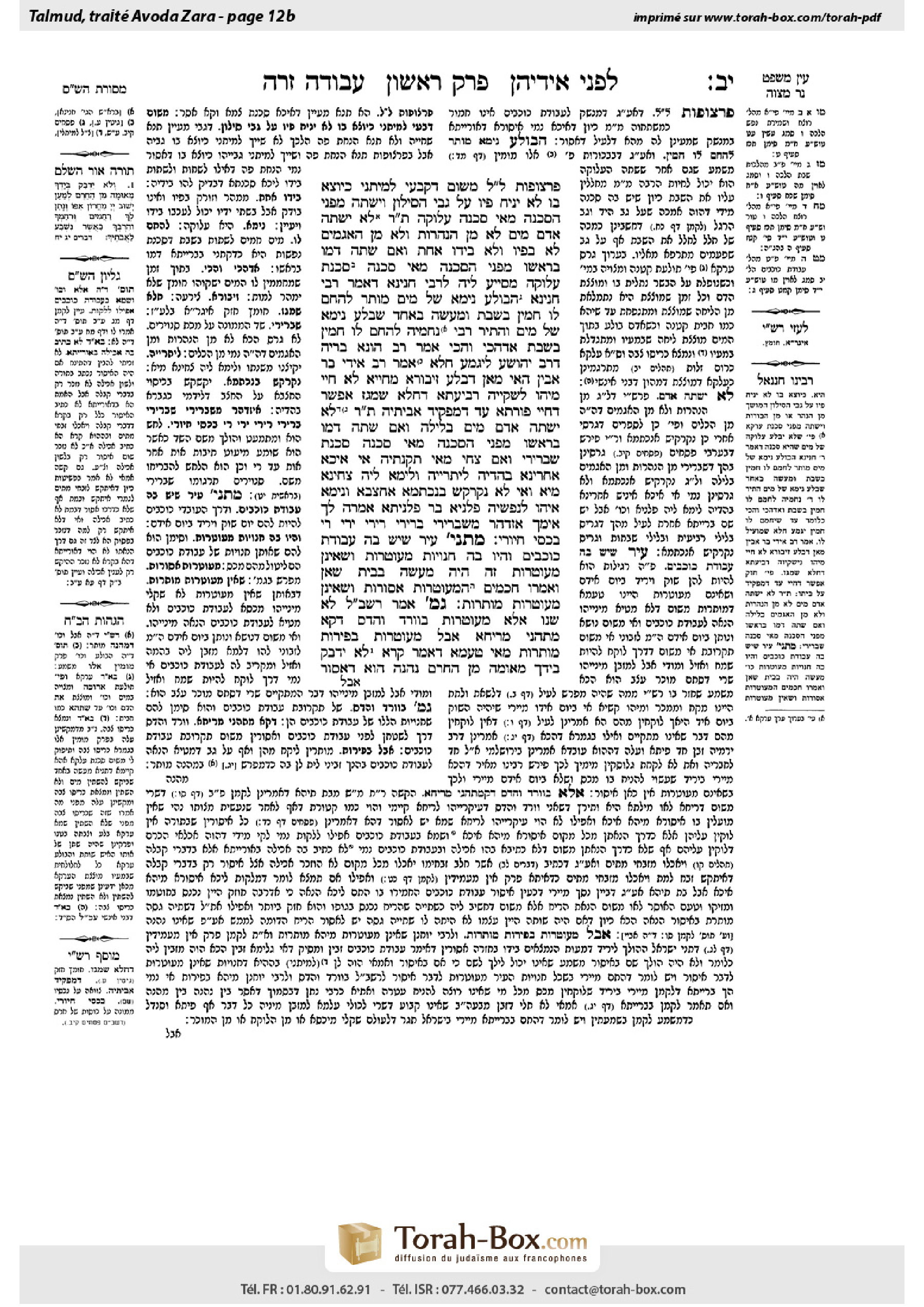
Avodah Zarah 12b: Talmud study for Daf Yomi
Study the Talmud for Daf Yomi with scanned pages, Hebrew text, English translations from Sefaria and AI-generated French translations.
Passage selection and English or AI-generated French translation are available where the scan has annotations. Daf Study is independent of Torah-Box and Sefaria.
Browse Avodah Zarah · עבודה זרה · All tractatesAvodah Zarah 12b text and translations
This page of Avodah Zarah includes the Aramaic text, an English translation and an AI-generated French translation, alongside the scan above.
עבודה זרה י״ב ב · Aramaic and Hebrew text
פַּרְצוּפוֹת לְמָה לִי? מִשּׁוּם דְּקָבָעֵי לְמִיתְנֵי: כַּיּוֹצֵא בוֹ לֹא יַנִּיחַ פִּיו עַל גַּבֵּי הַסִּילוֹן וְיִשְׁתֶּה, מִפְּנֵי הַסַּכָּנָה.
מַאי סַכָּנָה? עֲלוּקָה. תָּנוּ רַבָּנַן: לֹא יִשְׁתֶּה אָדָם מַיִם לֹא מִן הַנְּהָרוֹת וְלֹא מִן הָאֲגַמִּים, לֹא בְּפִיו וְלֹא בְּיָדוֹ אַחַת, וְאִם שָׁתָה — דָּמוֹ בְּרֹאשׁוֹ, מִפְּנֵי הַסַּכָּנָה. מַאי סַכָּנָה? סַכָּנַת עֲלוּקָה.
מְסַיַּיע לֵיהּ לְרַבִּי חֲנִינָא, דְּאָמַר רַבִּי חֲנִינָא: הַבּוֹלֵעַ נִימָא שֶׁל מַיִם — מוּתָּר לְהָחֵם לוֹ חַמִּין בְּשַׁבָּת. וּמַעֲשֶׂה בְּאֶחָד שֶׁבָּלַע נִימָא שֶׁל מַיִם, וְהִתִּיר רַבִּי נְחֶמְיָה לְהָחֵם לוֹ חַמִּין בְּשַׁבָּת. אַדְּהָכִי וְהָכִי? אָמַר רַב הוּנָא בְּרֵיהּ דְּרַב יְהוֹשֻׁעַ: לִיגַמַּע חַלָּא.
אָמַר רַב אִידִי בַּר אָבִין: הַאי מַאן דִּבְלַע זִיבּוּרָא — מִחְיָיא לָא חָיֵי, מִיהוּ לַשְׁקְיֵיהּ רְבִיעֲתָא דְחַלָּא שַׁמְגַּז, אֶפְשָׁר דְּחָיֵי פּוּרְתָּא עַד דְּמַפְקֵיד אַבֵּיתֵיהּ.
תָּנוּ רַבָּנַן: לֹא יִשְׁתֶּה אָדָם מַיִם בַּלַּיְלָה, וְאִם שָׁתָה — דָּמוֹ בְּרֹאשׁוֹ, מִפְּנֵי הַסַּכָּנָה. מַאי סַכָּנָה? סַכָּנַת שַׁבְרִירֵי. וְאִם צָחֵי, מַאי תַּקַּנְתֵּיהּ? אִי אִיכָּא אַחֲרִינָא בַּהֲדֵיהּ — לִיתְרְיֵיהּ וְלֵימָא לֵיהּ: ״צָחֵינָא מַיָּא״, וְאִי לָא — נְקַרְקֵשׁ בְּנִכְתְּמָא אַחַצְבָּא, וְנֵימָא אִיהוּ לְנַפְשֵׁיהּ: ״פְּלָנְיָא בַּר פְּלָנִיתָא, אָמְרָה לָךְ אִימָּךְ אִזְדְּהַר מִשַּׁבְרִירֵי בְּרִירֵי רִירֵי יְרֵי רֵי בְּכָסֵי חִיוָּרֵי״.
מַתְנִי׳ עִיר שֶׁיֵּשׁ בָּהּ עֲבוֹדָה זָרָה, וְהָיוּ בָּהּ חֲנוּיוֹת מְעוּטָּרוֹת וְשֶׁאֵינָן מְעוּטָּרוֹת, זֶה הָיָה מַעֲשֶׂה בְּבֵית שְׁאָן, וְאָמְרוּ חֲכָמִים: הַמְעוּטָּרוֹת אֲסוּרוֹת, וְשֶׁאֵינָן מְעוּטָּרוֹת מוּתָּרוֹת.
גְּמָ׳ אָמַר רַבִּי שִׁמְעוֹן בֶּן לָקִישׁ: לֹא שָׁנוּ אֶלָּא מְעוּטָּרוֹת בְּוֶורֶד וַהֲדַס, דְּקָא מִתְהֲנֵי מֵרֵיחָא, אֲבָל מְעוּטָּרוֹת בְּפֵירוֹת — מוּתָּרוֹת. מַאי טַעְמָא? דְּאָמַר קְרָא: ״לֹא יִדְבַּק בְּיָדְךָ מְאוּמָה מִן הַחֵרֶם״, נֶהֱנֶה הוּא דְּאָסוּר,
Avodah Zarah 12b · English translation
The Gemara asks: Why do I need the baraita to teach that it is prohibited to drink from fountains formed in the figure of human faces? If the reason is to teach the halakha in a life-threatening situation, the baraita already addressed this issue in the case of the spring. The Gemara answers: It was included because the baraita wanted to teach the continuation of that halakha: Similarly, one may not place his mouth on a pipe and drink, due to the danger that this poses.
The Gemara inquires: What danger is the baraita referring to here? It is referring to the danger of swallowing a leech in the water. As the Sages taught: A person should not drink water from rivers or from ponds either by drinking from the water directly with his mouth, or by collecting the water with one hand alone. And if he drank in this manner, his blood is upon his own head, due to the danger. The Gemara explains: What is this danger? It is the danger of swallowing a leech.
This supports the opinion of Rabbi Ḥanina, as Rabbi Ḥanina says: In the case of one who swallows a water leech [nima], it is permitted to perform labor on Shabbat and heat water for him to drink on Shabbat, as his life is in danger. And in fact there was an incident involving one who swallowed a water leech, and Rabbi Neḥemya permitted them to heat water for him on Shabbat. The Gemara asks: In the meantime, until the water is ready, what should he do? Rav Huna, son of Rav Yehoshua, said: He should swallow vinegar.
Rav Idi bar Avin said: One who swallowed a hornet will not live, as the hornet will sting him to death. Nevertheless, they should give him a quarter-log of sharp [shamgaz] vinegar to drink. In this manner it is possible that he will live for a bit longer until he can instruct his household with regard to his final wishes before dying.
The Sages taught: A person should not drink water at night. And if he drank, his blood is upon his own head, due to the danger. The Gemara asks: What is this danger? The Gemara answers: The danger of the shavrirei, an evil spirit that rules over water. And if he is thirsty, what is his remedy? If there is another person with him, he should wake him and say to him: I thirst for water, and then he may drink. And if there is no other person with him, he should knock with the lid on the jug and say to himself: So-and-so, son of so-and-so, your mother said to you to beware of the shavrirei verirei rirei yirei rei, found in white cups. This is an incantation against the evil spirit.
MISHNA: With regard to a city in which idol worship is practiced and in which there are stores that are adorned for the sake of idol worship and there are others that are not adorned, this was in fact an incident that occurred in Beit She’an, and the Sages said: With regard to the adorned shops, it is prohibited to buy from them, but in the case of those that are not adorned it is permitted.
GEMARA: Rabbi Shimon ben Lakish says: They taught that buying is prohibited only in the case of stores that are adorned with roses and myrtle, as one derives benefit from their smell and they serve as offerings to objects of idol worship. But with regard to stores that are adorned with fruit, it is permitted to buy from them. What is the reason that they are permitted? As the verse states: “And there shall cleave nothing dedicated to your hand” (Deuteronomy 13:18), i.e., the items dedicated to idol worship. From here it is derived that it is prohibited to derive benefit from idol worship,
Avodah Zarah 12b · Traduction française (IA)
La Guemara pose la question : Pourquoi ai-je besoin de la baraïta pour apprendre que boire à des fontaines formées en figure de visage est interdit ? Si la raison est d'apprendre la halakha dans un cas de danger de vie, la baraïta a déjà abordé cette question dans le cas de la source. La Guemara répond : C'était inclus car la baraïta voulait enseigner la continuation de cette halakha : De même, on ne doit pas placer sa bouche sur un tuyau et boire, en raison du danger que cela représente.
La Guemara interroge : Quel danger la baraïta fait-elle référence ici ? Il s'agit du danger d'avaler un ver de terre dans l'eau. Comme les Sages ont enseigné : Une personne ne doit pas boire de l'eau des rivières ou des étangs, qu'elle boive directement avec sa bouche ou qu'elle collecte l'eau avec une seule main. Et si elle boit ainsi, son sang est sur sa tête, en raison du danger. La Guemara explique : Quel est ce danger ? C'est le danger d'avaler un ver de terre.
Cela soutient l'opinion de Rabbi Ḥanina, car Rabbi Ḥanina dit : Dans le cas d'une personne qui avale un ver de terre [nima], il est permis de faire un travail le sabbat et de lui faire du thé pour boire le sabbat, car sa vie est en danger. Et en effet, il y avait un cas où une personne avait avalé un ver de terre, et Rabbi Neḥemya a permis qu'on lui fasse du thé le sabbat. La Guemara pose la question : Pendant ce temps, jusqu'à ce que l'eau soit prête, que devrait-il faire ? Rav Huna, fils de Rav Yehoshua, a dit : Il devrait avaler du vinaigre.
Rav Idi bar Avin a dit : Celui qui a avalé un guêpier ne vivra pas, car le guêpier le piquera jusqu'à la mort. Cependant, on devrait lui donner un quart de log de vinaigre aigre [shamgaz] à boire. Ainsi, il est possible qu'il survive un peu plus longtemps jusqu'à ce qu'il puisse instruire sa famille concernant ses dernières volontés avant de mourir.
Les Sages ont enseigné : Une personne ne doit pas boire de l'eau la nuit. Et si elle boit, son sang est sur sa tête, en raison du danger. La Guemara pose la question : Quel est ce danger ? La Guemara répond : Le danger des shavrirei, un esprit malin qui règne sur l'eau. Et si l'on a soif, quelle est sa solution ? S'il y a une autre personne à côté de lui, il devrait la réveiller et lui dire : J'ai soif d'eau, et alors il peut boire. Et si personne n'est avec lui, il devrait frapper avec le couvercle du bidon et lui dire à lui-même : Tel et tel, fils de tel et tel, ta mère t'a dit de te méfier des shavrirei verirei rirei rei, trouvés dans des tasses blanches. C'est une incantation contre cet esprit malin.
MICHNA : Concernant une ville où l'idolâtrie est pratiquée et où il y a des boutiques décorées à l'effet de l'idolâtrie et d'autres qui ne le sont pas, cela a été en effet un cas qui s'est produit à Beit She’an, et les Sages ont dit : Concernant les boutiques décorées, il est interdit d'y acheter, mais dans le cas des autres, il est permis.
GUEMARA : Rabbi Shimon ben Lakish dit : Ils ont enseigné que l'achat est interdit uniquement dans le cas des boutiques décorées avec des roses et des lauriers, car on en tire un bénéfice de leur parfum et elles servent d'offrandes aux objets d'idolâtrie. Mais concernant les boutiques décorées avec des fruits, il est permis d'y acheter. Quelle est la raison pour laquelle elles sont permises ? Comme le texte saint dit : « Et il ne restera rien dédié à ta main » (Deutéronome 13:18), c'est-à-dire les choses dédiées à l'idolâtrie. D'où l'on déduit qu'il est interdit de tirer un bénéfice de l'idolâtrie,
Traduction française générée par IA à partir de l’édition anglaise de Sefaria. Vérifie toujours un passage avec le texte source.
Text from Sefaria: William Davidson Edition - Vocalized Aramaic (CC BY NC); William Davidson Edition - English (CC BY NC).