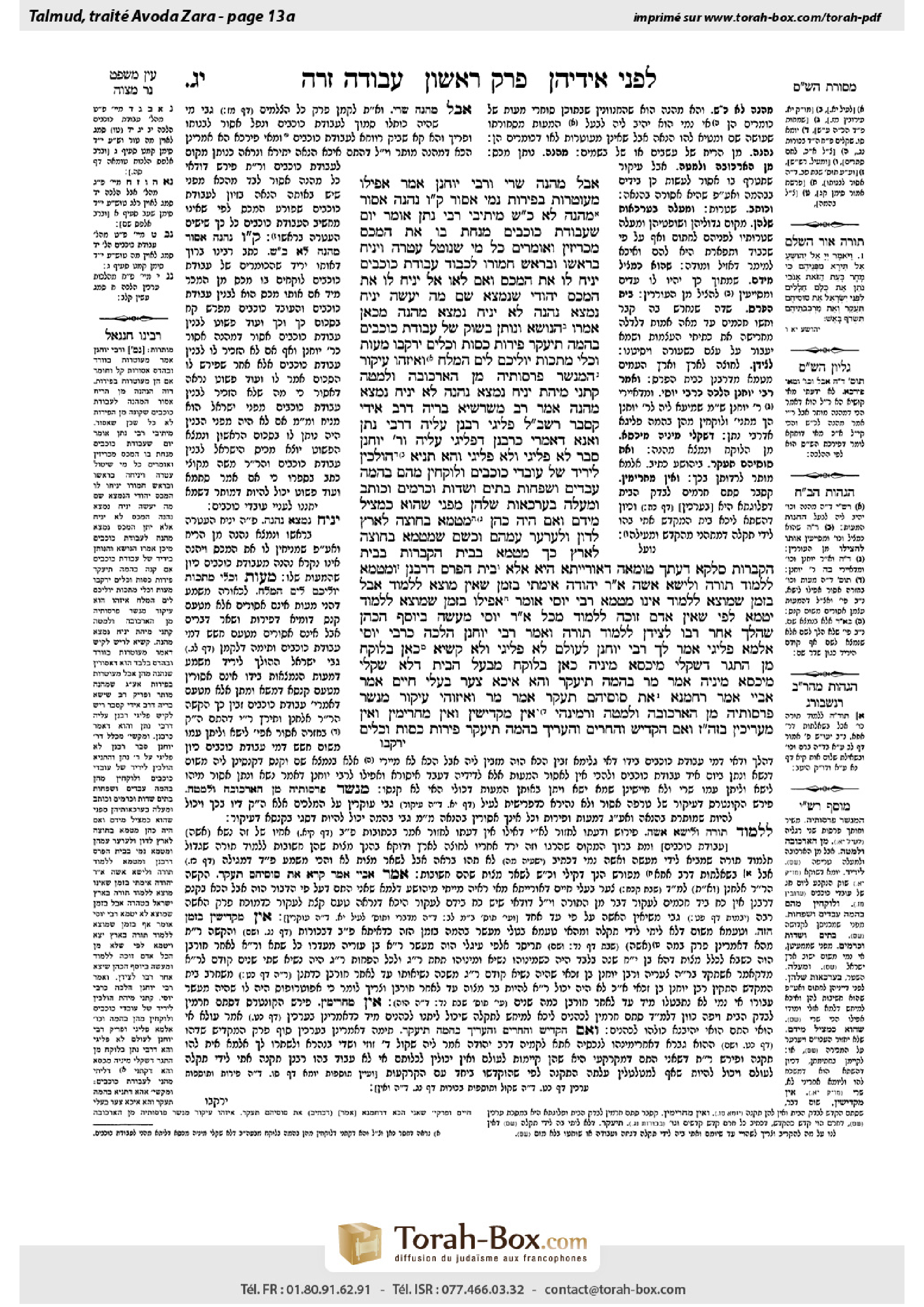
Avodah Zarah 13a: Talmud study for Daf Yomi
Study the Talmud for Daf Yomi with scanned pages, Hebrew text, English translations from Sefaria and AI-generated French translations.
Passage selection and English or AI-generated French translation are available where the scan has annotations. Daf Study is independent of Torah-Box and Sefaria.
Browse Avodah Zarah · עבודה זרה · All tractatesAvodah Zarah 13a text and translations
This page of Avodah Zarah includes the Aramaic text, an English translation and an AI-generated French translation, alongside the scan above.
עבודה זרה י״ג א · Aramaic and Hebrew text
אֲבָל מְהַנֶּה שְׁרֵי. וְרַבִּי יוֹחָנָן אָמַר: אֲפִילּוּ מְעוּטָּרוֹת בְּפֵירוֹת נָמֵי אָסוּר, קַל וָחוֹמֶר: נֶהֱנֶה — אָסוּר, מְהַנֶּה — לֹא כׇּל שֶׁכֵּן!
מֵיתִיבִי, רַבִּי נָתָן אוֹמֵר: יוֹם שֶׁעֲבוֹדָה זָרָה מַנַּחַת בּוֹ אֶת הַמֶּכֶס, מַכְרִיזִין וְאוֹמְרִים: כׇּל מִי שֶׁנּוֹטֵל עֲטָרָה וְיַנִּיחַ בְּרֹאשׁוֹ וּבְרֹאשׁ חֲמוֹרוֹ לִכְבוֹד עֲבוֹדָה זָרָה — יַנִּיחַ לוֹ אֶת הַמֶּכֶס, וְאִם לָאו — אַל יַנִּיחַ לוֹ אֶת הַמֶּכֶס.
יְהוּדִי שֶׁנִּמְצָא שָׁם מָה יַעֲשֶׂה? יַנִּיחַ — נִמְצָא נֶהֱנֶה, לֹא יַנִּיחַ — נִמְצָא מְהַנֶּה.
מִכָּאן אָמְרוּ: הַנּוֹשֵׂא וְנוֹתֵן בְּשׁוּק שֶׁל עֲבוֹדָה זָרָה, בְּהֵמָה תֵּיעָקֵר, פֵּירוֹת כְּסוּת וְכֵלִים יֵרָקְבוּ, מָעוֹת וּכְלֵי מַתָּכוֹת יוֹלִיכֵם לְיָם הַמֶּלַח, וְאֵיזֶהוּ עִיקּוּר? הַמְנַשֵּׁר פַּרְסוֹתֶיהָ מִן הָאַרְכּוּבָּה וּלְמַטָּה.
קָתָנֵי מִיהַת: יַנִּיחַ — נִמְצָא נֶהֱנֶה, לֹא יַנִּיחַ — נִמְצָא מְהַנֶּה!
אָמַר רַב מְשַׁרְשְׁיָא בְּרֵיהּ דְּרַב אִידִי: קָסָבַר רַבִּי שִׁמְעוֹן בֶּן לָקִישׁ, פְּלִיגִי רַבָּנַן עֲלֵיהּ דְּרַבִּי נָתָן, וַאֲנָא דַּאֲמַרִי כְּרַבָּנַן דִּפְלִיגִי עֲלֵיהּ. וְרַבִּי יוֹחָנָן סָבַר: לָא פְּלִיגִי.
וְלָא פְּלִיגִי? וְהָא תַּנְיָא: הוֹלְכִין לְיָרִיד שֶׁל גּוֹיִם, וְלוֹקְחִין מֵהֶם בְּהֵמָה, עֲבָדִים וּשְׁפָחוֹת, בָּתִּים וְשָׂדוֹת וּכְרָמִים, וְכוֹתֵב וּמַעֲלֶה בְּעַרְכָּאוֹת שֶׁלָּהֶן, מִפְּנֵי שֶׁהוּא כְּמַצִּיל מִיָּדָם.
וְאִם הָיָה כֹּהֵן — מִטַּמֵּא בְּחוּצָה לָאָרֶץ, לָדוּן וּלְעַרְעֵר עִמָּהֶם. וּכְשֵׁם שֶׁמִּטַּמֵּא בְּחוּצָה לָאָרֶץ, כָּךְ מִטַּמֵּא בְּבֵית הַקְּבָרוֹת.
בְּבֵית הַקְּבָרוֹת סָלְקָא דַּעְתָּךְ? טוּמְאָה דְּאוֹרָיְיתָא הִיא! אֶלָּא בֵּית הַפְּרָס דְּרַבָּנַן.
וּמְטַמֵּא לִלְמוֹד תּוֹרָה וְלִישָּׂא אִשָּׁה, אָמַר רַבִּי יְהוּדָה: אֵימָתַי? בִּזְמַן שֶׁאֵין מוֹצֵא לִלְמוֹד, אֲבָל בִּזְמַן שֶׁמּוֹצֵא לִלְמוֹד — אֵינוֹ מְטַמֵּא.
רַבִּי יוֹסֵי אוֹמֵר: אֲפִילּוּ בִּזְמַן שֶׁמּוֹצֵא לִלְמוֹד — יִטַּמֵּא, לְפִי שֶׁאֵין אָדָם זוֹכֶה לִלְמוֹד מִכֹּל.
אָמַר רַבִּי יוֹסֵי: מַעֲשֶׂה בְּיוֹסֵף הַכֹּהֵן שֶׁהָלַךְ אַחַר רַבּוֹ לְצִידוֹן לִלְמוֹד תּוֹרָה. וְאָמַר רַבִּי יוֹחָנָן: הֲלָכָה כְּרַבִּי יוֹסֵי.
אַלְמָא פְּלִיגִי! אָמַר לָךְ רַבִּי יוֹחָנָן: לְעוֹלָם לָא פְּלִיגִי,
וְלָא קַשְׁיָא, כָּאן — בְּלוֹקֵחַ מִן הַתַּגָּר, דְּשָׁקְלִי מִיכְסָא מִינֵּיהּ; כָּאן — בְּלוֹקֵחַ מִבַּעַל הַבַּיִת, דְּלָא שָׁקְלִי מִיכְסָא מִינֵּיהּ.
אָמַר מָר: בְּהֵמָה תֵּיעָקֵר. וְהָא אִיכָּא צַעַר בַּעֲלֵי חַיִּים! אָמַר אַבָּיֵי: אָמַר רַחֲמָנָא ״אֶת סוּסֵיהֶם תְּעַקֵּר״.
אָמַר מָר: וְאֵיזֶהוּ עִיקּוּר? מְנַשֵּׁר פַּרְסוֹתֶיהָ מִן הָאַרְכּוּבָּה וּלְמַטָּה. וּרְמִינְהִי: אֵין מַקְדִּישִׁין, וְאֵין מַחְרִימִין, וְאֵין מַעֲרִיכִין בַּזְּמַן הַזֶּה, וְאִם הִקְדִּישׁ וְהֶחְרִים וְהֶעֱרִיךְ — בְּהֵמָה תֵּיעָקֵר, פֵּירוֹת כְּסוּת וְכֵלִים.
Avodah Zarah 13a · English translation
but it is permitted to cause benefit. Although by buying from the store one indirectly supports idol worship, as a portion of the sales are given to support idol worship, this is not prohibited by Torah law. And Rabbi Yoḥanan says: Even if the stores are adorned only with fruit one is also prohibited from buying from them. This is derived by an a fortiori inference: If it is prohibited to derive benefit from idol worship, is it not all the more so prohibited to cause benefit to idol worship?
The Gemara raises an objection to Reish Lakish’s opinion from a baraita. Rabbi Natan says: On the day in which a reduction is made from the tax in honor of idol worship, they announce and say: Anyone who takes a wreath of roses and places it on his head and on the head of his donkey in honor of the object of idol worship, his tax will be reduced. And if one does not place a wreath on one’s head, his tax will not be reduced.
What should a Jew who is present there do? If he places the wreath on his head and on the head of his donkey, he will be found to derive benefit from idol worship. And if he does not place the wreath on his head, he will be found to cause benefit to idol worship, through the tax that he pays.
From here the Sages stated: One who conducts business in a market of idol worship will be forced either to benefit from or cause benefit to idol worship. Therefore, any animal he bought there should be destroyed, any produce, clothing or vessels should be left to decompose, and with regard to any money or metal vessels, which would not decompose on their own, one should take them and cast them into the Dead Sea. And what constitutes destroying the animal? One cuts off the hooves of the animal from the knee and below.
The Gemara explains the objection to Reish Lakish’s statement. In any event, the baraita teaches that it is prohibited to cause benefit to idol worship, as it states: If he places the wreath on his head then he will be found to derive benefit from idol worship, and if he does not place the wreath on his head, he will be found to cause benefit to idol worship. How, then, can Reish Lakish claim that it is permitted to cause benefit to idol worship?
Rav Mesharshiyya, son of Rav Idi, said: Rabbi Shimon ben Lakish holds as follows: The Rabbis disagree with Rabbi Natan, whose opinion is cited in the baraita, and I spoke in accordance with the opinion of the Rabbis who disagree with Rabbi Natan. The Gemara notes: And Rabbi Yoḥanan, who rules in accordance with the statement of Rabbi Natan, holds that the Rabbis do not disagree with Rabbi Natan; rather, everyone agrees that it is prohibited to cause benefit to idol worship.
The Gemara asks: And is it so that they do not disagree? But isn’t it taught in a baraita: One may go to a fair of gentiles, whose purpose is to honor idol worship, and buy from the gentiles animals, and slaves, and maidservants, as the purchase raises the items to a more sanctified state; and he may buy houses, fields, and vineyards from them, due to the mitzva to settle Eretz Yisrael. And one may write the necessary deeds and confirm them in their gentile courts [be’arkaot], although this involves an acknowledgement of their authority, because it is as though he is rescuing his property from their hands, as the court’s confirmation and stamp of approval prevents the seller from denying the sale and claiming that the property still belongs to him.
And if he is a priest, he may become ritually impure by going outside Eretz Yisrael, even though a priest is usually prohibited from leaving Eretz Yisrael to the impure land outside, in order to litigate with them and to contest their claims. And just as a priest may become ritually impure by going outside Eretz Yisrael, so may he become ritually impure for this purpose by entering a cemetery.
The Gemara interrupts its citation of the baraita to express surprise at this last ruling: Can it enter your mind to say that a priest may become impure by entering a cemetery? The halakha that a cemetery imparts ritual impurity to a priest is by Torah law; how could the Sages override this prohibition? Rather, the baraita is referring to an area where there is uncertainty with regard to the location of a grave or a corpse [beit haperas], owing to the fact that a grave had been unwittingly plowed over, and the bones may have become scattered throughout the field. Such a field imparts ritual impurity by rabbinic law.
The baraita continues: And a priest may likewise become ritually impure and leave Eretz Yisrael in order to study Torah or in order to marry a woman. Rabbi Yehuda says: When does this allowance apply? It applies when he cannot find a place to study in Eretz Yisrael. But when the priest can find a place to study in Eretz Yisrael, he may not become ritually impure by leaving the country.
Rabbi Yosei says: Even when he can find a place to study Torah in Eretz Yisrael, he may leave the country and become ritually impure, because a person does not merit to learn from everyone, and it is possible that the more suitable teacher for him lives outside of Eretz Yisrael.
Rabbi Yosei says, in support of his opinion: There was an incident involving Yosef the priest, who followed his teacher to the city of Sidon, outside of Eretz Yisrael, to learn Torah even though the preeminent Sage of his generation, Rabban Yoḥanan ben Zakkai, lived in Eretz Yisrael. And Rabbi Yoḥanan says about this: The halakha is in accordance with the opinion of Rabbi Yosei.
The Gemara returns to the issue at hand. This baraita apparently indicates that the Rabbis do disagree with Rabbi Natan, as they hold that it is permitted to buy items from a gentile fair and cause benefit to idol worship, whereas the ruling of Rabbi Natan is a minority opinion. The Gemara responds: Rabbi Yoḥanan could have said to you: Actually, the Rabbis do not disagree with Rabbi Natan, and even according to this baraita one is prohibited from causing benefit for idol worship.
The Gemara elaborates: And the fact that the baraita permits buying at a gentile fair is not difficult, as here, where Rabbi Natan prohibits buying items from a gentile fair, he states his ruling with regard to one who buys from a merchant, as a tax is taken from him for the benefit of idol worship; whereas there, in the baraita that permits buying items at the fair, it states its ruling with regard to one who buys from a homeowner, i.e., a private individual, where a tax is not taken from him.
§ The Gemara returns to discuss the baraita that cited the opinion of Rabbi Natan. The Master said above: Any animal that one bought there should be destroyed. The Gemara asks: But isn’t there a requirement to prevent suffering to animals? Abaye said: Although there is an enjoinder against causing suffering to a living creature, it is permitted when necessary, as the Merciful One states to Joshua: “You shall destroy their horses” (Joshua 11:6).
The Master said above: And what constitutes destroying the animal? One cuts the hooves of the animal from the knee and below. The Gemara raises a contradiction from a baraita: One may neither consecrate objects, nor dedicate items for sacred use, nor valuate an item’s worth based on its appraisal (see Leviticus, chapter 27) and dedicate its monetary worth to the Temple treasury, in the present time, when the Temple no longer exists. And if one did consecrate, or dedicate, or valuate items for sacred use, the presence of these items might lead to the violation of the prohibition against using consecrated property. Therefore, if one dedicated an animal it should be destroyed. If he dedicated produce, garments, or vessels made from materials that decompose,
Avodah Zarah 13a · Traduction française (IA)
mais il est permis de tirer un bénéfice. Bien que l'achat dans la boutique entraîne indirectement un soutien à l'idolâtrie, car une part des ventes est donnée pour soutenir l'idolâtrie, cela n'est pas interdit par la loi divine. Et Rabbi Yoḥanan dit : Même si les boutiques sont décorées uniquement avec des fruits, on est également interdit d'y acheter. Cela est déduit par une déduction a fortiori : si il est interdit de tirer un bénéfice de l'idolâtrie, n'est-ce pas encore plus interdit de permettre que l'idolâtrie tire un bénéfice ?
La Guemara soulève une objection contre l'opinion de Reish Lakish à partir d'une baraïta. Rabbi Natan dit : Le jour où une réduction est faite sur l'impôt en l'honneur de l'idolâtrie, on annonce et on dit : Quiconque prend une couronne de roses et la place sur sa tête et sur la tête de son âne en l'honneur de l'objet de l'idolâtrie, son impôt sera réduit. Et si l'on ne place pas une couronne sur sa tête, son impôt ne sera pas réduit.
Que doit faire un Juif présent là-bas ? Si il place la couronne sur sa tête et sur la tête de son âne, il sera trouvé avoir tiré un bénéfice de l'idolâtrie. Et si il ne place pas la couronne sur sa tête, il sera trouvé avoir permis que l'idolâtrie tire un bénéfice, par l'impôt qu'il paie.
D'après cela, les Sages ont dit : Celui qui fait des affaires dans un marché d'idolâtrie sera contraint soit de tirer un bénéfice de l'idolâtrie, soit de permettre que l'idolâtrie tire un bénéfice. Par conséquent, tout animal qu'il a acheté là doit être détruit, toute production, vêtements ou objets doivent être laissés se dégrader, et concernant tout argent ou objets en métal, qui ne se dégradent pas tout seuls, on doit les prendre et les jeter dans la Mer Morte. Et que signifie détruire l'animal ? On coupe les sabots de l'animal au genou et en dessous.
La Guemara explique l'objection contre l'assertion de Reish Lakish. En tout cas, la baraïta enseigne que c'est interdit de permettre que l'idolâtrie tire un bénéfice, car elle dit : Si on place la couronne sur sa tête, on sera trouvé avoir tiré un bénéfice de l'idolâtrie, et si on ne place pas la couronne sur sa tête, on sera trouvé avoir permis que l'idolâtrie tire un bénéfice. Comment alors Reish Lakish peut-il affirmer que c'est permis de permettre que l'idolâtrie tire un bénéfice ?
Rav Mesharshiyya, fils de Rav Idi, dit : Rabbi Shimon ben Lakish maintient que les Rabbins s'opposent à Rabbi Natan, dont l'opinion est citée dans la baraïta, et je parle selon l'opinion des Rabbins qui s'opposent à Rabbi Natan. La Guemara note : Et Rabbi Yoḥanan, qui règle selon l'assertion de Rabbi Natan, maintient que les Rabbins ne s'opposent pas à Rabbi Natan ; plutôt, tout le monde convient que c'est interdit de permettre que l'idolâtrie tire un bénéfice.
La Guemara pose une question : Et est-ce que cela n'est pas contesté ? Mais n'est-ce pas enseigné dans une baraïta : On peut aller à un marché des non-Juifs, dont le but est d'honorer l'idolâtrie, et acheter des animaux, des esclaves et des servantes des non-Juifs, car l'achat élève les objets à un état plus sanctifié ; et on peut acheter des maisons, des champs et des vignobles des non-Juifs, en raison de la mitsva de s'établir en Eretz Yisrael. Et on peut écrire les actes nécessaires et les confirmer dans leurs tribunaux non-Juifs [be’arkaot], même si cela implique une reconnaissance de leur autorité, car c'est comme si on sauvait ses biens de leurs mains, car la confirmation et l'approbation du tribunal empêchent le vendeur de nier la vente et de prétendre que la propriété lui appartient encore.
Et si c'est un prêtre, il peut devenir impur en sortant d'Eretz Yisrael, même si un prêtre est généralement interdit de sortir d'Eretz Yisrael vers la terre impure en dehors, afin de litiger avec eux et de contester leurs revendications. Et tout comme un prêtre peut devenir impur en sortant d'Eretz Yisrael, ainsi peut-il devenir impur pour cette raison en entrant dans un cimetière.
La Guemara interrompt sa citation de la baraïta pour exprimer sa surprise à ce dernier jugement : Peut-on imaginer qu'un prêtre puisse devenir impur en entrant dans un cimetière ? La halakha que le cimetière transmet l'impureté à un prêtre est par la loi divine ; comment les Sages pourraient-ils annuler cette interdiction ? Plutôt, la baraïta fait référence à un lieu où il y a une incertitude concernant la localisation d'un sépulcre ou d'un cadavre [beit haperas], en raison du fait qu'un sépulcre avait été accidentellement labouré, et les os pouvaient avoir été dispersés dans le champ. Un tel champ transmet l'impureté par la loi rabbinique.
La baraïta continue : Et un prêtre peut également devenir impur et sortir d'Eretz Yisrael afin d'étudier la Torah ou afin de se marier avec une femme. Rabbi Yehuda dit : Quand cela s'applique-t-il ? Cela s'applique quand il ne peut pas trouver un lieu pour étudier en Eretz Yisrael. Mais quand le prêtre peut trouver un lieu pour étudier en Eretz Yisrael, il ne peut pas devenir impur en sortant du pays.
Rabbi Yosei dit : Même quand il peut trouver un lieu pour étudier la Torah en Eretz Yisrael, il peut sortir du pays et devenir impur, car une personne ne mérite pas d'apprendre avec tout le monde, et il est possible que l'enseignant plus adapté pour lui vive en dehors d'Eretz Yisrael.
Rabbi Yosei dit, en soutien de son opinion : Il y avait un cas concernant Yosef le prêtre, qui a suivi son maître à la ville de Sidon, en dehors d'Eretz Yisrael, pour étudier la Torah même si le Sage prééminent de sa génération, Rabban Yoḥanan ben Zakkai, vivait en Eretz Yisrael. Et Rabbi Yoḥanan dit à ce sujet : La halakha est selon l'opinion de Rabbi Yosei.
La Guemara revient sur le sujet. Cette baraïta semble indiquer que les Rabbins ne s'entendent pas avec Rabbi Natan, car ils considèrent qu'il est permis d'acheter des objets au marché des non-juifs et d'en tirer un bénéfice pour l'idolâtrie, alors que la décision de Rabbi Natan est une opinion minoritaire. La Guemara répond : Rabbi Yoḥanan aurait pu dire à vous : En réalité, les Rabbins s'entendent avec Rabbi Natan, et même selon cette baraïta, il est interdit de tirer un bénéfice pour l'idolâtrie.
La Guemara développe : Et le fait que la baraïta permette d'acheter au marché des non-juifs n'est pas difficile, car ici, où Rabbi Natan interdit d'acheter des objets au marché des non-juifs, il formule sa décision concernant celui qui achète auprès d'un marchand, car une taxe est prélevée sur lui au bénéfice de l'idolâtrie ; tandis que là, dans la baraïta qui permet d'acheter au marché, elle formule sa décision concernant celui qui achète auprès d'un propriétaire, c'est-à-dire un individu privé, où une taxe n'est pas prélevée sur lui.
§ La Guemara revient à discuter de la baraïta qui cite l'opinion de Rabbi Natan. Le Maître a dit ci-dessus : Tout animal que l'on a acheté là doit être détruit. La Guemara demande : Mais n'y a-t-il pas un interdit de causer du mal à un être vivant ? Abaye dit : Bien que l'on interdise de causer du mal à un être vivant, cela est permis lorsqu'il est nécessaire, car le Tout-Puissant dit à Josué : « Vous détruirez leurs chevaux » (Josué 11 : 6).
Le Maître a dit ci-dessus : Et qu'est-ce qui constitue la destruction de l'animal ? On coupe les sabots de l'animal au-dessous du genou. La Guemara soulève une contradiction à partir d'une baraïta : On ne peut ni sanctifier des objets, ni dédier des objets à l'usage sacré, ni évaluer la valeur d'un objet selon son estimation (voir Lévitique, chapitre 27) et dédier sa valeur monétaire au trésor du Temple, dans l'époque actuelle où le Temple n'existe plus. Et si l'on avait sanctifié, ou dédié, ou évalué des objets à l'usage sacré, la présence de ces objets pourrait entraîner la violation de l'interdit d'utiliser des biens sanctifiés. Ainsi, si l'on avait dédié un animal, il devrait être détruit. Si l'on avait dédié des produits, des vêtements ou des objets faits de matériaux qui se décomposent,
Traduction française générée par IA à partir de l’édition anglaise de Sefaria. Vérifie toujours un passage avec le texte source.
Text from Sefaria: William Davidson Edition - Vocalized Aramaic (CC BY NC); William Davidson Edition - English (CC BY NC).