Avodah Zarah 13b: Talmud study for Daf Yomi
Study the Talmud for Daf Yomi with scanned pages, Hebrew text, English translations from Sefaria and AI-generated French translations.
Passage selection and English or AI-generated French translation are available where the scan has annotations. Daf Study is independent of Torah-Box and Sefaria.
Browse Avodah Zarah · עבודה זרה · All tractatesAvodah Zarah 13b text and translations
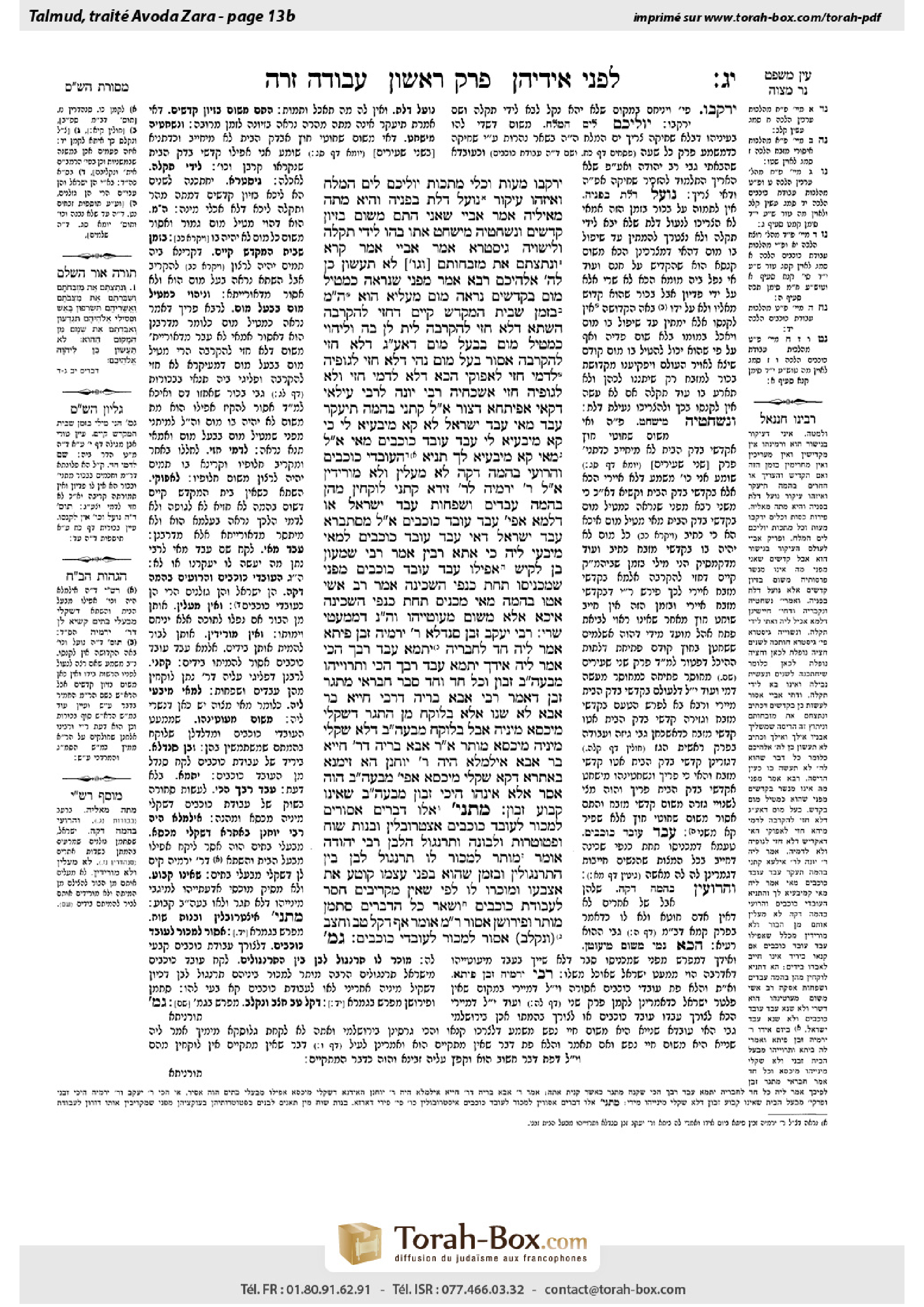
This page of Avodah Zarah includes the Aramaic text, an English translation and an AI-generated French translation, alongside the scan above.
עבודה זרה י״ג ב · Aramaic and Hebrew text
יֵרָקְבוּ, מָעוֹת וּכְלֵי מַתָּכוֹת — יוֹלִיכֵם לְיָם הַמֶּלַח, וְאֵיזֶהוּ עִיקּוּר? נוֹעֵל דֶּלֶת בְּפָנֶיהָ, וְהִיא מֵתָה מֵאֵילֶיהָ!
אָמַר אַבַּיֵּי: שָׁאנֵי הָתָם, מִשּׁוּם בִּזְיוֹן קָדָשִׁים. וְנִשְׁחֲטֵיהּ מִישְׁחָט! אָתוּ בְּהוּ לִידֵי תַקָּלָה.
וְלִישַׁוְּיֵהּ גִּיסְטְרָא! אָמַר אַבָּיֵי: אָמַר קְרָא ״וְנִתַּצְתֶּם אֶת מִזְבְּחֹתָם וְגוֹ׳ לֹא תַעֲשׂוּן כֵּן לַה׳ אֱלֹהֵיכֶם״.
רָבָא אָמַר: מִפְּנֵי שֶׁנִּרְאֶה כְּמֵטִיל מוּם בְּקָדָשִׁים. נִרְאֶה? מוּם מְעַלְּיָא הוּא! הָנֵי מִילֵּי בִּזְמַן שֶׁבֵּית הַמִּקְדָּשׁ קַיָּים, דַּחֲזֵי לְהַקְרָבָה. הַשְׁתָּא דְּלָא חֲזֵי לְהַקְרָבָה — לֵית לַן בַּהּ.
וְלִיהְוֵי כְּמֵטִיל מוּם בְּבַעַל מוּם, דְּאַף עַל גַּב דְּלָא חֲזֵי לְהַקְרָבָה — אָסוּר! בַּעַל מוּם, נְהִי דְּלָא חֲזֵי לְגוּפֵיהּ — לִדְמֵי חֲזֵי, לְאַפּוֹקֵי הָכָא, דְּלָא לִדְמֵי חֲזֵי וְלָא לְגוּפֵיהּ חֲזֵי.
אַשְׁכְּחֵיהּ רַבִּי יוֹנָה לְרַבִּי עִילַּאי דְּקָאֵי אַפִּיתְחָא דְּצוֹר, אֲמַר לֵיהּ: קָתָנֵי ״בְּהֵמָה תֵּיעָקֵר״, עֶבֶד מַאי? עֶבֶד יִשְׂרָאֵל לָא קָא מִיבַּעְיָא לִי. כִּי קָא מִיבַּעְיָא לִי עֶבֶד גּוֹי, מַאי? אֲמַר לֵיהּ: מַאי קָא מִיבַּעְיָא לְךָ? תַּנְיָא: הַגּוֹיִם (והרועי) [וְהָרוֹעִים] בְּהֵמָה דַּקָּה לֹא מַעֲלִין וְלֹא מוֹרִידִין.
אֲמַר לֵיהּ רַבִּי יִרְמְיָה לְרַבִּי זֵירָא: קָתָנֵי לוֹקְחִין מֵהֶן בְּהֵמָה עֲבָדִים וּשְׁפָחוֹת, עֶבֶד יִשְׂרָאֵל אוֹ דִלְמָא אֲפִילּוּ עֶבֶד גּוֹי? אֲמַר לֵיהּ: מִסְתַּבְּרָא עֶבֶד יִשְׂרָאֵל, דְּאִי עֶבֶד גּוֹי לְמַאי מִיבְּעֵי לֵיהּ? כִּי אֲתָא רָבִין אָמַר רַבִּי שִׁמְעוֹן בֶּן לָקִישׁ: אֲפִילּוּ עֶבֶד גּוֹי, מִפְּנֵי שֶׁמַּכְנִיסוֹ תַּחַת כַּנְפֵי הַשְּׁכִינָה.
אָמַר רַב אָשֵׁי: אַטּוּ בְּהֵמָה מַאי ״מַכְנִיס תַּחַת כַּנְפֵי הַשְּׁכִינָה״ אִיכָּא? אֶלָּא מִשּׁוּם מִעוּטַיְיהוּ, וְהָכָא נָמֵי דִּמְמַעֲטִי — שְׁרֵי.
רַבִּי יַעֲקֹב זְבַן סַנְדָּלָא, רַבִּי יִרְמְיָה זְבַן פִּיתָּא. אֲמַר לֵיהּ חַד לְחַבְרֵיהּ: יַתְמָא, עֲבַד רַבָּךְ הָכִי? אֲמַר לֵיהּ אִידַּךְ: יַתְמָא, עֲבַד רַבָּךְ הָכִי? וְתַרְוַיְיהוּ מִבַּעַל הַבַּיִת זְבוּן, וְכׇל חַד וְחַד סָבַר: חַבְרַאי מִתַּגָּר זְבַן. דְּאָמַר רַבִּי אַבָּא בְּרֵיהּ דְּרַבִּי חִיָּיא בַּר אַבָּא: לֹא שָׁנוּ אֶלָּא בְּלוֹקֵחַ מִן הַתַּגָּר, דְּשָׁקְלִי מִיכְסָא מִינֵּיהּ, אֲבָל בְּלוֹקֵחַ מִבַּעַל הַבַּיִת, דְּלָא שָׁקְלִי מִינֵּיהּ מִיכְסָא — מוּתָּר.
אָמַר רַבִּי אַבָּא בְּרֵיהּ דְּרַבִּי חִיָּיא בַּר אַבָּא: אִילְמָלֵא הָיָה רַבִּי יוֹחָנָן הָא זִימְנָא בְּאַתְרָא דְּקָא שָׁקְלִי מִיכְסָא, אֲפִילּוּ מִבַּעַל הַבַּיִת הֲוָה אָסַר. אֶלָּא אִינְהוּ הֵיכִי זְבוּן? מִבַּעַל הַבַּיִת שֶׁאֵינוֹ קָבוּעַ זְבוּן.
מַתְנִי׳ אֵלּוּ דְּבָרִים אֲסוּרִים לִמְכּוֹר לְגוֹי: אִצְטְרוֹבְלִין, וּבְנוֹת שׁוּחַ, וּפְטוֹטָרוֹת, וּלְבוֹנָה, וְתַרְנְגוֹל הַלָּבָן. רַבִּי יְהוּדָה אוֹמֵר: מוּתָּר לִמְכּוֹר לוֹ תַּרְנְגוֹל לָבָן בֵּין הַתַּרְנְגוֹלִין, וּבִזְמַן שֶׁהוּא בִּפְנֵי עַצְמוֹ — קוֹטֵעַ אֶת אֶצְבָּעוֹ וּמוֹכְרוֹ לוֹ, לְפִי שֶׁאֵין מַקְרִיבִים חָסֵר לַעֲבוֹדָה זָרָה.
וּשְׁאָר כׇּל הַדְּבָרִים, סְתָמָן מוּתָּר, וּפֵירוּשָׁן אָסוּר. רַבִּי מֵאִיר אוֹמֵר: אַף דֶּקֶל טָב וְחָצָב (ונקלב) [וְנִקְלָבֵס] אָסוּר לִמְכּוֹר לַגּוֹיִם.
Avodah Zarah 13b · English translation
he should store them until they decompose. And if he dedicated money or metal vessels, he should take them and cast them into the Dead Sea. And what constitutes destroying? He locks the door before it, and the animal dies on its own from hunger. According to the baraita, the disposal of the animal is carried out by starving it, not by cutting its hooves.
Abaye said: There, in the case of a consecrated animal, the method employed is different, because cutting the animal’s hooves would cause the degradation of sacrificial animals. The Gemara asks: But why does the baraita require this complicated method of killing the animal? Why not simply state that he should slaughter it? The Gemara answers: If he were to slaughter it, someone might come to experience a mishap through it, by eating the meat and thereby misusing consecrated property.
The Gemara asks: But why not let him render the animal a shard [gistera], by mutilating it so that it is unfit to be eaten? Why is it necessary to kill it in such a drawn-out fashion, by starving it to death? Abaye said that it is because the verse states: “And you shall break down their altars…you shall not do so to the Lord your God” (Deuteronomy 12:3–4). It is derived from here that one may not actively destroy any sacred item.
Rava said there is a different reason a consecrated animal may not be disposed of by cutting its hooves: It is because it appears as though he is inflicting a blemish on a sacrificial animal. The Gemara asks: Why does Rava say that it merely appears as though he is inflicting a blemish, when in actual fact he is inflicting a full-fledged blemish? The Gemara answers: This matter, that one may not inflict a blemish on a sacrificial animal, applies only when the Temple is standing, as the animal is fit for sacrifice and he renders it unfit. By contrast, now, when the animal is not fit for sacrifice, since there is no Temple, we have no problem with it by Torah law. The only problem is that it appears as though one is inflicting a blemish on a sanctified animal.
The Gemara asks: But this should be considered equivalent to one who inflicts a blemish on an animal that is already blemished, which is prohibited even though that animal is not fit for sacrifice. The Gemara answers: In the case of a blemished animal when the Temple is standing it is prohibited to inflict a blemish upon it, as granted, it itself is not fit to serve as an offering; but it is fit to make use of its monetary value, i.e., another animal may be purchased with the proceeds of its sale and sacrificed in its place. This is to the exclusion of the case here, when there is no Temple, as the animal is not fit for its monetary value and it is not fit to serve as an offering itself.
§ Rabbi Yona found Rabbi Elai, who was standing at the entrance to the city of Tyre. Rabbi Yona said to him: The baraita cited above teaches that if one bought an animal at a pagan fair it should be destroyed. What should be done with a slave purchased at the fair? Rabbi Yona elaborated: I do not raise the dilemma about a Jewish slave, as it is obvious that the master cannot cause him harm. Where it is a dilemma for me is the case of a gentile slave; what is the halakha? Rabbi Elai said to him in response: What is the reason that this is a dilemma for you? It is taught in a baraita: With regard to the gentiles and shepherds of small domesticated animals, we do not raise them from a pit but we do not actively lower them into a pit either. It may be inferred from here that one may not cause the death of a gentile slave.
Rabbi Yirmeya said to Rabbi Zeira: The second baraita cited above teaches that one may go to a pagan fair and buy from the gentiles animals, slaves, and maidservants. Does the baraita mean that one may buy a Jewish slave, or perhaps, is it teaching that one may buy even a gentile slave? Rabbi Zeira said to him: It stands to reason that the baraita means specifically a Jewish slave; as, if it is referring to a gentile slave, what is the reason that it is necessary for the Sages to permit this purchase? When Ravin came from Eretz Yisrael to Babylonia, he said that Rabbi Shimon ben Lakish says: It is permitted to purchase even a gentile slave, because he brings him under the wings of the Divine Presence by having him undergo the process of conversion when he becomes the slave of a Jew.
Rav Ashi said: But with regard to the permission to buy an animal, what is there about this purchase that one can be said to bring the animal under the wings of the Divine Presence? Rather, the reason it is permitted is because through this purchase the Jew reduces the possessions of the gentile. And here too, as he reduces the gentile’s property by purchasing the slave, it is permitted.
The Gemara relates: Rabbi Ya’akov bought sandals and Rabbi Yirmeya bought bread at a pagan fair. One said to the other: Orphan, i.e., one with no guide, would your teacher act in this manner? The other likewise said to him: Orphan, would your teacher act in this manner? The Gemara explains: Actually, both purchased these items from a homeowner, i.e., a private individual, and each one thought that the other had purchased his item from a merchant. As Rabbi Abba, son of Rabbi Ḥiyya bar Abba, says: The Sages taught that it is prohibited to buy from a gentile at a pagan fair only in the case of one who buys from a merchant, as a tax is taken from him and used for the benefit of idol worship. But with regard to one who buys from a homeowner, when a tax is not taken from him, it is permitted to make the purchase.
Rabbi Abba, son of Rabbi Ḥiyya bar Abba, says: If Rabbi Yoḥanan had been present at this time and age, in a place where the tax is taken from all sales, including those conducted with private individuals, he would have prohibited buying items even from a homeowner. The Gemara asks: But if so, how did these Sages, Rabbi Ya’akov and Rabbi Yirmeya, purchase items at the fair? The Gemara answers: They purchased the items from a homeowner who sells solely on a temporary basis.
MISHNA: These are the items that it is prohibited to sell to a gentile at any time of year, as they are used specifically for idol worship: Itzterubalin, benot shuaḥ, petotarot, frankincense, and a white rooster. Rabbi Yehuda says: It is permitted to sell a white rooster to a gentile provided that it is sold along with other types of roosters. But when it is sold by itself, one should cut off its toe and sell it to the gentile, because they do not sacrifice a defective animal to their object of idol worship.
And with regard to all remaining items, without specification it is permitted to sell them, but with specification it is prohibited to sell them. Rabbi Meir says: Even in the case of a good palm tree, ḥatzav, and naklav, it is prohibited to sell them to gentiles.
Avodah Zarah 13b · Traduction française (IA)
il doit les conserver jusqu'à ce qu'ils se décomposent. Et s'il a consacré de l'argent ou des vases métalliques, il doit les prendre et les jeter dans la Mer Morte. Et qu'est-ce qui constitue la destruction ? Il verrouille la porte avant, et l'animal meurt de faim. Selon la baraïta, la destruction de l'animal est accomplie en le laissant mourir de faim, et non en coupant ses sabots.
Abaye dit : Là, dans le cas d'un animal consacré, la méthode employée est différente, car couper les sabots de l'animal provoquerait la dégradation des animaux sacrés. La Guemara demande : Mais pourquoi la baraïta exige-t-elle cette méthode complexe de mise à mort de l'animal ? Pourquoi ne pas simplement dire qu'il doit le sacrifier ? La Guemara répond : S'il le sacrifiait, quelqu'un pourrait avoir un accident en consommant la viande et ainsi abuser de la propriété consacrée.
La Guemara demande : Mais pourquoi ne pas lui faire rendre l'animal inutilisable [gistera], en le mutilant de sorte qu'il ne soit pas comestible ? Pourquoi est-il nécessaire de le tuer de cette manière prolongée, en le laissant mourir de faim ? Abaye dit que c'est parce que la Parashah dit : « Et tu démoliras leurs autels… tu ne le fais pas au Seigneur ton Dieu » (Deutéronome 12:3–4). On en déduit ici que l'on ne doit pas détruire activement tout objet sacré.
Rava dit qu'il y a une autre raison pour laquelle un animal consacré ne peut être détruit en coupant ses sabots : c'est parce qu'il semble qu'on inflige une imperfection à un animal sacré. La Guemara demande : Pourquoi Rava dit-il qu'il semble qu'on inflige une imperfection, alors qu'en réalité on en inflige une imperfection complète ? La Guemara répond : Cette interdiction, qui stipule qu'on ne doit pas infliger une imperfection à un animal sacré, s'applique uniquement lorsque le Temple est debout, car l'animal est apte au sacrifice et on le rend inapte. En revanche, maintenant, lorsque l'animal n'est pas apte au sacrifice, puisque le Temple n'existe plus, nous n'avons pas de problème selon la Loi. Le seul problème est qu'il semble qu'on inflige une imperfection à un animal sanctifié.
La Guemara demande : Mais cela devrait être considéré comme équivalent à celui qui inflige une imperfection à un animal déjà imperfectionné, ce qui est interdit même si cet animal n'est pas apte au sacrifice. La Guemara répond : Dans le cas d'un animal imperfectionné lorsque le Temple est debout, il est interdit d'infliger une imperfection à cet animal, comme on le reconnaît, il n'est pas apte à servir d'offrande ; mais il est apte à utiliser sa valeur monétaire, c'est-à-dire qu'un autre animal peut être acheté avec les revenus de sa vente et sacrifié à sa place. Cela exclut le cas présent, où il n'y a pas de Temple, car l'animal n'est pas apte à sa valeur monétaire et il n'est pas apte à servir d'offrande.
§ Rabbi Yona a trouvé Rabbi Elai, qui était debout à l'entrée de la ville de Tyr. Rabbi Yona a dit à lui : La baraïta citée ci-dessus enseigne que si l'on achète un animal à un marché païen, il doit être détruit. Que faire d'un esclave acheté à ce marché ? Rabbi Yona a développé : Je ne soulève pas le dilemme concernant un esclave juif, car il est évident que le maître ne peut pas le nuire. C'est un dilemme pour moi dans le cas d'un esclave païen ; quelle est la halakha ? Rabbi Elai a répondu à lui : Quel est le motif pour lequel cela est un dilemme pour vous ? Il est enseigné dans une baraïta : Concernant les païens et les bergers d'animaux domestiques, nous ne les relevons pas d'un puits, mais nous ne les descendons pas activement non plus dans un puits. On peut en déduire ici que l'on ne doit pas causer la mort d'un esclave païen.
Rabbi Yirmeya a dit à Rabbi Zeira : La deuxième baraïta citée ci-dessus enseigne qu'on peut aller à un marché païen et acheter des animaux, des esclaves et des servantes. Le baraïta signifie-t-il qu'on peut acheter un esclave juif, ou peut-être enseigne-t-il qu'on peut acheter même un esclave païen ? Rabbi Zeira a dit à lui : Il est logique que le baraïta signifie spécifiquement un esclave juif ; car, si c'est à propos d'un esclave païen, pourquoi les Sages auraient-ils besoin de permettre cette acquisition ? Quand Ravin est venu de la Terre d'Israël en Babylone, il a dit que Rabbi Shimon ben Lakish dit : Il est permis d'acheter même un esclave païen, car il le met sous les ailes de la Divine Présence en le faisant subir le processus de conversion lorsqu'il devient l'esclave d'un Juif.
Rav Ashi a dit : Mais concernant la permission d'acheter un animal, qu'y a-t-il dans cette acquisition qui puisse être dit de mettre l'animal sous les ailes de la Divine Présence ? Plutôt, la raison pour laquelle cela est permis est que par cette acquisition, le Juif réduit les biens du païen. Et ici aussi, puisqu'il réduit les biens du païen en achetant l'esclave, cela est permis.
La Guemara rapporte : Rabbi Ya'akov a acheté des sandales et Rabbi Yirmeya a acheté du pain à un marché païen. On a dit à l'autre : Orphelin, c'est-à-dire celui qui n'a pas de guide, agirait votre maître ainsi ? L'autre a dit à lui aussi : Orphelin, agirait votre maître ainsi ? La Guemara explique : En réalité, ils ont acheté ces objets d'un propriétaire, c'est-à-dire un individu privé, et chacun pensait que l'autre avait acheté son objet d'un marchand. Comme Rabbi Abba, fils de Rabbi Ḥiyya bar Abba, dit : Les Sages ont enseigné que c'est interdit d'acheter auprès d'un païen à un marché païen uniquement dans le cas où l'on achète auprès d'un marchand, car une taxe est prise sur lui et utilisée pour le bénéfice de l'idolâtrie. Mais concernant celui qui achète auprès d'un propriétaire, lorsque la taxe n'est pas prise sur lui, il est permis d'effectuer l'achat.
Rabbi Abba, fils de Rabbi Ḥiyya bar Abba, dit : Si Rabbi Yoḥanan avait été présent à cette époque et dans un lieu où la taxe est prise sur toutes les ventes, y compris celles effectuées avec des individus privés, il aurait interdit d'acheter des objets même auprès d'un propriétaire. La Guemara demande : Mais si c'est ainsi, comment ces Sages, Rabbi Ya'akov et Rabbi Yirmeya, ont-ils pu acheter des objets à la foire ? La Guemara répond : Ils ont acheté les objets auprès d'un propriétaire qui vend uniquement de manière temporaire.
MICHNA : Ces sont les objets qui il est interdit de vendre à un non-Juif à tout moment de l'année, car ils sont utilisés spécifiquement pour l'idolâtrie : Itzterubalin, benot shuaḥ, petotarot, l'encens et un coq blanc. Rabbi Yehuda dit : Il est permis de vendre un coq blanc à un non-Juif à condition qu'il soit vendu avec d'autres types de coqs. Mais lorsqu'il est vendu seul, on doit couper son pied et le vendre au non-Juif, car ils ne sacrifient pas un animal déficient à leur objet d'idolâtrie.
Et concernant tous les autres objets restants, sans spécification il est permis de les vendre, mais avec spécification il est interdit de les vendre. Rabbi Meir dit : Même dans le cas d'un palmier bon, ḥatzav et naklav, il est interdit de les vendre aux non-Juifs.
Traduction française générée par IA à partir de l’édition anglaise de Sefaria. Vérifie toujours un passage avec le texte source.
Text from Sefaria: William Davidson Edition - Vocalized Aramaic (CC BY NC); William Davidson Edition - English (CC BY NC).