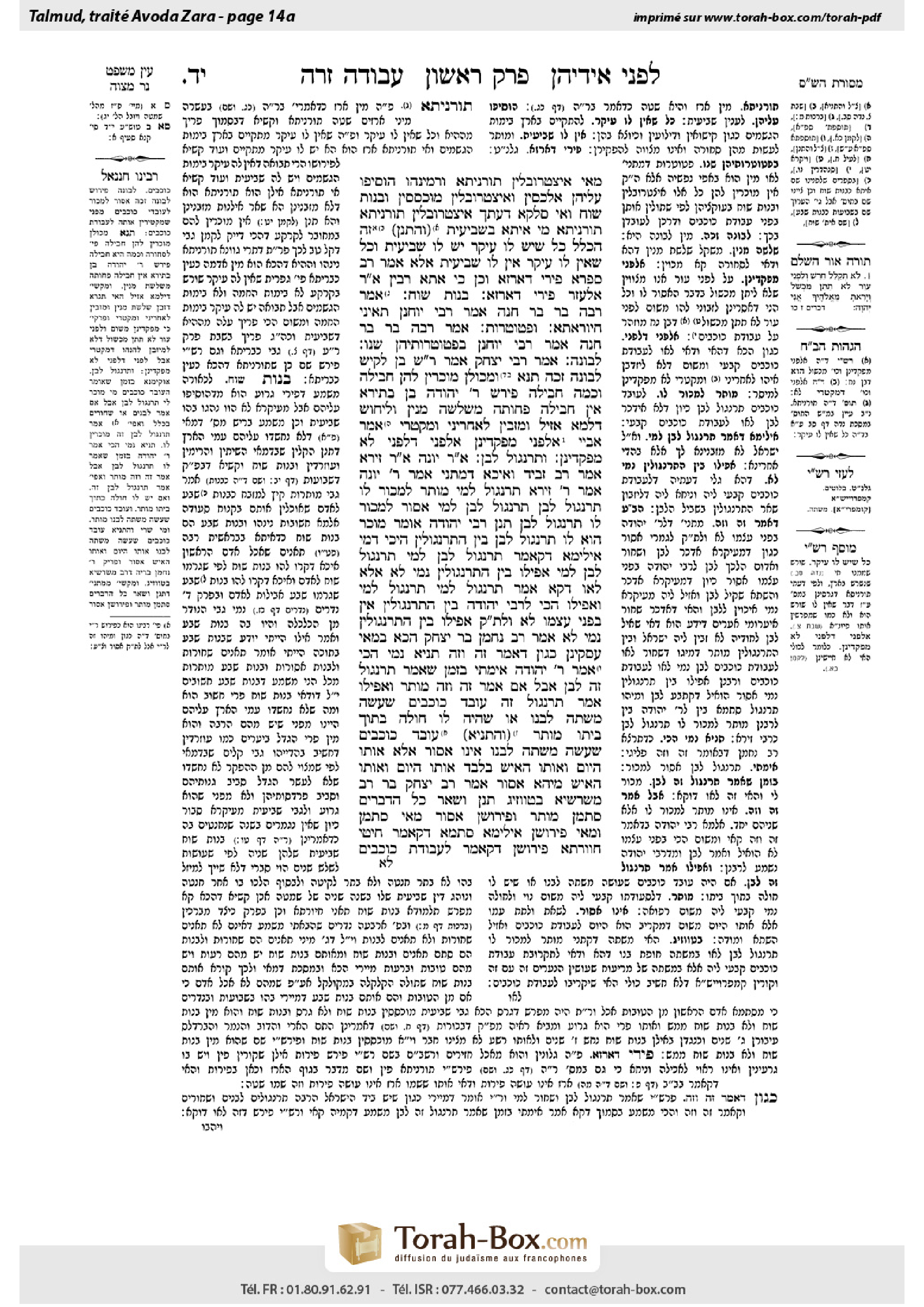
Avodah Zarah 14a: Talmud study for Daf Yomi
Study the Talmud for Daf Yomi with scanned pages, Hebrew text, English translations from Sefaria and AI-generated French translations.
Passage selection and English or AI-generated French translation are available where the scan has annotations. Daf Study is independent of Torah-Box and Sefaria.
Browse Avodah Zarah · עבודה זרה · All tractatesAvodah Zarah 14a text and translations
This page of Avodah Zarah includes the Aramaic text, an English translation and an AI-generated French translation, alongside the scan above.
עבודה זרה י״ד א · Aramaic and Hebrew text
גְּמָ׳ מַאי ״אִיצְטְרוֹבְלִין״? תּוּרְנִיתָא. וּרְמִינְהוּ: הוֹסִיפוּ עֲלֵיהֶן אֲלֶכְסִין וְאִיצְטְרוֹבְלִין, מוֹכְסָסִין וּבְנוֹת שׁוּחַ, וְאִי סָלְקָא דַעְתָּךְ אִיצְטְרוֹבְלִין תּוּרְנִיתָא — תּוּרְנִיתָא מִי אִיתָא בִּשְׁבִיעִית?
וְהָתְנַן: ״זֶה הַכְּלָל: כֹּל שֶׁיֵּשׁ לוֹ עִיקָּר — יֵשׁ לוֹ שְׁבִיעִית, וְכֹל שֶׁאֵין לוֹ עִיקָּר — אֵין לוֹ שְׁבִיעִית״! אֶלָּא אָמַר רַב סָפְרָא: פֵּירֵי דְּאַרְזָא, וְכֵן כִּי אֲתָא רָבִין אָמַר רַבִּי אֶלְעָזָר: פֵּירֵי דְּאַרְזָא.
בְּנוֹת שׁוּחַ — אָמַר רַבָּה בַּר בַּר חָנָה אָמַר רַבִּי יוֹחָנָן: תְּאֵינֵי חִיוָּרָאתָא. וּפְטוֹטָרוֹת — אָמַר רַבָּה בַּר בַּר חָנָה אָמַר רַבִּי יוֹחָנָן: בִּפְטוֹטְרוֹתֵיהֶן שָׁנוּ.
לְבוֹנָה — אָמַר רַבִּי יִצְחָק אָמַר רַבִּי שִׁמְעוֹן בֶּן לָקִישׁ: לְבוֹנָה זַכָּה. תָּנָא: וּמִכּוּלָּן מוֹכְרִין לָהֶן חֲבִילָה, וְכַמָּה חֲבִילָה? פֵּירֵשׁ רַבִּי יְהוּדָה בֶּן בְּתִירָא: אֵין חֲבִילָה פְּחוּתָה מִשְּׁלֹשָׁה מָנִין.
וְלֵיחוּשׁ דִּלְמָא אָזֵיל וּמְזַבֵּין לְאַחֲרִינֵי וּמַקְטְרִי! אָמַר אַבָּיֵי: אַ״לִּפְנֵי״ מִפַּקְּדִינַן, אַ״לִּפְנֵי״ דְּ״לִפְנֵי״ לָא מִפַּקְּדִינַן.
וְתַרְנְגוֹל לָבָן. אָמַר רַבִּי יוֹנָה אָמַר רַבִּי זֵירָא אָמַר רַב זְבִיד, וְאִיכָּא דְּמַתְנֵי אָמַר רַבִּי יוֹנָה אָמַר רַבִּי זֵירָא: ״תַּרְנְגוֹל לְמִי״ — מוּתָּר לִמְכּוֹר לוֹ תַּרְנְגוֹל לָבָן, ״תַּרְנְגוֹל לָבָן לְמִי״ — אָסוּר לִמְכּוֹר לוֹ תַּרְנְגוֹל לָבָן.
תְּנַן: רַבִּי יְהוּדָה אוֹמֵר: מוֹכֵר הוּא לוֹ תַּרְנְגוֹל לָבָן בֵּין הַתַּרְנְגוֹלִין. הֵיכִי דָמֵי? אִילֵּימָא דְּקָאָמַר: ״תַּרְנְגוֹל לָבָן לְמִי, תַּרְנְגוֹל לָבָן לְמֵי״ — אֲפִילּוּ בֵּין הַתַּרְנְגוֹלִין נָמֵי לָא!
אֶלָּא לָאו דְּקָא אָמַר ״תַּרְנְגוֹל לְמִי, תַּרְנְגוֹל לְמִי״, וַאֲפִילּוּ הָכִי, לְרַבִּי יְהוּדָה, בֵּין הַתַּרְנְגוֹלִין — אִין, בִּפְנֵי עַצְמוֹ — לָא, וּלְתַנָּא קַמָּא אֲפִילּוּ בֵּין הַתַּרְנְגוֹלִין נָמֵי לָא!
אָמַר רַב נַחְמָן בַּר יִצְחָק: הָכָא בְּמַאי עָסְקִינַן? כְּגוֹן דְּאָמַר ״זֶה וָזֶה״.
תַּנְיָא נָמֵי הָכִי, אָמַר רַבִּי יְהוּדָה: אֵימָתַי? בִּזְמַן שֶׁאָמַר ״תַּרְנְגוֹל זֶה לָבָן״, אֲבָל אִם אָמַר ״זֶה וָזֶה״ — מוּתָּר. וַאֲפִילּוּ אָמַר ״תַּרְנְגוֹל זֶה״, גּוֹי שֶׁעָשָׂה מִשְׁתֶּה לִבְנוֹ אוֹ שֶׁהָיָה לוֹ חוֹלֶה בְּתוֹךְ בֵּיתוֹ — מוּתָּר.
וְהָתַנְיָא: גּוֹי שֶׁעָשָׂה מִשְׁתֶּה לִבְנוֹ, אֵינוֹ אָסוּר אֶלָּא אוֹתוֹ הַיּוֹם וְאוֹתוֹ הָאִישׁ בִּלְבַד. אוֹתוֹ הַיּוֹם וְאוֹתוֹ הָאִישׁ מִיהָא אָסוּר! אָמַר רַב יִצְחָק בַּר רַב מְשַׁרְשְׁיָא: בְּטַוְוזִיג.
תְּנַן: וּשְׁאָר כׇּל הַדְּבָרִים — סְתָמָן מוּתָּר, וּפֵירוּשָׁן אָסוּר. מַאי סְתָמָן וּמַאי פֵּירוּשָׁן? אִילֵּימָא: סְתָמָא דְּקָאָמַר חִיטֵּי חִוָּורָתָא, פֵּירוּשָׁן דְּקָאָמַר לַעֲבוֹדָה זָרָה.
Avodah Zarah 14a · English translation
GEMARA: The Gemara analyzes the terms in the mishna: What is the meaning of itzterubalin? This is the plant known as torenita. And the Gemara raises a contradiction from a baraita: The Sages added to the list of plants whose use is prohibited during the Sabbatical Year: Alekesin and itzterubalin, mukhsasin, and benot shuaḥ. And if it would enter your mind to say that itzterubalin is torenita, is there torenita that is subject to the halakhot of the Sabbatical Year?
The Gemara explains: But didn’t we learn in a baraita that this is the principle: Anything that has a root and grows is subject to the halakhot of the Sabbatical Year, and anything that does not have a root is not subject to the halakhot of the Sabbatical Year? If so, torenita, which has no roots, is not subject to the halakhot of the Sabbatical Year, and therefore it cannot be identified as itzterubalin. Rather, Rav Safra says: What is itzterubalin? It is the fruit of the cedar tree. And similarly, when Ravin came from Eretz Yisrael, he said that Rabbi Elazar says: Itzterubalin is the fruit of the cedar tree.
The mishna includes benot shuaḥ among the items one may not sell to a gentile. Rabba bar bar Ḥana says that Rabbi Yoḥanan says: These are white figs. The mishna states: And petotarot. Rabba bar bar Ḥana says that Rabbi Yoḥanan says: This is not another type of fruit; rather, the mishna here taught that the sale of the various fruits listed in the mishna is prohibited only when they are sold with their stems, not if they have been pruned.
The mishna taught that selling frankincense to gentiles is prohibited. Rabbi Yitzḥak says that Rabbi Shimon ben Lakish says: The mishna is referring specifically to pure frankincense, which is used as incense for objects of idol worship. A Sage taught: And with regard to all of these items whose sale is prohibited, one may sell to gentiles a large bundle of merchandise, as it is clear that the gentile intends to sell the merchandise rather than sacrifice it to his object of idol worship. And how much does such a bundle weigh? Rabbi Yehuda ben Beteira explained: For the purposes of this halakha, no bundle is less than the weight of three hundred dinars.
The Gemara raises a difficulty: But let us be concerned lest the buyer go and sell these items to another gentile, and they sacrifice them. Abaye said in response: This scenario is certainly possible, but we are commanded only not to “place a stumbling block before the blind” (Leviticus 19:14), i.e., one may not be the direct cause of a gentile’s idol worship. We are not commanded not to place a stumbling block before one who may subsequently place it before the blind.
§ The mishna teaches: And it is prohibited to sell a white rooster to a gentile. Rabbi Yona says that Rabbi Zeira says that Rav Zevid says the following ruling; and there are those who teach merely that Rabbi Yona says that Rabbi Zeira says it. If a gentile says: Who has a rooster, without specifying any particular type, it is permitted to sell him a white rooster. But if he says: Who has a white rooster, it is prohibited to sell him a white rooster.
The Gemara raises an objection to this opinion. We learned in the mishna that Rabbi Yehuda says: He may sell a white rooster to a gentile, provided that it is sold along with other types of roosters. What are the circumstances? If we say that the gentile says: Who has a white rooster, who has a white rooster; in that case one may not provide him a white rooster even if it is sold along with other roosters, as the gentile specified that he wants a white rooster.
Rather, is it not referring to a case where the gentile says: Who has a rooster, who has a rooster; without mentioning a white rooster, and even so, according to Rabbi Yehuda if he sells him a white rooster along with other roosters then yes, it is permitted, but selling only a white rooster by itself is not permitted? And one can infer that according to the first tanna, who prohibits the sale of a white rooster, one may not sell him a white rooster even if it is sold along with other roosters. This does not accord with the statement of Rabbi Yona, who rules that if the gentile says: Who has a rooster, without specifying any particular type, it is permitted to sell him even a white rooster.
Rav Naḥman bar Yitzḥak said: The mishna is not discussing the case of a gentile who asks for a rooster without specifying its color, as everyone agrees that in such a situation it is permitted to sell him a white rooster. Rather, here we are dealing with a case where the Jew had several different roosters, and the gentile says, pointing to different roosters: Sell me this one and that one, and one of the roosters he chose was white.
The Gemara notes that this explanation is also taught in a baraita. Rabbi Yehuda said: When is selling a white rooster prohibited? It is prohibited when the gentile said: Sell me this white rooster. But if he said: Sell me this one and that one, it is permitted. And even if he said: Sell me this rooster, and he pointed to a white rooster, in the case of a gentile who is preparing a feast for his son or who has a sick person in his house, it is permitted to sell it to him, as it is clear that he wants it for the celebration for his son or for the sick person, not for idol worship.
The Gemara asks: But isn’t it taught in a mishna (8a): In the case of a gentile who made a feast for his son, engaging in business is prohibited only on that day, and with that man alone? This indicates that in any event, conducting business on that day and with that man is prohibited. Rav Yitzḥak bar Rav Mesharshiyya said: The baraita is speaking about a picnic [betavuzig], i.e., a social gathering rather than a wedding feast. A mere social gathering does not include the sacrifice of offerings to idolatry.
§ We learned in the mishna: And with regard to all remaining items, without specification it is permitted to sell them, but with specification it is prohibited to sell them. The Gemara asks: What is the meaning of: Without specification, and what is meant by: With specification? If we say that without specification is referring to a case when the gentile says that he wants white wheat without stating the reason he wants it, and with specification is referring to a case when he says that he will use the wheat for idol worship, why is it necessary for the mishna to teach this halakha?
Avodah Zarah 14a · Traduction française (IA)
GUEMARA : La Guemara analyse les termes de la michna : Quelle est la signification d'itzterubalin ? C'est la plante connue sous le nom de torenita. Et la Guemara soulève une contradiction à partir d'une baraïta : Les Sages ont ajouté à la liste des plantes dont l'utilisation est interdite pendant l'année sabbatique : Alekesin et itzterubalin, mukhsasin et benot shuaḥ. Et si l'idée vous venait à l'esprit de dire que itzterubalin est torenita, y a-t-il torenita soumise aux halakhot de l'année sabbatique ?
La Guemara explique : N'avons-nous pas appris dans une baraïta que ce principe est le suivant : Tout ce qui a une racine et pousse est soumis aux halakhot de l'année sabbatique, et tout ce qui n'a pas de racine n'est pas soumis aux halakhot de l'année sabbatique ? Si c'est le cas, torenita, qui n'a pas de racines, n'est pas soumise aux halakhot de l'année sabbatique, et par conséquent ne peut être identifiée comme itzterubalin. Plutôt, Rav Safra dit : Qu'est-ce qu'itzterubalin ? C'est le fruit de l'arbre de cèdre. De même, lorsque Ravin est venu d'Eretz Yisrael, il a dit que Rabbi Elazar dit : Itzterubalin est le fruit de l'arbre de cèdre.
La michna inclut benot shuaḥ parmi les choses dont on ne peut pas vendre à un non-Juif. Rabba bar bar Ḥana dit que Rabbi Yoḥanan dit : Ce sont des figues blanches. La michna stipule : Et petotarot. Rabba bar bar Ḥana dit que Rabbi Yoḥanan dit : Ce n'est pas un autre type de fruit ; plutôt, la michna ici enseigne que la vente des divers fruits listés dans la michna est interdite uniquement lorsqu'ils sont vendus avec leurs tiges, pas si ils ont été taillés.
La michna enseigne que vendre de l'encens à des non-Juifs est interdit. Rabbi Yitzḥak dit que Rabbi Shimon ben Lakish dit : La michna fait référence spécifiquement à l'encens pur, utilisé comme parfum pour les objets d'idolâtrie. Un Sage a enseigné : Et concernant tous ces objets dont la vente est interdite, on peut vendre à des non-Juifs un grand paquet de marchandises, car il est clair que le non-Juif veut vendre les marchandises plutôt que les sacrifier à son objet d'idolâtrie. Et combien pèse un tel paquet ? Rabbi Yehuda ben Beteira a expliqué : Pour l'effet de cette halakha, aucun paquet ne pèse moins que trois cents dinars.
La Guemara soulève une difficulté : Mais ne devons-nous pas avoir peur que l'acheteur aille et vende ces objets à un autre non-Juif, et qu'ils les sacrifient. Abaye a répondu : Ce scénario est certainement possible, mais nous sommes commandés uniquement de ne pas « placer un obstacle devant les aveugles » (Lévitique 19:14), c'est-à-dire qu'on ne doit pas être la cause directe de l'idolâtrie d'un non-Juif. Nous ne sommes pas commandés de ne pas placer un obstacle devant celui qui pourrait ultérieurement le placer devant les aveugles.
§ La michna enseigne : Et il est interdit de vendre un coq blanc à un non-Juif. Rabbi Yona dit que Rabbi Zeira dit que Rav Zevid a établi la suivante : et il y a ceux qui enseignent simplement que Rabbi Yona dit que Rabbi Zeira l'enseigne. Si un non-Juif dit : Qui a un coq, sans spécifier un type particulier, il est permis de lui vendre un coq blanc. Mais si il dit : Qui a un coq blanc, il est interdit de lui vendre un coq blanc.
La Guemara soulève une objection contre cet avis. Nous avons appris dans la michna que Rabbi Yehuda dit : On peut vendre un coq blanc à un non-Juif, à condition qu'il soit vendu avec d'autres types de coqs. Quelles sont les circonstances ? Si nous disons que le non-Juif dit : Qui a un coq blanc, qui a un coq blanc ; dans ce cas, on ne peut pas lui fournir un coq blanc même s'il est vendu avec d'autres coqs, car le non-Juif a spécifié qu'il veut un coq blanc.
Plutôt, n'est-ce pas en référence à un cas où le non-Juif dit : Qui a un coq, qui a un coq ; sans mentionner un coq blanc, et même ainsi, selon Rabbi Yehuda, si on lui vend un coq blanc avec d'autres coqs, alors oui, c'est permis, mais vendre uniquement un coq blanc est interdit ? Et on peut en déduire que selon le premier tanna, qui interdit la vente d'un coq blanc, on ne peut pas lui vendre un coq blanc même s'il est vendu avec d'autres coqs. Cela ne correspond pas à l'avis de Rabbi Yona, qui considère que si le non-Juif dit : Qui a un coq, sans spécifier un type particulier, il est permis de lui vendre même un coq blanc.
Rav Naḥman bar Yitzḥak a dit : La michna ne discute pas du cas d'un non-Juif qui demande un coq sans spécifier sa couleur, car tout le monde convient que dans ce cas, il est permis de lui vendre un coq blanc. Plutôt, ici nous traitons d'un cas où le Juif avait plusieurs coqs différents, et le non-Juif dit, en désignant différents coqs : Vendez-moi celui-ci et celui-là, et l'un des coqs qu'il a choisi était blanc.
La Guemara note que cette explication est également enseignée dans une baraïta. Rabbi Yehuda a dit : Quand est-il interdit de vendre un coq blanc ? C'est interdit quand le non-Juif dit : Vendez-moi ce coq blanc. Mais si il dit : Vendez-moi celui-ci et celui-là, c'est permis. Et même si il dit : Vendez-moi ce coq, et il désigne un coq blanc, dans le cas d'un non-Juif qui prépare un festin pour son fils ou qui a une personne malade chez lui, il est permis de lui vendre, car il est clair qu'il veut cela pour le festin de son fils ou pour la personne malade, pas pour l'idolâtrie.
La Guemara pose la question : Mais n'est-ce pas enseigné dans une michna (8a) : Dans le cas d'un non-Juif qui a organisé un festin pour son fils, l'activité commerciale est interdite uniquement ce jour-là, et avec cette personne uniquement ? Cela indique que dans tous les cas, l'activité commerciale ce jour-là et avec cette personne est interdite. Rav Yitzḥak bar Rav Mesharshiyya a dit : La baraïta parle d'un pique-nique [betavuzig], c'est-à-dire une réunion sociale plutôt qu'un festin de mariage. Une simple réunion sociale ne comprend pas la sacrifice d'offrandes à l'idolâtrie.
§ Nous avons appris dans la mishna : Et concernant tous les objets restants, sans spécification il est permis de les vendre, mais avec spécification il est interdit de les vendre. La Guemara pose la question : Qu'entend-on par « sans spécification » et qu'entend-on par « avec spécification » ? Si nous disons que « sans spécification » fait référence à un cas où le gentil dit qu'il veut du blé blanc sans préciser la raison pour laquelle il le veut, et que « avec spécification » fait référence à un cas où il dit qu'il utilisera le blé pour l'idolâtrie, pourquoi la mishna doit-elle enseigner cette halakha ?
Traduction française générée par IA à partir de l’édition anglaise de Sefaria. Vérifie toujours un passage avec le texte source.
Text from Sefaria: William Davidson Edition - Vocalized Aramaic (CC BY NC); William Davidson Edition - English (CC BY NC).