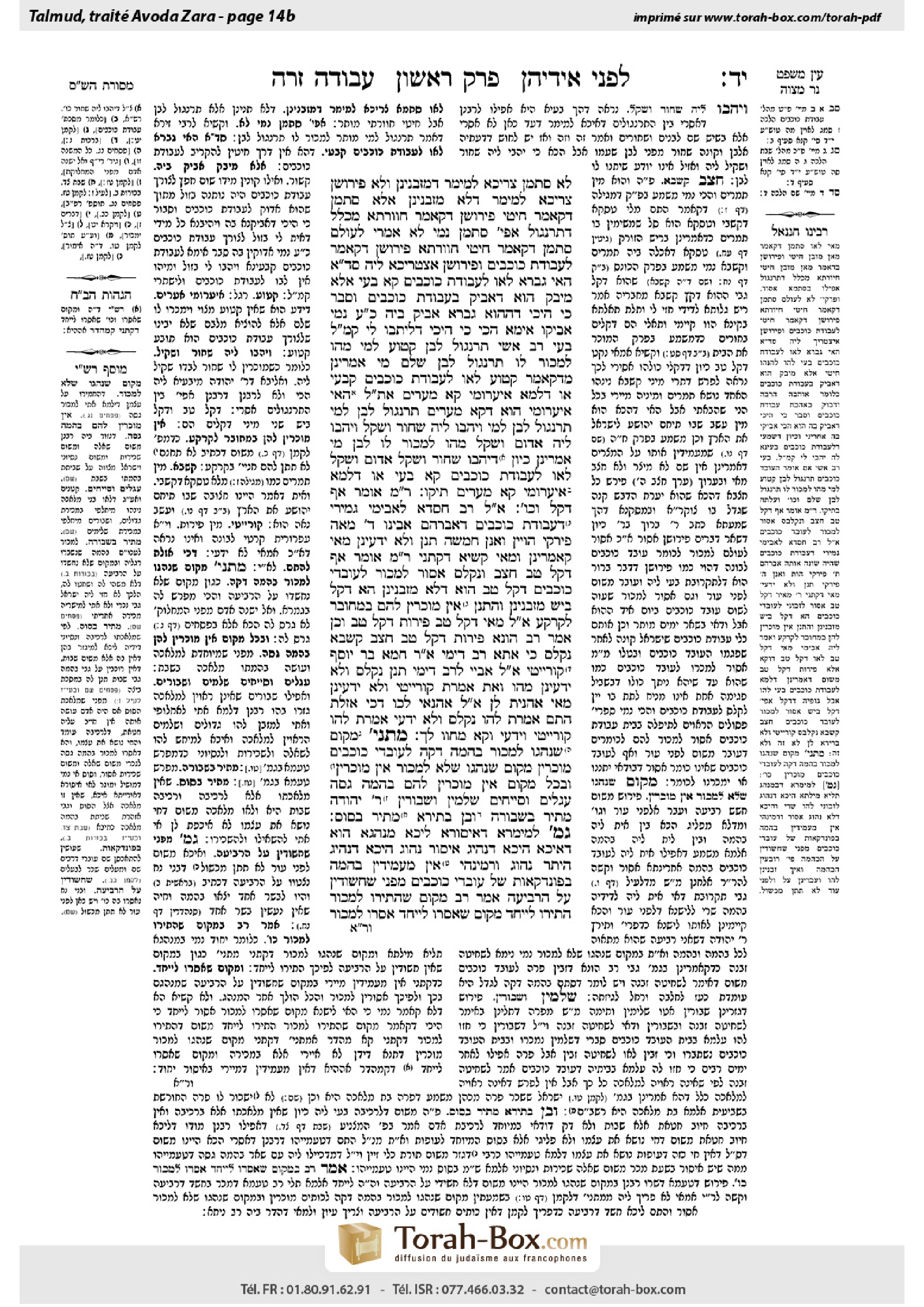
Avodah Zarah 14b: Talmud study for Daf Yomi
Study the Talmud for Daf Yomi with scanned pages, Hebrew text, English translations from Sefaria and AI-generated French translations.
Passage selection and English or AI-generated French translation are available where the scan has annotations. Daf Study is independent of Torah-Box and Sefaria.
Browse Avodah Zarah · עבודה זרה · All tractatesAvodah Zarah 14b text and translations
This page of Avodah Zarah includes the Aramaic text, an English translation and an AI-generated French translation, alongside the scan above.
עבודה זרה י״ד ב · Aramaic and Hebrew text
לָא סְתָמָן צְרִיכָא לְמֵימַר דִּמְזַבְּנִינַן, וְלָא פֵּירוּשָׁן צְרִיכָא לְמֵימַר דְּלָא מְזַבְּנִינַן, אֶלָּא סְתָמָן — דְּקָאָמַר חִיטֵּי, פֵּירוּשָׁן — דְּקָאָמַר חִוָּורָתָא.
מִכְּלָל דְּתַרְנְגוֹל, אֲפִילּוּ סְתָמָן נָמֵי לָא! אָמְרִי: לְעוֹלָם סְתָמָן — דְּקָאָמַר חִיטֵּי חִוָּורָתָא, פֵּירוּשָׁן — דְּקָאָמַר לַעֲבוֹדָה זָרָה.
וּפֵירוּשָׁן אִצְטְרִיכָא לֵיהּ, סָלְקָא דַּעְתָּךְ אָמֵינָא: הַאי גַּבְרָא לָאו לַעֲבוֹדָה זָרָה קָא בָּעֵי, אֶלָּא מֵיבָק הוּא דַּאֲבִיק בַּעֲבוֹדָה זָרָה, וְסָבַר: כִּי הֵיכִי דְּהָהוּא גַּבְרָא אֲבִיק בֵּיהּ, כּוּלֵּי עָלְמָא נָמֵי אֲבִיקוּ, אֵימָא הָכִי כִּי הֵיכִי דְּלִיתְּבוּ לִי, קָא מַשְׁמַע לַן.
בָּעֵי רַב אָשֵׁי: ״תַּרְנְגוֹל לָבָן קָטוּעַ לְמִי״, מַהוּ לִמְכּוֹר לוֹ תַּרְנְגוֹל לָבָן שָׁלֵם? מִי אָמְרִינַן: מִדְּקָאָמַר ״קָטוּעַ״, לָא לַעֲבוֹדָה זָרָה קָבָעֵי, אוֹ דִלְמָא אִיעָרוֹמֵי קָא מַעֲרֵים?
אִם תִּימְצֵי לוֹמַר הַאי אִיעָרוֹמֵי הוּא דְּקָא מַעֲרֵים, ״תַּרְנְגוֹל לָבָן לְמִי, תַּרְנְגוֹל לָבָן לְמִי״, וִיהַבוּ לֵיהּ שָׁחוֹר וּשְׁקַל, וִיהַבוּ לֵיהּ אָדוֹם וּשְׁקַל, מַהוּ לִמְכּוֹר לוֹ לָבָן? מִי אָמְרִינַן: כֵּיוָן דִּיהַבוּ שָׁחוֹר וּשְׁקַל, אָדוֹם וּשְׁקַל, לָאו לַעֲבוֹדָה זָרָה קָא בָּעֵי, אוֹ דִלְמָא אִיעָרוֹמֵי קָא מַעֲרֵים? תֵּיקוּ.
רַבִּי מֵאִיר אוֹמֵר: אַף דֶּקֶל וְכוּ׳. אֲמַר לֵיהּ רַב חִסְדָּא לַאֲבִימִי: גְּמִירִי דַּעֲבוֹדָה זָרָה דְּאַבְרָהָם אָבִינוּ אַרְבַּע מְאָה פִּירְקֵי הָוְיָין, וַאֲנַן חַמְשָׁה תְּנַן, וְלָא יָדְעִינַן מַאי קָאָמְרִינַן.
וּמַאי קַשְׁיָא? דְּקָתָנֵי: רַבִּי מֵאִיר אוֹמֵר אַף דֶּקֶל טָב, חָצָב (ונקלס) [וְנִקְלָבֵס] אָסוּר לִמְכּוֹר לַגּוֹיִם. דֶּקֶל טָב הוּא דְּלָא מְזַבְּנִינַן, הָא דֶּקֶל בִּישׁ מְזַבְּנִינַן? וְהָתְנַן: אֵין מוֹכְרִין לָהֶם בִּמְחוּבָּר לַקַּרְקַע! אֲמַר לֵיהּ: מַאי ״דֶּקֶל טָב״? פֵּירוֹת דֶּקֶל טָב. וְכֵן אֲמַר רַב הוּנָא: פֵּירוֹת דֶּקֶל טָב.
חָצָב — קַשְׁבָּא. (נקלס) [נִקְלָבֵס] — כִּי אֲתָא רַב דִּימִי אָמַר רַבִּי חָמָא בַּר יוֹסֵף: קוּרְיָיטֵי. אֲמַר לֵיהּ אַבָּיֵי לְרַב דִּימִי: תְּנַן (נקלס) [נִקְלָבֵס] וְלָא יָדְעִינַן מַהוּ, וְאַתְּ אָמְרַתְּ קוּרְיָיטֵי וְלָא יָדְעִינַן מַאי אַהֲנֵית לַן! אֲמַר לֵיהּ: אַהֲנַאי לְכוּ, דְּכִי אָזְלַתְּ הָתָם אָמְרַתְּ לְהוּ (נקלס) [נִקְלָבֵס] וְלָא יָדְעִי, אָמְרַתְּ לְהוּ קוּרְיָיטֵי וְיָדְעִי, וְקָא מַחְווּ לָךְ.
מַתְנִי׳ מָקוֹם שֶׁנָּהֲגוּ לִמְכּוֹר בְּהֵמָה דַּקָּה לַגּוֹיִם — מוֹכְרִין, מָקוֹם שֶׁנָּהֲגוּ שֶׁלֹּא לִמְכּוֹר — אֵין מוֹכְרִין. וּבְכׇל מָקוֹם אֵין מוֹכְרִין לָהֶם בְּהֵמָה גַּסָּה, עֲגָלִים וּסְיָיחִים, שְׁלֵמִין ושְׁבוּרִין. רַבִּי יְהוּדָה מַתִּיר בַּשְּׁבוּרָה, וּבֶן בְּתִירָא מַתִּיר בַּסּוּס.
גְּמָ׳ לְמֵימְרָא דְּאִיסּוּרָא לֵיכָּא, מִנְהֲגָא הוּא דְּאִיכָּא, הֵיכָא דִּנְהִיג אִיסּוּר — נְהוּג, הֵיכָא דִּנְהִיג הֶיתֵּר — נְהוּג.
וּרְמִינְהִי: אֵין מַעֲמִידִין בְּהֵמָה בְּפוּנְדְּקָאוֹת שֶׁל גּוֹיִם, מִפְּנֵי שֶׁחֲשׁוּדִין עַל הָרְבִיעָה. אָמַר רַב: מָקוֹם שֶׁהִתִּירוּ לִמְכּוֹר — הִתִּירוּ לְיַיחֵד, מָקוֹם שֶׁאָסְרוּ לְיַיחֵד — אָסְרוּ לִמְכּוֹר.
Avodah Zarah 14b · English translation
It does not need to be said that when he asks for the item without specification one may sell white wheat to him, and it does not need to be said that when he asks for it with specification one may not sell it to him, as he expressly stated that he will use it for idol worship. Rather, when the mishna says that he asks without specification, this is referring to a case where the gentile says that he wishes to buy wheat, in which case it is permitted to sell to him. If so, the case when he asks with specification is one where he says that he wants white wheat, which is an item used in idol worship, and the mishna teaches that it is prohibited to sell this to him.
By inference, this means that in the case of a rooster, referred to earlier in the mishna, even if the gentile requests without specification, i.e., without saying that he wants a white one, it is not permitted to sell it to him. This conclusion contradicts the opinion of Rabbi Zeira. The Gemara rejects this argument: Say in response that actually, without specification is referring to a case where the gentile says that he wants to purchase white wheat, and with specification is referring to a case where he says that he needs it for idol worship.
And as for the objection that this ruling is superfluous, in fact it is necessary for the mishna to state the halakha in a case where he specified that he would use the item for idol worship. The Gemara elaborates: It might enter your mind to say that this man does not really need the wheat for his idol worship. Rather, he is deeply attached to idol worship, and he thought that just as that man, i.e., he himself, is so attached to it, everyone else is also attached to idol worship. Therefore, he reasoned: I will say this, that I intend to use the item for idol worship, so that they will give it to me. Consequently, it is necessary for the mishna to teach us that if he says that he intends to use the item for idol worship it is prohibited to sell it to him, as he might be telling the truth.
§ Rav Ashi raised a dilemma: If a gentile asks the merchants: Who has a damaged white rooster, what is the halakha with regard to whether it is permitted to sell him an unblemished white rooster? Do we say that from the fact that he says that he wants a damaged rooster, it may be inferred that he does not need it for idol worship, as gentiles do not sacrifice defective animals, and therefore it is permitted? Or perhaps he is only employing artifice. In other words, he knows that a Jew will not sell him an undamaged white rooster upon request, and as it is unlikely that someone has a damaged white rooster to sell him, he hopes that he will receive an undamaged one. If so, it is prohibited to sell him a white rooster.
If you say that this gentile is employing artifice, and it is prohibited, in a case where he said: Who has a white rooster, who has a white rooster; and they brought him a black rooster and he took it, or in a case where they bought him a red one and he took it, what is the halakha with regard to whether it is permitted to sell him a white rooster? Do we say: Since they brought him a black rooster and he took it, or they bought him a red one and he took it, evidently he does not need the rooster for idol worship? Or perhaps, here too he is employing artifice? The Gemara comments: These dilemmas shall stand unresolved.
§ The mishna teaches that Rabbi Meir says: It is prohibited to sell even a good palm tree and ḥatzav to gentiles. Rav Ḥisda said to Avimei: It is learned as a tradition that the tractate Avoda Zara of our forefather Abraham contained four hundred chapters, and we have learned only five chapters in our tractate Avoda Zara, and we do not even know the meaning of what we are saying.
Avimei asked him: And what in the mishna here poses a difficulty for you? He replied: I do not understand the mishna which teaches the following: Rabbi Meir says: It is prohibited to sell even a good palm tree, ḥatzav, and naklas to gentiles. It may be inferred from here that it is a good palm tree that one does not sell to gentiles, but one may sell a bad palm tree. But didn’t we learn in another mishna (19b) that one may not sell to gentiles anything that is attached to the ground? Avimei said to him: What is the meaning of: A good palm tree? It means the detached fruit of a good palm tree. And similarly, Rav Huna says: The mishna means the fruit of a good palm tree.
The Gemara explains the meaning of other terms that appear in the mishna. Ḥatzav is a type of date known as kashba. With regard to the meaning of naklas, the Gemara relates: When Rav Dimi came from Eretz Yisrael to Babylonia, he said that Rabbi Ḥama bar Yosef said that it is referring to koreyatei. Abaye said to Rav Dimi: We learned in the mishna naklas, and we did not know what it is, and now you have said that it means koreyatei, and we do not know what that is either. How have you helped us? Rav Dimi said to him: I have in fact helped you, as when you go there, to Eretz Yisrael, and say to them naklas, and they do not know what it means, say to them koreyatei, and they will know what it is, and they will show it to you.
MISHNA: In a place where the residents were accustomed to sell small domesticated animals to gentiles, one may sell them. In a place where they were not accustomed to sell them, one may not sell them. But in every place, one may not sell them large livestock, calves, or foals, whether these animals are whole or damaged. The Sages prohibited these sales lest a Jew’s animal perform labor for the gentile on Shabbat in violation of an explicit Torah prohibition, as explained in the Gemara. Rabbi Yehuda permits the sale of a damaged animal because it is incapable of performing labor, and ben Beteira permits the sale of a horse for riding, because riding a horse on Shabbat is not prohibited by Torah law.
GEMARA: The mishna teaches that one may not sell small domesticated animals to gentiles if it is not the accepted practice. The Gemara infers: That is to say that there is no prohibition involved; rather, there is a custom not to sell small domesticated animals. Therefore, where the practice is to prohibit the sale, that is what is practiced, and where the practice is to permit the sale, that is what is practiced.
And the Gemara raises a contradiction from the mishna on 22a: One may not keep an animal in the inns of gentiles, because they are suspected of engaging in bestiality. If so, it should be prohibited in all places to sell animals to gentiles, as one is thereby placing a stumbling block before the blind. Rav says: The halakha of the mishna there, with regard to keeping an animal in a gentile inn, is contingent on the halakha of the mishna here. If it is a place where the Sages permitted one to sell animals to gentiles, it must be that the gentiles of that location are not suspected of engaging in bestiality. Therefore, the Sages permitted one to leave the animal in seclusion with the gentile at the inn. Conversely, in a place where the Sages prohibited one from leaving the animal in seclusion with the gentile at the inn, because the gentiles there are suspected of engaging in bestiality, they also prohibited one from selling animals to gentiles there.
Avodah Zarah 14b · Traduction française (IA)
Il n’est pas nécessaire de le dire que lorsqu’il demande un objet sans précision, on peut lui vendre du blé blanc, et il n’est pas nécessaire de le dire que lorsqu’il demande un objet avec précision, on ne peut pas lui vendre, car il a explicitement déclaré qu’il l’utilisera pour l’idolatry. En réalité, lorsque la Michna dit qu’il demande sans précision, cela fait référence à un cas où le gentil déclare qu’il souhaite acheter du blé, dans ce cas, il est permis de lui vendre. Si c’est ainsi, le cas où il demande avec précision est celui où il dit qu’il veut du blé blanc, qui est un objet utilisé dans l’idolatry, et la Michna enseigne que vendre cela à lui est interdit.
Par déduction, cela signifie que dans le cas d’un coq, mentionné plus tôt dans la Michna, même si le gentil demande sans précision, c’est-à-dire sans préciser qu’il veut un coq blanc, il n’est pas permis de lui vendre. Cette conclusion contredit l’opinion de Rabbi Zeira. La Guemara rejette cet argument : Dites en réponse que, en réalité, sans précision fait référence à un cas où le gentil déclare qu’il veut acheter du blé blanc, et avec précision fait référence à un cas où il dit qu’il a besoin de cela pour l’idolatry.
Et concernant l’objection selon laquelle cette décision est superflue, en réalité elle est nécessaire pour que la Michna énonce la halakha dans un cas où il a précisé qu’il utiliserait l’objet pour l’idolatry. La Guemara développe : Il pourrait entrer en vous l’idée de dire que cet homme n’a pas vraiment besoin du blé pour son idolatry. En réalité, il est profondément attaché à l’idolatry, et il pensait que tout comme cet homme, c’est-à-dire lui-même, est ainsi attaché à cela, tout le monde l’est aussi. Il a donc raisonné : Je dirai cela, que j’intends utiliser l’objet pour l’idolatry, afin qu’ils me le donnent. Il est donc nécessaire que la Michna nous enseigne que si il dit qu’il intente utiliser l’objet pour l’idolatry, il est interdit de lui vendre cela, car il pourrait dire vrai.
§ Rav Ashi a soulevé un dilemme : Si un gentil demande aux marchands : Qui a un coq abîmé, quelle est la halakha concernant la permission de lui vendre un coq blanc intact ? Disons-nous que du fait qu’il dit qu’il veut un coq abîmé, on peut en déduire qu’il n’a pas besoin de cela pour l’idolatry, car les gentils ne sacrifient pas d’animaux défectueux, et donc il est permis ? Ou peut-être qu’il utilise un artifice. En d’autres termes, il sait qu’un Juif ne lui vendra pas un coq blanc intact sur demande, et comme il est peu probable qu’on ait un coq blanc abîmé à vendre, il espère recevoir un coq intact. Si c’est ainsi, il est interdit de lui vendre un coq blanc.
Si vous dites que ce gentil utilise un artifice et qu'il est interdit, dans un cas où il dit : Qui a un coq blanc, qui a un coq blanc ; et qu'on lui apporte un coq noir et qu'il le prend, ou dans un cas où on lui achète un coq rouge et qu'il le prend, quelle est la halakha concernant la permission de lui vendre un coq blanc ? Disons-nous : Puisque qu'on lui a apporté un coq noir et qu'il l'a pris, ou qu'on lui a acheté un coq rouge et qu'il l'a pris, cela montre clairement qu'il n'a pas besoin du coq pour l'idolatry ? Ou peut-être qu'il utilise aussi un artifice ici ? La Guemara commente : Ces dilemmes resteront sans solution.
§ La Michna enseigne que Rabbi Meir dit : Il est interdit de vendre même un bon palmier et ḥatzav aux gentils. Rav Ḥisda a dit à Avimei : C'est une tradition apprise que le tractat Avoda Zara de notre aïeul Abraham contenait quatre cents chapitres, et nous avons appris seulement cinq chapitres dans notre tractat Avoda Zara, et nous ne connaissons même pas le sens de ce que nous disons.
Avimei lui a demandé : Et qu'est-ce dans la Michna ici qui pose un problème pour vous ? Il a répondu : Je ne comprends pas la Michna qui enseigne ceci : Rabbi Meir dit : Il est interdit de vendre même un bon palmier, ḥatzav, et naklas aux gentils. On peut en déduire ici qu'il s'agit d'un bon palmier que l'on ne vend pas aux gentils, mais on peut vendre un mauvais palmier. Mais n'avons-nous pas appris dans une autre Michna (19b) que l'on ne peut pas vendre aux gentils tout ce qui est attaché au sol ? Avimei a dit à lui : Quel est le sens de : un bon palmier ? Cela signifie la fructification d'un bon palmier. De même, Rav Huna dit : La Michna fait référence à la fructification d'un bon palmier.
La Guemara explique le sens d’autres termes qui apparaissent dans la Michna. Ḥatzav est un type de dattes connues sous le nom de kashba. Concernant le sens de naklas, la Guemara rapporte : Lorsque Rav Dimi est venu de la Terre d’Israël vers Babylone, il a dit que Rabbi Ḥama bar Yosef avait dit qu’il s’agit de koreyatei. Abaye a dit à Rav Dimi : Nous avons appris dans la Michna naklas, et nous ne savions pas ce que cela signifiait, et maintenant vous avez dit qu’il signifie koreyatei, et nous ne savons pas non plus ce que cela signifie. Comment avez-vous pu nous aider ? Rav Dimi a dit à lui : J’ai en effet pu vous aider, car lorsque vous irez là-bas, en Terre d’Israël, et direz à eux naklas, et qu’ils ne savent pas ce que cela signifie, dites-leur koreyatei, et ils sauront ce que cela est, et ils vous montreront cela.
MICHNA : Dans un lieu où les habitants étaient habitués à vendre des petits animaux domestiques aux gentils, on peut les vendre. Dans un lieu où ils n’étaient pas habitués à les vendre, on ne peut pas les vendre. Mais dans tout lieu, on ne peut pas vendre des grands animaux, des veaux ou des poulains, qu’ils soient entiers ou abîmés. Les Sages ont interdit ces ventes afin qu’un animal juif ne travaille pas pour le gentil le sabbat en violation d’une interdiction explicite de la Torah, comme expliqué dans la Guemara. Rabbi Yehuda permet la vente d’un animal abîmé car il est incapable de travailler, et ben Beteira permet la vente d’un cheval pour monter, car monter un cheval le sabbat n’est pas interdit par la loi de la Torah.
GUEMARA : La MICHNA enseigne que l'on ne peut pas vendre des petits animaux domestiques aux non-Juifs si ce n'est pas la pratique acceptée. La GUEMARA en déduit : Cela signifie qu'il n'y a pas d'interdiction ; plutôt, il s'agit d'une coutume de ne pas vendre des petits animaux domestiques. Ainsi, là où la pratique est de prohiber la vente, c'est ce qui est pratiqué, et là où la pratique est de permettre la vente, c'est ce qui est pratiqué.
Et la GUEMARA soulève une contradiction avec la MICHNA du 22a : On ne peut pas laisser un animal dans les auberges des non-Juifs, car on les soupçonne d'engager en bestialité. Si c'est le cas, la vente d'animaux aux non-Juifs devrait être prohibée partout, car cela place un obstacle devant le boiteux. Rav dit : La halakha de la MICHNA concernant laisser un animal dans une auberge de non-Juif dépend de la halakha de la MICHNA ici. Si c'est un lieu où les Sages ont permis la vente d'animaux aux non-Juifs, cela signifie que les non-Juifs de ce lieu ne sont pas soupçonnés d'engager en bestialité. Ainsi, les Sages ont permis de laisser l'animal en retrait avec le non-Juif dans l'auberge. À l'inverse, dans un lieu où les Sages ont prohibé de laisser l'animal en retrait avec le non-Juif dans l'auberge, car les non-Juifs y sont soupçonnés d'engager en bestialité, ils ont aussi prohibé la vente d'animaux aux non-Juifs.
Traduction française générée par IA à partir de l’édition anglaise de Sefaria. Vérifie toujours un passage avec le texte source.
Text from Sefaria: William Davidson Edition - Vocalized Aramaic (CC BY NC); William Davidson Edition - English (CC BY NC).