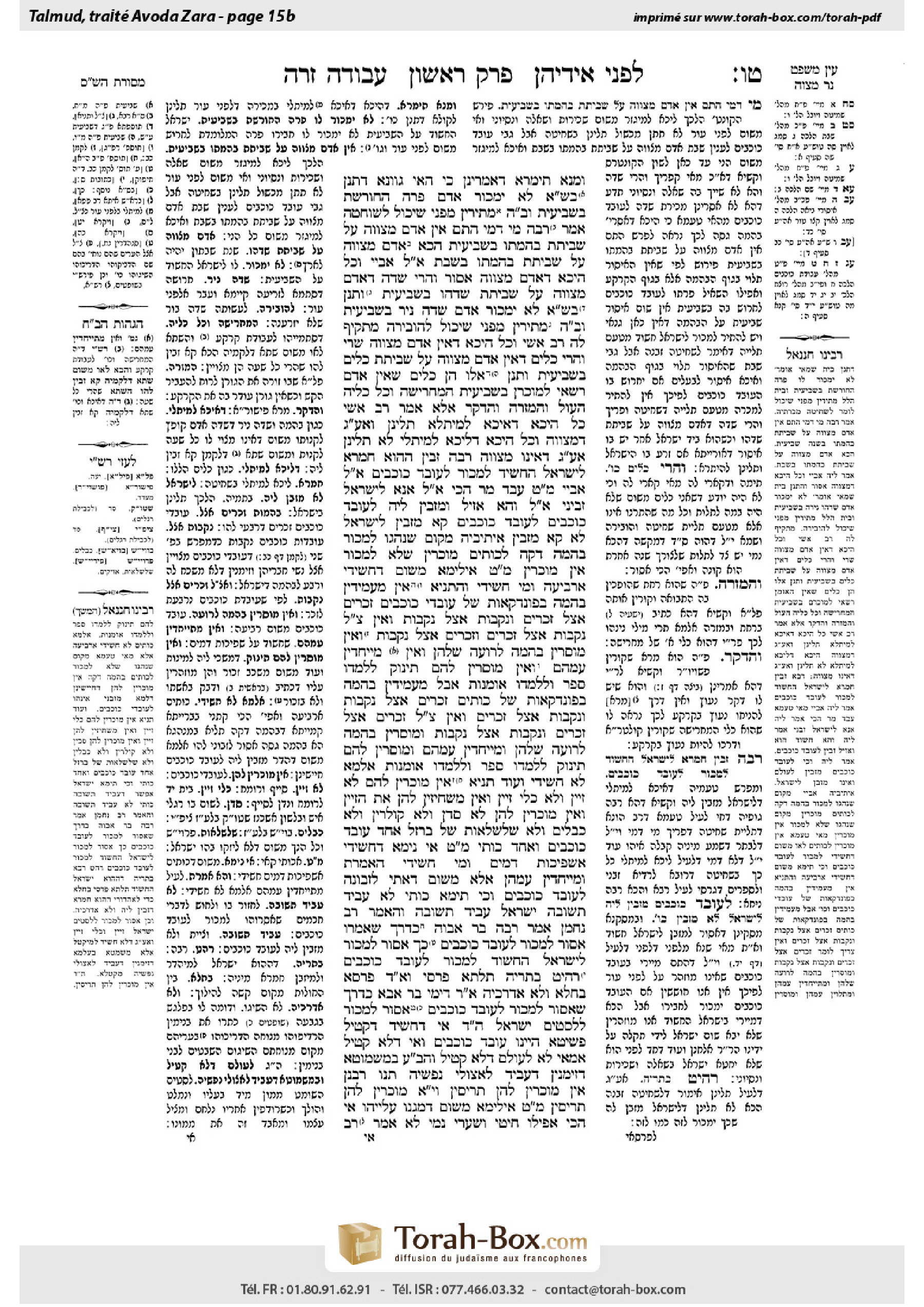
Avodah Zarah 15b: Talmud study for Daf Yomi
Study the Talmud for Daf Yomi with scanned pages, Hebrew text, English translations from Sefaria and AI-generated French translations.
Passage selection and English or AI-generated French translation are available where the scan has annotations. Daf Study is independent of Torah-Box and Sefaria.
Browse Avodah Zarah · עבודה זרה · All tractatesAvodah Zarah 15b text and translations
This page of Avodah Zarah includes the Aramaic text, an English translation and an AI-generated French translation, alongside the scan above.
עבודה זרה י״ה ב · Aramaic and Hebrew text
וּמְנָא תֵּימְרָא דְּאָמְרִינַן כִּי הַאי גַוְונָא? דִּתְנַן: בֵּית שַׁמַּאי אוֹמְרִים: לֹא יִמְכּוֹר אָדָם פָּרָה הַחוֹרֶשֶׁת בַּשְּׁבִיעִית, וּבֵית הִלֵּל מַתִּירִין, מִפְּנֵי שֶׁיָּכוֹל לְשׁוֹחְטָהּ.
אָמַר רַבָּה: מִי דָּמֵי? הָתָם אֵין אָדָם מְצוֶּּוה עַל שְׁבִיתַת בְּהֶמְתּוֹ בַּשְּׁבִיעִית, הָכָא אָדָם מְצוֶּּוה עַל שְׁבִיתַת בְּהֶמְתּוֹ בַּשַּׁבָּת.
אֲמַר לֵיהּ אַבָּיֵי: וְכֹל הֵיכָא דְּאָדָם מְצוֶּּוה אָסוּר? וַהֲרֵי שָׂדֶה, דְּאָדָם מְצוֶּּוה עַל שְׁבִיתַת שָׂדֵהוּ בַּשְּׁבִיעִית, וּתְנַן: בֵּית שַׁמַּאי אוֹמְרִים: לֹא יִמְכּוֹר אָדָם שְׂדֵה נִיר בַּשְּׁבִיעִית, וּבֵית הִלֵּל מַתִּירִין, מִפְּנֵי שֶׁיָּכוֹל לְהוֹבִירָהּ!
מַתְקֵיף לַהּ רַב אָשֵׁי: וְכֹל הֵיכָא דְּאֵין אָדָם מְצוֶּּוה — שְׁרֵי? וַהֲרֵי כֵּלִים, דְּאֵין אָדָם מְצוֶּּוה עַל שְׁבִיתַת כֵּלִים בִּשְׁבִיעִית, וּתְנַן: אֵלּוּ הֵן כֵּלִים שֶׁאֵין אָדָם רַשַּׁאי לְמוֹכְרָן בַּשְּׁבִיעִית: הַמַּחְרֵישָׁה וְכׇל כֵּלֶיהָ, הָעוֹל, וְהַמִּזְרֶה, וְהַדֶּקֶר!
אֶלָּא אָמַר רַב אָשֵׁי: כֹּל הֵיכָא דְּאִיכָּא לְמִיתְלֵא תָּלֵינַן, וְאַף עַל גַּב דִּמְצוֶּּוה, וְכֹל הֵיכָא דְּלֵיכָּא לְמִיתְלֵי — לָא תָּלֵינַן, אַף עַל גַּב דְּאֵינוֹ מְצוֶּּוה.
רַבָּה זַבֵּין הָהוּא חֲמָרָא לְיִשְׂרָאֵל הֶחָשׁוּד לִמְכּוֹר לְגוֹי, אֲמַר לֵיהּ אַבָּיֵי: מַאי טַעְמָא עָבֵד מָר הָכִי? אֲמַר לֵיהּ: אֲנָא לְיִשְׂרָאֵל זַבֵּינִי. אֲמַר לֵיהּ: וְהָא אָזֵיל וּמְזַבֵּין לֵיהּ לְגוֹי! לְגוֹי קָא מְזַבֵּין, לְיִשְׂרָאֵל לָא קָא מְזַבֵּין?
אֵיתִיבֵיהּ: מָקוֹם שֶׁנָּהֲגוּ לִמְכּוֹר בְּהֵמָה דַּקָּה לַכּוּתִים — מוֹכְרִין, שֶׁלֹּא לִמְכּוֹר — אֵין מוֹכְרִין. מַאי טַעְמָא? אִילֵּימָא מִשּׁוּם דַּחֲשִׁידִי אַרְבִיעָה, וּמִי חֲשִׁידִי? וְהָתַנְיָא: אֵין מַעֲמִידִין בְּהֵמָה בְּפוּנְדְּקָאוֹת שֶׁל גּוֹיִם, זְכָרִים אֵצֶל זְכָרִים, וּנְקֵבוֹת אֵצֶל נְקֵבוֹת, וְאֵין צָרִיךְ לוֹמַר נְקֵבוֹת אֵצֶל זְכָרִים וּזְכָרִים אֵצֶל נְקֵבוֹת.
וְאֵין מוֹסְרִין בְּהֵמָה לָרוֹעֶה שֶׁלָּהֶן, וְאֵין מְיַיחֲדִין עִמָּהֶם, וְאֵין מוֹסְרִין לָהֶם תִּינוֹק לְלַמְּדוֹ סֵפֶר וּלְלַמְּדוֹ אוּמָּנוּת, אֲבָל מַעֲמִידִין בְּהֵמָה בְּפוּנְדְּקָאוֹת שֶׁל כּוּתִים, זְכָרִים אֵצֶל נְקֵבוֹת וּנְקֵבוֹת אֵצֶל זְכָרִים, וְאֵין צָרִיךְ לוֹמַר זְכָרִים אֵצֶל זְכָרִים וּנְקֵבוֹת אֵצֶל נְקֵבוֹת.
וּמוֹסְרִין בְּהֵמָה לָרוֹעֶה שֶׁלָּהֶן, וּמְיַיחֲדִין עִמָּהֶם, וּמוֹסְרִין לָהֶם תִּינוֹק לְלַמְּדוֹ סֵפֶר וּלְלַמְּדוֹ אוּמָּנוּת; אַלְמָא לָא חֲשִׁידִי.
וְעוֹד תַּנְיָא: אֵין מוֹכְרִין לָהֶם לֹא זַיִין וְלֹא כְּלֵי זַיִין, וְאֵין מַשְׁחִיזִין לָהֶן אֶת הַזַּיִין, וְאֵין מוֹכְרִין לָהֶן לֹא סַדָּן וְלֹא קוֹלָרִין וְלֹא כְּבָלִים וְלֹא שַׁלְשְׁלָאוֹת שֶׁל בַּרְזֶל, אֶחָד גּוֹי וְאֶחָד כּוּתִי.
מַאי טַעְמָא? אִי נֵימָא דַּחֲשִׁידִי אַשְּׁפִיכוּת דָּמִים, וּמִי חֲשִׁידִי? הָאָמְרַתְּ: וּמְיַיחֲדִין עִמָּהֶן! אֶלָּא מִשּׁוּם דְּאָתֵי לְזַבּוֹנַהּ לְגוֹי.
וְכִי תֵּימָא: כּוּתִי לָא עָבֵיד תְּשׁוּבָה, יִשְׂרָאֵל עָבֵיד תְּשׁוּבָה, וְהָאָמַר רַב נַחְמָן אָמַר רַבָּה בַּר אֲבוּהּ: כְּדֶרֶךְ שֶׁאָמְרוּ אָסוּר לִמְכּוֹר לְגוֹי, כָּךְ אָסוּר לִמְכּוֹר לְיִשְׂרָאֵל הֶחָשׁוּד לִמְכּוֹר לְגוֹי! רְהַיט בָּתְרֵיהּ תְּלָתָא פַּרְסֵי, וְאִיכָּא דְּאָמְרִי: פַּרְסָא בְּחָלָא, וְלָא אַדְרְכֵיהּ.
אָמַר רַב דִּימִי בַּר אַבָּא: כְּדֶרֶךְ שֶׁאָסוּר לִמְכּוֹר לְגוֹי, אָסוּר לִמְכּוֹר לְלִסְטִים יִשְׂרָאֵל. הֵיכִי דָמֵי? אִי דַּחֲשִׁיד דְּקָטֵיל — פְּשִׁיטָא, הַיְינוּ גּוֹי.
וְאִי דְּלָא קָטֵיל, אַמַּאי לָא? לְעוֹלָם דְּלָא קָטֵיל, וְהָכָא בְּמַאי עָסְקִינַן? בְּמַשְׁמוֹטָא, דְּזִימְנִין דְּעָבֵיד לְאַצּוֹלֵי נַפְשֵׁיהּ.
תָּנוּ רַבָּנַן: אֵין מוֹכְרִין לָהֶן תְּרִיסִין, וְיֵשׁ אוֹמְרִים: מוֹכְרִין לָהֶן תְּרִיסִין. מַאי טַעְמָא? אִילֵּימָא מִשּׁוּם דְּמַגְּנוּ עֲלַיְיהוּ, אִי הָכִי, אֲפִילּוּ חִיטֵּי וּשְׂעָרֵי נָמֵי לָא! אָמַר רַב:
Avodah Zarah 15b · English translation
Rav Huna added: And from where do you say that in a case like this we say that the animal will be slaughtered, and one is not concerned about placing a stumbling block before the blind, despite the fact that the animal could be used to violate a prohibition? As we learned in a mishna (Shevi’it 5:8) that Beit Shammai say: A person may not sell a cow that plows in the Sabbatical Year, as it is prohibited to plow during the Sabbatical Year and the buyer presumably wants it for this purpose. And Beit Hillel permit selling the cow, since the buyer can slaughter it rather than use it for plowing. This shows that according to Beit Hillel, whose opinion is accepted as halakha, one may assume that an animal will be used for a permitted purpose, rather than for a prohibited action.
Rabba said: Are these matters comparable? There, with regard to the Sabbatical Year, a person is not commanded to let his animal rest during the Sabbatical Year, as there is no prohibition against his animal performing labor. Therefore, there is no reason to decree that the sale is prohibited lest he lend, lease, or test the animal. As for the concern that he is misleading the buyer and encouraging him to sin, he may rely on the fact that the buyer probably intends to slaughter the animal. But here, with regard to selling an animal to a gentile, a person is commanded to let his animal rest on Shabbat, and therefore the Sages decreed the sale prohibited in case he comes to lend, lease, or test the animal.
Abaye said to Rabba: And does this mean that wherever a person is commanded to allow his possessions to rest it is prohibited to sell an item to one who might use it to perform labor, even if he might also use it for an innocent purpose? But there is the case of a field, as a person is commanded to let his field rest during the Sabbatical Year, and yet we learned in a baraita that Beit Shammai say: A person may not sell a plowed field during the Sabbatical Year, as it is presumed that the buyer will sow it, and Beit Hillel permit this sale, since the buyer can let it lie fallow during the Sabbatical Year. In this case, although one is commanded to let his field rest during the Sabbatical Year, he may still sell it under the assumption that the buyer will use the field in a permitted manner.
Rav Ashi also objects to Rabba’s statement: And conversely, is it true that wherever a person is not commanded to allow his possessions to rest it is permitted to sell the item? But there is the case of vessels, as a person is not commanded to let his vessels rest during the Sabbatical Year, and yet we learned in a mishna (Shevi’it 5:6): These are the implements that a person is not allowed to sell during the Sabbatical Year: The plow and all of its appurtenances, the yoke that is used to hitch the cow to the plow, and the winnowing fork, and the stake.
Rather, Rav Ashi said: Anywhere that it is possible to assign an innocent motive, one assigns such a motive, and this applies even though one is commanded to allow the item to rest. And anywhere that it is not possible to assign an innocent motive, one does not assign an innocent motive, even though one is not commanded to allow the item to rest.
§ The Gemara relates: Rabba sold a certain donkey to a Jew who was suspected of selling large livestock to a gentile. Abaye said to Rabba: What is the reason that the Master acted in this manner? Rabba said to him: I sold the donkey to a Jew. Abaye said to him: But he will go and sell it to a gentile. Rabba responded: Is the only possibility that he will sell to a gentile, and he will not sell it to a Jew? Since there is no reason to assume that he will sell specifically to a gentile rather than to a Jew, there is no problem in selling to him.
Abaye raised an objection to Rabba’s opinion from a baraita: In a place where the people were accustomed to sell small livestock to Samaritans, one may sell the animals to them; in a place where the people were not accustomed to sell them one may not sell the animals to them. What is the reason that the sale of small livestock to Samaritans is prohibited? If we say that it is because Samaritans are suspected of engaging in bestiality, are they suspected of this practice? But isn’t it taught in a baraita: One may not keep an animal in the inns of gentiles. Male animals may not be placed with men, as they are suspected of engaging in bestiality, and female animals may not be left with women, despite the fact that there is no concern that they may engage in bestiality. And needless to say, it is prohibited to leave female animals with men, and male animals with women.
The baraita continues: And one may not entrust an animal to a gentile shepherd, and one may not seclude oneself with gentiles, due to the danger that this entails. And one may not entrust a child to them to teach him how to read books or to teach him a craft. But one may keep an animal in the inns of Samaritans, as they are not suspected of violating a Torah prohibition and engaging in bestiality. Male animals may be placed with women and female animals may be left with men, and needless to say, it is permitted to leave male animals with men and female animals with women.
The baraita concludes: And one may entrust an animal to a Samaritan shepherd, and one may seclude oneself with Samaritans, and one may entrust a child to them to teach him how to read books and to teach him a craft. The Gemara infers from the baraita: Evidently, Samaritans are not suspected of engaging in bestiality, yet livestock may not be sold to them, as they are suspected of selling it to gentiles.
And furthermore, it is taught in a baraita: One may not sell weapons to gentiles or the auxiliary equipment of weapons, and one may not sharpen weapons for them. And one may not sell them stocks used for fastening the feet of prisoners, or iron neck chains [kolarin], or foot chains, or iron chains. This prohibition applies equally to both a gentile and a Samaritan.
Abaye analyzes this baraita: What is the reason for the prohibition against selling these items to Samaritans? If we say that they are suspected of bloodshed, that is difficult: But are they suspected of this? Didn’t you say that one may seclude oneself with them, which indicates that they are not suspected of bloodshed? Rather, it is prohibited to sell these items to Samaritans because they will come to sell them to a gentile. According to this reasoning, it should likewise be prohibited to sell a donkey to a Jew who is suspected of selling animals to gentiles.
And if you would say that there is a difference between a Jew and a Samaritan, as a Samaritan will likely not repent and will sell to a gentile, whereas a Jew will likely repent and not sell these items, this reasoning is incorrect. But doesn’t Rav Naḥman say explicitly that Rabba bar Avuh says: Just as the Sages said that it is prohibited to sell to a gentile, so too it is prohibited to sell to a Jew who is suspected of selling to a gentile? When Rabba heard this and realized that Abaye was correct, he ran three parasangs after the buyer who purchased his donkey to revoke the sale, as the Jew was suspected of selling to gentiles; and some say that he ran one parasang through sand. But he did not succeed in overtaking him.
Apropos the baraita that discusses the prohibition against selling weapons, the Gemara relates that Rav Dimi bar Abba says: Just as it is prohibited to sell to a gentile, it is prohibited to sell to an armed bandit who is a Jew. The Gemara clarifies: What are the circumstances of this prohibition? If the thief is suspected of killing, isn’t it obvious that it is prohibited? After all, he is the same as a gentile. Providing a Jew who might kill with weapons is no different from giving a weapon to a gentile, as in both cases one violates the prohibition: Do not place a stumbling block before the blind.
And if he is a bandit who does not kill, why not sell to him? The Gemara answers: Actually, Rav Dimi bar Abba is referring to a bandit who does not kill, and here we are dealing with a bandit who steals, as sometimes he makes use of his weapon to save himself when he is caught. Consequently, it is prohibited to sell him weapons in case he kills with them in self-defense.
§ The Sages taught: One may not sell shields [terisin] to gentiles, despite the fact that they are used for protection, not to attack others. And some say: One may sell shields to them. The Gemara asks: What is the reason behind the opinion that prohibits selling shields to gentiles? If we say it is because they protect them in wartime, if so, then even wheat and barley should not be sold to them. Rav said:
Avodah Zarah 15b · Traduction française (IA)
Rav Huna ajouta : Et d'où dis-tu que dans un cas comme celui-ci, on dit que l'animal sera sacrifié, et on ne s'occupe pas de placer un obstacle devant le boiteux, malgré le fait que l'animal pourrait être utilisé pour enfreindre une interdiction ? Comme nous l'avons appris dans une mitsva (Shevi’it 5:8) que Beit Shammai disent : Une personne ne peut pas vendre une vache qui laboure dans l'année sabbatique, car il est interdit de labourer durant l'année sabbatique et l'acheteur présume probablement en avoir besoin à cette fin. Et Beit Hillel autorisent la vente de la vache, car l'acheteur peut sacrifier l'animal plutôt que de l'utiliser pour labourer. Cela montre que selon Beit Hillel, dont l'opinion est retenue comme halakha, on peut supposer que l'animal sera utilisé à une fin permise plutôt qu'à une action interdite.
Rabba dit : Ces questions sont-elles comparables ? Là, concernant l'année sabbatique, une personne n'est pas commandée à laisser reposer son animal durant l'année sabbatique, car il n'y a pas d'interdiction à ce que son animal travaille. Par conséquent, il n'y a pas de raison de décréter que la vente soit interdite de peur qu'il prête, loue ou teste l'animal. En ce qui concerne la crainte qu'il mente à l'acheteur et l'encourage à pécher, il peut se reposer sur le fait que l'acheteur présume probablement de sacrifier l'animal. Mais ici, concernant la vente d'un animal à un non-Juif, une personne est commandée à laisser reposer son animal le sabbat, et par conséquent les Sages ont décrété que la vente est interdite si l'on vient à prêter, louer ou tester l'animal.
Abaye dit à Rabba : Et cela signifie-t-il que partout où une personne est commandée à laisser reposer ses biens, il est interdit de vendre un objet à celui qui pourrait l'utiliser pour travailler, même s'il pourrait aussi l'utiliser à une fin innocente ? Mais il y a le cas d'un champ, car une personne est commandée à laisser reposer son champ durant l'année sabbatique, et pourtant nous avons appris dans une baraïta que Beit Shammai disent : Une personne ne peut pas vendre un champ labouré durant l'année sabbatique, car on présume que l'acheteur va le semer, et Beit Hillel autorisent cette vente, car l'acheteur peut laisser le champ en friche durant l'année sabbatique. Dans ce cas, même si l'on est commandé à laisser reposer son champ durant l'année sabbatique, on peut toutefois le vendre en supposant que l'acheteur l'utilisera à une fin permise.
Rav Ashi s'oppose également à l'avis de Rabba : Et inversement, est-ce vrai que partout où une personne n'est pas commandée à laisser reposer ses biens, il est permis de vendre l'objet ? Mais il y a le cas des ustensiles, car une personne n'est pas commandée à laisser reposer ses ustensiles durant l'année sabbatique, et pourtant nous avons appris dans une mitsva (Shevi’it 5:6) : Ces sont les ustensiles que l'on ne peut pas vendre durant l'année sabbatique : La charrue et tous ses accessoires, le joug utilisé pour atteler la vache à la charrue, le balai de blé, et le pieu.
Rav Ashi dit plutôt : Partout où il est possible d'attribuer une motivation innocente, on attribue une telle motivation, et cela s'applique même si l'on est commandé à laisser reposer l'objet. Et partout où il n'est pas possible d'attribuer une motivation innocente, on ne l'attribue pas, même si l'on n'est pas commandé à laisser reposer l'objet.
§ Le Guemara rapporte : Rabba a vendu un certain âne à un Juif soupçonné de vendre des bêtes de grande taille à un non-Juif. Abaye demande à Rabba : Quelle est la raison pour laquelle le Maître a agi ainsi ? Rabba répond à Abaye : J'ai vendu l'âne à un Juif. Abaye dit à Rabba : Mais il ira et le vendra à un non-Juif. Rabba répond : Est-ce que la seule possibilité est qu'il le vende à un non-Juif, et qu'il ne le vende pas à un Juif ? Comme il n'y a pas de raison d'assumer qu'il le vende spécifiquement à un non-Juif plutôt qu'à un Juif, il n'y a pas de problème à le vendre à lui.
Abaye a soulevé une objection contre l'opinion de Rabba à partir d'une baraïta : Dans un lieu où les gens étaient habitués à vendre des bêtes de petite taille aux Samaritains, on peut vendre les bêtes à eux ; dans un lieu où les gens n'étaient pas habitués à vendre des bêtes à eux, on ne peut pas vendre les bêtes à eux. Quelle est la raison que la vente de bêtes de petite taille aux Samaritains est interdite ? Si nous disons que c'est parce que les Samaritains sont soupçonnés d'engager en bestialité, sont-ils soupçonnés de cette pratique ? Mais n'est-il pas enseigné dans une baraïta : On ne peut pas laisser un animal dans les auberges des non-Juifs. Les animaux mâles ne peuvent pas être placés avec les hommes, car ils sont soupçonnés d'engager en bestialité, et les animaux femelles ne peuvent pas être laissés avec les femmes, malgré le fait qu'il n'y a pas de crainte qu'ils puissent engager en bestialité. Et de toute évidence, il est interdit de laisser des animaux femelles avec les hommes et les animaux mâles avec les femmes.
La baraïta continue : Et on ne peut pas confier un animal à un berger gentil, et on ne peut pas se retirer avec des gentils, en raison du danger que cela implique. Et on ne peut pas confier un enfant à eux pour l'enseigner à lire des livres ou à lui enseigner un métier. Mais on peut laisser un animal dans les auberges des Samaritains, car ils ne sont pas soupçonnés d'enfreindre une interdiction de la Torah et d'engager en bestialité. Les animaux mâles peuvent être placés avec les femmes et les animaux femelles peuvent être laissés avec les hommes, et de toute évidence, il est permis de laisser les animaux mâles avec les hommes et les animaux femelles avec les femmes.
La baraïta conclut : Et on peut confier un animal à un berger Samaritain, et on peut se retirer avec des Samaritains, et on peut confier un enfant à eux pour l'enseigner à lire des livres et à lui enseigner un métier. La Guemara en déduit de la baraïta : Évidemment, les Samaritains ne sont pas soupçonnés d'engager en bestialité, toutefois les bêtes ne peuvent pas être vendues à eux, car ils sont soupçonnés de les vendre aux non-Juifs.
Et de plus, il est enseigné dans une baraïta : On ne peut pas vendre d'armes aux gentils ou l'accessoire de ces armes, et on ne peut pas aiguiser des armes pour eux. Et on ne peut pas vendre à eux des stocks utilisés pour attacher les pieds des prisonniers, ou des chaînes en fer pour le cou [kolarin], ou des chaînes de pied, ou des chaînes en fer. Cette interdiction s'applique également à un gentil et à un Samaritain.
Abaye analyse ce baraïta : Quel est le motif de l'interdiction de vendre ces objets aux Samaritains ? Si l'on dit qu'ils sont soupçonnés de meurtre, cela est difficile : mais sont-ils soupçonnés de cela ? N'avez-vous pas dit qu'on peut se retirer avec eux, ce qui indique qu'ils ne sont pas soupçonnés de meurtre ? Plutôt, il est interdit de vendre ces objets aux Samaritains car ils viendront les vendre à un non-Juif. Selon cette raison, il devrait également être interdit de vendre un âne à un Juif soupçonné de vendre des animaux aux non-Juifs.
Et si l'on disait qu'il y a une différence entre un Juif et un Samaritain, car un Samaritain ne se repentra probablement pas et vendra aux non-Juifs, tandis qu'un Juif se repentra probablement et ne vendra pas ces objets, cette raison est incorrecte. Mais n'a-t-on pas dit explicitement Rav Naḥman que Rabba bar Avuh dit : Comme les Sages ont dit qu'il est interdit de vendre à un non-Juif, ainsi aussi il est interdit de vendre à un Juif soupçonné de vendre à des non-Juifs ? Lorsque Rabba entendit cela et réalisa que Abaye avait raison, il courut trois parasangs après l'acheteur qui avait acheté son âne pour annuler la vente, car le Juif était soupçonné de vendre aux non-Juifs ; et certains disent qu'il courut un parasang à travers le sable. Mais il n'a pas réussi à le rattraper.
En ce qui concerne le baraïta qui discute de l'interdiction de vendre des armes, la Guemara rapporte que Rav Dimi bar Abba dit : Comme il est interdit de vendre à un non-Juif, ainsi aussi il est interdit de vendre à un bandit juif. La Guemara précise : Quelles sont les circonstances de cette interdiction ? Si le voleur est soupçonné de meurtre, n'est-ce pas évident qu'il est interdit ? Après tout, il est le même qu'un non-Juif. Fournir à un Juif qui pourrait tuer des armes n'est pas différent de donner une arme à un non-Juif, car dans les deux cas on viole l'interdiction : Ne place pas un obstacle devant le boiteux.
Et si c'est un bandit qui ne tue pas, pourquoi ne pas lui vendre ? La Guemara répond : En réalité, Rav Dimi bar Abba fait référence à un bandit qui ne tue pas, et ici nous traitons d'un bandit qui vole, car parfois il utilise son arme pour se défendre lorsqu'il est attrapé. Ainsi, il est interdit de lui vendre des armes en cas où il les utilise pour tuer en défense de soi.
§ Les Sages enseignèrent : On ne peut pas vendre des boucliers [terisin] aux non-Juifs, malgré le fait qu'ils sont utilisés pour la protection, pas pour attaquer les autres. Et certains disent : On peut vendre des boucliers à eux. La Guemara pose la question : Quel est le motif de l'opinion qui interdit la vente de boucliers aux non-Juifs ? Si l'on dit qu'il est parce qu'ils les protègent en temps de guerre, alors même le blé et la céréale ne devraient pas être vendus à eux. Rav dit :
Traduction française générée par IA à partir de l’édition anglaise de Sefaria. Vérifie toujours un passage avec le texte source.
Text from Sefaria: William Davidson Edition - Vocalized Aramaic (CC BY NC); William Davidson Edition - English (CC BY NC).