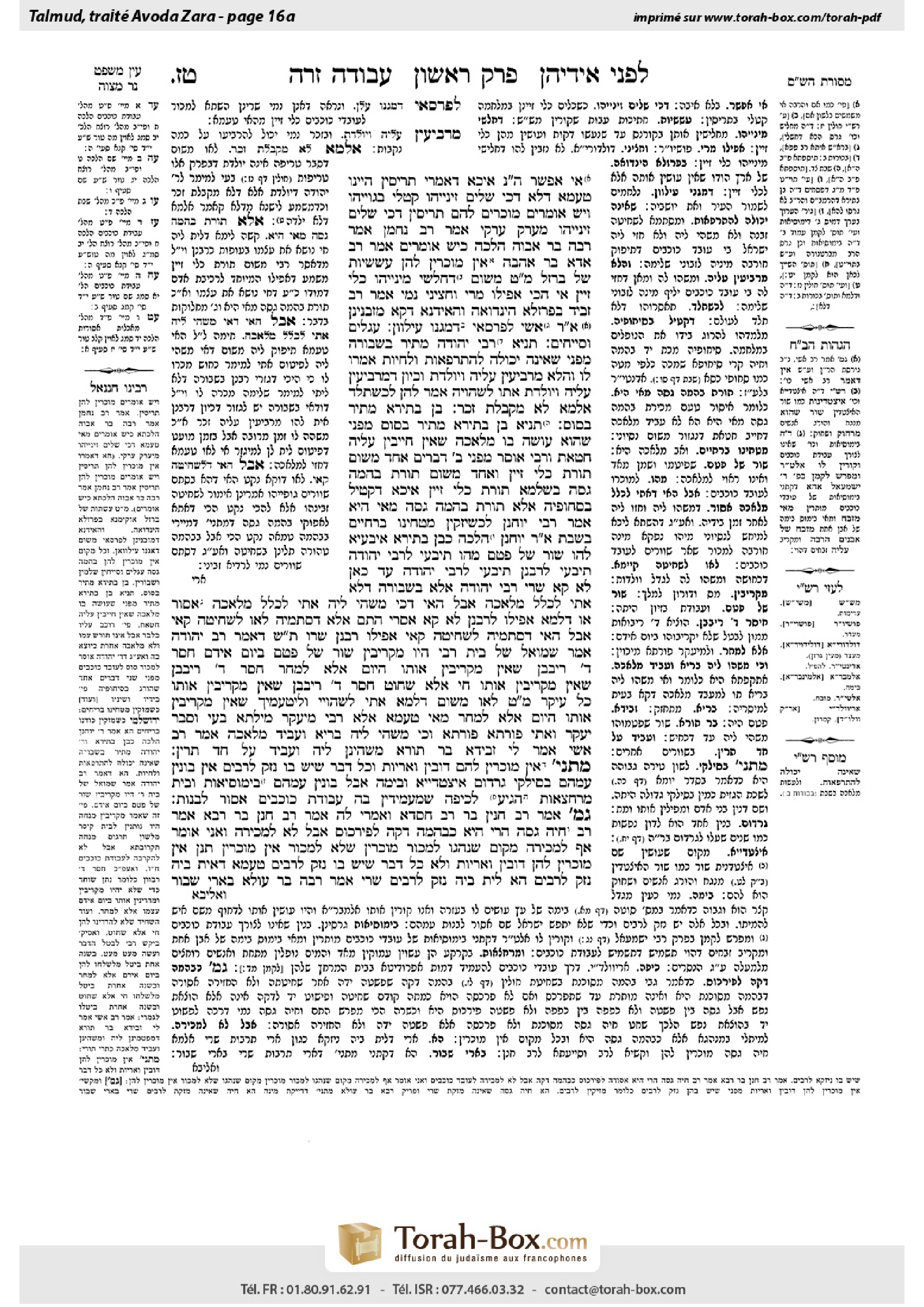
Avodah Zarah 16a: Talmud study for Daf Yomi
Study the Talmud for Daf Yomi with scanned pages, Hebrew text, English translations from Sefaria and AI-generated French translations.
Passage selection and English or AI-generated French translation are available where the scan has annotations. Daf Study is independent of Torah-Box and Sefaria.
Browse Avodah Zarah · עבודה זרה · All tractatesAvodah Zarah 16a text and translations
This page of Avodah Zarah includes the Aramaic text, an English translation and an AI-generated French translation, alongside the scan above.
עבודה זרה י״ו א · Aramaic and Hebrew text
אִי אֶפְשָׁר, הָכִי נָמֵי.
אִיכָּא דְּאָמְרִי: תְּרִיסִין הַיְינוּ טַעְמָא דְּלָא, דְּכִי שְׁלִים זֵינַיְיהוּ קָטְלִי בְּגַוַּיְיהוּ. וְיֵשׁ אוֹמְרִים: מוֹכְרִים לָהֶם תְּרִיסִין, דְּכִי שְׁלִים זֵינַיְיהוּ מִעְרָק עׇרְקִי. אָמַר רַב נַחְמָן אָמַר רַבָּה בַּר אֲבוּהּ: הֲלָכָה כְּיֵשׁ אוֹמְרִים.
אָמַר רַב אַדָּא בַּר אַהֲבָה: אֵין מוֹכְרִין לָהֶן עֲשָׁשִׁיּוֹת שֶׁל בַּרְזֶל, מַאי טַעְמָא? מִשּׁוּם דְּחָלְשִׁי מִינַּיְיהוּ כְּלֵי זַיִין. אִי הָכִי, אֲפִילּוּ מָרֵי וַחֲצִינֵי נָמֵי! אָמַר רַב זְבִיד: בְּפַרְזְלָא הִינְדּוּאָה. וְהָאִידָּנָא דְּקָא מְזַבְּנִינַן, אָמַר רַב אָשֵׁי: לְפָרְסָאֵי דְּמַגְּנוּ עִילָּוַון.
עֲגָלִים וּסְיָיחִים. תַּנְיָא: רַבִּי יְהוּדָה מַתִּיר בִּשְׁבוּרָה, מִפְּנֵי שֶׁאֵינָהּ יְכוֹלָה לְהִתְרַפְּאוֹת וְלִחְיוֹת. אָמְרוּ לוֹ: וַהֲלֹא מַרְבִּיעִין עָלֶיהָ וְיוֹלֶדֶת, וְכֵיוָן דְּמַרְבִּיעִין עָלֶיהָ וְיוֹלֶדֶת אָתוּ לְשַׁהוֹיַהּ. אָמַר לָהֶן: לִכְשֶׁתֵּלֵד. אַלְמָא לָא (מְקַבֶּלֶת) [מְקַבְּלָא] זָכָר.
בֶּן בְּתִירָא מַתִּיר בַּסּוּס. תַּנְיָא: בֶּן בְּתִירָא מַתִּיר בַּסּוּס, מִפְּנֵי שֶׁהוּא עוֹשֶׂה בּוֹ מְלָאכָה שֶׁאֵין חַיָּיבִין עָלֶיהָ חַטָּאת. וְרַבִּי אוֹסֵר מִפְּנֵי שְׁנֵי דְבָרִים: אֶחָד מִשּׁוּם תּוֹרַת כְּלֵי זַיִין, וְאֶחָד מִשּׁוּם תּוֹרַת בְּהֵמָה גַּסָּה.
בִּשְׁלָמָא תּוֹרַת כְּלֵי זַיִין אִיכָּא, דְּקָטֵיל בְּסִחוּפֵיהּ, אֶלָּא תּוֹרַת בְּהֵמָה גַּסָּה מַאי הִיא? אָמַר רַבִּי יוֹחָנָן: לִכְשֶׁיַּזְקִין מַטְחִינוֹ בְּרֵחַיִים בְּשַׁבָּת. אָמַר רַבִּי יוֹחָנָן: הֲלָכָה כְּבֶן בְּתִירָא.
אִיבַּעְיָא לְהוּ: שׁוֹר שֶׁל פַּטָּם מַהוּ? תִּיבְּעֵי לְרַבִּי יְהוּדָה, תִּיבְּעֵי לְרַבָּנַן.
תִּיבְּעֵי לְרַבִּי יְהוּדָה: עַד כָּאן לָא קָא שָׁרֵי רַבִּי יְהוּדָה אֶלָּא בִּשְׁבוּרָה, דְּלָא אָתֵי לִכְלַל מְלָאכָה, אֲבָל הַאי דְּכִי מְשַׁהֵי לֵיהּ אָתֵי לִכְלַל מְלָאכָה — אָסוּר.
אוֹ דִלְמָא, אֲפִילּוּ לְרַבָּנַן לָא קָא אָסְרִי הָתָם אֶלָּא דִּסְתָמֵיהּ לָאו לִשְׁחִיטָה קָאֵי, אֲבָל הַאי דִּסְתָמֵיהּ לִשְׁחִיטָה קָאֵי — אֲפִילּוּ רַבָּנַן שָׁרוּ?
תָּא שְׁמַע, דְּאָמַר רַב יְהוּדָה אָמַר שְׁמוּאֵל: שֶׁל בֵּית רַבִּי הָיוּ מַקְרִיבִין שׁוֹר שֶׁל פַּטָּם בְּיוֹם אֵידָם, חָסֵר אַרְבַּע רִיבְבָן שֶׁאֵין מַקְרִיבִין אוֹתוֹ הַיּוֹם אֶלָּא לְמָחָר, חָסֵר אַרְבַּע רִיבְבָן שֶׁאֵין מַקְרִיבִין אוֹתוֹ חַי אֶלָּא שָׁחוּט, חָסֵר אַרְבַּע רִיבְבָן שֶׁאֵין מַקְרִיבִין אוֹתוֹ כׇּל עִיקָּר.
מַאי טַעְמָא, לָאו מִשּׁוּם דִּלְמָא אָתֵי לְשַׁהוֹיֵי? וְלִיטַעְמָיךְ, שֶׁאֵין מַקְרִיבִין אוֹתוֹ הַיּוֹם אֶלָּא לְמָחָר — מַאי טַעְמָא? אֶלָּא, רַבִּי מִיעְקָר מִילְּתָא בָּעֵי, וְסָבַר: יִעֲקַר וְאָתֵי פּוּרְתָּא פּוּרְתָּא.
וְכִי מְשַׁהֵי לֵיהּ בָּרֵיא וְעָבֵיד מְלָאכָה? אָמַר רַב אָשֵׁי: אָמַר לִי זְבִידָא בַּר תּוֹרָא, מְשַׁהֵינַן לֵיהּ וְעָבֵיד עַל חַד תְּרֵין.
מַתְנִי׳ אֵין מוֹכְרִין לָהֶם דּוּבִּין וַאֲרָיוֹת וְכׇל דָּבָר שֶׁיֵּשׁ בּוֹ נֶזֶק לָרַבִּים. אֵין בּוֹנִין עִמָּהֶם בָּסִילְקֵי, גַּרְדּוֹם, אִיצְטַדְיָיא, וּבִימָה, אֲבָל בּוֹנִין עִמָּהֶם בִּימוֹסְיָאוֹת וּבֵית מֶרְחֲצָאוֹת. הִגִּיעַ לְכִיפָּה שֶׁמַּעֲמִידִין בָּהּ עֲבוֹדָה זָרָה — אָסוּר לִבְנוֹת.
גְּמָ׳ אָמַר רַב חָנִין בַּר רַב חִסְדָּא, וְאָמְרִי לַהּ אָמַר רַב חָנָן בַּר רָבָא אָמַר רַב: חַיָּה גַּסָּה הֲרֵי הִיא כִּבְהֵמָה דַּקָּה לְפִירְכּוּס, אֲבָל לֹא לִמְכִירָה.
וַאֲנִי אוֹמֵר: אַף לִמְכִירָה, מָקוֹם שֶׁנָּהֲגוּ לִמְכּוֹר — מוֹכְרִין, שֶׁלֹּא לִמְכּוֹר — אֵין מוֹכְרִין.
תְּנַן: אֵין מוֹכְרִין לָהֶן דּוּבִּין וַאֲרָיוֹת וְלֹא כׇּל דָּבָר שֶׁיֵּשׁ בּוֹ נֶזֶק לָרַבִּים. טַעְמָא דְּאִית בֵּיהּ נֶזֶק לָרַבִּים, הָא לֵית בֵּיהּ נֶזֶק לָרַבִּים — שְׁרֵי! אָמַר רַבָּה בַּר עוּלָּא: בַּאֲרִי שָׁבוּר,
Avodah Zarah 16a · English translation
If it were possible to avoid selling produce to gentiles without incurring their animosity, indeed it would be prohibited to sell them. Since limiting sales to gentiles to such an extent would cause great harm, it is only prohibited to sell them shields.
There are those who say: With regard to shields, this is the reason that one is not allowed to sell them to gentiles: As when their use of their weapon is finished in battle, they kill with these shields. And accordingly, the reason that some say in the baraita that one may sell shields to them is because they maintain that this is not a concern, as when their weapon is finished they flee, rather than use their shield as a weapon. Rav Naḥman says that Rabba bar Avuh says: The halakha is in accordance with the opinion cited as: Some say.
Rav Adda bar Ahava says: One may not sell blocks [ashashiot] of iron to gentiles. What is the reason? It is because they forge weapons from them. The Gemara asks: If so, then even hoes and axes should not be sold to them, as they too can be used to forge weapons. Rav Zevid said in response: The ruling of Rav Adda bar Ahava was stated with regard to Indian iron, which is of a superior quality and used only for crafting weapons. The Gemara clarifies: And as for the fact that nowadays we do sell all weapons, Rav Ashi said: We sell the weapons to the Persians, who protect us.
§ The mishna teaches: One may not sell to gentiles calves or foals. It is taught in a baraita that Rabbi Yehuda permits the sale of a damaged animal because it is incapable of being cured and living normally. The Sages said to him: But if one mates her, does she not bear offspring? And since one can mate her and she will bear offspring, the gentile will come to leave her in his possession, and Jews who see the animal in the possession of the gentile will assume that it is permitted to sell large livestock to gentiles. Rabbi Yehuda said to them in response: When she bears offspring, I will agree to be concerned about such a possibility. The Gemara notes: Apparently, Rabbi Yehuda holds that a damaged animal does not accept a male, i.e., since its legs are broken, it cannot participate in intercourse.
The mishna also teaches that ben Beteira permits the sale of a horse to a gentile. The Gemara notes that it is taught in a baraita: Ben Beteira permits the sale of a horse because the gentile uses it for performing an act for which one is not liable to bring a sin-offering, as riding a horse is not prohibited by Torah law. Therefore, there is no reason to prohibit its sale due to the concern that the gentile might use it for a prohibited action. And Rabbi Yehuda HaNasi prohibits its sale due to two reasons: One is because it has the status of a weapon, as horses are used in battle, and the other one is because it has the status of large livestock.
The Gemara asks: Granted, there is a reason to say that a horse has the status of a weapon, as a horse is taught to kill by striking down enemy troops. But what is the relevance of the observation that it has the status of large livestock? It has already been explained that a horse is used for riding, not for performing acts that are prohibited on Shabbat. Rabbi Yoḥanan says: When it becomes elderly and is no longer suitable for use in battle, one makes it grind with a millstone, and therefore it will in fact be used to perform prohibited labor on Shabbat. Nevertheless, Rabbi Yoḥanan says: The halakha is in accordance with the opinion of ben Beteira, and it is permitted to sell a horse to gentiles.
A dilemma was raised before the Sages: With regard to an ox of a fattener, which has been fattened for slaughter, what is the halakha? Let the dilemma be raised according to the opinion of Rabbi Yehuda, who permits the sale of a damaged animal, and let the dilemma be raised according to the opinion of the Rabbis, who dispute that ruling.
The Gemara elaborates: Let the dilemma be raised according to the opinion of Rabbi Yehuda, as follows: Perhaps Rabbi Yehuda permits only the sale of a damaged animal, which will never come to be included in the category of an animal that is fit for labor. But with regard to this fattened ox, which if kept for a sufficient amount of time without fattening will come to be included in the category of an animal that is fit for labor, the sale is prohibited.
Or perhaps it may be claimed that even according to the Rabbis, they prohibit the sale only there, in the case of a damaged animal that ordinarily does not stand ready for slaughter. But in this case of a fattened ox, which ordinarily stands ready for slaughter, even the Rabbis permit the sale.
The Gemara suggests a proof: Come and hear that which Rav Yehuda says that Shmuel says: The members of the household of Rabbi Yehuda HaNasi were required to bring as a present for the authorities an ox of a fattener on their festival day. They deprived themselves of forty-thousand dinars, i.e., they paid this sum as a bribe, to ensure that they would not have to bring it on the actual day of their festival, but rather on the next day. They deprived themselves again, i.e., they paid a further bribe, of another forty-thousand dinars, to ensure that they would not have to bring it alive but rather slaughtered. They deprived themselves again and paid yet another bribe of forty-thousand dinars to ensure that they would not have to bring it at all.
What is the reason that they paid a bribe to evade the responsibility of bringing a fattened ox to the authorities? Is it not due to the concern that perhaps they will come to keep the animal until it is fit for labor? The Gemara rejects this proof: And according to your reasoning, what is the reason that they paid a bribe to ensure that they would not have to bring it on the day of the festival, but rather the next day? Rather, it must be explained that Rabbi Yehuda HaNasi wanted to abolish the matter entirely, and he reasoned: It is best to abolish it gradually, little by little, and in this manner they ultimately had no obligation to bring the animal at all. Therefore, no proof can be brought from this incident with regard to the halakha of the sale of a fattened ox.
It was stated that if a fattened ox is kept for a sufficient amount of time without fattening it will come to be included in the category of an animal that is fit for labor. Concerning this, the Gemara asks: But even when a fattened ox is kept until it is slim, does it become healthy and able to perform labor? Rav Ashi said that the expert in this matter, Zevida, said to me: We keep a young ox that has been fattened until it is slim, and it performs twice the work of other oxen.
MISHNA: One may not sell bears, or lions, or any item that can cause injury to the public, to gentiles. One may not build with them a basilica [basileki], a tribunal [gardom], a stadium [itztadeyya], or a platform. But one may build with them small platforms [bimmusiot] and bathhouses. Even in this case, once he reaches the arched chamber in the bath where the gentiles put up objects of idol worship, it is prohibited to build it.
GEMARA: Rav Ḥanin bar Rav Ḥisda says, and some say Rav Ḥanan bar Rava says that Rav says: The status of a large beast is like that of small livestock with regard to a spasm [lefirkus], i.e., the symptoms of vitality required at the time of slaughtering. If an animal in danger of dying was slaughtered but did not display any spasmodic movement when it was slaughtered, it is not kosher. If it did spasm after being slaughtered, its meat is kosher But its status is not the same as that of small livestock with regard to its sale. Rather it is considered like large livestock, and therefore its sale to gentiles is always prohibited.
Rav Ḥanan bar Rava added: This is the statement of Rav, but I say that even with regard to its sale a large beast is akin to small livestock. Therefore, in a place where the people were accustomed to sell large beasts, one may sell them, and in a place where the people were not accustomed to sell them, one may not sell them.
The Gemara raises an objection to Rav’s statement. We learned in the mishna: One may not sell bears, or lions, or any item that can cause injury to the public, to gentiles. The Gemara analyzes the mishna: The reason that these beasts cannot be sold to gentiles is because they can cause injury to the public. It may be inferred from here that another beast, which does not cause injury to the public, is permitted to be sold to gentiles. Rabba bar Ulla says in response: This mishna does not pose a problem for Rav, as he holds that it is referring to a damaged lion, which is not fit for labor;
Avodah Zarah 16a · Traduction française (IA)
Si on pouvait éviter de vendre des produits aux non-Juifs sans provoquer leur hostilité, il serait interdit de les vendre. Puisque limiter la vente aux non-Juifs à ce point causerait un grand préjudice, il est seulement interdit de vendre des boucliers.
Certains disent : En ce qui concerne les boucliers, c'est pour cette raison qu'on ne peut pas les vendre aux non-Juifs : car, lorsqu'ils ont terminé l'utilisation de leur arme en guerre, ils tuent avec ces boucliers. Et ainsi, la raison selon laquelle certains disent dans la baraïta qu'on peut les vendre aux non-Juifs est qu'ils pensent que cela n'est pas un problème, car lorsqu'ils ont terminé leur arme, ils fuient plutôt que d'utiliser leur bouclier comme arme. Rav Naḥman dit que Rabba bar Avuh dit : La halakha suit l'opinion citée : Certains disent.
Rav Adda bar Ahava dit : On ne peut pas vendre des blocs d'acier aux non-Juifs. Pourquoi ? Parce qu'ils forment des armes à partir d'eux. La Guemara demande : Si c'est ainsi, alors même les faux et les haches ne devraient pas être vendus aux non-Juifs, car ils peuvent aussi être utilisés pour fabriquer des armes. Rav Zevid répondit : La décision de Rav Adda bar Ahava a été formulée concernant l'acier indien, qui est de meilleure qualité et utilisé uniquement pour la fabrication d'armes. La Guemara précise : Et concernant le fait que nous vendons aujourd'hui tous les armes, Rav Ashi dit : Nous vendons les armes aux Perses, qui nous protègent.
§ La mitsva enseigne : On ne peut pas vendre aux non-Juifs des veaux ou des poulains. Il est enseigné dans une baraïta que Rabbi Yehuda permet la vente d'un animal abîmé, car il est incapable de se rétablir et de vivre normalement. Les Sages lui dirent : Mais si on le fait accoupler, ne produira-t-il pas des petits ? Et puisque l'on peut le faire accoupler et qu'il produira des petits, le non-Juif viendra le garder, et les Juifs qui voient l'animal entre les mains du non-Juif supposeront que la vente de grandes bêtes aux non-Juifs est permise. Rabbi Yehuda répondit à leur propos : Lorsqu'il produira des petits, je serai d'accord pour m'inquiéter de cette possibilité. La Guemara note : Apparemment, Rabbi Yehuda considère qu'un animal abîmé ne peut pas accepter un mâle, c'est-à-dire que, puisque ses pattes sont cassées, il ne peut pas participer à l'acte sexuel.
La mitsva enseigne également que ben Beteira permet la vente d'un cheval à un non-Juif. La Guemara note que cela est enseigné dans une baraïta : ben Beteira permet la vente d'un cheval car le non-Juif l'utilise pour accomplir une action pour laquelle on n'est pas tenu de présenter un sacrifice expiatoire, car monter un cheval n'est pas interdit par la loi divine. Ainsi, il n'y a pas de raison de prohiber sa vente en raison de la crainte que le non-Juif l'utilise pour une action interdite. Et Rabbi Yehuda HaNasi prohibe sa vente pour deux raisons : l'une est qu'il a le statut d'arme, car les chevaux sont utilisés en guerre, et l'autre est qu'il a le statut de grande bête.
La Guemara demande : D'accord, il y a une raison de dire qu'un cheval a le statut d'arme, car un cheval est appris à tuer en frappant les troupes ennemies. Mais qu'est-ce que l'observation selon laquelle il a le statut de grande bête ? Il a déjà été expliqué qu'un cheval est utilisé pour monter, pas pour accomplir des actes interdits le sabbat. Rabbi Yoḥanan dit : Lorsqu'il vieillit et n'est plus adapté à l'usage en guerre, on le fait travailler avec une meule, et ainsi il sera effectivement utilisé pour accomplir un travail interdit le sabbat. Cependant, Rabbi Yoḥanan dit : La halakha suit l'opinion de ben Beteira, et il est permis de vendre un cheval aux non-Juifs.
Un dilemme a été soulevé devant les Sages : En ce qui concerne un taureau d'un éleveur, qui a été nourri pour être sacrifié, quelle est la halakha ? Que le dilemme soit soulevé selon l'opinion de Rabbi Yehuda, qui permet la vente d'un animal abîmé, et que le dilemme soit soulevé selon l'opinion des Sages, qui contestent cette décision.
La Guemara développe : Que le dilemme soit soulevé selon l'opinion de Rabbi Yehuda, comme suit : Peut-être que Rabbi Yehuda permet seulement la vente d'un animal abîmé, qui ne pourra jamais être inclus dans la catégorie d'un animal apte au travail. Mais concernant ce taureau nourri, qui, si on le garde suffisamment longtemps sans le nourrir, pourra être inclus dans la catégorie d'un animal apte au travail, la vente est interdite.
Ou peut-être qu'on puisse affirmer que même selon les Sages, ils interdisent la vente uniquement là, dans le cas d'un animal abîmé qui ne se prépare normalement pas à être sacrifié. Mais dans ce cas d'un taureau nourri, qui se prépare normalement à être sacrifié, même les Sages permettent la vente.
La Guemara suggère une preuve : Viens écouter ce que Rav Yehuda rapporte que Shmuel dit : Les membres de la famille de Rabbi Yehuda HaNasi étaient tenus de présenter comme présent aux autorités un taureau nourri lors de leur jour de fête. Ils se privèrent de quarante mille dinars, c'est-à-dire qu'ils payèrent cette somme comme un pot-de-vin, pour s'assurer qu'ils ne devraient pas le présenter le jour de leur fête, mais plutôt le lendemain. Ils se privèrent à nouveau, c'est-à-dire qu'ils payèrent un autre pot-de-vin de quarante mille dinars, pour s'assurer qu'ils ne devraient pas le présenter vivant mais plutôt sacrifié. Ils se privèrent à nouveau et payèrent un autre pot-de-vin de quarante mille dinars pour s'assurer qu'ils ne devraient pas le présenter du tout.
Quelle est la raison pour laquelle ils ont payé un pot-de-vin afin d'éviter l'obligation de présenter un taureau gras aux autorités ? N'est-ce pas à cause de la crainte qu'ils puissent garder l'animal jusqu'à ce qu'il soit en état de travail ? La Guemara rejette cette démonstration : Et selon votre raisonnement, quelle est la raison pour laquelle ils ont payé un pot-de-vin afin de ne pas avoir à présenter l'animal le jour de la fête, mais plutôt le lendemain ? Plutôt, il faut expliquer que Rabbi Yehuda HaNasi voulait abolir cette pratique entièrement, et il raisonnait ainsi : Il est préférable d'abolir progressivement, petit à petit, et ainsi finalement ils n'avaient plus aucune obligation de présenter l'animal. Par conséquent, aucune démonstration ne peut être tirée de cet incident concernant la halakha de la vente d'un taureau gras.
Il a été dit que si un taureau gras est gardé pendant une période suffisante sans être nourri, il entre dans la catégorie d'un animal adapté au travail. En ce qui concerne cela, la Guemara pose la question : Mais même lorsque un taureau gras est gardé jusqu'à ce qu'il soit maigre, devient-il sain et capable de travailler ? Rav Ashi a dit que l'expert dans cette affaire, Zévida, m'a dit : Nous gardons un taureau jeune qui a été nourri jusqu'à ce qu'il soit maigre, et il effectue le double du travail des autres taureaux.
MICHNA : On ne peut pas vendre des ours, des lions, ou tout objet pouvant causer un danger au public aux non-Juifs. On ne peut pas non plus construire avec eux une basilique [basileki], un tribunal [gardom], un stade [itztadeyya], ou une plateforme. Mais on peut construire avec eux des petites plateformes [bimmusiot] et des bains thermaux. Même dans ce cas, une fois qu'on arrive à la chambre arquée des bains où les non-Juifs mettent des objets d'idolâtrie, il est interdit de construire.
GUEMARA : Rav Ḥanin bar Rav Ḥisda dit, et certains disent Rav Ḥanan bar Rava dit que Rav dit : Le statut d'un grand animal est comme celui des petits animaux en ce qui concerne le spasme [lefirkus], c'est-à-dire les symptômes de vitalité requis au moment de la bête à sang. Si un animal en danger de mourir a été sacrifié mais n'a pas montré de mouvement spasmodique lors de sa mort, il n'est pas considéré comme propre. Si, en revanche, il a eu un spasme après avoir été sacrifié, sa viande est propre. Cependant, son statut n'est pas le même que celui des petits animaux en ce qui concerne sa vente. Plutôt, il est considéré comme un grand animal, et par conséquent, sa vente aux non-Juifs est toujours interdite.
Rav Ḥanan bar Rava a ajouté : C'est l'opinion de Rav, mais je dis que même en ce qui concerne sa vente, un grand animal est comparable aux petits animaux. Par conséquent, dans un lieu où les gens étaient habitués à vendre des grands animaux, on peut les vendre, et dans un lieu où les gens n'étaient pas habitués à les vendre, on ne peut pas les vendre.
La Guemara soulève un objet contre l'opinion de Rav. Nous avons appris dans la mishna : On ne peut pas vendre des ours, des lions, ou tout objet pouvant causer un danger au public aux non-Juifs. La Guemara analyse la mishna : La raison pour laquelle ces animaux ne peuvent pas être vendus aux non-Juifs est qu'ils peuvent causer un danger au public. On peut en déduire que tout autre animal, qui ne cause pas de danger au public, est permis à vendre aux non-Juifs. Rabba bar Ulla répond en disant : Cette mishna ne pose pas de problème pour Rav, car il considère qu'il s'agit d'un lion endommagé, qui n'est pas adapté au travail ;
Traduction française générée par IA à partir de l’édition anglaise de Sefaria. Vérifie toujours un passage avec le texte source.
Text from Sefaria: William Davidson Edition - Vocalized Aramaic (CC BY NC); William Davidson Edition - English (CC BY NC).