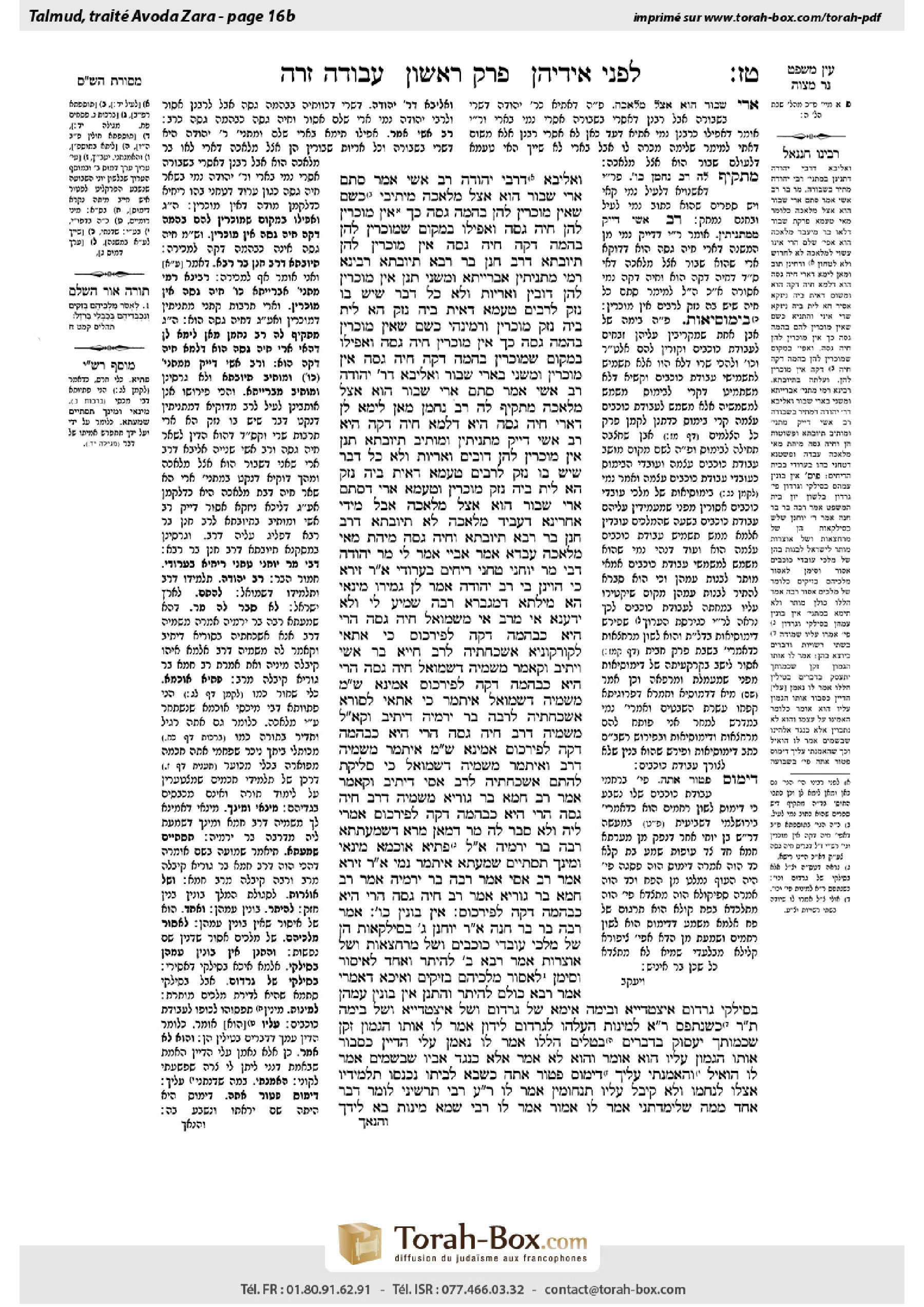
Avodah Zarah 16b: Talmud study for Daf Yomi
Study the Talmud for Daf Yomi with scanned pages, Hebrew text, English translations from Sefaria and AI-generated French translations.
Passage selection and English or AI-generated French translation are available where the scan has annotations. Daf Study is independent of Torah-Box and Sefaria.
Browse Avodah Zarah · עבודה זרה · All tractatesAvodah Zarah 16b text and translations
This page of Avodah Zarah includes the Aramaic text, an English translation and an AI-generated French translation, alongside the scan above.
עבודה זרה י״ו ב · Aramaic and Hebrew text
וְאַלִּיבָּא דְּרַבִּי יְהוּדָה. רַב אָשֵׁי אָמַר: סְתָם אֲרִי שָׁבוּר הוּא אֵצֶל מְלָאכָה.
מֵיתִיבִי: כְּשֵׁם שֶׁאֵין מוֹכְרִין לָהֶן בְּהֵמָה גַּסָּה, כָּךְ אֵין מוֹכְרִין לָהֶן חַיָּה גַּסָּה, וַאֲפִילּוּ בִּמְקוֹם שֶׁמּוֹכְרִין לָהֶן בְּהֵמָה דַּקָּה — חַיָּה גַּסָּה אֵין מוֹכְרִין לָהֶן. תְּיוּבְתָּא דְּרַב חָנָן בַּר רָבָא, תְּיוּבְתָּא.
רָבִינָא רָמֵי מַתְנִיתִין אַבָּרַיְיתָא וּמְשַׁנֵּי, תְּנַן: אֵין מוֹכְרִין לָהֶן דּוּבִּין וַאֲרָיוֹת וְלֹא כׇּל דָּבָר שֶׁיֵּשׁ בּוֹ נֶזֶק לָרַבִּים, טַעְמָא דְּאִית בֵּיהּ נֶזֶק, הָא לֵית בֵּיהּ נֶזֶק — מוֹכְרִין.
וּרְמִינְהִי: כְּשֵׁם שֶׁאֵין מוֹכְרִין בְּהֵמָה גַּסָּה, כָּךְ אֵין מוֹכְרִין חַיָּה גַּסָּה, וַאֲפִילּוּ בִּמְקוֹם שֶׁמּוֹכְרִין בְּהֵמָה דַּקָּה, חַיָּה גַּסָּה אֵין מוֹכְרִין. וּמְשַׁנֵּי: בַּאֲרִי שָׁבוּר, וְאַלִּיבָּא דְּרַבִּי יְהוּדָה. רַב אָשֵׁי אָמַר: סְתָם אֲרִי שָׁבוּר הוּא אֵצֶל מְלָאכָה.
מַתְקֵיף לַהּ רַב נַחְמָן: מַאן לֵימָא לַן דַּאֲרִי חַיָּה גַּסָּה הִיא? דִּלְמָא חַיָּה דַּקָּה הִיא!
רַב אָשֵׁי דָּיֵיק מַתְנִיתִין וּמוֹתֵיב תְּיוּבְתָּא, תְּנַן: אֵין מוֹכְרִין לָהֶן דּוּבִּים וַאֲרָיוֹת וְלֹא כׇּל דָּבָר שֶׁיֵּשׁ בּוֹ נֶזֶק לָרַבִּים. טַעְמָא דְּאִית בֵּיהּ נֶזֶק, הָא לֵית בֵּיהּ נֶזֶק מוֹכְרִין.
וְטַעְמָא אֲרִי, דִּסְתָם אֲרִי שָׁבוּר הוּא אֵצֶל מְלָאכָה, אֲבָל מִידֵּי אַחֲרִינָא דְּעָבֵיד מְלָאכָה — לָא. תְּיוּבְתָּא דְּרַב חָנָן בַּר רָבָא, תְּיוּבְתָּא.
וְחַיָּה גַּסָּה מִיהַת מַאי מְלָאכָה עָבְדָא? אָמַר אַבָּיֵי: אֲמַר לִי מָר יְהוּדָה, דְּבֵי מָר יוֹחָנִי טָחֲנִי רֵיחַיִם בַּעֲרוֹדֵי.
אָמַר רַבִּי זֵירָא: כִּי הֲוֵינַן בֵּי רַב יְהוּדָה, אֲמַר לַן: גְּמִירוּ מִינַּאי הָא מִילְּתָא, דְּמִגַּבְרָא רַבָּה שְׁמִיעַ לִי, וְלָא יָדַעְנָא אִי מֵרַב אִי מִשְּׁמוּאֵל: חַיָּה גַּסָּה הֲרֵי הִיא כִּבְהֵמָה דַּקָּה לְפִירְכּוּס.
כִּי אֲתַאי לְקוּרְקוּנְיָא, אַשְׁכַּחְתֵּיהּ לְרַב חִיָּיא בַּר אָשֵׁי, וְיָתֵיב וְקָאָמַר מִשְּׁמֵיהּ דִּשְׁמוּאֵל: חַיָּה גַּסָּה הֲרֵי הִיא כִּבְהֵמָה דַּקָּה לְפִירְכּוּס. אָמֵינָא: שְׁמַע מִינַּהּ מִשְּׁמֵיהּ דִּשְׁמוּאֵל אִיתְּמַר. כִּי אֲתַאי לְסוּרָא, אַשְׁכַּחְתֵּיהּ לְרַבָּה בַּר יִרְמְיָה דְּיָתֵיב וְקָאָמַר לַהּ מִשְּׁמֵיהּ דְּרַב: חַיָּה גַּסָּה הֲרֵי הִיא כִּבְהֵמָה דַּקָּה לְפִירְכּוּס. אָמֵינָא: שְׁמַע מִינַּהּ אִיתְּמַר מִשְּׁמֵיהּ דְּרַב וְאִיתְּמַר מִשְּׁמֵיהּ דִּשְׁמוּאֵל.
כִּי סְלֵיקִית לְהָתָם, אַשְׁכַּחְתֵּיהּ לְרַב אַסִּי דְּיָתֵיב וְקָאָמַר: אָמַר רַב חָמָא בַּר גּוּרְיָא מִשְּׁמֵיהּ דְּרַב: חַיָּה גַּסָּה הֲרֵי הִיא כִּבְהֵמָה דַּקָּה לְפִירְכּוּס. אֲמַרִי לֵיהּ: וְלָא סָבַר לַהּ מָר דְּמַאן מָרָא דִּשְׁמַעְתְּתָא רַבָּה בַּר יִרְמְיָה? אָמַר לִי: פַּתְיָא אוּכָּמָא, מִינַּאי וּמִינָּךְ תִּסְתַּיֵּים שְׁמַעְתָּא.
אִיתְּמַר נָמֵי: אָמַר רַבִּי זֵירָא, אָמַר רַב אַסִּי, אָמַר רַבָּה בַּר יִרְמְיָה, אָמַר רַב חָמָא בַּר גּוּרְיָא, אָמַר רַב: חַיָּה גַּסָּה הֲרֵי הִיא כִּבְהֵמָה דַּקָּה לְפִירְכּוּס.
אֵין בּוֹנִין כּוּ׳. אָמַר רַבָּה בַּר בַּר חָנָה אָמַר רַבִּי יוֹחָנָן: שָׁלֹשׁ בָּסִילְקָאוֹת הֵן, שֶׁל מְלָכִים, וְשֶׁל מֶרְחֲצָאוֹת, וְשֶׁל אוֹצָרוֹת. אָמַר רָבָא: שְׁתַּיִם לְהֶיתֵּר וְאֶחָד לְאִיסּוּר, וְסִימָן: ״לֶאְסֹר מַלְכֵיהֶם בְּזִקִּים״.
וְאִיכָּא דְּאָמְרִי, אָמַר רָבָא: כּוּלָּם לְהֶיתֵּר. וְהָתְנַן: אֵין בּוֹנִין עִמָּהֶן בָּסִילְקֵי, גַּרְדּוֹם, אִיצְטַדְיָיא וּבִימָה! אֵימָא: שֶׁל גַּרְדּוֹם וְשֶׁל אִיצְטַדְיָיא וְשֶׁל בִּימָה.
תָּנוּ רַבָּנַן: כְּשֶׁנִּתְפַּס רַבִּי אֱלִיעֶזֶר לְמִינוּת, הֶעֱלֻהוּ לַגַּרְדּוֹם לִידּוֹן. אָמַר לוֹ אוֹתוֹ הֶגְמוֹן: זָקֵן שֶׁכְּמוֹתְךָ יַעֲסוֹק בִּדְבָרִים בְּטֵלִים הַלָּלוּ?
אָמַר לוֹ: נֶאֱמָן עָלַי הַדַּיָּין. כְּסָבוּר אוֹתוֹ הֶגְמוֹן: עָלָיו הוּא אוֹמֵר, וְהוּא לֹא אָמַר אֶלָּא כְּנֶגֶד אָבִיו שֶׁבַּשָּׁמַיִם. אָמַר לוֹ: הוֹאִיל וְהֶאֱמַנְתִּי עָלֶיךָ, דִּימוֹס — פָּטוּר אַתָּה.
כְּשֶׁבָּא לְבֵיתוֹ, נִכְנְסוּ תַּלְמִידָיו אֶצְלוֹ לְנַחֲמוֹ, וְלֹא קִיבֵּל עָלָיו תַּנְחוּמִין. אָמַר לוֹ רַבִּי עֲקִיבָא: רַבִּי, תַּרְשֵׁינִי לוֹמַר דָּבָר אֶחָד מִמַּה שֶּׁלִּימַּדְתַּנִי? אָמַר לוֹ: אֱמוֹר. אָמַר לוֹ: רַבִּי, שֶׁמָּא מִינוּת בָּא לְיָדְךָ
Avodah Zarah 16b · English translation
and this is in accordance with the opinion of Rabbi Yehuda in the mishna on 14b, that it is permitted to sell to a gentile large livestock that are damaged. Yet, it is prohibited to sell large undamaged beasts, just as one may not sell large undamaged livestock. Rav Ashi says: It is not necessary to explain that the mishna is referring to such a specific case. Rather, an ordinary lion is considered damaged with regard to labor, as lions are not generally used to perform labor. Therefore there is no concern that a lion will be used to perform prohibited labor on Shabbat.
The Gemara raises an objection from a baraita: Just as one may not sell large livestock to gentiles, so too one may not sell large beasts to them. And even in a place where the people were accustomed to sell small livestock to gentiles; nevertheless, one may not sell large beasts to them. The Gemara concludes: The refutation of the opinion of Rav Ḥanan bar Rava is a conclusive refutation.
The Gemara presents a different version of this discussion. Ravina raises a contradiction between the mishna here and a baraita and resolves the contradiction. We learned in the mishna: One may not sell bears, or lions, or any item that can cause injury to the public, to gentiles. Ravina analyzes the mishna: The reason a beast such as a lion cannot be sold to gentiles is that it can cause injury to the public, from which it may be inferred that with regard to another beast, which does not cause injury to the public, one may sell it to gentiles.
And Ravina raises a contradiction from a baraita: Just as one may not sell large livestock to gentiles, so too, one may not sell large beasts to them. And even in a place where the people were accustomed to sell small livestock to gentiles, one may not sell large beasts to them. The baraita indicates that one may never sell large beasts to gentiles, even if it poses no danger to the public. And Ravina resolves the contradiction between the mishna and the baraita: The ruling of the mishna is stated with regard to a damaged lion, in accordance with the opinion of Rabbi Yehuda. Rav Ashi says there is a different explanation: An ordinary lion is considered damaged with regard to labor.
Rav Naḥman objects to the inference drawn from the mishna: Who will tell us that a lion is considered a large beast? Perhaps it is considered a small beast, in which case it cannot be inferred that the mishna permits the sale of large beasts.
The Gemara explains: Rav Ashi examined the mishna here carefully, and from it he raises a refutation of the opinion of Rav Ḥanan bar Rava, who permitted the sale of large beasts. We learned in the mishna: One may not sell bears, or lions, or any item that can cause injury to the public, to gentiles. Rav Ashi inferred two conclusions from here. First, the reason a beast such as a lion cannot be sold to gentiles is because it can cause injury to the public, whereas with regard to a beast that does not cause injury to the public, one may sell it to gentiles. This inference was cited in contradiction of the opinion of Rav, as explained before.
And Rav Ashi then inferred, in resolution of Rav’s opinion, that the reason the mishna specifies that one may sell a lion if it does not pose a danger to the public is that an ordinary lion is considered damaged with regard to labor. But a different animal that performs labor may not be sold. This presents a difficulty to the opinion of Rav Ḥanan bar Rava. The Gemara concludes: The refutation of the opinion of Rav Ḥanan bar Rava is a conclusive refutation.
The Gemara asks: But in any event, what labor can a large beast perform? Why is it necessary to prohibit the sale of large beasts if they are not trained to perform any labor? Abaye said: Mar Yehuda said to me that in the house of Mar Yoḥani, they grind the mill with wild asses, which are considered large beasts.
§ Rabbi Zeira said: When we were in the study hall of Rav Yehuda, he said to us: Learn from me this matter, which I heard from a great man, but I do not know if I heard it from Rav or from Shmuel: The status of a large beast is like that of small livestock with regard to a spasm, i.e., the symptoms of vitality required at the time of slaughtering.
Rabbi Zeira continued: When I came to the city of Korkoneya, I found Rav Ḥiyya bar Ashi sitting and saying in the name of Shmuel: The status of a large beast is like that of small livestock with regard to a spasm. I said to myself: One can conclude from here that this was stated in the name of Shmuel. When I came to Sura, I found Rabba bar Yirmeya sitting and saying in the name of Rav: The status of a large beast is like that of small livestock with regard to a spasm. I said to myself: One can conclude from here that this was stated in the name of Rav, and it was also stated in the name of Shmuel.
When I ascended to there, Eretz Yisrael, I found Rav Asi sitting and saying that Rav Ḥama bar Gurya says in the name of Rav: The status of a large beast is like that of small livestock with regard to a spasm. I said to him: And doesn’t the Master hold that the Master who is responsible for dissemination of this halakha is Rabba bar Yirmeya? Why don’t you attribute the statement to him? Rav Asi said to me: Black pot [patya], a term of endearment for a scholar who works hard studying Torah: From me and from you this halakha may be concluded. In other words, our two statements should be combined to form one accurate attribution of the halakha.
The Gemara notes that in fact this ruling was also stated: Rabbi Zeira says that Rav Asi says that Rabba bar Yirmeya says that Rav Ḥama bar Gurya says that Rav says: The status of a large beast is like that of small livestock with regard to a spasm.
§ The mishna teaches that one may not build a basilica in conjunction with gentiles. Rabba bar bar Ḥana says that Rabbi Yoḥanan says: There are three types of basilicas: Those of kings, and those of bathhouses, and those of storehouses. Rava says: Two of these types are permitted, as they are not used for inflicting the death penalty, and one is prohibited [le’isor]. And a mnemonic device for this ruling, that the basilica of kings is prohibited, is the verse: “To bind [le’esor] their kings with chains” (Psalms 149:8).
And there are those who say that this is what Rava says: All these types of basilica are permitted. The Gemara asks: How can it be permitted to build any type of basilica; but didn’t we learn in the mishna: One may not build with them a basilica, a tribunal, a stadium, or a platform? The Gemara answers: Say that the mishna means the following: One may not build in conjunction with gentiles a basilica of a tribunal, or of a stadium, or of a platform. But it is permitted to build a basilica that is not used for sentencing and inflicting the death penalty.
§ Apropos the above discussion, the Gemara relates incidents involving Sages who were sentenced by the ruling authorities. The Sages taught: When Rabbi Eliezer was arrested and charged with heresy by the authorities, they brought him up to a tribunal to be judged. A certain judicial officer [hegemon] said to him: Why should an elder like you engage in these frivolous matters of heresy?
Rabbi Eliezer said to him: The Judge is trusted by me to rule correctly. That officer thought that Rabbi Eliezer was speaking about him; but in fact he said this only in reference to his Father in Heaven. Rabbi Eliezer meant that he accepted God’s judgment, i.e., if he was charged he must have sinned to God in some manner. The officer said to him: Since you put your trust in me, you are acquitted [dimos]; you are exempt.
When Rabbi Eliezer came home, his students entered to console him for being accused of heresy, which he took as a sign of sin, and he did not accept their words of consolation. Rabbi Akiva said to him: My teacher, allow me to say one matter from all of that which you taught me. Rabbi Eliezer said to him: Speak. Rabbi Akiva said to him: My teacher, perhaps some statement of heresy came before you
Avodah Zarah 16b · Traduction française (IA)
et cela correspond à l'opinion du Rabbi Yéhuda dans la Michna de la page 14b, selon laquelle il est permis de vendre à un non-Juif des grandes bêtes endommagées. Cependant, il est interdit de vendre des grandes bêtes intactes, tout comme on ne peut pas vendre des grandes bêtes intactes. Rav Ashi dit : Il n'est pas nécessaire d'expliquer que la Michna fait référence à un cas spécifique. En réalité, un lion ordinaire est considéré comme endommagé en ce qui concerne le travail, car les lions ne sont généralement pas utilisés pour le travail. Ainsi, il n'y a pas de crainte que le lion soit utilisé pour un travail interdit le sabbat.
La Guemara soulève un objet tiré d'une baraïta : Tout comme on ne peut pas vendre des grandes bêtes à des non-Juifs, de même on ne peut pas vendre des grandes bêtes à des non-Juifs. Même dans un lieu où les gens étaient habitués à vendre des petites bêtes à des non-Juifs, on ne peut pas vendre des grandes bêtes à des non-Juifs. La Guemara conclut : La réfutation de l'opinion du Rabbi Hanan bar Rava est une réfutation définitive.
La Guemara présente une autre version de cette discussion. Ravina soulève une contradiction entre la Michna ici et une baraïta et la résout. Nous avons appris dans la Michna : On ne peut pas vendre des ours, des lions ou tout objet pouvant causer un danger au public aux non-Juifs. Ravina analyse la Michna : La raison pour laquelle un animal tel qu'un lion ne peut pas être vendu aux non-Juifs est qu'il peut causer un danger au public, ce qui suggère que, concernant un autre animal ne causant pas de danger au public, on peut le vendre aux non-Juifs.
Et Ravina soulève une contradiction tirée d'une baraïta : Tout comme on ne peut pas vendre des grandes bêtes aux non-Juifs, de même on ne peut pas vendre des grandes bêtes aux non-Juifs. Même dans un lieu où les gens étaient habitués à vendre des petites bêtes aux non-Juifs, on ne peut pas vendre des grandes bêtes aux non-Juifs. La baraïta indique que l'on ne peut jamais vendre des grandes bêtes aux non-Juifs, même s'il ne présente aucun danger pour le public. Et Ravina résout la contradiction entre la Michna et la baraïta : La décision de la Michna est formulée concernant un lion endommagé, conformément à l'opinion du Rabbi Yéhuda. Rav Ashi dit qu'il y a une autre explication : un lion ordinaire est considéré comme endommagé en ce qui concerne le travail.
Rav Naḥman s'oppose à l'inférence tirée de la Michna : Qui nous dira que le lion est considéré comme une grande bête ? Peut-être qu'il est considéré comme une petite bête, dans ce cas, on ne pourrait pas inférer que la Michna permet la vente de grandes bêtes.
La Guemara explique : Rav Ashi a examiné la Michna ici avec soin, et d'elle il a tiré une réfutation de l'opinion du Rabbi Hanan bar Rava, qui permettait la vente de grandes bêtes. Nous avons appris dans la Michna : On ne peut pas vendre des ours, des lions ou tout objet pouvant causer un danger au public aux non-Juifs. Rav Ashi a tiré deux conclusions de là. Premièrement, la raison pour laquelle un animal tel qu'un lion ne peut pas être vendu aux non-Juifs est qu'il peut causer un danger au public, tandis que concernant un animal ne causant pas de danger au public, on peut le vendre aux non-Juifs. Cette inférence a été citée en contradiction avec l'opinion du Rabbi, comme expliqué auparavant.
Et Rav Ashi a ensuite tiré, pour résoudre l'opinion de Rav, la conclusion que la raison pour laquelle la mitsna précise que l'on peut vendre un lion s'il ne présente pas de danger pour le public est que l'animal ordinaire est considéré comme endommagé en ce qui concerne le travail. Mais un autre animal qui effectue un travail ne peut pas être vendu. Cela présente une difficulté pour l'opinion de Rav Ḥanan bar Rava. La Guemara conclut : La réfutation de l'opinion de Rav Ḥanan bar Rava est une réfutation définitive.
La Guemara pose une question : Mais en tout cas, quel travail peut effectuer une grande bête ? Pourquoi est-il nécessaire d'interdire la vente de grandes bêtes si elles ne sont pas entraînées à effectuer un travail ? Abaye dit : Mar Yéhuda m'a dit que dans la maison de Mar Yoḥani, ils font fonctionner le moulin avec des ânes sauvages, qui sont considérés comme des grandes bêtes.
§ Rabbi Zéira dit : Quand nous étions dans la salle de study de Rabbi Yéhuda, il nous a dit : Apprenez-moi cette question, que j'ai entendue d'un grand homme, mais je ne sais pas si j'ai entendu cela de Rav ou de Shmuel : Le statut d'une grande bête est comme celui des petits animaux concernant un spasme, c'est-à-dire les symptômes de vitalité requis au moment de la bataille.
Rabbi Zéira continua : Quand je suis arrivé dans la ville de Korkoneya, j'ai trouvé Rabbi Ḥiyya bar Ashi assis et disant en nom de Shmuel : Le statut d'une grande bête est comme celui des petits animaux concernant un spasme. J'ai pensé à moi-même : On peut conclure de là que cela a été dit en nom de Shmuel. Quand je suis arrivé à Sura, j'ai trouvé Rabba bar Yirmeya assis et disant en nom de Rav : Le statut d'une grande bête est comme celui des petits animaux concernant un spasme. J'ai pensé à moi-même : On peut conclure de là que cela a été dit en nom de Rav, et cela a également été dit en nom de Shmuel.
Quand je suis monté là-bas, en Eretz Yisrael, j'ai trouvé Rav Asi assis et disant que Rav Ḥama bar Gurya dit en nom de Rav : Le statut d'une grande bête est comme celui des petits animaux concernant un spasme. J'ai dit à lui : Et n'est-ce pas que le Maître considère que le Maître responsable de la diffusion de cette halakha est Rabba bar Yirmeya ? Pourquoi ne lui attribuez-vous pas cette déclaration ? Rav Asi a dit à moi : Patya, un terme d'affection pour un savant qui étudie beaucoup la Torah : De moi et de vous, cette halakha peut être conclue. En d'autres termes, nos deux déclarations devraient être combinées pour former une attribution exacte de la halakha.
La Guemara note que cette décision a en effet été également formulée : Rabbi Zéira dit que Rav Asi dit que Rabba bar Yirmeya dit que Rav Ḥama bar Gurya dit que Rav dit : Le statut d'une grande bête est comme celui des petits animaux concernant un spasme.
§ La Michna enseigne que l'on ne peut pas construire une basilique en collaboration avec les Gentils. Rabba bar bar Ḥana dit que Rabbi Yoḥanan dit : Il y a trois types de basiliques : celles des rois, celles des bains et celles des entrepôts. Rava dit : Deux de ces types sont permis, car elles ne sont pas utilisées pour infliger la peine de mort, et une est interdite [le’isor]. Et un moyen mnémotechnique pour cette décision, que la basilique des rois est interdite, est la versette : « Pour attacher [le’esor] leurs rois avec des chaînes » (Psaumes 149:8).
Et ceux qui disent que c'est ce que Rava dit : Tous ces types de basiliques sont permis. La Guemara demande : Comment peut-il être permis de construire n'importe quel type de basiliques ; mais n'avons-nous pas appris dans la Michna : On ne peut pas construire avec eux une basiliques, un tribunal, un stade ou une plateforme ? La Guemara répond : Dites que la Michna signifie ceci : On ne peut pas construire en collaboration avec les Gentils une basiliques de tribunal, ou de stade, ou de plateforme. Mais il est permis de construire une basiliques qui n'est pas utilisée pour l'incrimination et l'infligence de la peine de mort.
§ À propos de la discussion ci-dessus, la Guemara rapporte des incidents concernant des Sages qui ont été jugés par les autorités compétentes. Les Sages enseignèrent : Lorsque Rabbi Eliezer a été arrêté et accusé de hérésie par les autorités, on l'a amené devant un tribunal pour être jugé. Un certain juge [hegemon] a dit à lui : Pourquoi un homme aussi âgé que vous s'engage dans ces affaires triviales de hérésie ?
Rabbi Eliezer lui a dit : Le Juge est digne de confiance pour juger correctement. Cet officier pensait que Rabbi Eliezer parlait de lui ; en réalité, il parlait de son Père céleste. Rabbi Eliezer voulait dire qu'il acceptait le jugement de Dieu, c'est-à-dire que s'il était accusé, il avait dû pécher contre Dieu de quelque manière. L'officier lui a dit : Puisque vous avez confiance en moi, vous êtes acquitté [dimos] ; vous êtes exempt.
Lorsque Rabbi Eliezer est rentré chez lui, ses élèves sont entrés pour le consoler de l'accusation de hérésie, qu'il prenait comme un signe de péché, et il n'a pas accepté leurs paroles de consolation. Rabbi Akiva lui a dit : Mon maître, permettez-moi de dire une seule chose parmi toutes celles que vous m'avez enseignées. Rabbi Eliezer lui a dit : Parle. Rabbi Akiva lui a dit : Mon maître, peut-être une déclaration de hérésie est venue avant vous
Traduction française générée par IA à partir de l’édition anglaise de Sefaria. Vérifie toujours un passage avec le texte source.
Text from Sefaria: William Davidson Edition - Vocalized Aramaic (CC BY NC); William Davidson Edition - English (CC BY NC).