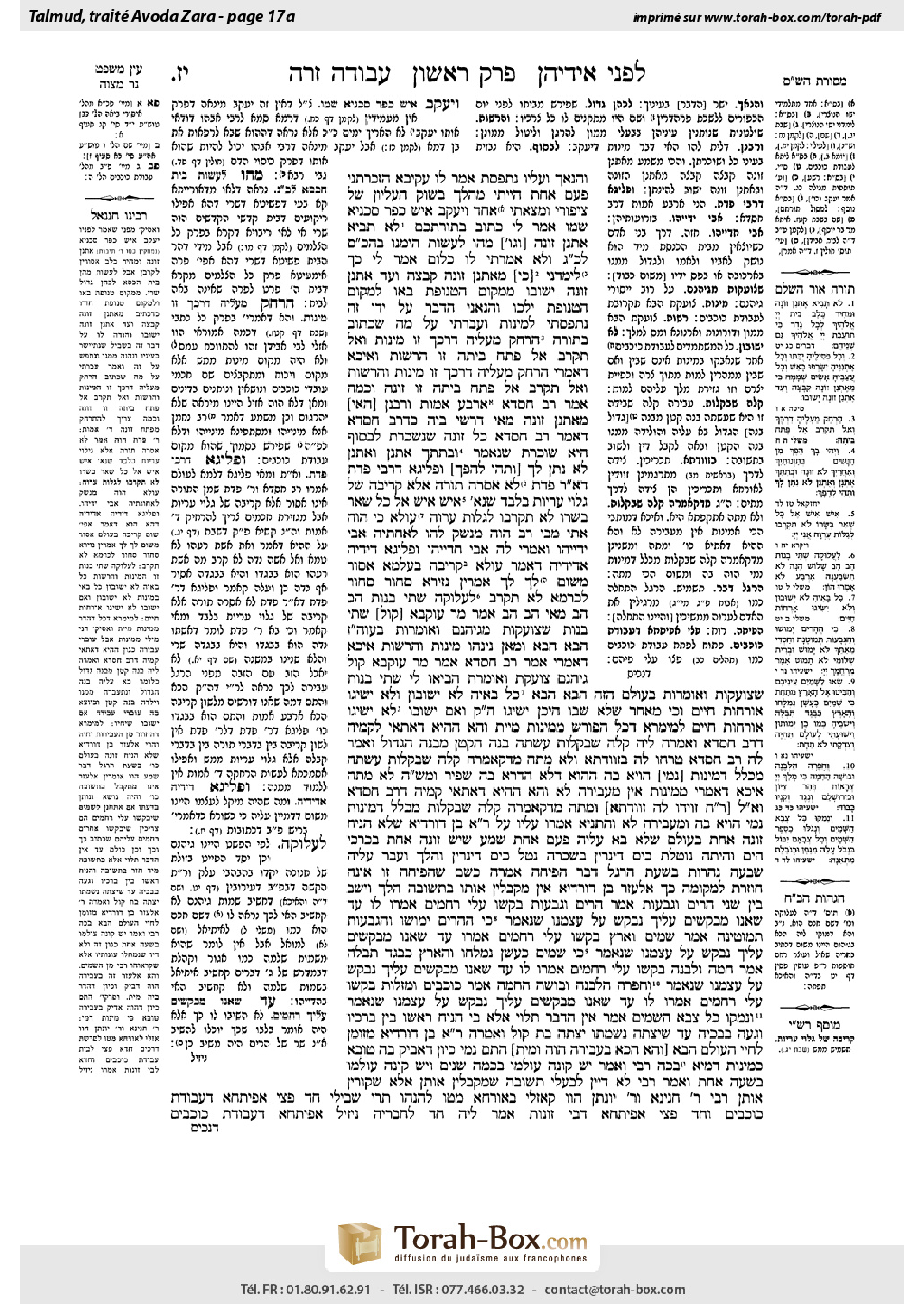
Avodah Zarah 17a: Talmud study for Daf Yomi
Study the Talmud for Daf Yomi with scanned pages, Hebrew text, English translations from Sefaria and AI-generated French translations.
Passage selection and English or AI-generated French translation are available where the scan has annotations. Daf Study is independent of Torah-Box and Sefaria.
Browse Avodah Zarah · עבודה זרה · All tractatesAvodah Zarah 17a text and translations
This page of Avodah Zarah includes the Aramaic text, an English translation and an AI-generated French translation, alongside the scan above.
עבודה זרה י״ז א · Aramaic and Hebrew text
וְהִנְאֲךָ, וְעָלָיו נִתְפַּסְתָּ? אָמַר לוֹ: עֲקִיבָא, הִזְכַּרְתַּנִי, פַּעַם אַחַת הָיִיתִי מְהַלֵּךְ בַּשּׁוּק הָעֶלְיוֹן שֶׁל צִיפּוֹרִי, וּמָצָאתִי אָדָם אֶחָד מִתַּלְמִידֵי יֵשׁוּ הַנּוֹצְרִי, וְיַעֲקֹב אִישׁ כְּפַר סְכַנְיָא שְׁמוֹ. אָמַר לִי: כָּתוּב בְּתוֹרַתְכֶם: ״לֹא תָבִיא אֶתְנַן זוֹנָה וְגוֹ׳״, מַהוּ לַעֲשׂוֹת הֵימֶנּוּ בֵּית הַכִּסֵּא לְכֹהֵן גָּדוֹל? וְלֹא אָמַרְתִּי לוֹ כְּלוּם.
אָמַר לִי: כָּךְ לִימְּדַנִי יֵשׁוּ הַנּוֹצְרִי, כִּי ״מֵאֶתְנַן זוֹנָה קֻבָּצָה וְעַד אֶתְנַן זוֹנָה יָשׁוּבוּ״, מִמְּקוֹם הַטִּנּוֹפֶת בָּאוּ, לִמְקוֹם הַטִּנּוֹפֶת יֵלֵכוּ.
וְהִנְאַנִי הַדָּבָר, עַל יְדֵי זֶה נִתְפַּסְתִּי לְמִינוּת, וְעָבַרְתִּי עַל מַה שֶּׁכָּתוּב בַּתּוֹרָה: ״הַרְחֵק מֵעָלֶיהָ דַּרְכֶּךָ״ — זוֹ מִינוּת, ״וְאַל תִּקְרַב אֶל פֶּתַח בֵּיתָהּ״ — זוֹ הָרָשׁוּת. וְאִיכָּא דְּאָמְרִי: ״הַרְחֵק מֵעָלֶיהָ דַּרְכֶּךָ״ — זוֹ מִינוּת וְהָרָשׁוּת, ״וְאַל תִּקְרַב אֶל פֶּתַח בֵּיתָהּ״ — זוֹ זוֹנָה. וְכַמָּה? אָמַר רַב חִסְדָּא: אַרְבַּע אַמּוֹת.
וְרַבָּנַן [הַאי] ״מֵאֶתְנַן זוֹנָה״ מַאי דָּרְשִׁי בֵּיהּ? כִּדְרַב חִסְדָּא, דְּאָמַר רַב חִסְדָּא: כׇּל זוֹנָה שֶׁנִּשְׂכֶּרֶת, לְבַסּוֹף הִיא שׂוֹכֶרֶת, שֶׁנֶּאֱמַר: ״וּבְתִתֵּךְ אֶתְנָן וְאֶתְנַן לֹא נִתַּן לָךְ [וַתְּהִי לְהֶפֶךְ]״.
וּפְלִיגָא דְּרַבִּי פְּדָת, דְּאָמַר רַבִּי פְּדָת: לֹא אָסְרָה תּוֹרָה אֶלָּא קְרִיבָה שֶׁל גִּלּוּי עֲרָיוֹת בִּלְבַד, שֶׁנֶּאֱמַר: ״אִישׁ אִישׁ אֶל כׇּל שְׁאֵר בְּשָׂרוֹ לֹא תִקְרְבוּ לְגַלּוֹת עֶרְוָה״.
עוּלָּא כִּי הֲוָה אָתֵי מִבֵּי רַב, הֲוָה מְנַשֵּׁק לְהוּ לַאֲחָתֵיהּ אַבֵּי יְדַיְיהוּ, וְאָמְרִי לַהּ: אַבֵּי חָדַיְיהוּ. וּפְלִיגָא דִּידֵיהּ אַדִּידֵיהּ, דְּאָמַר עוּלָּא: קְרִיבָה בְּעָלְמָא אָסוּר, מִשּׁוּם ״לָךְ לָךְ, אָמְרִין נְזִירָא; סְחוֹר סְחוֹר, לְכַרְמָא לָא תִּקְרַב״.
״לַעֲלוּקָה שְׁתֵּי בָנוֹת הַב הַב״. מַאי ״הַב הַב״? אָמַר מָר עוּקְבָא: [קוֹל] שְׁתֵּי בָּנוֹת שֶׁצּוֹעֲקוֹת מִגֵּיהִנָּם, וְאוֹמְרוֹת בָּעוֹלָם הַזֶּה ״הָבֵא הָבֵא״. וּמַאן נִינְהוּ? מִינוּת וְהָרָשׁוּת. אִיכָּא דְּאָמְרִי: אָמַר רַב חִסְדָּא אָמַר מָר עוּקְבָא, קוֹל גֵּיהִנָּם צוֹעֶקֶת וְאוֹמֶרֶת: הָבִיאוּ לִי שְׁתֵּי בָּנוֹת שֶׁצּוֹעֲקוֹת וְאוֹמְרוֹת בָּעוֹלָם הַזֶּה ״הָבֵא הָבֵא״.
״כׇּל בָּאֶיהָ לֹא יְשׁוּבוּן וְלֹא יַשִּׂיגוּ אׇרְחוֹת חַיִּים״, וְכִי מֵאַחַר שֶׁלֹּא שָׁבוּ, הֵיכָן יַשִּׂיגוּ? הָכִי קָאָמַר: וְאִם יָשׁוּבוּ — לֹא יַשִּׂיגוּ אוֹרְחוֹת חַיִּים.
לְמֵימְרָא, דְּכׇל הַפּוֹרֵשׁ מִמִּינוּת מָיֵית? וְהָא הָהִיא דַּאֲתַאי לְקַמֵּיהּ דְּרַב חִסְדָּא, וְאָמְרָה לֵיהּ: קַלָּה שֶׁבַּקַּלּוֹת עָשְׂתָה בְּנָהּ הַקָּטָן מִבְּנָהּ הַגָּדוֹל, וַאֲמַר לַהּ רַב חִסְדָּא: טְרַחוּ לַהּ בִּזְוָודְתָּא, וְלָא מִתָה.
מִדְּקָאָמְרָה קַלָּה שֶׁבַּקַּלּוֹת עָשְׂתָה, מִכְּלָל דְּמִינוּת [נָמֵי] הָוְיָא בַּהּ! הָהוּא דְּלָא הָדְרָא בַּהּ שַׁפִּיר, וּמִשּׁוּם הָכִי לֹא מֵתָה.
אִיכָּא דְּאָמְרִי: מִמִּינוּת — אִין, מֵעֲבֵירָה — לָא? וְהָא הָהִיא דַּאֲתַאי קַמֵּיהּ דְּרַב חִסְדָּא, וַאֲמַר לְהוּ [רַב חִסְדָּא: זַוִּידוּ לַהּ זְוַודְתָּא], וּמִתָה! מִדְּקָאָמְרָה ״קַלָּה שֶׁבַּקַּלּוֹת״, מִכְּלָל דְּמִינוּת נָמֵי הַוְיָא בַּהּ.
וּמֵעֲבֵירָה לָא? וְהָתַנְיָא: אָמְרוּ עָלָיו עַל רַבִּי אֶלְעָזָר בֶּן דּוּרְדְּיָא, שֶׁלֹּא הִנִּיחַ זוֹנָה אַחַת בָּעוֹלָם שֶׁלֹּא בָּא עָלֶיהָ. פַּעַם אַחַת שָׁמַע שֶׁיֵּשׁ זוֹנָה אַחַת בִּכְרַכֵּי הַיָּם, וְהָיְתָה נוֹטֶלֶת כִּיס דִּינָרִין בִּשְׂכָרָהּ. נָטַל כִּיס דִּינָרִין וְהָלַךְ וְעָבַר עָלֶיהָ שִׁבְעָה נְהָרוֹת. בִּשְׁעַת הֶרְגֵּל דָּבָר הֵפִיחָה, אָמְרָה: כְּשֵׁם שֶׁהֲפָיחָה זוֹ אֵינָהּ חוֹזֶרֶת לִמְקוֹמָהּ, כָּךְ אֶלְעָזָר בֶּן דּוּרְדְּיָא אֵין מְקַבְּלִין אוֹתוֹ בִּתְשׁוּבָה.
הָלַךְ וְיָשַׁב בֵּין שְׁנֵי הָרִים וּגְבָעוֹת, אָמַר: הָרִים וּגְבָעוֹת בַּקְּשׁוּ עָלַי רַחֲמִים! אָמְרוּ לוֹ: עַד שֶׁאָנוּ מְבַקְּשִׁים עָלֶיךָ נְבַקֵּשׁ עַל עַצְמֵנוּ, שֶׁנֶּאֱמַר: ״כִּי הֶהָרִים יָמוּשׁוּ וְהַגְּבָעוֹת תְּמוּטֶינָה״. אָמַר: שָׁמַיִם וָאָרֶץ בַּקְּשׁוּ עָלַי רַחֲמִים! אָמְרוּ: עַד שֶׁאָנוּ מְבַקְּשִׁים עָלֶיךָ נְבַקֵּשׁ עַל עַצְמֵנוּ, שֶׁנֶּאֱמַר: ״כִּי שָׁמַיִם כֶּעָשָׁן נִמְלָחוּ וְהָאָרֶץ כַּבֶּגֶד תִּבְלֶה״.
אָמַר: חַמָּה וּלְבָנָה בַּקְּשׁוּ עָלַי רַחֲמִים! אָמְרוּ לוֹ: עַד שֶׁאָנוּ מְבַקְּשִׁים עָלֶיךָ, נְבַקֵּשׁ עַל עַצְמֵנוּ, שֶׁנֶּאֱמַר: ״וְחָפְרָה הַלְּבָנָה וּבוֹשָׁה הַחַמָּה״. אָמַר: כּוֹכָבִים וּמַזָּלוֹת בַּקְּשׁוּ עָלַי רַחֲמִים! אָמְרוּ לוֹ: עַד שֶׁאָנוּ מְבַקְּשִׁים עָלֶיךָ, נְבַקֵּשׁ עַל עַצְמֵנוּ, שֶׁנֶּאֱמַר: ״וְנָמַקּוּ כׇּל צְבָא הַשָּׁמַיִם״.
אָמַר: אֵין הַדָּבָר תָּלוּי אֶלָּא בִּי. הִנִּיחַ רֹאשׁוֹ בֵּין בִּרְכָּיו וְגָעָה בִּבְכִיָּה עַד שֶׁיָּצְתָה נִשְׁמָתוֹ. יָצְתָה בַּת קוֹל וְאָמְרָה: רַבִּי אֶלְעָזָר בֶּן דּוּרְדְּיָא מְזֻומָּן לְחַיֵּי הָעוֹלָם הַבָּא! [וְהָא הָכָא בַּעֲבֵירָה הֲוָה וּמִית], הָתָם נָמֵי, כֵּיוָן דַּאֲבִיק בַּהּ טוּבָא, כְּמִינוּת דָּמְיָא.
בָּכָה רַבִּי וְאָמַר: יֵשׁ קוֹנֶה עוֹלָמוֹ בְּכַמָּה שָׁנִים, וְיֵשׁ קוֹנֶה עוֹלָמוֹ בְּשָׁעָה אַחַת. וְאָמַר רַבִּי: לֹא דַּיָּין לְבַעֲלֵי תְשׁוּבָה שֶׁמְּקַבְּלִין אוֹתָן, אֶלָּא שֶׁקּוֹרִין אוֹתָן ״רַבִּי״.
רַבִּי חֲנִינָא וְרַבִּי יוֹנָתָן הֲווֹ קָאָזְלִי בְּאוֹרְחָא, מְטוֹ לְהָנְהוּ תְּרֵי שְׁבִילֵי, חַד פָּצֵי אַפִּיתְחָא דַּעֲבוֹדָה זָרָה, וְחַד פָּצֵי אַפִּיתְחָא דְּבֵי זוֹנוֹת. אֲמַר לֵיהּ חַד לְחַבְרֵיהּ: נֵיזִיל אַפִּיתְחָא דַּעֲבוֹדָה זָרָה
Avodah Zarah 17a · English translation
and you derived pleasure from it, and because of this you were held responsible by Heaven. Rabbi Eliezer said to him: Akiva, you are right, as you have reminded me that once I was walking in the upper marketplace of Tzippori, and I found a man who was one of the students of Jesus the Nazarene, and his name was Ya’akov of Kefar Sekhanya. He said to me: It is written in your Torah: “You shall not bring the payment to a prostitute, or the price of a dog, into the house of the Lord your God” (Deuteronomy 23:19). What is the halakha: Is it permitted to make from the payment to a prostitute for services rendered a bathroom for a High Priest in the Temple? And I said nothing to him in response.
He said to me: Jesus the Nazarene taught me the following: It is permitted, as derived from the verse: “For of the payment to a prostitute she has gathered them, and to the payment to a prostitute they shall return” (Micah 1:7). Since the coins came from a place of filth, let them go to a place of filth and be used to build a bathroom.
And I derived pleasure from the statement, and due to this, I was arrested for heresy by the authorities, because I transgressed that which is written in the Torah: “Remove your way far from her, and do not come near the entrance of her house” (Proverbs 5:8). “Remove your way far from her,” this is a reference to heresy; “and do not come near the entrance of her house,” this is a reference to the ruling authority. The Gemara notes: And there are those who say a different interpretation: “Remove your way far from her,” this is a reference to heresy and the ruling authority; “and do not come near the entrance of her house,” this is a reference to a prostitute. And how much distance must one maintain from a prostitute? Rav Ḥisda said: Four cubits.
With regard to the derivation of the verse by Jesus the Nazarene, the Gemara asks: And what do the Sages derive from this phrase: “Payment to a prostitute”? The Gemara answers: They explain it in accordance with the opinion of Rav Ḥisda, as Rav Ḥisda says: Any prostitute who hires herself out to others for money will become so attached to this practice that ultimately, when others no longer wish to hire her, she will hire others to engage in intercourse with her. As it is stated: “And in that you gave payment, and no payment is given to you, therefore you are contrary” (Ezekiel 16:34).
The Gemara comments: And Rav Ḥisda, who stated above that the Torah requires one to maintain a distance of four cubits from a prostitute, disagrees with the opinion of Rabbi Pedat. As Rabbi Pedat says: The Torah prohibited only intimacy that involves engaging in prohibited sexual relations, as it is stated: “None of you shall approach to any that is near of kin to him, to uncover their nakedness” (Leviticus 18:6). The prohibition against intimacy in the Torah applies exclusively to sexual intercourse, and all other kinds of intimacy that do not include actual intercourse are not included in the prohibition.
The Gemara relates: When Ulla would come from the study hall, he would kiss his sisters on their hands. And some say: On their chests. And the Gemara points out that this action of his disagrees with another ruling that Ulla himself issued, as Ulla says: Mere intimacy with a woman with whom one is prohibited from engaging in sexual intercourse is prohibited, due to the maxim: Go, go, we say to a nazirite, go around, go around but do not come near to the vineyard. Just as a nazirite is warned not even to come into close proximity of a vineyard lest he consume a product of the vine, so too one is obligated to distance himself from anyone with whom intercourse is forbidden.
§ In connection to the earlier mention of heresy and the ruling authorities, the Gemara cites a verse: “The horseleech has two daughters: Give, give” (Proverbs 30:15). What is meant by “give, give”? Mar Ukva says: This is the voice of the two daughters who cry out from Gehenna due to their suffering; and they are the ones who say in this world: Give, give, demanding dues and complete allegiance. And who are they? They are heresy and the ruling authority. There are those who say that Rav Ḥisda says that Mar Ukva says: The voice of Gehenna cries out and says: Bring me two daughters who cry and say in this world: Give, give.
The following verse in Proverbs makes reference to a foreign woman, which according to the Sages is a euphemism for heresy: “None that go to her return, neither do they attain the paths of life” (Proverbs 2:19). The Gemara asks: Since those that are drawn to heresy do not return, from where would they attain the path of life? Why is it necessary for the verse to add that they do not attain the paths of life? The Gemara explains that this is what the verse is saying: In general, those who go to her do not return, and even if they return, they do not attain the paths of life, i.e., the pain of their regret will shorten their lives.
The Gemara asks: Is this to say that anyone who separates himself from heresy and returns from his mistaken ways must die? But what about that woman who came before Rav Ḥisda to confess to him, and she said to him: The lightest of the light, i.e., the least of the sins that she committed, is that she conceived her younger son from engaging in intercourse with her older son. And Rav Ḥisda said to her: Prepare funeral shrouds for her, i.e., yourself, as you will certainly die soon, but she did not die.
The above incident refutes the claim that anyone who repents for the sin of heresy must die, as from the fact that she said that the lightest of the light of her sins was that she conceived one son from engaging in intercourse with another son, by inference one can learn that she was also involved in heresy, and yet she did not die. The Gemara answers: That is a case where the woman did not repent properly, and due to that reason she did not die.
There are those who say there is a different version of the objection to the Gemara’s statement that those who repent for the sin of heresy must die: Is that to say that if one repents for the sin of heresy, yes, the result is death, whereas if one repents for the sin of forbidden sexual intercourse he does not die? But what about that woman who came before Rav Ḥisda to confess to him and Rav Ḥisda said to those present: Prepare funeral shrouds for her, and she died? The Gemara answers: From the fact that she said: The lightest of the light, by inference one can learn that she was also involved in heresy.
The Gemara asks: And is it correct that one who repents of the sin of forbidden sexual intercourse does not die? But isn’t it taught in a baraita: They said about Rabbi Elazar ben Durdayya that he was so promiscuous that he did not leave one prostitute in the world with whom he did not engage in sexual intercourse. Once, he heard that there was one prostitute in one of the cities overseas who would take a purse full of dinars as her payment. He took a purse full of dinars and went and crossed seven rivers to reach her. When they were engaged in the matters to which they were accustomed, a euphemism for intercourse, she passed wind and said: Just as this passed wind will not return to its place, so too Elazar ben Durdayya will not be accepted in repentance, even if he were to try to repent.
This statement deeply shocked Elazar ben Durdayya, and he went and sat between two mountains and hills and said: Mountains and hills, pray for mercy on my behalf, so that my repentance will be accepted. They said to him: Before we pray for mercy on your behalf, we must pray for mercy on our own behalf, as it is stated: “For the mountains may depart, and the hills be removed” (Isaiah 54:10). He said: Heaven and earth, pray for mercy on my behalf. They said to him: Before we pray for mercy on your behalf, we must pray for mercy on our own behalf, as it is stated: “For the heavens shall vanish away like smoke, and the earth shall wax old like a garment” (Isaiah 51:6).
He said: Sun and moon, pray for mercy on my behalf. They said to him: Before we pray for mercy on your behalf, we must pray for mercy on our own behalf, as it is stated: “Then the moon shall be confounded, and the sun ashamed” (Isaiah 24:23). He said: Stars and constellations, pray for mercy on my behalf. They said to him: Before we pray for mercy on your behalf, we must pray for mercy on our own behalf, as it is stated: “And all the hosts of heaven shall molder away” (Isaiah 34:4).
Elazar ben Durdayya said: Clearly the matter depends on nothing other than myself. He placed his head between his knees and cried loudly until his soul left his body. A Divine Voice emerged and said: Rabbi Elazar ben Durdayya is destined for life in the World-to-Come. The Gemara explains the difficulty presented by this story: And here Elazar ben Durdayya was guilty of the sin of forbidden sexual intercourse, and yet he died once he repented. The Gemara answers: There too, since he was attached so strongly to the sin, to an extent that transcended the physical temptation he felt, it is similar to heresy, as it had become like a form of idol worship for him.
When Rabbi Yehuda HaNasi heard this story of Elazar ben Durdayya, he wept and said: There is one who acquires his share in the World-to-Come only after many years of toil, and there is one who acquires his share in the World-to-Come in one moment. And Rabbi Yehuda HaNasi further says: Not only are penitents accepted, but they are even called: Rabbi, as the Divine Voice referred to Elazar ben Durdayya as Rabbi Elazar ben Durdayya.
§ In relation to the issue of distancing oneself from idol worship and prostitution, the Gemara relates: Rabbi Ḥanina and Rabbi Yonatan were once walking along the road when they came to a certain two paths, one of which branched off toward the entrance of a place of idol worship, and the other one branched off toward the entrance of a brothel. One said to the other: Let us go by the path that leads to the entrance of the place of idol worship,
Avodah Zarah 17a · Traduction française (IA)
et vous avez trouvé plaisir à cela, et à cause de cela vous avez été tenu responsable par le Ciel. Le maître Eliezer a dit à lui : Akiva, tu as raison, car tu m'as rappelé que j'étais un jour en train de marcher dans le marché supérieur de Tzippori, et j'ai trouvé un homme qui était l'un des élèves de Jésus le Nazaréen, et son nom était Ya’akov de Kefar Sekhanya. Il m'a dit : Il est écrit dans votre Torah : « Vous ne donnerez pas la récompense à une prostituée, ni le prix d'un chien, dans la maison du Seigneur votre Dieu » (Deutéronome 23:19). Quelle est la halakha : est-il permis de faire d'une récompense donnée à une prostituée pour des services rendus une salle de bain pour un prêtre haut dans le Temple ? Et je n'ai pas répondu à son propos.
Il m'a dit : Jésus le Nazaréen m'a enseigné ceci : il est permis, comme déduit de la parole : « Car de la récompense donnée à une prostituée elle a réuni ceux-ci, et à la récompense donnée à une prostituée ils doivent retourner » (Micha 1:7). Puisque les monnaies viennent d'un lieu de souillure, qu'elles aillent à un lieu de souillure et soient utilisées pour construire une salle de bain.
Et j'ai trouvé plaisir à cette déclaration, et à cause de cela, j'ai été arrêté pour hérésie par les autorités, car j'ai transgressé ce qui est écrit dans la Torah : « Éloigne-toi de sa voie, et ne t'approche pas de la porte de sa maison » (Proverbes 5:8). « Éloigne-toi de sa voie », c'est une référence à l'hérésie ; « et ne t'approche pas de la porte de sa maison », c'est une référence à l'autorité régnante. La Guemara note : et il y a ceux qui disent une autre interprétation : « Éloigne-toi de sa voie », c'est une référence à l'hérésie et à l'autorité régnante ; « et ne t'approche pas de la porte de sa maison », c'est une référence à une prostituée. Et quelle distance doit-on maintenir d'une prostituée ? Rav Ḥisda a dit : quatre coudées.
Concernant la dérivation de la parole par Jésus le Nazaréen, la Guemara pose la question : et que déduisent les Sages de cette expression : « récompense donnée à une prostituée » ? La Guemara répond : ils l'expliquent selon l'opinion de Rav Ḥisda, car Rav Ḥisda dit : toute prostituée qui se vend à d'autres pour de l'argent deviendra si attachée à cette pratique qu'au final, lorsque d'autres ne veulent plus la payer, elle engage d'autres à avoir des relations sexuelles avec elle. Comme il est dit : « Et en ce que tu as donné, et que tu n'as pas reçu, donc tu es contraire » (Ezéchiel 16:34).
La Guemara commente : et Rav Ḥisda, qui a dit ci-dessus que la Torah exige de maintenir une distance de quatre coudées d'une prostituée, est en désaccord avec l'opinion de Rabbi Pedat. Car Rabbi Pedat dit : la Torah interdit uniquement l'intimité qui implique des relations sexuelles interdites, comme il est dit : « Aucun de vous ne s'approchera d'une personne proche de lui, pour découvrir leur nudité » (Lévitique 18:6). L'interdiction d'intimité dans la Torah s'applique uniquement aux relations sexuelles, et toutes les autres formes d'intimité qui n'incluent pas une relation sexuelle réelle ne sont pas comprises dans l'interdiction.
La Guemara rapporte : lorsque Ulla venait de la salle de étude, il embrassait ses sœurs sur leurs mains. Et certains disent : sur leurs poitrines. Et la Guemara souligne que cette action de sa part est en désaccord avec un autre jugement que Ulla lui-même a émis, car Ulla dit : l'intimité avec une femme avec laquelle on est interdit de faire l'amour est interdite, en raison du principe : Allez, allez, nous disons à un nazirite, allez autour, allez autour mais ne vous approchez pas du verger. Tout comme un nazirite est averti de ne pas même entrer en proximité d'un verger de peur qu'il ne consomme un produit du vigne, de même on est tenu de s'éloigner de quiconque avec lequel l'intercourse est interdit.
§ En lien avec la mention précédente de l'hérésie et des autorités régnantes, la Guemara cite un verset : « La crique a deux filles : Donne, donne » (Proverbes 30:15). Qu'entend-on par « donne, donne » ? Mar Ukva dit : c'est la voix des deux filles qui pleurent en Gehenna en raison de leur souffrance ; et elles sont celles qui disent dans ce monde : Donne, donne, exigeant des impôts et une complète soumission. Et qui sont-elles ? Ce sont l'hérésie et l'autorité régnante. Il y a ceux qui disent que Rav Ḥisda dit que Mar Ukva dit : la voix de Gehenna pleure et dit : Apporte-moi deux filles qui pleurent et disent dans ce monde : Donne, donne.
Le verset suivant dans Proverbes fait référence à une femme étrangère, qui selon les Sages est une figure de style pour l'hérésie : « Aucun qui va vers elle ne revient, ni ne parvient aux chemins de la vie » (Proverbes 2:19). La Guemara pose la question : puisque ceux qui sont attirés par l'hérésie ne reviennent pas, d'où viennent-ils parvenir au chemin de la vie ? La Guemara explique que c'est ce que le verset dit : en général, ceux qui vont vers elle ne reviennent pas, et même s'ils reviennent, ils ne parviennent pas aux chemins de la vie, c'est-à-dire que la souffrance de leur regret raccourcit leur vie.
La Guemara pose la question : est-ce que cela signifie que quiconque se sépare de l'hérésie et revient de ses erreurs doit mourir ? Mais que dire de cette femme qui est venue devant Rav Ḥisda pour se confesser, et elle a dit à lui : La lumière la plus légère de la lumière, c'est-à-dire la moindre des péchés qu'elle a commis, est que elle a conçu son fils aîné en ayant des relations sexuelles avec son fils cadet. Et Rav Ḥisda a dit à elle : Préparez des linceuls funéraires pour elle, c'est-à-dire pour toi-même, car tu mourras certainement bientôt, mais elle n'est pas morte.
L'incident ci-dessus réfute l'affirmation que quiconque se repent du péché d'hérésie doit mourir, car à partir du fait qu'elle a dit que la lumière la plus légère de la lumière de ses péchés était qu'elle avait conçu un fils en ayant des relations sexuelles avec un autre fils, on peut en déduire qu'elle était également impliquée dans l'hérésie, et pourtant elle n'est pas morte. La Guemara répond : c'est un cas où la femme n'a pas répenti correctement, et à cause de cela elle n'est pas morte.
Il y a ceux qui disent qu'il existe une autre version de l'objection à l'affirmation de la Guemara selon laquelle ceux qui se repentent pour le péché d'hérésie doivent mourir : Est-ce que cela signifie que si l'on se repent pour le péché d'adultère, oui, le résultat est la mort, tandis que si l'on se repent pour le péché d'hérésie, il ne meurt pas ? Mais que dire de cette femme qui est venue devant Rav Ḥisda pour se confesser et que Rav Ḥisda a dit à ceux qui étaient présents : Préparez des linceuls funéraires pour elle, et elle est morte ? La Guemara répond : D'après le fait qu'elle a dit : Le plus léger des lueurs, on peut en déduire qu'elle était également impliquée dans l'hérésie.
La Guemara demande : Et est-ce correct que celui qui se repent du péché d'adultère ne meurt pas ? Mais n'est-il pas enseigné dans une baraïta : On dit sur Rabbi Elazar ben Durdayya qu'il était si promiscue qu'il n'avait laissé aucune prostituée dans le monde avec laquelle il n'avait pas eu des relations sexuelles. Un jour, il entendit qu'il existait une prostituée dans une ville étrangère qui acceptait une bourse pleine de dinars comme paiement. Il prit une bourse pleine de dinars et traversa sept rivières pour la rejoindre. Lorsqu'ils étaient engagés dans les affaires auxquelles ils étaient habitués, une expression équivoque pour les relations sexuelles, elle expira et dit : Comme ce souffle ne reviendra pas à son lieu, ainsi Elazar ben Durdayya ne sera pas accepté dans la repentance, même s'il tentait de se repentir.
Cette déclaration a profondément choqué Elazar ben Durdayya, et il alla s'asseoir entre deux montagnes et collines et dit : Montagnes et collines, priez pour la miséricorde en mon nom, afin que ma repentance soit acceptée. Ils lui dirent : Avant de prier pour la miséricorde en votre nom, nous devons prier pour la miséricorde en notre nom, car il est dit : « Car les montagnes peuvent partir, et les collines être enlevées » (Isaïe 54:10). Il dit : Ciel et terre, priez pour la miséricorde en mon nom. Ils lui dirent : Avant de prier pour la miséricorde en votre nom, nous devons prier pour la miséricorde en notre nom, car il est dit : « Car les cieux s'évanouiront comme un nuage, et la terre vieillira comme une robe » (Isaïe 51:6).
Il dit : Soleil et lune, priez pour la miséricorde en mon nom. Ils lui dirent : Avant de prier pour la miséricorde en votre nom, nous devons prier pour la miséricorde en notre nom, car il est dit : « Alors la lune sera confondue, et le soleil honteux » (Isaïe 24:23). Il dit : Étoiles et constellations, priez pour la miséricorde en mon nom. Ils lui dirent : Avant de prier pour la miséricorde en votre nom, nous devons prier pour la miséricorde en notre nom, car il est dit : « Et toutes les armées du ciel s'évanouiront » (Isaïe 34:4).
Elazar ben Durdayya dit : Évidemment, la question dépend de rien d'autre que de moi-même. Il posa sa tête entre ses genoux et pleura fort jusqu'à ce que son âme quitte son corps. Une Voix Divine émergea et dit : Rabbi Elazar ben Durdayya est destiné à la vie dans le Monde à Venir. La Guemara explique la difficulté présentée par cette histoire : Et ici, Elazar ben Durdayya était coupable du péché d'adultère, et pourtant il est mort une fois qu'il s'était repent. La Guemara répond : Il en est de même, car il était attaché si fortement au péché, à un point tel qu'il dépassait la tentation physique qu'il ressentait, il est comparable à l'hérésie, car cela avait pris la forme d'un culte idolâtre pour lui.
Lorsque Rabbi Yehuda HaNasi entendit cette histoire d'Elazar ben Durdayya, il pleura et dit : Il y a celui qui acquiert sa part dans le Monde à Venir seulement après de nombreuses années de travail, et il y a celui qui acquiert sa part dans le Monde à Venir en un seul moment. Et Rabbi Yehuda HaNasi dit encore : Non seulement les repentants sont acceptés, mais ils sont même appelés : Rabbi, comme la Voix Divine a désigné Elazar ben Durdayya comme Rabbi Elazar ben Durdayya.
§ En ce qui concerne la question de s'éloigner de l'idolâtrie et de la prostitution, la Guemara rapporte : Rabbi Ḥanina et Rabbi Yonatan étaient un jour en chemin lorsqu'ils arrivèrent à deux chemins, l'un menant à l'entrée d'un lieu d'idolâtrie, et l'autre à l'entrée d'une maison de prostituées. L'un dit à l'autre : Allons par le chemin qui mène à l'entrée du lieu d'idolâtrie,
Traduction française générée par IA à partir de l’édition anglaise de Sefaria. Vérifie toujours un passage avec le texte source.
Text from Sefaria: William Davidson Edition - Vocalized Aramaic (CC BY NC); William Davidson Edition - English (CC BY NC).