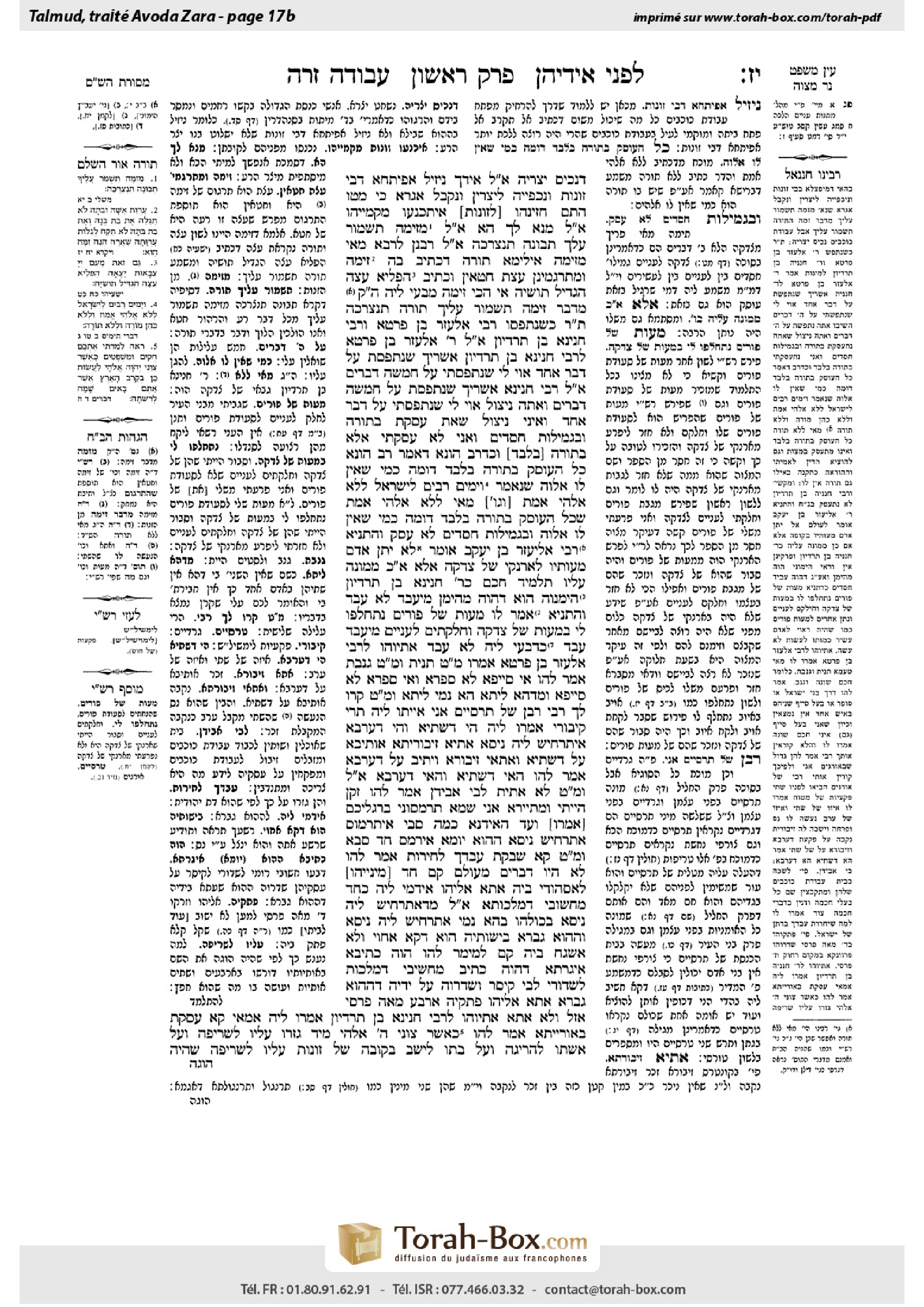
Avodah Zarah 17b: Talmud study for Daf Yomi
Study the Talmud for Daf Yomi with scanned pages, Hebrew text, English translations from Sefaria and AI-generated French translations.
Passage selection and English or AI-generated French translation are available where the scan has annotations. Daf Study is independent of Torah-Box and Sefaria.
Browse Avodah Zarah · עבודה זרה · All tractatesAvodah Zarah 17b text and translations
This page of Avodah Zarah includes the Aramaic text, an English translation and an AI-generated French translation, alongside the scan above.
עבודה זרה י״ז ב · Aramaic and Hebrew text
דִּנְכִיס יִצְרֵיהּ. אֲמַר לֵיהּ אִידַּךְ: נֵיזִיל אַפִּיתְחָא דְּבֵי זוֹנוֹת וְנִכְפְּיֵיהּ לְיִצְרִין וּנְקַבֵּל אַגְרָא. כִּי מָטוּ הָתָם, חֲזוֹנְהוּ [לְזוֹנוֹת], אִיתְכְּנַעוּ מִקַּמַּיְיהוּ.
אֲמַר לֵיהּ: מְנָא לָךְ הָא? אֲמַר לֵיהּ: ״מְזִמָּה תִּשְׁמֹר עָלֶיךָ תְּבוּנָה תִנְצְרֶכָּה״.
אֲמַרוּ לֵיהּ רַבָּנַן לְרָבָא: מַאי ״מְזִמָּה״? אִילֵימָא תּוֹרָה, דִּכְתִיב בַּהּ ״זִמָּה״ וּמְתַרְגְּמִינַן: עֵצַת חִטְאִין, וּכְתִיב: ״הִפְלִיא עֵצָה הִגְדִּיל תּוּשִׁיָּה״. אִי הָכִי, ״זִמָּה״ מִבְּעֵי לֵיהּ! הָכִי קָאָמַר: מִדְּבַר זִימָּה תִּשְׁמוֹר עָלֶיךָ, תּוֹרָה תִנְצְרֶכָּה.
תָּנוּ רַבָּנַן: כְּשֶׁנִּתְפְּסוּ רַבִּי אֶלְעָזָר בֶּן פַּרְטָא וְרַבִּי חֲנִינָא בֶּן תְּרַדְיוֹן, אָמַר לוֹ רַבִּי אֶלְעָזָר בֶּן פַּרְטָא לְרַבִּי חֲנִינָא בֶּן תְּרַדְיוֹן: אַשְׁרֶיךָ שֶׁנִּתְפַּסְתָּ עַל דָּבָר אֶחָד, אוֹי לִי שֶׁנִּתְפַּסְתִּי עַל חֲמִשָּׁה דְּבָרִים.
אָמַר לוֹ רַבִּי חֲנִינָא: אַשְׁרֶיךָ שֶׁנִּתְפַּסְתָּ עַל חֲמִשָּׁה דְּבָרִים וְאַתָּה נִיצּוֹל, אוֹי לִי שֶׁנִּתְפַּסְתִּי עַל דָּבָר אֶחָד וְאֵינִי נִיצּוֹל, שֶׁאַתָּה עָסַקְתָּ בַּתּוֹרָה וּבִגְמִילוּת חֲסָדִים, וַאֲנִי לֹא עָסַקְתִּי אֶלָּא בַּתּוֹרָה [בִּלְבָד].
וְכִדְרַב הוּנָא, דְּאָמַר רַב הוּנָא: כׇּל הָעוֹסֵק בַּתּוֹרָה בִּלְבַד דּוֹמֶה כְּמִי שֶׁאֵין לוֹ אֱלוֹהַּ, שֶׁנֶּאֱמַר: ״וְיָמִים רַבִּים לְיִשְׂרָאֵל לְלֹא אֱלֹהֵי אֱמֶת וְגוֹ׳״. מַאי ״לְלֹא אֱלֹהֵי אֱמֶת״? שֶׁכׇּל הָעוֹסֵק בַּתּוֹרָה בִּלְבַד דּוֹמֶה כְּמִי שֶׁאֵין לוֹ אֱלוֹהַּ.
וּבִגְמִילוּת חֲסָדִים לֹא עָסַק? וְהָתַנְיָא: רַבִּי אֱלִיעֶזֶר בֶּן יַעֲקֹב אוֹמֵר: לֹא יִתֵּן אָדָם מְעוֹתָיו לְאַרְנָקִי שֶׁל צְדָקָה אֶלָּא אִם כֵּן מְמוּנֶּה עָלָיו תַּלְמִיד חָכָם כְּרַבִּי חֲנִינָא בֶּן תְּרַדְיוֹן! (הֵימְנוּהּ) [הֵימוֹנֵי] הוּא דַּהֲוָה מְהֵימַן, מֶיעְבַּד לָא עֲבַד.
וְהָתַנְיָא, אָמַר לוֹ: מָעוֹת שֶׁל פּוּרִים נִתְחַלְּפוּ לִי בְּמָעוֹת שֶׁל צְדָקָה וְחִלַּקְתִּים לַעֲנִיִּים! מֶיעְבַּד עֲבַד, כִּדְבָעֵי לֵיהּ לָא עֲבַד.
אַתְיוּהּ לְרַבִּי אֶלְעָזָר בֶּן פַּרְטָא, אֲמַרוּ: מַאי טַעְמָא תָּנֵית, וּמַאי טַעְמָא גָּנְבַתְּ? אֲמַר לְהוּ: אִי סַיָּיפָא לָא סָפְרָא, וְאִי סָפְרָא לָא סַיָּיפָא, וּמִדְּהָא לֵיתַהּ הָא נָמֵי לֵיתַהּ. וּמַאי טַעְמָא קָרוּ לָךְ ״רַבִּי״? רַבָּן שֶׁל תַּרְסִיִּים אֲנִי.
אַיְיתוֹ לֵיהּ תְּרֵי קִיבּוּרֵי, אֲמַרוּ לֵיהּ: הֵי דְּשִׁתְיָא וְהֵי דְּעִרְבָּא? אִיתְרְחִישׁ לֵיהּ נִיסָּא, (אָתְיָא) [אֲתַאי] זִיבּוּרִיתָא אִיתִּיב עַל דְּשִׁתְיָא, וַאֲתָאי זִיבּוּרָא וִיתֵיב עַל דְּעִרְבָּא. אֲמַר לְהוּ: הַאי דְּשִׁתְיָא וְהַאי דְּעִרְבָּא.
אֲמַרוּ לֵיהּ: וּמַאי טַעְמָא לָא אָתֵית לְבֵי אֲבִידָן? אֲמַר לְהוּ: זָקֵן הָיִיתִי וּמִתְיָירֵא אֲנִי שֶׁמָּא תִּרְמְסוּנִי בְּרַגְלֵיכֶם. [אֲמַרוּ]: וְעַד הָאִידָּנָא כַּמָּה סָבֵי אִיתְרְמוּס? אִתְרְחִישׁ נִיסָּא, הַהוּא יוֹמָא אִירְמַס חַד סָבָא.
וּמַאי טַעְמָא קָא שָׁבְקַתְּ עַבְדָּךְ לְחֵירוּת? אֲמַר לְהוּ: לֹא הָיוּ דְבָרִים מֵעוֹלָם. קָם חַד [מִינַּיְיהוּ] לְאַסְהוֹדֵי בֵּיהּ, אֲתָא אֵלִיָּהוּ אִידְּמִי לֵיהּ כְּחַד מֵחַשִּׁובֵי דְּמַלְכוּתָא, אֲמַר לֵיהּ: מִדְּאִתְרְחִישׁ לֵיהּ נִיסָּא בְּכוּלְּהוּ, בְּהָא נָמֵי אִתְרְחִישׁ לֵיהּ נִיסָּא, וְהָהוּא גַּבְרָא בִּישׁוּתֵיהּ הוּא דְּקָא (אַחְוִי) [מַחְוֵי].
וְלָא אַשְׁגַּח בֵּיהּ, קָם לְמֵימַר לְהוּ. הֲוָה כְּתִיבָא אִיגַּרְתָּא, דַּהֲוָה כְּתִיב מֵחַשִּׁיבֵי דְּמַלְכוּת לְשַׁדּוֹרֵי לְבֵי קֵיסָר, וְשַׁדְּרוּהָ עַל יְדֵיהּ דְּהָהוּא גַּבְרָא. אֲתָא אֵלִיָּהוּ פַּתְקֵיהּ אַרְבַּע מְאָה פַּרְסֵי, אֲזַל וְלָא אֲתָא.
אַתְיוּהּ לְרַבִּי חֲנִינָא בֶּן תְּרַדְיוֹן, אֲמַרוּ לֵיהּ: אַמַּאי קָא עָסְקַתְּ בְּאוֹרָיְיתָא? אֲמַר לְהוּ: ״כַּאֲשֶׁר צִוַּנִי ה׳ אֱלֹהָי״. מִיָּד גָּזְרוּ עָלָיו לִשְׂרֵיפָה, וְעַל אִשְׁתּוֹ לַהֲרִיגָה, וְעַל בִּתּוֹ לֵישֵׁב בְּקוּבָּה שֶׁל זוֹנוֹת. עָלָיו לִשְׂרֵיפָה — שֶׁהָיָה
Avodah Zarah 17b · English translation
as the inclination to engage in idol worship has been slaughtered and the temptation to sin in this manner no longer exists. The other said to him: Let us go by the path that leads to the entrance of the brothel and overpower our inclination, and thereby receive a reward. When they arrived there, they saw that the prostitutes yielded before their presence, i.e., they entered the building out of respect for the Sages.
One said to the other: From where did you know this, that the prostitutes would retreat from us in embarrassment? He said to him: It is written: “From lewdness [mezimma] it shall watch over you; discernment shall guard you” (Proverbs 2:11), i.e., the Torah will serve as a safeguard against lewdness.
The Sages said to Rava: What is the meaning of mezimma? If we say that it is referring to the Torah that will guard you, as it is written in it: “Zimma” (Leviticus 18:17), and we translate this term as: The counsel of [atzat] the sinners, demonstrating that zimma is referring to counsel or wisdom, and the term etza is also written with regard to the Torah: “This also comes forth from the Lord of hosts: Wonderful is His counsel [etza], and great is His wisdom” (Isaiah 28:29), this is difficult. The Gemara explains the difficulty: If so, the verse should have said: Zimma, and not mezimma. Rather, this is what the verse is saying: From lewd matters [midevar zimma], it shall watch over you, the Torah shall guard you, i.e., the term discernment is a reference to the Torah.
§ The Gemara returns to its discussion of the judgments of the Sages by the Roman rulers. The Sages taught: When Rabbi Elazar ben Perata and Rabbi Ḥanina ben Teradyon were arrested by the Romans during the time of the religious persecution of the Jewish people, Rabbi Elazar ben Perata said to Rabbi Ḥanina ben Teradyon: Fortunate are you, as you were arrested on one charge only, of teaching Torah publicly; woe is me, as I have been arrested on five charges.
Rabbi Ḥanina ben Teradyon said to him: Fortunate are you, as you were arrested on five charges but you will be saved; woe is me, as I have been arrested on one charge, but I will not be saved. You will be saved because you engaged in Torah study and in acts of charity, and I engaged in Torah study alone.
The Gemara comments: And this is in accordance with a statement of Rav Huna, as Rav Huna says: Anyone who occupies himself with Torah study alone is considered like one who does not have a God. As it is stated: “Now for long seasons Israel was without the true God, and without a teaching priest, and without the Torah” (II Chronicles 15:3). What is meant by “without the true God”? This teaches that anyone who engages in Torah study alone is considered like one who does not have a true God.
The Gemara asks: And is it true that Rabbi Ḥanina ben Teradyon did not engage in acts of charity? But isn’t it taught in a baraita that Rabbi Eliezer ben Ya’akov says: A person should not donate his money to the charity purse [le’arnakei] unless a Torah scholar like Rabbi Ḥanina ben Teradyon is appointed as supervisor over it? The Gemara answers: He was trusted to distribute the charity with honesty and integrity, but he himself did not perform charitable acts.
The Gemara asks: But isn’t it taught in a baraita that Rabbi Ḥanina ben Teradyon said to Rabbi Yosei ben Kisma: I confused my own coins that I needed for the festivities of Purim with coins of charity, and I distributed them all to the poor at my own expense. How then can it be said that he never engaged in charitable acts? The Gemara responds: He did perform acts of charity, but he did not perform as many acts as he should have, in light of his wealth.
The Gemara returns to the description of the trial of the Sages. The Romans brought Rabbi Elazar ben Perata for his trial and said: What is the reason that you taught Torah, and what is the reason that you stole, as these were the crimes of which he was accused. Rabbi Elazar ben Perata said to them: If one is an armed robber [sayafa], he is not a scholar [safra], and if one is a scholar he is not an armed robber, i.e., I am accused of two mutually exclusive crimes; and from the fact that this characterization is not true, one may also conclude that that characterization is also not true. They asked him: But if you do not teach Torah, then what is the reason that they call you rabbi? He answered: I am the master [rabban] of weavers [tarsiyyim].
In order to ascertain whether Rabbi Elazar ben Perata was in fact an expert weaver, they brought him two coils of wool and said to him: Which is the warp, and which is the woof? The threads used for each differ in their thickness and strength and would be immediately recognizable to an expert. A miracle occurred, as a female hornet came and sat on the coil of warp, and a male hornet came and sat on the coil of woof. Rabbi Elazar ben Perata said to them: This is a coil of warp, and that is a coil of woof. He realized that the male hornet was a sign that the coil was the woof, as the woof is threaded through the warp, while the warp, which is fixed in the loom and receives the woof, was the one on which the female hornet sat, as the female of a species receives the male.
The Romans said to him: And what is the reason that you did not come to the house of Abidan? This was a gathering place where debates on wisdom and faith were conducted. Rabbi Elazar ben Perata said to them: I was old and feared that perhaps I would be trampled under your feet, due to the huge crowds. The Romans said: And until now, how many elders have been trampled there, that you would be worried about such a possibility? The Gemara comments: A miracle occurred, and on that day, one old man was trampled.
The Romans asked Rabbi Elazar ben Perata: And what is the reason that you emancipated your slave? Rabbi Elazar ben Perata said to them: This matter never happened. One of them stood to testify against him, and Elijah came disguised as one of the of the Roman noblemen, and he said to that individual: From the fact that miracles occurred for Rabbi Elazar ben Perata in every other case, in this instance as well a miracle will occur for him, and that man, i.e., you, is only demonstrating his wickedness, since you cannot succeed in your aim and are merely showing yourself to be desperate to cause harm.
But the man paid him no heed, and he stood to say his testimony to them. At that time there was a written letter that was composed by some of the most important people of the Roman Empire in order to send it to the Emperor’s court, and they had sent it in the possession of that man, i.e., the potential witness. Elijah came and threw it a distance of four hundred parasangs. The man went and did not come back, and therefore all the charges against Rabbi Elazar ben Perata were dropped.
The Romans brought Rabbi Ḥanina ben Teradyon for judgment, and they said to him: Why did you occupy yourself with the Torah? Rabbi Ḥanina ben Teradyon said to them, citing a verse: “As the Lord my God commanded me” (Deuteronomy 4:5). They immediately sentenced him to death by means of burning, and they sentenced his wife to execution by decapitation, and his daughter was condemned to sit in a brothel [kubba shel zonot]. The Gemara explains the Divine decree that he should receive this punishment: He was sentenced to death by burning, as he would
Avodah Zarah 17b · Traduction française (IA)
car l'inclination à pratiquer l'idolâtrie a été éliminée et la tentation de commettre un péché de cette manière n'existe plus. L'autre lui dit : Allons par le chemin qui mène à l'entrée de la maison de prostituées et combattons notre inclination, et ainsi nous recevrons une récompense. Lorsqu'ils arrivèrent là-bas, ils virent que les prostituées cédaient devant leur présence, c'est-à-dire qu'elles entraient dans le bâtiment par respect pour les Sages.
L'un dit à l'autre : D'où as-tu su cela, que les prostituées reculeraient devant nous en honte ? Il lui répondit : Il est écrit : « De la luxure [mezimma], il te gardera ; la sagesse te surveillera » (Proverbes 2:11), c'est-à-dire que la Torah servira de garde contre la luxure.
Les Sages dirent à Rava : Quelle est la signification de mezimma ? Si nous disons qu'il s'agit de la Torah qui te gardera, comme il est écrit dans la Torah : « Zimma » (Lévitique 18:17), et nous traduisons ce terme comme : « Le conseil des pécheurs », ce qui montre que zimma désigne le conseil ou la sagesse, et le terme etza est également écrit dans la Torah : « Cela vient aussi du Seigneur des armées : Admirable est son conseil [etza], et grand est sa sagesse » (Yachout 28:29), cela est difficile. La Guemara explique la difficulté : Si tel était le cas, la Bible aurait dû dire : Zimma, et non mezimma. Plutôt, c'est ce que la Bible dit : « De la luxure [midevar zimma], il te gardera », la Torah te gardera, c'est-à-dire que le terme discernement fait référence à la Torah.
§ La Guemara reprend la discussion sur les jugements des Sages par les autorités romaines. Les Sages enseignèrent : Lorsque Rabbi Elazar ben Perata et Rabbi Ḥanina ben Teradyon furent arrêtés par les Romains pendant la persécution religieuse du peuple juif, Rabbi Elazar ben Perata dit à Rabbi Ḥanina ben Teradyon : Heureux es-tu, car tu as été arrêté pour une seule charge, celle de dispenser la Torah publiquement ; malheur m'advient, car j'ai été arrêté pour cinq charges.
Rabbi Ḥanina ben Teradyon dit à lui : Heureux es-tu, car tu as été arrêté pour cinq charges mais tu seras sauvé ; malheur m'advient, car j'ai été arrêté pour une charge, mais je ne serai pas sauvé. Tu seras sauvé car tu t'occupais de l'étude de la Torah et des actes de charité, et moi j'étudiais la Torah seule.
La Guemara commente : Et cela correspond à une déclaration de Rav Huna, car Rav Huna dit : Quiconque s'occupe uniquement de l'étude de la Torah est considéré comme celui qui n'a pas de Dieu. Comme il est dit : « Maintenant, pendant de longues années, Israël fut sans le Dieu véritable, et sans un prêtre instruit, et sans la Torah » (Chroniques 2 15:3). Qu'entend-on par « sans le Dieu véritable » ? Cela enseigne que quiconque s'occupe de l'étude de la Torah seul est considéré comme celui qui n'a pas un Dieu véritable.
La Guemara demande : Et est-ce vrai que Rabbi Ḥanina ben Teradyon n'a pas accompli d'actes de charité ? Mais n'est-il pas enseigné dans une baraïta que Rabbi Eliezer ben Ya'akov dit : Une personne ne doit pas donner son argent à la charité [le'arnakei] à moins qu'un savant comme Rabbi Ḥanina ben Teradyon ne soit désigné comme surveillant ? La Guemara répond : Il était confiant pour distribuer la charité avec honnêteté et intégrité, mais lui-même n'a pas accompli d'actes de charité.
La Guemara demande : Mais n'est-il pas enseigné dans une baraïta que Rabbi Ḥanina ben Teradyon dit à Rabbi Yosei ben Kisma : J'ai confondu mes propres pièces nécessaires aux festivités de Purim avec des pièces de charité, et j'ai distribué toutes ces pièces aux pauvres à mes frais. Comment alors peut-on dire qu'il n'a jamais accompli d'actes de charité ? La Guemara répond : Il a effectivement accompli des actes de charité, mais il n'en a pas accompli autant qu'il aurait dû, en fonction de sa richesse.
La Guemara reprend la description du procès des Sages. Les Romains amenèrent Rabbi Elazar ben Perata pour son procès et dirent : Quel est le motif pour lequel tu enseignais la Torah, et quel est le motif pour lequel tu volais, car ces étaient les crimes pour lesquels il était accusé. Rabbi Elazar ben Perata dit à eux : Si l'on est un voleur armé [sayafa], il n'est pas un savant [safra], et si l'on est un savant, il n'est pas un voleur armé, c'est-à-dire que je suis accusé de deux crimes mutuellement exclusifs ; et du fait que cette caractérisation n'est pas vraie, on peut aussi conclure que cette caractérisation n'est pas non plus vraie. Ils lui demandèrent : Mais si tu ne dispenses pas la Torah, alors quel est le motif pour lequel on t'appelle rabbi ? Il répondit : Je suis le maître [rabban] des tisseurs [tarsiyyim].
Afin de vérifier si Rabbi Elazar ben Perata était effectivement un expert tisseur, ils lui amenèrent deux bobines de laine et lui dirent : Laquelle est la trame, et laquelle est la chaîne ? Les fils utilisés pour chacune diffèrent en épaisseur et en résistance et seraient immédiatement reconnaissables pour un expert. Un miracle eut lieu, car une guêpe femelle vint s'asseoir sur la bobine de trame, et un guêpe mâle vint s'asseoir sur la bobine de chaîne. Rabbi Elazar ben Perata dit à eux : Celle-ci est une bobine de trame, et celle-là est une bobine de chaîne. Il comprit que le guêpe mâle était un signe que la bobine était la chaîne, car la chaîne est passée à travers la trame, tandis que la trame, fixée dans la tisserie et recevant la chaîne, était celle sur laquelle la guêpe femelle s'était assise, car la femelle d'une espèce reçoit le mâle.
Les Romains dirent à lui : Et quel est le motif pour lequel tu n'es pas venu chez Abidan ? C'était un lieu de réunion où des débats sur la sagesse et la foi étaient tenus. Rabbi Elazar ben Perata dit à eux : J'étais âgé et j'avais peur que je sois écrasé sous vos pieds, en raison des grandes foules. Les Romains dirent : Et jusqu'à présent, combien d'anciens ont été écrasés là-bas, que tu t'inquiètes de telles possibilités ? La Guemara commente : Un miracle eut lieu, et ce jour-là, un seul vieillard fut écrasé.
Les Romains interrogèrent le Rabbi Eléazar ben Pérata : Et quelle est la raison pour laquelle vous avez libéré votre esclave ? Le Rabbi Eléazar ben Pérata leur répondit : Cette affaire n'a jamais eu lieu. L'un d'entre eux s'était levé pour témoigner contre lui, et Eliézer vint se déguiser en l'un des nobles romains, et il dit à cet individu : D'après les miracles qui se sont produits pour le Rabbi Eléazar ben Pérata dans tous les autres cas, un miracle se produira également dans ce cas-ci, et cet homme, c'est-à-dire vous, montre seulement votre malice, car vous ne réussirez pas à atteindre votre but et vous montrez simplement votre désespoir pour causer du mal.
Mais l'homme ne prêta pas attention à cela, et il s'leva pour témoigner contre lui. À ce moment-là, il existait une lettre écrite composée par certains des plus importants personnages de l'Empire romain afin de l'envoyer au tribunal impérial, et ils l'avaient confiée à cet homme, c'est-à-dire au témoin potentiel. Eliézer vint et la lança à une distance de quatre cents parasangs. L'homme partit et ne revint pas, et par conséquent toutes les accusations contre le Rabbi Eléazar ben Pérata furent abandonnées.
Les Romains amenèrent le Rabbi Ḥanina ben Teradyon devant le tribunal, et ils lui dirent : Pourquoi t'es-tu occupé de la Torah ? Le Rabbi Ḥanina ben Teradyon leur répondit, en citant un verset : « Comme l'Éternel mon Dieu m'a commandé » (Deutéronome 4:5). Ils le condamnèrent immédiatement à la mort par le feu, et ils condamnèrent sa femme à l'execution par la tête, et sa fille fut condamnée à occuper une maison de prostituées [kubba shel zonot]. La Guemara explique le décret divin selon lequel il devait recevoir cette peine : Il fut condamné à la mort par le feu, car il aurait
Traduction française générée par IA à partir de l’édition anglaise de Sefaria. Vérifie toujours un passage avec le texte source.
Text from Sefaria: William Davidson Edition - Vocalized Aramaic (CC BY NC); William Davidson Edition - English (CC BY NC).