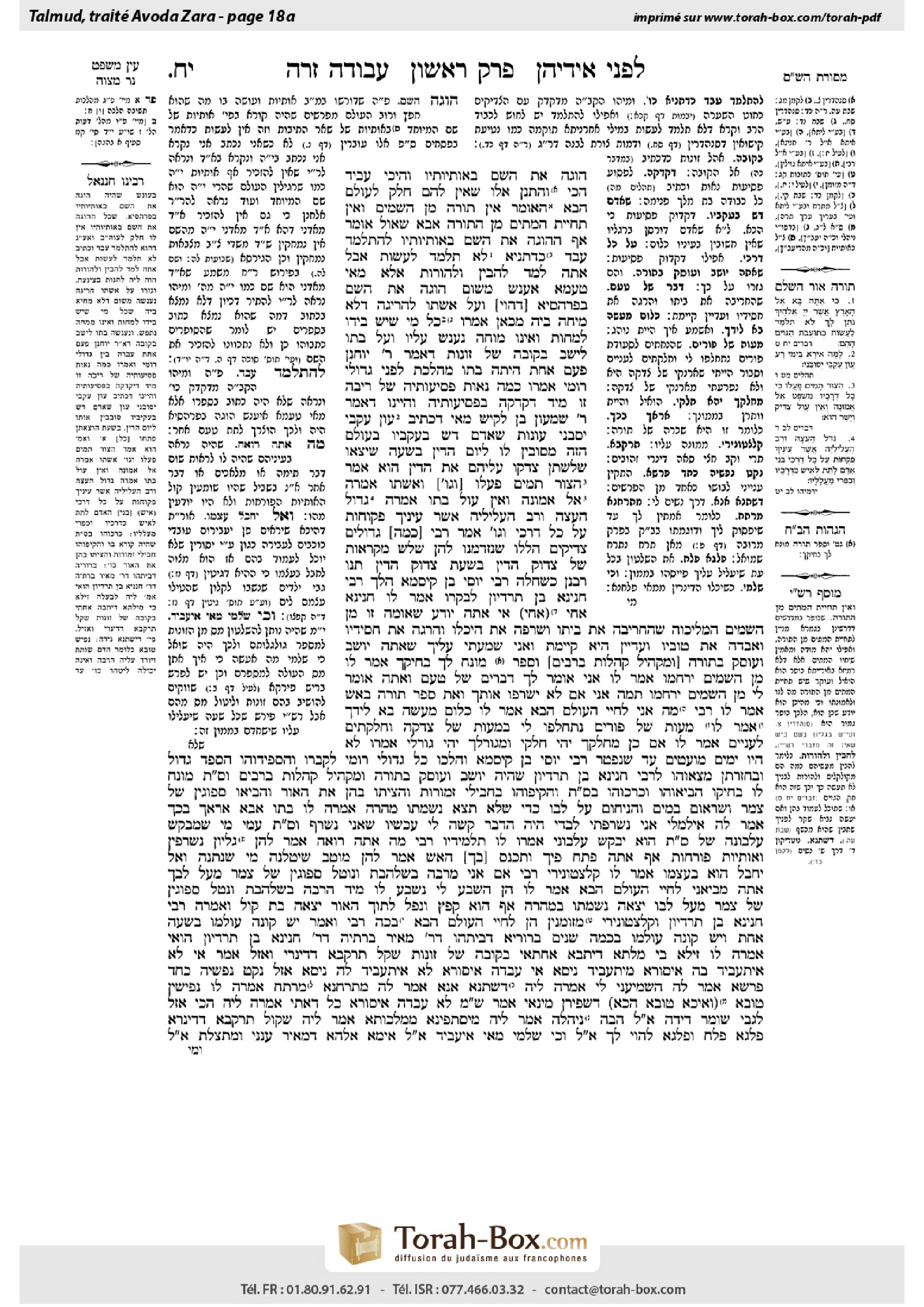
Avodah Zarah 18a: Talmud study for Daf Yomi
Study the Talmud for Daf Yomi with scanned pages, Hebrew text, English translations from Sefaria and AI-generated French translations.
Passage selection and English or AI-generated French translation are available where the scan has annotations. Daf Study is independent of Torah-Box and Sefaria.
Browse Avodah Zarah · עבודה זרה · All tractatesAvodah Zarah 18a text and translations
This page of Avodah Zarah includes the Aramaic text, an English translation and an AI-generated French translation, alongside the scan above.
עבודה זרה י״ח א · Aramaic and Hebrew text
הוֹגֶה אֶת הַשֵּׁם בְּאוֹתִיּוֹתָיו. וְהֵיכִי עָבֵיד הָכִי? וְהָתְנַן: אֵלּוּ שֶׁאֵין לָהֶם חֵלֶק לָעוֹלָם הַבָּא — הָאוֹמֵר אֵין תּוֹרָה מִן הַשָּׁמַיִם, וְאֵין תְּחִיַּית הַמֵּתִים מִן הַתּוֹרָה. אַבָּא שָׁאוּל אוֹמֵר: אַף הַהוֹגֶה אֶת הַשֵּׁם בְּאוֹתִיּוֹתָיו!
לְהִתְלַמֵּד עֲבַד, כִּדְתַנְיָא: ״לֹא תִלְמַד לַעֲשׂוֹת״, אֲבָל אַתָּה לָמֵד לְהָבִין וּלְהוֹרוֹת.
אֶלָּא מַאי טַעְמָא אִעֲנַשׁ? מִשּׁוּם (הוגה) [דְּהוֹגֶה] אֶת הַשֵּׁם בְּפַרְהֶסְיָא [הֲוָה], וְעַל אִשְׁתּוֹ לַהֲרִיגָה דְּלָא (מַיחָה) [מַחַתָה] בֵּיהּ. מִכָּאן אָמְרוּ: כָּל מִי שֶׁיֵּשׁ בְּיָדוֹ לִמְחוֹת וְאֵינוֹ מוֹחֶה נֶעֱנָשׁ עָלָיו.
וְעַל בִּתּוֹ לֵישֵׁב בְּקוּבָּה שֶׁל זוֹנוֹת, דְּאָמַר רַבִּי יוֹחָנָן: פַּעַם אַחַת הָיְתָה בִּתּוֹ מְהַלֶּכֶת לִפְנֵי גְּדוֹלֵי רוֹמִי, אָמְרוּ: כַּמָּה נָאוֹת פְּסִיעוֹתֶיהָ שֶׁל רִיבָה זוֹ, מִיָּד דִּקְדְּקָה בִּפְסִיעוֹתֶיהָ. וְהַיְינוּ דְּאָמַר רַבִּי שִׁמְעוֹן בֶּן לָקִישׁ: מַאי דִּכְתִיב ״עֲוֹן עֲקֵבַי יְסוּבֵּנִי״? עֲוֹנוֹת שֶׁאָדָם דָּשׁ בַּעֲקֵבָיו בָּעוֹלָם הַזֶּה מְסוּבִּין לוֹ לְיוֹם הַדִּין.
בְּשָׁעָה שֶׁיָּצְאוּ שְׁלָשְׁתָּן, צִדְּקוּ עֲלֵיהֶם אֶת הַדִּין, הוּא אָמַר: ״הַצּוּר תָּמִים פׇּעֳלוֹ [וְגוֹ׳]״, וְאִשְׁתּוֹ אָמְרָה: ״אֵל אֱמוּנָה וְאֵין עָוֶל״, בִּתּוֹ אָמְרָה: ״גְּדֹל הָעֵצָה וְרַב הָעֲלִילִיָּה אֲשֶׁר עֵינֶיךָ פְקֻחוֹת עַל כׇּל דַּרְכֵי וְגוֹ׳״, אָמַר רַבִּי: [כַּמָּה] גְּדוֹלִים צַדִּיקִים הַלָּלוּ, שֶׁנִּזְדַּמְּנוּ לָהֶן שָׁלֹשׁ מִקְרָאוֹת שֶׁל צִדּוּק הַדִּין בִּשְׁעַת צִדּוּק הַדִּין.
תָּנוּ רַבָּנַן: כְּשֶׁחָלָה רַבִּי יוֹסֵי בֶּן קִיסְמָא, הָלַךְ רַבִּי חֲנִינָא בֶּן תְּרַדְיוֹן לְבַקְּרוֹ. אָמַר לוֹ: חֲנִינָא אָחִי, (אָחִי), אִי אַתָּה יוֹדֵעַ שֶׁאוּמָּה זוֹ מִן הַשָּׁמַיִם הִמְלִיכוּהָ? שֶׁהֶחְרִיבָה אֶת בֵּיתוֹ וְשָׂרְפָה אֶת הֵיכָלוֹ, וְהָרְגָה אֶת חֲסִידָיו וְאִבְּדָה אֶת טוֹבָיו, וַעֲדַיִין הִיא קַיֶּימֶת. וַאֲנִי שָׁמַעְתִּי עָלֶיךָ שֶׁאַתָּה יוֹשֵׁב וְעוֹסֵק בַּתּוֹרָה [וּמַקְהִיל קְהִלּוֹת בָּרַבִּים], וְסֵפֶר מוּנָּח לְךָ בְּחֵיקֶךָ!
אָמַר לוֹ: מִן הַשָּׁמַיִם יְרַחֲמוּ. אָמַר לוֹ: אֲנִי אוֹמֵר לְךָ דְּבָרִים שֶׁל טַעַם, וְאַתָּה אוֹמֵר לִי ״מִן הַשָּׁמַיִם יְרַחֲמוּ״? תָּמֵהַּ אֲנִי אִם לֹא יִשְׂרְפוּ אוֹתְךָ וְאֶת סֵפֶר תּוֹרָה בָּאֵשׁ! אָמַר לוֹ: רַבִּי, מָה אֲנִי לְחַיֵּי הָעוֹלָם הַבָּא?
אָמַר לוֹ: כְּלוּם מַעֲשֶׂה בָּא לְיָדֶךָ? אָמַר לוֹ: מָעוֹת שֶׁל פּוּרִים נִתְחַלְּפוּ לִי בְּמָעוֹת שֶׁל צְדָקָה וְחִלַּקְתִּים לַעֲנִיִּים. אָמַר לוֹ: אִם כֵּן, מֵחֶלְקְךָ יְהִי חֶלְקִי וּמִגּוֹרָלְךָ יְהִי גּוֹרָלִי.
אָמְרוּ: לֹא הָיוּ יָמִים מוּעָטִים עַד שֶׁנִּפְטַר רַבִּי יוֹסֵי בֶּן קִיסְמָא, וְהָלְכוּ כׇּל גְּדוֹלֵי רוֹמִי לְקׇבְרוֹ וְהִסְפִּידוּהוּ הֶסְפֵּד גָּדוֹל, וּבַחֲזָרָתָן מְצָאוּהוּ לְרַבִּי חֲנִינָא בֶּן תְּרַדְיוֹן שֶׁהָיָה יוֹשֵׁב וְעוֹסֵק בַּתּוֹרָה וּמַקְהִיל קְהִלּוֹת בָּרַבִּים וְסֵפֶר תּוֹרָה מוּנָּח לוֹ בְּחֵיקוֹ.
הֱבִיאוּהוּ וּכְרָכוּהוּ בְּסֵפֶר תּוֹרָה, וְהִקִּיפוּהוּ בַּחֲבִילֵי זְמוֹרוֹת וְהִצִּיתוּ בָּהֶן אֶת הָאוּר, וְהֵבִיאוּ סְפוֹגִין שֶׁל צֶמֶר וּשְׁרָאוּם בְּמַיִם וְהִנִּיחוּם עַל לִבּוֹ, כְּדֵי שֶׁלֹּא תֵּצֵא נִשְׁמָתוֹ מְהֵרָה. אָמְרָה לוֹ בִּתּוֹ: אַבָּא, אֶרְאֲךָ בְּכָךְ? אֲמַר לַהּ: אִילְמָלֵי אֲנִי נִשְׂרַפְתִּי לְבַדִּי הָיָה הַדָּבָר קָשֶׁה לִי, עַכְשָׁיו שֶׁאֲנִי נִשְׂרָף וְסֵפֶר תּוֹרָה עִמִּי, מִי שֶׁמְבַקֵּשׁ עֶלְבּוֹנָהּ שֶׁל סֵפֶר תּוֹרָה הוּא יְבַקֵּשׁ עֶלְבּוֹנִי.
אָמְרוּ לוֹ תַּלְמִידָיו: רַבִּי, מָה אַתָּה רוֹאֶה? אָמַר לָהֶן: (גִּלְיוֹן) [גְּוִילִין] נִשְׂרָפִין וְאוֹתִיּוֹת פּוֹרְחוֹת. אַף אַתָּה פְּתַח פִּיךָ וְתִכָּנֵס בְּךָ הָאֵשׁ. אָמַר לָהֶן: מוּטָב שֶׁיִּטְּלֶנָּה מִי שֶׁנְּתָנָהּ, וְאַל יְחַבֵּל הוּא בְּעַצְמוֹ.
אָמַר לוֹ קְלַצְטוֹנֵירִי: רַבִּי, אִם אֲנִי מַרְבֶּה בַּשַּׁלְהֶבֶת וְנוֹטֵל סְפוֹגִין שֶׁל צֶמֶר מֵעַל לִבְּךָ, אַתָּה מְבִיאֵנִי לְחַיֵּי הָעוֹלָם הַבָּא? אָמַר לוֹ: הֵן. הִשָּׁבַע לִי, נִשְׁבַּע לוֹ. מִיָּד הִרְבָּה בַּשַּׁלְהֶבֶת וְנָטַל סְפוֹגִין שֶׁל צֶמֶר מֵעַל לִבּוֹ, יָצְאָה נִשְׁמָתוֹ בִּמְהֵרָה. אַף הוּא קָפַץ וְנָפַל לְתוֹךְ הָאוּר.
יָצְאָה בַּת קוֹל וְאָמְרָה: רַבִּי חֲנִינָא בֶּן תְּרַדְיוֹן וּקְלַצְטוֹנֵירִי מְזוּמָּנִין הֵן לְחַיֵּי הָעוֹלָם הַבָּא. בָּכָה רַבִּי וְאָמַר: יֵשׁ קוֹנֶה עוֹלָמוֹ בְּשָׁעָה אַחַת, וְיֵשׁ קוֹנֶה עוֹלָמוֹ בְּכַמָּה שָׁנִים.
בְּרוּרְיָא דְּבֵיתְהוּ דְּרַבִּי מֵאִיר, בְּרַתֵּיה דְּרַבִּי חֲנִינָא בֶּן תְּרַדְיוֹן הֲוַאי, אֲמַרָה לֵיהּ: זִילָא בִּי מִלְּתָא דְּיָתְבָא אֲחָתַאי בְּקוּבָּה שֶׁל זוֹנוֹת. שְׁקַל תַּרְקַבָּא דְּדִינָרֵי וַאֲזַל, אֲמַר: אִי לָא אִיתְעֲבִיד בַּהּ אִיסּוּרָא — (מִיתְעֲבִיד) [מִתְרְחִישׁ] נִיסָּא, אִי עֲבַדָה אִיסּוּרָא — לָא (אִיתְעֲבִיד) [מִתְרְחִישׁ] לַהּ נִיסָּא.
אֲזַל נְקַט נַפְשֵׁיהּ כְּחַד פָּרָשָׁא, אֲמַר לַהּ: (הַשְׁמִיעִנִי) [הִשָּׁמְעִי] לִי. אֲמַרָה לֵיהּ: דַּשְׁתָּנָא אֲנָא. אֲמַר לַהּ: מִתָּרַחְנָא (מִרְתָח). אֲמַרָה לֵיהּ: נְפִישָׁן טוּבָא (וְאִיכָּא טוּבָא הָכָא) דְּשַׁפִּירָן מִינַּאי. אָמַר: שְׁמַע מִינַּהּ לָא עֲבַדָה אִיסּוּרָא, כֹּל דְּאָתֵי אָמְרָה לֵיהּ הָכִי.
אֲזַל לְגַבֵּי שׁוֹמֵר דִּידַהּ, אֲמַר לֵיהּ: הֲבַהּ נִיהֲלַי, אֲמַר לֵיהּ: מִיסְתְּפֵינָא מִמַּלְכוּתָא, אֲמַר לֵיהּ: שְׁקוֹל תַּרְקַבָּא דְּדִינָרֵי, פַּלְגָא פְּלַח וּפַלְגָא לֶהֱוֵי לָךְ, אֲמַר לֵיהּ: וְכִי שָׁלְמִי מַאי אֶיעְבֵּיד? אֲמַר לֵיהּ: אֵימָא ״אֱלָהָא דְּמֵאִיר עֲנֵנִי״ וּמִתַּצְּלַתְּ, אֲמַר לֵיהּ:
Avodah Zarah 18a · English translation
pronounce the ineffable name of God with all of its letters, i.e., as it is spelled. The Gemara asks: And how could he do that? But didn’t we learn in the mishna (Sanhedrin 90a): These are the people who have no share in the World-to-Come: One who says that the Torah is not from Heaven or that there is no source from the Torah for the resurrection of the dead. Abba Shaul says: Also one who pronounces the ineffable name as it is written, with all of its letters, has no share in the World-to-Come.
The Gemara answers: Rabbi Ḥanina ben Teradyon did it to teach himself, as it is taught in a baraita with regard to the prohibition against sorcery: “You shall not learn to do” (Deuteronomy 18:9); this indicates: But you may learn to understand and to teach. In other words, certain prohibitions do not apply when one is acting only in order to acquire knowledge of the subject.
The Gemara asks: Rather, what is the reason that he was punished? The Gemara answers: He was punished because he would pronounce the ineffable name of God in public, instead of privately. And his wife was condemned to execution by decapitation because she did not protest his doing so. From here the Sages stated: Anyone who has the capability to protest effectively the sinful conduct of another and does not protest is punished for that person’s sin.
The Gemara asks: And why was his daughter condemned to sit in a brothel? As Rabbi Yoḥanan says: Once, the daughter of Rabbi Ḥanina ben Teradyon was walking before the nobles of Rome, and they said to each other: How pleasant are the steps of this young woman. Upon hearing this, she immediately took care to keep walking in such a fashion that her steps would continue to be pleasing to them. And this is the same as that which Rabbi Shimon ben Lakish says: What is the meaning of that which is written: “The iniquity of my heel encircles me” (Psalms 49:6)? It means that the sins that a person tramples with one’s heel in this world, i.e., dismisses and pays no attention to them as they seem to lack importance, e.g., the way that one walks, come and encircle him on the Day of Judgment.
The Gemara relates: When the three of them went out after being sentenced, they accepted the justice of God’s judgment. Rabbi Ḥanina ben Teradyon said: “The Rock, His work is perfect; for all His ways are justice” (Deuteronomy 32:4). And his wife said the continuation of the verse: “A God of faithfulness and without iniquity.” His daughter said: “Great in counsel, and mighty in work; whose eyes are open upon all the ways of the sons of men, to give every one according to his ways” (Jeremiah 32:19). Rabbi Yehuda HaNasi said: How great are these righteous people, that these three verses, which speak of the acceptance of God’s judgment, occurred to them at the time of accepting the righteousness of His judgment.
§ The Sages taught: When Rabbi Yosei ben Kisma fell ill, Rabbi Ḥanina ben Teradyon went to visit him. Rabbi Yosei ben Kisma said to him: Ḥanina my brother, do you not know that this nation has been given reign by a decree from Heaven? The proof is that Rome has destroyed God’s Temple, and burned His Sanctuary, and killed His pious ones, and destroyed His best ones, and it still exists. Evidently, all of this is by Divine decree. And yet I heard about you that you sit and engage in Torah study, and convene assemblies in public, and have a Torah scroll placed in your lap, thereby demonstrating complete disregard for the decrees issued by the Romans.
Rabbi Ḥanina ben Teradyon said to him: Heaven will have mercy and protect me. Rabbi Yosei ben Kisma said to him: I am saying reasonable matters to you, and you say to me: Heaven will have mercy? I wonder if the Romans will not burn both you and your Torah scroll by fire. Rabbi Ḥanina ben Teradyon said to him: My teacher, what will become of me? Am I destined for life in the World-to-Come?
Rabbi Yosei ben Kisma said to him: Did any special incident occur to you which might serve as an indication? Rabbi Ḥanina ben Teradyon said to him: I confused my own coins that I needed for the festivities of Purim with coins of charity, and I distributed them all to the poor at my own expense. Rabbi Yosei ben Kisma said to him: If that is so, may my portion be of your portion, and may my lot be of your lot.
The Sages said: Not even a few days passed before Rabbi Yosei ben Kisma died of his illness, and all of the Roman notables went to bury him, and they eulogized him with a great eulogy. And upon their return, they found Rabbi Ḥanina ben Teradyon, who was sitting and engaging in Torah study and convening assemblies in public, with a Torah scroll placed in his lap.
They brought him to be sentenced, and wrapped him in the Torah scroll, and encircled him with bundles of branches, and they set fire to it. And they brought tufts of wool and soaked them in water, and placed them on his heart, so that his soul should not leave his body quickly, but he would die slowly and painfully. His daughter said to him: Father, must I see you like this? Rabbi Ḥanina ben Teradyon said to her: If I alone were being burned, it would be difficult for me, but now that I am burning along with a Torah scroll, He who will seek retribution for the insult accorded to the Torah scroll will also seek retribution for the insult accorded to me.
His students said to him: Our teacher, what do you see? Rabbi Ḥanina ben Teradyon said to them: I see the parchment burning, but its letters are flying to the heavens. They said to him: You too should open your mouth and the fire will enter you, and you will die quickly. Rabbi Ḥanina ben Teradyon said to them: It is preferable that He who gave me my soul should take it away, and one should not harm oneself to speed his death.
The executioner [kaltzatoniri] said to him: My teacher, if I increase the flame and take off the tufts of wool from your heart, so that you will die sooner and suffer less, will you bring me to the life of the World-to-Come? Rabbi Ḥanina ben Teradyon said to the executioner: Yes. The executioner said: Take an oath for me, that what you say is true. Rabbi Ḥanina ben Teradyon took the oath for him, and the executioner immediately increased the flame and took off the tufts of wool from his heart, causing his soul to leave his body quickly. The executioner too leaped and fell into the fire and died.
A Divine Voice emerged and said: Rabbi Ḥanina ben Teradyon and the executioner are destined for the life of the World-to-Come. Upon hearing this, Rabbi Yehuda HaNasi wept and said: There is one who acquires his share in the World-to-Come in one moment, such as the executioner, and there is one who acquires his share in the World-to-Come only after many years of toil, such as Rabbi Ḥanina ben Teradyon.
§ The Gemara relates: Berurya, the wife of Rabbi Meir, was a daughter of Rabbi Ḥanina ben Teradyon. She said to Rabbi Meir: It is a disrespectful matter for me that my sister is sitting in a brothel; you must do something to save her. Rabbi Meir took a vessel [tarkeva] full of dinars and went. He said to himself: If no transgression was committed with her, a miracle will be performed for her; if she committed a transgression, no miracle will be performed for her.
Rabbi Meir went and dressed as a Roman knight, and said to her: Accede to my wishes, i.e., engage in intercourse with me. She said to him: I am menstruating [dashtana] and cannot. He said to her: I will wait. She said to him: There are many women in the brothel, and there are many women here who are more beautiful than I. He said to himself: I can conclude from her responses that she did not commit a transgression, as she presumably said this to all who come.
Rabbi Meir went over to her guard, and said to him: Give her to me. The guard said to him: I fear that if I do so, I will be punished by the government. Rabbi Meir said to him: Take this vessel full of dinars; give half to the government as a bribe, and half will be for you. The guard said to him: But when the money is finished, what shall I do? Rabbi Meir said to him: Say: God of Meir answer me! And you will be saved. The guard said to him:
Avodah Zarah 18a · Traduction française (IA)
prononcer le nom ineffable de Dieu avec toutes ses lettres, c'est-à-dire tel qu'il est écrit. La Guemara demande : Et comment pouvait-il le faire ? Mais n'avons-nous pas appris dans la mitsva (Sanhédrin 90a) : Ces sont les gens qui n'ont pas part au monde à venir : Celui qui dit que la Torah ne vient pas du Ciel ou que la résurrection des morts n'a pas de source dans la Torah. Abba Shaul dit : Aussi celui qui prononce le nom ineffable tel qu'il est écrit, avec toutes ses lettres, n'a pas part au monde à venir.
La Guemara répond : Rabbi Ḥanina ben Teradyon l'a fait pour s'enseigner lui-même, comme il est dit dans une baraïta concernant l'interdiction de la sorcellerie : « Tu ne t'appliqueras pas à apprendre » (Deutéronome 18:9) ; cela signifie : Mais tu peux t'appliquer à comprendre et à enseigner. En d'autres termes, certains interdits ne s'appliquent pas lorsque l'on agit uniquement pour acquérir des connaissances sur la matière.
La Guemara demande : Plutôt, quelle est la raison pour laquelle il a été puni ? La Guemara répond : Il a été puni parce qu'il prononçait le nom ineffable de Dieu en public, au lieu de faire cela en privé. Et sa femme a été condamnée à l'exécution par décapitation parce qu'elle n'avait pas protesté contre son comportement. D'où les Sages ont dit : Quiconque a la capacité de protester efficacement contre le comportement criminel d'un autre et ne proteste pas est puni pour le péché de cette personne.
La Guemara demande : Et pourquoi cette fille a-t-elle été condamnée à rester dans une maison de prostituées ? Comme Rabbi Yoḥanan dit : Un jour, la fille de Rabbi Ḥanina ben Teradyon marchait devant les notables de Rome, et ils se dirent mutuellement : Quellement sont les pas de cette jeune femme. En entendant cela, elle s'est immédiatement prise soin de marcher de telle sorte que ses pas resteraient agréables à leurs yeux. Et c'est la même chose que ce que Rabbi Shimon ben Lakish dit : Quelle est la signification de ce qui est écrit : « L'iniquité de mon talon m'entoure » (Psaumes 49:6) ? Cela signifie que les péchés que la personne trample avec son talon dans ce monde, c'est-à-dire qu'elle les ignore et n'y prête pas attention, par exemple la manière dont elle marche, viennent l'entourer le Jour du Jugement.
La Guemara rapporte : Lorsqu'ils sont sortis après avoir été condamnés, ils ont accepté la justice du jugement de Dieu. Rabbi Ḥanina ben Teradyon a dit : « Le Rocher, son œuvre est parfaite ; car toutes ses voies sont justice » (Deutéronome 32:4). Et sa femme a dit la continuation du verset : « Un Dieu de fidélité et sans iniquité. » Sa fille a dit : « Grand en conseil, et puissant en œuvre ; dont les yeux sont ouverts sur toutes les voies des fils des hommes, pour donner à chacun selon ses voies » (Jérémie 32:19). Rabbi Yehuda HaNasi a dit : Quels sont ces justes, que ces trois versets, qui parlent de l'acceptation du jugement de Dieu, se sont présentés à eux au moment de l'acceptation de la justice de son jugement.
§ Les Sages enseignent : Lorsque Rabbi Yosei ben Kisma était malade, Rabbi Ḥanina ben Teradyon est allé le voir. Rabbi Yosei ben Kisma a dit à lui : Ḥanina mon frère, ne sais-tu pas que ce peuple a été confié la domination par un décret du Ciel ? La preuve est que Rome a détruit le Temple de Dieu, et a brûlé son Sanctuaire, et a tué ses justes, et a détruit ses meilleurs, et il existe encore. Évidemment, toutes ces choses sont par le décret divin. Et pourtant j'ai entendu parler de toi que tu t'asseyais et tu étudiais la Torah, et que tu convoquais des assemblées en public, et que tu avais un rouleau de Torah placé sur tes genoux, en démontrant un total mépris pour les décrets émis par les Romains.
Rabbi Ḥanina ben Teradyon a dit à lui : Le Ciel aura miséricorde et me protègera. Rabbi Yosei ben Kisma a dit à lui : Je te dis des choses raisonnables, et tu dis à moi : Le Ciel aura miséricorde ? Je me demande si les Romains ne brûleront pas toi et ton rouleau de Torah par le feu. Rabbi Ḥanina ben Teradyon a dit à lui : Mon maître, que deviendrai-je ? Suis-je destiné à la vie dans le monde à venir ?
Rabbi Yosei ben Kisma a dit à lui : Est-ce qu'un incident spécial est survenu à toi qui pourrait servir d'indication ? Rabbi Ḥanina ben Teradyon a dit à lui : J'ai confondu mes propres pièces que j'avais besoin pour les festivités de Purim avec des pièces de charité, et j'ai distribué toutes celles-ci aux pauvres à mes frais. Rabbi Yosei ben Kisma a dit à lui : Si c'est ainsi, que ma part soit celle de ta part, et que mon sort soit celui de ton sort.
Les Sages dirent : Peu de jours ne s'étaient pas écoulés avant que Rabbi Yosei ben Kisma meure de sa maladie, et tous les notables romains allèrent le faire enterrer, et ils l'éludèrent avec une grande éloge. Et lorsqu'ils rentrèrent, ils trouvèrent Rabbi Ḥanina ben Teradyon, qui était assis et occupé à l'étude de la Torah, et convoquant des assemblées en public, avec un rouleau de Torah placé sur ses genoux.
Ils l'amenèrent à être condamné, et le recouvrirent avec le rouleau de Torah, et l'entourèrent avec des faisceaux de branches, et ils allumèrent le feu. Et ils amenèrent des touffes de laine et les trempèrent dans l'eau, et les placèrent sur son cœur, afin que son âme ne quitte pas rapidement son corps, mais qu'il meure lentement et douloureusement. Sa fille lui dit : Père, dois-je te voir ainsi ? Rabbi Ḥanina ben Teradyon dit à elle : Si je seul étais brûlé, cela me serait difficile, mais maintenant que je brûle avec un rouleau de Torah, Celui qui vengera l'insulte faite au rouleau de Torah vengera aussi l'insulte faite à moi.
Ses élèves dirent à lui : Notre maître, que vois-tu ? Rabbi Ḥanina ben Teradyon dit à eux : Je vois le parchemin brûler, mais ses lettres volent vers le ciel. Ils dirent à lui : Tu devrais ouvrir ta bouche et le feu entrera en toi, et tu mourras rapidement. Rabbi Ḥanina ben Teradyon dit à eux : Il est préférable que celui qui m'a donné mon âme le prenne, et qu'on ne s'efforce pas de précipiter sa mort.
L’exécuteur [kaltzatoniri] dit à lui : Mon maître, si je fais augmenter le feu et que je retire les touffes de laine de votre cœur, de sorte que vous mouriez plus tôt et souffriez moins, accepterez-vous de m’emmener dans la vie du Monde à Venir ? Rabbi Ḥanina ben Teradyon dit à l’exécuteur : Oui. L’exécuteur dit : Prends serment pour moi, afin que ce que tu dis soit vrai. Rabbi Ḥanina ben Teradyon prit le serment pour lui, et l’exécuteur augmenta immédiatement le feu et retira les touffes de laine de son cœur, causant ainsi que son âme quitte son corps rapidement. L’exécuteur lui-même sauta et tomba dans le feu et mourut.
Une Voix Divine s’éleva et dit : Rabbi Ḥanina ben Teradyon et l’exécuteur sont destinés à la vie du Monde à Venir. En entendant cela, Rabbi Yehuda HaNasi pleura et dit : Il y a celui qui acquiert sa part dans le Monde à Venir en un seul moment, tel que l’exécuteur, et il y a celui qui acquiert sa part dans le Monde à Venir seulement après de nombreuses années de travail, tel que Rabbi Ḥanina ben Teradyon.
§ La Guemara rapporte : Berurya, la femme de Rabbi Meir, était la fille de Rabbi Ḥanina ben Teradyon. Elle dit à Rabbi Meir : C’est une chose déshonorante pour moi que ma sœur soit assise dans une maison de prostituées ; tu dois faire quelque chose pour la sauver. Rabbi Meir prit un récipient [tarkeva] plein de dinars et partit. Il se dit à lui-même : Si aucun péché n’a été commis avec elle, un miracle sera accompli pour elle ; si elle a commis un péché, aucun miracle ne sera accompli pour elle.
Rabbi Meir alla vers elle, s’habilla en chevalier romain, et lui dit : Accordons-moi mes désirs, c’est-à-dire engage-toi en relations sexuelles avec moi. Elle lui répondit : Je suis en période de ménstruation [dashtana] et je ne peux pas. Il lui dit : Je vais attendre. Elle lui dit : Il y a beaucoup de femmes dans la maison de prostituées, et il y a beaucoup de femmes ici qui sont plus belles que moi. Il se dit à lui-même : Je peux conclure de ses réponses qu’elle n’a pas commis de péché, car elle a probablement dit cela à tous ceux qui viennent.
Rabbi Meir alla vers son gardien et lui dit : Donne-la-moi. Le gardien lui dit : J’ai peur que si je le fais, je sois puni par l’État. Rabbi Meir lui dit : Prends ce récipient plein de dinars ; donne la moitié à l’État en tant que rançon, et la moitié sera pour toi. Le gardien lui dit : Mais quand l’argent sera terminé, que dois-je faire ? Rabbi Meir lui dit : Dis : Dieu de Meir réponds-moi ! Et tu seras sauvé. Le gardien lui dit :
Traduction française générée par IA à partir de l’édition anglaise de Sefaria. Vérifie toujours un passage avec le texte source.
Text from Sefaria: William Davidson Edition - Vocalized Aramaic (CC BY NC); William Davidson Edition - English (CC BY NC).