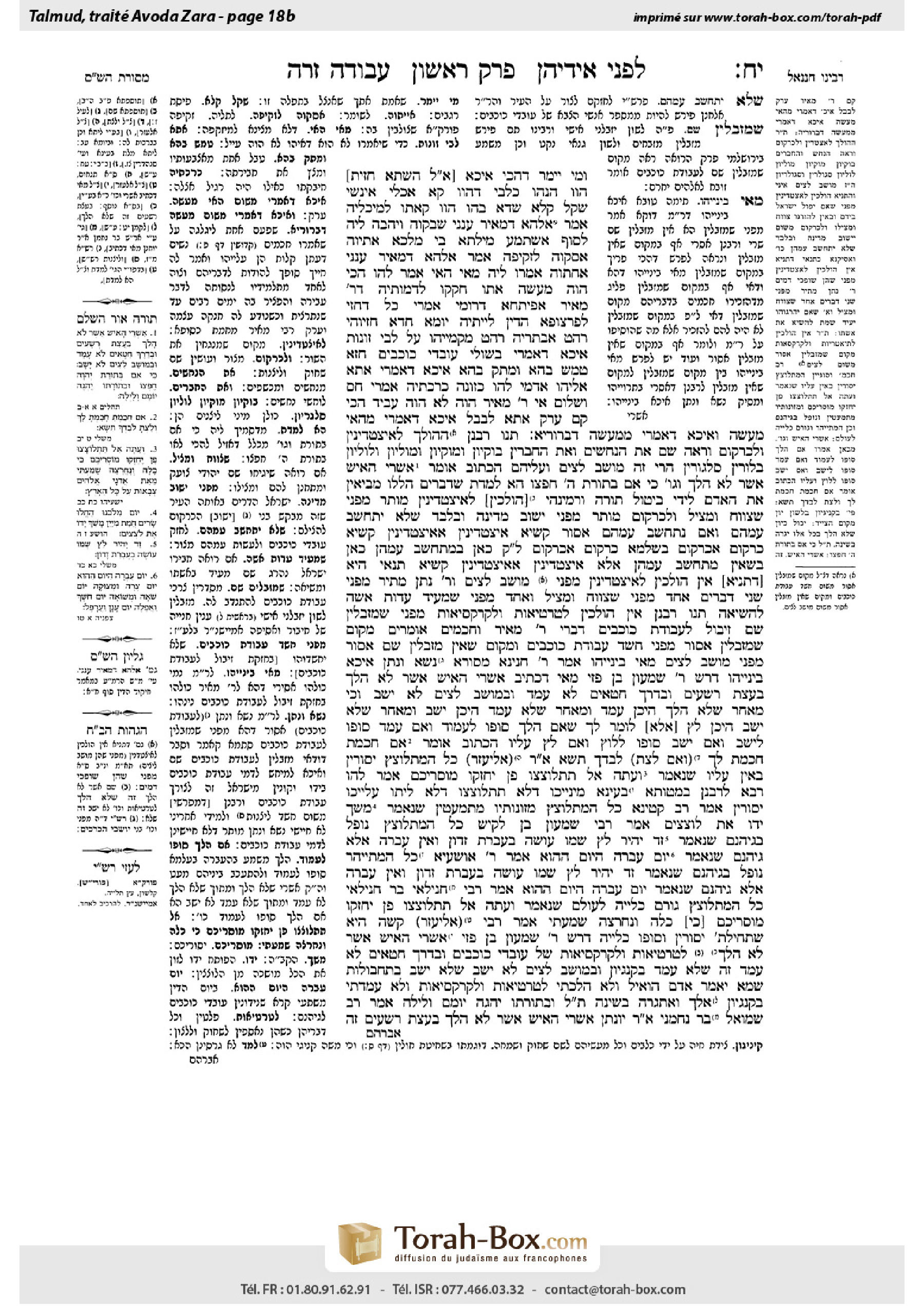
Avodah Zarah 18b: Talmud study for Daf Yomi
Study the Talmud for Daf Yomi with scanned pages, Hebrew text, English translations from Sefaria and AI-generated French translations.
Passage selection and English or AI-generated French translation are available where the scan has annotations. Daf Study is independent of Torah-Box and Sefaria.
Browse Avodah Zarah · עבודה זרה · All tractatesAvodah Zarah 18b text and translations
This page of Avodah Zarah includes the Aramaic text, an English translation and an AI-generated French translation, alongside the scan above.
עבודה זרה י״ח ב · Aramaic and Hebrew text
וּמִי יֵימַר דְּהָכִי אִיכָּא? אֲמַר לֵיהּ: הַשְׁתָּא חָזֵית. הֲווֹ הָנְהוּ כַּלְבֵי דַּהֲווֹ קָא אָכְלִי אִינָשֵׁי, שְׁקַל קָלָא שְׁדָא בְּהוּ. הֲווֹ קָאָתוּ לְמֵיכְלֵיהּ, אֲמַר: ״אֱלָהָא דְּמֵאִיר עֲנֵנִי!״, שַׁבְקוּהּ, וְיַהֲבַהּ לֵיהּ.
לְסוֹף אִשְׁתְּמַע מִילְּתָא בֵּי מַלְכָּא, אַתְיוּהּ אַסְּקוּהּ לִזְקִיפָה. אֲמַר: ״אֱלָהָא דְּמֵאִיר עֲנֵנִי!״ אַחֲתוּהּ. אֲמַרוּ לֵיהּ: מַאי הַאי? אֲמַר לְהוּ: הָכִי הֲוָה מַעֲשֶׂה.
אֲתוֹ חֲקַקוּ לִדְמוּתֵיהּ דְּרַבִּי מֵאִיר אַפִּיתְחָא דְרוֹמִי, אָמְרִי: כֹּל דְּחָזֵי לְפַרְצוּפָא הָדֵין לַיְיתֵיהּ. יוֹמָא חֲדָא חַזְיוּהִי, רְהוּט אַבָּתְרֵיהּ, רְהַט מִקַּמַּיְיהוּ, עָל לְבֵי זוֹנוֹת. אִיכָּא דְּאָמְרִי: בִּשּׁוּלֵי גוֹיִם חֲזָא, טְמַשׁ בְּהָא וּמְתַק בְּהָא. אִיכָּא דְּאָמְרִי: אֲתָא אֵלִיָּהוּ אִדְּמִי לְהוּ כְּזוֹנָה, כְּרַכְתֵּיהּ. אָמְרִי: חַס וְשָׁלוֹם, אִי רַבִּי מֵאִיר הֲוָה לָא הֲוָה עָבֵיד הָכִי.
קָם עֲרַק, אֲתָא לְבָבֶל. אִיכָּא דְּאָמְרִי: מֵהַאי מַעֲשֶׂה, וְאִיכָּא דְּאָמְרִי: מִמַּעֲשֶׂה דִּבְרוּרְיָא.
תָּנוּ רַבָּנַן: הַהוֹלֵךְ לְאִיצְטָדִינִין וּלְכַרְקוֹם, וְרָאָה שָׁם אֶת הַנְּחָשִׁים וְאֶת הַחַבָּרִין, בּוּקְיוֹן וּמוּקְיוֹן וּמוּלְיוֹן וְלוּלְיוֹן, בְּלוּרִין סַלְגּוּרִין — הֲרֵי זֶה מוֹשַׁב לֵצִים, וַעֲלֵיהֶם הַכָּתוּב אוֹמֵר: ״אַשְׁרֵי הָאִישׁ אֲשֶׁר לֹא הָלַךְ וְגוֹ׳ כִּי אִם בְּתוֹרַת ה׳ חֶפְצוֹ״, הָא לָמַדְתָּ שֶׁדְּבָרִים הַלָּלוּ מְבִיאִין אֶת הָאָדָם לִידֵי בִּיטּוּל תּוֹרָה.
וּרְמִינְהִי: לְאִיצְטָדִינִין מוּתָּר, מִפְּנֵי שֶׁצּוֹוֵחַ וּמַצִּיל, וּלְכַרְקוֹם מוּתָּר, מִפְּנֵי יִשּׁוּב מְדִינָה, וּבִלְבַד שֶׁלֹּא יִתְחַשֵּׁב עִמָּהֶם, וְאִם נִתְחַשֵּׁב עִמָּהֶם — אָסוּר. קַשְׁיָא אִיצְטְדִינִין אַאִיצְטָדִינִין, קַשְׁיָא כַּרְקוֹם אַכַּרְקוֹם!
בִּשְׁלָמָא כַּרְקוֹם אַכַּרְקוֹם לָא קַשְׁיָא, כָּאן — בְּמִתְחַשֵּׁב עִמָּהֶן, כָּאן — בְּשֶׁאֵין מִתְחַשֵּׁב עִמָּהֶן, אֶלָּא אִיצְטָדִינִין אַאִיצְטָדִינִין קַשְׁיָא!
תַּנָּאֵי הִיא, דְּתַנְיָא: אֵין הוֹלְכִין לְאִיצְטָדִינִין מִפְּנֵי ״מוֹשַׁב לֵצִים״, וְרַבִּי נָתָן מַתִּיר מִפְּנֵי שְׁנֵי דְבָרִים: אֶחָד, מִפְּנֵי שֶׁצּוֹוֵחַ וּמַצִּיל, וְאֶחָד, מִפְּנֵי שֶׁמֵּעִיד עֵדוּת אִשָּׁה לְהַשִּׂיאָהּ.
תָּנוּ רַבָּנַן: אֵין הוֹלְכִין לְטֵרַטְיָאוֹת וּלְקִרְקְסִיאוֹת, מִפְּנֵי שֶׁמְּזַבְּלִין שָׁם זִיבּוּל לַעֲבוֹדָה זָרָה, דִּבְרֵי רַבִּי מֵאִיר. וַחֲכָמִים אוֹמְרִים: מָקוֹם שֶׁמְּזַבְּלִין — אָסוּר מִפְּנֵי חֲשַׁד עֲבוֹדָה זָרָה, וּמָקוֹם שֶׁאֵין מְזַבְּלִין שָׁם — אָסוּר מִפְּנֵי ״מוֹשַׁב לֵצִים״.
מַאי בֵּינַיְיהוּ? אָמַר רַבִּי חֲנִינָא מִסּוּרָא: נָשָׂא וְנָתַן אִיכָּא בֵּינַיְיהוּ.
דְּרָשׁ רַבִּי שִׁמְעוֹן בֶּן פַּזִּי: מַאי דִּכְתִיב ״אַשְׁרֵי הָאִישׁ אֲשֶׁר לֹא הָלַךְ בַּעֲצַת רְשָׁעִים וּבְדֶרֶךְ חַטָּאִים לֹא עָמָד וּבְמוֹשַׁב לֵצִים לֹא יָשָׁב״? וְכִי מֵאַחַר שֶׁלֹּא הָלַךְ, הֵיכָן עָמַד? וּמֵאַחַר שֶׁלֹּא עָמַד, הֵיכָן יָשַׁב? וּמֵאַחַר שֶׁלֹּא יֵשֵׁב, הֵיכָן לָץ?
אֶלָּא לוֹמַר לָךְ, שֶׁאִם הָלַךְ — סוֹפוֹ לַעֲמוֹד, וְאִם עָמַד — סוֹפוֹ לֵישֵׁב, וְאִם יָשַׁב — סוֹפוֹ לָלוּץ, וְאִם לָץ — עָלָיו הַכָּתוּב אוֹמֵר: ״אִם חָכַמְתָּ חָכַמְתָּ לָּךְ וְאִם לַצְתָּ לְבַדְּךָ תִשָּׂא״.
אָמַר רַבִּי אֱלִיעֶזֶר: כׇּל הַמִּתְלוֹצֵץ יִסּוּרִין בָּאִין עָלָיו, שֶׁנֶּאֱמַר: ״וְעַתָּה אַל תִּתְלוֹצָצוּ פֶּן יֶחְזְקוּ מוֹסְרֵיכֶם״. אֲמַר לְהוּ רָבָא לְרַבָּנַן: בְּמָטוּתָא בָּעֵינָא מִינַּיְיכוּ דְּלָא תִּתְלוֹצְצוּ, דְּלָא לֵיתוֹ עֲלַיְיכוּ יִסּוּרִין.
אָמַר רַב קַטִּינָא: כָּל הַמִּתְלוֹצֵץ מְזוֹנוֹתָיו מִתְמַעֲטִין, שֶׁנֶּאֱמַר: ״מָשַׁךְ יָדוֹ אֶת לֹצְצִים״. אָמַר רַבִּי שִׁמְעוֹן בֶּן לָקִישׁ: כׇּל הַמִּתְלוֹצֵץ נוֹפֵל בְּגֵיהִנָּם, שֶׁנֶּאֱמַר: ״זֵד יָהִיר לֵץ שְׁמוֹ עוֹשֶׂה בְּעֶבְרַת זָדוֹן״, וְאֵין עֶבְרָה אֶלָּא גֵּיהִנָּם, שֶׁנֶּאֱמַר: ״יוֹם עֶבְרָה הַיּוֹם הַהוּא״.
אָמַר רַבִּי אוֹשַׁעְיָא: כׇּל הַמִּתְיַיהֵר נוֹפֵל בְּגֵיהִנָּם, שֶׁנֶּאֱמַר: ״זֵד יָהִיר לֵץ שְׁמוֹ עוֹשֶׂה בְּעֶבְרַת זָדוֹן״, וְאֵין עֶבְרָה אֶלָּא גֵּיהִנָּם, שֶׁנֶּאֱמַר: ״יוֹם עֶבְרָה הַיּוֹם הַהוּא״. אָמַר רַבִּי חֲנִילַאי בַּר חֲנִילַאי: כׇּל הַמִּתְלוֹצֵץ גּוֹרֵם כְּלָיָיה לָעוֹלָם, שֶׁנֶּאֱמַר: ״וְעַתָּה אַל תִּתְלוֹצָצוּ פֶּן יֶחְזְקוּ מוֹסְרֵיכֶם כִּי כָלָה וְנֶחֱרָצָה שָׁמַעְתִּי״.
אָמַר רַבִּי אֱלִיעֶזֶר: קָשָׁה הִיא שֶׁתְּחִילָּתוֹ יִסּוּרִין וְסוֹפוֹ כְּלָיָיה. דָּרַשׁ רַבִּי שִׁמְעוֹן בֶּן פַּזִּי: ״אַשְׁרֵי הָאִישׁ אֲשֶׁר לֹא הָלַךְ״ לְטֵרַטְיָאוֹת וּלְקִרְקְסִיאוֹת שֶׁל גּוֹיִם, ״וּבְדֶרֶךְ חַטָּאִים לֹא עָמָד״ — זֶה שֶׁלֹּא עָמַד בְּקִנִגְיוֹן, ״וּבְמוֹשַׁב לֵצִים לֹא יָשָׁב״ — שֶׁלֹּא יָשַׁב בְּתַחְבּוּלוֹת.
שֶׁמָּא יֹאמַר אָדָם: הוֹאִיל וְלֹא הָלַכְתִּי לְטֵרַטְיָאוֹת וּלְקִרְקְסִיאוֹת וְלֹא עָמַדְתִּי בְּקִנִגְיוֹן, אֵלֵךְ וְאֶתְגָּרֶה בְּשֵׁינָה, תַּלְמוּד לוֹמַר: ״וּבְתוֹרָתוֹ יֶהְגֶּה יוֹמָם וָלָיְלָה״.
אָמַר רַב שְׁמוּאֵל בַּר נַחְמָנִי אָמַר רַבִּי יוֹנָתָן: ״אַשְׁרֵי הָאִישׁ אֲשֶׁר לֹא הָלַךְ בַּעֲצַת רְשָׁעִים״ — זֶה
Avodah Zarah 18b · English translation
And who can say that this is the case, that I will be saved by this utterance? Rabbi Meir said to him: You will now see. There were these carnivorous dogs that would devour people; Rabbi Meir took a clod of earth, threw it at them, and when they came to devour him, he said: God of Meir answer me! The dogs then left him alone, and after seeing this the guard gave the daughter of Rabbi Ḥanina ben Teradyon to Rabbi Meir.
Ultimately the matter was heard in the king’s court, and the guard, who was brought and taken to be hanged, said: God of Meir answer me! They then lowered him down, as they were unable to hang him. They said to him: What is this? He said to them: This was the incident that occurred, and he proceeded to relate the entire story to them.
They then went and engraved the image of Rabbi Meir at the entrance of Rome where it would be seen by everyone, and they said: Anyone who sees a man with this face should bring him here. One day, Romans saw Rabbi Meir and ran after him, and he ran away from them and entered a brothel to hide. Some say he then escaped capture because he saw food cooked by gentiles and dipped [temash] this finger in the food and tasted it with that other finger, and thereby fooled them into thinking that he was eating their food, which they knew Rabbi Meir would not do. And some say that he escaped detection because Elijah came, appeared to them as a prostitute and embraced Rabbi Meir. The Romans who were chasing him said: Heaven forbid, if this were Rabbi Meir, he would not act in that manner.
Rabbi Meir arose, fled, and arrived in Babylonia. The Gemara notes: There are those who say that he fled because of this incident, and there are those who say that he fled due to embarrassment from the incident involving his wife Berurya.
§ The Sages taught: With regard to one who goes to stadiums [le’itztadinin] where people are killed in contests with gladiators or beasts, or to a camp of besiegers [ulkharkom] where different forms of entertainment are provided for the besieging army, and he sees there the acts of the diviners and those who cast spells, or the acts of the clowns known as bukiyon, or mukiyon, or muliyon, or luliyon, or belurin, or salgurin, this is categorized as “the seat of the scornful”; and with regard to such places the verse states: “Happy is the man that has not walked in the council of the wicked, nor stood in the way of sinners, nor sat in the seat of the scornful. But his delight is in the Torah of the Lord” (Psalms 1:1–2). You learn from here that these matters bring a person to dereliction of the study of Torah, since had he not sat in “the seat of the scornful,” he would delight in the study of Torah.
And the Gemara raises a contradiction from another baraita: One is permitted to go to stadiums, because he can scream and save the life of a Jew who would otherwise be killed there; and it is permitted to go to a camp of besiegers, because at times one can provide for the public welfare by petitioning the besiegers and saving the residents of the town, provided that he is not counted as one of them; but if he is counted as one of them, it is prohibited. This is difficult, as there is a contradiction between the statement about attending stadiums in the first baraita and the statement about attending stadiums in the second baraita, and is similarly difficult as there is a contradiction between the statement about a camp of besiegers in the first baraita and the statement about a camp of besiegers in the second baraita.
The Gemara continues: Granted, the apparent contradiction between one statement about a camp of besiegers and the other statement about a camp of besiegers is not difficult, as here, the first baraita is referring to a case where he is counted as one of them, and there, the second baraita is referring to a case where he is not counted as one of them. But with regard to the contradiction between the ruling about attending stadiums in the first baraita and the ruling about attending stadiums in the second baraita, it is difficult.
The Gemara answers: This issue is a dispute between tanna’im, as it is taught in a baraita: One may not go to stadiums, because they are considered “the seat of the scornful.” And Rabbi Natan permits attending stadiums due to two reasons; one is because he can scream and save the life of someone who would otherwise be killed, and the other one is because even if he cannot save the man’s life, he can provide testimony that a woman’s husband died, which will enable her to marry again.
The Sages taught: One may not go to theaters [letarteiot] or circuses [ulkirkaseiot] because they sacrifice offerings there to objects of idol worship; this is the statement of Rabbi Meir. And the Rabbis say: It is prohibited to go to a place where they sacrifice offerings, due to a suspicion of idol worship, and it is also prohibited to go to a place where they do not sacrifice offerings, due to it being considered “the seat of the scornful.”
The Gemara asks: What is the practical difference between the opinion of the Rabbis and that of Rabbi Meir? After all, according to both opinions it is prohibited to attend theaters or circuses. Rabbi Ḥanina of Sura said: The difference between them arises in the case of one who engaged in business there. According to Rabbi Meir, the profits are forbidden as the proceeds of idol worship, as Rabbi Meir maintains that the gentiles certainly worship idols at theaters or circuses. Conversely, according to the Rabbis, the profits are forbidden only if it is established that they worshipped idols there.
§ Apropos the earlier discussion of the evils of scornfulness, the Gemara cites several statements that criticize such behavior. Rabbi Shimon ben Pazi taught: What is the meaning of that which is written: “Happy is the man that has not walked in the counsel of the wicked, nor stood in the way of sinners, nor sat in the seat of the scornful” (Psalms 1:1)? Since he did not walk in the counsel of the wicked, how could he stand with them? And since he did not stand, how could he sit with them? And since he did not sit with them, how could he have scorned? Since he never joined the company of the wicked, he would have no reason to be involved with them in any manner.
Rather, the verse serves to say to you that if he walked with the wicked, he will ultimately stand with them. And if he stood with them, he will ultimately sit in their company, and if he sat, he will ultimately scorn along with them. And if he scorned, the verse says about him: “If you are wise, you are wise for yourself; and if you scorn, you alone shall bear it” (Proverbs 9:12).
Rabbi Eliezer says: Concerning anyone who scoffs, suffering will befall him, as it is stated: “Now therefore do not be scoffers, lest your suffering be made strong” (Isaiah 28:22). Similarly, Rava said to the Sages who were sitting before him: Please, I ask of you that you not scoff, so that suffering will not befall you.
Rav Ketina says: Concerning anyone who scoffs, his sustenance is lessened, as it is stated: “He stretches out his hand with scorners” (Hosea 7:5), meaning that God withdraws His providence from scoffers and does not provide for them. Rabbi Shimon ben Lakish says: Anyone who scoffs falls into Gehenna, as it is stated: “A proud and haughty man, scorner is his name, he acts in arrogant wrath” (Proverbs 21:24). And wrath means nothing other than Gehenna, as it is stated with regard to the Day of Judgment: “That day is a day of wrath” (Zephaniah 1:15).
Rabbi Oshaya says, based on the same verse: Anyone who is haughty falls into Gehenna, as it is stated: “A proud and haughty man, scorner is his name, he acts in arrogant wrath” (Proverbs 21:24). And wrath means nothing other than Gehenna, as it is stated: “That day is a day of wrath” (Zephaniah 1:15). Rabbi Ḥanilai bar Ḥanilai says: Anyone who scoffs causes extermination to be wrought upon the world, as it is stated: “Now therefore do not be scoffers, lest your suffering be made strong; for an extermination wholly determined have I heard from the Lord, the God of hosts, upon the whole land” (Isaiah 28:22).
Rabbi Eliezer says: Scoffing is a severe sin, as at first one is punished with suffering, and ultimately one is punished with extermination. Rabbi Shimon ben Pazi taught: “Happy is the man that has not walked in the counsel of the wicked,” this is referring to the theaters and circuses of gentiles; “nor stood in the way of sinners,” this is referring to one who has not stood as an observer at bestial contests [bekinigiyyon]; “nor sat in the seat of the scornful,” this is referring to one who has not sat in the bad company of people who engage in scoffing and jeering.
Lest a person say: Since I did not go to theaters and circuses, and did not stand in bestial contests, I will go and indulge in sleep, the verse states: “And he meditates in His law day and night” (Psalms 1:2). This demonstrates that it is not sufficient simply to avoid transgressions; rather, it is necessary to engage actively in Torah study.
§ The Gemara relates an alternative homiletic interpretation of the verse discussed above. Rav Shmuel bar Naḥmani says that Rabbi Yonatan says: “Happy is the man that has not walked in the counsel of the wicked” (Psalms 1:1); this
Avodah Zarah 18b · Traduction française (IA)
Et qui peut dire que c'est le cas, que je serai sauvé par cette parole ? Rabbi Meïr dit à lui : Tu vas maintenant voir. Il y avait ces chiens carnivores qui mangeaient les gens ; Rabbi Meïr prit un morceau de terre, le lança contre eux, et lorsqu'ils vinrent le manger, il dit : Dieu de Meïr, réponds-moi ! Les chiens le laissèrent alors seul, et après avoir vu cela, le gardien donna la fille de Rabbi Ḥanina ben Teradyon à Rabbi Meïr.
Finalement, l'histoire fut entendue dans le tribunal du roi, et le gardien, qui fut amené et menacé d'être pendu, dit : Dieu de Meïr, réponds-moi ! Ils le baissèrent alors, car ils ne pouvaient pas le pendre. Ils lui dirent : Qu'est-ce que cela signifie ? Il leur répondit : C'était l'incident qui s'est produit, et il raconta toute l'histoire à eux.
Ils allèrent ensuite et gravèrent l'image de Rabbi Meïr à l'entrée de Rome, où tout le monde pourrait la voir, et ils dirent : Quiconque verra un homme avec ce visage doit le ramener ici. Un jour, les Romains virent Rabbi Meïr et le poursuivirent, et il s'échappa d'eux en entrant dans une maison de prostituées pour se cacher. Certains disent qu'il échappa à la capture parce qu'il vit de la nourriture cuisinée par des non-Juifs et qu'il trempa ce doigt dans la nourriture et goûta avec l'autre doigt, et ainsi ils pensèrent qu'il mangeait leur nourriture, ce qu'ils savaient que Rabbi Meïr ne ferait pas. D'autres disent qu'il échappa à la détection parce que Elie vint, se présenta à eux comme une prostituée et embrassa Rabbi Meïr. Les Romains qui le poursuivaient dirent : Dieu forbid, si c'était Rabbi Meïr, il ne se comporterait pas ainsi.
Rabbi Meïr se leva, fuit et arriva en Babylone. La Guemara note : Certains disent qu'il fuit à cause de cet incident, et d'autres disent qu'il fuit à cause de la honte liée à l'incident concernant sa femme Berurya.
§ Les Sages enseignèrent : Concernant celui qui va aux arènes [le'itztadinin] où des gens sont tués dans des combats avec des gladiateurs ou des bêtes, ou à un camp de siège [ulkharkom] où différents types de divertissements sont offerts à l'armée assiégeante, et il y voit les actes des devins et des sorciers, ou les actes des clowns connus sous les noms de bukiyon, ou mukiyon, ou muliyon, ou luliyon, ou belurin, ou salgurin, cela est considéré comme « le siège des méprisants » ; et concernant ces lieux, la Sainte Écriture dit : « Heureux l'homme qui n'a pas marché dans le conseil des méchants, ni stationné sur le chemin des pécheurs, ni siégé sur le siège des méprisants. Mais son délice est dans la Torah du Seigneur » (Psaumes 1:1–2). Vous en tirez que ces choses conduisent à la négligence de l'étude de la Torah, car s'il n'avait pas siégé « sur le siège des méprisants », il aurait trouvé délice dans l'étude de la Torah.
Et la Guemara soulève une contradiction à partir d'une autre baraïta : On est autorisé à aller aux arènes, car on peut crier et sauver la vie d'un Juif qui serait autrement tué là-bas ; et on est autorisé à aller à un camp de siège, car parfois on peut contribuer au bien commun en demandant aux assiégeants de sauver les habitants de la ville, à condition qu'on ne soit pas compté parmi eux ; mais si on est compté parmi eux, cela est interdit. Cela est difficile, car il y a une contradiction entre l'affirmation concernant l'assistance aux arènes dans la première baraïta et celle concernant l'assistance aux arènes dans la deuxième baraïta, et de même il y a une contradiction entre l'affirmation concernant un camp de siège dans la première baraïta et celle concernant un camp de siège dans la deuxième baraïta.
La Guemara continue : Cela est admis, la contradiction entre l'affirmation concernant un camp de siège et l'autre affirmation concernant un camp de siège n'est pas difficile, car ici, la première baraïta fait référence à un cas où il est compté parmi eux, et là, la deuxième baraïta fait référence à un cas où il n'est pas compté parmi eux. Mais concernant la contradiction entre la décision concernant l'assistance aux arènes dans la première baraïta et celle concernant l'assistance aux arènes dans la deuxième baraïta, cela est difficile.
La Guemara répond : Cette question est un débat entre les tannaïm, car il est enseigné dans une baraïta : On ne doit pas aller aux arènes, car elles sont considérées comme « le siège des méprisants ». Et Rabbi Natan permet d'assister aux arènes pour deux raisons ; l'une est parce qu'on peut crier et sauver la vie d'une personne qui serait autrement tuée, et l'autre est parce qu'on peut témoigner que la femme de quelqu'un est morte, ce qui permettra à celle-ci de se remarier.
Les Sages enseignèrent : On ne doit pas aller aux théâtres [letarteiot] ou aux cirques [ulkirkaseiot] car des offrandes sont sacrifiées là-bas à des objets d'idolâtrie ; c'est l'opinion de Rabbi Meïr. Et les Rabbins disent : Il est interdit d'aller dans un lieu où des offrandes sont sacrifiées, en raison d'une suspicion d'idolâtrie, et il est également interdit d'aller dans un lieu où des offrandes ne sont pas sacrifiées, en raison de l'idée qu'il s'agit de « le siège des méprisants ».
La Guemara pose la question : Quelle est la différence pratique entre l'opinion des Rabbins et celle de Rabbi Meïr ? Après tout, selon les deux opinions, il est interdit d'assister aux théâtres ou aux cirques. Rabbi Ḥanina de Sura dit : La différence entre eux réside dans le cas d'une personne qui y fait des affaires. Selon Rabbi Meïr, les profits sont interdits car ils proviennent de l'idolâtrie, car Rabbi Meïr maintient que les païens adorent certainement des dieux dans les théâtres ou les cirques. À l'inverse, selon les Rabbins, les profits sont interdits uniquement si cela est établi qu'ils adoraient des dieux là-bas.
§ En ce qui concerne la discussion précédente sur les maux de l'arrogance, la Guemara cite plusieurs propos qui condamnent ce comportement. Rabbi Šimon ben Pazi enseignait : Quelle est la signification de ce qui est écrit : « Heureux l'homme qui n'a pas marché dans le conseil des méchants, ni demeuré dans la voie des pécheurs, ni siégé dans le siège des moqueurs » (Psaumes 1:1) ? Puisqu'il n'a pas marché dans le conseil des méchants, comment pouvait-il demeurer avec eux ? Et puisqu'il n'a pas demeuré avec eux, comment pouvait-il siéger avec eux ? Et puisqu'il n'a pas siégé avec eux, comment pouvait-il moquer ? Puisqu'il n'a jamais fréquenté la compagnie des méchants, il n'avait aucune raison d'être impliqué avec eux d'une quelconque manière.
Au contraire, la parole sert à vous dire que si l'homme marchait avec les méchants, il finirait par demeurer avec eux. Et si l'homme demeurait avec eux, il finirait par siéger avec eux, et si l'homme siégeait avec eux, il finirait par moquer avec eux. Et si l'homme moquait, la parole dit à son sujet : « Si tu es sage, tu es sage pour toi-même ; et si tu moques, tu seul porteras la charge » (Proverbes 9:12).
Rabbi Éliezer dit : Concernant celui qui moque, la souffrance le frappera, comme il est dit : « Maintenant donc, ne sois pas moqueur, afin que ta souffrance ne soit pas forte » (Isaïe 28:22). De même, Rava dit aux Sages qui étaient assis devant lui : S'il vous plaît, je vous demande de ne pas moquer, afin que la souffrance ne vous frappe pas.
Rav Ketina dit : Concernant celui qui se moque, sa subsistance est diminuée, comme il est dit : « Il étire sa main avec les moqueurs » (Osée 7:5), ce qui signifie que Dieu retire Sa providence des moqueurs et ne les nourrit pas. Rabbi Šimon ben Lakish dit : Celui qui se moque tombe en Gehenna, comme il est dit : « Un homme fier et orgueilleux, moqueur est son nom, il agit en colère orgueilleuse » (Proverbes 21:24). Et la colère signifie rien d'autre que Gehenna, comme il est dit à propos du Jour du Jugement : « Ce jour est un jour de colère » (Zephanie 1:15).
Rabbi Oshaya dit, fondé sur la même parole : Celui qui est orgueilleux tombe en Gehenna, comme il est dit : « Un homme fier et orgueilleux, moqueur est son nom, il agit en colère orgueilleuse » (Proverbes 21:24). Et la colère signifie rien d'autre que Gehenna, comme il est dit : « Ce jour est un jour de colère » (Zephanie 1:15). Rabbi Ḥanilai bar Ḥanilai dit : Celui qui se moque provoque l'extermination du monde, comme il est dit : « Maintenant donc, ne sois pas moqueur, afin que ta souffrance ne soit pas forte ; car une extermination toute déterminée j'ai entendue du Seigneur, Dieu des armées, sur toute la terre » (Isaïe 28:22).
Rabbi Éliezer dit : Le moquerie est un grand péché, car d'abord on est puni par la souffrance, et finalement on est puni par l'extermination. Rabbi Šimon ben Pazi enseignait : « Heureux l'homme qui n'a pas marché dans le conseil des méchants », cela fait référence aux théâtres et aux cirques des non-juifs ; « ni demeuré dans la voie des pécheurs », cela fait référence à celui qui n'a pas demeuré comme témoin aux combats de bêtes [bekinigiyyon] ; « ni siégé dans le siège des moqueurs », cela fait référence à celui qui n'a pas siégé dans la mauvaise compagnie des gens qui se moquent et se moquent.
De peur qu'une personne dise : Puisque je n'ai pas été aux théâtres et aux cirques, et que je n'ai pas assisté aux combats de bêtes, je vais me reposer, la parole dit : « Et il médite sur Sa loi jour et nuit » (Psaumes 1:2). Cela démontre que simplement éviter les transgressions n'est pas suffisant ; il est nécessaire d'engager activement l'étude de la Torah.
§ La Guemara rapporte une autre interprétation homiletique de la parole discutée ci-dessus. Rav Šmuel bar Naḥmani dit que Rabbi Yonatan dit : « Heureux l'homme qui n'a pas marché dans le conseil des méchants » (Psaumes 1:1) ; cela
Traduction française générée par IA à partir de l’édition anglaise de Sefaria. Vérifie toujours un passage avec le texte source.
Text from Sefaria: William Davidson Edition - Vocalized Aramaic (CC BY NC); William Davidson Edition - English (CC BY NC).