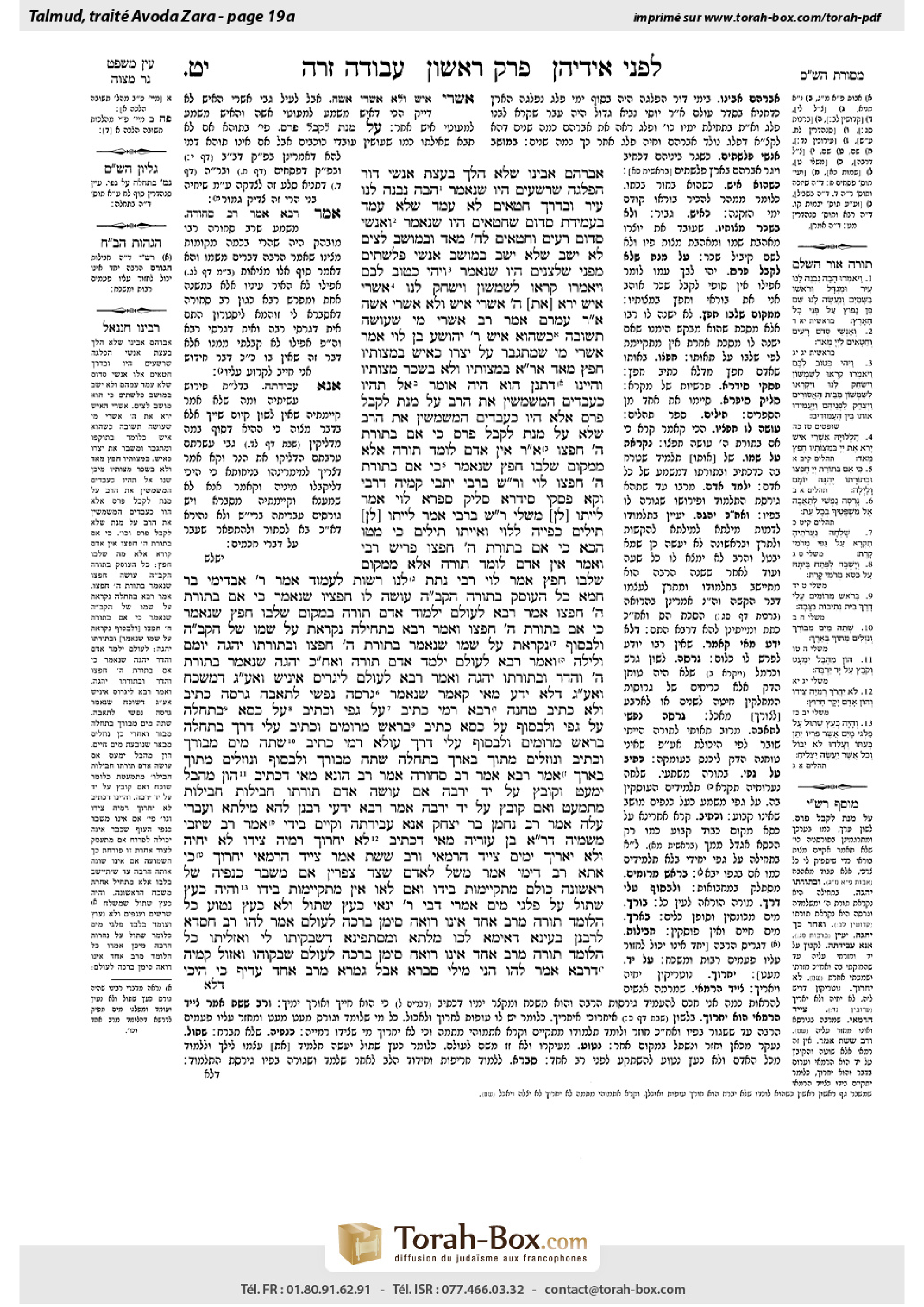
Avodah Zarah 19a: Talmud study for Daf Yomi
Study the Talmud for Daf Yomi with scanned pages, Hebrew text, English translations from Sefaria and AI-generated French translations.
Passage selection and English or AI-generated French translation are available where the scan has annotations. Daf Study is independent of Torah-Box and Sefaria.
Browse Avodah Zarah · עבודה זרה · All tractatesAvodah Zarah 19a text and translations
This page of Avodah Zarah includes the Aramaic text, an English translation and an AI-generated French translation, alongside the scan above.
עבודה זרה י״ט א · Aramaic and Hebrew text
אַבְרָהָם אָבִינוּ, שֶׁלֹּא הָלַךְ בַּעֲצַת אַנְשֵׁי דּוֹר הַפְּלַגָּה, שֶׁרְשָׁעִים הָיוּ, שֶׁנֶּאֱמַר: ״הָבָה נִבְנֶה לָּנוּ עִיר״, ״וּבְדֶרֶךְ חַטָּאִים לֹא עָמָד״ — שֶׁלֹּא עָמַד בַּעֲמִידַת סְדוֹם, שֶׁחֲטָאִים הָיוּ, שֶׁנֶּאֱמַר: ״וְאַנְשֵׁי סְדֹם רָעִים וְחַטָּאִים לַה׳ מְאֹד״.
״וּבְמוֹשַׁב לֵצִים לֹא יָשָׁב״ — שֶׁלֹּא יָשַׁב בְּמוֹשַׁב אַנְשֵׁי פְּלִשְׁתִּים, מִפְּנֵי שֶׁלֵּצָנִים הָיוּ, שֶׁנֶּאֱמַר: ״וַיְהִי כְּטוֹב לִבָּם וַיֹּאמְרוּ קִרְאוּ לְשִׁמְשׁוֹן וִישַׂחֶק לָנוּ״.
״אַשְׁרֵי אִישׁ יָרֵא אֶת ה׳״, אַשְׁרֵי אִישׁ וְלֹא אַשְׁרֵי אִשָּׁה? אָמַר רַב עַמְרָם אָמַר רַב: אַשְׁרֵי מִי שֶׁעוֹשֶׂה תְּשׁוּבָה כְּשֶׁהוּא ״אִישׁ״. רַבִּי יְהוֹשֻׁעַ בֶּן לֵוִי אָמַר: אַשְׁרֵי מִי שֶׁמִּתְגַּבֵּר עַל יִצְרוֹ ״כְּאִישׁ״.
״בְּמִצְוֹתָיו חָפֵץ מְאֹד״, אָמַר רַבִּי אֶלְעָזָר: ״בְּמִצְוֹתָיו״ וְלֹא בִּשְׂכַר מִצְוֹתָיו, וְהַיְינוּ דִּתְנַן: הוּא הָיָה אוֹמֵר: אַל תִּהְיוּ כַּעֲבָדִים הַמְשַׁמְּשִׁין אֶת הָרַב עַל מְנָת לְקַבֵּל פְּרָס, אֶלָּא הֱיוּ כַּעֲבָדִים הַמְשַׁמְּשִׁין אֶת הָרַב שֶׁלֹּא עַל מְנָת לְקַבֵּל פְּרָס.
״כִּי אִם בְּתוֹרַת ה׳ חֶפְצוֹ״, אָמַר רַבִּי: אֵין אָדָם לוֹמֵד תּוֹרָה אֶלָּא מִמָּקוֹם שֶׁלִּבּוֹ חָפֵץ, שֶׁנֶּאֱמַר: ״כִּי אִם בְּתוֹרַת ה׳ חֶפְצוֹ״.
לֵוִי וְרַבִּי שִׁמְעוֹן בְּרַבִּי יָתְבִי קַמֵּיהּ דְּרַבִּי, וְקָא פָּסְקִי סִידְרָא. סְלֵיק סִפְרָא, לֵוִי אָמַר: לַיְיתוֹ [לַן] מִשְׁלֵי, רַבִּי שִׁמְעוֹן בְּרַבִּי אָמַר: לַיְיתוֹ [לַן] תִּילִּים. כַּפְיֵיהּ לְלֵוִי וְאַיְיתוֹ תִּילִּים, כִּי מְטוֹ הָכָא ״כִּי אִם בְּתוֹרַת ה׳ חֶפְצוֹ״, פָּרֵישׁ רַבִּי וַאֲמַר: אֵין אָדָם לוֹמֵד תּוֹרָה אֶלָּא מִמָּקוֹם שֶׁלִּבּוֹ חָפֵץ. אָמַר לֵוִי: רַבִּי, נָתַתָּ לָנוּ רְשׁוּת לַעֲמוֹד.
אָמַר רַבִּי אַבְדִּימִי בַּר חָמָא: כׇּל הָעוֹסֵק בַּתּוֹרָה, הַקָּדוֹשׁ בָּרוּךְ הוּא עוֹשֶׂה לוֹ חֲפָצָיו, שֶׁנֶּאֱמַר: ״כִּי אִם בְּתוֹרַת ה׳ חֶפְצוֹ״. אָמַר רָבָא: לְעוֹלָם יִלְמוֹד אָדָם תּוֹרָה בְּמָקוֹם שֶׁלִּבּוֹ חָפֵץ, שֶׁנֶּאֱמַר: ״כִּי אִם בְּתוֹרַת ה׳ חֶפְצוֹ״.
וְאָמַר רָבָא: בַּתְּחִילָּה נִקְרֵאת עַל שְׁמוֹ שֶׁל הַקָּדוֹשׁ בָּרוּךְ הוּא, וּלְבַסּוֹף נִקְרֵאת עַל שְׁמוֹ, שֶׁנֶּאֱמַר: ״בְּתוֹרַת ה׳ חֶפְצוֹ״, ״וּבְתוֹרָתוֹ יֶהְגֶּה יוֹמָם וָלָיְלָה״.
וְאָמַר רָבָא: לְעוֹלָם יִלְמַד אָדָם תּוֹרָה, וְאַחַר כָּךְ יֶהֱגֶה, שֶׁנֶּאֱמַר: ״בְּתוֹרַת ה׳״, וַהֲדַר ״וּבְתוֹרָתוֹ יֶהְגֶּה״.
וְאָמַר רָבָא: לְעוֹלָם לִיגְרֵיס אִינִישׁ, וְאַף עַל גַּב דִּמְשַׁכַּח, וְאַף עַל גַּב דְּלָא יָדַע מַאי קָאָמַר, שֶׁנֶּאֱמַר: ״גָּרְסָה נַפְשִׁי לְתַאֲבָה״, ״גָּרְסָה״ כְּתִיב וְלָא כְּתִיב ״טָחֲנָה״.
רָבָא רָמֵי: כְּתִיב ״עַל גַּפֵּי״, וּכְתִיב ״עַל כִּסֵּא״! בַּתְּחִלָּה ״עַל גַּפֵּי״, וּלְבַסּוֹף ״עַל כִּסֵּא״.
כְּתִיב ״בְּרֹאשׁ מְרֹמִים״, וּכְתִיב ״עֲלֵי דָרֶךְ״. בַּתְּחִלָּה ״בְּרֹאשׁ מְרוֹמִים״, וּלְבַסּוֹף ״עֲלֵי דָרֶךְ״.
עוּלָּא רָמֵי: כְּתִיב ״שְׁתֵה מַיִם מִבּוֹרֶךָ״, וּכְתִיב ״וְנוֹזְלִים מִתּוֹךְ בְּאֵרֶךָ״ — בַּתְּחִלָּה ״שְׁתֵה מִבּוֹרֶךָ״, וּלְבַסּוֹף ״וְנוֹזְלִים מִתּוֹךְ בְּאֵרֶךָ״.
אָמַר רָבָא אָמַר רַב סְחוֹרָה אָמַר רַב הוּנָא: מַאי דִּכְתִיב ״הוֹן מֵהֶבֶל יִמְעָט וְקֹבֵץ עַל יָד יַרְבֶּה״? אִם עוֹשֶׂה אָדָם תּוֹרָתוֹ חֲבִילוֹת חֲבִילוֹת — מִתְמַעֵט, וְאִם קוֹבֵץ עַל יָד — יַרְבֶּה.
אָמַר רָבָא: יָדְעִי רַבָּנַן לְהָא מִילְּתָא וְעָבְרִי עֲלַהּ. אָמַר רַב נַחְמָן בַּר יִצְחָק: אֲנָא עֲבִידְתַּהּ, וְאִקַּיַּים בִּידִי.
אָמַר רַב שֵׁיזְבִי מִשְּׁמֵיהּ דְּרַבִּי אֶלְעָזָר בֶּן עֲזַרְיָה: מַאי דִּכְתִיב ״לֹא יַחֲרֹךְ רְמִיָּה צֵידוֹ״? לֹא יִחְיֶה וְלֹא יַאֲרִיךְ יָמִים צַיָּיד הָרַמַּאי.
וְרַב שֵׁשֶׁת אָמַר: ״צַיָּיד הָרַמַּאי יַחֲרוֹךְ״. כִּי אֲתָא רַב דִּימִי אָמַר: מָשָׁל לְאָדָם שֶׁצָּד צִפֳּרִין, אִם מְשַׁבֵּר כְּנָפֶיהָ שֶׁל רִאשׁוֹנָה — כּוּלָּם מִתְקַיְּימוֹת בְּיָדוֹ, וְאִם לָאו — אֵין מִתְקַיְּימוֹת בְּיָדוֹ.
״וְהָיָה כְּעֵץ שָׁתוּל עַל פַּלְגֵי מָיִם״, אָמְרִי דְּבֵי רַבִּי יַנַּאי: ״כְּעֵץ שָׁתוּל״ וְלֹא ״כְּעֵץ נָטוּעַ״, כׇּל הַלּוֹמֵד תּוֹרָה מֵרַב אֶחָד אֵינוֹ רוֹאֶה סִימַן בְּרָכָה לְעוֹלָם.
אֲמַר לְהוּ רַב חִסְדָּא לְרַבָּנַן: בָּעֵינָא דְּאֵימָא לְכוּ מִלְּתָא, וּמִסְתְּפֵינָא דְּשָׁבְקִיתוּ לִי וְאָזְלִיתוּ. כׇּל הַלּוֹמֵד תּוֹרָה מֵרַב אֶחָד — אֵינוֹ רוֹאֶה סִימַן בְּרָכָה לְעוֹלָם. שַׁבְקוּהּ וַאֲזוּל קַמֵּיהּ דְּרָבָא. אֲמַר לְהוּ: הָנֵי מִילֵּי סְבָרָא, אֲבָל גְּמָרָא מֵרַב אֶחָד עֲדִיף, כִּי הֵיכִי
Avodah Zarah 19a · English translation
is referring to our forefather Abraham, who did not walk in the counsel of the members of the generation of the dispersion, who were wicked, as it is stated that they said to each other: “Come, let us build us a city, and a tower, with its top in heaven” (Genesis 11:4), a project with a wicked aim. “Nor stood in the way of sinners” (Psalms 1:1); this too is referring to Abraham, who did not join in the stand of the residents of Sodom, who were sinners, as it is stated: “Now the men of Sodom were wicked and sinners against the Lord exceedingly” (Genesis 13:13).
“Nor sat in the seat of the scornful” (Psalms 1:1); this means that Abraham did not sit in the seat of the Philistines, because they were scorners who engaged in jest and buffoonery. As it is stated with regard to the Philistines in a later period: “And it came to pass, when their hearts were merry, that they said: Call for Samson, that he may make us sport” (Judges 16:25).
The Gemara cites an interpretation of a similar verse: “Happy is the man that fears the Lord, that delights greatly in His mitzvot” (Psalms 112:1). The Gemara asks: Is that to say happy is the man, but not happy is the woman? Why is it necessary for the verse to emphasize that it is speaking of a man? Rav Amram says that Rav says: The verse applies to both men and women and is teaching: Happy is one who repents when he is still a man, i.e., before he becomes elderly and his strength dwindles. Rabbi Yehoshua ben Levi says: Happy is one who triumphs over his evil inclination like a man, i.e., with strength and vigor.
The verse continues: “He delights greatly in His mitzvot.” Rabbi Elazar says: The person delights in His mitzvot themselves and not in the reward for performing His mitzvot. And this is the same as we learned in a mishna (Avot 1:3): Antigonus of Sokho would say: Do not be like the servants who serve the master on the condition of receiving a reward; rather, be like the servants who serve the master not on the condition that they receive a reward.
§ The Gemara returns to its interpretation of the verse that was discussed previously: “But his delight is in the Torah of the Lord” (Psalms 1:2). Rabbi Yehuda HaNasi says: A person can learn Torah only from a place in the Torah that his heart desires, as it is stated: But his delight is in the Torah of the Lord, i.e., his delight is in the part of the Torah that he wishes to study.
The Gemara relates: Levi and Rabbi Shimon, son of Rabbi Yehuda HaNasi, were sitting before Rabbi Yehuda HaNasi, and they were learning the Torah portion. When they finished the book that they were learning and were ready to begin a new subject, Levi said: Let them bring us the book of Proverbs; and Rabbi Shimon, son of Rabbi Yehuda HaNasi, said: Let them bring us the book of Psalms. He compelled Levi to acquiesce, and they brought a book of Psalms. When they arrived here, at the verse: “But his delight is in the Torah of the Lord,” Rabbi Yehuda HaNasi explained the verse and said: A person can learn Torah only from a place in the Torah that his heart desires. Levi said: My teacher, you have given us, i.e., me, permission to rise and leave, as I wish to study Proverbs, not Psalms.
The Gemara cites other interpretations of this verse. Rabbi Avdimi bar Ḥama says: With regard to anyone who engages in the study of Torah, the Holy One, Blessed be He, fulfills his desires, as it is stated: “But in the Torah of the Lord is his delight,” i.e., if one engages in the study of the Torah of the Lord, he will have his desires met by the Lord. Rava says, in accordance with the statement of Rabbi Yehuda HaNasi: A person should always learn Torah from a place in the Torah that his heart desires, as it is stated: “But his delight is in the Torah of the Lord.”
And Rava also says, with regard to this verse: Initially the Torah is called by the name of the Holy One, Blessed be He, but ultimately it is called by the name of the one who studies it. As it is first stated: “His delight is in the Torah of the Lord,” and in the continuation of the verse it states: “And in his Torah he meditates day and night.” This teaches that through study one acquires ownership, as it were, of the Torah.
And Rava says in reference to this verse: A person must always study Torah and gain a broad knowledge of it, and only then may he analyze and delve into it. As it is stated: “His delight is in the Torah of the Lord,” meaning that he studies the Torah on a basic level, and only afterward does the verse state: “And in his Torah he meditates,” i.e., he analyzes it.
And Rava says with regard to Torah study: A person should always study [ligeris] and review even though he may afterward forget, and even though he does not understand what it is saying. As it is stated with regard to the study of Torah: “My soul breaks [garesa] for the longing that it has for Your ordinances at all times” (Psalms 119:20). It is written: “Breaks,” and it is not written: Grinds, demonstrating that the soul is satisfied with breaking apart material, on a basic level, even if it does not have the opportunity to grind and analyze it in greater depth.
Rava raises a contradiction between two verses: It is written that the Torah calls to people: “Upon the highest places of the city” (Proverbs 9:3), and it is written far more specifically: “On a seat in the high places of the city” (Proverbs 9:14). He explains: Initially, one who studies Torah does not have a secure place to sit, and therefore he is located merely upon the highest places, but ultimately, as he advances in his learning, he is placed on a seat of honor.
The Gemara mentions a similar contradiction. It is written with regard to the Torah: “In the top of high places” (Proverbs 8:2), and it is written in the continuation of the verse that the Torah is “by the path.” This contradiction is resolved as follows: Initially, a person studies Torah in a private location, in the top of high places, but ultimately he will spread his knowledge, by the path, in the public realm.
Ulla raises a contradiction with regard to the following verse. It is written: “Drink waters out of your own cistern” (Proverbs 5:15), and it is written in the continuation of the verse: “And running waters out of your own well.” He explains: Initially one should “drink waters out of your own cistern,” i.e., like the cistern that draws water into one location, learning all existing knowledge; and ultimately one can produce “running waters out of your own well,” i.e., original thought and innovative insights in Torah.
The Gemara cites other statements relating to Torah study. Rava says that Rav Seḥora says that Rav Huna says: What is the meaning of that which is written: “Wealth gotten through vanity [mehevel] shall be diminished; but he that gathers little by little shall increase” (Proverbs 13:11)? If a person turns his Torah into many bundles [ḥavilot], by studying large amounts in a short period of time without reviewing, his Torah will diminish. But if he gathers his knowledge little by little, by studying slowly and reviewing, his knowledge shall increase.
Rava said: The Sages know this, but nevertheless they transgress it, i.e., they fail to heed this advice. Rav Naḥman bar Yitzḥak says: I did this, as I studied little by little and regularly reviewed what I had learned, and my learning has in fact endured.
Rav Sheizvi said in the name of Rabbi Elazar ben Azarya: What is the meaning of that which is written: “The slothful man [remiyya] will not roast [yaḥarokh] his prey” (Proverbs 12:27)? The deceitful [harammai] hunter, i.e., one who tricks people into believing that he has acquired vast stores of knowledge by studying new material without reviewing that which he has already learned, will not live [yiḥye] a long [ya’arikh] life. According to this interpretation, yaḥarokh is a combination of the words yiḥye and ya’arikh.
And Rav Sheshet says that the verse means the opposite: The cunning [harammai] hunter will roast his prey to prevent it from escaping, i.e., he reads the verse as a rhetorical question: Will not the hunter roast? When Rav Dimi came from Eretz Yisrael to Babylonia, he said: This is comparable to a person who is hunting birds; if he breaks the wings of the first bird so that it will be unable to fly off, and he proceeds in this manner, all of his prey will remain in his possession; but if not, they will not remain in his possession, as each bird will fly off when the next is captured. In a similar fashion, a clever student reviews that which he learns, to ensure that he retains his knowledge.
§ The Gemara returns to its interpretation of the first verses of Psalms. “And he shall be like a tree planted [shatul] by streams of water” (Psalms 1:3). The students of the school of Rabbi Yannai say: The verse states that a Torah scholar is comparable to a tree that has been uprooted from its original location and replanted [shatul] somewhere else. It does not say that he is comparable to a tree that is planted [natu’a] and remains in one place. This is teaching that anyone who learns Torah from one teacher alone never sees a sign of blessing, as it is necessary to acquire knowledge from many teachers.
Rav Ḥisda said to the Sages who were studying with him: I wish to say something to you, but I am afraid that then you will leave me and go. What did he wish to tell them? He wanted to say that anyone who learns Torah from one teacher alone never sees a sign of blessing. When the students heard this, they did in fact leave him and went to learn from Rava. Rav Ḥisda said to them: That matter applies only with regard to reasoning, i.e., in order to come up with sophisticated reasoning it is necessary to hear many different opinions. But with regard to the oral tradition itself, it is preferable to learn from one teacher so that
Avodah Zarah 19a · Traduction française (IA)
il s'agit de notre père Abraham, qui n'a pas suivi la conduite des membres de la génération de la dispersion, qui étaient méchants, comme il est dit qu'ils dirent l'un à l'autre : « Allons, bâtissons-nous une ville, et une tour, dont le sommet touche au ciel » (Genèse 11:4), un projet dont l'intention était mauvaise. « Ni n'a-t-il été dans la voie des pervers » (Psaumes 1:1) ; cela aussi s'applique à Abraham, qui n'a pas participé à la rébellion des habitants de Sodome, qui étaient des pervers, comme il est dit : « Les hommes de Sodome étaient méchants et pervers contre l'Éternel de manière extrême » (Genèse 13:13).
« Ni n'a-t-il occupé la place des méprisants » (Psaumes 1:1) ; cela signifie que Abraham n'a pas occupé la place des Philistins, car ils étaient des méprisants qui s'adonnaient à la moquerie et à la plaisanterie. Comme il est dit à propos des Philistins à une époque ultérieure : « Il arriva, lorsqu'ils étaient joyeux, qu'ils dirent : Appelle Samson, afin qu'il nous fasse du spectacle » (Juges 16:25).
La Guemara cite une interprétation d'un verset similaire : « Heureux l'homme qui craint l'Éternel, qui se réjouit beaucoup de ses commandements » (Psaumes 112:1). La Guemara demande : Est-ce que cela signifie heureux l'homme, mais pas heureuse la femme ? Pourquoi est-il nécessaire que le verset insiste sur le fait qu'il s'agit d'un homme ? Rav Amram dit que Rav dit : le verset s'applique à la fois aux hommes et aux femmes et enseigne : heureux celui qui se repente quand il est encore un homme, c'est-à-dire avant qu'il ne vieillisse et que sa force s'épuise. Rabbi Yéhoshua ben Levi dit : heureux celui qui domine son penchant mauvais comme un homme, c'est-à-dire avec force et vigueur.
Le verset continue : « Il se réjouit beaucoup de ses commandements. » Rabbi Eléazar dit : la personne se réjouit de ses commandements eux-mêmes et non de la récompense pour avoir accompli ses commandements. Et cela est le même que nous avons appris dans une michna (Avot 1:3) : Antigonus de Sokho disait : ne sois pas comme les serviteurs qui servent le maître en échange d'une récompense ; plutôt, sois comme les serviteurs qui servent le maître sans condition de récompense.
§ La Guemara reprend son interprétation du verset discuté précédemment : « Mais son délice est dans la Torah de l'Éternel » (Psaumes 1:2). Rabbi Yéhuda HaNasi dit : une personne peut apprendre la Torah seulement d'un endroit dans la Torah qui correspond à son cœur, comme il est dit : « Mais son délice est dans la Torah de l'Éternel », c'est-à-dire son délice est dans la partie de la Torah qu'il souhaite étudier.
La Guemara rapporte : Levi et Rabbi Shimon, fils de Rabbi Yéhuda HaNasi, étaient assis devant Rabbi Yéhuda HaNasi, et ils étudiaient la portion de la Torah. Lorsqu'ils avaient terminé le livre qu'ils étudiaient et étaient prêts à commencer un nouveau sujet, Levi dit : Apporte-nous le livre des Proverbes ; et Rabbi Shimon, fils de Rabbi Yéhuda HaNasi, dit : Apporte-nous le livre des Psaumes. Il força Levi à accepter, et ils apportèrent un livre des Psaumes. Lorsqu'ils arrivèrent ici, au verset : « Mais son délice est dans la Torah de l'Éternel », Rabbi Yéhuda HaNasi expliqua le verset et dit : une personne peut apprendre la Torah seulement d'un endroit dans la Torah qui correspond à son cœur. Levi dit : Mon maître, tu nous as permis, c'est-à-dire à moi, de nous lever et de partir, car je souhaite étudier les Proverbes, pas les Psaumes.
La Guemara cite d'autres interprétations de ce verset. Rabbi Avdimi bar Ḥama dit : concernant toute personne qui s'engage dans l'étude de la Torah, l'Éternel, béni soit Son Nom, satisfait ses désirs, comme il est dit : « Mais dans la Torah de l'Éternel est son délice », c'est-à-dire si l'on s'engage dans l'étude de la Torah de l'Éternel, il aura ses désirs remplis par l'Éternel. Rava dit, conformément à la déclaration de Rabbi Yéhuda HaNasi : une personne devrait toujours étudier la Torah d'un endroit dans la Torah qui correspond à son cœur, comme il est dit : « Mais son délice est dans la Torah de l'Éternel. »
Et Rava dit aussi, concernant ce verset : initialement la Torah est appelée par le nom de l'Éternel, béni soit Son Nom, mais finalement elle est appelée par le nom de celui qui l'étudie. Comme il est d'abord dit : « Son délice est dans la Torah de l'Éternel », et dans la continuation du verset il est dit : « Et dans sa Torah il médite jour et nuit. » Cela enseigne que par l'étude, on acquiert, en quelque sorte, la propriété de la Torah.
Et Rava dit, concernant ce verset : une personne doit toujours étudier la Torah et acquérir une connaissance large de celle-ci, et seulement alors peut-il analyser et s'immerger dedans. Comme il est dit : « Son délice est dans la Torah de l'Éternel », c'est-à-dire qu'il étudie la Torah à un niveau de base, et seulement après cela le verset dit : « Et dans sa Torah il médite », c'est-à-dire qu'il l'analyse.
Et Rava dit, concernant l'étude de la Torah : une personne devrait toujours étudier et réviser, même s'il oublie ensuite, et même s'il ne comprend pas ce qu'il lit. Comme il est dit concernant l'étude de la Torah : « Mon âme se brise pour le désir qu'elle a de vos ordonnances en tout temps » (Psaumes 119:20). Il est écrit : « Se brise », et il n'est pas écrit : « Grinde », ce qui montre que l'âme est satisfaite de briser les matériaux, à un niveau de base, même s'il n'a pas l'opportunité de les broyer et d'analyser davantage.
Rava soulève une contradiction entre deux versets : il est écrit que la Torah appelle les gens : « Sur les plus hautes places de la ville » (Proverbes 9:3), et il est écrit bien plus précisément : « Sur un siège des plus hautes places de la ville » (Proverbes 9:14). Il explique : initialement, celui qui étudie la Torah n'a pas un lieu sûr où s'asseoir, et donc il est simplement sur les plus hautes places, mais finalement, à mesure qu'il progresse dans son apprentissage, il est placé sur un siège d'honneur.
La Guemara mentionne une contradiction similaire. Il est écrit concernant la Torah : « Au sommet des hauteurs » (Proverbes 8:2), et il est écrit dans la continuation de la versette que la Torah est « par le chemin ». Cette contradiction est résolue comme suit : Initialement, une personne étudie la Torah dans un lieu privé, au sommet des hauteurs, mais finalement il étendra ses connaissances, par le chemin, dans le domaine public.
Ulla soulève une contradiction concernant la versette suivante. Il est écrit : « Bois l'eau de ton propre cistern » (Proverbes 5:15), et il est écrit dans la continuation de la versette : « Et les eaux courantes de ton propre puits ». Il explique : Initialement, on devrait « boire l'eau de son propre cistern », c'est-à-dire comme le cistern qui tire l'eau vers une seule localisation, apprendre toutes les connaissances existantes ; et finalement, on peut produire « des eaux courantes de son propre puits », c'est-à-dire des idées originales et des réflexions innovantes dans la Torah.
La Guemara cite d'autres déclarations relatives à l'étude de la Torah. Rava dit que Rav Séchora dit que Rav Huna dit : Quelle est la signification de ce qui est écrit : « La richesse acquise par vanité [mehevel] sera diminuée ; mais celui qui accumule peu à peu augmentera » (Proverbes 13:11) ? Si une personne transforme sa Torah en de nombreux fagots [ḥavilot], en étudiant beaucoup en un court laps de temps sans réviser, sa Torah diminuera. Mais si elle accumule ses connaissances peu à peu, en étudiant lentement et en révisant, ses connaissances augmenteront.
Rava dit : Les Sages savent cela, mais néanmoins ils transgressent cela, c'est-à-dire qu'ils négligent ce conseil. Rav Naḥman bar Yitzḥak dit : J'ai fait cela, car j'ai étudié peu à peu et j'ai régulièrement révisé ce que j'avais appris, et mon apprentissage a en effet persisté.
Rav Sheizvi dit au nom de Rabbi Eléazar ben Azariah : Quelle est la signification de ce qui est écrit : « L'oisif [remiyya] ne cuisinera pas [yaḥarokh] sa proie » (Proverbes 12:27) ? Le chasseur trompeur [harammai], c'est-à-dire celui qui fait croire aux gens qu'il a acquis de vastes connaissances en étudiant de nouveaux matériaux sans réviser ce qu'il a déjà appris, ne vivra pas longtemps. Selon cette interprétation, yaḥarokh est une combinaison des mots yiḥye et ya’arikh.
Et Rav Sheshet dit que la versette signifie l'opposé : Le chasseur rusé [harammai] cuisinera sa proie pour l'empêcher de s'échapper, c'est-à-dire qu'il lit la versette comme une question rhétorique : Ne cuisinera-t-il pas le chasseur ? Lorsque Rav Dimi est venu d'Éretz Yisraël en Babylone, il a dit : Cela est comparable à un homme qui chasse des oiseaux ; s'il casse les ailes du premier oiseau afin qu'il ne puisse pas s'envoler, et s'il procède ainsi, toutes ses proies resteront en son possession ; mais s'il ne fait pas cela, elles ne resteront pas en son possession, car chaque oiseau s'envolera lorsque le suivant sera capturé. De la même manière, un étudiant intelligent révise ce qu'il a appris afin de s'assurer de retenir ses connaissances.
§ La Guemara reprend son interprétation des premiers versets des Psaumes. « Et il sera comme un arbre planté [shatul] aux rives des eaux » (Psaumes 1:3). Les élèves de la maison de Rabbi Yannai disent : Le verset indique que le savant de la Torah est comparable à un arbre qui a été arraché de son lieu d'origine et replanté [shatul] ailleurs. Il ne dit pas qu'il est comparable à un arbre qui est planté [natu’a] et reste en un seul lieu. Cela enseigne que celui qui apprend la Torah d'un seul maître ne voit jamais un signe de bénédictions, car il est nécessaire d'acquérir des connaissances auprès de plusieurs maîtres.
Rav Ḥisda dit aux Sages qui étudiaient avec lui : Je veux dire quelque chose à vous, mais j'ai peur que vous me quitterez et irez. Qu'est-ce qu'il voulait leur dire ? Il voulait dire que celui qui apprend la Torah d'un seul maître ne voit jamais un signe de bénédictions. Lorsque les élèves l'ont entendu, ils ont effectivement quitté lui et sont allés apprendre auprès de Rava. Rav Ḥisda dit à eux : Cette affaire s'applique seulement concernant la raison, c'est-à-dire afin de venir à des raisonnements sophistiqués, il est nécessaire d'entendre plusieurs opinions différentes. Mais concernant la tradition orale elle-même, il est préférable d'apprendre auprès d'un seul maître afin que
Traduction française générée par IA à partir de l’édition anglaise de Sefaria. Vérifie toujours un passage avec le texte source.
Text from Sefaria: William Davidson Edition - Vocalized Aramaic (CC BY NC); William Davidson Edition - English (CC BY NC).