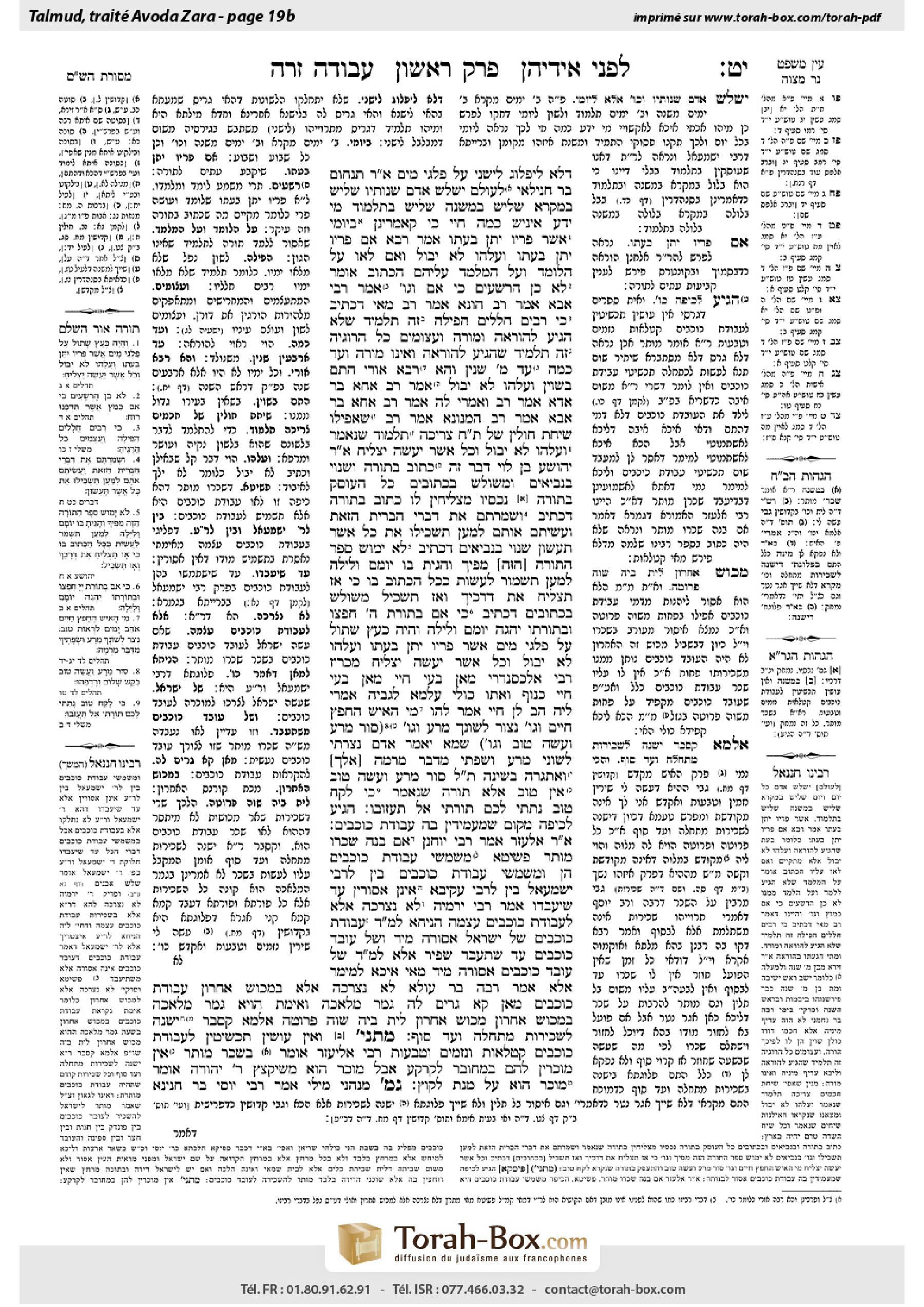
Avodah Zarah 19b: Talmud study for Daf Yomi
Study the Talmud for Daf Yomi with scanned pages, Hebrew text, English translations from Sefaria and AI-generated French translations.
Passage selection and English or AI-generated French translation are available where the scan has annotations. Daf Study is independent of Torah-Box and Sefaria.
Browse Avodah Zarah · עבודה זרה · All tractatesAvodah Zarah 19b text and translations
This page of Avodah Zarah includes the Aramaic text, an English translation and an AI-generated French translation, alongside the scan above.
עבודה זרה י״ט ב · Aramaic and Hebrew text
דְּלָא לִיפַּלּוּג לִישָּׁנֵי. ״עַל פַּלְגֵי מַיִם״. אָמַר רַבִּי תַּנְחוּם בַּר חֲנִילַאי: לְעוֹלָם יְשַׁלֵּשׁ אָדָם שְׁנוֹתָיו — שְׁלִישׁ בַּמִּקְרָא, שְׁלִישׁ בַּמִּשְׁנָה, שְׁלִישׁ בַּתַּלְמוּד.
מִי יָדַע אִינִישׁ כַּמָּה חָיֵי? כִּי קָאָמְרִינַן — בְּיוֹמֵי.
״אֲשֶׁר פִּרְיוֹ יִתֵּן בְּעִתּוֹ״, אָמַר רָבָא: אִם ״פִּרְיוֹ יִתֵּן בְּעִתּוֹ״ — ״וְעָלֵהוּ לֹא יִבּוֹל״, וְאִם לָאו — עַל הַלּוֹמֵד וְעַל הַמְלַמֵּד עֲלֵיהֶם הַכָּתוּב אוֹמֵר: ״לֹא כֵן הָרְשָׁעִים כִּי אִם וְגוֹ׳״.
אָמַר רַבִּי אַבָּא אָמַר רַב הוּנָא אָמַר רַב, מַאי דִּכְתִיב: ״כִּי רַבִּים חֲלָלִים הִפִּילָה״ — זֶה תַּלְמִיד שֶׁלֹּא הִגִּיעַ לְהוֹרָאָה וּמוֹרֶה, ״וַעֲצֻמִים כׇּל הֲרוּגֶיהָ״ — זֶה תַּלְמִיד שֶׁהִגִּיעַ לְהוֹרָאָה וְאֵינוֹ מוֹרֶה.
וְעַד כַּמָּה? עַד אַרְבְּעִין שְׁנִין. וְהָא רָבָא אוֹרִי! הָתָם בְּשָׁוִין.
״וְעָלֵהוּ לֹא יִבּוֹל״, אָמַר רַב אַחָא בַּר אַדָּא אָמַר רַב, וְאָמְרִי לַהּ אָמַר רַב אַחָא בַּר אַבָּא אָמַר רַב הַמְנוּנָא אָמַר רַב: שֶׁאֲפִילּוּ שִׂיחַת חוּלִּין שֶׁל תַּלְמִידֵי חֲכָמִים צְרִיכָה תַּלְמוּד, שֶׁנֶּאֱמַר: ״וְעָלֵהוּ לֹא יִבּוֹל״.
״וְכֹל אֲשֶׁר יַעֲשֶׂה יַצְלִיחַ״, אָמַר רַבִּי יְהוֹשֻׁעַ בֶּן לֵוִי: דָּבָר זֶה כָּתוּב בַּתּוֹרָה, וְשָׁנוּי בַּנְּבִיאִים, וּמְשׁוּלָּשׁ בַּכְּתוּבִים — כׇּל הָעוֹסֵק בַּתּוֹרָה נְכָסָיו מַצְלִיחִין לוֹ. כָּתוּב בַּתּוֹרָה — דִּכְתִיב: ״וּשְׁמַרְתֶּם אֶת דִּבְרֵי הַבְּרִית הַזֹּאת וַעֲשִׂיתֶם אֹתָם לְמַעַן תַּשְׂכִּילוּ אֵת כׇּל אֲשֶׁר תַּעֲשׂוּן״.
שָׁנוּי בַּנְּבִיאִים — דִּכְתִיב: ״לֹא יָמוּשׁ סֵפֶר הַתּוֹרָה [הַזֶּה] מִפִּיךָ וְהָגִיתָ בּוֹ יוֹמָם וָלַיְלָה לְמַעַן תִּשְׁמֹר לַעֲשׂוֹת כְּכׇל הַכָּתוּב בּוֹ כִּי אָז תַּצְלִיחַ אֶת דְּרָכֶיךָ וְאָז תַּשְׂכִּיל״. מְשׁוּלָּשׁ בַּכְּתוּבִים — דִּכְתִיב: ״כִּי אִם בְּתוֹרַת ה׳ חֶפְצוֹ וּבְתוֹרָתוֹ יֶהְגֶּה יוֹמָם וָלָיְלָה וְהָיָה כְּעֵץ שָׁתוּל עַל פַּלְגֵי מָיִם אֲשֶׁר פִּרְיוֹ יִתֵּן בְּעִתּוֹ וְעָלֵהוּ לֹא יִבּוֹל וְכֹל אֲשֶׁר יַעֲשֶׂה יַצְלִיחַ״.
מַכְרִיז רַבִּי אֲלֶכְּסַנְדְּרִי: מַאן בָּעֵי חַיֵּי? מַאן בָּעֵי חַיֵּי? (כנוף) [אִיכְּנוּף] וַאֲתוֹ כּוּלֵּי עָלְמָא לְגַבֵּיהּ, אָמְרִי לֵיהּ: הַב לַן חַיֵּי! אֲמַר לְהוּ: ״מִי הָאִישׁ הֶחָפֵץ חַיִּים וְגוֹ׳ נְצֹר לְשׁוֹנְךָ מֵרָע וְגוֹ׳״.
״סוּר מֵרָע וַעֲשֵׂה טוֹב וְגוֹ׳״, שֶׁמָּא יֹאמַר: נָצַרְתִּי לְשׁוֹנִי מֵרָע וּשְׂפָתַי מִדַּבֵּר מִרְמָה, אֵלֵךְ וְאֶתְגָּרֶה בְּשֵׁינָה? תַּלְמוּד לוֹמַר: ״סוּר מֵרָע וַעֲשֵׂה טוֹב״, ואין ״טוֹב״ אֶלָּא תּוֹרָה, שֶׁנֶּאֱמַר: ״כִּי לֶקַח טוֹב נָתַתִּי לָכֶם תּוֹרָתִי אַל תַּעֲזֹבוּ״.
הִגִּיעַ לַכִּיפָּה מָקוֹם שֶׁמַּעֲמִידִין בָּהּ עֲבוֹדָה זָרָה. אָמַר רַבִּי אֶלְעָזָר אָמַר רַבִּי יוֹחָנָן: אִם בָּנָה — שְׂכָרוֹ מוּתָּר. פְּשִׁיטָא! מְשַׁמְּשֵׁי עֲבוֹדָה זָרָה הֵן, וּמְשַׁמְּשֵׁי עֲבוֹדָה זָרָה, בֵּין לְרַבִּי יִשְׁמָעֵאל בֵּין לְרַבִּי עֲקִיבָא, אֵינָן אֲסוּרִין עַד שִׁיעְבְּדוּ.
אָמַר רַבִּי יִרְמְיָה: לֹא נִצְרְכָה אֶלָּא לַעֲבוֹדָה זָרָה עַצְמָהּ. הָנִיחָא לְמַאן דְּאָמַר: עֲבוֹדָה זָרָה שֶׁל יִשְׂרָאֵל אֲסוּרָה מִיָּד, וְשֶׁל גּוֹי עַד שֶׁתֵּעָבֵד — שַׁפִּיר, אֶלָּא לְמַאן דְּאָמַר: שֶׁל גּוֹי אֲסוּרָה מִיָּד, מַאי אִיכָּא לְמֵימַר?
אֶלָּא אָמַר רַבָּה בַּר עוּלָּא: לֹא נִצְרְכָה אֶלָּא בְּמַכּוֹשׁ אַחֲרוֹן. עֲבוֹדָה זָרָה מַאן קָא גָרֵים לַהּ? גְּמַר מְלָאכָה, וְאֵימַת הָוְיָא גְּמַר מְלָאכָה? בְּמַכּוֹשׁ אַחֲרוֹן. מַכּוֹשׁ אַחֲרוֹן לֵית בֵּיהּ שָׁוֶה פְּרוּטָה.
אַלְמָא קָסָבַר, יֶשְׁנָהּ לִשְׂכִירוּת מִתְּחִלָּה וְעַד סוֹף.
מַתְנִי׳ וְאֵין עוֹשִׂין תַּכְשִׁיטִין לַעֲבוֹדָה זָרָה, קַטְלָאוֹת וּנְזָמִים וְטַבָּעוֹת. רַבִּי אֱלִיעֶזֶר אוֹמֵר: בְּשָׂכָר מוּתָּר. אֵין מוֹכְרִין לָהֶם בִּמְחוּבָּר לַקַּרְקַע, אֲבָל מוֹכֵר הוּא מִשֶּׁיִּקָּצֵץ. רַבִּי יְהוּדָה אוֹמֵר: מוֹכֵר הוּא עַל מְנָת לָקוֹץ.
גְּמָ׳ מְנָהָנֵי מִילֵּי? אָמַר רַבִּי יוֹסֵי בַּר חֲנִינָא:
Avodah Zarah 19b · English translation
he will not become confused by the different versions of the same statements he hears from each teacher, as he will have no clear authoritative version from one source. The Gemara continues discussing the verse cited above: “By streams [palgei] of water” (Psalms 1:3). Rabbi Tanḥum bar Ḥanilai says: Since the root peh, lamed, gimmel can also refer to dividing, the verse is interpreted as follows: A person should always divide his years into thirds, as follows: One third for Bible, one third for Mishna and one third for Talmud.
The Gemara asks: How can one divide his life this way? Does a person know the length of his life, that he can calculate how much a third will be? The Gemara answers: When we said that a one should divide his time into thirds, the intention was with regard to his days, i.e., he should devote one third of each day to Bible, Mishna, and Talmud, respectively.
The Gemara discusses the continuation of the verse cited above: “That brings forth its fruit in its season and whose leaf does not wither” (Psalms 1:3). Rava says: If one brings forth fruit in its season, i.e., if he acts in accordance with the precepts of Torah that he learns, then his leaf will not wither, as the Torah will sustain him. But if one does not learn with the intention that his studies should lead to action, then with regard to both the one who is taught and with regard to the one who teaches, the verse states about them: “Not so the wicked; but they are like the chaff that the wind drives away” (Psalms 1:4).
Rabbi Abba says that Rav Huna says that Rav says: What is the meaning of that which is written: “For she has cast down [hippila] many wounded and a mighty host are all her slain” (Proverbs 7:26)? This is referring to a student who has not yet reached the level where he can render legal decisions, but nevertheless he already issues decisions. He is like a fetus that emerged from the womb before its time, as the word hippila also means to miscarry. “And a mighty host are all her slain”; this is referring to a student who has reached the level where he can render legal decisions, referred to here as “a mighty host,” but he does not issue decisions, and by refraining from teaching what he knows prevents the masses from learning Torah properly.
And until when is a scholar considered too immature to render legal decisions? He is considered immature until the age of forty years. The Gemara asks: But didn’t Rava issue legal decisions before that age? The Gemara answers: There it is permitted, as in Rava’s case they are equal, i.e., if one has achieved a level of knowledge that is equivalent to that of the foremost scholar in his city, he is permitted to render decisions even before reaching the age of forty.
The Gemara cites another discussion with regard to the aforementioned verse: “And whose leaf does not wither” (Psalms 1:3). Rav Aḥa bar Adda says that Rav says, and some say that it was Rav Aḥa bar Abba who says that Rav Hamnuna says that Rav says: One should know that even the ordinary conversation of Torah scholars require analysis, as it is stated: “And whose leaf does not wither.” This teaches that even the ordinary conversation of a Torah scholar, which is comparable to the leaves of a tree, has great significance like the actual fruit of the tree.
The verse continues: “And in whatsoever he does he shall prosper.” Rabbi Yehoshua ben Levi says: This matter is written in the Torah, and repeated in the Prophets, and stated a third time in the Writings: Concerning anyone who engages in Torah study, his property dealings will be successful. It is written in the Torah, as it is written: “Observe therefore the words of this covenant, and do them, that you may make all that you do to prosper” (Deuteronomy 29:8).
It is repeated in the Prophets, as it is written: “This book of the Torah shall not depart out of your mouth, but you shall meditate on it day and night, that you may observe to do according to all that is written in it; for then you shall make your ways prosperous, and then you shall have good success” (Joshua 1:8). It is stated a third time in the Writings, as it is written: “But his delight is in the Torah of the Lord; and in His Torah he meditates day and night. And he shall be like a tree planted by streams of water, that brings forth its fruit in its season, and whose leaf does not wither; and in whatsoever he does he shall prosper” (Psalms 1:2–3).
The Gemara relates that Rabbi Alexandri would proclaim in public, in the manner of a merchant selling wares: Who desires life? Who desires life? Everyone gathered around him to buy from him, saying to him: Give us life! He stated the following verse to them: “Who is the man that desires life, and loves days, that he may see good in them? Keep your tongue from evil, and your lips from speaking guile” (Psalms 34:13–14).
The psalm continues: “Depart from evil, and do good; seek peace and pursue it” (Psalms 34:15). The Gemara explains: Lest one say: I have kept my tongue from evil and my lips from speaking guile, I will therefore go and indulge in sleep. To counter this possibility, the verse states: “Depart from evil, and do good,” i.e., it is not enough to avoid evil, but one must actively do good. And the word good means nothing other than Torah, as it is stated: “For I have given you a good portion; My Torah, do not abandon it” (Proverbs 4:2).
§ The mishna teaches: One may build with gentiles small platforms and bathhouses, but once he reaches the arched chamber in the bath where the gentiles put up objects of idol worship, it is prohibited for a Jew to continue building it. Rabbi Elazar says that Rabbi Yoḥanan says: If he did continue to build the arched chamber, his wages are permitted. The Gemara asks: Isn’t that obvious? After all, such arched chambers are only accessories of idol worship, and with regard to accessories of idol worship, both according to Rabbi Yishmael and according to Rabbi Akiva, who disagree with regard to deriving benefit from an actual object of idol worship (51b), deriving benefit from accessories of idol worship is not prohibited until they are worshipped.
Rabbi Yirmeya says: Rabbi Elazar’s statement is necessary only to permit the wages of a Jew who built an object of idol worship itself. The Gemara asks: This works out well according to the one who says that an object of idol worship of a Jew is forbidden immediately once it is built, but it is not prohibited to derive benefit from an object of idol worship of a gentile until it is actually worshipped. In this case the idol was built for a gentile, and therefore the laborer may receive payment for his work, as the idol was never worshipped. But according to the one who says that an object of idol worship of a gentile is also forbidden immediately, what can be said?
Rather, Rabba bar Ulla says: Rabbi Elazar’s statement that the worker’s wages are permitted is necessary only with regard to the final stroke with which the laborer completes his work. In the case of an object of idol worship, what causes it to be used for idol worship? It is the completion of labor, and when is the completion of labor achieved? It is achieved with the final stroke of the laborer. The final stroke alone does not have the value of one peruta, and therefore the wages he receives are due when each act of labor is performed during the entire process, not when the final stroke completes the work.
Evidently, Rabbi Elazar holds that the obligation to pay a wage is incurred continuously from the beginning of the period he was hired to its end, not merely upon completion of the work. Since the worker has rights to his wages at every stage of labor performed during the entire period of work, the wages are not considered a benefit that he receives from idol worship, as the object is classified as an object of idol worship only at the very end.
MISHNA: And one may not fashion jewelry for an object of idol worship, and this applies to jewelry such as necklaces [katla’ot], nose rings, and rings. Rabbi Eliezer says: If one fashions them in exchange for payment, it is permitted. The mishna returns to the issue of selling items to gentiles: One may not sell to a gentile any item that is attached to the ground, but one may sell such an item once it is severed from the ground. Rabbi Yehuda says: It is not necessary to sever the item from the ground; rather, one may sell it on the condition that it be severed.
GEMARA: The Gemara asks: From where is this matter, that it is prohibited to sell to a gentile anything that is attached to the ground, derived? Rabbi Yosei bar Ḥanina says:
Avodah Zarah 19b · Traduction française (IA)
il ne sera pas confus par les différentes versions des mêmes propos qu'il entend de chaque maître, car il n'aura pas de version autoritaire claire provenant d'une seule source. La Guemara continue de discuter du verset cité ci-dessus : « Par des rivières [palgei] d'eau » (Psaumes 1:3). Rabbi Tanḥum bar Ḥanilai dit : Puisque la racine peh, lamed, gimmel peut aussi signifier diviser, le verset est interprété ainsi : une personne devrait toujours diviser ses années en trois, comme suit : un tiers pour la Torah écrite, un tiers pour la Michna et un tiers pour le Talmud.
La Guemara demande : comment peut-on diviser ainsi sa vie ? Un homme sait-il la durée de sa vie, afin de calculer combien un tiers sera ? La Guemara répond : lorsque nous avons dit qu'une personne devrait diviser son temps en trois, l'intention était concernant ses jours, c'est-à-dire qu'il devrait consacrer un tiers de chaque jour à la Torah écrite, à la Michna et au Talmud, respectivement.
La Guemara discute de la continuation du verset cité ci-dessus : « Qui porte ses fruits à son temps et dont les feuilles ne s'effritent pas » (Psaumes 1:3). Rava dit : si l'on porte des fruits à leur temps, c'est-à-dire si l'on agit selon les préceptes de la Torah qu'on apprend, alors ses feuilles ne s'effritent pas, car la Torah le sustentera. Mais si l'on ne s'engage pas à apprendre avec l'intention que ses études mènent à l'action, alors concernant à la fois celui qui est enseigné et celui qui enseigne, le verset dit à leur sujet : « Non ainsi les méchants ; mais ils sont comme la paille que le vent emporte » (Psaumes 1:4).
Rabbi Abba dit que Rav Huna dit que Rav dit : quelle est la signification de ce qui est écrit : « Car elle a fait tomber [hippila] beaucoup de blessés et une armée puissante sont tous ses morts » (Proverbes 7:26) ? Cela fait référence à un étudiant qui n'a pas encore atteint le niveau où il peut rendre des décisions juridiques, mais qui émet déjà des décisions. Il est comme un fœtus qui est sorti du ventre avant l'heure, car le mot hippila signifie aussi avorter. « Et une armée puissante sont tous ses morts » ; cela fait référence à un étudiant qui a atteint le niveau où il peut rendre des décisions, désigné ici comme « une armée puissante », mais qui ne rend pas de décisions, et en évitant d'enseigner ce qu'il sait, il empêche les masses d'apprendre la Torah correctement.
Et jusqu'à quel âge un savant est-il considéré comme trop jeune pour rendre des décisions juridiques ? Il est considéré comme immature jusqu'à l'âge de quarante ans. La Guemara demande : mais n'a-t-il pas Rava rendu des décisions avant cet âge ? La Guemara répond : là, cela est permis, car dans le cas de Rava, ils sont égaux, c'est-à-dire si l'on a atteint un niveau de connaissance équivalent à celui du plus grand savant de sa ville, il est permis de rendre des décisions même avant d'atteindre l'âge de quarante ans.
La Guemara cite une autre discussion concernant le verset mentionné ci-dessus : « Et dont les feuilles ne s'effritent pas » (Psaumes 1:3). Rav Aḥa bar Adda dit que Rav dit, et certains disent que c'était Rav Aḥa bar Abba qui dit que Rav Hamnuna dit que Rav dit : on doit savoir que même la conversation ordinaire des savants de la Torah exige une analyse, comme il est dit : « Et dont les feuilles ne s'effritent pas ». Cela enseigne que même la conversation ordinaire d'un savant de la Torah, comparable aux feuilles d'un arbre, a une grande importance comme le fruit réel de l'arbre.
Le verset continue : « Et en ce qu'il fait, il prospère. » Rabbi Yehoshua ben Levi dit : cette affaire est écrite dans la Torah, répétée dans les Prophètes et déclarée une troisième fois dans les Ecritures : concernant toute personne qui s'engage dans l'étude de la Torah, ses affaires matérielles seront prospères. Il est écrit dans la Torah, comme il est écrit : « Observe donc les paroles de ce pacte, et fais-les, afin que tout ce que tu fais prospère » (Deutéronome 29:8).
Il est répété dans les Prophètes, comme il est écrit : « Ce livre de la Torah ne doit pas sortir de ta bouche, mais tu dois méditer dessus jour et nuit, afin que tu accomplisses tout ce qui est écrit en lui ; car alors tes voies prospéreront, et alors tu auras une bonne réussite » (Josué 1:8). Il est déclaré une troisième fois dans les Ecritures, comme il est écrit : « Mais son délice est dans la Torah du Seigneur ; et dans Sa Torah il médite jour et nuit. Et il sera comme un arbre planté près des rivières d'eau, qui porte ses fruits à son temps, et dont les feuilles ne s'effritent pas ; et en ce qu'il fait, il prospère » (Psaumes 1:2–3).
La Guemara rapporte que Rabbi Alexandri proclamait en public, dans le style d'un marchand vendant des marchandises : Qui désire la vie ? Qui désire la vie ? Tout le monde s'assembla autour de lui pour acheter de lui, disant à lui : Donnez-nous la vie ! Il cita le verset suivant à leur sujet : « Qui est l'homme qui désire la vie, et aime les jours, afin de voir le bien en eux ? Garde ta langue de l'evil, et tes lèvres de parler de tromperie » (Psaumes 34:13–14).
Le psaume continue : « Éloigne-toi du mal, et fais le bien ; cherche la paix et poursuis-la » (Psaumes 34:15). La Guemara explique : afin que l'on ne dise pas : J'ai gardé ma langue du mal et mes lèvres de parler de tromperie, je vais donc me reposer en sommeil. Pour contrebalancer cette possibilité, le verset dit : « Éloigne-toi du mal, et fais le bien », c'est-à-dire il n'est pas suffisant d'éviter le mal, mais l'on doit faire le bien. Et le mot « bien » ne signifie rien d'autre que la Torah, comme il est dit : « Car je t'ai donné une bonne portion ; Ma Torah, ne l'abandonne pas » (Proverbes 4:2).
§ La Michna enseigne : On peut construire avec des non-Juifs des petites plateformes et des bassins, mais une fois qu'on atteint la chambre voûtée dans le bassin où les non-Juifs posent des objets d'idolâtrie, il est interdit à un Juif de continuer la construction. Rabbi Eléazar dit que Rabbi Yochanan dit : Si l'on a continué à construire la chambre voûtée, ses salaires sont permis. La Guemara demande : N'est-ce pas évident ? En effet, ces chambres voûtées sont seulement des accessoires d'idolâtrie, et concernant les accessoires d'idolâtrie, à la fois selon Rabbi Yishmael et selon Rabbi Akiva, qui s'opposent concernant l'acquisition d'avantage d'un objet d'idolâtrie réel (51b), l'acquisition d'avantage d'accessoires d'idolâtrie n'est pas interdite jusqu'à ce qu'ils soient adorés.
Rabbi Yirmeyah dit : L'affirmation de Rabbi Eléazar est nécessaire uniquement pour permettre les salaires d'un Juif qui a construit un objet d'idolâtrie lui-même. La Guemara demande : Cela s'explique bien selon celui qui dit qu'un objet d'idolâtrie d'un Juif est interdit immédiatement une fois qu'il est construit, mais il n'est pas interdit d'acquérir un avantage d'un objet d'idolâtrie d'un non-Juif jusqu'à ce qu'il soit effectivement adoré. Dans ce cas, l'idole a été construite pour un non-Juif, et par conséquent le travailleur peut recevoir sa rémunération pour son travail, car l'idole n'a jamais été adorée. Mais selon celui qui dit qu'un objet d'idolâtrie d'un non-Juif est également interdit immédiatement, que peut-on dire ?
En réalité, Rabba bar Ulla dit : L'affirmation de Rabbi Eléazar selon laquelle les salaires du travailleur sont permis est nécessaire uniquement concernant le dernier geste avec lequel le travailleur termine son travail. Dans le cas d'un objet d'idolâtrie, qu'est-ce qui le rend utilisable pour l'idolâtrie ? C'est la fin du travail, et quand la fin du travail est accomplie ? C'est avec le dernier geste du travailleur. Ce dernier geste seul ne vaut pas un peruta, et par conséquent les salaires qu'il reçoit sont dus à chaque acte de travail effectué tout au long du processus, et non lorsque le dernier geste termine le travail.
Évidemment, Rabbi Eléazar considère que l'obligation de payer un salaire s'acquiert continuellement depuis le début de la période où il a été embauché jusqu'à la fin, et non seulement à la fin du travail. Puisque le travailleur a des droits sur ses salaires à chaque étape du travail effectué durant toute la période de travail, les salaires ne sont pas considérés comme un avantage qu'il reçoit de l'idolâtrie, car l'objet est classé comme un objet d'idolâtrie uniquement à la fin.
MICHNA : On ne doit pas fabriquer de bijoux pour un objet d'idolâtrie, et cela s'applique aux bijoux tels que des colliers [katla’ot], des boucles d'oreilles et des bagues. Rabbi Eléazar dit : Si l'on les fabrique en échange d'une rémunération, cela est permis. La Michna revient sur la question de la vente d'objets aux non-Juifs : On ne doit pas vendre à un non-Juif tout objet attaché au sol, mais on peut vendre cet objet une fois qu'il a été détaché du sol. Rabbi Yéhuda dit : Il n'est pas nécessaire de détacher l'objet du sol ; plutôt, on peut le vendre sous la condition qu'il soit détaché.
GUEMARA : La Guemara pose la question : D'où tire-t-on cette loi, selon laquelle il est interdit de vendre à un non-Juif tout objet attaché au sol ? Rabbi Yosei bar Ḥanina dit :
Traduction française générée par IA à partir de l’édition anglaise de Sefaria. Vérifie toujours un passage avec le texte source.
Text from Sefaria: William Davidson Edition - Vocalized Aramaic (CC BY NC); William Davidson Edition - English (CC BY NC).