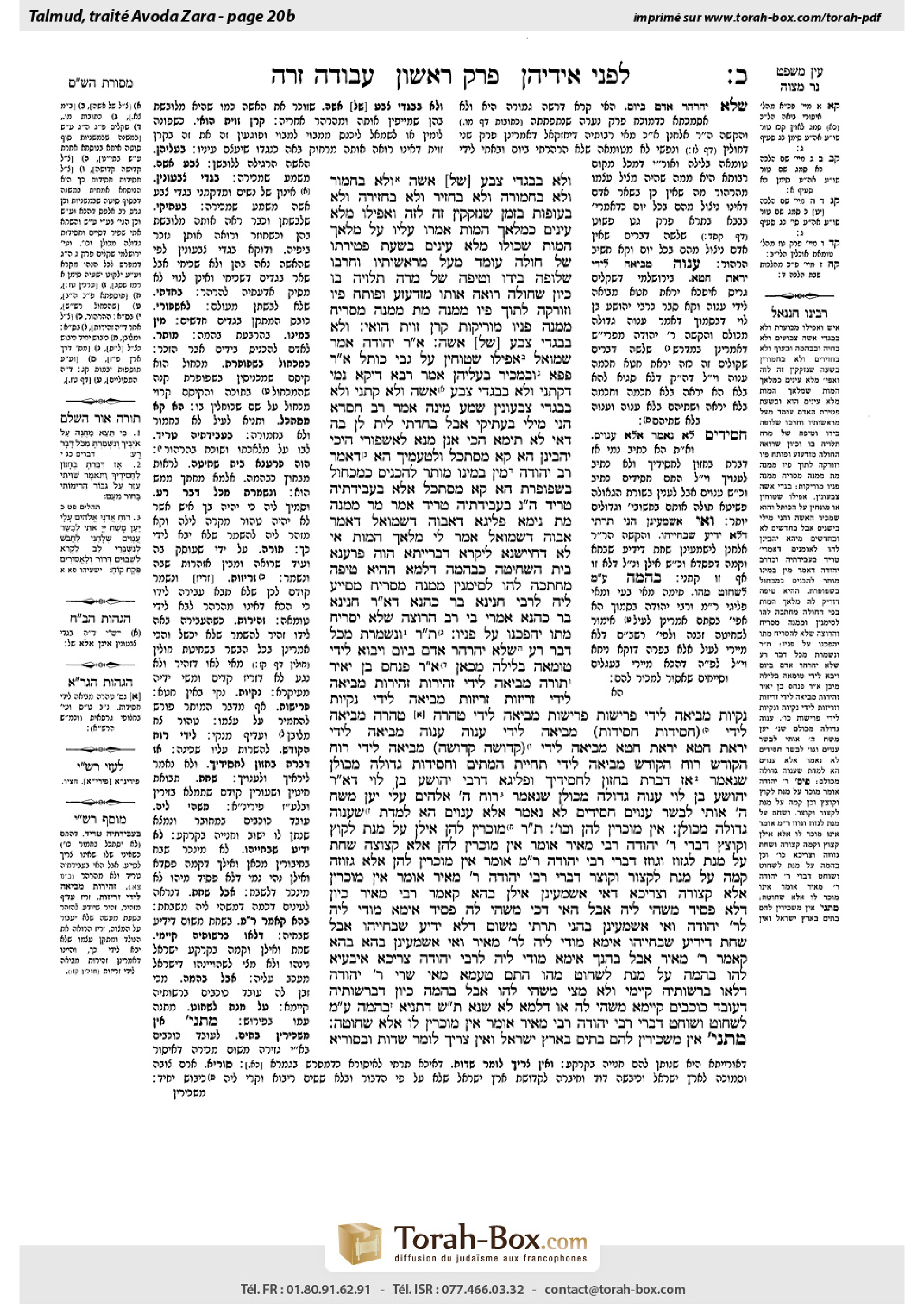
Avodah Zarah 20b: Talmud study for Daf Yomi
Study the Talmud for Daf Yomi with scanned pages, Hebrew text, English translations from Sefaria and AI-generated French translations.
Passage selection and English or AI-generated French translation are available where the scan has annotations. Daf Study is independent of Torah-Box and Sefaria.
Browse Avodah Zarah · עבודה זרה · All tractatesAvodah Zarah 20b text and translations
This page of Avodah Zarah includes the Aramaic text, an English translation and an AI-generated French translation, alongside the scan above.
עבודה זרה כ׳ ב · Aramaic and Hebrew text
וְלֹא בְּבִגְדֵי צֶבַע [שֶׁל] אִשָּׁה, וְלֹא בַּחֲמוֹר וְלֹא בַּחֲמוֹרָה, וְלֹא בַּחֲזִיר וְלֹא בַּחֲזִירָה, וְלֹא בְּעוֹפוֹת בִּזְמַן שֶׁנִּזְקָקִין זֶה לָזֶה, וַאֲפִילּוּ מָלֵא עֵינַיִם כְּמַלְאַךְ הַמָּוֶת.
אָמְרוּ עָלָיו עַל מַלְאַךְ הַמָּוֶת, שֶׁכּוּלּוֹ מָלֵא עֵינַיִם, בִּשְׁעַת פְּטִירָתוֹ שֶׁל חוֹלֶה עוֹמֵד מֵעַל מְרַאֲשׁוֹתָיו, וְחַרְבּוֹ שְׁלוּפָה בְּיָדוֹ, וְטִיפָּה שֶׁל מָרָה תְּלוּיָה בּוֹ, כֵּיוָן שֶׁחוֹלֶה רוֹאֶה אוֹתוֹ מִזְדַּעְזֵעַ וּפוֹתֵחַ פִּיו, וְזוֹרְקָהּ לְתוֹךְ פִּיו, מִמֶּנָּה מֵת, מִמֶּנָּה מַסְרִיחַ, מִמֶּנָּה פָּנָיו מוֹרִיקוֹת!
קֶרֶן זָוִית הֲוַאי.
וְלֹא בְּבִגְדֵי צֶבַע [שֶׁל] אִשָּׁה. אָמַר רַב יְהוּדָה אָמַר שְׁמוּאֵל: אֲפִילּוּ שְׁטוּחִין עַל גַּבֵּי כּוֹתֶל. אָמַר רַב פָּפָּא: וּבְמַכִּיר בַּעֲלֵיהֶן. אָמַר רָבָא: דַּיְקָא נָמֵי, דְּקָתָנֵי ״וְלֹא בְּבִגְדֵי צֶבַע אִשָּׁה״, וְלָא קָתָנֵי ״וְלֹא בְּבִגְדֵי צִבְעוֹנִין״, שְׁמַע מִינַּהּ.
אָמַר רַב חִסְדָּא: הָנֵי מִילֵּי בְּעַתִּיקֵי, אֲבָל בְּחַדְתֵי לֵית לַן בַּהּ, דְּאִי לָא תֵּימָא הָכִי, אֲנַן מָנָא לְאַשְׁפּוֹרֵי הֵיכִי יָהֲבִינַן? הָא קָא מִסְתַּכֵּל!
וּלְטַעְמָיךְ, הָא דְּאָמַר רַב יְהוּדָה: מִין בְּמִינוֹ מוּתָּר לְהַכְנִיס כְּמִכְחוֹל בִּשְׁפוֹפֶרֶת, הָא קָא מִסְתַּכַּל! אֶלָּא בַּעֲבִידְתֵּיהּ טְרִיד, הָכִי נָמֵי בַּעֲבִידְתֵּיהּ טְרִיד.
אָמַר מָר: מִמֶּנָּה מֵת. נֵימָא פְּלִיגָא דַּאֲבוּהּ דִּשְׁמוּאֵל, דְּאָמַר אֲבוּהּ דִּשְׁמוּאֵל: אָמַר לִי מַלְאַךְ הַמָּוֶת ״אִי לָא דְּחָיֵישְׁנָא לִיקָרָא דִּבְרִיָּיתָא, הֲוָה פָּרַעְנָא בֵּית הַשְּׁחִיטָה כִּבְהֵמָה״. דִּלְמָא הָהִיא טִיפָּה מְחַתְּכָה לְהוּ לְסִימָנִין.
מִמֶּנָּה מַסְרִיחַ. מְסַיַּיע לֵיהּ לְרַבִּי חֲנִינָא בַּר כָּהֲנָא, דְּאָמַר רַבִּי חֲנִינָא בַּר כָּהֲנָא: אָמְרִי בֵּי רַב: הָרוֹצֶה שֶׁלֹּא יַסְרִיחַ מֵתוֹ, יְהַפְּכֶנּוּ עַל פָּנָיו.
תָּנוּ רַבָּנַן: ״וְנִשְׁמַרְתָּ מִכֹּל דָּבָר רָע״, שֶׁלֹּא יְהַרְהֵר אָדָם בַּיּוֹם וְיָבוֹא לִידֵי טוּמְאָה בַּלַּיְלָה.
מִכָּאן אָמַר רַבִּי פִּנְחָס בֶּן יָאִיר: תּוֹרָה מְבִיאָה לִידֵי זְהִירוּת, זְהִירוּת מְבִיאָה לִידֵי זְרִיזוּת, זְרִיזוּת מְבִיאָה לִידֵי נְקִיּוּת, נְקִיּוּת מְבִיאָה לִידֵי פְּרִישׁוּת, פְּרִישׁוּת מְבִיאָה לִידֵי טׇהֳרָה, טׇהֳרָה מְבִיאָה לִידֵי חֲסִידוּת, חֲסִידוּת מְבִיאָה לִידֵי עֲנָוָה, עֲנָוָה מְבִיאָה לִידֵי יִרְאַת חֵטְא, יִרְאַת חֵטְא מְבִיאָה לִידֵי קְדוּשָּׁה, קְדוּשָּׁה מְבִיאָה לִידֵי רוּחַ הַקּוֹדֶשׁ, רוּחַ הַקּוֹדֶשׁ מְבִיאָה לִידֵי תְּחִיַּית הַמֵּתִים, וַחֲסִידוּת גְּדוֹלָה מִכּוּלָּן, שֶׁנֶּאֱמַר: ״אָז דִּבַּרְתָּ בְחָזוֹן לַחֲסִידֶיךָ״.
וּפְלִיגָא דְּרַבִּי יְהוֹשֻׁעַ בֶּן לֵוִי, דְּאָמַר רַבִּי יְהוֹשֻׁעַ בֶּן לֵוִי: עֲנָוָה גְּדוֹלָה מִכּוּלָּן, שֶׁנֶּאֱמַר: ״רוּחַ ה׳ אֱלֹהִים עָלָי יַעַן מָשַׁח ה׳ אֹתִי לְבַשֵּׂר עֲנָוִים״, ״חֲסִידִים״ לֹא נֶאֱמַר אֶלָּא ״עֲנָוִים״, הָא לָמַדְתָּ שֶׁעֲנָוָה גְּדוֹלָה מִכּוּלָּן.
אֵין מוֹכְרִין לָהֶן וְכוּ׳. תָּנוּ רַבָּנַן: מוֹכְרִין לָהֶן אִילָן עַל מְנָת לָקוֹץ וְקוֹצֵץ, דִּבְרֵי רַבִּי יְהוּדָה. רַבִּי מֵאִיר אוֹמֵר: אֵין מוֹכְרִין לָהֶן אֶלָּא קְצוּצָה. שַׁחַת עַל מְנָת לִגְזוֹז וְגוֹזֵז, דִּבְרֵי רַבִּי יְהוּדָה. רַבִּי מֵאִיר אוֹמֵר: אֵין מוֹכְרִין לָהֶן אֶלָּא גְּזוּזָה. קָמָה עַל מְנָת לִקְצוֹר וְקוֹצֵר, דִּבְרֵי רַבִּי יְהוּדָה. רַבִּי מֵאִיר אוֹמֵר: אֵין מוֹכְרִין אֶלָּא קְצוּרָה.
וּצְרִיכָא, דְּאִי אַשְׁמְעִינַן אִילָן, בְּהָא קָאָמַר רַבִּי מֵאִיר, כֵּיוָן דְּלָא פָּסֵיד מְשַׁהֵי לֵיהּ, אֲבָל הַאי דְּכִי מְשַׁהֵי לֵהּ פָּסֵיד, אֵימָא מוֹדֵי לֵיהּ לְרַבִּי יְהוּדָה.
וְאִי אַשְׁמְעִינַן בְּהָנֵי תַּרְתֵּי, מִשּׁוּם דְּלָא יְדִיעַ שְׁבָחַיְיהוּ, אֲבָל שַׁחַת דִּידִיעַ שְׁבָחַיְיהוּ — אֵימָא מוֹדֵי לֵיהּ לְרַבִּי מֵאִיר.
וְאִי אַשְׁמְעִינַן בְּהָא, בְּהָא קָאָמַר רַבִּי מֵאִיר, אֲבָל בְּהָנָךְ אֵימָא מוֹדֵי לֵיהּ לְרַבִּי יְהוּדָה, צְרִיכָא.
אִיבַּעְיָא לְהוּ: בְּהֵמָה עַל מְנָת לִשְׁחוֹט, מַהוּ?
הָתָם טַעְמָא מַאי שָׁרֵי רַבִּי יְהוּדָה? דְּלָאו בִּרְשׁוּתֵיהּ קָיְימִי וְלָא מָצֵי מְשַׁהֵי לְהוּ, אֲבָל בְּהֵמָה, כֵּיוָן דְּבִרְשׁוּתֵיהּ דְּגוֹי קָיְימָא, מְשַׁהֵי לָהּ, אוֹ דִלְמָא לָא שְׁנָא?
תָּא שְׁמַע, דְּתַנְיָא: בְּהֵמָה עַל מְנָת לִשְׁחוֹט וְשׁוֹחֵט, דִּבְרֵי רַבִּי יְהוּדָה. רַבִּי מֵאִיר אוֹמֵר: אֵין מוֹכְרִין לוֹ אֶלָּא שְׁחוּטָה.
מַתְנִי׳ אֵין מַשְׂכִּירִין לָהֶם בָּתִּים בְּאֶרֶץ יִשְׂרָאֵל, וְאֵין צָרִיךְ לוֹמַר שָׂדוֹת, וּבְסוּרְיָא
Avodah Zarah 20b · English translation
and a person should not gaze upon the colored garments of a woman; and a person should not gaze at a male donkey, at a female donkey, at a pig, at a sow, or at fowl, when they are mating; and even if one were full of eyes like the Angel of Death and saw from every direction, it is not permitted to look.
They said about the Angel of Death that he is entirely full of eyes. When a sick person is about to die, the Angel of Death stands above his head, with his sword drawn in his hand, and a drop of poison hanging on the edge of the sword. Once the sick person sees him, he trembles and thereby opens his mouth; and the Angel of Death throws the drop of poison into his mouth. From this drop of poison the sick person dies, from it he putrefies, from it his face becomes green.
The Gemara answers: Rabban Gamliel did not intentionally look at the woman; rather, he was walking around a corner and he saw her unexpectedly as they each turned.
With regard to the statement in the baraita: Nor may one gaze at the colored garments of a woman, Rav Yehuda says that Shmuel says: This is the halakha even if they are spread on a wall, not only when they are being worn. Rav Pappa says: And the prohibition applies only when one knows their owner. Rava said: The language of the baraita is also precise, as it teaches: Nor may one gaze at the colored garments of a woman, and it does not teach: Nor may one gaze at colored garments. Learn from it that the prohibition applies only to the garments of one he knows.
Rav Ḥisda said: That statement applies only in the case of old garments, i.e., garments that have been worn; but in the case of new garments, we have no problem with it. The reason is that if you do not say so, how can we give a woman’s garment before it is worn to a launderer, i.e., one who prepares new garments for use, knowing that the launderer must look at the garments?
The Gemara refutes this proof: But according to your reasoning, i.e., your assumption that a launderer is no different from all other men, there is a similar difficulty with that which Rav Yehuda says: If one wishes to mate an animal of one species with an animal of its own species, it is permitted to insert the male organ into the female like a brush into a tube. One could ask here as well: But isn’t he looking at the animals as they mate? Rather, he is occupied with his work, and therefore his mind will not entertain sinful thoughts. So too with regard to a launderer, he is occupied with his work, and therefore a launderer differs from other men.
§ The Master said above in the baraita: From this drop of poison on the Angel of Death’s sword, the sick person dies. The Gemara asks: Shall we say that this opinion disagrees with a statement of Shmuel’s father? As Shmuel’s father says: The Angel of Death said to me: Were I not concerned for human dignity, I would uncover the place of the incision of the slaughter, as one does to an animal that is slaughtered. This indicates that the Angel of Death kills by slaughtering his victims with his sword, not by poisoning them. The Gemara answers: Perhaps that drop of poison cuts the two organs that must be severed in ritual slaughter, i.e., the trachea and the esophagus, and thereby slaughters people.
The Gemara notes that the continuation of the baraita, which states that from this drop of poison a corpse putrefies, supports the opinion of Rabbi Ḥanina bar Kahana. As Rabbi Ḥanina bar Kahana says that they say in the school of Rav: One who wishes that his dead relative will not putrefy should turn it on its face immediately, as the drop of poison enters through the mouth, and this causes the putrefaction of the corpse.
§ The Gemara cites another source that interprets the verse cited above. The Sages taught a baraita explaining the verse: “And you shall keep yourself from every evil thing” (Deuteronomy 23:10), which is immediately followed by the verse: “If there be among you any man who is not ritually pure by reason of that which happened to him by night” (Deuteronomy 23:11). This teaches that a person should not think impure thoughts by day and thereby come to the impurity of an emission by night.
From here Rabbi Pineḥas ben Ya’ir would say: Torah study leads to care in the performance of mitzvot. Care in the performance of mitzvot leads to diligence in their observance. Diligence leads to cleanliness of the soul. Cleanliness of the soul leads to abstention from all evil. Abstention from evil leads to purity and the elimination of all base desires. Purity leads to piety. Piety leads to humility. Humility leads to fear of sin. Fear of sin leads to holiness. Holiness leads to the Divine Spirit. The Divine Spirit leads to the resurrection of the dead. And piety is greater than all of them, as it is stated: “Then You did speak in a vision to Your pious ones” (Psalms 89:20).
And this statement disagrees with the opinion of Rabbi Yehoshua ben Levi, as Rabbi Yehoshua ben Levi says: Humility is greater than all of them, as it is stated: “The spirit of the Lord God is upon me; because the Lord has anointed me to bring good tidings to the humble” (Isaiah 61:1). Since the pious is not stated, but rather “the humble,” you learn that humility is greater than all of them.
§ The mishna teaches that one may not sell to a gentile any item that is attached to the ground. The Sages taught: One may sell to them a tree on the condition that he cut it down, and the buyer cuts it down; this is the statement of Rabbi Yehuda. Rabbi Meir says: One may sell to them only a tree that has actually been cut down. Similarly, one may sell to them fodder, i.e., produce that has grown stalks but is not yet ripe, on the condition to cut it down, and he cuts it down; this is the statement of Rabbi Yehuda. Rabbi Meir says: One may sell to them only fodder that has been cut down. So too, one may sell to them standing grain on the condition to harvest it, and he harvests it; this is the statement of Rabbi Yehuda. Rabbi Meir says: One may sell to them only harvested grain.
The Gemara comments: And it is necessary to state the halakha in each of these different scenarios. As, had the baraita taught us the dispute only with regard to a tree, I might have said that it is only in that case that Rabbi Meir says it must be cut down before being sold. The reason is that since the gentile does not lose out by keeping the tree in the soil, he might keep it in the ground. But in this case of standing grain, since if he keeps it in the ground he will lose out, one might say that Rabbi Meir concedes to Rabbi Yehuda that it may be sold before being harvested, on the condition that the gentile will harvest it, because the gentile would not leave the grain in the soil to spoil.
And had the baraita taught us only these two halakhot, one might have said that Rabbi Yehuda permits selling these items on the condition that they be cut down because the improvement to the tree or grain is not recognizable when it is left in the ground. But in the case of fodder, whose improvement is recognizable, as it would continue to grow and ripen if left in the ground, one might say that Rabbi Yehuda concedes to Rabbi Meir that we are concerned that the gentile will not cut down the fodder, and therefore one may sell it only once it has been cut down.
And furthermore, had the baraita taught us only the dispute in this case of fodder, one might have said that it is merely in this case that Rabbi Meir says it must be cut down before being sold, but with regard to those cases of a tree or standing grain, one might say that he concedes to Rabbi Yehuda that one may sell these items before they are harvested on the condition that the gentile will harvest them, as there is no recognizable improvement to them if they are left in the ground. Consequently, it is necessary for the dispute to be stated in all three cases.
A dilemma was raised before the Sages: With regard to the sale of large livestock, which is forbidden due to the concern that the gentile might use them to perform labor (see 14b), if such livestock are sold on the condition that the gentile will slaughter them, what is the halakha?
The Gemara explains the aspects of the dilemma: There, in the mishna, what is the reason that Rabbi Yehuda permits the sale of a tree on the condition that the gentile will cut it down? Is the reason that the trees are not in the gentile’s domain and therefore he is not able to keep them, as the Jew will force him to cut them down? But in the case of large livestock, since the animal stands in the domain of the gentile once it is sold, there is a concern that he might keep it and not slaughter it. Or perhaps there is no difference between the cases, and Rabbi Yehuda would permit one to sell even large livestock to a gentile, on the condition that he will slaughter the animals.
The Gemara suggests a resolution: Come and hear, as it is taught in a baraita: One may sell large livestock to a gentile on the condition that he slaughter it, and he slaughters it; this is the statement of Rabbi Yehuda. Rabbi Meir says: One may sell to a gentile only a slaughtered animal.
MISHNA: One may not rent a house to a gentile in Eretz Yisrael, and needless to say one may not rent fields to them, as explained in the Gemara. And in Syria
Avodah Zarah 20b · Traduction française (IA)
et une personne ne doit pas regarder les vêtements colorés d'une femme ; et une personne ne doit pas regarder un âne mâle, une âne femelle, un porc, une truie ou des oiseaux lorsqu'ils s'accouplent ; et même si l'on avait des yeux comme l'Ange de la Mort et qu'on voyait de toutes parts, il n'est pas permis de regarder.
On a dit à propos de l'Ange de la Mort qu'il est entièrement rempli d'yeux. Lorsqu'une personne malade est sur le point de mourir, l'Ange de la Mort se tient au-dessus de sa tête, avec son épée brandie, et une goutte de poison suspendue à l'extrémité de l'épée. Lorsque la personne malade le voit, elle tremble et ouvre ainsi la bouche ; l'Ange de la Mort jette la goutte de poison dans sa bouche. De cette goutte de poison la personne malade meurt, se putréfie et son visage devient vert.
La Guemara répond : Rabban Gamliel n'a pas regardé intentionnellement la femme ; plutôt, il marchait autour d'un coin et l'a surprise en même temps qu'elle tournait.
En ce qui concerne l'affirmation de la baraïta : On ne doit pas non plus regarder les vêtements colorés d'une femme, Rav Yehuda dit que Shmuel dit : Cette halakha s'applique même si les vêtements sont accrochés au mur, pas seulement lorsqu'ils sont portés. Rav Pappa dit : Et la prohibition s'applique uniquement lorsqu'on connaît l'owner. Rava dit : La formulation de la baraïta est aussi précise, car elle enseigne : On ne doit pas non plus regarder les vêtements colorés d'une femme, et elle ne dit pas : On ne doit pas non plus regarder des vêtements colorés. Apprenez-en que la prohibition s'applique uniquement aux vêtements dont on connaît l'owner.
Rav Ḥisda dit : Cette affirmation s'applique uniquement aux vêtements usagés, c'est-à-dire aux vêtements portés ; mais dans le cas des vêtements neufs, il n'y a pas de problème. La raison est que si l'on ne disait pas cela, comment pourrait-on donner les vêtements d'une femme, avant qu'ils ne soient usagés, à un lavandier, c'est-à-dire à celui qui prépare des vêtements neufs à l'usage, sachant que le lavandier doit regarder les vêtements ?
La Guemara réfute cette preuve : Mais selon votre raisonnement, c'est-à-dire selon votre hypothèse que le lavandier n'est pas différent des autres hommes, il y a une difficulté similaire avec ce que Rav Yehuda dit : Si l'on veut accoupler un animal d'une espèce avec un animal de la même espèce, il est permis d'insérer l'organe masculin dans l'organe féminin comme un pinceau dans un tube. On pourrait poser la même question ici aussi : Mais n'est-ce pas qu'il regarde les animaux lorsqu'ils s'accouplent ? Plutôt, il est occupé par son travail, et par conséquent son esprit ne nourrit pas de pensées criminelles. De même, concernant le lavandier, il est occupé par son travail, et par conséquent le lavandier diffère des autres hommes.
§ Le Maître a dit ci-dessus dans la baraïta : De cette goutte de poison sur l'épée de l'Ange de la Mort, la personne malade meurt. La Guemara pose la question : Devons-nous dire que cet avis s'oppose à une déclaration de Shmuel père ? Comme Shmuel père dit : L'Ange de la Mort m'a dit : Si je n'étais pas préoccupé par la dignité humaine, je dévoilerais la place de la section de l'abattage, comme l'on fait avec un animal abattu. Cela indique que l'Ange de la Mort tue en abattant ses victimes avec son épée, pas en les empoisonnant. La Guemara répond : Peut-être que cette goutte de poison coupe les deux organes qui doivent être séparés dans l'abattage rituel, c'est-à-dire la trachée et l'œsophage, et par conséquent tue les gens.
La Guemara note que la continuation de la baraïta, qui affirme que de cette goutte de poison le corps putréfié, soutient l'opinion de Rabbi Ḥanina bar Kahana. Comme Rabbi Ḥanina bar Kahana dit que l'on dit dans l'école de Rav : Celui qui veut que son proche décédé ne putréfie pas doit le tourner sur le visage immédiatement, car la goutte de poison entre par la bouche et provoque la putréfaction du corps.
§ La Guemara cite une autre source qui interprète le verset cité ci-dessus. Les Sages enseignent une baraïta expliquant le verset : « Et tu te garderas de toute chose mauvaise » (Deutéronome 23:10), qui est immédiatement suivi du verset : « Si parmi vous il y a un homme qui n'est pas rituellement pur à cause de ce qui s'est produit à lui la nuit » (Deutéronome 23:11). Cela enseigne que l'on ne doit pas penser à des choses impures pendant la journée et ainsi arriver à l'impureté d'une émission la nuit.
De là, Rabbi Pineḥas ben Ya’ir dit : L'étude de la Torah conduit à la diligence dans l'accomplissement des mitsvot. La diligence dans l'accomplissement des mitsvot conduit à la rigueur dans leur observation. La rigueur conduit à la pureté de l'âme. La pureté de l'âme conduit à l'abstention de tout mal. L'abstention du mal conduit à la pureté et à l'élimination de toutes les désirs bas. La pureté conduit à la piété. La piété conduit à la humilité. La humilité conduit à la crainte du péché. La crainte du péché conduit à la sainteté. La sainteté conduit à l'Esprit Divin. L'Esprit Divin conduit à la résurrection des morts. Et la piété est supérieure à toutes ces choses, comme il est dit : « Puis Vous avez parlé en vision à vos justes » (Psaumes 89:20).
Et cette affirmation s'oppose à l'opinion de Rabbi Yehoshua ben Levi, comme Rabbi Yehoshua ben Levi dit : La humilité est supérieure à toutes ces choses, comme il est dit : « L'esprit du Seigneur, l'Éternel, est sur moi, car l'Éternel m'a consacré pour annoncer de bonnes nouvelles aux humbles » (Yachout 61:1). Puisque le juste n'est pas mentionné, mais plutôt « les humbles », vous apprenez que la humilité est supérieure à toutes ces choses.
§ La Michna enseigne que l'on ne peut pas vendre à un non-Juif un objet attaché au sol. Les Sages enseignent : On peut vendre à eux un arbre à la condition qu'on le coupe et que l'acheteur le coupe ; c'est la déclaration de Rabbi Yéhuda. Rabbi Méir dit : On peut vendre à eux un arbre seulement s'il a déjà été coupé. De même, on peut vendre à eux du foin, c'est-à-dire des produits qui ont des tiges mais ne sont pas encore mûrs, à la condition qu'on le coupe et que l'acheteur le coupe ; c'est la déclaration de Rabbi Yéhuda. Rabbi Méir dit : On peut vendre à eux du foin seulement s'il a déjà été coupé. De même, on peut vendre à eux du blé en paille à la condition qu'on le récolle et que l'acheteur le récolle ; c'est la déclaration de Rabbi Yéhuda. Rabbi Méir dit : On peut vendre à eux du blé seulement s'il a déjà été récolté.
La Guemara commente : Il est nécessaire d'énoncer la halakha dans chaque cas différent. Car, si la baraïta nous avait appris le débat uniquement concernant un arbre, je pourrais avoir pensé que c'est seulement dans ce cas que Rabbi Méir dit qu'il faut le couper avant de le vendre. La raison est que puisque le non-Juif ne perd rien en laissant l'arbre dans le sol, il pourrait le laisser dans le sol. Mais dans le cas du blé en paille, puisque s'il le laisse dans le sol il perdra, on pourrait dire que Rabbi Méir reconnaît à Rabbi Yéhuda que l'on peut le vendre avant de le récolter à la condition que le non-Juif le récolle, car le non-Juif ne laisserait pas le blé dans le sol pour se gâter.
Et si la baraïta nous avait appris seulement ces deux halakhot, on aurait pu penser que Rabbi Yéhuda permet la vente de ces objets à la condition qu'ils soient coupés, car l'amélioration de l'arbre ou du blé n'est pas reconnaissable s'ils restent dans le sol. Mais dans le cas du foin, dont l'amélioration est reconnaissable, car il continue à grandir et à mûrir s'il reste dans le sol, on pourrait dire que Rabbi Yéhuda reconnaît à Rabbi Méir que nous sommes préoccupés par le fait que le non-Juif ne coupera pas le foin, et donc on peut le vendre seulement s'il a déjà été coupé.
Et de plus, si la baraïta nous avait appris seulement le débat dans ce cas de foin, on aurait pu penser que c'est seulement dans ce cas que Rabbi Méir dit qu'il faut le couper avant de le vendre, mais concernant les cas d'un arbre ou de blé en paille, on pourrait dire qu'il reconnaît à Rabbi Yéhuda que l'on peut vendre ces objets avant qu'ils ne soient récoltés à la condition que le non-Juif les récolte, car il n'y a pas d'amélioration reconnaissable s'ils restent dans le sol. Ainsi, il est nécessaire d'énoncer le débat dans les trois cas.
Un dilemme a été soulevé devant les Sages : Concernant la vente de grands animaux, qui est interdite en raison de la crainte que le non-Juif les utilise pour le travail (voir 14b), si ces animaux sont vendus à la condition que le non-Juif les abatte, quelle est la halakha ?
La Guemara explique les aspects du dilemme : Là, dans la Michna, quelle est la raison pour laquelle Rabbi Yéhuda permet la vente d'un arbre à la condition que le non-Juif le coupe ? Est-ce que la raison est que les arbres ne sont pas dans le domaine du non-Juif et donc il ne peut pas les garder, car le Juif le forcerait à les couper ? Mais dans le cas des grands animaux, puisque l'animal est dans le domaine du non-Juif une fois vendu, il y a une crainte qu'il le garde et ne l'abatte pas. Ou peut-être qu'il n'y a pas de différence entre les cas, et Rabbi Yéhuda permettrait de vendre même des grands animaux à un non-Juif à la condition qu'il les abatte.
La Guemara suggère une résolution : Viens écouter, car il est enseigné dans une baraïta : On peut vendre des grands animaux à un non-Juif à la condition qu'il les abatte, et qu'il les abatte ; c'est la déclaration de Rabbi Yéhuda. Rabbi Méir dit : On peut vendre à un non-Juif seulement un animal abattu.
MICHNA : On ne peut pas louer une maison à un non-Juif en Eretz Yisrael, et encore moins des champs à eux, comme expliqué dans la Guemara. Et en Syrie
Traduction française générée par IA à partir de l’édition anglaise de Sefaria. Vérifie toujours un passage avec le texte source.
Text from Sefaria: William Davidson Edition - Vocalized Aramaic (CC BY NC); William Davidson Edition - English (CC BY NC).