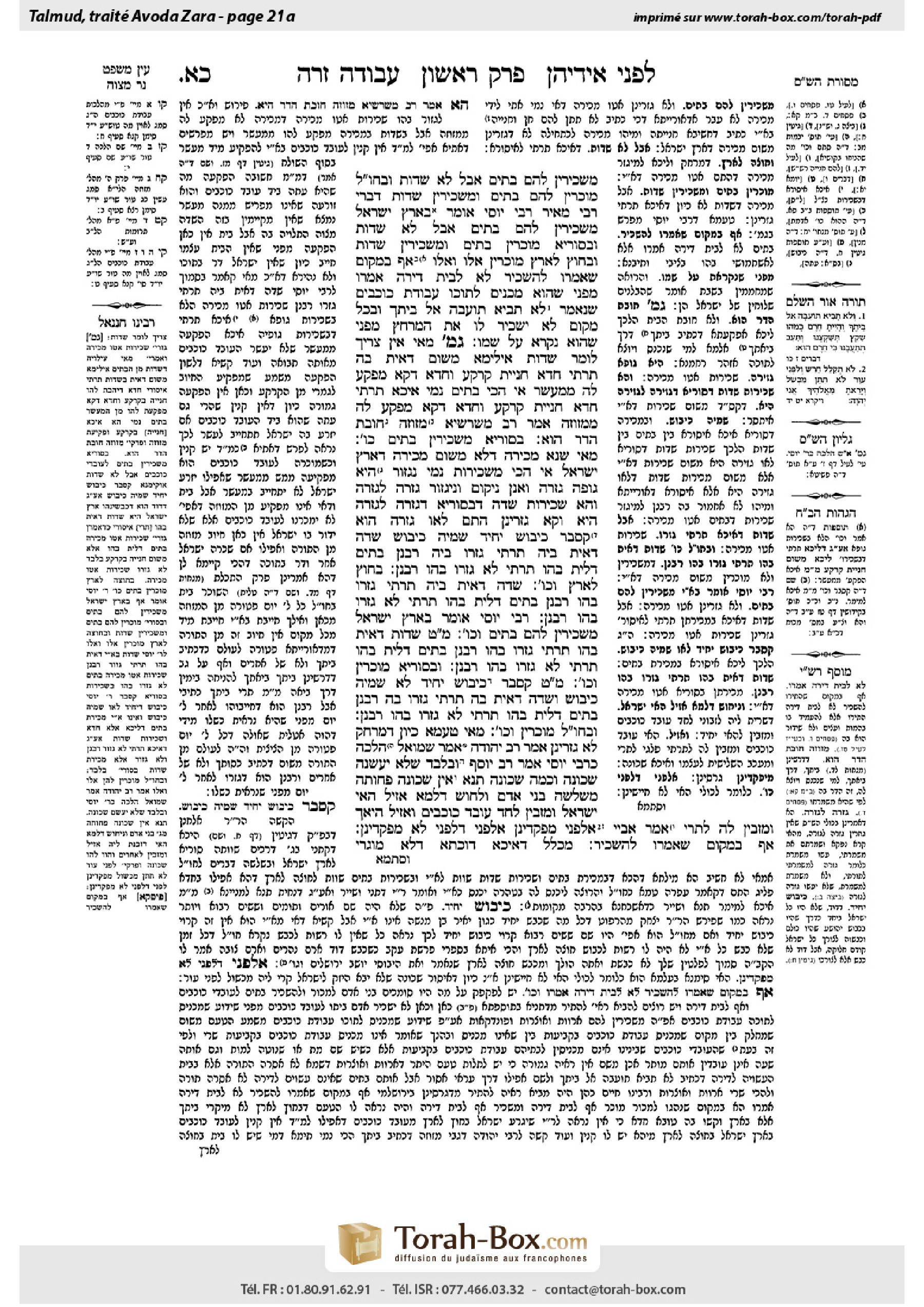
Avodah Zarah 21a: Talmud study for Daf Yomi
Study the Talmud for Daf Yomi with scanned pages, Hebrew text, English translations from Sefaria and AI-generated French translations.
Passage selection and English or AI-generated French translation are available where the scan has annotations. Daf Study is independent of Torah-Box and Sefaria.
Browse Avodah Zarah · עבודה זרה · All tractatesAvodah Zarah 21a text and translations
This page of Avodah Zarah includes the Aramaic text, an English translation and an AI-generated French translation, alongside the scan above.
עבודה זרה כ״א א · Aramaic and Hebrew text
מַשְׂכִּירִין לָהֶם בָּתִּים אֲבָל לֹא שָׂדוֹת, וּבְחוּצָה לָאָרֶץ מוֹכְרִין לָהֶם בָּתִּים וּמַשְׂכִּירִין שָׂדוֹת, דִּבְרֵי רַבִּי מֵאִיר. רַבִּי יוֹסֵי אוֹמֵר: בְּאֶרֶץ יִשְׂרָאֵל מַשְׂכִּירִין לָהֶם בָּתִּים אֲבָל לֹא שָׂדוֹת, וּבְסוּרְיָא מוֹכְרִין בָּתִּים וּמַשְׂכִּירִין שָׂדוֹת, וּבְחוּצָה לָאָרֶץ מוֹכְרִין אֵלּוּ וָאֵלּוּ.
אַף בְּמָקוֹם שֶׁאָמְרוּ לְהַשְׂכִּיר, לֹא לְבֵית דִּירָה אָמְרוּ, מִפְּנֵי שֶׁהוּא מַכְנִיס לְתוֹכוֹ עֲבוֹדָה זָרָה, שֶׁנֶּאֱמַר: ״לֹא תָבִיא תוֹעֵבָה אֶל בֵּיתֶךָ״, וּבְכׇל מָקוֹם לֹא יַשְׂכִּיר לוֹ אֶת הַמֶּרְחָץ, מִפְּנֵי שֶׁהוּא נִקְרָא עַל שְׁמוֹ.
גְּמָ׳ מַאי ״אֵין צָרִיךְ לוֹמַר שָׂדוֹת״? אִילֵּימָא מִשּׁוּם דְּאִית בַּהּ תַּרְתֵּי: חֲדָא, חֲנָיַית קַרְקַע; וַחֲדָא, דְּקָא מַפְקַע לַהּ מִמַּעֲשֵׂר.
אִי הָכִי, בָּתִּים נָמֵי אִיכָּא תַּרְתֵּי: חֲדָא, חֲנָיַית קַרְקַע; וַחֲדָא, דְּקָא מַפְקַע לַהּ מִמְּזוּזָה! אָמַר רַב מְשַׁרְשְׁיָא: מְזוּזָה חוֹבַת הַדָּר הוּא.
בְּסוּרְיָא מַשְׂכִּירִין בָּתִּים כּוּ׳. מַאי שְׁנָא מְכִירָה דְּלָא? מִשּׁוּם מְכִירָה דְּאֶרֶץ יִשְׂרָאֵל. אִי הָכִי, מִשְּׂכִירוּת נָמֵי נִגְזוֹר! הִיא גּוּפַהּ גְּזֵרָה, וַאֲנַן נֵיקוּם וְנִיגְזוֹר גְּזֵרָה לִגְזֵרָה?
וְהָא שְׂכִירוּת שָׂדֶה דִּבְסוּרְיָא, דִּגְזֵרָה לִגְזֵרָה הִיא, וְקָא גָזְרִינַן! הָתָם לָאו גְּזֵרָה הוּא, קָסָבַר: כִּיבּוּשׁ יָחִיד שְׁמֵיהּ כִּיבּוּשׁ.
שָׂדֶה דְּאִית בֵּיהּ תַּרְתֵּי — גְּזַרוּ בֵּיהּ רַבָּנַן, בָּתִּים דְּלֵית בְּהוּ תַּרְתֵּי — לָא גְּזַרוּ בְּהוּ רַבָּנַן.
בְּחוּצָה לָאָרֶץ וְכוּ׳. שָׂדֶה דְּאִית בֵּיהּ תַּרְתֵּי — גְּזַרוּ בְּהוּ רַבָּנַן, בָּתִּים דְּלֵית בְּהוּ תַּרְתֵּי — לָא גְּזַרוּ בְּהוּ רַבָּנַן.
רַבִּי יוֹסֵי אוֹמֵר: בְּאֶרֶץ יִשְׂרָאֵל מַשְׂכִּירִין לָהֶם בָּתִּים וְכוּ׳. מַאי טַעְמָא? שָׂדוֹת דְּאִית בְּהוּ תַּרְתֵּי — גְּזַרוּ בְּהוּ רַבָּנַן, בָּתִּים דְּלֵית בְּהוּ תַּרְתֵּי — לָא גְּזַרוּ בְּהוּ רַבָּנַן.
וּבְסוּרְיָא מוֹכְרִין וְכוּ׳. מַאי טַעְמָא? קָסָבַר: כִּיבּוּשׁ יָחִיד לָא שְׁמֵיהּ כִּיבּוּשׁ, וְשָׂדֶה דְּאִית בַּהּ תַּרְתֵּי — גְּזַרוּ בַּהּ רַבָּנַן, בָּתִּים דְּלֵית בְּהוּ תַּרְתֵּי — לָא גְּזַרוּ בְּהוּ רַבָּנַן.
וּבְחוּצָה לָאָרֶץ מוֹכְרִין וְכוּ׳. מַאי טַעְמָא? כֵּיוָן דִּמְרַחַק, לָא גָּזְרִינַן.
אָמַר רַב יְהוּדָה אָמַר שְׁמוּאֵל: הֲלָכָה כְּרַבִּי יוֹסֵי. אָמַר רַב יוֹסֵף: וּבִלְבַד שֶׁלֹּא יַעֲשֶׂנָּה שְׁכוּנָה. וְכַמָּה שְׁכוּנָה? תָּנָא: אֵין שְׁכוּנָה פְּחוּתָה מִשְּׁלֹשָׁה בְּנֵי אָדָם.
וְלֵחוּשׁ דִּלְמָא אָזֵיל הַאי יִשְׂרָאֵל וּמְזַבֵּין לְחַד גּוֹי, וְאָזֵיל הַאיְךְ וּמְזַבֵּין לַהּ לִתְרֵי! אָמַר אַבָּיֵי: אַ״לִּפְנֵי״ מִפַּקְּדִינַן, אַ״לִּפְנֵי״ דְּ״לִפְנֵי״ לָא מִפַּקְּדִינַן.
אַף בְּמָקוֹם שֶׁאָמְרוּ לְהַשְׂכִּיר. מִכְּלָל דְּאִיכָּא דּוּכְתָּא דְּלָא מוֹגְרִי.
Avodah Zarah 21a · English translation
one may rent houses to gentiles, but one may not rent fields. And outside of Eretz Yisrael one may sell houses and rent fields to gentiles; this is the statement of Rabbi Meir. Rabbi Yosei says: In Eretz Yisrael one may rent houses to gentiles but one may not rent fields. And in Syria one may sell houses to them and rent fields, and outside of Eretz Yisrael one may sell both these, houses, and those, fields.
Even in a place with regard to which the Sages said that it is permitted for a Jew to rent a house to a gentile, they did not say that one may rent it for use as a residence, because the gentile will bring objects of idol worship into it, as it is stated: “You shall not bring an abomination into your house” (Deuteronomy 7:26), and this is still considered the house of a Jew. And for the same reason, in every place, one may not rent a bathhouse to a gentile, since it is called by the name of the owner, and onlookers will think that the Jew is operating it on Shabbat.
GEMARA: What is the meaning of the mishna’s statement: Needless to say one may not allow gentiles to rent fields? Why is the halakha with regard to fields more obvious than the halakha of houses? If we say that it is because allowing a gentile to rent a field entails two problems, one of which is aiding gentiles in encamping in the land, and the other one is that doing so releases the land from the mitzva of separating tithe, this cannot be correct.
The Gemara explains why that cannot be the reason: If that is so, the same can be said about the prohibition against renting houses, as it also involves two problems: One is aiding gentiles in encamping in the land, and the other one is that it releases the house from the mitzva of mezuza. Rav Mesharshiyya says in response: Affixing a mezuza is the obligation of the resident, rather than an obligation that applies to the house. Therefore, if no Jew lives in a house, it is not subject to the mitzva of mezuza. This means that by renting a house to a gentile one is not removing the right to perform the mitzva from the house.
The mishna teaches: In Syria one may rent houses but not fields to gentiles. The Gemara asks: What is different about selling houses that it is not permitted to sell houses in Syria? The Gemara answers that it is prohibited due to a concern that this will ultimately result in the selling of houses in Eretz Yisrael. The Gemara challenges: If that is so, let us also issue a decree prohibiting renting houses to gentiles in Syria, lest it lead to renting to gentiles in Eretz Yisrael. The Gemara explains: The prohibition against renting houses to gentiles in Eretz Yisrael is itself a rabbinic decree lest one come to sell the houses, and shall we arise and issue one decree to prevent the violation of another decree?
The Gemara challenges: But the prohibition against renting a field that is in Syria is also a decree whose purpose is to prevent the violation of another decree, as the prohibition against allowing a gentile to rent one’s field in Eretz Yisrael is a rabbinic decree, and yet we still issue the decree. The Gemara explains: According to Rabbi Meir, there, with regard to selling houses and fields in Syria to gentiles, the prohibition is not merely a decree intended to prevent the violation of the decree with regard to Eretz Yisrael. Rather, Rabbi Meir holds that the conquest of an individual is called a conquest. Once Syria was conquered by King David, who is considered an individual in this regard, the sanctity of Eretz Yisrael applied to it.
Therefore, concerning a field, which has two problems, as one releases the land from the mitzva of separating tithes and aids gentiles in acquiring land in Eretz Yisrael, the Sages issued a decree as a preventative measure, prohibiting the renting of fields just as in Eretz Yisrael. But concerning houses, which do not have two problems, the Sages did not issue such a decree.
The mishna teaches that according to Rabbi Meir, outside of Eretz Yisrael one may sell houses and rent fields, but one may not sell fields to gentiles. The Gemara explains: Concerning a field, which has two problems when it is in Eretz Yisrael, the Sages issued a decree preventing its sale even outside of Eretz Yisrael. Concerning houses, which do not have two problems, the Sages did not issue a decree prohibiting their sale.
The mishna further teaches that Rabbi Yosei says: In Eretz Yisrael one may rent houses but not fields to gentiles. The Gemara explains: What is the reason that one may rent houses but not fields? Concerning fields, which have two problems, the Sages issued a decree as a preventive measure prohibiting the renting of fields in Eretz Yisrael. But concerning houses, which do not have two problems, the Sages did not issue a decree prohibiting renting houses to gentiles.
The mishna teaches that Rabbi Yosei rules: And in Syria one may sell houses and rent fields to gentiles, but one may not sell fields. The Gemara asks: What is the reason that one may sell houses but not fields? The Gemara answers: Rabbi Yosei holds that the conquest of an individual is not called a conquest, and therefore there is no prohibition by Torah law against selling houses in Syria. And concerning a field, which has two problems, the Sages issued a decree as a preventive measure prohibiting the sale of fields in Syria. Concerning houses, which do not have two problems, the Sages did not issue a decree prohibiting their sale.
The mishna continues: And outside of Eretz Yisrael one may sell houses and fields. The Gemara asks: What is the reason for this? The Gemara answers: Since this land is at a distance from Eretz Yisrael, the Sages do not issue a decree, unlike Syria, which is near Eretz Yisrael.
In conclusion, Rav Yehuda says that Shmuel says: The halakha is in accordance with the opinion of Rabbi Yosei, that it is permitted to sell houses outside of Eretz Yisrael to gentiles. Rav Yosef says: And this is the halakha provided that one does not make it into a gentile settlement. And how many people constitute a settlement? The Sage taught: There is no settlement that consists of fewer than three people.
The Gemara challenges: But let us be concerned that perhaps this Jew will go and sell to one gentile, and the other owners of the adjacent houses will go and sell to two other gentiles, resulting in a gentile settlement. Abaye said: We are commanded about placing a stumbling block before the blind (see Leviticus 19:14), but we are not commanded about placing a stumbling block before someone who may place it before the blind. In other words, this prohibition applies only when one causes another to sin by his direct action, not in a situation such as this, where the prohibition is two stages removed from the Jew’s action.
§ The mishna teaches that even in a place with regard to which the Sages said that it is permitted for a Jew to rent a house to a gentile, they did not say that one may rent it for use as a residence. The Gemara points out: By inference, this means that there is a place where one may not rent any house to a gentile.
Avodah Zarah 21a · Traduction française (IA)
On peut louer des maisons aux non-Juifs, mais on ne peut pas louer des champs. Et hors de la Terre d'Israël, on peut vendre des maisons et louer des champs aux non-Juifs ; c'est la déclaration du Rabbi Meïr. Le Rabbi Yosei dit : En Terre d'Israël, on peut louer des maisons aux non-Juifs mais on ne peut pas louer des champs. Et en Syrie, on peut vendre des maisons aux non-Juifs et louer des champs, et hors de la Terre d'Israël, on peut vendre à la fois ces maisons et ces champs.
Même dans un lieu où les Sages ont dit qu'il est permis à un Juif de louer une maison à un non-Juif, ils n'ont pas dit qu'on puisse la louer pour en faire un lieu de résidence, car le non-Juif apporterait des objets d'idolâtrie dans cette maison, comme il est dit : « Vous ne mettrez point d'abomination dans votre maison » (Deutéronome 7:26), et cela est encore considéré comme la maison d'un Juif. Et pour la même raison, dans tout lieu, on ne peut pas louer une maison de bain à un non-Juif, car elle porte le nom du propriétaire, et les passants penseront que le Juif l'exploite le sabbat.
GUEMARA : Quelle est la signification de la déclaration de la mitsna : « Il est évident qu'on ne doit pas permettre aux non-Juifs de louer des champs » ? Pourquoi la halakha concernant les champs est-elle plus évidente que celle concernant les maisons ? Si nous disons que c'est parce que permettre à un non-Juif de louer un champ entraîne deux problèmes, l'un étant d'aider les non-Juifs à s'installer sur la terre, et l'autre étant que cela libère la terre de la mitsva de séparation des dîmes, cela ne peut pas être correct.
La Guemara explique pourquoi cela ne peut pas être la raison : Si c'est ainsi, on pourrait dire la même chose concernant l'interdiction de louer des maisons, car elle implique également deux problèmes : l'un est d'aider les non-Juifs à s'installer sur la terre, et l'autre est que cela libère la maison de la mitsva de mezuza. Rav Mesharshiyya répond : L'attachement de la mezuza est l'obligation du résident, et non une obligation qui s'applique à la maison. Donc, si aucun Juif ne vit dans une maison, elle n'est pas soumise à la mitsva de mezuza. Cela signifie que louer une maison à un non-Juif ne retire pas le droit d'accomplir la mitsva de la maison.
La mitsva enseigne : En Syrie, on peut louer des maisons mais pas des champs aux non-Juifs. La Guemara pose la question : Qu'est-ce qui diffère dans la vente des maisons qui rend cette vente interdite en Syrie ? La Guemara répond que c'est interdit par crainte que cela entraîne finalement la vente des maisons en Terre d'Israël. La Guemara conteste : Si c'est ainsi, pourquoi ne pas aussi émettre un décret interdisant de louer des maisons aux non-Juifs en Syrie, de peur qu'il entraîne la location en Terre d'Israël. La Guemara explique : L'interdiction de louer des maisons aux non-Juifs en Terre d'Israël est elle-même un décret rabbinique afin de prévenir la vente des maisons, et devons-nous nous lever pour émettre un décret pour empêcher la violation d'un autre décret ?
La Guemara conteste : Mais l'interdiction de louer un champ en Syrie est aussi un décret dont l'objectif est de prévenir la violation d'un autre décret, car l'interdiction de permettre à un non-Juif de louer un champ en Terre d'Israël est un décret rabbinique, et pourtant nous émettons ce décret. La Guemara explique : Selon le Rabbi Meïr, là, concernant la vente de maisons et de champs en Syrie aux non-Juifs, l'interdiction n'est pas simplement un décret visant à prévenir la violation du décret concernant la Terre d'Israël. Plutôt, le Rabbi Meïr considère que la conquête d'un individu est appelée une conquête. Une fois que la Syrie a été conquise par le roi David, qui est considéré comme un individu à cet égard, la sanctité de la Terre d'Israël s'applique à elle.
Donc, concernant un champ, qui a deux problèmes, comme il libère la terre de la mitsva de séparation des dîmes et aide les non-Juifs à acquérir des terres en Terre d'Israël, les Sages ont émis un décret préventif interdisant la location des champs, tout comme en Terre d'Israël. Mais concernant les maisons, qui n'ont pas deux problèmes, les Sages n'ont pas émis un tel décret.
La mitsva enseigne que selon le Rabbi Meïr, hors de la Terre d'Israël, on peut vendre des maisons et louer des champs, mais on ne peut pas vendre des champs aux non-Juifs. La Guemara explique : Concernant un champ, qui a deux problèmes lorsqu'il est en Terre d'Israël, les Sages ont émis un décret préventif interdisant sa vente même hors de la Terre d'Israël. Concernant les maisons, qui n'ont pas deux problèmes, les Sages n'ont pas émis un décret interdisant leur vente.
La mitsva enseigne également que le Rabbi Yosei dit : En Terre d'Israël, on peut louer des maisons mais pas des champs aux non-Juifs. La Guemara explique : Quelle est la raison pour laquelle on peut louer des maisons mais pas des champs ? Concernant les champs, qui ont deux problèmes, les Sages ont émis un décret préventif interdisant la location des champs en Terre d'Israël. Mais concernant les maisons, qui n'ont pas deux problèmes, les Sages n'ont pas émis un décret interdisant la location des maisons aux non-Juifs.
La mitsva enseigne que le Rabbi Yosei déclare : Et en Syrie, on peut vendre des maisons et louer des champs aux non-Juifs, mais on ne peut pas vendre des champs. La Guemara pose la question : Quelle est la raison pour laquelle on peut vendre des maisons mais pas des champs ? La Guemara répond : Le Rabbi Yosei considère que la conquête d'un individu n'est pas appelée une conquête, et donc il n'y a pas d'interdiction par la Loi divine de vendre des maisons en Syrie. Et concernant un champ, qui a deux problèmes, les Sages ont émis un décret préventif interdisant la vente des champs en Syrie. Concernant les maisons, qui n'ont pas deux problèmes, les Sages n'ont pas émis un décret interdisant leur vente.
La mitsva continue en disant : Et hors de la Terre d'Israël, on peut vendre des maisons et des champs. La Guemara pose la question : Quelle est la raison de cela ? La Guemara répond : Puisque cette terre est éloignée de la Terre d'Israël, les Sages n'émettent pas un décret, contrairement à la Syrie, qui est proche de la Terre d'Israël.
En conclusion, Rav Yehuda dit que Shmuel dit : La halakha suit l'opinion de Rabbi Yosei, qui dit qu'il est permis de vendre des maisons en dehors d'Eretz Yisrael aux non-Juifs. Rav Yosef dit : Et cela est la halakha à condition qu'on ne fasse pas de cela un quartier non juif. Et combien de personnes constituent un quartier ? Le Sage a enseigné : Il n'existe pas de quartier composé de moins de trois personnes.
La Guemara soulève un défi : Mais on doit crainre que ce Juif aille vendre à un non-Juif, et les autres propriétaires des maisons adjacentes aillent vendre à deux autres non-Juifs, ce qui formerait un quartier non juif. Abaye dit : Nous sommes commandés de ne pas placer un obstacle devant le boiteux (cf. Lévitique 19:14), mais nous ne sommes pas commandés de placer un obstacle devant celui qui peut à son tour placer un obstacle devant le boiteux. En d'autres termes, cette interdiction s'applique uniquement lorsque l'on cause directement le péché à un autre, pas dans un cas tel que celui-ci, où l'interdiction est à deux étapes de l'action du Juif.
§ La mitsna enseigne que même dans un lieu où les Sages ont dit qu'il est permis à un Juif de louer une maison à un non-Juif, ils n'ont pas dit qu'on puisse louer une maison pour en faire une résidence. La Guemara souligne : Par déduction, cela signifie qu'il existe un lieu où on ne peut pas louer aucune maison à un non-Juif.
Traduction française générée par IA à partir de l’édition anglaise de Sefaria. Vérifie toujours un passage avec le texte source.
Text from Sefaria: William Davidson Edition - Vocalized Aramaic (CC BY NC); William Davidson Edition - English (CC BY NC).