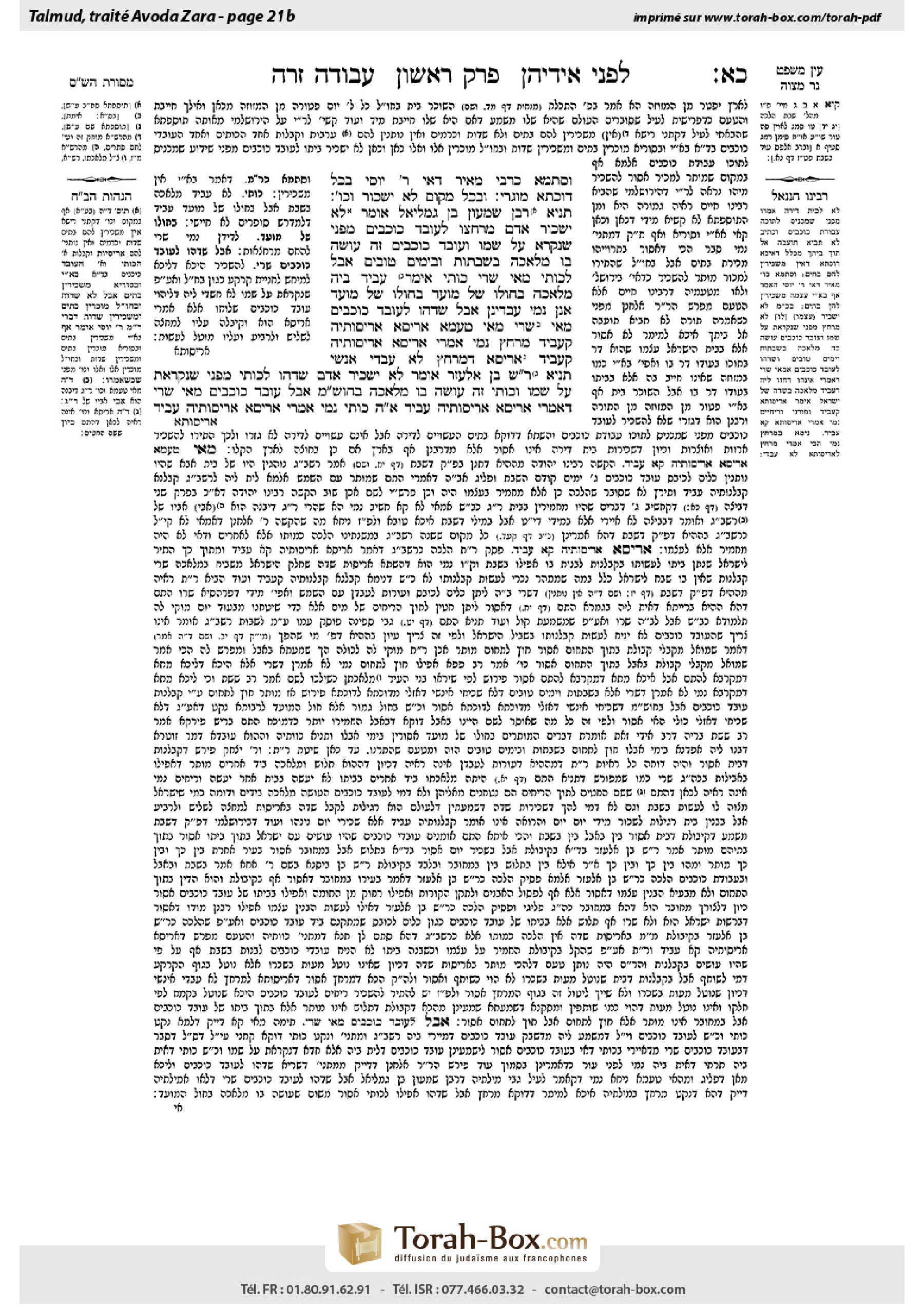
Avodah Zarah 21b: Talmud study for Daf Yomi
Study the Talmud for Daf Yomi with scanned pages, Hebrew text, English translations from Sefaria and AI-generated French translations.
Passage selection and English or AI-generated French translation are available where the scan has annotations. Daf Study is independent of Torah-Box and Sefaria.
Browse Avodah Zarah · עבודה זרה · All tractatesAvodah Zarah 21b text and translations
This page of Avodah Zarah includes the Aramaic text, an English translation and an AI-generated French translation, alongside the scan above.
עבודה זרה כ״א ב · Aramaic and Hebrew text
וּסְתָמָא כְּרַבִּי מֵאִיר, דְּאִי רַבִּי יוֹסֵי, בְּכׇל דּוּכְתָּא מוֹגְרִי.
וּבְכׇל מָקוֹם לֹא יִשְׂכּוֹר וְכוּ׳. תַּנְיָא: רַבָּן שִׁמְעוֹן בֶּן גַּמְלִיאֵל אוֹמֵר: לֹא יִשְׂכּוֹר אָדָם מֶרְחָצוֹ לְגוֹי, מִפְּנֵי שֶׁנִּקְרָא עַל שְׁמוֹ, וְגוֹי זֶה עוֹשֶׂה בּוֹ מְלָאכָה בְּשַׁבָּתוֹת וּבְיָמִים טוֹבִים.
אֲבָל לְכוּתִי, מַאי? שְׁרֵי. כּוּתִי אֵימַר עָבֵיד בֵּיהּ מְלָאכָה בְּחוּלּוֹ שֶׁל מוֹעֵד! בְּחוּלּוֹ שֶׁל מוֹעֵד אֲנַן נָמֵי עָבְדִינַן.
אֲבָל שָׂדֵהוּ לְגוֹי, מַאי? שְׁרֵי. מַאי טַעְמָא? אֲרִיסָא אֲרִיסוּתֵיהּ קָעָבֵיד. מֶרְחָץ נָמֵי אָמְרִי: אֲרִיסָא אֲרִיסוּתֵיהּ קָעָבֵיד? אֲרִיסָא דְּמֶרְחָץ לָא עָבְדִי אַנְשֵׁי.
תַּנְיָא, רַבִּי שִׁמְעוֹן בֶּן אֶלְעָזָר אוֹמֵר: לֹא יַשְׂכִּיר אָדָם שָׂדֵהוּ לְכוּתִי, מִפְּנֵי שֶׁנִּקְרֵאת עַל שְׁמוֹ, וְכוּתִי זֶה עוֹשֶׂה בּוֹ מְלָאכָה בְּחוּלּוֹ שֶׁל מוֹעֵד. אֲבָל גּוֹי מַאי? שְׁרֵי, דְּאָמְרִי: אֲרִיסָא אֲרִיסוּתֵיהּ עָבֵיד. אִי הָכִי, כּוּתִי נָמֵי אָמְרִי: אֲרִיסָא אֲרִיסוּתֵיהּ עָבֵיד!
Avodah Zarah 21b · English translation
And this unattributed opinion in the mishna is in accordance with the opinion of Rabbi Meir. As, if you say that this ruling is in accordance with the opinion of Rabbi Yosei, that cannot be, since he holds that in every place one may rent a house to a gentile, including Eretz Yisrael.
§ The mishna teaches: And in every place, one may not rent a bathhouse to a gentile, as it is called by the name of the owner. The Gemara notes that it is taught in a baraita that Rabban Shimon ben Gamliel says: A person may not rent his bathhouse to a gentile, because it is called by the name of the owner, and this gentile uses it for performing prohibited labor on Shabbatot and on Festivals.
The Gemara asks: It is prohibited to rent one’s bathhouse to a gentile, but with regard to a Samaritan, what is the halakha? It can be inferred from the lack of mention of a Samaritan that it is permitted. The Gemara asks: Why not say that a Samaritan will perform work in the bathhouse during the intermediate days of a Festival? The Gemara answers: During the intermediate days of a Festival we too perform work and heat bathhouses.
The Gemara further infers: It is prohibited to rent one’s bathhouse to a gentile; but with regard to renting one’s field to a gentile, what is the halakha? Evidently, it is permitted. What is the reason for this? People know that a gentile sharecropper works for his tenancy, not for the Jewish owner. The Gemara asks: But if so, in the case of a bathhouse as well, why not say that the gentile sharecropper works for his tenancy, and therefore a Jew should be permitted to rent them to gentiles. The Gemara answers: People do not usually make this type of arrangement whereby a second party works as a sharecropper of a bathhouse. Consequently, it will be assumed that the gentile is a hired worker who is working for the Jew.
The Gemara cites a similar discussion. It is taught in a baraita that Rabbi Shimon ben Elazar says: A person may not rent his field to a Samaritan, since it is called by the name of the owner and this Samaritan will perform work in it during the intermediate days of a Festival. The Gemara infers: It is prohibited to rent one’s field to a Samaritan, but with regard to a gentile, what is the halakha? Evidently, it is permitted, as we say that the gentile sharecropper works for his tenancy and not for the Jewish owner. The Gemara asks: If that is so, in the case of a Samaritan as well, why not say that the sharecropper works for his tenancy?
Avodah Zarah 21b · Traduction française (IA)
Et cette opinion non attribuée dans la Michna est conforme à l'opinion du Rabbi Meir. Car, si l'on dit que cette décision est conforme à l'opinion du Rabbi Yosei, cela ne peut pas être, car il considère que dans chaque lieu on peut louer une maison à un non-Juif, y compris en Terre d'Israël.
§ La Michna enseigne : Et dans chaque lieu, on ne peut pas louer une salle de bain à un non-Juif, car elle porte le nom de son propriétaire. La Guemara note que cela est enseigné dans une baraïta que Rabban Shimon ben Gamliel dit : Une personne ne doit pas louer sa salle de bain à un non-Juif, car elle porte le nom de son propriétaire, et ce non-Juif l'utilise pour accomplir des travaux interdits le sabbat et les fêtes.
La Guemara pose la question : Il est interdit de louer sa salle de bain à un non-Juif, mais concernant un Samaritain, quelle est la halakha ? On peut en déduire que cela est permis, à partir du fait qu'il n'est pas mentionné de Samaritain. La Guemara pose la question : Pourquoi ne pas dire qu'un Samaritain effectuera des travaux dans la salle de bain pendant les jours intermédiaires des fêtes ? La Guemara répond : Pendant les jours intermédiaires des fêtes, nous aussi, nous effectuons des travaux et nous chauffons les salles de bain.
La Guemara infère davantage : Il est interdit de louer sa salle de bain à un non-Juif ; mais concernant la location d'un champ à un non-Juif, quelle est la halakha ? Évidemment, cela est permis. Quelle est la raison de cela ? Les gens savent qu'un fermier non-Juif travaille pour son bail, pas pour le propriétaire juif. La Guemara pose la question : Mais si c'est ainsi, dans le cas d'une salle de bain également, pourquoi ne pas dire que le fermier non-Juif travaille pour son bail, et donc un Juif devrait être autorisé à les louer aux non-Juifs ? La Guemara répond : Les gens n'ont pas l'habitude de faire ce type d'arrangement où un second partie travaille comme fermier d'une salle de bain. Par conséquent, on supposera que le non-Juif est un ouvrier engagé qui travaille pour le Juif.
La Guemara cite une discussion similaire. Il est enseigné dans une baraïta que Rabbi Shimon ben Elazar dit : Une personne ne doit pas louer son champ à un Samaritain, car il porte le nom de son propriétaire et ce Samaritain effectuera des travaux dans ce champ pendant les jours intermédiaires des fêtes. La Guemara infère : Il est interdit de louer son champ à un Samaritain, mais concernant un non-Juif, quelle est la halakha ? Évidemment, cela est permis, car nous disons que le fermier non-Juif travaille pour son bail et non pour le propriétaire juif. La Guemara pose la question : Si c'est ainsi, dans le cas d'un Samaritain également, pourquoi ne pas dire que le fermier travaille pour son bail ?
Traduction française générée par IA à partir de l’édition anglaise de Sefaria. Vérifie toujours un passage avec le texte source.
Text from Sefaria: William Davidson Edition - Vocalized Aramaic (CC BY NC); William Davidson Edition - English (CC BY NC).