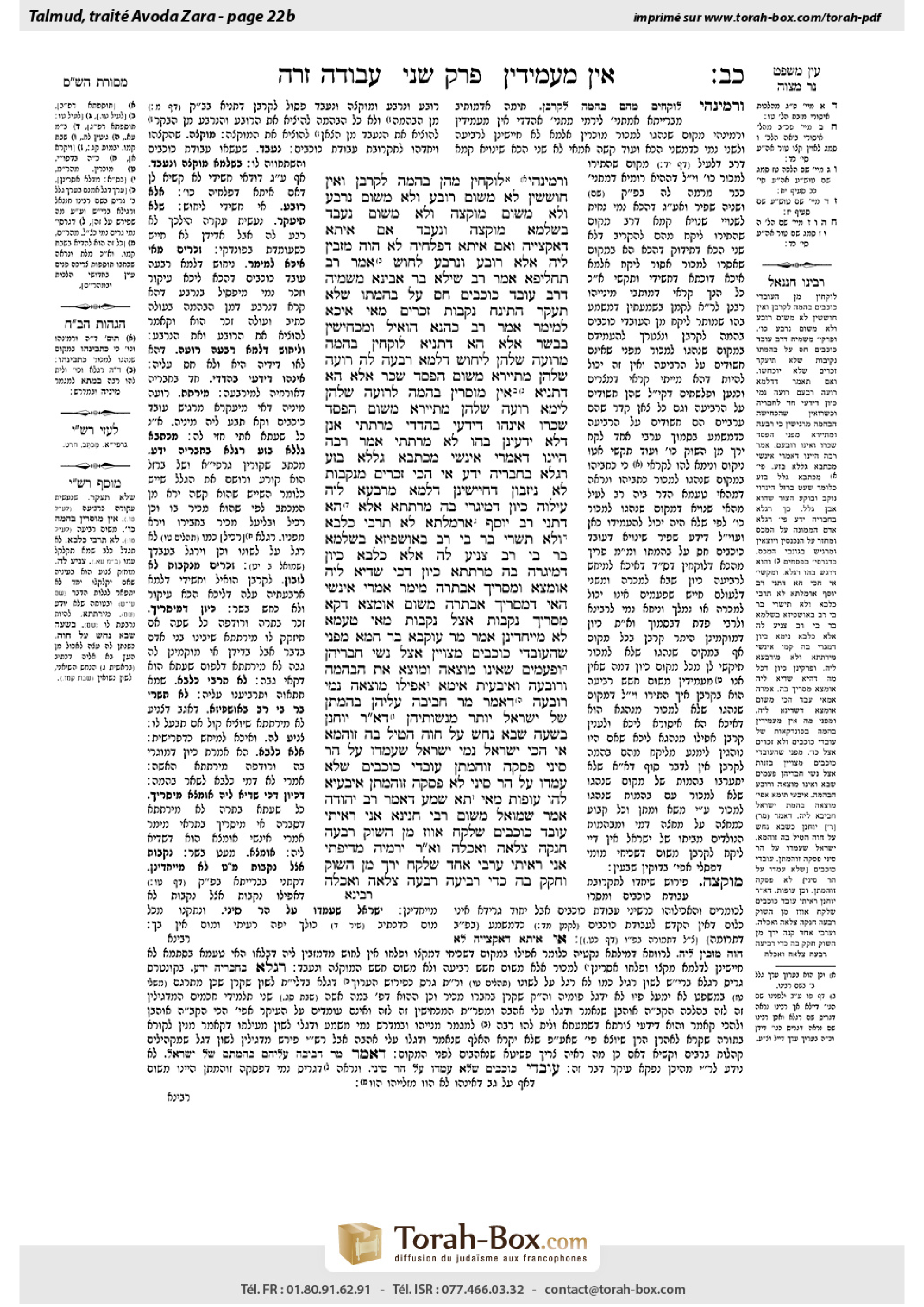
Avodah Zarah 22b: Talmud study for Daf Yomi
Study the Talmud for Daf Yomi with scanned pages, Hebrew text, English translations from Sefaria and AI-generated French translations.
Passage selection and English or AI-generated French translation are available where the scan has annotations. Daf Study is independent of Torah-Box and Sefaria.
Browse Avodah Zarah · עבודה זרה · All tractatesAvodah Zarah 22b text and translations
This page of Avodah Zarah includes the Aramaic text, an English translation and an AI-generated French translation, alongside the scan above.
עבודה זרה כ״ב ב · Aramaic and Hebrew text
גְּמָ׳ וּרְמִינְהִי: לוֹקְחִין מֵהֶן בְּהֵמָה לְקׇרְבָּן, וְאֵין חוֹשְׁשִׁין לֹא מִשּׁוּם רוֹבֵעַ, וְלֹא מִשּׁוּם נִרְבָּע, וְלֹא מִשּׁוּם מוּקְצֶה, וְלֹא מִשּׁוּם נֶעֱבָד.
בִּשְׁלָמָא מוּקְצֶה וְנֶעֱבָד, אִם אִיתָא דְּאַקְצְיֵיהּ וְאִם אִיתָא דְּפַלְחֵיהּ — לָא הֲוָה מְזַבֵּין לֵיהּ, אֶלָּא רוֹבֵעַ וְנִרְבָּע לֵחוּשׁ! אָמַר רַב תַּחְלִיפָא אָמַר רַב שֵׁילָא בַּר אֲבִינָא מִשְּׁמֵיהּ דְּרַב: גּוֹי חָס עַל בְּהֶמְתּוֹ שֶׁלֹּא תֵּעָקֵר.
הָתִינַח נְקֵבוֹת, זְכָרִים מַאי אִיכָּא לְמֵימַר? אָמַר רַב כָּהֲנָא: הוֹאִיל וּמַכְחִישִׁין בַּבָּשָׂר.
אֶלָּא הָא דְּתַנְיָא: לוֹקְחִין בְּהֵמָה מֵרוֹעֶה שֶׁלָּהֶן, לֵיחוּשׁ דִּלְמָא רַבְעַהּ לָהּ! רוֹעֶה שֶׁלָּהֶן מִתְיָירֵא מִשּׁוּם הֶפְסֵד שָׂכָר.
אֶלָּא הָא דְּתַנְיָא: אֵין מוֹסְרִין בְּהֵמָה לָרוֹעֶה שֶׁלָּהֶן, לֵימָא: רוֹעֶה שֶׁלָּהֶן מִתְיָירֵא מִשּׁוּם הֶפְסֵד שְׂכָרוֹ!
אִינְהוּ דְּיָדְעִי בַּהֲדָדֵי, מִרַתְתִי. אֲנַן דְּלָא יָדְעִינַן בְּהוּ, לָא מִרַתְתִי. אָמַר רַבָּה: הַיְינוּ דְּאָמְרִי אִינָשֵׁי: מַכְתְּבָא גְּלָלָא בָּזַע, רַגָּלָא בְּחַבְרֵיהּ יָדַע.
אִי הָכִי, זְכָרִים מִנְּקֵבוֹת לָא נִיזְבּוֹן, דְּחָיְישִׁינַן דִּלְמָא מַרְבְּעָא לֵיהּ עִילָּוַהּ! כֵּיוָן דְּמִיגָּרֵי בַּהּ, מִרַתְתָא.
אֶלָּא הָא דְּתָנֵי רַב יוֹסֵף: אַרְמַלְתָּא לָא תְּרַבֵּי כַּלְבָּא, וְלָא תַּשְׁרֵי בַּר בֵּי רַב בְּאוּשְׁפִּיזָא. בִּשְׁלָמָא בַּר בֵּי רַב צְנִיעַ לַהּ, אֶלָּא כַּלְבָּא, כֵּיוָן דְּמִיגָּרֵה בַּהּ — מִרַתְתָא!
כֵּיוָן דְּכִי שָׁדְיָא לֵיהּ אוּמְצָא וּמִסְּרִיךְ אַבָּתְרַהּ, מֵימָר אָמְרִי אִינָשֵׁי: הַאי דְּמִסְּרִיךְ אַבָּתְרַהּ מִשּׁוּם אוּמְצָא דְּקָא מִסְּרִיךְ.
נְקֵבוֹת אֵצֶל נְקֵבוֹת, מַאי טַעְמָא לָא מְיַיחֲדִינַן? אָמַר מָר עוּקְבָא בַּר חָמָא: מִפְּנֵי שֶׁהַגּוֹיִם מְצוּיִין אֵצֶל נְשֵׁי חַבְרֵיהֶן, וּפְעָמִים שֶׁאֵינוֹ מוֹצְאָהּ וּמוֹצֵא אֶת הַבְּהֵמָה וְרוֹבְעָהּ.
וְאִיבָּעֵית אֵימָא: אֲפִילּוּ מוֹצְאָהּ נָמֵי רוֹבְעָהּ, דְּאָמַר מָר: חֲבִיבָה עֲלֵיהֶן בְּהֶמְתָּן שֶׁל יִשְׂרָאֵל יוֹתֵר מִנְּשׁוֹתֵיהֶן, דְּאָמַר רַבִּי יוֹחָנָן: בְּשָׁעָה שֶׁבָּא נָחָשׁ עַל חַוָּה הֵטִיל בָּהּ זוּהֲמָא. אִי הָכִי, יִשְׂרָאֵל נָמֵי? יִשְׂרָאֵל שֶׁעָמְדוּ עַל הַר סִינַי — פָּסְקָה זוּהֲמָתָן, גּוֹיִם שֶׁלֹּא עָמְדוּ עַל הַר סִינַי — לֹא פָּסְקָה זוּהֲמָתָן.
אִיבַּעְיָא לְהוּ: עוֹפוֹת מַאי? תָּא שְׁמַע, דְּאָמַר רַב יְהוּדָה אָמַר שְׁמוּאֵל מִשּׁוּם רַבִּי חֲנִינָא: אֲנִי רָאִיתִי גּוֹי שֶׁלָּקַח אַוָּוז מִן הַשּׁוּק, רְבָעָהּ, חֲנָקָהּ, צְלָאָהּ, וַאֲכָלָהּ. וְאָמַר רַבִּי יִרְמְיָה מִדִּיפְתִּי: אֲנִי רָאִיתִי עַרְבִי אֶחָד שֶׁלָּקַח יָרֵךְ מִן הַשּׁוּק, וְחָקַק בָּהּ כְּדֵי רְבִיעָה, רְבָעָהּ, צְלָאָהּ, וַאֲכָלָהּ.
Avodah Zarah 22b · English translation
GEMARA: With regard to the assumption that gentiles are suspected of bestiality, the Gemara raises a contradiction from a baraita (Tosefta 2:1): One may purchase an animal from gentiles for use as an offering, and there is no concern that it might be unfit due to it being an animal that copulated with a person, or due to is being an animal that was the object of bestiality, or due to it having been set aside for idol worship, or due to the animal itself having been worshipped.
The Gemara analyzes this ruling: Granted, there is no concern that the animal was set aside for idolatry or was itself worshipped. The reason is that if it is so that it was set aside, or if it is so that it was worshipped, then the gentile would not have sold it to the Jew in the first place. But with regard to the possibility that it is an animal that copulated with a person or an animal that was the object of bestiality, let one raise a concern in line with the ruling of the mishna. The Gemara explains: Rav Taḥlifa says that Rav Sheila bar Avina says in the name of Rav: A gentile protects and thereby spares his own animal so that it will not become barren. Since an act of bestiality may cause an animal to become barren, there is no concern that the gentile engaged in immoral behavior with it. Therefore, one may use an animal purchased from a gentile as an offering.
The Gemara asks: This works out well with regard to female animals, as they can become barren, but with regard to males, what is there to say? Rav Kahana says: Gentiles also refrain from engaging in bestiality with their male livestock, since doing so deteriorates the animals’ flesh, i.e., it makes them physically weaker.
Rather, the Gemara instead raises a contradiction from that which is taught in a baraita: One may purchase an animal for use as an offering from their shepherd, i.e., a gentile shepherd. The Gemara explains the apparent contradiction: In light of the ruling of the mishna, let us be concerned that perhaps he engaged in bestiality with the animal, as it does not belong to him, and therefore it should be prohibited to purchase an animal from gentile shepherds. The Gemara answers: Their shepherd is fearful of engaging in bestiality with the animals under his care, due to the forfeit of his wages that would result if this were discovered.
Rather, the Gemara instead raises a contradiction from that which is taught in a baraita: One may not deliver an animal to their shepherd, i.e., a gentile shepherd. The Gemara explains the contradiction: Why may one not do so? Let us say that their shepherd is fearful due to the forfeit of his wages, and accordingly one should be permitted to give him an animal.
The Gemara answers: With regard to themselves, i.e., other gentiles, as they are aware of each other’s actions, they are fearful that they may be caught, and therefore will not engage in bestiality with an animal belonging to another gentile. But with regard to ourselves, Jews, as we are not aware of them and their behavior, they are not fearful of us. The Gemara notes that Rabba said: This is in accordance with the adage that people say: Just as the stylus etches script upon marble, a sinner knows his fellow sinner, i.e., a transgressor is acutely aware of others who act in the same manner.
The Gemara raises a difficulty: If that is so, and the reason one may purchase an animal for use as an offering from a gentile is that engaging in bestiality has a negative impact on the animal, then let us not purchase male animals from female gentiles, as we should be concerned that perhaps she engaged in bestiality with it. This would not damage the animal or render it barren, and therefore there is no deterrent that would prevent a gentile woman from doing so. The Gemara answers: Since, if she were to engage in bestiality, the animal would follow her around in public, she is afraid of others discovering her behavior.
The Gemara further asks: But consider that which Rav Yosef teaches: A widow may not raise a dog due to the suspicion that she may engage in bestiality, and she may not allow a student of Torah to dwell as a lodger [be’ushpiza] in her home. Granted, it makes sense that is prohibited for her to have a student of Torah lodging in her home, as he is regarded as discreet in her eyes, so she will not be deterred from sinning with him. But with regard to a dog, since it would follow her around after she mates with it, she is afraid to engage in bestiality with it. Therefore, it should be permitted for her to raise a dog.
The Gemara answers: Since it will also follow her around in a case when she throws it a piece of meat, people will say: The fact that it is following her is due to the meat she threw at it, and they will not suspect her of bestiality. Consequently, she will not be deterred from transgressing.
The Gemara asks: With regard to female animals with females, what is the reason that we do not permit them to be secluded with each other? Mar Ukva bar Ḥama says: It is because gentiles frequent the wives of others, and on occasion the gentile does not find her, and he finds the animal and engages in bestiality with it instead.
And if you wish, say instead: Even when he finds the wife, he also engages in bestiality with the animal, as the Master said: The animal of a Jew is more appealing to gentiles than their own wives, as Rabbi Yoḥanan says: At the time when the snake came upon Eve, at the time of the sin of her eating from the Tree of Knowledge, it infected her with moral contamination, and this contamination lingers in all human beings. The Gemara asks: If that is so, a Jew should also be suspected of engaging in bestiality. The Gemara answers: With regard to the Jewish people, who stood at Mount Sinai and received the Torah, their contamination ended, whereas in the case of gentiles, who did not stand at Mount Sinai and receive the Torah, their contamination has not ended.
§ The Gemara inquires with regard to the halakha in the case of a bird. A dilemma was raised before the Sages: With regard to birds, what is the halakha? Are gentiles suspected of engaging in bestiality with birds? The Gemara suggests: Come and hear a proof that they are suspected of doing so, as Rav Yehuda says that Shmuel says in the name of Rabbi Ḥanina: I once saw a gentile who bought a goose in the market, engaged in bestiality with it, strangled it, roasted it, and then ate it. And similarly, Rabbi Yirmeya of Difti says: I saw a certain Arab who bought a thigh of meat from the market and carved a space in it that was the size necessary to allow for penetration. Subsequently, he penetrated it, roasted it, and ate it. These incidents demonstrate that gentiles are suspected of immoral conduct with fowl.
Avodah Zarah 22b · Traduction française (IA)
GUEMARA : Concernant l'hypothèse selon laquelle les Gentils sont soupçonnés de bestialité, la Guemara soulève une contradiction tirée d'une baraïta (Tosefta 2:1) : On peut acheter un animal des Gentils pour l'utiliser comme sacrifice, et il n'y a pas de crainte qu'il soit inadapté en raison de l'avoir copulé avec un être humain, ou en raison d'avoir été l'objet de bestialité, ou en raison d'avoir été désigné pour l'idolâtrie, ou en raison de l'avoir lui-même adoré.
La Guemara analyse cette décision : C'est évident qu'il n'y a pas de crainte que l'animal ait été désigné pour l'idolâtrie ou qu'il ait été adoré. La raison est que si c'était le cas, le Gentil n'aurait pas vendu l'animal au Juif en premier lieu. Mais concernant la possibilité qu'il s'agisse d'un animal qui a copulé avec un être humain ou d'un animal qui a été l'objet de bestialité, on doit élever une crainte conformément à la décision de la mitsna. La Guemara explique : Rav Taḥlifa dit que Rav Sheila bar Avina dit au nom de Rav : Un Gentil protège et préserve ainsi son propre animal afin qu'il ne devienne pas stérile. Puisque l'acte de bestialité peut rendre un animal stérile, il n'y a pas de crainte que le Gentil ait eu un comportement immoral avec lui. Par conséquent, on peut utiliser un animal acheté chez un Gentil comme sacrifice.
La Guemara pose une question : Cela s'applique bien aux femelles, car elles peuvent devenir stériles, mais concernant les mâles, qu'est-ce que cela signifie ? Rav Kahana dit : Les Gentils évitent également de pratiquer la bestialité avec leurs bêtes mâles, car cela affaiblit leur chair, c'est-à-dire qu'il les rend physiquement plus faibles.
Au lieu de cela, la Guemara soulève une contradiction tirée d'une baraïta : On peut acheter un animal pour l'utiliser comme sacrifice auprès de leur berger, c'est-à-dire un berger gentil. La Guemara explique la contradiction apparente : En lumière de la décision de la mitsva, on doit avoir une crainte qu'il ait pratiqué la bestialité avec l'animal, car il n'appartient pas à lui, et par conséquent il devrait être interdit d'acheter un animal auprès des bergers gentils. La Guemara répond : Leur berger craint de pratiquer la bestialité avec les animaux sous sa garde, en raison de la perte de ses salaires qui en résulterait si cela était découvert.
Au lieu de cela, la Guemara soulève une contradiction tirée d'une baraïta : On ne peut pas confier un animal à leur berger, c'est-à-dire un berger gentil. La Guemara explique la contradiction : Pourquoi ne peut-on pas le faire ? Disons que leur berger craint en raison de la perte de ses salaires, et par conséquent on devrait être autorisé à lui donner un animal.
La Guemara répond : Concernant eux-mêmes, c'est-à-dire d'autres Gentils, comme ils connaissent les actions les uns des autres, ils craignent d'être découverts, et par conséquent ne pratiquent pas la bestialité avec un animal appartenant à un autre Gentil. Mais concernant nous, les Juifs, comme nous ne connaissons pas leurs actions et leur comportement, ils ne craignent pas nous. La Guemara note que Rabba a dit : Cela correspond à l'adage que les gens disent : Comme le stylet gravite le script sur le marbre, un pécheur connaît son collègue pécheur, c'est-à-dire un transgresseur est très conscient des autres qui agissent de la même manière.
La Guemara soulève une difficulté : Si c'est ainsi, et que la raison pour laquelle on peut acheter un animal pour l'utiliser comme sacrifice auprès d'un Gentil est que la bestialité a un impact négatif sur l'animal, alors ne devrions-nous pas éviter d'acheter des animaux mâles auprès de femmes Gentiles, car nous devrions avoir une crainte qu'elle ait pratiqué la bestialité avec lui. Cela ne nuirait pas à l'animal ni ne le rendrait stérile, et par conséquent il n'y aurait pas de deterrent qui empêcherait une femme Gentile de le faire. La Guemara répond : Puisque, si elle y avait pratiqué la bestialité, l'animal la suivrait en public, elle craint qu'on découvre son comportement.
La Guemara pose une autre question : Mais considérez ce que Rav Yosef enseigne : Une veuve ne peut pas avoir un chien en raison du soupçon qu'elle pourrait pratiquer la bestialité, et elle ne peut pas permettre à un étudiant de la Torah de séjourner chez elle. Cela a du sens qu'il soit interdit qu'elle ait un étudiant de la Torah loger chez elle, car il est considéré comme discret à ses yeux, donc elle ne sera pas découragée de commettre un péché avec lui. Mais concernant le chien, puisqu'il le suivrait après qu'elle ait copulé avec lui, elle craint de pratiquer la bestialité avec lui. Par conséquent, elle devrait être autorisée à avoir un chien.
La Guemara répond : Puisque cela le suivra également en cas où elle lui lance un morceau de viande, les gens diront : Le fait qu'il la suive est dû au morceau de viande qu'elle lui a lancé, et ils ne soupçonneront pas qu'elle pratique la bestialité. Par conséquent, elle ne sera pas découragée de transgresser.
La Guemara pose la question : Concernant les animaux femelles, quelle est la raison pour laquelle nous ne permettons pas qu'ils soient seuls ensemble ? Mar Ukva bar Ḥama dit : C'est parce que les Gentils fréquentent les épouses des autres, et parfois le Gentil ne les trouve pas, et il trouve l'animal et engage en bestialité avec lui à la place.
Et si vous le souhaitez, dites plutôt : Même lorsqu'il trouve la femme, il engage également en bestialité avec l'animal, comme le Maître a dit : L'animal d'un Juif est plus attirant pour les Gentils que leurs propres épouses, comme Rabbi Yoḥanan dit : À l'époque où le serpent est venu sur Ève, à l'époque du péché d'avoir mangé de l'Arbre de la Connaissance, il l'a infectée de corruption morale, et cette corruption persiste dans tous les humains. La Guemara pose la question : Si c'est ainsi, un Juif devrait également être soupçonné d'engager en bestialité. La Guemara répond : Concernant le peuple juif, qui s'est tenu au Mont Sinaï et a reçu la Torah, leur corruption s'est terminée, tandis que dans le cas des Gentils, qui n'ont pas tenu au Mont Sinaï et n'ont pas reçu la Torah, leur corruption n'a pas pris fin.
§ La Guemara interroge concernant la halakha dans le cas d'un oiseau. Un dilemme a été soulevé devant les Sages : concernant les oiseaux, quelle est la halakha ? Les gentils sont-ils soupçonnés d'engager des relations bestiales avec des oiseaux ? La Guemara suggère : viens écouter une preuve qui montre qu'ils sont soupçonnés d'en faire autant, car Rav Yehuda rapporte que Shmuel, dans le nom de Rabbi Ḥanina, dit : j'ai vu un gentil qui acheta un canard au marché, engagea des relations bestiales avec lui, l'étouffa, le rôta et le mangea. De même, Rabbi Yirmeya de Difti dit : j'ai vu un certain Arabe qui acheta une cuisse de viande au marché et fit un espace dans celle-ci de la taille nécessaire pour permettre l'entrée. Par la suite, il pénétra dans cet espace, le rôta et le mangea. Ces incidents démontrent que les gentils sont soupçonnés de comportements immoraux avec les oiseaux.
Traduction française générée par IA à partir de l’édition anglaise de Sefaria. Vérifie toujours un passage avec le texte source.
Text from Sefaria: William Davidson Edition - Vocalized Aramaic (CC BY NC); William Davidson Edition - English (CC BY NC).