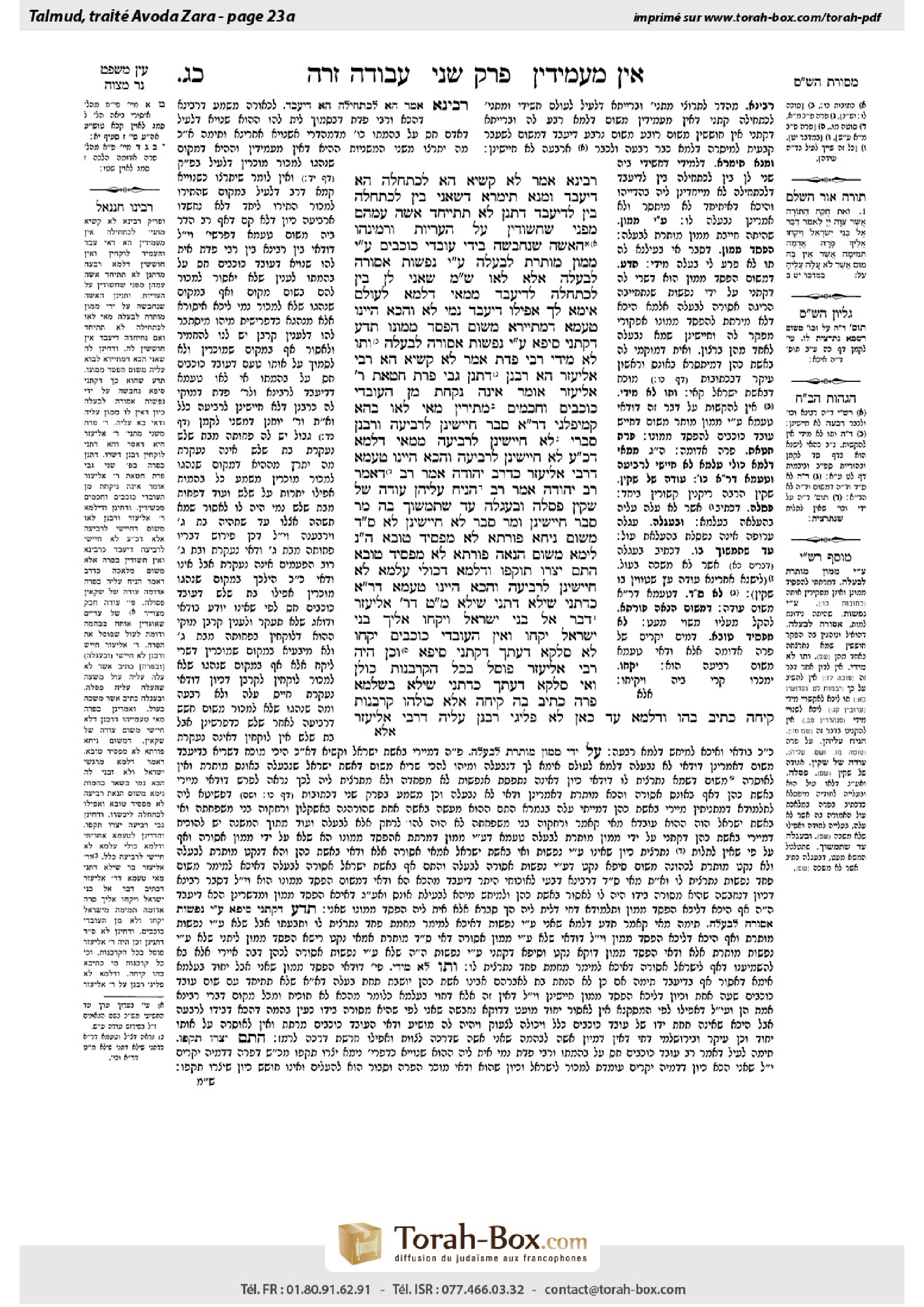
Avodah Zarah 23a: Talmud study for Daf Yomi
Study the Talmud for Daf Yomi with scanned pages, Hebrew text, English translations from Sefaria and AI-generated French translations.
Passage selection and English or AI-generated French translation are available where the scan has annotations. Daf Study is independent of Torah-Box and Sefaria.
Browse Avodah Zarah · עבודה זרה · All tractatesAvodah Zarah 23a text and translations
This page of Avodah Zarah includes the Aramaic text, an English translation and an AI-generated French translation, alongside the scan above.
עבודה זרה כ״ג א · Aramaic and Hebrew text
רָבִינָא אָמַר: לָא קַשְׁיָא — הָא לְכַתְּחִלָּה, הָא דִּיעֲבַד.
וּמְנָא תֵּימְרָא דְּשָׁאנֵי בֵּין לְכַתְּחִלָּה בֵּין לְדִיעֲבַד? דִּתְנַן: לֹא תִּתְיַיחֵד אִשָּׁה עִמָּהֶם, מִפְּנֵי שֶׁחֲשׁוּדִין עַל הָעֲרָיוֹת. וּרְמִינְהוּ: הָאִשָּׁה שֶׁנֶּחְבְּשָׁה בִּידֵי גּוֹיִם, עַל יְדֵי מָמוֹן — מוּתֶּרֶת לְבַעְלָהּ, עַל יְדֵי נְפָשׁוֹת — אֲסוּרָה לְבַעְלָהּ!
אֶלָּא לָאו שְׁמַע מִינַּהּ, שָׁאנֵי לַן בֵּין לְכַתְּחִלָּה לְדִיעֲבַד? מִמַּאי? דִּלְמָא לְעוֹלָם אֵימָא לָךְ: אֲפִילּוּ דִּיעֲבַד נָמֵי לָא, וְהָכָא הַיְינוּ טַעְמָא, דְּמִתְיָירֵא מִשּׁוּם הֶפְסֵד מָמוֹנוֹ.
תֵּדַע, דְּקָתָנֵי סֵיפָא: עַל יְדֵי נְפָשׁוֹת אֲסוּרָה לְבַעְלָהּ, וְתוּ לָא מִידִּי.
רַבִּי פְּדָת אָמַר: לָא קַשְׁיָא — הָא רַבִּי אֱלִיעֶזֶר, הָא רַבָּנַן. דִּתְנַן גַּבֵּי פָּרַת חַטָּאת: רַבִּי אֱלִיעֶזֶר אוֹמֵר: אֵינָהּ נִקַּחַת מִן הַגּוֹיִם, וַחֲכָמִים מַתִּירִין. מַאי לָאו בְּהָא קָמִיפַּלְגִי, דְּרַבִּי אֱלִיעֶזֶר סָבַר: חָיְישִׁינַן לִרְבִיעָה, וְרַבָּנַן סָבְרִי: לָא חָיְישִׁינַן לִרְבִיעָה?
מִמַּאי? דִּלְמָא דְּכוּלֵּי עָלְמָא לָא חָיְישִׁינַן לִרְבִיעָה, וְהָכָא הַיְינוּ טַעְמָא דְּרַבִּי אֱלִיעֶזֶר — כִּדְרַב יְהוּדָה אָמַר רַב, דְּאָמַר רַב יְהוּדָה אָמַר רַב: הִנִּיחַ (עֲלֵיהֶן) [עָלֶיהָ] עוּדָּה שֶׁל שַׂקִּין — פְּסָלָהּ, וּבְעֶגְלָה — עַד שֶׁתִּמְשׁוֹךְ בָּהּ.
מָר סָבַר חָיְישִׁינַן, וּמַר סָבַר לָא חָיְישִׁינַן! לָא סָלְקָא דַּעְתָּךְ, מִשּׁוּם נִיחָא פּוּרְתָּא לָא מַפְסֵיד טוּבָא.
הָכִי נָמֵי לֵימָא: מִשּׁוּם הֲנָאָה פּוּרְתָּא לָא מַפְסֵיד טוּבָא! הָתָם, יִצְרוֹ תּוֹקְפוֹ.
וְדִלְמָא דְּכוּלֵּי עָלְמָא לָא חָיְישִׁינַן לִרְבִיעָה, וְהָכָא הַיְינוּ טַעְמָא דְּרַבִּי אֱלִיעֶזֶר, כִּדְתָנֵי שֵׁילָא, דְּתָנֵי שֵׁילָא: מַאי טַעְמָא דְּרַבִּי אֱלִיעֶזֶר? ״דַּבֵּר אֶל בְּנֵי יִשְׂרָאֵל וְיִקְחוּ אֵלֶיךָ״ — בְּנֵי יִשְׂרָאֵל יִקְחוּ, וְאֵין הַגּוֹיִם יִקְחוּ.
לָא סָלְקָא דַּעְתָּךְ, דְּקָתָנֵי סֵיפָא: וְכֵן הָיָה רַבִּי אֱלִיעֶזֶר פּוֹסֵל בְּכׇל הַקָּרְבָּנוֹת כּוּלָּן. וְאִי סָלְקָא דַעְתָּךְ כִּדְתָנֵי שֵׁילָא, בִּשְׁלָמָא פָּרָה — כְּתִיב בָּהּ ״קִיחָה״, אֶלָּא כּוּלְּהוּ קׇרְבָּנוֹת — קִיחָה כְּתִיב בְּהוּ? וְדִלְמָא עַד כָּאן לָא פְּלִיגִי רַבָּנַן עֲלֵיהּ דְּרַבִּי אֱלִיעֶזֶר.
Avodah Zarah 23a · English translation
§ The Gemara cites another resolution of the apparent contradiction between the mishna, which rules that gentiles are suspected of bestiality, and the baraita, which permits an animal purchased from gentiles to be sacrificed as an offering. Ravina said that it is not difficult; this mishna issues its ruling with regard to the halakha ab initio, while that baraita is referring to the halakha after the fact.
The Gemara asks: And from where do you say that there is a difference in this case between ab initio and after the fact? As we learned in the mishna: A woman may not seclude herself with them because they are suspected of engaging in forbidden sexual intercourse. And one can raise a contradiction from another mishna (Ketubot 26b): With regard to a woman who was imprisoned by gentiles, if she was imprisoned due to monetary matters she is permitted to her husband even if he is a priest, as there is no concern that she was raped. If she was imprisoned due to a capital offense she is forbidden to her husband if he is a priest, as the captors would not restrain themselves from raping her. The first clause of the mishna in Ketubot rules that a woman who was imprisoned in seclusion with gentiles is not assumed to have engaged in intercourse with them. This apparently contradicts the statement of the mishna here, which rules that a woman may not seclude herself with gentiles.
The Gemara continues: Rather, isn’t it correct to conclude from here that there is a difference for us between ab initio, as in the mishna here, and after the fact, as in the mishna in Ketubot? The Gemara rejects this conclusion: From where can this be proven? Perhaps I could actually say to you: Generally, even after the fact, one may not assume that a woman who was secluded with a gentile did not engage in intercourse with him, and here, in the mishna in Ketubot, this is the reason that she is permitted to her husband even after having been imprisoned: Since her husband might not agree to pay if his wife was raped, the gentile is fearful of raping her due to the potential loss of his money.
The Gemara adds: Know that this is the explanation, as the latter clause of that mishna teaches: If she was imprisoned due to a capital offense she is forbidden to her husband. Clearly, the difference is that in this case there is no incentive for the gentiles to leave her unharmed. The Gemara concludes: And nothing more needs discussion, as this is certainly the correct interpretation of that mishna.
Rabbi Pedat said: The contradiction between the mishna, which rules that gentiles are suspected of bestiality, and the baraita, which permits an animal purchased from gentiles to be sacrificed as an offering, is not difficult; this mishna is in accordance with the opinion of Rabbi Eliezer, while that baraita is in accordance with the opinion of the Rabbis. As we learned in a mishna (Para 2:1) with regard to the red heifer of purification: Rabbi Eliezer says that it may not be purchased from gentiles, and the Rabbis permit it to be purchased from gentiles. Rabbi Pedat explains: What, is it not correct to say that Rabbi Eliezer and the Rabbis disagree with regard to this issue, that Rabbi Eliezer holds that we are concerned that a person might have engaged in bestiality with the animal, and the Rabbis hold that we are not concerned that a person engaged in bestiality with the animal?
The Gemara rejects this conclusion: From where do you know that this is the case? Perhaps everyone agrees that we are not concerned that a person might have engaged in bestiality with the animal, and here, this is the reasoning of Rabbi Eliezer: He holds in accordance with a statement that Rabbi Yehuda says that Rav says. As Rabbi Yehuda says that Rav says: If one placed a bundle of sacks upon a red heifer, he has rendered it unfit for purification, as a red heifer is fit only if it has not borne any burden, in accordance with the verse: “Upon which never came a yoke” (Numbers 19:2); and in the case of the heifer whose neck is broken, it is not rendered unfit until you pull a load with it, as the verse states: “And which has not drawn in the yoke” (Deuteronomy 21:3).
The Gemara elaborates: One Sage, Rabbi Eliezer, holds: A red heifer purchased from a gentile cannot be used for purification because we are concerned that it might have been used for labor, and one Sage, the Rabbis, holds: We are not concerned that the gentile used it for labor. Accordingly, the disagreement in that mishna does not relate to a concern with regard to bestiality. The Gemara responds: No; it cannot enter your mind that Rabbi Eliezer prohibits purchasing a red heifer from a gentile due to the concern that he might have placed sacks upon it, as due to the slight convenience of placing a bundle of sacks upon the heifer, the gentile will not forfeit the potential to earn a great deal of money which he can obtain by selling the heifer.
The Gemara counters: So too, let us say: Due to the slight pleasure of engaging in bestiality with an animal, a gentile will not forfeit a great deal of money which he can otherwise obtain by selling the heifer. The Gemara responds: There, with regard to bestiality, his inclination overcomes him, and he is apt to engage in bestiality with the heifer despite the fact that he knows it is to his disadvantage to do so.
The Gemara suggests: And perhaps everyone agrees that we are not concerned that a person might have engaged in bestiality with the animal, and here, this is the reason of Rabbi Eliezer, in accordance with that which Sheila taught, as Sheila taught in a baraita: What is the reason of Rabbi Eliezer? The verse states: “Speak unto the children of Israel that they take to you a red heifer” (Numbers 19:2). This teaches that the children of Israel take the red heifer, but gentiles do not take the red heifer.
The Gemara answers: It should not enter your mind to say so, as the latter clause of that same baraita teaches: And similarly, Rabbi Eliezer would disqualify an animal purchased from a gentile in the case of all offerings. The Gemara elaborates: And if it should enter your mind that Rabbi Eliezer’s reason is in accordance with that which Sheila taught, granted, in the case of the red heifer a term of taking is written, but is a term of taking written with regard to all other offerings? Since a term of taking does not appear in the context of other offerings, this cannot be Rabbi Eliezer’s reasoning. The Gemara suggests: And perhaps the Rabbis disagree with Rabbi Eliezer
Avodah Zarah 23a · Traduction française (IA)
§ La Guemara cite une autre résolution de la contradiction apparente entre la Michna, qui déclare que les gentils sont soupçonnés de bestialité, et la baraïta, qui permet à un animal acheté chez des gentils d'être sacrifié en offrande. Ravina dit que cela n'est pas difficile ; cette Michna énonce sa décision concernant la halakha ab initio, tandis que cette baraïta fait référence à la halakha post factum.
La Guemara demande : Et d'où dis-tu qu'il y a une différence dans ce cas entre ab initio et post factum ? Comme nous l'avons appris dans la Michna : Une femme ne doit pas se retirer en privé avec eux, car ils sont soupçonnés d'engager en relations sexuelles interdites. On pourrait élever une contradiction à partir d'une autre Michna (Ketubot 26b) : Concernant une femme emprisonnée par des gentils, si elle a été emprisonnée en raison de questions financières, elle est autorisée à son mari même s'il est un prêtre, car il n'y a pas de crainte qu'elle ait été violée. Si elle a été emprisonnée en raison d'une offense capitale, elle est interdite à son mari si celui-ci est un prêtre, car les gardiens ne se retenaient pas de la violer. La première clause de la Michna dans Ketubot déclare que la femme emprisonnée en privé avec des gentils n'est pas supposée avoir eu des relations sexuelles avec eux. Cela semble contredire la déclaration de la Michna ici, qui déclare que la femme ne doit pas se retirer en privé avec des gentils.
La Guemara continue : N'est-ce pas plutôt correct de conclure ici qu'il y a une différence pour nous entre ab initio, comme dans la Michna ici, et post factum, comme dans la Michna dans Ketubot ? La Guemara rejette cette conclusion : D'où peut-on prouver cela ? Peut-être puis-je te dire : Généralement, même post factum, on ne peut pas supposer que la femme qui s'est retirée en privé avec un gentil n'a pas eu de relations sexuelles avec lui, et ici, dans la Michna dans Ketubot, c'est la raison pour laquelle elle est autorisée à son mari même après avoir été emprisonnée : car son mari pourrait ne pas accepter de payer si sa femme a été violée, le gentil craint de la violer en raison de la perte potentielle de ses biens.
La Guemara ajoute : Sache que c'est cette explication, car la seconde clause de cette Michna enseigne : Si elle a été emprisonnée en raison d'une offense capitale, elle est interdite à son mari. Évidemment, la différence est que dans ce cas, il n'y a pas d'incentif pour les gentils à la laisser intacte. La Guemara conclut : Et plus rien n'a besoin d'être discuté, car cela est certainement l'interprétation correcte de cette Michna.
Rabbi Pedat dit : La contradiction entre la Michna, qui établit que les gentils sont soupçonnés de bestialité, et la baraïta, qui permet à un animal acheté chez des gentils d'être sacrifié en offrande, n'est pas difficile ; cette Michna est selon l'opinion de Rabbi Eliezer, tandis que cette baraïta est selon l'opinion des Rabbins. Comme nous l'avons appris dans une Michna (Para 2:1) concernant la vache rouge de purification : Rabbi Eliezer dit qu'elle ne peut pas être achetée chez des gentils, et les Rabbins permettent qu'elle soit achetée chez des gentils. Rabbi Pedat explique : Qu'est-ce que cela ne serait pas correct de dire que Rabbi Eliezer et les Rabbins s'opposent sur ce point, que Rabbi Eliezer maintient que nous sommes préoccupés par le fait qu'une personne ait eu des relations sexuelles avec l'animal, et les Rabbins maintiennent que nous ne sommes pas préoccupés par le fait qu'une personne ait eu des relations sexuelles avec l'animal ?
La Guemara rejette cette conclusion : D'où sais-tu cela ? Peut-être tout le monde est d'accord sur le fait que nous ne sommes pas préoccupés par le fait qu'une personne ait eu des relations sexuelles avec l'animal, et ici, c'est la raison de Rabbi Eliezer : Il maintient selon une déclaration que Rabbi Yéhuda rapporte que Rav a dit. Comme Rabbi Yéhuda rapporte que Rav a dit : Si l'on a placé un faisceau de sacs sur une vache rouge, il l'a rendue inutilisable pour la purification, car une vache rouge est utilisable uniquement si elle n'a pas porté de charge, conformément au verset : « Sur laquelle jamais ne vint un joug » (Nombres 19:2) ; et dans le cas de la vache dont le cou est brisé, elle n'est rendue inutilisable qu'une fois qu'on la fait tirer avec une charge, comme le verset dit : « Et qui n'a pas tiré un joug » (Deutéronome 21:3).
La Guemara développe : Un Sage, Rabbi Eliezer, maintient : Une vache rouge achetée chez un gentil ne peut pas être utilisée pour la purification car nous craignons qu'elle ait été utilisée pour le travail, et un Sage, les Rabbins, maintient : Nous ne craignons pas que le gentil l'ait utilisée pour le travail. Ainsi, le désaccord dans cette Michna ne concerne pas la crainte concernant la bestialité. La Guemara répond : Non ; il ne peut pas entrer dans ton esprit que Rabbi Eliezer interdise l'achat d'une vache rouge chez un gentil en raison de la crainte qu'il l'ait utilisée pour le travail, car en raison du petit avantage de placer un faisceau de sacs sur la vache, le gentil ne perdrait pas un grand gain de revenus qu'il pourrait obtenir en vendant la vache.
La Guemara contredit : De même, disons : En raison du petit plaisir d'avoir des relations sexuelles avec un animal, un gentil ne perdrait pas un grand gain de revenus qu'il pourrait obtenir en vendant la vache. La Guemara répond : Là, concernant la bestialité, son penchant le domine, et il est enclin à avoir des relations sexuelles avec la vache malgré le fait qu'il sache que cela lui est défavorable.
La Guemara suggère : Et peut-être tout le monde est d'accord sur le fait que nous ne craignons pas que quelqu'un ait eu des relations sexuelles avec l'animal, et ici, c'est la raison de Rabbi Eliezer, selon ce que Sheila a enseigné, comme Sheila a enseigné dans une baraïta : Quelle est la raison de Rabbi Eliezer ? Le verset dit : « Parle aux enfants d'Israël afin qu'ils prennent pour vous une vache rouge » (Nombres 19:2). Cela enseigne que les enfants d'Israël prennent la vache rouge, mais les gentils ne la prennent pas.
La Guemara répond : Il ne faut pas que cela entre dans votre esprit de dire cela, car la dernière partie de cette même baraïta enseigne : De même, le maître Eléazar désignerait comme non conforme un animal acheté chez un non-Juif dans le cas de tous les sacrifices. La Guemara développe : Et si cela entre dans votre esprit que la raison du maître Eléazar est en conformité avec ce que Sheila a enseigné, alors, dans le cas de la vache rousse, un terme de récolte est écrit, mais y a-t-il un terme de récolte concernant tous les autres sacrifices ? Puisque aucun terme de récolte ne figure dans le contexte des autres sacrifices, cela ne peut pas être la raison du maître Eléazar. La Guemara suggère : Et peut-être les Rabbins sont-ils en désaccord avec le maître Eléazar.
Traduction française générée par IA à partir de l’édition anglaise de Sefaria. Vérifie toujours un passage avec le texte source.
Text from Sefaria: William Davidson Edition - Vocalized Aramaic (CC BY NC); William Davidson Edition - English (CC BY NC).