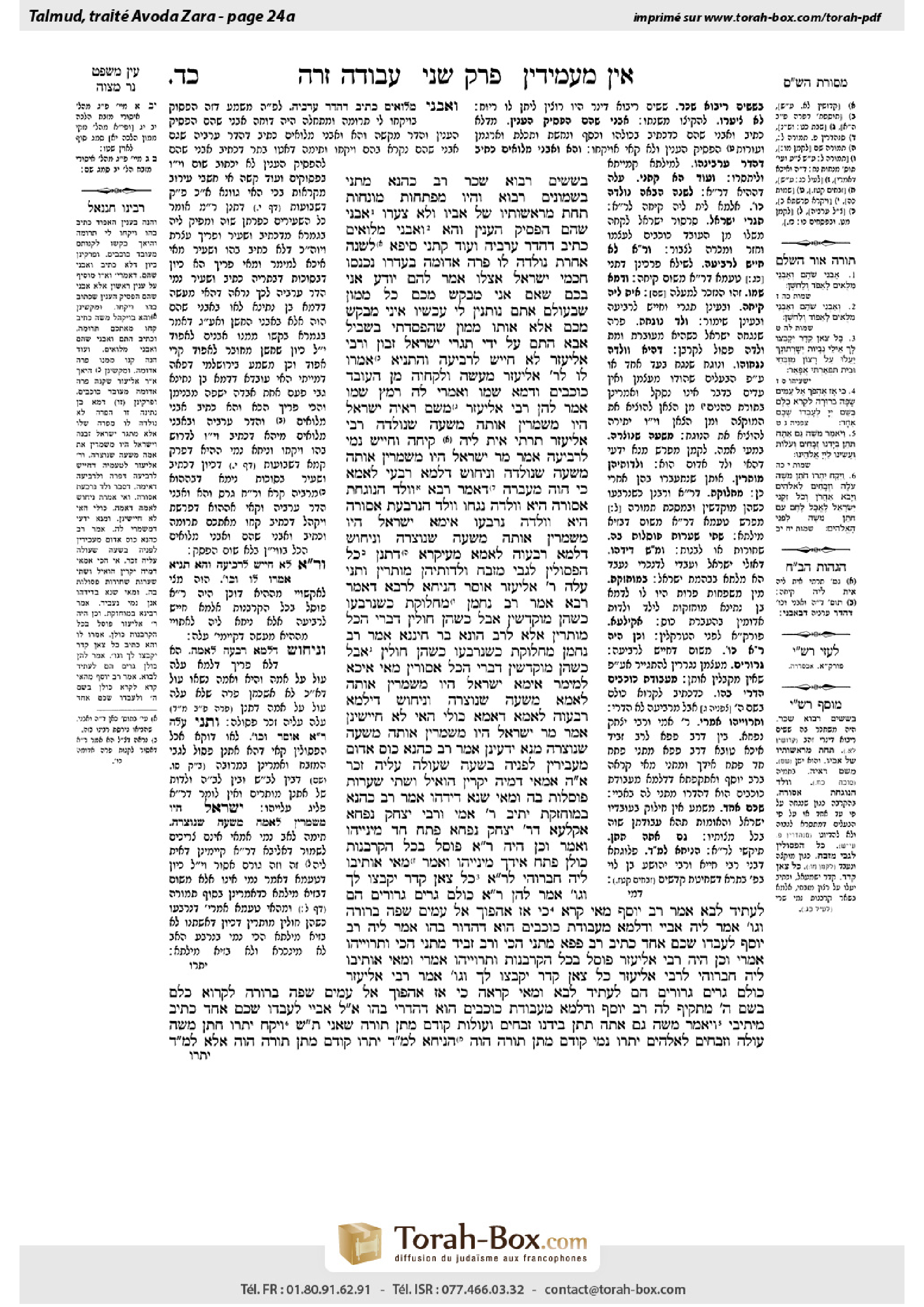
Avodah Zarah 24a: Talmud study for Daf Yomi
Study the Talmud for Daf Yomi with scanned pages, Hebrew text, English translations from Sefaria and AI-generated French translations.
Passage selection and English or AI-generated French translation are available where the scan has annotations. Daf Study is independent of Torah-Box and Sefaria.
Browse Avodah Zarah · עבודה זרה · All tractatesAvodah Zarah 24a text and translations
This page of Avodah Zarah includes the Aramaic text, an English translation and an AI-generated French translation, alongside the scan above.
עבודה זרה כ״ד א · Aramaic and Hebrew text
בְּשִׁשִּׁים רִבּוֹא שָׂכָר, רַב כָּהֲנָא מַתְנֵי בִּשְׁמוֹנִים רִבּוֹא, וְהָיוּ מַפְתְּחוֹת מוּנָּחוֹת תַּחַת מְרַאֲשׁוֹתָיו שֶׁל אָבִיו, וְלֹא צַּעֲרוֹ.
״אַבְנֵי שֹׁהַם״ הִפְסִיק הָעִנְיָן, וְהָא ״וְאַבְנֵי מִלּוּאִים״ כְּתִיב, דַּהֲדַר עָרְבֵיהּ!
וְעוֹד, קָתָנֵי סֵיפָא: לְשָׁנָה אַחֶרֶת נוֹלְדָה לוֹ פָּרָה אֲדוּמָּה בְּעֶדְרוֹ, נִכְנְסוּ חַכְמֵי יִשְׂרָאֵל אֶצְלוֹ. אָמַר לָהֶם: יוֹדֵעַ אֲנִי בָּכֶם שֶׁאִם אֲנִי מְבַקֵּשׁ מִכֶּם כׇּל מָמוֹן שֶׁבָּעוֹלָם אַתֶּם נוֹתְנִין לִי, עַכְשָׁיו אֵינִי מְבַקֵּשׁ מִכֶּם אֶלָּא אוֹתוֹ מָמוֹן שֶׁהִפְסַדְתִּי בִּשְׁבִיל אַבָּא.
הָתָם, עַל יְדֵי תַּגָּרֵי יִשְׂרָאֵל זְבוּן.
וְרַבִּי אֱלִיעֶזֶר לָא חָיֵישׁ לִרְבִיעָה?
וְהָתַנְיָא, אָמְרוּ לוֹ לְרַבִּי אֱלִיעֶזֶר: מַעֲשֶׂה וּלְקָחוּהָ מִן הַגּוֹי, וְדָמָא שְׁמוֹ, וְאָמְרִי לַהּ רֶמֶץ שְׁמוֹ. אָמַר לָהֶן רַבִּי אֱלִיעֶזֶר: מִשָּׁם רְאָיָה? יִשְׂרָאֵל הָיוּ מְשַׁמְּרִין אוֹתָהּ מִשָּׁעָה שֶׁנּוֹלְדָה! רַבִּי אֱלִיעֶזֶר תַּרְתֵּי אִית לֵיהּ: קִיחָה, וְחָיֵישׁ נָמֵי לִרְבִיעָה.
אָמַר מָר: יִשְׂרָאֵל הָיוּ מְשַׁמְּרִין אוֹתָהּ מִשָּׁעָה שֶׁנּוֹלְדָה. וְנֵיחוּשׁ דִּלְמָא רָבְעִי לְאִמַּהּ כִּי הֲוָה מְעַבְּרָה! דְּאָמַר רָבָא: וְולַד הַנּוֹגַחַת אֲסוּרָה — הִיא וּוְלָדָהּ נָגְחוּ, וְולַד הַנִּרְבַּעַת אֲסוּרָה — הִיא וּוְלָדָהּ נִרְבְּעוּ. אֵימָא: יִשְׂרָאֵל הָיוּ מְשַׁמְּרִין אוֹתָהּ מִשָּׁעָה שֶׁנּוֹצְרָה.
וְנֵיחוּשׁ דִּלְמָא רַבְעוּהָ לְאִמַּהּ מֵעִיקָּרָא! דִּתְנַן: כׇּל הַפְּסוּלִין לְגַבֵּי מִזְבֵּחַ — וַלְדוֹתֵיהֶן מוּתָּרִין, וְתָנֵי עֲלַהּ: רַבִּי אֱלִיעֶזֶר אוֹסֵר.
הָנִיחָא לְרָבָא, דְּאָמַר רָבָא אָמַר רַב נַחְמָן: מַחְלוֹקֶת כְּשֶׁנִּרְבְּעוּ כְּשֶׁהֵן מוּקְדָּשִׁין, אֲבָל כְּשֶׁהֵן חוּלִּין — דִּבְרֵי הַכֹּל מוּתָּרִין.
אֶלָּא לְרַב הוּנָא בַּר חִינָּנָא אָמַר רַב נַחְמָן: מַחְלוֹקֶת כְּשֶׁנִּרְבְּעוּ כְּשֶׁהֵן חוּלִּין, אֲבָל כְּשֶׁהֵן מוּקְדָּשִׁין — דִּבְרֵי הַכֹּל אֲסוּרִין, מַאי אִיכָּא לְמֵימַר?
אֵימָא: יִשְׂרָאֵל הָיוּ מְשַׁמְּרִין אוֹתָהּ לְאִמָּהּ מִשָּׁעָה שֶׁנּוֹצְרָה. וְנֵיחוּשׁ דִּילְמָא רַבְעוּהָ לְאִמָּא דְּאִמַּהּ! כּוּלֵּי הַאי לָא חָיְישִׁינַן.
אָמַר מָר: יִשְׂרָאֵל הָיוּ מְשַׁמְּרִין אוֹתָהּ מִשָּׁעָה שֶׁנּוֹצְרָה. מְנָא יָדְעִינַן? אָמַר רַב כָּהֲנָא: כּוֹס אָדוֹם מַעֲבִירִין לְפָנֶיהָ בְּשָׁעָה שֶׁעוֹלֶה עָלֶיהָ זָכָר.
אִי הָכִי, אַמַּאי דָּמֶיהָ יְקָרִין? הוֹאִיל וּשְׁתֵּי שְׂעָרוֹת פּוֹסְלוֹת בָּהּ. וּמַאי שְׁנָא דִּידְהוּ? אָמַר רַב כָּהֲנָא: בְּמוּחְזֶקֶת.
יָתֵיב רַבִּי אַמֵּי וְרַבִּי יִצְחָק נַפָּחָא אַקִּלְעָא דְּרַבִּי יִצְחָק נַפָּחָא, פְּתַח חַד מִינַּיְיהוּ וַאֲמַר: וְכֵן הָיָה רַבִּי אֱלִיעֶזֶר פּוֹסֵל בְּכׇל הַקָּרְבָּנוֹת כּוּלָּן.
פְּתַח אִידַּךְ מִינַּיְיהוּ וְאָמַר: מַאי אוֹתִיבוּ לֵיהּ חַבְרוֹהִי לְרַבִּי אֱלִיעֶזֶר? ״כׇּל צֹאן קֵדָר יִקָּבְצוּ לָךְ וְגוֹ׳״! אָמַר לָהֶן רַבִּי אֱלִיעֶזֶר: כּוּלָּם גֵּרִים גְּרוּרִים הֵם לֶעָתִיד לָבֹא.
אָמַר רַב יוֹסֵף: מַאי קְרָא? ״כִּי אָז אֶהְפֹּךְ אֶל עַמִּים שָׂפָה בְרוּרָה וְגוֹ׳״. אֲמַר לֵיהּ אַבָּיֵי: וְדִלְמָא מֵעֲבוֹדָה זָרָה הוּא דַּהֲדוּר בְּהוּ? אֲמַר לֵיהּ רַב יוֹסֵף: ״לְעׇבְדוֹ שְׁכֶם אֶחָד״ כְּתִיב.
רַב פָּפָּא מַתְנֵי הָכִי, וְרַב זְבִיד מַתְנֵי הָכִי, וְתַרְוַיְיהוּ אָמְרִי: וְכֵן הָיָה רַבִּי אֱלִיעֶזֶר פּוֹסֵל בְּכׇל הַקָּרְבָּנוֹת, וְתַרְוַיְיהוּ אָמְרִי: וּמַאי אוֹתִיבוּ לֵיהּ חַבְרוֹהִי לְרַבִּי אֱלִיעֶזֶר? ״כׇּל צֹאן קֵדָר יִקָּבְצוּ לָךְ וְגוֹ׳״, אָמַר רַבִּי אֱלִיעֶזֶר: כּוּלָּם גֵּרִים גְּרוּרִים הֵם לֶעָתִיד לָבֹא.
וּמַאי קְרָאָה? ״כִּי אָז אֶהְפֹּךְ אֶל עַמִּים שָׂפָה בְרוּרָה לִקְרֹא כֻלָּם בְּשֵׁם ה׳״. מַתְקֵיף לַהּ רַב יוֹסֵף: וְדִלְמָא מֵעֲבוֹדָה זָרָה הוּא דְּהָדְרִי בְּהוּ? אֲמַר לֵיהּ אַבָּיֵי: ״לְעׇבְדוֹ שְׁכֶם אֶחָד״ כְּתִיב.
מֵיתִיבִי: ״וַיֹּאמֶר מֹשֶׁה גַּם אַתָּה תִּתֵּן בְּיָדֵנוּ זְבָחִים וְעֹלֹת״! קוֹדֶם מַתַּן תּוֹרָה שָׁאנֵי.
תָּא שְׁמַע: ״וַיִּקַּח יִתְרוֹ חֹתֵן מֹשֶׁה עֹלָה וּזְבָחִים לֵאלֹהִים״! יִתְרוֹ נָמֵי קוֹדֶם מַתַּן תּוֹרָה הֲוָה. הָנִיחָא לְמַאן דְּאָמַר: יִתְרוֹ קוֹדֶם מַתַּן תּוֹרָה הֲוָה, אֶלָּא לְמַאן דְּאָמַר:
Avodah Zarah 24a · English translation
for six hundred thousand gold dinars’ profit, and Rav Kahana teaches that it was eight hundred thousand dinars’ profit. But the keys to the chest holding the jewels were placed under his father’s head, and he would not disturb him. It is evident from this story that the stones of the ephod may be purchased from gentiles. If so, Rabbi Eliezer’s reasoning cannot be based on Numbers 19:2, as an identical phrase appears in Exodus 25:2, and yet contributions to the Tabernacle may be accepted from gentiles.
The Gemara answers that the phrase “onyx stones” (Exodus 25:7) concluded discussion of that matter. In other words, almost all the items listed in Exodus, chapter 25, for the contributions to the Tabernacle, are joined by the conjunction “and.” Before the verse mentions the stones for the ephod, it states “onyx stones,” without the conjunction “and.” This omission serves to disconnect these stones from the earlier phrase: “That they take” (Exodus 25:2), which means that the disqualification of items purchased from gentiles for use in the Temple derived from this phrase does not apply to the items listed after that point, including the stones of the ephod. The Gemara asks: But isn’t it subsequently written: “And stones to be set,” by which the verse goes back and combines the list, so that the earlier verse applies once more? Accordingly, it should be prohibited to purchase any of the items listed in the verse from gentiles.
The Gemara adds: And furthermore, the latter clause teaches: In a subsequent year, a red heifer was born in Dama’s herd and the Sages of Israel approached him, seeking to purchase the heifer. Dama said to them: I know concerning you that if I were to ask from you all the money in the world, you would give it to me. Now I am requesting from you only that amount of money which I lost by refraining from waking my father. This latter clause explicitly states that the Sages intended to purchase a red heifer from a gentile, which contradicts the ruling of Rabbi Eliezer.
The Gemara answers: There, it was through the agency of Jewish merchants that they purchased the heifer. In other words, Jewish merchants purchased the heifer from Dama ben Netina, after which the Sages acquired the animal from the merchants to be used as a red heifer of purification. In this manner, the animal was purchased for the purpose of an offering from Jews.
According to Sheila, Rabbi Eliezer’s reason for not allowing a red heifer to be purchased from gentiles is based on a derivation from a verse rather than a concern that a person may have engaged in bestiality with it. The Gemara therefore asks: And is Rabbi Eliezer not concerned about the possibility that a person has engaged in bestiality with the animal?
The Gemara elaborates: But isn’t it taught in a baraita that the Rabbis who hold that the heifer may be purchased from a gentile said to Rabbi Eliezer: There was an incident in which Jews purchased the red heifer from a gentile, and Dama was his name. And some say Remetz was his name. In response to this claim, Rabbi Eliezer said to them: Can one bring a proof from there? Certainly not, as Jews were safeguarding it from the time that it was born, to ensure that a person did not engage in bestiality with it. Contrary to the opinion of Sheila, it is evident from here that Rabbi Eliezer was concerned about this possibility. The Gemara explains that Rabbi Eliezer has two requirements: The purchase of the red heifer must be from a Jew, and he is also concerned about the possibility that a person had engaged in bestiality with the animal.
The Gemara analyzes Rabbi Eliezer’s statement. The Master said: Jews were safeguarding the red heifer purchased from Dama ben Netina from the time that it was born. The Gemara asks: And let us be concerned that perhaps gentiles engaged in bestiality with the mother while she was pregnant, as Rava says: The offspring of an animal that gored and killed a Jew is forbidden as an offering, as it is considered as if she and her offspring together gored. And similarly, the offspring of an animal that was the object of bestiality is forbidden because it is considered as if a person engaged in bestiality with both her and her offspring. The Gemara answers: Say that Rabbi Eliezer meant that Jews were safeguarding it from the time that it was conceived.
The Gemara asks: And let us be concerned that perhaps they engaged in bestiality with the mother from the outset, i.e., before conception, as we learned in a mishna (Temura 30b): With regard to all animals that are disqualified for the altar, such as one that was the object of bestiality, sacrifice of their offspring is permitted; and it is taught with regard to this case that Rabbi Eliezer prohibits their offspring from being sacrificed on the altar. If this is the case, Rabbi Eliezer should agree that there is a concern that a person might have engaged in bestiality with the heifer’s mother at some point before its birth.
The Gemara clarifies the difficulty: Granted, this works out well according to the opinion of Rava, as Rava says that Rav Naḥman says: The dispute between the Rabbis and Rabbi Eliezer applies only when a person engaged in bestiality with the animals when they were consecrated and then they conceived, as Rabbi Eliezer holds that in that case the offspring are disqualified from being sacrificed as offerings; but if someone engaged in bestiality with the animals when they were non-sacred, everyone agrees that the offspring are permitted. Accordingly, it needs to be ascertained only that no one engaged in bestiality with the mother after she was consecrated.
But according to the opinion of Rav Huna bar Ḥinnana, who says that Rav Naḥman says: The dispute applies only when a person engaged in bestiality with the animals when they were non-sacred, but if someone engaged in bestiality with them when they were consecrated, everyone agrees that the offspring are forbidden, what is there to say? According to this opinion, Rabbi Eliezer should be concerned that a person might have engaged in bestiality with the animal prior to conception.
The Gemara answers: Say that Jews were safeguarding it as well, i.e., the mother of the red heifer, from the time that it was conceived. The Gemara challenges: And let us be concerned that perhaps someone engaged in bestiality with the mother of the heifer’s mother. The Gemara responds: We are not concerned to such an extent.
The Gemara discusses the revised version of Rabbi Eliezer’s statement. The Master said above: Jews were safeguarding the red heifer from the time that it was conceived. The Gemara asks: From where do we know that the mother would give birth to a red heifer, which would warrant safeguarding her? Rav Kahana says: They would pass a red cup before her while the male mounts her, an act that would cause the offspring to be red.
The Gemara asks: If that is so, and the birth of a red heifer can be induced in such a simple manner, why is its price so expensive? The Gemara answers: Since two hairs of a different color render the red heifer unfit, this method is unreliable. The Gemara asks another question: And what is different about these cows? Why did the Jews resort to purchasing the red heifer from a gentile when they could have induced its conception themselves? Rav Kahana said: Dama ben Netina owned a herd of cattle that were known to beget red heifers, and therefore they preferred to employ the aforementioned method with one of his cows.
§ The Gemara relates: Rabbi Ami and Rabbi Yitzḥak Nappaḥa were sitting on Rabbi Yitzḥak Nappaḥa’s porch. One of them began and said that the baraita teaches: And, similarly, Rabbi Eliezer would disqualify all offerings purchased from gentiles, due to the concern that a person had engaged in bestiality with the animals.
The other one of them began and said: What did Rabbi Eliezer’s colleagues respond to him? They quoted the verse: “All flocks of Kedar shall be gathered together unto you, the rams of Nebaioth shall minister unto you; they shall come up with acceptance upon My altar” (Isaiah 60:7). This verse clearly indicates that offerings will be accepted from gentiles. Rabbi Eliezer said to them: In the future all gentiles will be calculating converts, i.e., those who converted for personal gain, and as converts, they will not be suspected of engaging in bestiality.
Rav Yosef said: What is the verse from which it is derived that they will convert? The verse states: “For then will I turn to the peoples a pure language, that they may all call upon the name of the Lord, to serve Him with one consent” (Zephaniah 3:9). This verse indicates that all nations will worship God. Abaye said to him: But perhaps it is only from idol worship that they will withdraw, while they will still engage in forbidden sexual relations, including bestiality? Rav Yosef said to him: That cannot be, as it is written at the conclusion of the verse: “To serve Him with one consent,” which indicates that the gentiles will accept all of God’s mitzvot.
The Gemara comments: Rav Pappa teaches that discussion in this manner, but Rav Zevid teaches it in this manner: Both Rabbi Ami and Rabbi Yitzḥak Nappaḥa said: And similarly, Rabbi Eliezer would disqualify all offerings taken from gentiles. And both said: What did Rabbi Eliezer’s colleagues respond to him? They quoted the verse: “All flocks of Kedar shall be gathered together unto you, the rams of Nebaioth shall minister unto you; they shall come up with acceptance upon My altar.” Rabbi Eliezer said to them: All gentiles will be calculating converts in the future.
Rabbi Eliezer continues: And what is the verse from which it is derived that they will convert? It is from the verse: “For then will I turn to the peoples a pure language, that they may all call upon the name of the Lord, to serve him with one consent.” Rav Yosef objects to this proof: But perhaps it is only from idol worship that they will withdraw? Abaye said to him: That cannot be, as it is written: “To serve Him with one consent.”
§ The Gemara cites a series of verses which present difficulties with regard to the claim that animals purchased from gentiles may not be used as offerings. The Gemara raises an objection from the following verse: “And Moses said: You must also give into our hand offerings and burnt-offerings that we may sacrifice unto the Lord our God” (Exodus 10:25). Moses demanded that Pharaoh provide the Jews with offerings, despite the fact that he was a gentile. The Gemara explains: The halakha prior to the giving of the Torah was different, as at that time it was acceptable to use animals taken from gentiles as offerings.
The Gemara raises another objection: Come and hear a proof from the verse: “And Yitro, Moses’ father-in-law, took a burnt-offering and offerings for God” (Exodus 18:12). Yitro was not a Jew, and yet he brought offerings for God. The Gemara answers: The incident with Yitro was also prior to the giving of the Torah. The Gemara observes: Granted, this works out well according to the one who says that the incident with Yitro was prior to the giving of the Torah. But according to the one who says that
Avodah Zarah 24a · Traduction française (IA)
pour un profit de six cent mille dinars d'or, et Rav Kahana enseigne que le profit était de huit cent mille dinars. Mais les clés du coffre contenant les pierres étaient placées sous la tête de son père, et il ne voulait pas le déranger. Il est évident de cette histoire que les pierres de l'éphod peuvent être achetées auprès des non-Juifs. Si c'est le cas, la raisonnement de Rabbi Eliezer ne peut pas s'appuyer sur Nombres 19:2, car une phrase identique apparaît dans Exode 25:2, et pourtant des contributions pour le Tabernacle peuvent être acceptées auprès des non-Juifs.
La Guemara répond que la phrase « pierres d'onyx » (Exode 25:7) conclut la discussion sur ce sujet. En d'autres termes, presque tous les objets listés dans Exode, chapitre 25, pour les contributions au Tabernacle, sont joints par la conjonction « et ». Avant que la paragraphe mentionne les pierres pour l'éphod, il dit « pierres d'onyx », sans la conjonction « et ». Cette omission sert à détacher ces pierres de la phrase précédente : « Que l'on prenne » (Exode 25:2), qui signifie que l'interdiction d'acheter des objets auprès des non-Juifs pour l'usage du Temple dérivée de cette phrase ne s'applique pas aux objets listés après ce point, y compris les pierres de l'éphod. La Guemara demande : Mais n'est-il pas ensuite écrit : « Et des pierres à placer », par lequel la paragraphe revient et combine la liste, de sorte que la phrase précédente s'applique à nouveau ? Ainsi, il devrait être interdit d'acheter tout objet listé dans la paragraphe auprès des non-Juifs.
La Guemara ajoute : Et de plus, cette dernière clause enseigne : L'année suivante, une vache rouge naquit dans la troupe de Dama et les Sages d'Israël s'approchèrent de lui, cherchant à acheter la vache. Dama dit à eux : Je sais à votre sujet que si je demandais à vous tout l'argent du monde, vous me le donneriez. Maintenant, je demande à vous seulement cette somme d'argent que j'ai perdu en ne dérangeant pas mon père. Cette dernière clause affirme explicitement que les Sages souhaitaient acheter une vache rouge auprès d'un non-Juif, ce qui contredit la décision de Rabbi Eliezer.
La Guemara répond : Là, c'était par l'intermédiaire des marchands juifs qu'ils achetèrent la vache. En d'autres termes, les marchands juifs achetèrent la vache à Dama ben Netina, après quoi les Sages acquérir l'animal des marchands pour être utilisé comme une vache rouge de purification. Ainsi, l'animal a été acheté à des fins d'offrande par des Juifs.
Selon Sheila, la raison pour laquelle Rabbi Eliezer ne permet pas d'acheter une vache rouge auprès des non-Juifs est basée sur une dérivation d'un verset plutôt que sur une préoccupation que quelqu'un ait eu un rapport bestial avec elle. La Guemara demande donc : Et Rabbi Eliezer n'est-il pas préoccupé par la possibilité qu'une personne ait eu un rapport bestial avec l'animal ?
La Guemara développe : Mais n'est-il pas enseigné dans une baraïta que les Rabbins qui pensent que la vache rouge peut être achetée auprès d'un non-Juif dirent à Rabbi Eliezer : Il y avait un incident où les Juifs achetèrent la vache rouge auprès d'un non-Juif, et son nom était Dama. Et certains disent Remetz. En réponse à cette allégation, Rabbi Eliezer dit à eux : Peut-on tirer une preuve de là ? Certainement pas, car les Juifs la protégeaient depuis qu'elle était née, pour s'assurer qu'une personne n'avait pas eu de rapport bestial avec elle. Contrairement à l'opinion de Sheila, il est évident d'ici que Rabbi Eliezer était préoccupé par cette possibilité. La Guemara explique que Rabbi Eliezer a deux exigences : l'achat de la vache rouge doit être fait par un Juif, et il est également préoccupé par la possibilité qu'une personne ait eu un rapport bestial avec l'animal.
La Guemara analyse l'affirmation de Rabbi Eliezer. Le Maître dit : Les Juifs protégeaient la vache rouge achetée auprès de Dama ben Netina depuis qu'elle était née. La Guemara demande : Et soyons-nous préoccupés que peut-être les non-Juifs aient eu un rapport bestial avec la mère pendant sa grossesse, comme Rava dit : L'offspring d'un animal qui a écrasé et tué un Juif est interdit comme offrande, car il est considéré comme si elle et ses enfants ensemble avaient écrasé. De même, l'offspring d'un animal qui a été l'objet d'un rapport bestial est interdit car il est considéré comme si une personne avait eu un rapport bestial avec elle et ses enfants. La Guemara répond : Dites que Rabbi Eliezer voulait dire que les Juifs la protégeaient depuis qu'elle était conçue.
La Guemara demande : Et soyons-nous préoccupés que peut-être ils ont eu un rapport bestial avec la mère dès le début, c'est-à-dire avant la conception, comme nous l'avons appris dans une mitsna (Temura 30b) : Concernant tous les animaux disqualifiés pour l'autel, tels qu'un animal qui a été l'objet d'un rapport bestial, la sacrifice de leurs enfants est permis ; et il est enseigné concernant ce cas que Rabbi Eliezer interdit la sacrifice de leurs enfants sur l'autel. Si c'est le cas, Rabbi Eliezer devrait accepter que l'on ait une préoccupation que quelqu'un ait eu un rapport bestial avec la vache avant sa naissance.
La Guemara clarifie la difficulté : En effet, cela fonctionne bien selon l'opinion de Rava, car Rava dit que Rav Naḥman dit : Le débat entre les Rabbins et Rabbi Eliezer s'applique uniquement lorsque quelqu'un a eu un rapport bestial avec les animaux lorsqu'ils étaient consacrés et ensuite ils ont conçu, car Rabbi Eliezer considère que dans ce cas les enfants sont disqualifiés pour être sacrifiés comme offrandes ; mais si quelqu'un a eu un rapport bestial avec les animaux lorsqu'ils étaient non consacrés, tout le monde convient que les enfants sont permis. Ainsi, il faut déterminer uniquement que personne n'a eu un rapport bestial avec la mère après qu'elle ait été consacrée.
Mais selon l'opinion de Rav Huna bar Ḥinnana, qui dit que Rav Naḥman dit : Le débat s'applique uniquement lorsque quelqu'un a eu un rapport bestial avec les animaux lorsqu'ils étaient non consacrés, mais si quelqu'un a eu un rapport bestial avec eux lorsqu'ils étaient consacrés, tout le monde convient que les enfants sont interdits, que dire alors ? Selon cette opinion, Rabbi Eliezer devrait être préoccupé que quelqu'un ait eu un rapport bestial avec l'animal avant la conception.
La Guemara répond : Disons que les Juifs le protégeaient également, c'est-à-dire la mère de la vache rouge, depuis qu'elle était conçue. La Guemara soulève un doute : Et peut-être devons-nous craindre que quelqu'un ait eu des relations avec la mère de la mère de la vache rouge. La Guemara répond : Nous ne craignons pas autant cela.
La Guemara discute de la version corrigée de l'affirmation du maître Rabbi Eliezer. Le Maître dit ci-dessus : Les Juifs le protégeaient depuis qu'elle était conçue. La Guemara pose une question : D'où savons-nous que la mère donnerait naissance à une vache rouge, ce qui justifierait sa protection ? Rav Kahana dit : Ils présentaient une coupe rouge devant elle pendant que le mâle la montait, une action qui provoquerait que l'offspring soit rouge.
La Guemara pose une question : Si c'est ainsi, et que la naissance d'une vache rouge peut être induite de manière aussi simple, pourquoi son prix est-il si élevé ? La Guemara répond : Puisque deux poils de couleur différente rendent la vache rouge inutilisable, cette méthode est peu fiable. La Guemara pose une autre question : Et qu'y a-t-il de particulier dans ces vaches ? Pourquoi les Juifs ont-ils recours à l'achat de la vache rouge auprès d'un non-Juif lorsqu'ils pouvaient induire sa conception eux-mêmes ? Rav Kahana dit : Dama ben Netina possédait une troupe de bœufs connus pour engendrer des vaches rouges, et c'est pourquoi ils préféraient employer la méthode mentionnée avec l'un de ses bœufs.
§ La Guemara relate : Rabbi Ami et Rabbi Yitzḥak Nappaḥa étaient assis sur le porche de Rabbi Yitzḥak Nappaḥa. L'un d'eux commença et dit que la baraïta enseigne : Et de même, Rabbi Eliezer disqualifiait tous les sacrifices achetés auprès des non-Juifs, en raison de la crainte qu'une personne ait eu des relations avec les animaux.
L'autre d'eux commença et dit : Quelle fut la réponse des collègues de Rabbi Eliezer à cela ? Ils citaient la versette : « Toutes les troupeaux de Kedar seront rassemblés vers toi, les béliers de Nebaioth te serviront, ils monteront avec acceptation sur mon autel » (Isaïe 60:7). Ce verset indique clairement que des sacrifices seront acceptés des non-Juifs. Rabbi Eliezer dit à eux : À l'avenir, tous les non-Juifs seront des convertis calculés, c'est-à-dire ceux qui se sont convertis pour leur propre avantage, et comme des convertis, ils ne seront pas soupçonnés d'avoir eu des relations avec les animaux.
Rav Yosef dit : De quelle versette tire-t-on que cela se produira ? La versette dit : « Car alors je tournerai vers les peuples une langue pure, afin qu'ils invoquent tous le nom du Seigneur, pour le servir d'unanimité » (Zacharie 3:9). Ce versette indique que tous les peuples adoreront Dieu. Abaye dit à lui : Mais peut-être s'agit-il seulement de quitter l'idolâtrie, tandis qu'ils continueront encore des relations sexuelles interdites, y compris l'animalité ? Rav Yosef dit à lui : Cela ne peut pas être, car il est écrit à la fin de la versette : « Pour le servir d'unanimité », ce qui indique que les non-Juifs accepteront toutes les mitsvot de Dieu.
La Guemara commente : Rav Pappa enseigne cette discussion de cette manière, mais Rav Zevid l'enseigne de cette manière : Rabbi Ami et Rabbi Yitzḥak Nappaḥa dirent tous les deux : Et de même, Rabbi Eliezer disqualifiait tous les sacrifices pris auprès des non-Juifs. Et les deux dirent : Quelle a été la réponse des collègues de Rabbi Eliezer à cela ? Ils citaient le verset : « Toutes les troupeaux de Kedar seront rassemblés vers toi, les béliers de Nebaioth te serviront, ils monteront avec acceptation sur mon autel. » Rabbi Eliezer dit à eux : Tous les non-Juifs seront des convertis calculés à l'avenir.
Rabbi Eliezer continue : Et de quel verset tire-t-on que cela se produira ? C'est du verset : « Car alors je tournerai vers les peuples une langue pure, afin qu'ils invoquent tous le nom du Seigneur, pour le servir d'unanimité. » Rav Yosef s'oppose à cette preuve : Mais peut-être s'agit-il seulement de quitter l'idolâtrie ? Abaye dit à lui : Cela ne peut pas être, car il est écrit : « Pour le servir d'unanimité. »
§ La Guemara cite une série de versets qui posent des difficultés concernant l'affirmation que les animaux achetés auprès des non-Juifs ne peuvent pas être utilisés comme sacrifices. La Guemara soulève un contre-argument à partir du verset suivant : « Et Moïse dit : Vous devez aussi donner en notre main des offrandes et des holocaustes que nous puissions sacrifier au Seigneur notre Dieu » (Exode 10:25). Moïse exigea que Pharaon fournisse aux Juifs des offrandes, malgré le fait qu'il était un non-Juif. La Guemara explique : La halakha avant la révélation de la Torah était différente, car à cette époque il était acceptable d'utiliser des animaux pris auprès des non-Juifs comme offrandes.
La Guemara soulève un autre contre-argument : Viens écouter une preuve tirée du verset : « Et Yitro, le beau-père de Moïse, apporta un holocauste et des offrandes à Dieu » (Exode 18:12). Yitro n'était pas juif, et pourtant il apporta des offrandes à Dieu. La Guemara répond : L'incident de Yitro était également avant la révélation de la Torah. La Guemara observe : Cela fonctionne bien selon celui qui dit que l'incident de Yitro était avant la révélation de la Torah. Mais selon celui qui dit que
Traduction française générée par IA à partir de l’édition anglaise de Sefaria. Vérifie toujours un passage avec le texte source.
Text from Sefaria: William Davidson Edition - Vocalized Aramaic (CC BY NC); William Davidson Edition - English (CC BY NC).