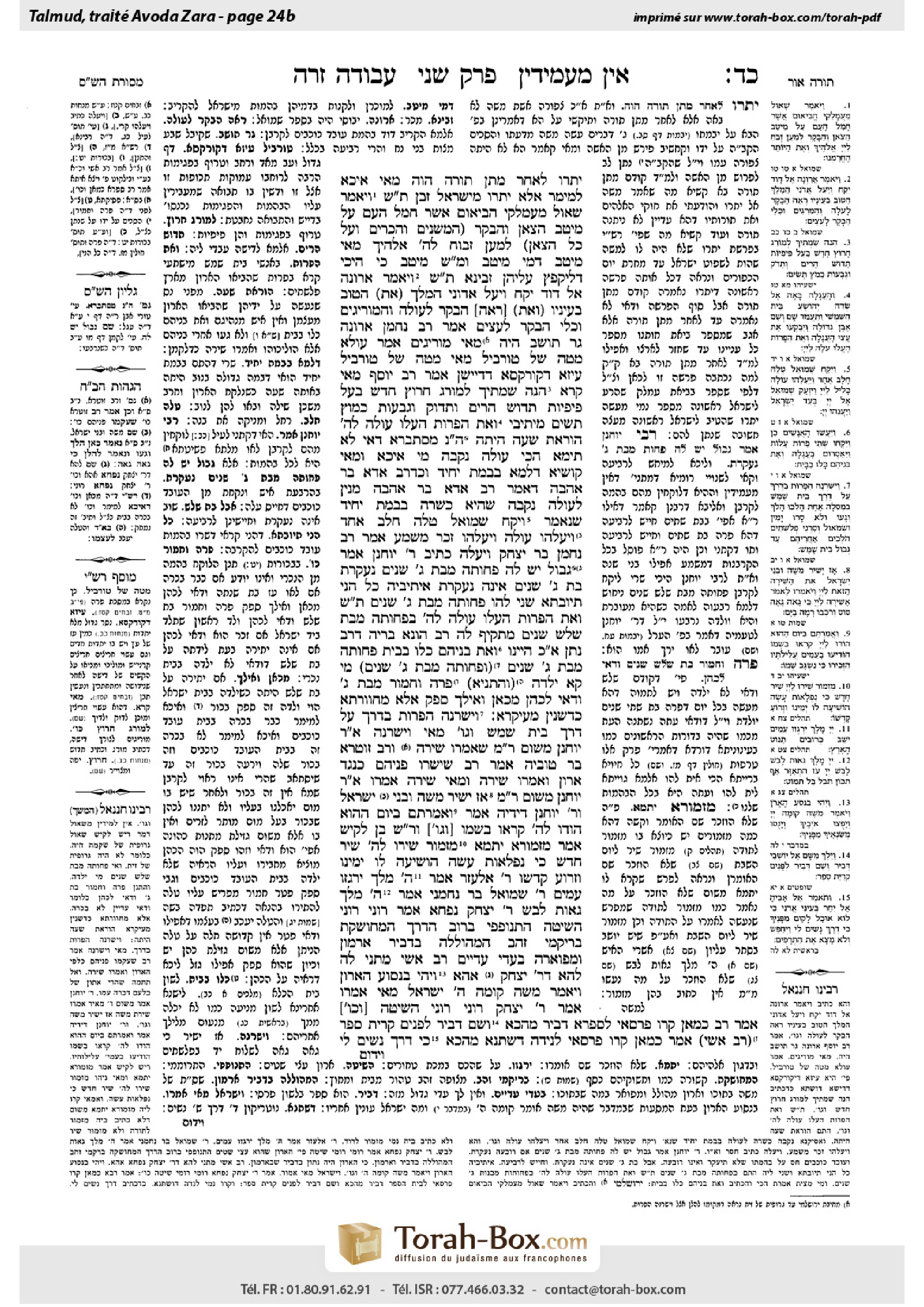
Avodah Zarah 24b: Talmud study for Daf Yomi
Study the Talmud for Daf Yomi with scanned pages, Hebrew text, English translations from Sefaria and AI-generated French translations.
Passage selection and English or AI-generated French translation are available where the scan has annotations. Daf Study is independent of Torah-Box and Sefaria.
Browse Avodah Zarah · עבודה זרה · All tractatesAvodah Zarah 24b text and translations
This page of Avodah Zarah includes the Aramaic text, an English translation and an AI-generated French translation, alongside the scan above.
עבודה זרה כ״ד ב · Aramaic and Hebrew text
יִתְרוֹ לְאַחַר מַתַּן תּוֹרָה הֲוָה, מַאי אִיכָּא לְמֵימַר? אֶלָּא, יִתְרוֹ מִיִּשְׂרָאֵל זְבַן.
תָּא שְׁמַע: ״וַיֹּאמֶר שָׁאוּל מֵעֲמָלֵקִי הֱבִיאוּם אֲשֶׁר חָמַל הָעָם עַל מֵיטַב הַצֹּאן וְהַבָּקָר (הַמִּשְׁנִים וְהַכָּרִים וְעַל כׇּל הַצֹּאן) לְמַעַן זְבֹחַ לַה׳ אֱלֹהֶיךָ״! מַאי ״מֵיטַב״? דְּמֵי מֵיטָב.
וּמַאי שְׁנָא מֵיטָב? כִּי הֵיכִי דְּלִיקְפֹּץ עֲלַיְהוּ זָבֹינָא.
תָּא שְׁמַע: ״וַיֹּאמֶר אֲרַוְנָה אֶל דָּוִד יִקַּח וְיַעַל אֲדֹנִי הַמֶּלֶךְ (אֶת) הַטּוֹב בְּעֵינוֹ (וְאֶת) [רְאֵה] הַבָּקָר לָעֹלָה וְהַמֹּרִגִּים וּכְלֵי הַבָּקָר לָעֵצִים״! אָמַר רַב נַחְמָן: אֲרַוְנָה גֵּר תּוֹשָׁב הָיָה.
מַאי מוֹרִגִּים? אָמַר עוּלָּא: מִטָּה שֶׁל טוּרְבִּיל. מַאי מִטָּה שֶׁל טוּרְבִּיל? עִיזָּא דְּקוּרְקְסָא דְּדָיְישָׁן. אָמַר רַב יוֹסֵף: מַאי קְרָא? ״הִנֵּה שַׂמְתִּיךְ לְמוֹרַג חָרוּץ חָדָשׁ בַּעַל פִּיפִיּוֹת תָּדוּשׁ הָרִים וְתָדֹק וּגְבָעוֹת כַּמֹּץ תָּשִׂים״.
מֵיתִיבִי: ״וְאֶת הַפָּרוֹת הֶעֱלוּ עֹלָה לַה׳״! הוֹרָאַת שָׁעָה הָיְתָה.
הָכִי נָמֵי מִסְתַּבְּרָא, דְּאִי לָא תֵּימָא הָכִי, עוֹלָה נְקֵבָה מִי אִיכָּא?
וּמַאי קוּשְׁיָא? דִּלְמָא בְּבָמַת יָחִיד, וְכִדְרַב אַדָּא בַּר אַהֲבָה, דְּאָמַר רַב אַדָּא בַּר אַהֲבָה: מִנַּיִן לְעוֹלָה נְקֵבָה שֶׁהִיא כְּשֵׁרָה בְּבָמַת יָחִיד? שֶׁנֶּאֱמַר: ״וַיִּקַּח שְׁמוּאֵל טְלֵה חָלָב אֶחָד וַיַּעֲלֵהוּ עוֹלָה״.
״וַיַּעֲלֵהוּ״ — זָכָר מַשְׁמַע! אָמַר רַב נַחְמָן בַּר יִצְחָק: ״וַיַּעֲלֶהָ״ כְּתִיב.
רַבִּי יוֹחָנָן אָמַר: גְּבוּל יֵשׁ לָהּ, פְּחוּתָה מִבַּת שָׁלֹשׁ שָׁנִים — נֶעֱקֶרֶת, בַּת שָׁלֹשׁ שָׁנִים — אֵינָהּ נֶעֱקֶרֶת.
אֵיתִיבֵיהּ כֹּל הָנֵי תְּיוּבָתָא, שַׁנִּי לְהוּ: פְּחוּתָה מִבַּת שָׁלֹשׁ שָׁנִים. תָּא שְׁמַע: ״וְאֶת הַפָּרוֹת הֶעֱלוּ עֹלָה לַה׳״ — בִּפְחוּתָה מִבַּת שָׁלֹשׁ שָׁנִים.
מַתְקֵיף לַהּ רַב הוּנָא בְּרֵיהּ דְּרַב נָתָן: אִם כֵּן, הַיְינוּ ״וְאֶת בְּנֵיהֶם כָּלוּ בַבָּיִת״ — פְּחוּתָה מִבַּת שָׁלֹשׁ שָׁנִים?
וּפְחוּתָה מִבַּת שָׁלֹשׁ שָׁנִים מִי קָא יָלְדָה? וְהָתַנְיָא: פָּרָה וַחֲמוֹר מִבַּת שָׁלֹשׁ — וַדַּאי לַכֹּהֵן, מִכָּאן וְאֵילָךְ — סָפֵק. אֶלָּא מְחַוַּורְתָּא כִּדְשַׁנִּין מֵעִיקָּרָא.
״וַיִּשַּׁרְנָה הַפָּרוֹת בַּדֶּרֶךְ עַל דֶּרֶךְ בֵּית שֶׁמֶשׁ וְגוֹ׳״, מַאי ״וַיִּשַּׁרְנָה״? אָמַר רַבִּי יוֹחָנָן מִשּׁוּם רַבִּי מֵאִיר: שֶׁאָמְרוּ שִׁירָה. וְרַב זוּטְרָא בַּר טוֹבִיָּה אָמַר רַב: שֶׁיִּשְּׁרוּ פְּנֵיהֶם כְּנֶגֶד אָרוֹן וְאָמְרוּ שִׁירָה.
וּמַאי שִׁירָה אָמְרוּ? אָמַר רַבִּי יוֹחָנָן מִשּׁוּם רַבִּי מֵאִיר: ״אָז יָשִׁיר מֹשֶׁה וּבְנֵי יִשְׂרָאֵל״, וְרַבִּי יוֹחָנָן דִּידֵיהּ אָמַר: ״וַאֲמַרְתֶּם בַּיּוֹם הַהוּא הוֹדוּ לַה׳ קִרְאוּ בִשְׁמוֹ וְגוֹ׳״.
וְרַבִּי שִׁמְעוֹן בֶּן לָקִישׁ אָמַר: מִזְמוֹרָא יַתְמָא, ״מִזְמוֹר שִׁירוּ לַה׳ שִׁיר חָדָשׁ כִּי נִפְלָאוֹת עָשָׂה הוֹשִׁיעָה לּוֹ יְמִינוֹ וּזְרוֹעַ קׇדְשׁוֹ״. רַבִּי אֶלְעָזָר אָמַר: ״ה׳ מָלָךְ יִרְגְּזוּ עַמִּים״.
רַבִּי שְׁמוּאֵל בַּר נַחְמָנִי אָמַר: ״ה׳ מָלָךְ גֵּאוּת לָבֵשׁ״. רַבִּי יִצְחָק נַפָּחָא אָמַר: ״רוֹנִּי רוֹנִּי הַשִּׁיטָה, הִתְנוֹפְפִי בְּרוֹב הֲדָרֵךְ, הַמְחוּשֶּׁקֶת בְּרִיקְמֵי זָהָב, הַמְהוּלָּלָה בִּדְבִיר אַרְמוֹן, וּמְפוֹאָרָה בַּעֲדִי עֲדָיִים״.
רַב אָשֵׁי מַתְנֵי לַהּ לְהָא דְּרַבִּי יִצְחָק, אַהָא ״וַיְהִי בִּנְסֹעַ הָאָרֹן וַיֹּאמֶר מֹשֶׁה קוּמָה ה׳״, יִשְׂרָאֵל מַאי אָמְרוּ? אָמַר רַבִּי יִצְחָק: ״רוֹנִּי רוֹנִּי הַשִּׁיטָה״ וְכוּ׳.
אָמַר רַב: כְּמַאן קָרוּ פָּרְסָאֵי לְסָפְרָא ״דְּבִיר״? מֵהָכָא, ״וְשֵׁם דְּבִיר לְפָנִים קִרְיַת סֵפֶר״.
רַב אָשֵׁי אָמַר: כְּמַאן קָרוּ פָּרְסָאֵי לְנִידָּה ״דַּשְׁתָּנָא״? מֵהָכָא, ״כִּי דֶרֶךְ נָשִׁים לִי״.
Avodah Zarah 24b · English translation
the incident involving Yitro was after the giving of the Torah, what is there to say? How could they accept offerings from him? Rather, it must be that Yitro purchased the animals from a Jew.
The Gemara further states: Come and hear another objection from a verse: “And Saul said: They have brought them from the Amalekites; for the people spared the best of the flock and of the herd, to sacrifice unto the Lord your God” (I Samuel 15:15). The verse states explicitly that the Israelites intended to sacrifice animals previously owned by gentiles. The Gemara explains: What is the meaning of the phrase: “The best”? This is referring to the monetary value of the best livestock. The intention was not to sacrifice the animals themselves, but to sell them and use the proceeds of the sale to purchase other animals to sacrifice as offerings.
The Gemara inquires: And what is different about the best animals? If the animals were sold for their value, why sell those animals in particular, rather than several inferior-quality animals? The Gemara explains that they did so in order that buyers would jump at the opportunity to buy superior-quality livestock. In other words, it is easier to sell one superior-quality animal than several inferior-quality ones.
Come and hear another objection from a verse: “And Araunah said unto David: Let my lord the king take and offer up what seems good unto him; behold the cattle for the burnt-offering, and the threshing instruments [morigim] and the accoutrements of the cattle for the wood” (II Samuel 24:22). Apparently, David was willing to accept oxen as offerings from a gentile. Rav Naḥman says: Araunah was a gentile who resided in Eretz Yisrael and observed the seven Noahide mitzvot [ger toshav]. The seven Noahide mitzvot include the prohibition against engaging in bestiality, and therefore Araunah was not suspected of this practice.
Tangentially, the Gemara asks: What is the meaning of the term “morigim,” mentioned in this verse? Ulla said: It is a turbil bed. The Gemara asks: What is a turbil bed? It is a serrated board [kurkesa] used for threshing. Rav Yosef said: What is the verse from which the meaning of morigim is derived? It is derived from the verse: “Behold, I have made you a new threshing board [morag] having sharp teeth; you shall thresh the mountains, and beat them small, and shall make the hills as chaff” (Isaiah 41:15).
The Gemara raises an objection to the opinion of Rabbi Eliezer. After the Philistines returned the Ark of the Covenant to the Israelites upon a cart drawn by cattle, the verse states: “And they sacrificed the cattle as a burnt-offering unto the Lord” (I Samuel 6:14). Evidently, the Jews did not hesitate to sacrifice the Philistines’ animals. The Gemara explains: There, it was a provisional edict issued in extraordinary circumstances, and their actions are not representative of the general halakha.
The Gemara adds: This also stands to reason, as, if you do not say so, one can raise a further difficulty with this episode: Is there a female burnt-offering? Only males may be sacrificed as burnt-offerings. Since the Jews sacrificed the cows as burnt-offerings, it is clear that they were acting unconventionally due to extenuating circumstances.
The Gemara rejects this proof: And what is the difficulty? In other words, the additional problem with the incident, that the animals were female, which is cited as proof that there were extenuating circumstances, is not in fact difficult at all. The Gemara elaborates: Perhaps the cows were offered upon a private altar, and this is in accordance with the opinion of Rav Adda bar Ahava, as Rav Adda bar Ahava says: From where is it derived that a female burnt-offering is fit to be sacrificed upon a private altar? As it is stated: “And Samuel took a milking lamb, and sacrificed it [vaya’alehu] for a burnt-offering unto the Lord” (I Samuel 7:9). The phrase “milking lamb” indicates that it was a female, and yet Samuel sacrificed it upon a private altar.
The Gemara raises a difficulty: But the word vaya’alehu is masculine, which means that the lamb was a male. Rav Naḥman bar Yitzḥak says: Although the word is read in the masculine, it is written in the feminine form, vaya’alah, which teaches that even a female lamb may be sacrificed on a private altar.
§ After concluding its discussion of the opinion of Rabbi Eliezer, the Gemara cites another resolution of the contradiction between the mishna and the baraita. Rabbi Yoḥanan says: There is a clear demarcation in the case of an animal with whom a man engaged in bestiality. If she is less than three years old, she becomes barren as a result of penetration, but if she is already three years old, she does not become barren. Although gentiles are generally suspected of engaging in bestiality, the baraita rules that an animal that is less than three years old may be used as an offering because a gentile will refrain from engaging in bestiality with an animal that may become barren as a result of his actions.
They raised all of those refutations from the aforementioned verses which indicate that animals purchased from gentiles may be brought as offerings, and he answered them by claiming that the animals being offered were less than three years old. The Gemara reexamines one of the objections. Come and hear, as the verse states: “And they sacrificed the cattle as a burnt-offering unto the Lord” (I Samuel 6:14). Rabbi Yoḥanan explained that although in that incident the cattle had been owned by Philistines, they were less than three years old, and it was therefore presumed that the Philistines had not engaged in bestiality with them.
The Gemara cites a refutation of Rabbi Yoḥanan’s answer: Rav Huna, son of Rabbi Natan, objects to this: If so, then this is also true with regard to the verse: “And they took two nursing cows and tied them to the cart and shut up their calves at home” (I Samuel 6:10). According to Rabbi Yoḥanan, the verse is necessarily referring to cows that are less than three years old.
And can a cow that is less than three years old give birth? But isn’t it taught in a baraita: With regard to a cow or a donkey purchased from a gentile when they were less than three years old, the first of their offspring born after the purchase is certainly reserved for the priest, who is entitled to the firstborn of a cow or donkey owned by a Jew. From this point forward, i.e., if they were older than three years at the time of the sale, it is uncertain whether or not the offspring is the firstborn. This indicates that an animal does not bear offspring within the first three years of its life. Since the cows in the verse had already given birth, they could not have been less than three years old, as Rabbi Yoḥanan claimed. The Gemara concludes: Rather, it is clear as we initially answered, i.e., Rabbi Yoḥanan’s suggestion is rejected, and the actions in that verse were due to a provisional edict.
§ The Gemara further analyzes the episode involving the cows sent by the Philistines. The verse states: “And the cattle took the straight [vayyisharna] way, on the way to Beit Shemesh; they went along the highway, lowing as they went” (I Samuel 6:12). The Gemara asks: What is the meaning of the word vayyisharna? Rabbi Yoḥanan says in the name of Rabbi Meir: It means that they recited a song [shira]. And Rav Zutra bar Toviyya says that Rav says: It means that they straightened [yishru] their faces so that they were opposite the Ark and recited a song.
The Gemara asks: And what song did they recite? Rabbi Yoḥanan says in the name of Rabbi Meir: They recited the song that follows the verse: “Then sang Moses and the children of Israel this song unto the Lord” (Exodus 15:1). And Rabbi Yoḥanan himself says that it was: “And on that day shall you say: Give thanks unto the Lord, proclaim His name, declare His doings among the peoples, make mention that His name is exalted” (Isaiah 12:4).
And Rabbi Shimon ben Lakish says that it was an orphaned psalm, i.e., a psalm whose author and the event to which it makes reference are not specified. The psalm begins with: “A Psalm. O sing unto the Lord a new song, for He has done marvelous things; His right hand, and His holy arm, have wrought salvation for Him” (Psalms 98:1). Rabbi Elazar says that it was the psalm beginning with: “The Lord reigns; let the peoples tremble” (Psalms 99:1).
Rabbi Shmuel bar Naḥmani says that it was the Psalm beginning: “The Lord reigns; He is clothed in majesty” (Psalms 93:1). Rabbi Yitzḥak Nappaḥa says: They did not recite a verse found in the Bible, but rather, the following song: Sing, sing, acacia; ascend in all your glory; overlaid with golden embroidery, exalted by the book [devir] of the palace, and magnificent with jewels. The song alludes to the Ark of the Covenant, which was made of acacia wood and covered with gold. The expression: Book of the palace, is a reference to the Torah scroll that was placed in the Ark.
Rav Ashi teaches this statement of Rabbi Yitzḥak in relation to this verse: “And it came to pass, when the Ark set forward, that Moses said: Rise up, O Lord, and let Your enemies be scattered” (Numbers 10:35). The Gemara asks: What did the Jewish people recite at this juncture? Rabbi Yitzḥak says that they recited: Sing, sing, acacia, ascend in all your glory; overlaid with golden embroidery, exalted by the book of the palace, and magnificent with jewels.
§ Apropos the mention of the term devir, the Gemara discusses its etymology. Rav said: On what basis do the Persians call a book [sifra] by the term devir? They derive it from here: “Now the name of Debir [devir] beforehand was Kiriath Sefer” (Judges 1:11). Since the name devir was changed to Kiriath Sefer, the Persians referred to a sifra, i.e., a book, as devir.
The Gemara examines the etymology of another term coined by the Persians. Rav Ashi said: On what basis do the Persians call a menstruating woman by the term dashtana? It is from here, a verse in which Rachel claims to be a menstruating woman: “For the manner of women is upon me [derekh nashim li]” (Genesis 31:35). The word dashtana is a shortened form of the phrase derekh nashim.
Avodah Zarah 24b · Traduction française (IA)
l'incident concernant Yitro s'est produit après la révélations de la Torah, que dire alors ? Comment pouvaient-ils accepter des offrandes de sa part ? Plutôt, il faut comprendre que Yitro a acheté les bêtes à un Juif.
La Guemara ajoute : Viens écouter une autre objection tirée d'une autre verset : « Et Saül dit : Ils les ont apportés des Amalakites ; car le peuple avait épargné les meilleurs du troupeau et de la bétail, pour les sacrifier à l'Éternel votre Dieu » (I Samuel 15:15). Le verset indique explicitement que les Israélites avaient l'intention de sacrifier des bêtes précédemment possédées par des non-Juifs. La Guemara explique : Qu'entend-on par « les meilleurs » ? Cela fait référence à la valeur monétaire des meilleurs animaux. L'intention n'était pas de sacrifier les bêtes elles-mêmes, mais de les vendre et d'utiliser les revenus de la vente pour acheter d'autres bêtes à sacrifier.
La Guemara pose une question : Et qu'y a-t-il de particulier aux meilleurs animaux ? Si les animaux étaient vendus à leur valeur, pourquoi vendre précisément ces animaux plutôt que plusieurs animaux de moindre qualité ? La Guemara explique que cela a été fait afin que les acheteurs soient prêts à acheter des bêtes de qualité supérieure. En d'autres termes, il est plus facile de vendre une seule bête de qualité supérieure que plusieurs bêtes de moindre qualité.
Viens écouter une autre objection tirée d'un verset : « Et Araunah dit à David : Que mon seigneur le roi prenne et offre ce qui lui semble bon ; voici les bœufs pour l'holocauste, et les instruments de faucille [morigim] et les accessoires des bœufs pour le bois » (II Samuel 24:22). Apparemment, David était prêt à accepter des bœufs comme offrandes d'un non-Juif. Rav Naḥman dit : Araunah était un non-Juif résidant en Eretz Yisrael et observant les sept commandements de Noé [ger toshav]. Les sept commandements de Noé incluent la prohibition d'engager en bestialité, et par conséquent Araunah n'était pas soupçonné de cette pratique.
Par ailleurs, la Guemara pose une question : Qu'entend-on par le terme « morigim », mentionné dans ce verset ? Ulla dit : C'est un lit de balayage. La Guemara demande : Qu'est-ce qu'un lit de balayage ? C'est une planche dentelée [kurkesa] utilisée pour battre le grain. Rav Yosef dit : De quel verset tire-t-on la signification de « morigim » ? C'est tiré du verset : « Voici, j'ai fait de toi un nouveau lit de balayage [morag] ayant des dents aiguës ; tu battras les montagnes, et les réduiras en poussière, et tu feras des collines comme de la paille » (Isaïe 41:15).
La Guemara soulève une objection contre l'opinion du Rabbi Eliezer. Après que les Philistins aient rendu l'Arca du Pacte aux Israélites sur un char tiré par des bœufs, le verset dit : « Et ils sacrifièrent les bœufs comme holocauste à l'Éternel » (I Samuel 6:14). Évidemment, les Juifs n'ont pas hésité à sacrifier les bêtes des Philistins. La Guemara explique : Là, il s'agissait d'un édit provisoire émis dans des circonstances extraordinaires, et leurs actions ne sont pas représentatives de la halakha générale.
La Guemara ajoute : Cela est également logique, car, si l'on ne dit pas cela, on peut élever une difficulté supplémentaire avec cet épisode : y a-t-il un holocauste féminin ? Seuls les mâles peuvent être sacrifiés comme holocauste. Puisque les Juifs sacrifièrent les vaches comme holocauste, il est clair qu'ils agissaient de manière inhabituelle en raison de circonstances exceptionnelles.
La Guemara rejette cette preuve : Et quelle est la difficulté ? En d'autres termes, la difficulté supplémentaire liée à l'incident, que les animaux étaient femelles, citée comme preuve qu'il y avait des circonstances exceptionnelles, n'est pas en réalité difficile du tout. La Guemara explique : Peut-être que les vaches étaient offertes sur un autel privé, et cela correspond à l'opinion de Rav Adda bar Ahava, car Rav Adda bar Ahava dit : D'où tire-t-on que la femelle peut être sacrifiée sur un autel privé ? Comme il est dit : « Et Samuel prit une agnelle en train de lait, et sacrifia (vaya'alehu) pour un holocauste à l'Éternel » (I Samuel 7:9). Le terme « agnelle en train de lait » indique qu'il s'agissait d'une femelle, et pourtant Samuel sacrifia cette agnelle sur un autel privé.
La Guemara soulève une difficulté : Mais le mot vaya'alehu est masculin, ce qui signifie que l'agneau était un mâle. Rav Naḥman bar Yitzḥak dit : Bien que le mot soit lu au masculin, il est écrit au féminin, vaya'alah, ce qui enseigne que même une agnelle femelle peut être sacrifiée sur un autel privé.
§ Après avoir conclu sa discussion sur l'opinion du Rabbi Eliezer, la Guemara cite une autre résolution de la contradiction entre la Michna et la baraïta. Rabbi Yoḥanan dit : Il y a une distinction claire dans le cas d'un animal avec lequel un homme a eu un rapport bestial. Si elle est moins de trois ans, elle devient stérile en raison de l'acte, mais si elle est déjà de trois ans, elle ne devient pas stérile. Bien que les non-Juifs soient généralement soupçonnés d'avoir eu un rapport bestial, la baraïta règle que l'animal qui est moins de trois ans peut être utilisé comme offrande car un non-Juif se abstiendra de faire un rapport bestial avec un animal qui pourrait devenir stérile en raison de ses actions.
Ils ont soulevé toutes ces objections tirées des versets mentionnés ci-dessus qui indiquent que les animaux achetés auprès des non-Juifs peuvent être offerts en sacrifice, et il a répondu à toutes ces objections en affirmant que les animaux offerts étaient moins de trois ans. La Guemara reconsidère l'une de ces objections. Viens écouter, comme le verset dit : « Et ils sacrifièrent les bœufs comme holocauste à l'Éternel » (I Samuel 6:14). Rabbi Yoḥanan explique que bien que les bœufs aient été possédés par les Philistins, ils étaient moins de trois ans, et il était donc supposé que les Philistins n'avaient pas eu de rapport bestial avec eux.
La Guemara cite une réfutation de la réponse du Rabbi Yoḥanan : Rav Huna, fils du Rabbi Natan, s'oppose à cela : Si c'est ainsi, alors cela est également vrai concernant la verset : « Et ils prirent deux vaches allaitantes et les attachèrent au chariot et enfermèrent leurs petits à la maison » (I Samuel 6:10). Selon le Rabbi Yoḥanan, ce verset fait nécessairement référence à des vaches dont l'âge est inférieur à trois ans.
Et peut-on avoir une vache dont l'âge est inférieur à trois ans qui donne naissance ? Mais n'est-il pas enseigné dans une baraïta : Concernant une vache ou un âne acheté chez un non-Juif lorsqu'ils avaient moins de trois ans, le premier de leurs petits nés après l'achat est certainement réservé au prêtre, qui a le droit au premier-né d'une vache ou d'un âne possédé par un Juif. À partir de ce moment-là, c'est-à-dire si ils avaient plus de trois ans lors de l'achat, il est incertain si le petit est le premier-né. Cela indique qu'un animal ne donne pas naissance pendant les trois premières années de sa vie. Puisque les vaches du verset avaient déjà donné naissance, elles ne pouvaient pas avoir moins de trois ans, comme le prétendait le Rabbi Yoḥanan. La Guemara conclut : Plutôt, c'est clair comme nous l'avions initialement répondu, c'est-à-dire la suggestion du Rabbi Yoḥanan est rejetée, et les actions dans ce verset étaient dues à un édit provisoire.
§ La Guemara analyse davantage l'incident des vaches envoyées par les Philistins. Le verset dit : « Et les bêtes prirent le chemin droit, sur le chemin de Beit Shemesh ; elles allèrent sur la route, mugissant en marchant » (I Samuel 6:12). La Guemara demande : Quelle est la signification du mot vayyisharna ? Le Rabbi Yoḥanan dit au nom du Rabbi Meir : Cela signifie qu'elles chantaient une chanson [shira]. Et Rav Zutra bar Toviyya dit que Rav dit : Cela signifie qu'elles redressèrent [yishru] leur visage afin d'être face à l'Arca et chantaient une chanson.
La Guemara demande : Et quelle chanson chantaient-elles ? Le Rabbi Yoḥanan dit au nom du Rabbi Meir : Elles chantaient la chanson qui suit le verset : « Alors chanta Moses et les enfants d'Israël cette chanson à l'Éternel » (Exode 15:1). Et le Rabbi Yoḥanan lui-même dit que c'était : « Et ce jour-là, tu diras : Béni soit l'Éternel, proclame Son nom, déclare Ses œuvres parmi les peuples, fais mention que Son nom est exalté » (Isaïe 12:4).
Et le Rabbi Shimon ben Lakish dit que c'était une psalme orpheline, c'est-à-dire une psalme dont l'auteur et l'événement à quoi elle fait référence ne sont pas spécifiés. La psalme commence par : « Psalme. Chantez à l'Éternel une nouvelle chanson, car Il a fait des merveilles ; Sa main droite, et Son bras saint, ont accompli la salut pour Lui » (Psaumes 98:1). Le Rabbi Elazar dit que c'était la psalme qui commence par : « L'Éternel règne ; que les peuples tremblent » (Psaumes 99:1).
Le Rabbi Shmuel bar Naḥmani dit que c'était la psalme qui commence par : « L'Éternel règne ; Il est vêtu de majesté » (Psaumes 93:1). Le Rabbi Yitzḥak Nappaḥa dit : Ils n'ont pas chanté un verset trouvé dans la Bible, mais plutôt la chanson suivante : Chantez, chantez, acacia ; montez en toute splendeur ; recouvert d'orbroderie, exalté par le livre du palais, et magnifique avec des pierres précieuses. La chanson fait référence à l'Arca, qui était faite de bois d'acacia et recouverte d'or. L'expression : Livre du palais, fait référence au rouleau de la Torah placé dans l'Arca.
Rav Ashi enseigne cette déclaration du Rabbi Yitzḥak en rapport avec ce verset : « Et il advint, quand l'Arca marchait, que Moïse dit : Lève-toi, ô Éternel, et fais éloigner tes ennemis » (Nombres 10:35). La Guemara demande : Qu'ont chanté les Juifs à ce moment-là ? Le Rabbi Yitzḥak dit qu'ils ont chanté : Chantez, chantez, acacia, montez en toute splendeur ; recouvert d'orbroderie, exalté par le livre du palais, et magnifique avec des pierres précieuses.
§ A propos de la mention du terme devir, la Guemara discute de son origine. Rav dit : Sur quelle base les Perses appellent un livre [sifra] par le terme devir ? Ils en dérivent ici : « Le nom de Debir [devir] avant était Kiriath Sefer » (Juges 1:11). Puisque le nom devir a été changé en Kiriath Sefer, les Perses appelaient un livre, c'est-à-dire un livre, devir.
La Guemara examine l'origine d'un autre terme inventé par les Perses. Rav Ashi dit : Sur quelle base les Perses appellent une femme en période de ménstruation dashtana ? Cela vient d'ici, un verset où Rachel affirme être une femme en période de ménstruation : « La manière des femmes est sur moi [derekh nashim li] » (Genèse 31:35). Le mot dashtana est une forme abrégée de la phrase derekh nashim.
Traduction française générée par IA à partir de l’édition anglaise de Sefaria. Vérifie toujours un passage avec le texte source.
Text from Sefaria: William Davidson Edition - Vocalized Aramaic (CC BY NC); William Davidson Edition - English (CC BY NC).