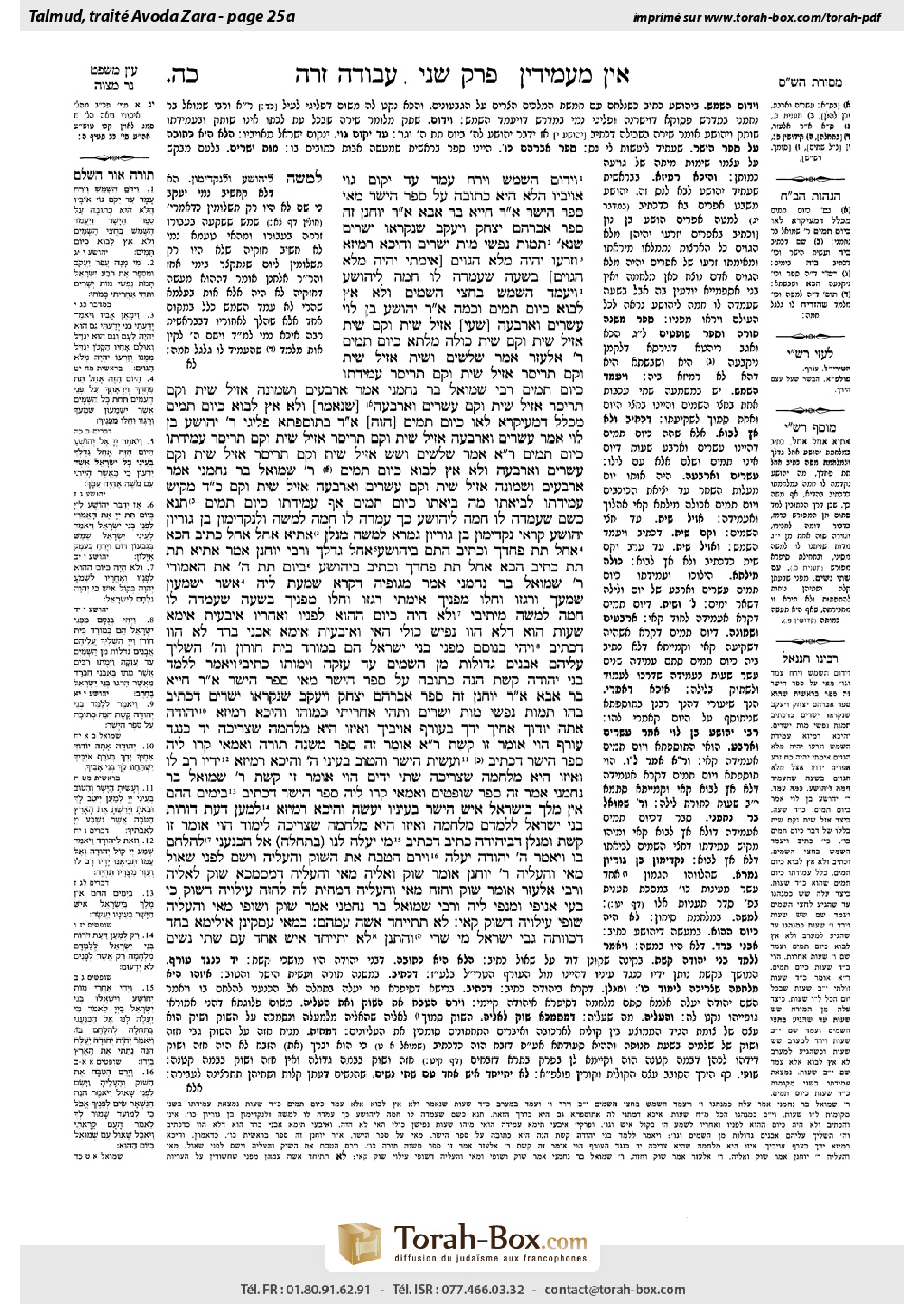
Avodah Zarah 25a: Talmud study for Daf Yomi
Study the Talmud for Daf Yomi with scanned pages, Hebrew text, English translations from Sefaria and AI-generated French translations.
Passage selection and English or AI-generated French translation are available where the scan has annotations. Daf Study is independent of Torah-Box and Sefaria.
Browse Avodah Zarah · עבודה זרה · All tractatesAvodah Zarah 25a text and translations
This page of Avodah Zarah includes the Aramaic text, an English translation and an AI-generated French translation, alongside the scan above.
עבודה זרה כ״ה א · Aramaic and Hebrew text
״וַיִּדֹּם הַשֶּׁמֶשׁ וְיָרֵחַ עָמָד עַד יִקֹּם גּוֹי אֹיְבָיו הֲלֹא הִיא כְתוּבָה עַל סֵפֶר הַיָּשָׁר״, מַאי סֵפֶר הַיָּשָׁר? אָמַר רַבִּי חִיָּיא בַּר אַבָּא אָמַר רַבִּי יוֹחָנָן: זֶה סֵפֶר אַבְרָהָם יִצְחָק וְיַעֲקֹב, שֶׁנִּקְרְאוּ יְשָׁרִים, שֶׁנֶּאֱמַר: ״תָּמֹת נַפְשִׁי מוֹת יְשָׁרִים״.
וְהֵיכָא רְמִיזָא? ״וְזַרְעוֹ יִהְיֶה מְלֹא הַגּוֹיִם״, [אֵימָתַי יִהְיֶה מְלֹא הַגּוֹיִם?] בְּשָׁעָה שֶׁעָמְדָה לוֹ חַמָּה לִיהוֹשֻׁעַ, ״וַיַּעֲמֹד הַשֶּׁמֶשׁ בַּחֲצִי הַשָּׁמַיִם וְלֹא אָץ לָבוֹא כְּיוֹם תָּמִים״.
וְכַמָּה? אָמַר רַבִּי יְהוֹשֻׁעַ בֶּן לֵוִי: עֶשְׂרִים וְאַרְבַּע [שָׁעֵי], אֲזַל שֵׁית וְקָם שֵׁית, אֲזַל שֵׁית וְקָם שֵׁית, כּוּלַּהּ מִלְּתָא כְּיוֹם תָּמִים.
רַבִּי אֶלְעָזָר אָמַר: שְׁלֹשִׁים וְשֵׁית, אֲזַל שֵׁית וְקָם תְּרֵיסַר, אֲזַל שֵׁית וְקָם תְּרֵיסַר, עֲמִידָתוֹ כְּיוֹם תָּמִים. רַבִּי שְׁמוּאֵל בַּר נַחְמָנִי אָמַר: אַרְבָּעִים וּשְׁמוֹנָה, אֲזַל שֵׁית וְקָם תְּרֵיסַר, אֲזַל שֵׁית וְקָם עֶשְׂרִים וְאַרְבְּעָה, [שֶׁנֶּאֱמַר]: ״וְלֹא אָץ לָבוֹא כְּיוֹם תָּמִים״, מִכְּלָל דְּמֵעִיקָּרָא לָאו כְּיוֹם תָּמִים [הֲוָה].
אִיכָּא דְּאָמְרִי, בְּתוֹסֶפְתָּא פְּלִיגִי: רַבִּי יְהוֹשֻׁעַ בֶּן לֵוִי אָמַר: עֶשְׂרִים וְאַרְבְּעָה — אֲזַל שֵׁית וְקָם תְּרֵיסַר, אֲזַל שֵׁית וְקָם תְּרֵיסַר, עֲמִידָתוֹ כְּיוֹם תָּמִים. רַבִּי אֶלְעָזָר אָמַר: שְׁלֹשִׁים וָשֵׁשׁ — אֲזַל שֵׁית וְקָם תְּרֵיסַר, אֲזַל שֵׁית וְקָם עֶשְׂרִים וְאַרְבְּעָה, ״וְלֹא אָץ לָבוֹא כְּיוֹם תָּמִים״.
רַבִּי שְׁמוּאֵל בַּר נַחְמָנִי אָמַר: אַרְבָּעִים וּשְׁמוֹנָה, אֲזַל שֵׁית וְקָם עֶשְׂרִים וְאַרְבְּעָה, אֲזַל שֵׁית וְקָם עֶשְׂרִים וְאַרְבְּעָה, מַקִּישׁ עֲמִידָתוֹ לְבִיאָתוֹ — מָה בִּיאָתוֹ כְּיוֹם תָּמִים, אַף עֲמִידָתוֹ כְּיוֹם תָּמִים.
תָּנָא: כְּשֵׁם שֶׁעָמְדָה לוֹ חַמָּה לִיהוֹשֻׁעַ, כָּךְ עָמְדָה לוֹ חַמָּה לְמֹשֶׁה וּלְנַקְדִּימוֹן בֶּן גּוּרְיוֹן. יְהוֹשֻׁעַ — קְרָאֵי, נַקְדִּימוֹן בֶּן גּוּרְיוֹן — גְּמָרָא. לְמֹשֶׁה מְנָלַן? אָתְיָא ״אָחֵל״ ״אָחֵל״: כְּתִיב הָכָא ״אָחֵל תֵּת פַּחְדְּךָ״, וּכְתִיב הָתָם בִּיהוֹשֻׁעַ ״אָחֵל גַּדֶּלְךָ״.
וְרַבִּי יוֹחָנָן אָמַר, אָתְיָא ״תֵּת״ ״תֵּת״: כְּתִיב הָכָא ״אָחֵל תֵּת פַּחְדְּךָ״, וּכְתִיב בִּיהוֹשֻׁעַ ״בְּיוֹם תֵּת ה׳ אֶת הָאֱמֹרִי״.
רַבִּי שְׁמוּאֵל בַּר נַחְמָנִי אָמַר, מִגּוּפֵיהּ דִּקְרָא שָׁמְעַתְּ לֵיהּ: ״אֲשֶׁר יִשְׁמְעוּן שִׁמְעֲךָ וְרָגְזוּ וְחָלוּ מִפָּנֶיךָ״, אֵימָתַי ״רָגְזוּ וְחָלוּ מִפָּנֶיךָ״? בְּשָׁעָה שֶׁעָמְדָה לוֹ חַמָּה לְמֹשֶׁה.
מֵיתִיבִי: ״וְלֹא הָיָה כַּיּוֹם הַהוּא לְפָנָיו וְאַחֲרָיו״! אִיבָּעֵית אֵימָא: שָׁעוֹת הוּא דְּלָא הֲווֹ (נפיש) [נְפִישָׁן] כּוּלֵּי הַאי, וְאִיבָּעֵית אֵימָא: אַבְנֵי בָרָד לָא הֲווֹ, דִּכְתִיב: ״וַיְהִי בְּנֻסָם מִפְּנֵי בְּנֵי יִשְׂרָאֵל הֵם בְּמוֹרַד בֵּית חוֹרֹן וַה׳ הִשְׁלִיךְ עֲלֵיהֶם אֲבָנִים גְּדֹלוֹת מִן הַשָּׁמַיִם עַד עֲזֵקָה וַיָּמֻתוּ״.
כְּתִיב ״וַיֹּאמֶר לְלַמֵּד בְּנֵי יְהוּדָה קָשֶׁת הִנֵּה כְתוּבָה עַל סֵפֶר הַיָּשָׁר״, מַאי ״סֵפֶר הַיָּשָׁר״? אָמַר רַבִּי חִיָּיא בַּר אַבָּא אָמַר רַבִּי יוֹחָנָן: זֶה סֵפֶר אַבְרָהָם יִצְחָק וְיַעֲקֹב, שֶׁנִּקְרְאוּ ״יְשָׁרִים״, דִּכְתִיב בְּהוּ ״תָּמֹת נַפְשִׁי מוֹת יְשָׁרִים וּתְהִי אַחֲרִיתִי כָּמוֹהוּ״.
וְהֵיכָא רְמִיזָא? ״יְהוּדָה אַתָּה יוֹדוּךָ אַחֶיךָ יָדְךָ בְּעֹרֶף אֹיְבֶיךָ״, וְאֵיזוֹ הִיא מִלְחָמָה שֶׁצְּרִיכָה יָד כְּנֶגֶד עוֹרֶף? הֱוֵי אוֹמֵר: זוֹ קֶשֶׁת.
רַבִּי אֶלְעָזָר אוֹמֵר: זֶה סֵפֶר מִשְׁנֵה תּוֹרָה, וְאַמַּאי קָרוּ לֵיהּ ״סֵפֶר הַיָּשָׁר״? דִּכְתִיב: ״וְעָשִׂיתָ הַיָּשָׁר וְהַטּוֹב בְּעֵינֵי ה׳״. וְהֵיכָא רְמִיזָא? ״יָדָיו רַב לוֹ״, וְאֵיזוֹ הִיא מִלְחָמָה שֶׁצְּרִיכָה שְׁתֵּי יָדַיִם? הֱוֵי אוֹמֵר: זוֹ קֶשֶׁת.
רַבִּי שְׁמוּאֵל בַּר נַחְמָנִי אָמַר: זֶה סֵפֶר שׁוֹפְטִים, וְאַמַּאי קָרוּ לֵיהּ ״סֵפֶר הַיָּשָׁר״? דִּכְתִיב: ״בַּיָּמִים הָהֵם אֵין מֶלֶךְ בְּיִשְׂרָאֵל אִישׁ הַיָּשָׁר בְּעֵינָיו יַעֲשֶׂה״, וְהֵיכָא רְמִיזָא? ״לְמַעַן דַּעַת דֹּרוֹת בְּנֵי יִשְׂרָאֵל לְלַמְּדָם מִלְחָמָה״, וְאֵיזוֹ הִיא מִלְחָמָה שֶׁצְּרִיכָה לִימּוּד? הֱוֵי אוֹמֵר: זוֹ קֶשֶׁת.
וּמְנָלַן דְּבִיהוּדָה כְּתִיב? דִּכְתִיב: ״מִי יַעֲלֶה לָּנוּ בַתְּחִלָּה אֶל הַכְּנַעֲנִי לְהִלָּחֵם בּוֹ, וַיֹּאמֶר ה׳ יְהוּדָה יַעֲלֶה״.
״וַיָּרֶם הַטַּבָּח אֶת הַשּׁוֹק וְהֶעָלֶיהָ וַיָּשֶׂם לִפְנֵי שָׁאוּל״, מַאי ״וְהֶעָלֶיהָ״? רַבִּי יוֹחָנָן אוֹמֵר: שׁוֹק וְאַלְיָה. מַאי ״וְהֶעָלֶיהָ״? דִּמְסַמְּכָא שׁוֹק לְאַלְיָה.
וְרַבִּי אֶלְעָזָר אוֹמֵר: שׁוֹק וְחָזֶה, מַאי ״וְהֶעָלֶיהָ״? דְּמַחֵית לֵהּ לְחָזֶה עִילָּוֵיהּ דְּשׁוֹק כִּי בָעֵי אֹנוֹפֵי, וּמֹנְפִי לֵיהּ. וְרַבִּי שְׁמוּאֵל בַּר נַחְמָנִי אָמַר: שׁוֹק וְשׁוֹפִי, מַאי ״וְהֶעָלֶיהָ״? שׁוֹפִי עִילָּוֵיהּ דְּשׁוֹק קָאֵי.
לֹא תִּתְיַיחֵד אִשָּׁה עִמָּהֶם, בְּמַאי עָסְקִינַן? אִילֵימָא בְּחַד, דִּכְוָותַהּ גַּבֵּי יִשְׂרָאֵל מִי שְׁרֵי? וְהָתְנַן: ״לֹא יִתְיַיחֵד אִישׁ אֶחָד עִם שְׁתֵּי נָשִׁים״!
Avodah Zarah 25a · English translation
§ The Gemara cites a series of expositions with regard to what is called the book of Yashar. The verse states: “And the sun stood still, and the moon stayed, until the nation had avenged themselves of their enemies. Is this not written in the book of Yashar”? (Joshua 10:13). The Gemara asks: What is the book of Yashar? Rabbi Ḥiyya bar Abba says that Rabbi Yoḥanan says: This is Genesis, which is the book of Abraham, Isaac, and Jacob, who were called righteous [yesharim], as it is stated: “Let me die the death of the righteous [yesharim]” (Numbers 23:10).
The Gemara asks: And where is it alluded to in Genesis that the sun would stand still for Joshua? The verse states in reference to Ephraim, who was Joshua’s ancestor: “And his seed shall become a multitude of nations” (Genesis 48:19). The Gemara asks: When will he become a multitude of nations? He became a multitude of nations at the time when the sun stood in place for Joshua, as it is written: “And the sun stayed in the midst of heaven, and hastened not to go down for an entire day” (Joshua 10:13).
The Gemara inquires: And how much time elapsed before the sun finally set? Rabbi Yehoshua ben Levi said that it took twenty-four hours: It traveled across the sky for six hours and stood still for six hours, and again traveled six hours and stood still for six hours, so that the entire matter lasted the duration of an entire day.
Rabbi Elazar said that it lasted thirty-six hours: The sun traveled for six hours and stood for twelve hours, and again traveled six hours and stood for twelve hours, so that the accumulated time of its suspension was that of an entire day. Rabbi Shmuel bar Naḥmani said: Forty-eight hours elapsed before it set. It traveled six hours and stood for twelve hours, and then traveled six hours and stood for twenty-four hours, as it is stated: “And the sun stayed in the midst of heaven,” and then: “And hastened not to go down for an entire day.” By inference, it can be understood that initially it was not suspended for an entire day. Rather, at first it stood still for twelve hours, and was later suspended for an entire day.
There are those who say that these Sages do not disagree over how much time had elapsed before the sun set. Rather, they disagree with regard to the additional time by which the day was extended. Rabbi Yehoshua ben Levi said: Twenty-four hours were added to that day, because the sun traveled six hours and stood twelve hours, and again traveled six hours and stood for another twelve hours, which meant that its standing time lasted for an entire day. Rabbi Elazar said that thirty-six hours were added: It traveled six hours and stood for twelve hours, and then traveled six hours and stood for twenty-four more hours. It is with regard to the second suspension that the verse states: “And hastened not to go down for an entire day.”
Rabbi Shmuel bar Naḥmani said: The time the sun stood in place was forty-eight hours in total. The sun traveled six hours and stood twenty-four hours, and then traveled another six hours and stood for another twenty-four hours. His reasoning is that the verse juxtaposes the sun’s suspension to its motion: Just as the sun is in motion for an entire day, so too, its suspension was for an entire day.
It is taught: Just as the sun stood still for Joshua, so too the sun stood still for Moses and for Nakdimon ben Guryon. It is known that it stood still for Joshua from a verse, and it is known that it stood still for Nakdimon ben Guryon by tradition. From where do we derive that it stood still for Moses as well? The Gemara answers: It is derived by means of a verbal analogy between the terms “I will begin” and “I will begin.” The Gemara elaborates: It is written here, with regard to Moses: “I will begin to deliver the dread of you and the fear of you upon the peoples” (Deuteronomy 2:25), and it is written there, with regard to Joshua: “I will begin to magnify you” (Joshua 3:7).
And Rabbi Yoḥanan says: It is derived from a verbal analogy between the words “delivered” and “delivered.” It is written here, with regard to Moses: “I will begin to deliver the dread of you,” and it is written there, with regard to Joshua: “In the day when the Lord delivered up the Amorites before the children of Israel” (Joshua 10:12).
Rabbi Shmuel bar Naḥmani said that there is no need for a verbal analogy, as you can learn this idea from the verse itself: “This day will I begin to deliver the dread of you and the fear of you upon the peoples that are under the whole heaven, who, when they hear the report of you, shall tremble and be in anguish because of you” (Deuteronomy 2:25). When was the fulfillment of the prophecy that all the nations “shall tremble and be in anguish because of you”? It was at the time when the sun stood still for Moses.
The Gemara raises an objection: After the sun stood still, the verse states: “And there was no day like that before it or after it” (Joshua 10:14). If there was no day comparable to it, how can it be asserted that the sun stood still for Moses as well? The Gemara answers: If you wish, say that the number of hours the sun stood still for Moses were not as many as in the case of Joshua. And if you wish, say instead: When the sun stood still for Moses there were no hailstones, whereas in the case of Joshua there were hailstones, as it is written: “And it came to pass, as they fled from before the children of Israel, while they were in the descent of Beth Horon, that the Lord cast down great stones from heaven upon them into Azeka and they died” (Joshua 10:11).
The Gemara cites another exposition with regard to the book of Yashar. It is written: “And said: To teach the sons of Judah the bow. Behold, it is written in the book of Yashar” (II Samuel 1:18). The Gemara again asks: What is the book of Yashar? Rabbi Ḥiyya bar Abba says that Rabbi Yoḥanan says: This is the book of Abraham, Isaac, and Jacob, who were called righteous [yesharim], as it is written with regard to them: “Let me die the death of the righteous [yesharim] and let my end be like his” (Numbers 23:10).
The Gemara further analyzes the verse in Samuel: And where is it alluded to in Genesis that Judah must be taught to use the bow? The verse states: “Judah, your brothers shall praise you; your hand shall be on the nape of your enemies” (Genesis 49:8). The Gemara explains: What is the form of warfare that requires one’s hand to be held opposite the nape? You must say that this is referring to the use of a bow. This is the referent of the verse in Samuel.
The Gemara cites a different interpretation: Rabbi Elazar says that the book of Yashar is the book of Deuteronomy. And why did they call it the book of Yashar? As it is written: “And you shall do that which is right [yashar] and good in the sight of the Lord” (Deuteronomy 6:18). And where is it alluded to in Deuteronomy that Judah must be taught to use the bow? The verse states: “And this for Judah, and he said: Hear, Lord, the voice of Judah, and bring him in unto his people; his hands shall contend for him” (Deuteronomy 33:7). What is the form of warfare that requires the use of two hands? You must say that this is referring to the use of a bow. This is the referent of the verse in Samuel.
The Gemara provides yet another explanation: Rabbi Shmuel bar Naḥmani says that the book of Yashar is the book of Judges. And why did they call it the book of Yashar? As it is written: “In those days there was no king in Israel; every man did that which was right [yashar] in his own eyes” (Judges 17:6). And where is it alluded to in Judges that Judah must be taught to use the bow? The verse states: “Only that the generations of the children of Israel might know, to teach them war” (Judges 3:2). What is the form of warfare that requires teaching? You must say that this is referring to the use of a bow. This is the referent of the verse in Samuel.
The Gemara asks: And from where do we derive that Judges 3:2 is written in reference to Judah? We derive it as it is written: “The children of Israel asked the Lord, saying: Who shall go up for us first against the Canaanites, to fight against them? And the Lord said: Judah shall go up” (Judges 1:1–2).
§ The Gemara cites another dispute between the same amora’im. The verse states: “And the cook took up the thigh, and that which was upon it [vehe’aleha], and set it before Saul” (I Samuel 9:24). To what does the term “and that which was upon it” refer? Rabbi Yoḥanan says: It refers to the thigh and the tail. The Gemara asks: What is the reason that the tail is referred to as: “And that which was upon it”? The reason is that the thigh supports the tail, as it rests upon it.
And Rabbi Elazar says: The verse refers to the thigh and the breast. What is the reason that the breast is referred to as: “And that which was upon it”? The reason is that one places the breast upon the thigh when it requires sacrificial waving, and waves it. And Rabbi Shmuel bar Naḥmani says: The verse refers to the thigh and the cap [shofi], i.e., the very top part of the leg. What is the reason that the cap is referred to as: “And that which was upon it”? It is because it is referring to the cap that stands above the thigh.
§ The mishna teaches that a woman may not seclude herself with gentiles. The Gemara asks: What are we dealing with? If we say that we are dealing with a woman who secludes herself with one gentile, is this permitted in the corresponding situation involving a Jew? But didn’t we learn in a mishna (Kiddushin 80b): One man may not seclude himself even with two women? It is certainly forbidden for one man to be secluded with one woman.
Avodah Zarah 25a · Traduction française (IA)
§ La Guemara cite une série d'explications concernant ce qu'on appelle le livre de Yashar. La versette dit : « Et le soleil s'arrêta, et la lune resta, jusqu'à ce que le peuple ait vengé ses ennemis. N'est-ce pas écrit dans le livre de Yashar ? » (Josué 10:13). La Guemara demande : Quel est le livre de Yashar ? Rabbi Ḥiyya bar Abba dit que Rabbi Yoḥanan dit : C'est la Genèse, qui est le livre d'Abraham, d'Isaac et de Jacob, qui étaient appelés justes [yesharim], comme il est dit : « Que je meure la mort des justes [yesharim] » (Nombres 23:10).
La Guemara demande : Et où est-il allégué dans la Genèse que le soleil s'arrêterait pour Josué ? La versette dit, en référence à Ephraïm, qui était l'ancêtre de Josué : « Et sa postérité deviendra une multitude de nations » (Genèse 48:19). La Guemara demande : Quand deviendra-t-il une multitude de nations ? Il devint une multitude de nations à l'époque où le soleil resta en place pour Josué, comme il est écrit : « Et le soleil resta au milieu du ciel, et ne s'abaissa point pour une journée entière » (Josué 10:13).
La Guemara interroge : Et combien de temps s'est-il écoulé avant que le soleil ne se soit enfin couché ? Rabbi Yehoshua ben Levi dit qu'il s'est écoulé vingt-quatre heures : il a traversé le ciel pendant six heures et s'est arrêté pendant six heures, puis a traversé six heures et s'est arrêté pendant six heures, de sorte que l'ensemble de l'histoire a duré la durée d'une journée entière.
Rabbi Elazar dit qu'il s'est écoulé trente-six heures : le soleil a traversé pendant six heures et s'est arrêté pendant douze heures, puis a traversé six heures et s'est arrêté pendant douze heures, de sorte que la durée totale de son arrêt était celle d'une journée entière. Rabbi Shmuel bar Naḥmani dit : Quarante-huit heures s'étaient écoulées avant qu'il ne se couche. Il a traversé six heures et s'est arrêté pendant douze heures, puis a traversé six heures et s'est arrêté pendant vingt-quatre heures, comme il est dit : « Et le soleil resta au milieu du ciel », et ensuite : « Et ne s'abaissa point pour une journée entière ». Par déduction, on peut comprendre qu'initialement il n'était pas suspendu pendant une journée entière. Plutôt, d'abord il s'est arrêté pendant douze heures, puis a été suspendu pendant une journée entière.
Certains disent que ces Sages ne s'entendent pas sur la durée pendant laquelle le soleil s'était éloigné avant de se coucher. Plutôt, ils s'entendent sur la durée supplémentaire par laquelle la journée a été prolongée. Rabbi Yehoshua ben Levi dit : Vingt-quatre heures ont été ajoutées à cette journée, car le soleil a traversé six heures et s'est arrêté douze heures, puis a traversé six heures et s'est arrêté encore douze heures, ce qui signifiait que sa durée d'arrêt a duré une journée entière. Rabbi Elazar dit que trente-six heures ont été ajoutées : il a traversé six heures et s'est arrêté douze heures, puis a traversé six heures et s'est arrêté vingt-quatre heures supplémentaires. C'est à propos de cette deuxième suspension que la versette dit : « Et ne s'abaissa point pour une journée entière ».
Rabbi Shmuel bar Naḥmani dit : La durée pendant laquelle le soleil s'est arrêté a été quarante-huit heures en totalité. Le soleil a traversé six heures et s'est arrêté vingt-quatre heures, puis a traversé six heures et s'est arrêté vingt-quatre heures supplémentaires. Son raisonnement est que la versette juxtapose la suspension du soleil à son mouvement : Tout comme le soleil est en mouvement pendant une journée entière, de même sa suspension a duré une journée entière.
Il est enseigné : Tout comme le soleil s'est arrêté pour Josué, de même le soleil s'est arrêté pour Moïse et pour Nakdimon ben Guryon. On sait qu'il s'est arrêté pour Josué à partir d'une versette, et on sait qu'il s'est arrêté pour Nakdimon ben Guryon par tradition. D'où tire-t-on qu'il s'est arrêté pour Moïse également ? La Guemara répond : On le tire par analogie verbale entre les termes « je commencerais » et « je commencerais ». La Guemara explique : Il est écrit ici, concernant Moïse : « Je commencerais à faire connaître la terreur de toi et la crainte de toi auprès des peuples » (Deutéronome 2:25), et il est écrit là, concernant Josué : « Je commencerais à magnifier toi » (Josué 3:7).
Rabbi Yoḥanan dit : On le tire par analogie verbale entre les mots « livrer » et « livrer ». Il est écrit ici, concernant Moïse : « Je commencerais à livrer la terreur de toi », et il est écrit là, concernant Josué : « En ce jour que l'Éternel livra les Amorites devant les enfants d'Israël » (Josué 10:12).
Rabbi Shmuel bar Naḥmani dit qu'il n'y a pas besoin d'analogie verbale, car on peut apprendre cette idée directement à partir de la versette : « Ce jour-là je commencerais à livrer la terreur de toi et la crainte de toi auprès des peuples qui sont sous tout le ciel, qui, lorsqu'ils entendent le récit de toi, trembleront et seront en angoisse à cause de toi » (Deutéronome 2:25). Quand a eu lieu la réalisation de la prophétie que tous les peuples « trembleront et seront en angoisse à cause de toi » ? C'était à l'époque où le soleil s'était arrêté pour Moïse.
La Guemara soulève une objection : Après que le soleil s'était arrêté, la versette dit : « Et il n'y eut point de jour semblable à celui-ci avant lui ou après lui » (Josué 10:14). Si aucun jour n'était comparable à celui-ci, comment peut-on affirmer que le soleil s'est arrêté pour Moïse également ? La Guemara répond : Si tu veux, dis que le nombre d'heures pendant lesquelles le soleil s'était arrêté pour Moïse n'était pas aussi grand que dans le cas de Josué. Et si tu veux, dis plutôt : Lorsque le soleil s'était arrêté pour Moïse, il n'y avait pas de grêle, alors que dans le cas de Josué, il y avait de la grêle, comme il est écrit : « Et il arriva, pendant qu'ils fuyaient devant les enfants d'Israël, alors qu'ils descendaient de Beth Horon, que l'Éternel jeta des pierres grandes du ciel sur eux à Azeka et ils moururent » (Josué 10:11).
La Guemara cite une autre explication concernant le livre de Yashar. Il est écrit : « Et dit : Pour enseigner aux fils de Juda l'arc. Voici, il est écrit dans le livre de Yashar » (II Samuel 1:18). La Guemara interroge à nouveau : Quel est le livre de Yashar ? Rabbi Ḥiyya bar Abba dit que Rabbi Yoḥanan dit : C'est le livre d'Abraham, d'Isaac et de Jacob, qui étaient appelés justes [yesharim], comme il est écrit à leur sujet : « Que je meure la mort des justes [yesharim] et que ma fin soit comme la sienne » (Nombres 23:10).
La Guemara analyse davantage la versette du livre de Samuel : « Et où est-ce allégué dans la Genèse que Juda doit être appris à utiliser l’arc ? » La Guemara explique : Quel est le type de guerre qui exige que la main soit tenue en face du cou de l’ennemi ? Tu dois dire que cela fait référence à l’utilisation d’un arc. C’est la référence de la versette du livre de Samuel.
La Guemara cite une autre interprétation : Rabbi Eléazar dit que le livre de Yashar est le livre de Deutéronome. Et pourquoi l’appellent-ils le livre de Yashar ? Comme il est écrit : « Et tu feras ce qui est droit [yashar] et bon aux yeux du Seigneur » (Deutéronome 6 : 18). Et où est-ce allégué dans le Deutéronome que Juda doit être appris à utiliser l’arc ? La versette dit : « Et ceci pour Juda, et il dit : Écoute, Seigneur, la voix de Juda, et ramène-le à son peuple ; ses mains combattront pour lui » (Deutéronome 33 : 7). Quel est le type de guerre qui exige l’utilisation de deux mains ? Tu dois dire que cela fait référence à l’utilisation d’un arc. C’est la référence de la versette du livre de Samuel.
La Guemara donne une autre explication : Rabbi Shmuel bar Naḥmani dit que le livre de Yashar est le livre des Juges. Et pourquoi l’appellent-ils le livre de Yashar ? Comme il est écrit : « Dans ces jours-là, il n’y avait pas de roi en Israël ; chacun faisait ce qui était droit [yashar] à ses yeux » (Juges 17 : 6). Et où est-ce allégué dans les Juges que Juda doit être appris à utiliser l’arc ? La versette dit : « Pour que les générations des enfants d’Israël sachent, afin de leur apprendre la guerre » (Juges 3 : 2). Quel est le type de guerre qui exige l’enseignement ? Tu dois dire que cela fait référence à l’utilisation d’un arc. C’est la référence de la versette du livre de Samuel.
La Guemara pose une question : Et d’où dérivons-nous que la versette Juges 3 : 2 est écrite à propos de Juda ? On la dérive comme il est écrit : « Les enfants d’Israël demandèrent au Seigneur, en disant : Qui montera pour nous contre les Cananéens, pour combattre contre eux ? Et le Seigneur dit : Juda montera » (Juges 1 : 1–2).
§ La Guemara cite un autre débat entre les mêmes amoraïm. La versette dit : « Et le cuisinier prit la cuisse, et ce qui était sur elle [vehe’aleha], et le posa devant Saül » (I Samuel 9 : 24). À quoi fait référence le terme « et ce qui était sur elle » ? Rabbi Yoḥanan dit : Cela fait référence à la cuisse et à la queue. La Guemara pose une question : Quelle est la raison pour laquelle la queue est appelée « et ce qui était sur elle » ? La raison est que la cuisse soutient la queue, car elle repose dessus.
Et Rabbi Eléazar dit : La versette fait référence à la cuisse et à la poitrine. Quelle est la raison pour laquelle la poitrine est appelée « et ce qui était sur elle » ? La raison est qu’on place la poitrine sur la cuisse lorsqu’elle nécessite le balayage sacré, et on la balaye. Et Rabbi Shmuel bar Naḥmani dit : La versette fait référence à la cuisse et à la pointe [shofi], c’est-à-dire la partie très haute de la jambe. Quelle est la raison pour laquelle la pointe est appelée « et ce qui était sur elle » ? C’est parce qu’il s’agit de la pointe qui se trouve au-dessus de la cuisse.
§ La Michna enseigne que la femme ne doit pas se retirer en privé avec des non-Juifs. La Guemara pose une question : De quoi sommes-nous en train de parler ? Si nous disons que nous parlons d’une femme qui se retire en privé avec un non-Juif, est-ce permis dans le cas correspondant impliquant un Juif ? Mais n’avons-nous pas appris dans une Michna (Kiddushin 80b) : Un homme ne doit pas se retirer en privé même avec deux femmes ? Il est certainement interdit à un homme de se retirer en privé avec une seule femme.
Traduction française générée par IA à partir de l’édition anglaise de Sefaria. Vérifie toujours un passage avec le texte source.
Text from Sefaria: William Davidson Edition - Vocalized Aramaic (CC BY NC); William Davidson Edition - English (CC BY NC).