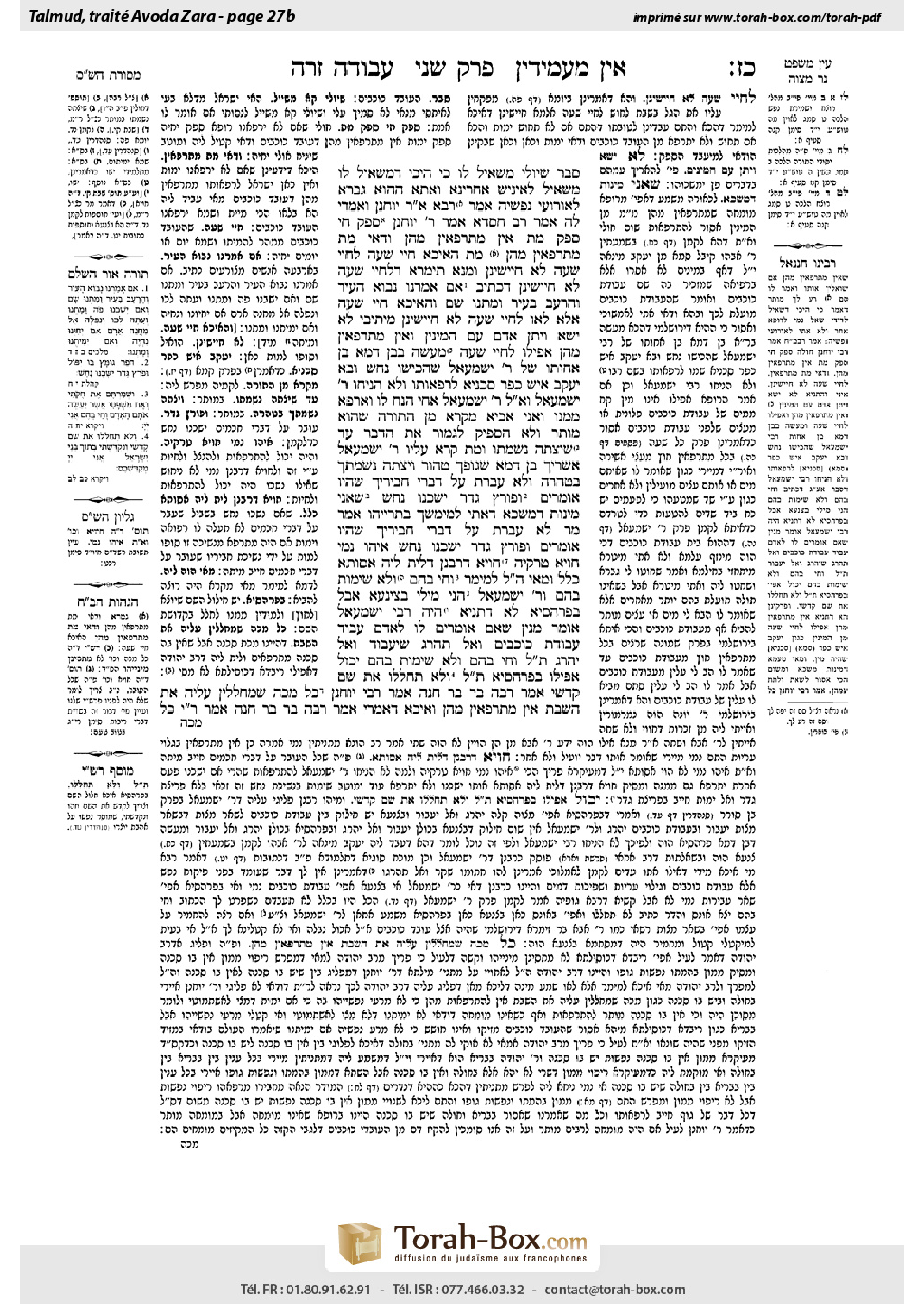
Avodah Zarah 27b: Talmud study for Daf Yomi
Study the Talmud for Daf Yomi with scanned pages, Hebrew text, English translations from Sefaria and AI-generated French translations.
Passage selection and English or AI-generated French translation are available where the scan has annotations. Daf Study is independent of Torah-Box and Sefaria.
Browse Avodah Zarah · עבודה זרה · All tractatesAvodah Zarah 27b text and translations
This page of Avodah Zarah includes the Aramaic text, an English translation and an AI-generated French translation, alongside the scan above.
עבודה זרה כ״ז ב · Aramaic and Hebrew text
סָבַר שַׁיּוֹלֵי מְשַׁאֵיל לוֹ, כִּי הֵיכִי דְּמַשְׁאִיל לוֹ מְשַׁאֵיל לְאִינִישׁ אַחֲרִינָא, וַאֲתָא הָהוּא גַּבְרָא לְאוֹרוֹעֵי נַפְשֵׁיהּ.
אָמַר רָבָא אָמַר רַבִּי יוֹחָנָן, וְאָמְרִי לַהּ אָמַר רַב חִסְדָּא אָמַר רַבִּי יוֹחָנָן: סָפֵק חַי סָפֵק מֵת — אֵין מִתְרַפְּאִין מֵהֶן, וַדַּאי מֵת — מִתְרַפְּאִין מֵהֶן.
מֵת? הָאִיכָּא חַיֵּי שָׁעָה! לְחַיֵּי שָׁעָה לָא חָיְישִׁינַן.
וּמְנָא תֵּימְרָא דִּלְחַיֵּי שָׁעָה לָא חָיְישִׁינַן? דִּכְתִיב: ״אִם אָמַרְנוּ נָבוֹא הָעִיר וְהָרָעָב בָּעִיר וָמַתְנוּ שָׁם״, וְהָאִיכָּא חַיֵּי שָׁעָה! אֶלָּא לָאו לְחַיֵּי שָׁעָה לָא חָיְישִׁינַן.
מֵיתִיבִי: לֹא יִשָּׂא וְיִתֵּן אָדָם עִם הַמִּינִין, וְאֵין מִתְרַפְּאִין מֵהֶן אֲפִילּוּ לְחַיֵּי שָׁעָה.
מַעֲשֶׂה בְּבֶן דָּמָא בֶּן אֲחוֹתוֹ שֶׁל רַבִּי יִשְׁמָעֵאל שֶׁהִכִּישׁוֹ נָחָשׁ, וּבָא יַעֲקֹב אִישׁ כְּפַר סְכַנְיָא לְרַפּאוֹתוֹ, וְלֹא הִנִּיחוֹ רַבִּי יִשְׁמָעֵאל, וְאָמַר לוֹ: רַבִּי יִשְׁמָעֵאל אָחִי! הַנַּח לוֹ וְאֵרָפֵא מִמֶּנּוּ, וַאֲנִי אָבִיא מִקְרָא מִן הַתּוֹרָה שֶׁהוּא מוּתָּר, וְלֹא הִסְפִּיק לִגְמוֹר אֶת הַדָּבָר עַד שֶׁיָּצְתָה נִשְׁמָתוֹ וָמֵת.
קָרָא עָלָיו רַבִּי יִשְׁמָעֵאל: אַשְׁרֶיךָ בֶּן דָּמָא, שֶׁגּוּפְךָ טָהוֹר וְיָצְתָה נִשְׁמָתְךָ בְּטׇהֳרָה, וְלֹא עָבַרְתָּ עַל דִּבְרֵי חֲבֵירֶיךָ, שֶׁהָיוּ אוֹמְרִים: ״וּפוֹרֵץ גָּדֵר יִשְּׁכֶנּוּ נָחָשׁ״.
שָׁאנֵי מִינוּת דְּמָשְׁכָא, דְּאָתֵי לְמִימְּשַׁךְ בָּתְרַיְיהוּ.
אָמַר מָר: לֹא עָבַרְתָּ עַל דִּבְרֵי חֲבֵירֶיךָ, שֶׁהָיוּ אוֹמְרִים: ״וּפוֹרֵץ גָּדֵר יִשְּׁכֶנּוּ נָחָשׁ״. אִיהוּ נָמֵי חִוְיָא טַרְקֵיהּ! חִוְיָא דְּרַבָּנַן דְּלֵית לֵיהּ אָסוּתָא כְּלָל.
וּמַאי הֲוָה לֵיהּ לְמֵימַר? ״וְחַי בָּהֶם״ — וְלֹא שֶׁיָּמוּת בָּהֶם.
וְרַבִּי יִשְׁמָעֵאל? הָנֵי מִילֵּי בְּצִינְעָא, אֲבָל בְּפַרְהֶסְיָא — לָא. דְּתַנְיָא: הָיָה רַבִּי יִשְׁמָעֵאל אוֹמֵר: מִנַּיִן שֶׁאִם אוֹמְרִים לוֹ לָאָדָם ״עֲבוֹד עֲבוֹדָה זָרָה וְאַל תֵּהָרֵג״, שֶׁיַּעֲבוֹד וְאַל יֵהָרֵג? תַּלְמוּד לוֹמַר: ״וְחַי בָּהֶם״ — וְלֹא שֶׁיָּמוּת בָּהֶם. יָכוֹל אֲפִילּוּ בְּפַרְהֶסְיָא? תַּלְמוּד לוֹמַר: ״וְלֹא תְחַלְּלוּ אֶת שֵׁם קׇדְשִׁי״.
אָמַר רַבָּה בַּר בַּר חָנָה אָמַר רַבִּי יוֹחָנָן: כׇּל מַכָּה שֶׁמְּחַלְּלִין עָלֶיהָ אֶת הַשַּׁבָּת אֵין מִתְרַפְּאִין מֵהֶן, וְאִיכָּא דְּאָמְרִי אָמַר רַבָּה בַּר בַּר חָנָה אָמַר רַבִּי יוֹחָנָן: כׇּל
Avodah Zarah 27b · English translation
The Gemara explains the rationale for this leniency: The gentile thinks to himself that the Jew is asking him for his opinion, and just as he is asking him, he will also ask other people. And the gentile further reasons that if the Jew understands that the gentile provided him with bad advice, that man, i.e., the gentile, will bring harm to himself by damaging his own reputation. It is therefore assumed that the gentile will provide good advice in order to avoid sullying his reputation.
§ The Gemara analyzes a situation in which one may receive medical attention from gentiles. Rava says that Rabbi Yoḥanan says, and some say that it was Rav Ḥisda who says that Rabbi Yoḥanan says: If there is uncertainty as to whether a patient will live through his ailment or die from it, the patient may not be treated by gentile doctors, due to the concern that a gentile doctor may kill him. But if it is certain that he will die from his affliction if he does not receive medical attention, the patient is treated by them, as it is possible that a gentile physician will save him.
The Gemara challenges: Even if it is certain that the patient will die if he is not treated, nevertheless, there is value in temporal life, i.e., it is preferable for the Jew to live as long as his ailment permits rather than risking a premature death at the hands of a gentile physician. The Gemara explains: We are not concerned with the value of temporal life when there is a possibility of permanent recovery, and therefore it is preferable to receive medical attention from a gentile despite the risk involved.
The Gemara asks: And from where do you say that we are not concerned with the value of temporal life? As it is written with regard to the discussion held by four lepers left outside a besieged city: “If we say: We will enter into the city, then the famine is in the city, and we shall die there; and if we sit still here, we also die. Now therefore come, and let us fall unto the host of the Arameans; if they save us alive, we shall live; and if they kill us, we shall but die” (II Kings 7:4). The starving lepers decided to risk premature death rather than waiting to die of starvation. The Gemara asks rhetorically: But isn’t there temporal life to be lost, in which case it would be preferable for the lepers to remain in their current location? Rather, is it not apparent that we are not concerned with the value of temporal life?
The Gemara raises an objection from a baraita: A person may not engage in dealings with heretics, and one may not be treated by them even in a case where it is clear that without medical attention one will experience only temporal life.
The baraita relates an incident illustrating this point. There was an incident involving ben Dama, son of Rabbi Yishmael’s sister, in which a snake bit him. And following the attack, Ya’akov of the village of Sekhanya, who was a heretic, a disciple of Jesus the Nazarene, came to treat him, but Rabbi Yishmael did not let him do so. And ben Dama said to him: Rabbi Yishmael, my brother, let him treat me, and I will be healed by him. And I will cite a verse from the Torah to prove that accepting medical treatment from a heretic is permitted in this situation. But ben Dama did not manage to complete the statement before his soul departed from his body and he died.
Rabbi Yishmael recited with regard to him: Fortunate are you, ben Dama, as your body is pure and your soul departed in purity, and you did not transgress the statement of your colleagues, who would state the verse: “And who breaks through a fence, a snake shall bite him” (Ecclesiastes 10:8), i.e., one is punished for ignoring an ordinance of the Sages. This incident indicates that it is not permitted for one to accept medical treatment from a heretic even if it is clear that without it he will live only a short while.
The Gemara explains: Heresy is different, as it is enticing. In other words, it is prohibited to accept medical treatment from a heretic, as one might come to be drawn after his heresy. By contrast, receiving medical attention from a gentile is permitted if it is certain that one will die if he is not treated.
The Master said above: You did not transgress the statement of your colleagues, who would state the verse: “And who breaks through a fence, a snake shall bite him.” The Gemara asks: But ben Dama was also bitten by a snake, even before this declaration of Rabbi Yishmael, so how can he be considered fortunate? The Gemara explains: The snake mentioned in the curse of the Sages is different, as it has no remedy whatsoever. Although ben Dama was bitten by a snake, he could have been healed.
The Gemara asks: And what would ben Dama have said? What verse did he intend to cite as proof that it was permitted for him to be healed by a heretic? The verse: “You shall therefore keep My statutes, and My ordinances, which if a man do, he shall live by them” (Leviticus 18:5). This teaches that one should live by God’s mitzvot, and not that he should die by them. This verse serves as a source for the halakha that one may violate a prohibition in order to save a life.
And why does Rabbi Yishmael disagree with ben Dama? He maintains that this matter applies only in private, but in public one may not transgress a prohibition even to save a life. As it is taught in a baraita that Rabbi Yishmael would say: From where is it derived that if oppressors say to a person: Worship an idol and you will not be killed, that one should worship the idol and not be killed? The verse states: “He shall live by them,” and not that he should die by them. One might have thought that this applies even in public. Therefore, the verse states: “And you shall not profane My holy name” (Leviticus 22:32).
§ The Gemara examines various circumstances in which one is permitted to receive treatment from a gentile. Rabba bar bar Ḥana says that Rabbi Yoḥanan says: With regard to any injury for which Shabbat is desecrated, one may not be treated by gentiles. And there are those who say that Rabba bar bar Ḥana says that Rabbi Yoḥanan says: With regard to any
Avodah Zarah 27b · Traduction française (IA)
La Guemara explique la raison de cette leniency : Le gentil pense à lui-même que le Juif lui demande son avis, et tout comme il lui demande son avis, il demandera aussi l'avis d'autres personnes. Le gentil raisonne également que si le Juif comprend que le gentil lui a donné un mauvais conseil, ce dernier, c'est-à-dire le gentil, causera à lui-même un préjudice en détruisant sa réputation. On suppose donc que le gentil donnera un bon conseil afin d'éviter de salir sa réputation.
§ La Guemara analyse une situation dans laquelle on peut recevoir des soins médicaux des gentils. Rava dit que Rabbi Yoḥanan dit, et certains disent que c'était Rav Ḥisda qui dit que Rabbi Yoḥanan dit : Si l'on est incertain quant à la survie d'un malade ou à sa mort en raison de sa maladie, le malade ne doit pas être soigné par des médecins gentils, en raison de la crainte qu'un médecin gentil puisse le tuer. Mais si l'on est certain qu'il mourra s'il ne reçoit pas de soins médicaux, le malade est soigné par eux, car il est possible qu'un médecin gentil le sauve.
La Guemara soulève un défi : Même si l'on est certain que le malade mourra s'il n'est pas soigné, néanmoins, la vie temporelle a une valeur, c'est-à-dire il est préférable pour le Juif de vivre aussi longtemps que possible avec sa maladie plutôt que de risquer une mort prématurée entre les mains d'un médecin gentil. La Guemara explique : Nous ne nous inquiétons pas de la valeur de la vie temporelle lorsqu'il y a une possibilité de guérison permanente, et par conséquent, il est préférable de recevoir des soins médicaux d'un gentil malgré le risque.
La Guemara pose une question : Et d'où dis-tu que nous ne nous inquiétons pas de la valeur de la vie temporelle ? Comme il est écrit concernant la discussion entre quatre lépreux restés en dehors d'une ville assiégée : « Si nous disons : Nous entrerons dans la ville, alors la famine est en ville, et nous mourrons là ; et si nous restons ici, nous mourrons aussi. Maintenant donc, venez, et que nous tombions sur la troupe des Araméens ; s'ils nous sauvent vivants, nous vivrons ; et s'ils nous tuent, nous mourrons seulement » (II Rois 7:4). Les lépreux affamés décidèrent de risquer une mort prématurée plutôt que d'attendre de mourir de faim. La Guemara pose une question rhétorique : Mais n'y a-t-il pas une vie temporelle à perdre, dans ce cas, il serait préférable que les lépreux restent à leur place actuelle ? Plutôt, n'est-ce pas évident que nous ne nous inquiétons pas de la valeur de la vie temporelle ?
La Guemara soulève une objection tirée d'une baraïta : Une personne ne doit pas engager des affaires avec des hérétiques, et l'on ne doit pas être soigné par eux même dans un cas où il est clair que sans soins médicaux on vivra seulement une vie temporelle.
La baraïta relate un incident illustrant ce point. Il y avait un incident concernant ben Dama, fils de la sœur de Rabbi Yishmael, dans lequel un serpent l'avait mordu. Et après l'attaque, Ya'akov du village de Sekhanya, qui était un hérétique, disciple de Jésus le Nazaréen, vint le soigner, mais Rabbi Yishmael ne lui permit pas de le faire. Et ben Dama lui dit : Rabbi Yishmael, mon frère, laisse-le me soigner, et je serai guéri par lui. Et je citerai un verset de la Torah pour prouver que l'acceptation de soins médicaux d'un hérétique est permise dans ce cas. Mais ben Dama n'arriva pas à terminer l'énoncé avant que son âme ne quitte son corps et qu'il meure.
Rabbi Yishmael récita à son égard : Heureux es-tu, ben Dama, car ton corps est pur et ton âme est sortie en pureté, et tu n'as pas transgressé la déclaration de tes collègues, qui citaient le verset : « Et celui qui franchit un mur, un serpent le mordra » (Ecclésiaste 10:8), c'est-à-dire qu'on est puni pour ignorer un ordonnance des Sages. Cet incident montre que l'on ne doit pas accepter des soins médicaux d'un hérétique même si l'on sait qu'on vivra seulement une courte durée sans cela.
La Guemara explique : L'hérésie est différente, car elle est attirante. En d'autres termes, il est interdit d'accepter des soins médicaux d'un hérétique, car l'on pourrait se laisser entraîner par sa hérésie. Par contraste, recevoir des soins médicaux d'un gentil est permis si l'on est certain qu'on mourra s'il n'est pas soigné.
Le Maître dit ci-dessus : Tu n'as pas transgressé la déclaration de tes collègues, qui citaient le verset : « Et celui qui franchit un mur, un serpent le mordra. » La Guemara pose une question : Mais ben Dama avait déjà été mordu par un serpent, même avant cette déclaration de Rabbi Yishmael, donc comment peut-il être considéré comme heureux ? La Guemara explique : Le serpent mentionné dans la malédiction des Sages est différent, car il n'a aucun remède. Bien que ben Dama ait été mordu par un serpent, il aurait pu être guéri.
La Guemara pose une question : Et que dirait ben Dama ? Quel verset voulait-il citer comme preuve que l'acceptation de soins médicaux d'un hérétique était permise dans ce cas ? Le verset : « Vous donc garderez mes statues, et mes ordonnances, et si un homme les fait, il vivra par elles » (Lévitique 18:5). Cela enseigne qu'on doit vivre par les commandements de Dieu, et non pas mourir par eux. Ce verset sert de source pour la halakha selon laquelle on peut enfreindre une interdiction pour sauver une vie.
Et pourquoi Rabbi Yishmael diffère-t-il de ben Dama ? Il maintient que cette affaire s'applique seulement en privé, mais en public, on ne doit pas enfreindre une interdiction même pour sauver une vie. Comme il est enseigné dans une baraïta que Rabbi Yishmael disait : D'où est tiré le fait que si des oppresseurs disent à une personne : Adore un idole et tu ne seras pas tué, qu'on doive adorer l'idole et ne pas être tué ? Le verset dit : « Il vivra par elles », et non pas qu'il doive mourir par elles. On aurait pu penser que cela s'applique même en public. Par conséquent, le verset dit : « Et tu ne profaneras pas mon nom saint » (Lévitique 22:32).
§ La Guemara examine divers cas dans lesquels on est autorisé à recevoir un traitement d'un non-Juif. Rabba bar bar Ḥana dit que Rabbi Yoḥanan dit : En ce qui concerne toute blessure pour laquelle le Shabbat est enfreint, on ne doit pas être soigné par des non-Juifs. Et il y a ceux qui disent que Rabba bar bar Ḥana dit que Rabbi Yoḥanan dit : En ce qui concerne toute
Traduction française générée par IA à partir de l’édition anglaise de Sefaria. Vérifie toujours un passage avec le texte source.
Text from Sefaria: William Davidson Edition - Vocalized Aramaic (CC BY NC); William Davidson Edition - English (CC BY NC).